OpenAI Official Plugin Strongly Integrated into Claude Code

marsbitОпубликовано 2026-03-31Обновлено 2026-03-31

Введение

OpenAI has officially released the "codex-plugin-cc" on GitHub, enabling developers to integrate OpenAI’s Codex model capabilities directly into Anthropic’s command-line development tool, Claude Code. This cross-platform integration breaks down ecosystem barriers between major AI tools, allowing developers to leverage the strengths of both models without switching environments. With simple configuration, Claude Code becomes a versatile programming assistant combining the advantages of both companies. Key features include: - Standard code review via the `/codex:review` command, providing expert improvement recommendations and double-checking for logic errors. - Adversarial review using `/codex:adversarial-review`, which challenges design decisions to identify potential performance bottlenecks or security risks. - Task delegation through `/codex:rescue`, allowing complex debugging or repair tasks to be handed off to a Codex sub-agent for collaborative problem-solving. This integration enhances code quality and development efficiency through multi-model collaboration.

Recently, the AI developer community welcomed a major update: OpenAI officially released an open-source project named codex-plugin-cc on GitHub. This plugin allows developers to directly utilize the capabilities of OpenAI's Codex model within the command-line development tool Claude Code, introduced by Anthropic.

This "cross-brand" integration breaks down the ecosystem barriers that previously existed between major AI model tools, enabling developers to leverage the technical strengths of both industry giants without switching environments. With simple command configurations, Claude Code instantly transforms into an all-in-one programming assistant that combines the best of both.
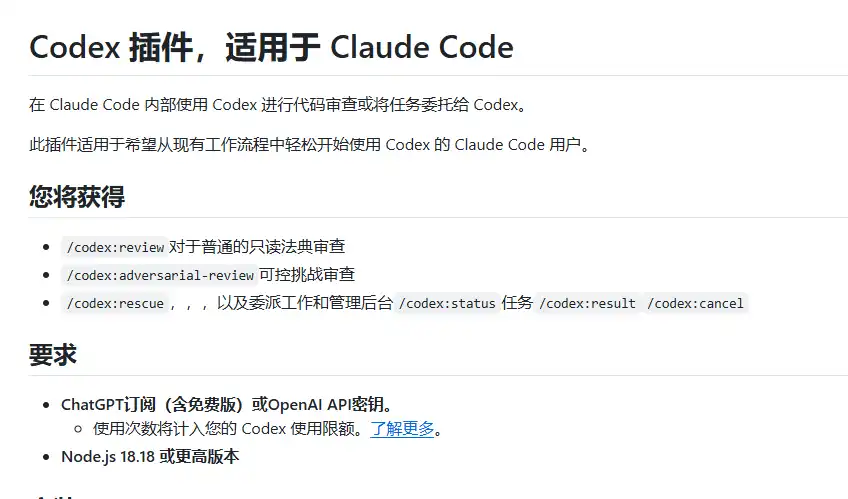
Empowered by this plugin, users can initiate a standard read-only code review using the /codex:review command to receive professional improvement suggestions from Codex. This dual verification mechanism effectively catches logical vulnerabilities that a single model might miss, adding a "double insurance" for code quality.

More uniquely, its "adversarial review" feature allows developers to use /codex:adversarial-review to actively request Codex to challenge existing design decisions. This mode is specifically designed to stress-test the rationality of system architecture, uncovering potential performance bottlenecks or security risks from a "fault-finding" perspective.

Additionally, the plugin introduces a task delegation mechanism, enabling users to transfer complex debugging or repair tasks to a Codex sub-agent via /codex:rescue. This collaborative model achieves automatic task distribution, allowing the primary model and auxiliary models to each focus on their respective areas of expertise.

github:https://github.com/openai/codex-plugin-cc

Связанные с этим вопросы

QWhat is the name of the official OpenAI plugin that integrates with Claude Code?

AThe plugin is called codex-plugin-cc.

QWhat is the primary function of the /codex:review command in the new plugin?

AThe /codex:review command is used to initiate a standard read-only code review to get professional improvement suggestions from the Codex model.

QWhat unique feature does the /codex:adversarial-review command provide?

AThe /codex:adversarial-review command enables an 'adversarial review' function, which actively challenges existing design decisions to stress-test the system architecture and uncover potential performance bottlenecks or security risks.

QHow does the /codex:rescue command facilitate task management?

AThe /codex:rescue command allows users to delegate complex debugging or repair tasks to a Codex sub-agent, enabling a collaborative model where the main and auxiliary models work in their respective areas of expertise.

QWhere was the codex-plugin-cc project officially released?

AThe project was officially released by OpenAI on GitHub.

Похожее

Embodied Intelligence Breakthrough: Amap Fully Open-Sources Universal Robot Base Model ABot-M0

Embodied Intelligence Breakthrough: AutoNavi Open-Sources Universal Robot Base Model ABot-M0 AutoNavi has announced the full open-source release of ABot-M0, the world's first unified architecture-based embodied manipulation base model. This model is designed to enable "one general brain to adapt to multiple forms of robots," aiming to break down barriers between heterogeneous hardware and accelerate the adoption of embodied intelligence in industrial and household settings. ABot-M0 demonstrated exceptional performance in industry tests, achieving a task success rate of 80.5% on the Libero-Plus benchmark—a nearly 30% improvement over the previous benchmark, Pi0. It also set new state-of-the-art records on benchmarks like Libero and RoboCasa. The open-source release addresses long-standing challenges in the field, such as data isolation and deployment difficulties, by providing resources across three key dimensions: - **Data:** The UniACT dataset, the largest of its kind, with over 6 million real operation trajectories and full data pipeline tools. - **Algorithm:** The model architecture and training framework, featuring innovative components like Action Manifold Learning (AML) and a dual-stream perception architecture. - **Model:** End-to-end pre-trained models and a complete toolchain for out-of-the-box deployment, significantly lowering the barrier to adaptation. According to AutoNavi's ABot-M0 technical lead, this open-source initiative aims to build a bridge between academic research and industrial application, enabling robots of various forms to possess a smart, reliable, and universal "brain."

marsbit10 мин. назад

Embodied Intelligence Breakthrough: Amap Fully Open-Sources Universal Robot Base Model ABot-M0

marsbit10 мин. назад

Will Middle Management Be Replaced by AI? What Will the Future Company Structure Look Like

The article explores whether AI will eliminate middle management and reshape future corporate structures. It traces the historical evolution of organizations—from Roman military units to modern corporations—showing how hierarchical systems emerged to manage information flow under the constraint of limited "span of control." Middle management, matrix structures, and bureaucratic systems were all solutions to coordination challenges in information-scarce environments. AI, however, challenges this foundational premise. By enabling real-time modeling, understanding, and distribution of information, AI could replace human-centric coordination mechanisms. Examples like the AI firm "Moon Dark Side" illustrate radical experiments: no departments, titles, or traditional KPIs, with co-founders directly managing large teams and AI agents handling tasks from data processing to code generation. Block (founded by Jack Dorsey) is presented as a case study in building an "intelligent company." This model relies on two core components: a "company world model" (a real-time understanding of internal operations via digital traces) and a "customer world model" (built from real behavioral data, especially financial transactions). An intelligence layer uses these models to dynamically combine capabilities (e.g., payments, lending) to serve customers proactively, without pre-defined product roadmaps. In this structure, traditional roles shift. Middle managers are replaced by a system that handles coordination, while humans focus on individual contributions (ICs), direct responsibility (DRIs), or player-coach roles. The organization becomes flatter, faster, and more adaptive. The article concludes that AI is not just a tool for efficiency but a transformative force that could redefine organizational design, moving companies from human-led hierarchies to system-driven intelligence.

marsbit18 мин. назад

Will Middle Management Be Replaced by AI? What Will the Future Company Structure Look Like

marsbit18 мин. назад

Торговля

Спот
Фьючерсы
活动图片