A Memory Reduction Report Triggers a Plunge: Is It an Overreaction?

marsbitОпубликовано 2026-06-05Обновлено 2026-06-05

Введение

A supply chain report regarding NVIDIA's Rubin platform's system memory configuration triggered a significant sell-off in AI memory stocks. The report suggested a potential reduction in per-rack CPU-side system memory (SOCAMM/LPDDR) from ~55TB to ~28TB, impacting the perceived value per cabinet. This led to sharp declines for Micron and SK Hynix, as the market broadly reacted to the negative headline of "memory cut," without initially distinguishing between CPU system memory and GPU-side HBM4. The article clarifies that the reported adjustment primarily affects the CPU-side system memory profit pool, not the HBM4 demand tied directly to GPUs, which remains a critical and supply-constrained component. The sell-off is interpreted as a high-position, sentiment-driven reaction in a crowded trade, rather than a fundamental reassessment of HBM. While the cost reduction per cabinet could theoretically boost overall rack shipments, this remains speculative. The key going forward is concrete data on final Rubin BOMs, actual shipment volumes, and revenue splits for companies like Micron (exposed to SOCAMM/DRAM) and SK Hynix (focused on HBM). The event highlights a market shift from buying a broad AI memory narrative to scrutinizing specific profit pools within the AI hardware chain.

A supply chain report regarding NVIDIA's Rubin rack caused a first-round decline in the AI memory sector.

The report mentioned that single-rack memory capacity might drop from approximately 55TB to about 28TB. Subsequently, Micron fell about 7.7% in a single day, and SK Hynix opened down more than 8% the next day. More subtly, the report's author, Dylan Patel, later clarified that many reposts only captured the most eye-catching part, and this was not a "catastrophic bearish" report.

The reason for such a significant reaction is that it touched the most sensitive point of the current AI hardware trend. Over the past period, the market has been trading not on an ordinary memory cycle, but on the expectation that after the Rubin platform enters mass production, AI racks will continue to drive demand for HBM and supporting memory, thereby re-elevating memory suppliers' revenue and pricing power. Since GTC earlier this year, themes like HBM4, SK Hynix's market share, and Micron catching up in AI memory have been repeatedly traded in the market.

However, the phrase "memory being cut" is too crude.

The adjustments disclosed by SemiAnalysis primarily refer to changes in the configuration of SOCAMM and LPDDR on the CPU side within the Rubin NVL72 rack. Most systems might adopt 96GB modules instead of higher-capacity 192GB modules, reducing single-rack memory capacity from a planned ~55TB to ~28TB. This change affects the system memory value per rack but cannot directly imply that HBM4 demand on the GPU side has been simultaneously downgraded.

What really needs to be dissected is which profit pool this adjustment affects and which expectation the market is currently trading on.

Why Did AI Memory Stocks Plunge Collectively?

The market sold off based on a positioning reaction when a high-flying theme encountered negative keywords.

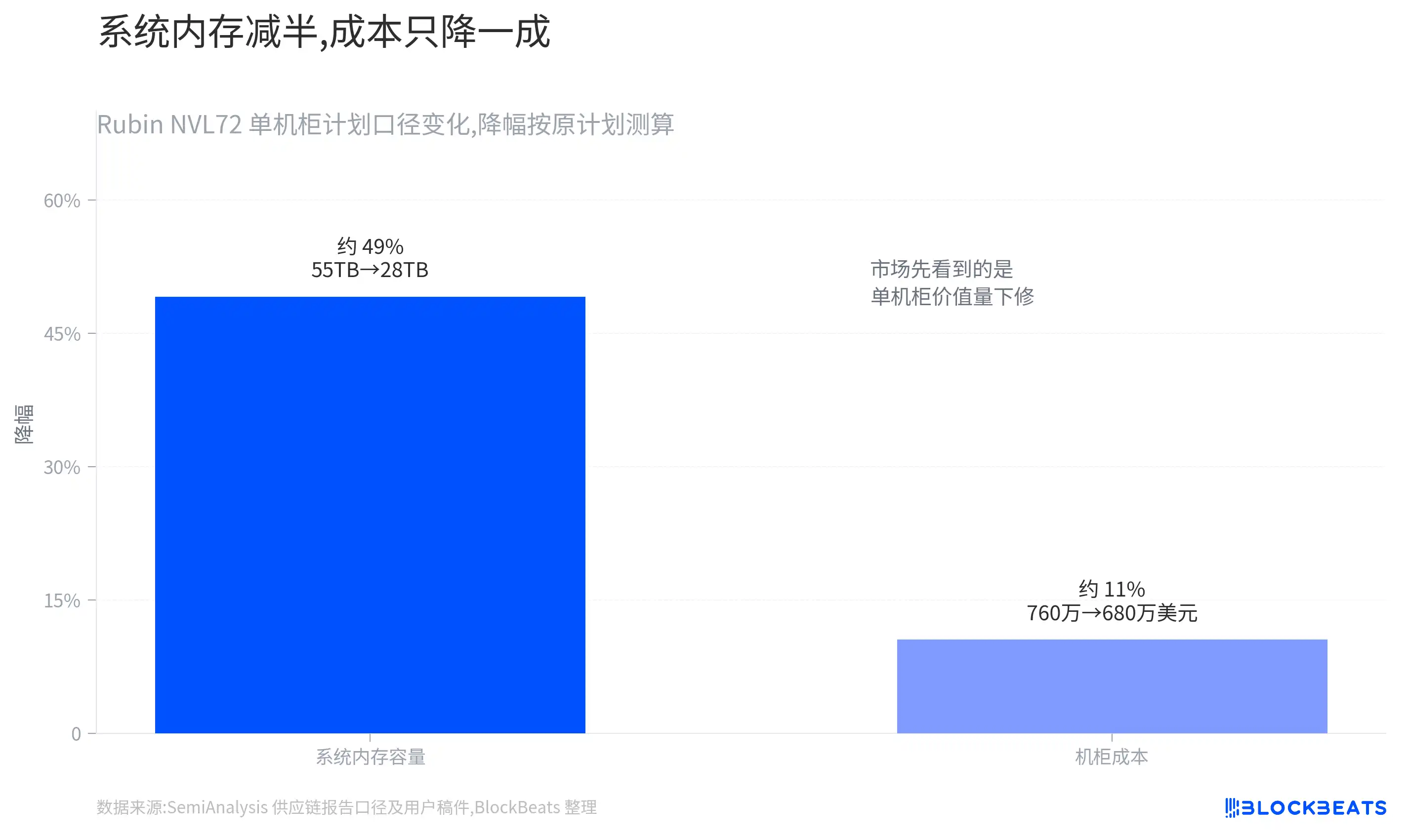
Currently, the confirmed part is that the market reaction was heavy, but the event itself remains at the level of a supply chain report. SemiAnalysis disclosed that NVIDIA might downgrade the CPU-side SOCAMM configuration to ensure the delivery schedule for the Rubin NVL72. The numbers mentioned in the report include single-rack memory capacity dropping from ~55TB to ~28TB, and rack cost decreasing from ~$7.6 million to ~$6.8 million. These numbers should be understood as the reporting perspective of SemiAnalysis, not yet the final confirmed BOM (Bill of Materials) from NVIDIA.
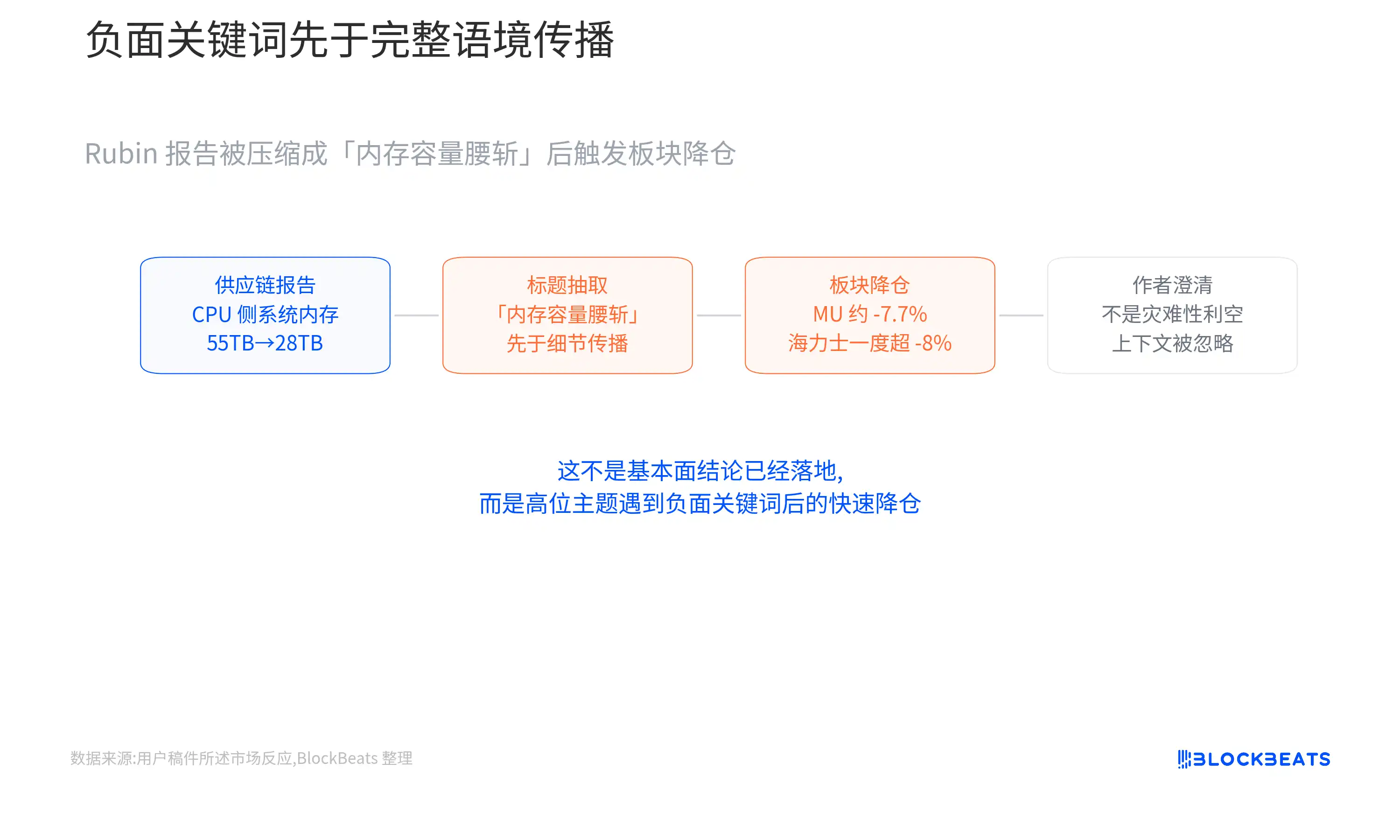
Over the past few quarters, the rise of AI memory stocks relied on a very smooth narrative: the more AI racks, the greater the shortage of advanced memory, and the thicker the profits for suppliers.

The simpler this story, the greater the killing power of a negative headline. Once "memory capacity halved" appeared, the market would first downgrade the memory value per rack, rarely distinguishing immediately which type of memory was being adjusted.

Micron's reaction is most illustrative.

It is both a traditional DRAM supplier and a beneficiary of AI server memory upgrades. Much of the upside previously priced in by the market came from the repricing notion that "AI memory is no longer just a cyclical product." If Rubin's per-rack system memory capacity declines, capital would immediately worry whether expectations for Micron's per-rack revenue from SOCAMM and LPDDR segments were set too high.

SK Hynix also followed the decline, indicating the shock has extended beyond a single supplier.

It is stronger in the HBM field, and the market had previously circulated rumors that it secured the majority of HBM orders related to Vera Rubin. But when AI memory trading becomes crowded, capital does not wait to verify all details before acting. The synchronous decline of memory stocks reflects a contraction in sector risk appetite, not that each company suffered the same fundamental shock.

Dylan Patel's subsequent clarification also points to this. He stated the report was not intended to create a "disaster" narrative, and many missed the context.

Translated into market language, capital did not fully trade on a supply chain analysis but rather on a rapid position reduction after a high-flying sector encountered negative keywords.

AI Memory Begins Redividing Profit Pools

What was primarily downgraded this time is the CPU-side system memory, not the GPU-adjacent HBM4.

Memory in a Rubin rack cannot be summarized with one word. The simplest breakdown is into two layers:

The first layer is GPU-side HBM4, serving the accelerator chip itself;

The second layer is CPU-side SOCAMM and LPDDR, more akin to the system RAM for the entire machine.
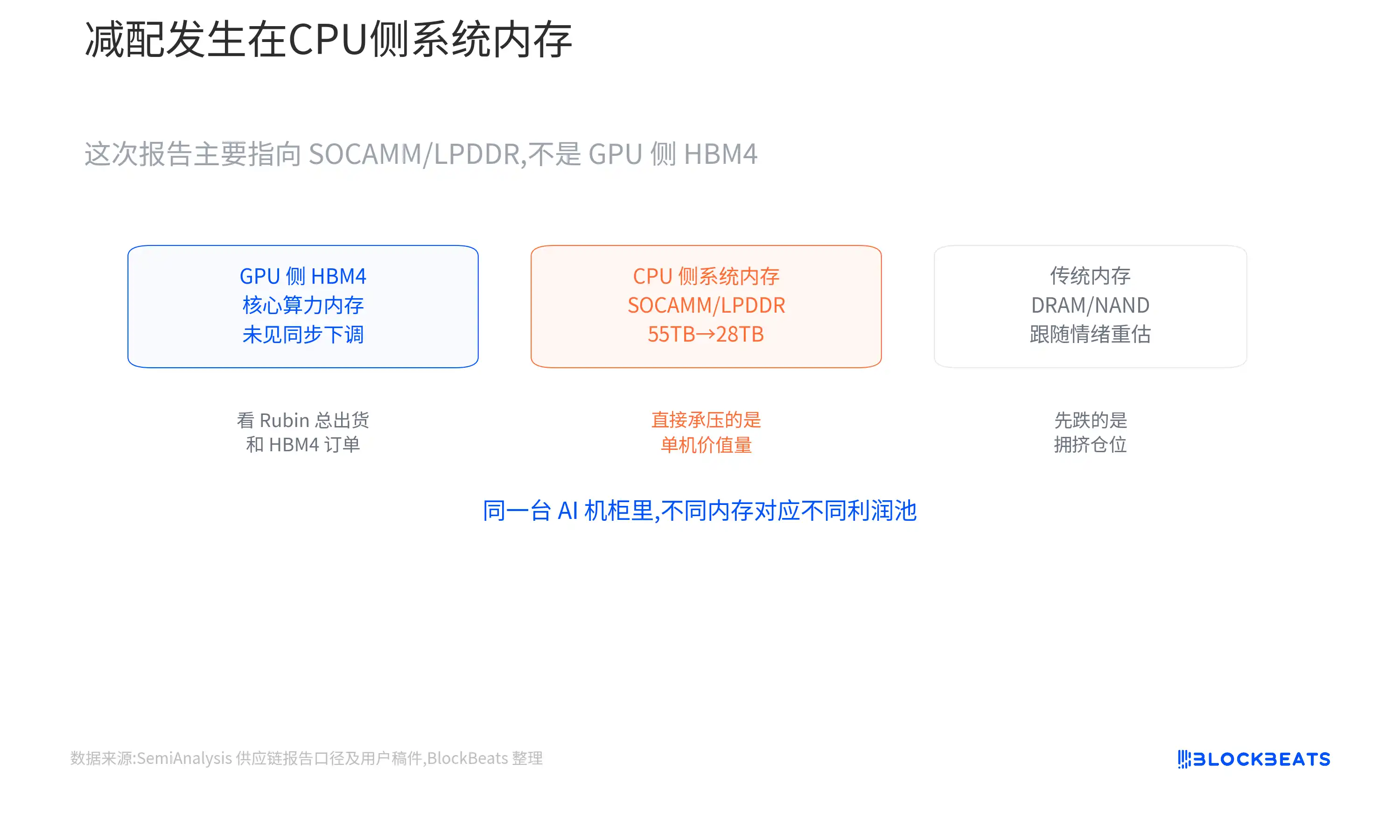
The former determines the speed at which data is fed to the GPU, while the latter affects overall machine scheduling, maintenance, and the performance of some workloads.

The "55TB to 28TB" mentioned by SemiAnalysis primarily falls on CPU-side system memory.

It might change the quantity, capacity, and procurement cost of SOCAMM modules per Rubin NVL72 rack. If most systems shift from 192GB modules to 96GB modules, the per-unit value of high-capacity SOCAMM indeed decreases, pressuring the revenue upside for related suppliers.

But GPU-side HBM4 is another line.

The Rubin platform still revolves around the Rubin GPU and Vera CPU, and HBM4 remains the core memory component for GPU packaging and computing power release. Current information does not show that HBM4 capacity or Rubin GPU shipments have been simultaneously downgraded. Previous multi-party predictions still regard HBM as one of the tightest and most pricing-powerful segments in AI servers, with SK Hynix also seen by the market as a primary beneficiary.

Think of an AI rack as an extremely expensive high-performance server.

HBM is closer to high-speed memory attached next to the GPU, while SOCAMM is closer to replaceable system memory for the whole machine. This adjustment mainly targets the latter.

For holdings, the distinction is very direct: if Micron has greater exposure in the SOCAMM segment, the downgrade in per-unit value would hit its expectations first; SK Hynix's HBM logic is relatively independent but would also be dragged down by sector sentiment in crowded trading.

Extrapolating system memory reduction directly into a breakdown of HBM4 demand lacks sufficient evidence.

A more reasonable breakdown is that the CPU-side profit pool indeed faces downward revision pressure, while the GPU-side HBM still depends on total Rubin shipments and HBM4 order cadence.

The AI memory theme can no longer be covered by a single line of "all memory is strong." Micron, SK Hynix, and Samsung Electronics have different exposures in HBM, SOCAMM, traditional DRAM, and NAND. Different types of memory within the same rack also correspond to different prices, margins, and supply-demand constraints.

Can Cost Reduction Translate to More Rack Shipments?

An optimistic interpretation stems from cost and delivery cadence.

SemiAnalysis's calculations show that the Rubin NVL72 rack cost might drop from ~$7.6 million to ~$6.8 million, a reduction of ~$800,000.
For cloud vendors like Microsoft, Google, Amazon, and Meta, AI racks are not just hardware purchases but involve calculating hourly computing costs, delivery time, and stability of large-scale deployment.

If a reduced configuration allows Rubin to be delivered faster, some per-unit value decline might be offset by more racks.

The logic is not complicated. If high-capacity SOCAMM supply is tight, NVIDIA choosing a more readily available configuration can lower the BOM per rack and reduce the risk of a single component delaying overall machine delivery.

For buyers, if a lower system memory configuration does not significantly impact core workloads, getting racks earlier might be more attractive than waiting for fully configured versions.

The problem is that this step remains speculative for now.

Cost reduction does not automatically equal increased orders. For "per-unit value decline" to be offset by "increased total rack volume," NVIDIA needs to deliver more Rubin NVL72 racks, and cloud vendors also need to add or advance purchases.

Existing materials lack public orders, quarterly guidance, or actual shipment data to prove this.

To understand with a simple scenario: if a certain SOCAMM capacity is nearly halved per rack, then total rack shipments need to increase significantly for the total Bit demand in this segment to return to previous expectations.
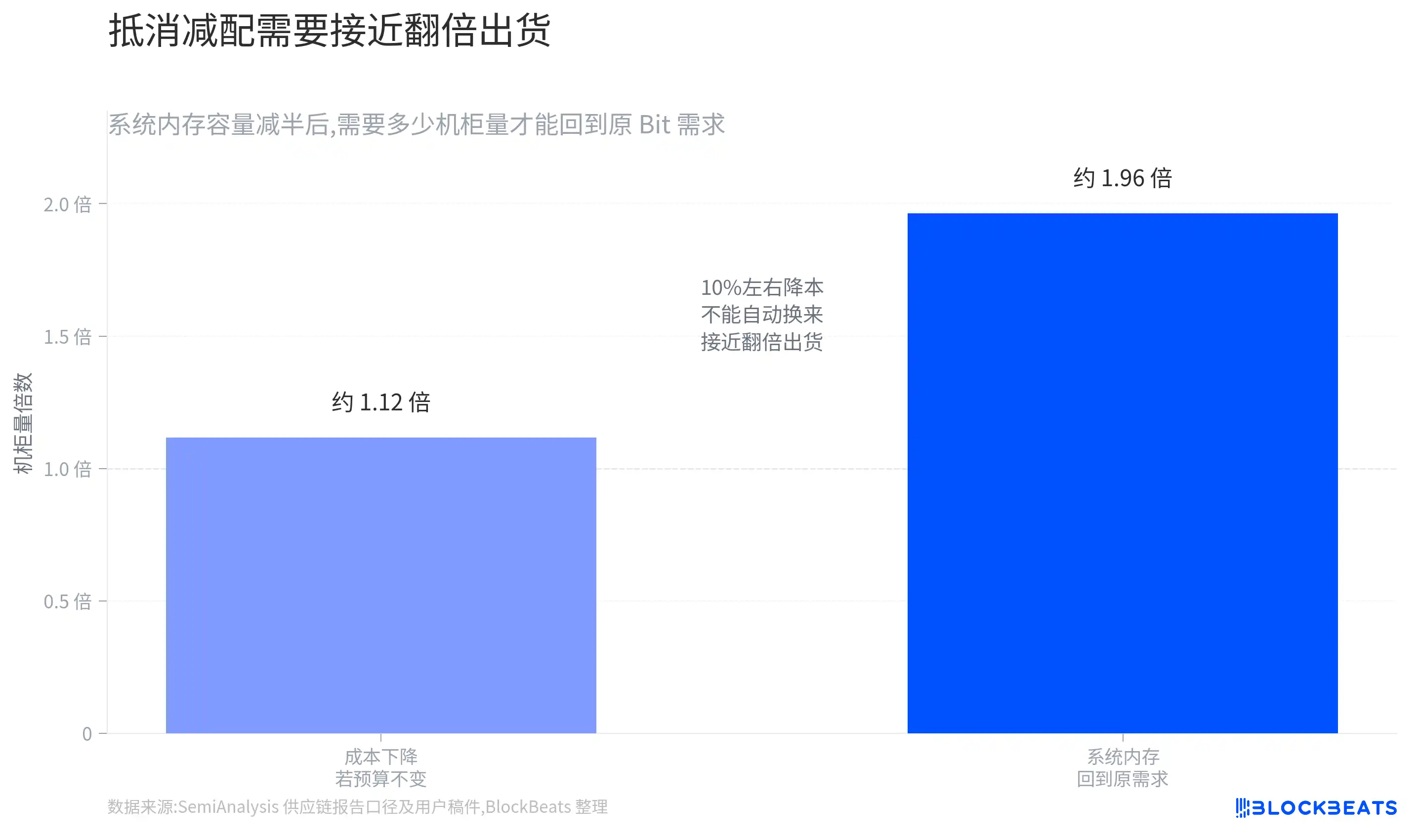
Even with a ~10% cost reduction, one cannot directly conclude that customers will buy enough extra racks. Large cloud vendor procurement is also influenced by power, data center construction, GPU supply, advanced packaging, and networking equipment; a single BOM reduction is just one variable.

The HBM situation is relatively more stable but not completely immune.

If total Rubin shipments remain robust, HBM4 will still be one of the most direct beneficiaries; if subsequent evidence shows overall machine delivery is hampered by other bottlenecks, HBM would also be affected by the platform's shipment cadence.

The difference is that this report did not directly downgrade HBM4 configuration. What the market awaits is total rack shipment volume, not just focusing on SOCAMM capacity numbers.

Shipment Data is the True Pricing Anchor

The current biggest risk is that the market first revalues based on profit pool breakdown, but subsequent data fails to back the optimistic interpretation.

If NVIDIA or the supply chain ultimately confirms that Rubin NVL72 will long-term adopt lower SOCAMM configurations, while total rack shipments are not significantly revised upward, CPU-side system memory suppliers will face more lasting compression of revenue expectations.

For Micron, the key is not just the overall label of "benefiting from AI memory," but the revenue breakdown of different products.

In subsequent earnings reports and conference calls, it's necessary to see if management discloses growth cadence for AI server-related DRAM, SOCAMM, HBM, and whether margins change due to specifications, prices, or customer bargaining power.

If the company only provides optimistic statements on overall demand but cannot explain the impact of SOCAMM configuration adjustments, the market may continue to discount it.

For SK Hynix, the verification point leans more towards HBM.

If its HBM4 order share, shipment cadence, and pricing maintain strength, this pullback resembles more of a sector sentiment fluctuation; if subsequent Rubin total shipments or HBM delivery cadence also show downgrades, the market would then extend the shock from SOCAMM to the HBM theme.

This is also a typical evolution as the AI memory theme reaches its mid-stage.

Early on, the market bought the direction: more AI racks are being built, and advanced memory is getting scarcer.

Now, representative stocks have accumulated significant gains, and capital is beginning to scrutinize whether each piece of profit is truly materializing. A single supply chain detail can trigger a 7%-8% intraday swing, indicating sector trading has become somewhat crowded, making negative information easier to amplify.

Before actual shipment and earnings breakdowns emerge, labeling this pullback as "bad news fully priced in" or "AI demand collapse" is premature.

A more prudent view is to acknowledge the pressure of per-unit value downgrade on the CPU side, while pricing HBM4 and SOCAMM separately.

What can most change the judgment next is still whether NVIDIA confirms the final BOM for Rubin NVL72, whether actual Rubin rack shipment plans can be revised upward, and the revenue exposure and margin changes for Micron, SK Hynix, and Samsung Electronics in HBM versus SOCAMM/LPDDR.

Связанные с этим вопросы

QWhat triggered the sharp decline in the AI memory stock market according to the article?

AThe decline was triggered by a supply chain report from SemiAnalysis, which suggested a potential reduction in CPU-side system memory (SOCAMM/LPDDR) capacity per Nvidia Rubin NVL72 rack, from about 55TB to about 28TB. The report's alarming headline caused a market panic, despite later clarifications that it was not a 'disastrous bearish' report.

QAccording to the article, what is the key distinction between the two main types of memory in an AI server rack, and which one was reportedly impacted by the configuration change?

AThe two main types are GPU-side HBM (High Bandwidth Memory, like HBM4) and CPU-side system memory (like SOCAMM and LPDDR). The reported configuration change primarily impacted the CPU-side system memory (SOCAMM/LPDDR), potentially reducing its capacity and value per rack. The article states there is no confirmed change to the GPU-side HBM4 configuration.

QWhy did stocks like Micron and SK Hynix both fall significantly, even though their exposure to the affected memory segment might differ?

ABoth stocks fell due to a sharp contraction in sector risk appetite and a crowded trade. When the negative headline about 'memory capacity being halved' hit, investors reacted quickly by reducing exposure to the entire AI memory theme without initially distinguishing between the different memory types (HBM vs. system memory). This caused a broad sell-off before details were fully digested.

QWhat is the potential positive interpretation of the reported memory configuration change for the Rubin rack, as mentioned in the article?

AThe potential positive interpretation is that reducing the CPU-side memory specification could lower the overall cost and complexity of the Rubin NVL72 rack, potentially improving its delivery timeline and reliability. If this leads to increased total rack shipments by Nvidia, the reduction in per-unit value for certain memory components could be offset by higher volume.

QWhat does the article suggest is the most important factor for determining the true impact on memory suppliers following this report?

AThe article suggests that actual shipment data and financial breakdowns are the key determinants. For a final assessment, the market needs to see: Nvidia's confirmed final BOM for Rubin racks, the actual shipment plans for Rubin platforms, and detailed revenue/earnings breakdowns from suppliers like Micron and SK Hynix showing their exposure and margin trends for HBM versus SOCAMM/LPDDR products.

Похожее

Near Returns to the AI Stage: Transformation into a Public Chain Due to 'Payroll Difficulties,' Agent and Privacy Emerge as New Growth Narratives

NEAR Returns to AI Origins: From Payroll Struggles to Blockchain, Now Focusing on AI Agents and Privacy NEAR Protocol's journey began not with grand blockchain ambitions, but from a practical hurdle: its AI startup founders, including Transformer paper co-author Illia Polosukhin, couldn't efficiently pay international developers in 2017. This led them to pivot and build a high-performance, scalable blockchain. After years navigating various crypto narratives like sharding and cross-chain interoperability, NEAR is now leveraging its AI roots to re-enter the AI arena. A key driver is its "NEAR Intents" layer, which abstracts complex cross-chain transactions. Users simply state their goal (e.g., swap BTC for ETH), and a solver network finds the optimal route. This system has processed over $20B in cross-chain volume, generating significant fee revenue. A major growth area is private transactions via "Confidential Intents/Swaps," which hide trade details until settlement to protect against MEV and front-running. Remarkably, private swaps recently accounted for over 40% of NEAR's transaction volume, highlighting strong demand but also potential regulatory scrutiny. With its AI-founder pedigree, NEAR is positioning itself at the intersection of blockchain, AI agents, and privacy, aiming to become infrastructure for the emerging agent economy while navigating the challenges of its rapid adoption.

marsbit1 ч. назад

Near Returns to the AI Stage: Transformation into a Public Chain Due to 'Payroll Difficulties,' Agent and Privacy Emerge as New Growth Narratives

marsbit1 ч. назад

From Ethereum to AI's 'CROPS': What Exactly is This Set of 'Slow Variables' That Vitalik Repeatedly Emphasizes?

In recent discussions, Vitalik Buterin has frequently emphasized the concept of "CROPS," a framework defining core values for Ethereum's development. CROPS stands for Censorship Resistance, Capture Resistance, Open Source, Privacy, and Security. Initially outlined in the Ethereum Foundation's "EF Mandate," it represents a commitment to user sovereignty, ensuring that the network resists external control, remains open, protects privacy, and prioritizes security. The relevance of CROPS extends beyond Ethereum's foundational principles, becoming crucial in the context of AI integration. As AI agents begin handling wallet operations and automated transactions, the risk increases that users may cede control over their digital assets, privacy, and intentions to centralized AI service providers. A "CROPS AI" would therefore emphasize local execution where possible, privacy-preserving remote model calls (e.g., using zero-knowledge proofs), and transparent, verifiable processes to maintain user agency. Vitalik highlights a significant convergence between "CROPS Ethereum access layer" and "CROPS AI." Both address the same fundamental challenge: how users can access powerful services—be it blockchain data via RPCs or AI models—without exposing sensitive information or relinquishing ultimate control. This intersection points toward a future digital entry point that is more private, secure, and user-controlled. Ultimately, CROPS is not merely an abstract ideal but a practical guidepost. It steers development—from protocol resilience and wallet design to AI agent safety—towards a future where users retain self-sovereignty even as digital systems grow more complex and powerful. In an era of accelerating AI adoption, these "slow variables" of censorship resistance, openness, privacy, and security may define Ethereum's enduring value.

marsbit1 ч. назад

From Ethereum to AI's 'CROPS': What Exactly is This Set of 'Slow Variables' That Vitalik Repeatedly Emphasizes?

marsbit1 ч. назад

Silicon Valley 'Startup Guru' Steve Hoffman: Web3 + AI Could Be a Trap

Silicon Valley investor and "Godfather of Startups" Steve Hoffman warns that combining Web3 with AI is likely a trap, not a promising venture. In an interview, Hoffman argues that while AI is a foundational technology touching all industries, Web3 adds complexity, friction, and regulatory risk without solving mainstream consumer or business needs. He advises founders to focus on deep, specialized applications where startups can out-iterate giants, rather than on generic features easily replicated by large tech companies. Hoffman observes that Silicon Valley will lead foundational AI research, while China excels at rapid, large-scale application and commercialization, particularly in robotics. He stresses that AI-driven autonomous agents capable of collaborative, multi-step tasks are 2-4 years away, which will cause significant job displacement. The solution is not to slow AI but to redesign business models around human-AI collaboration and reform social systems like education and retraining. For startups, Hoffman recommends focusing on vertical, expertise-heavy domains to build defensibility. He sees major opportunities in AI fraud detection and cybersecurity. Key founder mindsets include systemic thinking over feature-focus, relentless customer centricity, building adaptive teams, and deeply understanding AI's capabilities and limits. Hoffman is also leading a non-profit initiative to establish university centers aimed at training future leaders in responsible, human-value-aligned AI innovation.

marsbit2 ч. назад

Silicon Valley 'Startup Guru' Steve Hoffman: Web3 + AI Could Be a Trap

marsbit2 ч. назад

Token Inefficient, Economy Tokenless

The article "Tokens Aren't Economical, Economics Aren't Tokenized" analyzes a pivotal shift in the AI industry from a technology-driven narrative to one dominated by capital efficiency. It highlights two concurrent trends: a severe capital shortage due to the exorbitant and recurring costs of compute (e.g., OpenAI's high burn rate) and a wave of corporate spin-offs where major tech companies are separating their AI units (like Kuaishou's Kling and Baidu's Kunlunxin). The core argument is that AI's "anti-internet" business model, where user growth increases costs rather than profits, has created a disconnect between high valuations and actual cash flow. Spin-offs address this by allowing AI assets to be valued independently. Within a parent company, they are seen as cost centers, but as standalone entities, they are priced based on their growth potential and scarcity in the primary market, leading to massive valuation premiums (e.g., Kling's estimated value tripling post-spin-off). The industry is at an inflection point, moving from "model worship" to "value realization." The competition is evolving from a pure compute (GPU) race to a broader focus on systemic efficiency and full-stack engineering (involving CPUs and orchestration) to achieve viable commercialization. The year 2026 is framed as a critical moment where the industry must definitively answer how to economically translate AI capability into tangible business value, reshaping the sector's future power structure.

marsbit2 ч. назад

Token Inefficient, Economy Tokenless

marsbit2 ч. назад

Торговля

Спот
Фьючерсы

Популярные статьи

Как купить S

Добро пожаловать на HTX.com! Мы сделали приобретение Sonic (S) простым и удобным. Следуйте нашему пошаговому руководству и отправляйтесь в свое крипто-путешествие.Шаг 1: Создайте аккаунт на HTXИспользуйте свой адрес электронной почты или номер телефона, чтобы зарегистрироваться и бесплатно создать аккаунт на HTX. Пройдите удобную регистрацию и откройте для себя весь функционал.Создать аккаунтШаг 2: Перейдите в Купить криптовалюту и выберите свой способ оплатыКредитная/Дебетовая Карта: Используйте свою карту Visa или Mastercard для мгновенной покупки Sonic (S).Баланс: Используйте средства с баланса вашего аккаунта HTX для простой торговли.Третьи Лица: Мы добавили популярные способы оплаты, такие как Google Pay и Apple Pay, для повышения удобства.P2P: Торгуйте напрямую с другими пользователями на HTX.Внебиржевая Торговля (OTC): Мы предлагаем индивидуальные услуги и конкурентоспособные обменные курсы для трейдеров.Шаг 3: Хранение Sonic (S)После приобретения вами Sonic (S) храните их в своем аккаунте на HTX. В качестве альтернативы вы можете отправить их куда-либо с помощью перевода в блокчейне или использовать для торговли с другими криптовалютами.Шаг 4: Торговля Sonic (S)С легкостью торгуйте Sonic (S) на спотовом рынке HTX. Просто зайдите в свой аккаунт, выберите торговую пару, совершайте сделки и следите за ними в режиме реального времени. Мы предлагаем удобный интерфейс как для начинающих, так и для опытных трейдеров.

1.4k просмотров всегоОпубликовано 2025.01.15Обновлено 2026.06.02

Как купить S

Sonic: Обновления под руководством Андре Кронье – новая звезда Layer-1 на фоне спада рынка

Он решает проблемы масштабируемости, совместимости между блокчейнами и стимулов для разработчиков с помощью технологических инноваций.

2.3k просмотров всегоОпубликовано 2025.04.09Обновлено 2025.04.09

Sonic: Обновления под руководством Андре Кронье – новая звезда Layer-1 на фоне спада рынка

HTX Learn: Пройдите обучение по "Sonic" и разделите 1000 USDT

HTX Learn — ваш проводник в мир перспективных проектов, и мы запускаем специальное мероприятие "Учитесь и Зарабатывайте", посвящённое этим проектам. Наше новое направление .

1.8k просмотров всегоОпубликовано 2025.04.10Обновлено 2025.04.10

HTX Learn: Пройдите обучение по "Sonic" и разделите 1000 USDT

Обсуждения

Добро пожаловать в Сообщество HTX. Здесь вы сможете быть в курсе последних новостей о развитии платформы и получить доступ к профессиональной аналитической информации о рынке. Мнения пользователей о цене на S (S) представлены ниже.

活动图片