Why Is Nvidia Borrowing $20 Billion When It's Not Short of Cash?

marsbitОпубликовано 2026-06-15Обновлено 2026-06-15

Введение

Nvidia's recent announcement to issue at least $20 billion in senior notes, despite holding a strong cash position with over $48.6 billion in free cash flow last quarter, is not a sign of financial need. Instead, it represents a strategic move to leverage its high credit rating (recently upgraded to AA by S&P) to secure low-cost, long-term debt. This capital will support long-term AI infrastructure investments, data centers, R&D, supply chain prepayments, and strategic investments, while allowing the company to continue aggressive shareholder returns through stock buybacks and dividends. The decision reflects a mature capital management strategy: using debt to finance long-term growth assets is more efficient and less dilutive to shareholders than equity financing. It signals that Nvidia, like other tech giants (Alphabet, Meta, Amazon), is entering a new phase of heavy AI capital expenditure, shifting from a pure growth story to a story about capital allocation, credit strength, and long-term ecosystem positioning. The key question for investors is whether Nvidia can maintain its high cash flow generation and ensure that returns from these AI investments justify the cost of capital over the long term. The bond issuance amplifies its expansion capabilities but also ties its valuation more closely to the broader AI investment cycle's sustainability and profitability.

TL;DR

Nvidia's latest bond issuance is most easily misread as a simple question: with so much cash on hand, why does it need to borrow money?

According to the company's most recent quarterly data, for FY2027 Q1 ending April 26, 2026, Nvidia's revenue reached $81.6 billion, with free cash flow around $48.6 billion. At the same time, the company added $80 billion in stock repurchase authorization and raised its quarterly dividend from $0.01 to $0.25. In other words, this is not a company with tight cash flow needing the bond market to stay afloat.

But it's precisely because of this that the market is particularly sensitive to its plan to issue at least $20 billion in senior notes. The bond maturities range from 2 to 30 years, with proceeds intended for general corporate purposes, refinancing, AI data center and infrastructure, R&D, supply chain prepayments, and strategic investments. For investors, the real question worth asking is not "Does Nvidia have money?" but rather: When the biggest AI cash cow also starts systematically using long-term debt, has the AI capital expenditure narrative entered a new phase?

The core of this matter is not that Nvidia suddenly needs money, but that it is converting its cash flow and credit rating into another form of expansion capability.

The Stronger the Cash, the More Qualified to Borrow Long-Term

The average investor seeing "bond issuance" often first thinks the company is short of money. But for mature large companies, borrowing is often not a passive plea for help, but an active choice of a cheaper, less shareholder-dilutive financing method.

Nvidia plans to issue senior notes (corporate IOUs), essentially borrowing money from bond investors, paying periodic interest and repaying principal at maturity. The biggest difference from issuing new shares is that issuing debt does not carve out a piece of the company's ownership. As long as the company's future returns exceed the debt cost, existing shareholders can retain more earnings.

This is the paradox of this transaction. Nvidia's free cash flow in the last quarter was about $48.6 billion, its single-quarter cash generation capacity already significantly exceeding the scale of this proposed financing. The company is also simultaneously conducting massive buybacks and raising dividends, indicating the bond issuance cannot be simply understood as "not having enough cash."
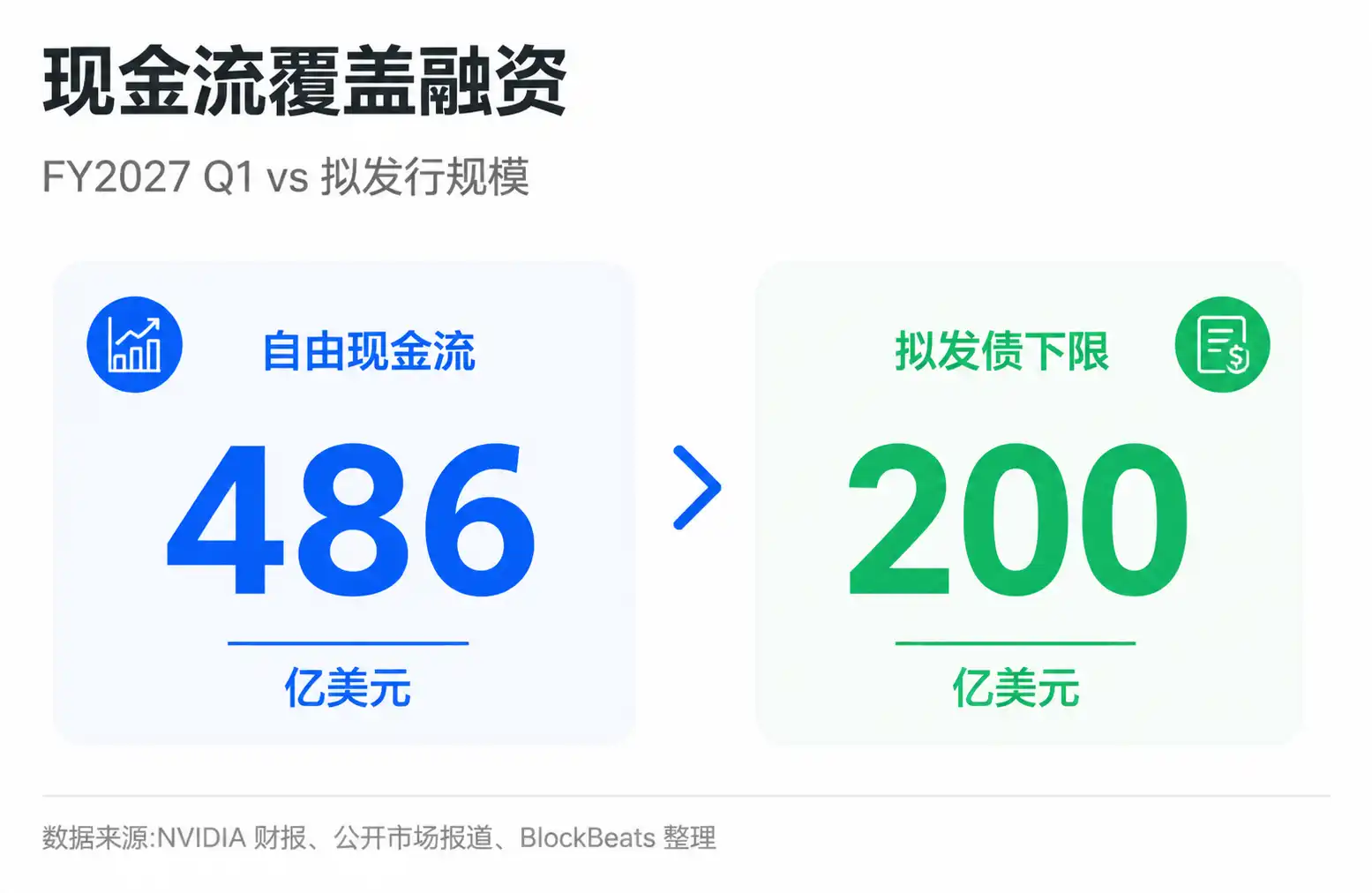
A more reasonable explanation is that Nvidia is locking in a source of long-term funding when its credit is strongest and the market is most willing to lend to it. For a company in an AI infrastructure expansion cycle, data centers, supply chain prepayments, ecosystem investments, and R&D spending are not short-term projects. Their payback periods may span years, even a decade or more. Matching long-term assets with 30-year debt is closer to mature capital management than relying entirely on short-term operating cash flow.

This is also the plain meaning of "capital structure optimization": the company uses not just cash on hand but also appropriately pairs it with low-cost debt. As long as the long-term return generated by the borrowed money is higher than the interest cost, debt is not just a burden; it can also be a tool to improve capital efficiency.

AA Rating Turns Bonds into AI Ammunition

That Nvidia can do this relies on the bond market being willing to lend to it at a low enough cost. The most important variable behind this is the credit rating.

S&P Global Ratings recently upgraded Nvidia to AA, citing reasons including competitive advantages from AI demand, strong cash flow generation capacity, and a robust balance sheet. An AA rating can be understood as a high-credit label in the bond market: investors believe the company has an extremely low default risk, therefore willing to accept lower spreads and longer maturities.

This is key. Bond issuance isn't just about "getting money"; what truly determines the transaction's value is "at what cost, for how long, and in what market window." When a company is in a phase of credit upgrades, rapidly expanding cash flow, and the AI theme is still favored by institutional funds, its bargaining power for long-term funding significantly strengthens.

This also explains why Nvidia is acting at this moment. It's not waiting until cash flow weakens or expansion pressure increases to raise funds; instead, it's reducing future financing uncertainty in advance when the market most recognizes its credit quality. For shareholders, this is more attractive than being forced to finance in a worse environment in the future.

The listed uses of the bond proceeds are also worth considering together: refinancing, AI data center and infrastructure, R&D, supply chain prepayments, strategic investment. Refinancing leans towards financial management, infrastructure and supply chain towards expansion security, and strategic investment towards ecosystem positioning. They collectively point to one fact: Nvidia's capital needs are no longer just about "producing more chips," but about maintaining its position within the entire AI ecosystem.
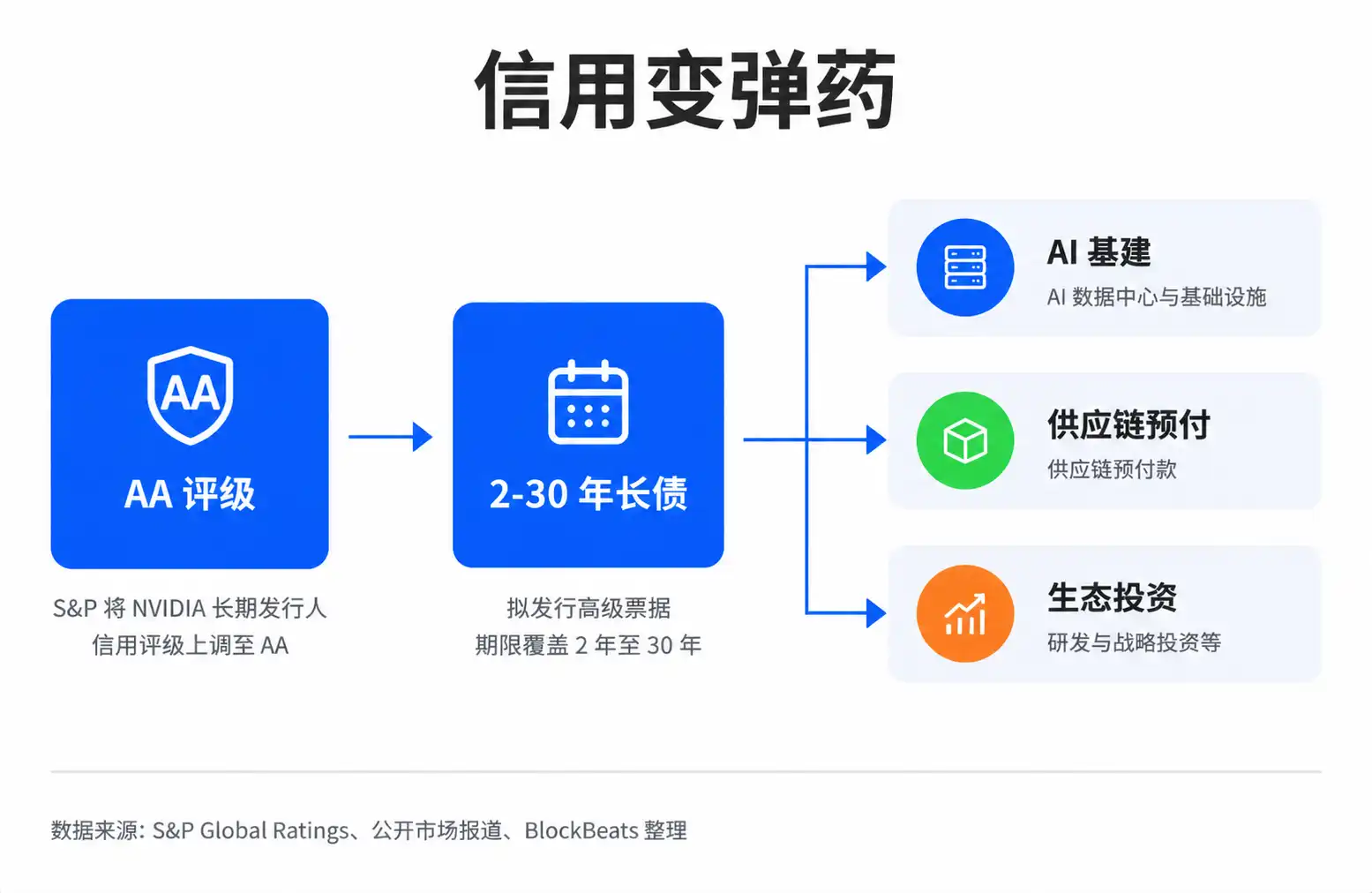
Nvidia sells the most critical computing power tools of the AI era, but it also needs to ensure its customers, supply chain, infrastructure, and ecosystem partners can keep up. The more important this role becomes, the more its capital allocation resembles a platform company, not just a hardware company.

Borrowing Is More Aligned with Shareholder Interests Than Issuing Shares

For NVDA shareholders, this bond issuance has another direct implication: the company is reserving ammunition for long-term expansion while maintaining shareholder returns.

Nvidia's last quarter not only had strong cash flow but also added $80 billion in buyback authorization and raised its dividend. Buybacks and dividends represent the company returning cash directly to shareholders; issuing debt represents using external long-term funds to support future investments. Looking at them together conveys not an "either-or" but the company's attempt to maintain two lines simultaneously: rewarding existing shareholders while not slowing down AI expansion.

If Nvidia chose to raise funds by issuing new shares, existing shareholders would be diluted. Even if the company continues to grow, earnings per share would be reduced. In contrast, the cost of debt is clearer: interest and principal. For a company with extremely strong free cash flow and a high credit rating, this cost is easier to manage.

Of course, this doesn't mean bond issuance is necessarily positive. Debt increases fixed expenses and raises market expectations for capital allocation efficiency. The reason Nvidia can get investors to accept this debt today is that the market believes its future cash flow can cover the interest and that AI infrastructure investments will ultimately translate into revenue and profit. If these two premises change, debt could shift from an efficiency tool to a valuation pressure.

Therefore, what this bond issuance truly changes is how investors observe Nvidia. In the past, the market focused more on GPU demand, gross margins, and revenue growth; now, it must also pay attention to how cash flow is allocated: how much for buybacks and dividends, how much for supply chain and infrastructure, how much for ecosystem investment, and how much is locked in early through debt.

This will make NVDA's valuation anchor more complex. It's no longer just a "profit growth story"; it's also beginning to feature characteristics of a "credit asset" and a "long-term capital allocation platform."

The AI Financing Template for Large Tech Companies Is Taking Shape

Nvidia is not the only company doing this. Alphabet completed a $20 billion bond issuance in February 2026, with maturities also covering multiple series, reportedly with orders once exceeding $100 billion. Meta, Amazon, and other large tech companies are also using debt financing during the AI investment cycle as one tool to support infrastructure spending.
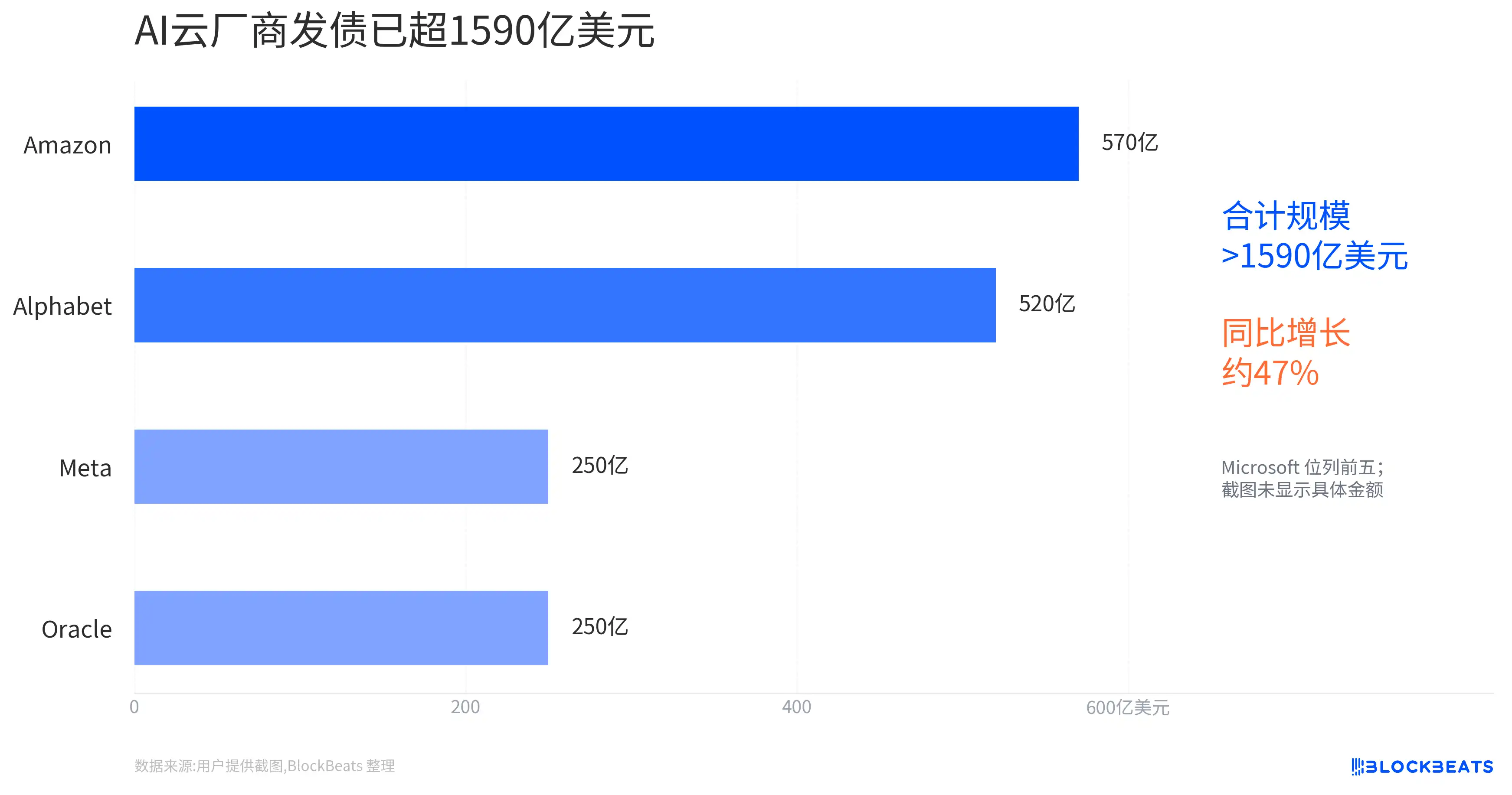
These cases cannot be simply written off as "tech giants are all short of money." A more accurate description is: AI infrastructure has shifted from a light-asset software growth story to a heavy-asset cycle involving data centers, power, chips, networks, and the supply chain. The company that can obtain funds at lower costs and for longer periods will have more room to maneuver in this expansion.

This has two implications for market pricing.

First, debt financing extends the endurance of AI capex (capital expenditure). As long as the bond market is willing to buy, large tech companies don't have to rely entirely on current cash flow to pay for long-term construction. This will support demand expectations for data centers, power, optical communications, semiconductor supply chains, and other areas.

Second, debt financing will also make investors more attentive to the payback period. In the past, the market was willing to pay a high valuation for AI investments because the growth speed was fast enough. But as investments become heavier and financing terms longer, the question becomes: When will these infrastructures generate sufficient returns? If AI application revenue materializes slower than expected, or the commercial return per unit of computing power declines, the market will re-examine whether these debt-supported expansions are too aggressive.

Nvidia's special position is that it sits at the upstream of the AI capital expenditure chain. The more customers invest, the more it benefits; but if the investment returns of the entire industry are questioned, it cannot remain completely insulated. Therefore, this bond issuance both reinforces the market's recognition of its credit and cash flow and embeds it deeper into the narrative of long-cycle AI capital expenditure.

What Remains to Be Tested Is Whether Pricing and Returns Can Coexist

The most important caveat at present is: this is still a "proposed issuance of at least $20 billion"; the final issuance size, coupon, spread, and order book strength remain to be confirmed. Only after the transaction closes can the market more accurately judge at what low cost and for how long bond investors are willing to fund Nvidia.

If the final pricing shows strong demand and long-term spreads remain low, this will further prove that Nvidia is turning its AA credit into an expansion tool. It can not only profit from customers' AI spending but also finance its own long-term positioning at lower costs in the capital market.

But the more important verification later lies not in the bonds themselves, but in the next phase of earnings reports and capital expenditure data. Investors need to see whether Nvidia can continue to maintain strong free cash flow while advancing AI infrastructure, supply chain prepayments, ecosystem investment, and shareholder returns. If these variables can still progress in parallel, bond issuance becomes an amplifier of capital efficiency.

Conversely, if the payback period for future AI infrastructure lengthens, or the company increasingly relies on external financing to sustain expansion, the market's understanding of such debt will change. Then the question will no longer be "Is Nvidia short of cash?" but "Is the return rate on long-cycle AI investments sufficient to support the expectations being front-loaded by today's low-cost funds?"


Связанные с этим вопросы

QWhy is Nvidia raising $20 billion through debt issuance despite having very strong cash flow?

ANvidia is issuing debt not because it lacks cash, but as an active capital management strategy to optimize its capital structure. With its strong AA credit rating and robust cash flow, it can lock in low-cost, long-term funding now to support its long-term AI infrastructure expansion, data center build-out, R&D, supply chain prepayments, and strategic investments. Using debt is a cheaper and more shareholder-friendly way to finance these long-duration assets compared to diluting equity, allowing the company to simultaneously fund growth and maintain shareholder returns through buybacks and dividends.

QWhat are the potential benefits for shareholders from Nvidia's debt issuance instead of issuing more stock?

AIssuing debt instead of equity prevents dilution of existing shareholders' ownership. This means current shareholders retain a larger share of the company's future earnings. For a company like Nvidia with strong projected returns and low borrowing costs, using debt is seen as a more efficient way to finance growth. It also allows the company to continue its significant stock buyback program and increased dividends while still funding large-scale, long-term investments, thus balancing shareholder rewards with expansion.

QWhat does the timing of Nvidia's bond issuance indicate about the broader AI investment cycle?

AThe timing signals that the AI capital expenditure (capex) narrative may be entering a new, more mature stage. Large technology firms are shifting from light-asset, software-driven growth to a heavy-asset cycle involving data centers, power, chips, and supply chains. Nvidia, along with other giants like Alphabet and Meta using debt, shows that securing low-cost, long-term capital is becoming a strategic imperative to fuel and extend this infrastructure build-out, making debt financing a key tool for competitive advantage in the AI arms race.

QWhat is the significance of Nvidia's AA credit rating for its recent bond offering?

ANvidia's recent upgrade to an AA credit rating by S&P Global is crucial. It acts as a 'high-credit label' in the bond market, indicating extremely low perceived default risk. This allows Nvidia to borrow large sums at very low interest rates and with long maturities (like 30-year bonds). The strong rating means investors are willing to accept lower returns for the perceived safety, giving Nvidia significant pricing power and the ability to secure favorable long-term funding to support its strategic, multi-year AI investments.

QWhat are the key risks or future tests associated with Nvidia's use of long-term debt to fund AI expansion?

AThe main risk is whether the future returns from AI infrastructure investments will justify the current use of cheap, long-term debt. If AI application revenue grows slower than expected, or if the return on invested capital for these heavy assets declines, the debt could become a burden rather than an efficiency tool. The market will closely watch Nvidia's ability to maintain its strong free cash flow while executing its expansion plans. The key test is whether the AI capex cycle's actual profitability can support the growth expectations that are being pre-funded by the bond market.

Похожее

The Value Distribution of Stablecoins

**Summary: The Value Distribution of Stablecoins** The article argues that stablecoins are evolving from mere trading tools into broader channels for dollar access. It divides the stablecoin ecosystem into four layers to analyze how value is distributed: 1. **Issuance Layer:** Mints stablecoins, holds reserve assets, and captures the spread between reserve yield and user costs (e.g., Tether, Circle). This layer currently earns the largest profit margin. 2. **Infrastructure Layer:** Connects stablecoins to the traditional financial system, handling fiat on/off-ramps, banking integration, compliance (KYC/AML), and asset management (e.g., Bridge, BVNK). This is the "unglamorous" but critical work, building the essential bridges between crypto and real-world finance. 3. **Acquiring/Distribution Layer:** Integrates stablecoins into merchant systems, manages payment flows, and provides enterprise financial software (e.g., Stripe, Coinbase). They act as the access point for businesses. 4. **Application Layer:** The end-users and businesses that ultimately use stablecoins for payments, settlements, or as a store of value. They benefit from convenience but have little pricing power. The core thesis is that while the issuance layer currently dominates profits, the often-overlooked **infrastructure layer holds significant long-term potential**. The real challenge and barrier to mass adoption is not the on-chain transfer of stablecoins (which is simple), but the complex "last mile" integration into existing business workflows, banking systems, and regulatory frameworks across different countries. Companies in this layer are currently in a "land grab" phase, investing heavily to build networks, secure bank partnerships, and establish compliance pathways. While their position is currently pressured by the profitable issuers above and distribution platforms below, the article suggests that if stablecoins become a default financial rail for businesses, the infrastructure providers who have done the hard work of integration will ultimately gain strong pricing power and become entrenched, essential players.

marsbit1 ч. назад

The Value Distribution of Stablecoins

marsbit1 ч. назад

The Value Distribution of Stablecoins

The Value Distribution of Stablecoins The article argues that stablecoins are evolving from a mere trading tool into a broad "dollar channel." It analyzes the industry's value chain through four layers: 1. **Issuance Layer (e.g., Tether, Circle):** The top layer that mints stablecoins, holds reserve assets, and captures the thickest interest rate spread. 2. **Infrastructure Layer (e.g., Bridge, BVNK):** Connects stablecoins to the traditional financial system, handling critical but complex "dirty work" like fiat on/off-ramps, banking integration, compliance (KYC/AML), and cross-border settlement. 3. **Acquiring/Distribution Layer (e.g., Stripe, Coinbase):** Embeds stablecoins into merchant systems, manages payment flows, and integrates with enterprise software. 4. **Application Layer:** End-users and businesses that ultimately use stablecoins for payments, settlement, or storing value. The author posits that while the issuance layer currently captures the most profit, the most overlooked and potentially critical layer is infrastructure. The core challenge for stablecoin adoption isn't the on-chain transfer (which is simple), but bridging the gap between blockchain and the real-world financial system. This involves solving practical problems for businesses: fiat conversion, reconciliation, tax handling, and user onboarding. Infrastructure companies are currently in a difficult "land-grab" phase—building networks, securing banking relationships, and achieving compliance country-by-country. They face pressure from both the profitable issuance layer above and distribution platforms below. However, the author suggests this layer is building a crucial moat. Once stablecoins become a default business rail, the infrastructure players who have done the hard work of integration may gain significant, durable value and pricing power.

链捕手1 ч. назад

The Value Distribution of Stablecoins

链捕手1 ч. назад

How to Do Research Well: Deliberately Practice the Real Skills That Matter

No one truly teaches you how to do research. You're often given a desk, a pre-selected problem, and vague instructions to "create something new." Consequently, many people reverse-engineer the job based on visible outputs—papers, posts, announcements—learning only how to *appear* like a researcher rather than how to *become* one. True research capability is built from stacking small, trainable skills, nearly all of which can be developed through deliberate practice. **Pick Your Own Problem:** Most researchers absorb problems from advisors or trends, lacking the underlying reasoning. Choosing a problem you genuinely care about, as John Schulman advises, leads to original work. Develop "taste" like a muscle: predict experiment outcomes, guess paper results from methods, and track which findings remain important over time. **Upgrade Your Inputs:** Relying on shared reading lists (arXiv hot lists, filtered group chats) leads to unoriginal conclusions. Undervalued old literature often holds crucial insights (e.g., MoE, LSTM, backpropagation). Richard Sutton's "The Bitter Lesson" or Claude Shannon's 1952 talk on creative thinking are more predictive than lengthy modern surveys. Breadth matters as much as depth: draw from neuroscience, mechanism design, hardware knowledge, and honest statistics. Read papers directly, especially appendices and limitations sections. **Write Everything Down:** As Paul Graham noted, writing exposes flaws in seemingly mature ideas. Writing is the cheapest defense against self-deception. Following Feynman's principle, Darwin programmatically wrote down facts contradicting his theory to combat memory bias. Maintain a detailed log of hypotheses, setups, predictions, results, and updated understandings. Reviewing past logs fosters essential humility.

marsbit4 ч. назад

How to Do Research Well: Deliberately Practice the Real Skills That Matter

marsbit4 ч. назад

Торговля

Спот
Фьючерсы

Популярные статьи

Как купить S

Добро пожаловать на HTX.com! Мы сделали приобретение Sonic (S) простым и удобным. Следуйте нашему пошаговому руководству и отправляйтесь в свое крипто-путешествие.Шаг 1: Создайте аккаунт на HTXИспользуйте свой адрес электронной почты или номер телефона, чтобы зарегистрироваться и бесплатно создать аккаунт на HTX. Пройдите удобную регистрацию и откройте для себя весь функционал.Создать аккаунтШаг 2: Перейдите в Купить криптовалюту и выберите свой способ оплатыКредитная/Дебетовая Карта: Используйте свою карту Visa или Mastercard для мгновенной покупки Sonic (S).Баланс: Используйте средства с баланса вашего аккаунта HTX для простой торговли.Третьи Лица: Мы добавили популярные способы оплаты, такие как Google Pay и Apple Pay, для повышения удобства.P2P: Торгуйте напрямую с другими пользователями на HTX.Внебиржевая Торговля (OTC): Мы предлагаем индивидуальные услуги и конкурентоспособные обменные курсы для трейдеров.Шаг 3: Хранение Sonic (S)После приобретения вами Sonic (S) храните их в своем аккаунте на HTX. В качестве альтернативы вы можете отправить их куда-либо с помощью перевода в блокчейне или использовать для торговли с другими криптовалютами.Шаг 4: Торговля Sonic (S)С легкостью торгуйте Sonic (S) на спотовом рынке HTX. Просто зайдите в свой аккаунт, выберите торговую пару, совершайте сделки и следите за ними в режиме реального времени. Мы предлагаем удобный интерфейс как для начинающих, так и для опытных трейдеров.

1.5k просмотров всегоОпубликовано 2025.01.15Обновлено 2026.06.02

Как купить S

Sonic: Обновления под руководством Андре Кронье – новая звезда Layer-1 на фоне спада рынка

Он решает проблемы масштабируемости, совместимости между блокчейнами и стимулов для разработчиков с помощью технологических инноваций.

2.3k просмотров всегоОпубликовано 2025.04.09Обновлено 2025.04.09

Sonic: Обновления под руководством Андре Кронье – новая звезда Layer-1 на фоне спада рынка

HTX Learn: Пройдите обучение по "Sonic" и разделите 1000 USDT

HTX Learn — ваш проводник в мир перспективных проектов, и мы запускаем специальное мероприятие "Учитесь и Зарабатывайте", посвящённое этим проектам. Наше новое направление .

1.8k просмотров всегоОпубликовано 2025.04.10Обновлено 2025.04.10

HTX Learn: Пройдите обучение по "Sonic" и разделите 1000 USDT

Обсуждения

Добро пожаловать в Сообщество HTX. Здесь вы сможете быть в курсе последних новостей о развитии платформы и получить доступ к профессиональной аналитической информации о рынке. Мнения пользователей о цене на S (S) представлены ниже.

活动图片