South Korean Stocks Plunge, Global Funds Liquidate: Has the Semiconductor Fundamentals Really Changed?

marsbitОпубликовано 2026-06-08Обновлено 2026-06-08

Введение

South Korean stocks experienced their sharpest decline of the year, with the KOSPI index plunging nearly 9% on Monday, triggering a market circuit breaker. Leading semiconductor firms Samsung Electronics and SK Hynix were heavily sold off, raising questions about whether the AI-driven bull market has reached an inflection point. This sell-off was largely triggered by a significant drop in the U.S. semiconductor sector late last week. Concurrently, NVIDIA CEO Jensen Huang visited Seoul over the weekend, meeting with top executives from SK Group, Samsung, LG, and NAVER. He announced a new multi-year partnership with SK Hynix to co-develop next-generation memory products for AI data centers. Huang emphasized that AI infrastructure build-out remains in its early stages, creating a stark contrast between market panic and ongoing, strengthened industry collaboration. The article argues that South Korea has become one of the most sensitive markets for global AI-related capital flows, functioning like a large AI memory ETF due to the heavy weighting of its chipmakers. The current market turmoil reflects a shift in investor focus: from simply betting on overall AI growth to scrutinizing which companies will actually capture the profits from that growth. This "profit pool reassessment" phase is causing high volatility based on supply chain news and earnings guidance. Ultimately, the direction of the Korean market will be determined by external factors—NVIDIA's orders, HBM supply-dem...

TL;DR

The South Korean stock market just experienced its sharpest drop this year.

After opening on Monday, the KOSPI fell nearly 9% intraday, triggering a circuit breaker. Both Samsung Electronics and SK Hynix plunged heavily, and the market began discussing whether the AI bull market has reached an inflection point.

But while the market panicked and sold off, another event was unfolding in Seoul.

Jensen Huang began his visit to South Korea over the weekend, not only meeting with SK Group Chairman Chey Tae-won but also announcing a new multi-year cooperation agreement between NVIDIA and SK Hynix to jointly develop next-generation memory products for AI data centers. Simultaneously, he held intensive meetings with South Korean tech giants like Samsung Electronics, LG, and NAVER, reiterating that AI infrastructure construction is still in its early stages.

Thus, a rather contrasting picture emerged in the market.

On one side, South Korea's AI leaders faced concentrated selling pressure; on the other, the most core customer in the AI supply chain was moving to strengthen its ties with Korean suppliers.

If AI demand was truly collapsing, Jensen Huang wouldn't have needed to fly to Seoul specifically to reinforce cooperation.

This is also why a new debate is emerging in the market today.

Is the Korean market preemptively signaling the peak of the AI cycle, or is it experiencing a typical high-leverage deleveraging event?

South Korea Becomes One of the Most Sensitive Markets for Global AI Trading

Although this decline occurred in South Korea, the trigger did not originate there.

Last Friday, the U.S. semiconductor sector faced a sharp sell-off. The Philadelphia Semiconductor Index recorded one of its worst single-day declines in recent years, with AI infrastructure-related companies like Broadcom and Micron also correcting. Subsequently, the market began to reassess the risk exposure of high-valuation tech stocks.

South Korea became the most directly affected market.

Over the past year, the core driver of the South Korean stock market's rise has not been its domestic economy, but rather AI data center construction, HBM demand growth, and the expansion of the NVIDIA supply chain.

Samsung Electronics and SK Hynix together account for an extremely high weighting in the Korean market. When global funds want to bet on AI infrastructure, South Korea is one of the most convenient entry points; and when funds begin to reduce their AI exposure, South Korea naturally becomes one of the easiest markets to sell.

As a result, the decline in the Korean market far exceeded that in the U.S. market itself.
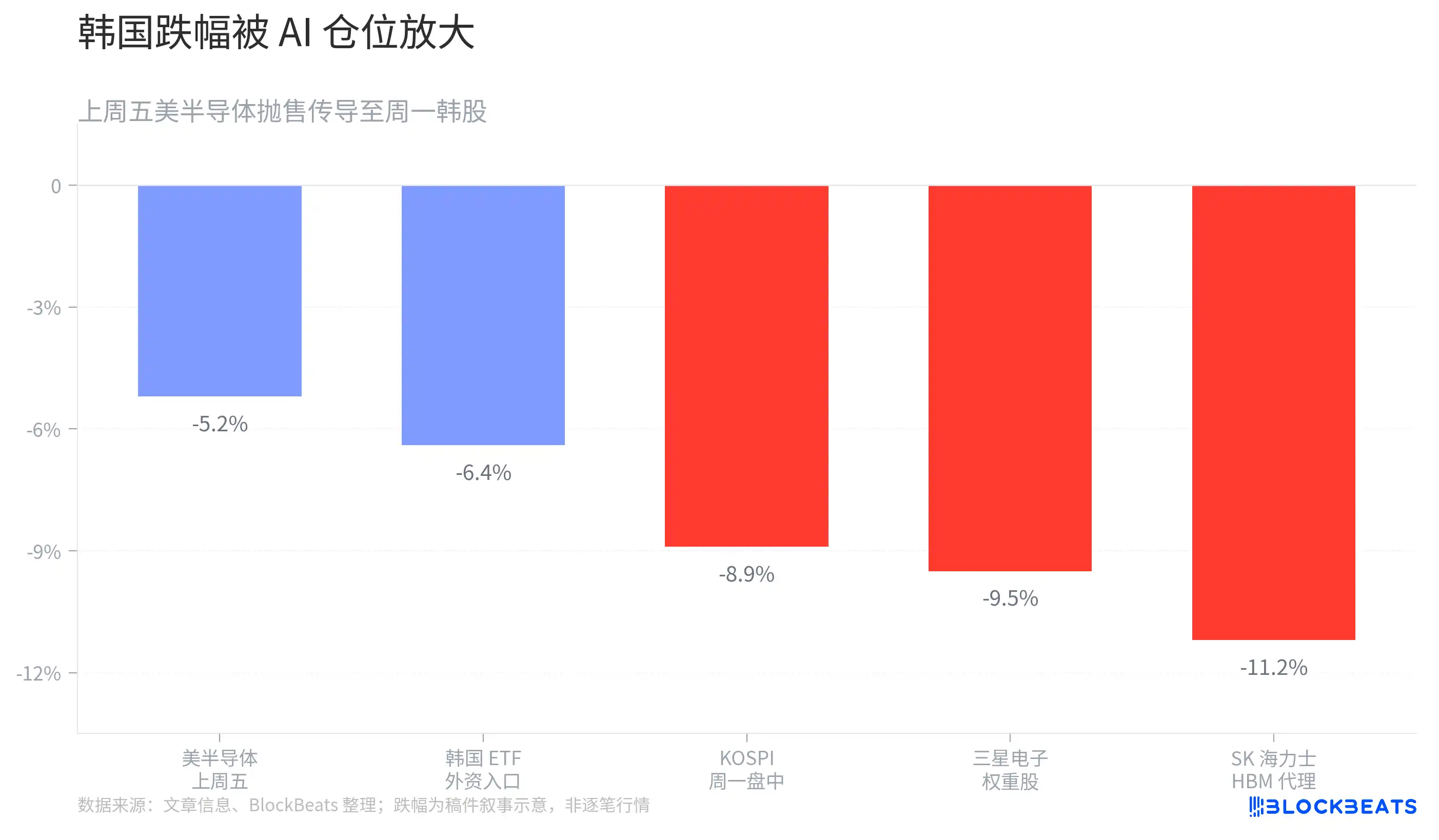
In a sense, South Korea is no longer just a national index, but more like a large AI memory ETF.

Jensen Huang's Visit to South Korea Presents a Stark Contrast to Market Panic

If market panic stems from valuations, then the biggest positive news over the weekend came from the supply chain itself.

The core objective of Jensen Huang's visit to South Korea was very clear: to further strengthen the cooperative relationship between NVIDIA and the Korean AI supply chain. The most notable development was the announcement of a new multi-year cooperation agreement between NVIDIA and SK Hynix. Over the past two years, HBM has become one of the most critical components in AI servers, and SK Hynix is one of the biggest beneficiaries of this trend.

This is also why the market highly anticipated this cooperation.

In recent months, as the scale of AI infrastructure construction continues to expand, the market began to worry about whether HBM demand growth would gradually peak. However, Jensen Huang's visit to South Korea at this time actually sends the opposite signal. If NVIDIA believed that AI data center construction was nearing its end, it wouldn't need to reinforce long-term cooperative relationships with suppliers at this point.
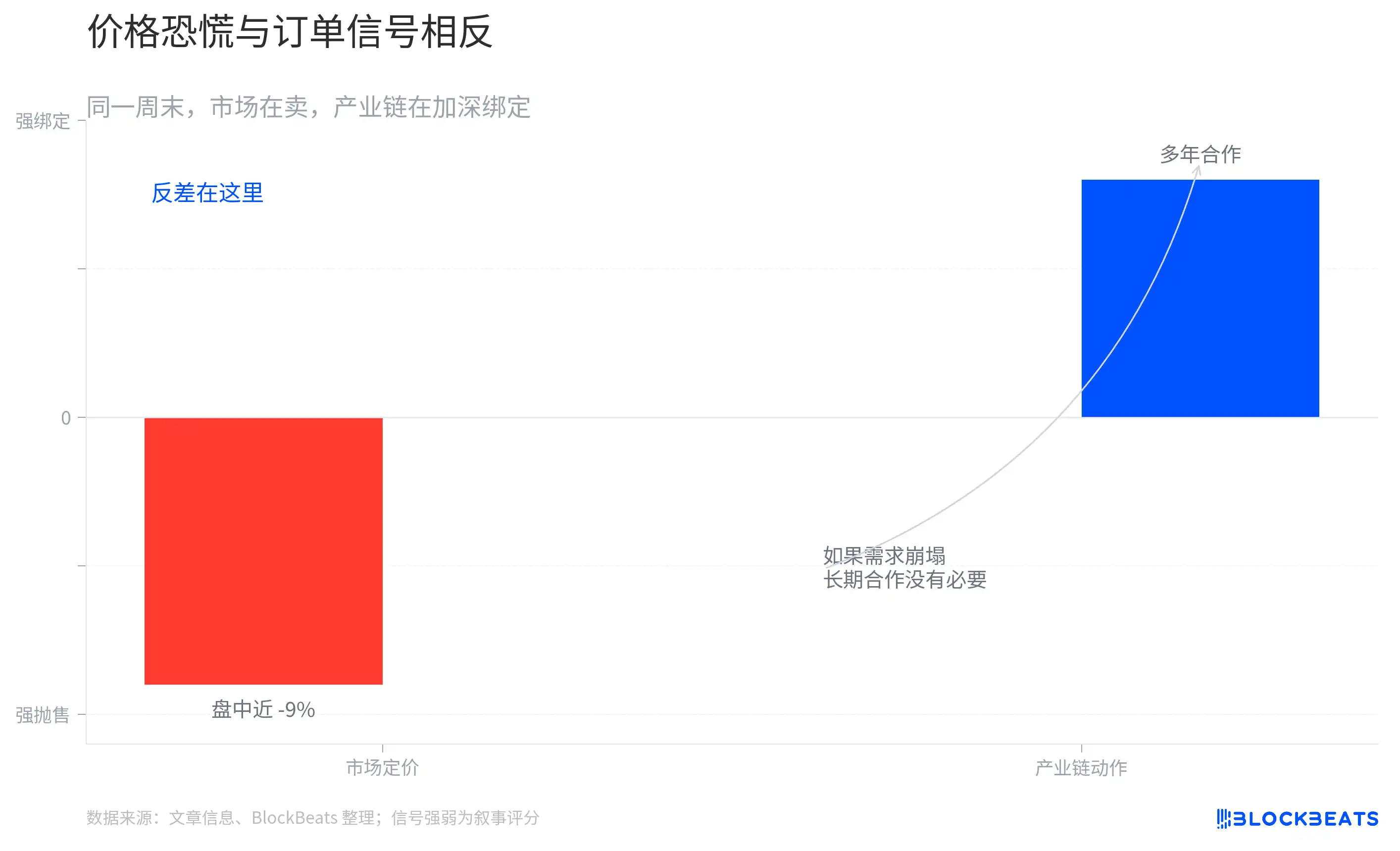
From a supply chain perspective, there is no evidence yet of a sudden disappearance of AI demand.

The most interesting part of the past two days lies right here. The capital market is using stock prices to express concerns about AI sector valuations, while the core enterprises in the supply chain are still discussing expansion and cooperation plans for the coming years. A significant temperature gap remains between the price signaled by the market and the signal released by the industry.

The AI Bull Market Begins Entering the Profit Pool Reassessment Stage

This is also the core of the current major divergence.

Over the past year, the market traded a very simple logic: AI demand growth. Therefore, NVIDIA rose, Micron rose, SK Hynix rose, Samsung Electronics rose—almost any company related to AI received a valuation boost.

But as the sector's gains continued to expand, the market has entered a second stage.

Investors are no longer satisfied with the story of 'AI will grow,' and have begun to ask another question: Who will ultimately capture the profits created by AI growth? In recent months, from the Rubin rack system memory adjustments, to the market reaction following Broadcom's earnings, to this Korean market crash, they all essentially reflect the same thing—the market is beginning to deconstruct the AI profit pool.

SK Hynix benefits from HBM, Samsung Electronics positions itself across HBM, DRAM, and advanced packaging, while Micron benefits more from the overall AI server memory upgrade. Although they all belong to the AI supply chain, their respective profit sources and pricing power are not the same.
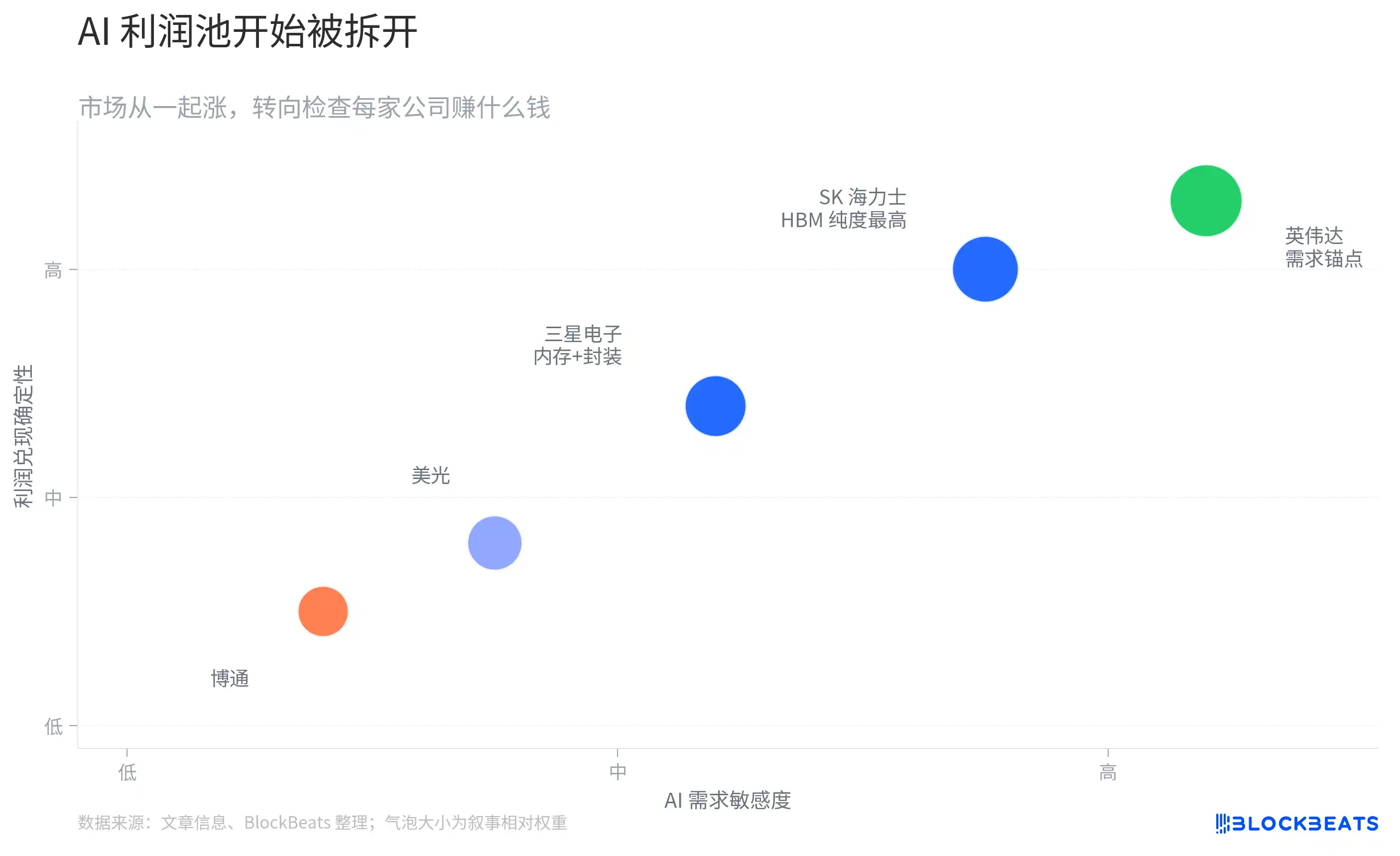
Previously, the market was willing to collectively expand valuations for the entire sector. Now, capital is beginning to examine, one by one, whether these profits can truly be realized.

This is also why a supply chain update, an earnings guidance, or even a capital expenditure adjustment can trigger significant volatility across the entire sector. The focus of market trading has shifted: rather than whether AI will continue to grow, investors are more concerned about whose financial statements the growth will ultimately land on.

What Decides South Korean Stocks is Not South Korea

In the coming weeks, what will truly determine the direction of the South Korean market remains NVIDIA's orders, HBM supply and demand, and capital expenditures from cloud service providers.
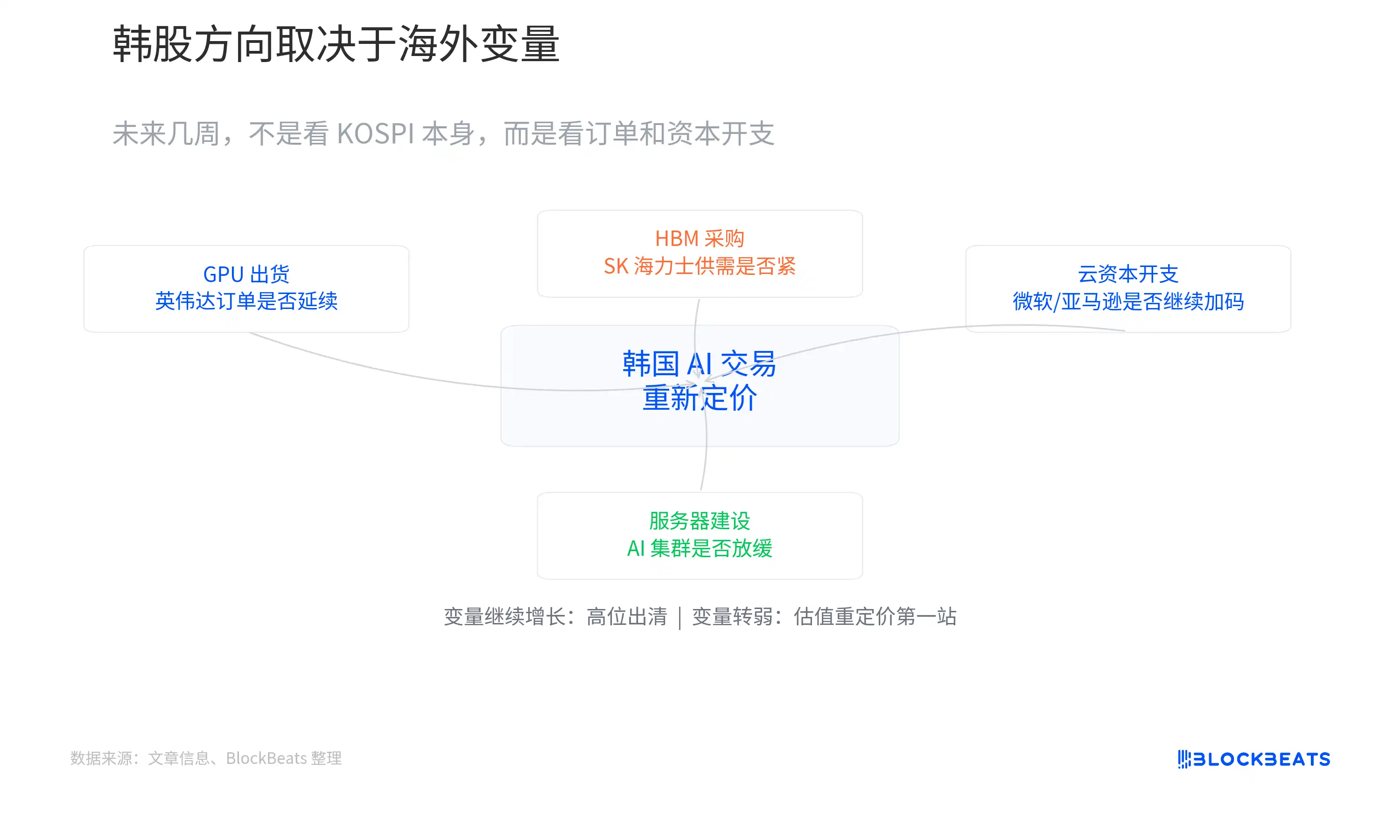
If this data begins to weaken, then this crash may be just the beginning of a larger-scale valuation adjustment.

But if data center construction, GPU shipments, and HBM procurement continue to maintain high growth, then Monday's circuit breaker looks more like a concentrated liquidation of a crowded trade.

At least from the current vantage point, the price signaled by the market and the signal released by the industry are not entirely aligned.

On one side, South Korea's AI leaders are facing the most severe selling pressure in years; on the other, Jensen Huang is in Seoul discussing the next generation of AI infrastructure with supply chain partners.

Whose judgment is closer to reality? Perhaps we will have an answer soon.

Связанные с этим вопросы

QAccording to the article, what event triggered the sharp decline in the South Korean stock market (KOSPI), and which two companies were most affected?

AThe sharp decline in the South Korean stock market was triggered by a significant sell-off in the U.S. semiconductor sector on the previous Friday. The two most affected companies were Samsung Electronics and SK Hynix, both of which are major players in the AI supply chain and carry high weightings in the Korean market index.

QDespite the market panic, what significant business activity did Jensen Huang's recent visit to Seoul indicate about the AI industry's future?

AJensen Huang's visit to Seoul involved strengthening partnerships with key South Korean AI suppliers. The highlight was the announcement of a new multi-year cooperation agreement between NVIDIA and SK Hynix to jointly develop next-generation memory products for AI data centers. This activity indicates that core players in the AI infrastructure chain remain committed to long-term collaboration and expansion, suggesting they believe AI demand is still in its early stages and not collapsing.

QHow does the article describe the current main focus of investors in the AI sector, shifting from the initial investment phase?

AThe article states that the market has entered a second stage where the main focus of investors has shifted. Initially, investors broadly valued any company related to AI growth. Now, they are scrutinizing the 'profit pool,' asking which specific companies will actually capture and realize the profits generated by AI growth, leading to a re-evaluation based on individual profit sources and pricing power rather than sector-wide optimism.

QWhat key factors does the article identify as ultimately determining the future direction of the South Korean stock market?

AThe article identifies that the future direction of the South Korean stock market will be determined by external, global factors related to AI infrastructure demand, not domestic Korean issues. The key factors are: NVIDIA's orders, the supply and demand dynamics for HBM (High Bandwidth Memory), and the capital expenditure plans of major cloud service providers.

QWhat contrasting views does the article present regarding the nature of the South Korean market crash?

AThe article presents two contrasting interpretations of the market crash. One view is that it signals an early peak in the AI cycle, reflecting a fundamental change in demand prospects. The other view is that it represents a typical 'high-leverage unwinding' or a concentrated sell-off in a crowded trade, driven more by valuation concerns and position adjustments than by a sudden disappearance of underlying AI demand.

Похожее

Michael Saylor's Latest Article: Bitcoin Must Find Balance Between Uniqueness and Universal Value

Michael Saylor outlines four key Bitcoin ideologies shaping its future: * **Bitcoin Maximalists** see Bitcoin as the dominant digital monetary network and a breakthrough in economic empowerment, emphasizing its superior property rights and role as a sound money solution. * **Bitcoin Capitalists** focus on integration, believing Bitcoin must embed into the global economy—through institutions, capital markets, and financial products—to reach its full potential as digital capital. * **Bitcoin Technologists** advocate for continuous protocol improvements in scalability, privacy, and security to adapt to evolving needs and threats, while acknowledging the high bar for change. * **Bitcoin Fundamentalists** guard Bitcoin's core principles of self-custody, decentralization, and censorship resistance, warning against dilution from institutions or risky modifications. Saylor argues that a healthy Bitcoin ecosystem requires a balance of these perspectives. Bitcoin's path forward involves disciplined expansion: preserving its immutable core (Fundamentalist insight), recognizing its dominant status (Maximalist view), integrating with the global economy (Capitalist drive), and enabling careful innovation, primarily in higher layers (Technologist role). The challenge is to maintain Bitcoin's unique properties while making it useful for the world, ensuring it remains Bitcoin as it grows.

Foresight News12 мин. назад

Michael Saylor's Latest Article: Bitcoin Must Find Balance Between Uniqueness and Universal Value

Foresight News12 мин. назад

Reddit Weekly Hot Stock Watch: RKLB/LUNR/ASTS Plunge Collectively, Is the Space Sector Still Worth Considering?

Reddit's stock communities witnessed a concentrated surge in discussion around space stocks last week, with SPCE, RKLB, LUNR, and ASTS leading the chatter. This often signals an underlying catalyst for investor attention. However, despite being grouped as "space plays," these companies have vastly different fundamentals and recent performances. While SPCE (Virgin Galactic) saw a 22% single-day surge—potentially fueled by short covering and fallout from Blue Origin's rocket test anomaly—the other three stocks declined sharply. RKLB dropped 15%, LUNR fell 13%, and ASTS was down 7%. This divergence highlights they are not a monolithic sector. The downturn for RKLB, LUNR, and ASTS stemmed from multiple headwinds converging: Blue Origin's New Glenn rocket explosion (directly impacting ASTS's launch plans), anticipation of SpaceX's massive IPO drawing funds away from these "alternative" public space stocks, and insider selling at RKLB after significant rallies. A closer look reveals key differences: RKLB stands out with substantial, growing revenue ($113.9M in Q1) and a $2.2B backlog, though its high valuation (~80x Forward P/S) prices in success for its upcoming Neutron rocket. LUNR's reported revenue growth is largely acquisition-driven, with its core moon landing business facing a crucial test with the upcoming IM-3 mission. ASTS has a large potential market in space-based cellular connectivity but faces significant execution risk, especially after the Blue Origin launch setback. SPCE, despite high discussion volume, has minimal revenue and its recent spike appears driven more by sentiment than fundamentals. The analysis suggests it's premature to call a "buying opportunity" for the sector broadly. RKLB is considered the most fundamentally sound but may be more attractive at a lower price point ($96-$102). For the others, investors are advised to wait for specific catalysts: LUNR's IM-3 mission outcome, clarity on ASTS's revised launch timeline, and for SPCE, to avoid the speculative frenzy. The long-term space thesis remains, but short-term valuations have run ahead of fundamentals for most names.

marsbit26 мин. назад

Reddit Weekly Hot Stock Watch: RKLB/LUNR/ASTS Plunge Collectively, Is the Space Sector Still Worth Considering?

marsbit26 мин. назад

Why Does Crypto Always Build 'Casinos', But Rarely Creates 'Indispensable Products'?

The article explores why cryptocurrency has primarily fostered speculation rather than essential, "sticky" consumer products. It introduces the concept of "sofalarity"—the point where a platform's convenience becomes so ingrained that leaving feels unthinkable. While Big Tech creates this lock-in through ecosystem control and data harvesting, crypto lacks equivalent everyday utility. Its appeal hinges on the variable rewards of price volatility, akin to gambling, which drives engagement but not dependency. The author argues crypto's core promise—fixing opaque backend systems like correspondent banking—solves problems most people never see or feel, failing to deliver a tangible "aha moment" of improved daily life. This need for explanation hinders mass adoption. Meanwhile, platforms like Google and Meta monetize vast behavioral data, a treasure trove crypto's transparent ledgers (recording only financial transactions) cannot match for predictive insight. The piece further questions whether crypto's potential lies in consumer super-apps or, more plausibly, in becoming enterprise-grade infrastructure—modern settlement rails. It concludes with a critical look at Real-World Asset (RWA) tokenization, suggesting it may merely digitize and accelerate corporate extraction (e.g., in housing or healthcare) rather than democratize access, as the technology itself is a neutral tool. True disruption, the author implies, requires building sovereign systems outside exploitative platforms.

marsbit27 мин. назад

Why Does Crypto Always Build 'Casinos', But Rarely Creates 'Indispensable Products'?

marsbit27 мин. назад

Торговля

Спот
Фьючерсы
活动图片