Anthropic: AI Has Not Led to an Increase in Unemployment Rate

marsbitОпубликовано 2026-08-24Обновлено 2026-08-24

Введение

Anthropic's Chief Economist, Peter McCrory, argues that despite significant growth in AI adoption, it has not yet led to increased unemployment in the US. Current data shows stable unemployment rates, even in occupations highly exposed to AI automation. His analysis, based on Anthropic's research over 18 months, suggests AI is currently a "skill-biased, labor-augmenting" technology. It enhances human capabilities rather than replacing workers because every job contains tasks—like interpersonal coordination or physical interaction—that AI cannot systematically perform. Furthermore, effective use of AI requires high user expertise, and human roles in planning and judgment remain crucial, even as agents handle more delegated tasks. McCrory acknowledges three future scenarios—software, economic, and Coasean singularities—where AI could recursively improve itself or drastically lower transaction costs, potentially disrupting labor markets and organizational structures. However, he posits that "weak links," the indispensable tasks resistant to automation, will act as a buffer, preventing a collapse in labor's share of income. He predicts US unemployment will not rise significantly due to AI within the next 12 months, with key indicators being unemployment in AI-exposed jobs and the return on human expertise in agent-based workflows.

AI has not taken anyone's job. At least not so far.

This conclusion comes from a lengthy article recently published by Peter McCrory, Head of Economic Research at Anthropic.
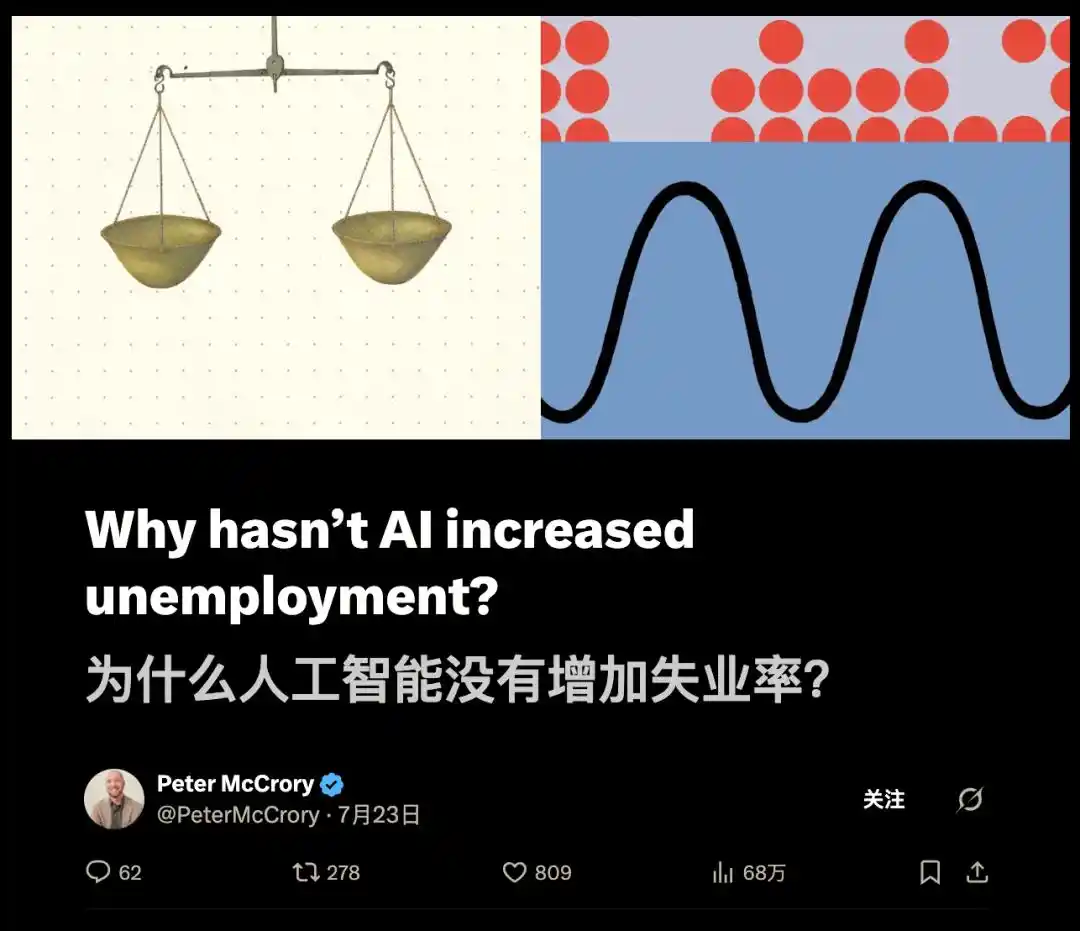
https://x.com/PeterMcCrory/article/2079979321607745905

Quality-adjusted AI output grew over 2000% in both 2024 and 2025, and about one-fifth of US businesses already use AI in their operations, yet the US unemployment rate in June remained at 4.2%, right at the full employment level.

McCrory's core judgment is: AI is currently still a "skill-biased, labor-augmenting" technology; it is amplifying human capabilities, not replacing humans.

He also gave this judgment an expiration date: 12 months.

Data Doesn't Lie: Even High AI-Exposure Jobs Are Fine

McCrory compiled a full chain of data to demonstrate how stable the US labor market is: unemployment rate at 4.2%, the job openings-to-unemployed ratio just above 1, employment-population ratio for ages 25-54 near multi-decade highs, and initial jobless claims running low for four consecutive years.

He believes that, overall, the US employment situation is stable and improving.

Aggregate data is just the starting point; cross-group comparisons reveal the real picture.

McCrory and his colleague Maxim Massenkoff previously conducted an analysis: they isolated jobs corresponding to tasks that Claude is heavily used to automate and examined whether their unemployment rates were deteriorating faster than other jobs.

The answer was no.

Updating with the latest Bureau of Labor Statistics data, the conclusion remains unchanged.

Job postings for software engineering positions have rebounded since May 2025, with growth rates even exceeding the average for other positions.

The only group worth noting is young workers.

McCrory acknowledges that it has indeed become harder for young people to find jobs in high AI-exposure positions, and a paper from Stanford's Digital Economy Lab provides similar evidence.

But he also points out an easily overlooked context: since 2022, the US has experienced the largest non-recessionary labor market cooling on record. The "low hiring, low layoffs" pattern naturally squeezes early-career individuals first.

Attributing this entirely to AI lacks sufficient evidence.

Why Jobs Haven't Been Taken: Every Job Has Parts AI Can't Handle

McCrory's explanation is built on the factual foundation of multiple Anthropic research reports from the past 18 months, with a logical chain as follows:

First-layer fact: Among all occupational classifications in the US Department of Labor's O*NET, there is not a single job where all associated tasks are systematically completed by Claude.

Every job has components that AI struggles with: interpersonal coordination, face-to-face interaction, and dealing with the physical world.

These components act like the short planks of a barrel, both limiting the extent to which AI can boost overall productivity and making people who can fill these gaps more valuable.

Second-layer fact: The stronger AI becomes, the higher the requirements for the people who operate it.

Anthropic's Economic Primitives report from January this year found that the more complex Claude's output, the higher the professional expertise of the user's input behind it.

When the model produces a complex economic model, it's often a professional user capable of giving precise instructions who is directing it.

https://www.anthropic.com/research/economic-index-primitives

The Learning Curves report in March showed that after six months of using Claude, users increasingly employed it as a thinking partner, with higher interaction success rates.

If AI were already strong enough to perform jobs independently, this learning effect shouldn't occur.

https://www.anthropic.com/research/economic-index-march-2026-report

Third-layer fact: Even in the era of Agents, human value remains solid.

Anthropic analyzed seven months of Claude Code usage data and found that task value continued to climb, but the return on human professional skills did not decline:

Users are responsible for planning and delegate implementation to Claude;

Users with stronger professional skills have higher task success rates and recover faster when Claude makes mistakes.

The premium for pure programming implementation might be shrinking, but the value of planning, judgment, and error correction is rising instead.

An interesting piece of supporting evidence comes from users' own perceptions.

In Anthropic's June Economic Index survey, over one-third of respondents expected AI to be able to do most of their job within 12 months, but the proportion expecting to become unemployed as a result was significantly lower.

Users with higher levels of AI automation were even more optimistic about their salaries and job security.

https://www.anthropic.com/research/economic-index-june-2026-report

Three Types of "Singularities" and One Line of Defense

McCrory's assessment of the present is optimistic, but he does not avoid discussing three possible future scenarios that could disrupt the current landscape.

They are referred to in academic literature and industry discussions as the Software Singularity, the Economic Singularity, and the Coasean Singularity.

https://x.com/MTSlive/status/2090610614154764509

The Software Singularity refers to the automation of innovation itself by AI.

>

No matter how powerful past general-purpose technologies were, an internal combustion engine couldn't invent new modes of transportation.

But AI is directly endowed with general cognitive abilities, theoretically capable of accelerating its own iteration in return.

McCrory's article explicitly discusses this scenario: if recursive self-improvement (RSI) becomes a reality, the improvement of AI capabilities will break free from the pace of human control.

The Economic Singularity is the economic consequence of the Software Singularity.

McCrory cites a 2017 model by Aghion, Jones, and Jones, pointing out that if the innovation process itself is automated, standard economic models predict "infinite growth in finite time."

This conclusion sounds like science fiction, but it is the result of rigorous mathematical deduction.

The Coasean Singularity targets another dimension.

An NBER paper from 2025 (co-authored by Shahidi, Rusak, Manning, et al.) proposed that when Agents reduce transaction costs like search, negotiation, contracting, and supervision to near zero, Ronald Coase's classic 1937 question is reactivated—once the cost of market coordination disappears, the very reason for a firm's existence is called into question.
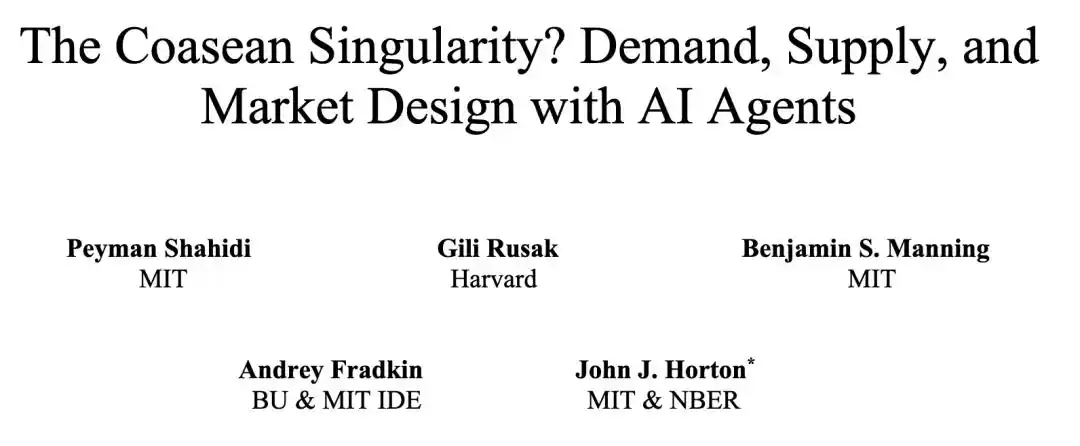
https://www.nber.org/system/files/chapters/c15309/c15309.pdf

The Agent scenario discussed by McCrory naturally dialogues with this framework: if Agents not only change production methods but also organizational forms, the impact on the labor market will be far more complex than simply "who lost their job."

Faced with the three singularities, McCrory offers the same line of defense: the "weak link."

This concept comes from the paper by Aghion, Jones, and Jones—the ceiling of economic growth is not determined by the best-performing links, but by those indispensable links that are difficult to improve.
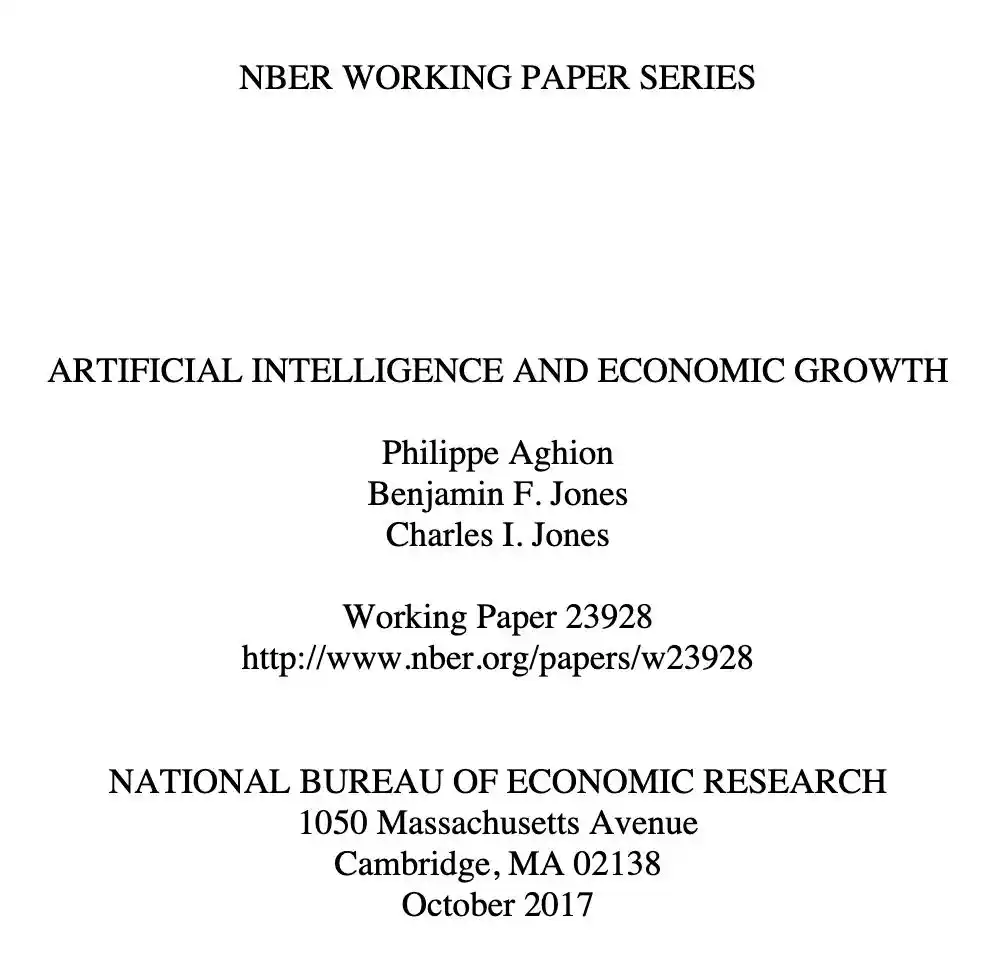
https://www.nber.org/system/files/working_papers/w23928/w23928.pdf

As long as there exist critical tasks that consistently cannot be automated, whether due to technical bottlenecks or social constraints, the labor income share will not collapse, and corporate forms will not completely dissolve.

The current state of coding Agents is already validating this logic.

Data cited by McCrory shows that after introducing coding Agents, lines of code increased by 10 to 20 times, but the number of software releases only increased by 30%, with no growth in the actual usage of applications.

Coding is just one part of software production; links like testing, architectural design, and product judgment are still in human hands—they are the current "weak links."

McCrory gives a clear prediction: One year from now, the US unemployment rate will not have risen significantly due to AI.

This judgment is valid for 12 months, and the signals for verification are clear—observe whether the unemployment rate for high AI-exposure positions begins to diverge from other positions, and whether the return on human professional skills in Agent scenarios begins to decline.

The day both indicators turn simultaneously is the day the analytical framework he built himself will also need to be revised.

References:

https://x.com/PeterMcCrory/article/2079979321607745905

https://x.com/MTSlive/status/2091252532689658001

This article is from the WeChat public account "新智元" (New Zhiyuan), author: ASI启示录 (ASI Apocalypse), editor: 马可 (Ma Ke)


Связанные с этим вопросы

QAccording to the article, what is Anthropic's economic research director Peter McCrory's main conclusion about AI's impact on employment so far?

AHis core conclusion is that AI currently remains a 'skill-biased, labor-augmenting' technology. It is amplifying human capabilities rather than replacing people.

QWhat key data point does McCrory use to argue that the U.S. job market remains stable despite widespread AI adoption?

AHe points out that the U.S. unemployment rate in June was 4.2%, which is exactly at the full employment level, and that even for high-AI-exposure occupations, the unemployment rate has not deteriorated faster than other jobs.

QWhat are the 'weak links' that McCrory identifies as a key reason why AI has not yet caused widespread job loss?

AThe 'weak links' are tasks within every job that AI cannot handle systematically. These include interpersonal coordination, face-to-face interaction, and tasks involving interaction with the physical world. They limit AI's overall productivity gains and make people who can handle these tasks more valuable.

QWhat are the three potential 'singularity' scenarios McCrory discusses that could disrupt the current optimistic view of AI and employment?

AThe three scenarios are: 1) Software Singularity (AI automating the process of innovation itself), 2) Economic Singularity (the economic consequence of software singularity, potentially leading to 'infinite growth in finite time'), and 3) Coasian Singularity (AI agents reducing transaction costs so much that the rationale for firms is undermined).

QWhat is the timeframe Peter McCrory gives for the validity of his judgment that AI will not significantly increase U.S. unemployment?

AHe gives his judgment an 'expiration date' of 12 months. He predicts that one year later, the U.S. unemployment rate will not have risen significantly due to AI.

Похожее

Ethereum обогнал по росту биткоин и обновил максимум с января

Эфириум (ETH) обогнал биткоин (BTC) по темпам роста, прибавив почти 3% за сутки и около 30% за неделю. Цена ETH достигла $2,54 тыс., обновив максимум за семь месяцев. Биткоин также продолжил рост, подорожав за сутки на 1,5% и за неделю на 22%, торгуясь около $77,3 тыс. Курс ETH к BTC поднялся до уровня конца января и составляет около 0,032 BTC за 1 ETH. Доходность Эфириума в третьем квартале превысила 55%, напоминая сильный рост в аналогичный период 2025 года. Standard Chartered прогнозирует достижение ценой ETH отметки $4 тыс. в этом году и $40 тыс. к концу десятилетия, связывая это с центральной ролью блокчейна Ethereum в развивающемся рынке DeFi. Сооснователь Ethereum Виталик Бутерин отметил вклад биткоин-сообщества в разработку технологий, которые потенциально могут быть использованы для масштабирования Эфириума.

cryptonews.ru10 мин. назад

Ethereum обогнал по росту биткоин и обновил максимум с января

cryptonews.ru10 мин. назад

Поступления в биткоин-ETF достигли $1,9 млрд за самую сильную неделю с октября 2025 года

По данным SoSoValue, приток средств в американские биткоин-ETF на спотовом рынке на прошлой неделе достиг 1,92 млрд долларов, что стало лучшим недельным показателем с октября 2025 года. Аналитик Нейт Герачи отметил, что спотовые ETF на эфир также привлекли около 700 млн долларов. Этот всплеск интереса совпал с ростом биткоина более чем на 20% за неделю, когда цена ненадолго превысила 79 000 долларов. Несмотря на недавний рост, с начала 2026 года чистый отток из биткоин-ETF в США составил около 2,91 млрд долларов. Самые значительные ежемесячные оттоки были зафиксированы в июне (4,51 млрд долларов), однако август, с притоком в 2,38 млрд долларов по состоянию на пятницу, стал лучшим месяцем по притоку средств в этом году. Фонд iShares Bitcoin Trust (IBIT) от BlackRock был главным драйвером прошлой недели, привлекшим около 1,33 млрд долларов за пять торговых дней подряд. Аналитик Bloomberg Эрик Балчунас охарактеризовал график ежедневных потоков IBIT как классический бычий сигнал — «паттерн Flipping the Bird». Отмечается, что предыдущий крупный приток в октябре 2025 года (3,42 млрд долларов) предшествовал обвалу рынка 10 октября, в результате которого было ликвидировано примерно 19 млрд долларов в leveraged-позициях. С тех пор цена биткоина упала примерно на 38% с отметок около 124 700 долларов.

cointelegraph12 мин. назад

Поступления в биткоин-ETF достигли $1,9 млрд за самую сильную неделю с октября 2025 года

cointelegraph12 мин. назад

Артур Хейс в десятитысячном интервью: ETH достигнет 30 000 долларов; FLOP превзойдет ETH

Артур Хейз, сооснователь BitMEX, в интервью обсуждает макроэкономические факторы, влияющие на крипторынок. Он связывает недавний рост рынка с увеличением ликвидности из-за действий Министерства финансов США по выкупу гособлигаций, что, по его мнению, повторяет сценарий 2008 года, ведущий к росту ценности биткоина. Хейз предсказывает, что BTC достигнет $126 000 к концу года, а ETH может подняться до $20 000–30 000, учитывая его отставание в текущем цикле. Также он критикует американский «Закон о ясности» (Clarity Act) как несущественный для реального развития криптоиндустрии. Основное внимание в беседе уделяется его новому проекту — Flop Network. Это блокчейн, предназначенный для экономики AI-агентов, где нативная монета FLOP напрямую привязана к вычислительной мощности (FLOPS — операции с плавающей запятой в секунду). Хейз анонсирует масштабный аирдроп 20% от 10-летнего предложения токенов для тестирования сети, подчёркивая отсутствие предпродаж и венчурного финансирования. Он верит, что если Flop Network станет стандартной валютой для AI-агентов, его капитализация сможет соперничать с биткоином.

Odaily星球日报13 мин. назад

Артур Хейс в десятитысячном интервью: ETH достигнет 30 000 долларов; FLOP превзойдет ETH

Odaily星球日报13 мин. назад

Отчет Goldman Sachs: Доходность акционеров Samsung Electronics ниже ожиданий, расширение FCF поддерживает восстановление стоимости

Аналитики Goldman Sachs в отчете от 23 августа отмечают, что программа вознаграждения акционеров Samsung Electronics, объявленная на 2026 год в диапазоне 90-110 трлн вон, оказалась ниже краткосрочных рыночных ожиданий (около 150 трлн вон). Однако ключевым драйвером восстановления оценки компании аналитики считают не разовый масштаб выплат, а устойчивое расширение свободного денежного потока (FCF) и стабильный механизм его возврата акционерам. Samsung не объявил о единовременных крупных выплатах, как, например, SK Hynix, но представил четкий поэтапный план. По расчетам Goldman Sachs, совокупный FCF компании за 2024-2026 гг. составит около 270 трлн вон, а общий объем возврата акционерам при 50% норме распределения — примерно 135 трлн вон. Выплаты в 2026 году, согласно прогнозам, достигнут около 106 трлн вон, причем в их структуре будет преобладать дивидендная составляющая. Аналитики ожидают значительного роста FCF в 2027-2028 гг., что позволит увеличить пул средств для акционеров до 179 трлн и 232 трлн вон соответственно, даже при сохранении текущей политики распределения 50% FCF. Это может приблизить или даже превысить уровень выплат конкурентов. Goldman Sachs сохраняет рекомендацию «Покупать» по обыкновенным акциям Samsung с целевой ценой 49 000 вон, что подразумевает потенциал роста в 74%. Текущая оценка выглядит привлекательной: коэффициент P/B на 2027 и 2028 годы прогнозируется на уровне 1,7x и 1,2x при рентабельности собственного капитала (ROE) 40-50%. Ключевыми рисками являются ухудшение ситуации на рынке памяти, снижение маржинальности смартфонов и потеря доли рынка OLED-панелей. Таким образом, история вознаграждения акционеров Samsung рассматривается аналитиками как структурное улучшение, основанное на устойчивом росте денежного потока, а не как разовое событие.

marsbit22 мин. назад

Отчет Goldman Sachs: Доходность акционеров Samsung Electronics ниже ожиданий, расширение FCF поддерживает восстановление стоимости

marsbit22 мин. назад

Торговля

Спот
活动图片