Last Week in Crypto: Best Crypto to Buy Based on the Current Trends

bitcoinistОпубликовано 2025-03-24Обновлено 2025-03-24

Введение

Stuck under a rock last week? Crypto never sleeps. But if you did, here’s what happened, and which tokens are...

Trusted Editorial content, reviewed by leading industry experts and seasoned editors. Ad Disclosure

Stuck under a rock last week?

Crypto never sleeps. But if you did, here’s what happened, and which tokens are the best crypto to buy given market trends:

With $XRP, $TON, and of course $BTC all making big moves, the best altcoins and memecoins are starting to shift into position for major gains. Established cryptos like $XRP and $BTC look increasingly promising.

And with major financial players like Ark Invest embracing tokenization, crypto adoption gains steam.

The hype is growing, so let’s get you caught up on three of the best crypto to buy now.

1. BTC Bull ($BTCBULL) – Stack the First-Ever Bitcoin Memecoin for Double Wins

BTC Bull Token ($BTCBULL) adds yet another way to win with Bitcoin.

A meme coin, it’s true that BTC Bull offers limited utility on its own. Of course, there’s an attractive 105% staking reward, and the potential – always there, with memecoins – for a wild 100x run.

But BTC Bull really shines when you put it together with Bitcoin for a powerhouse combo.

Every time Bitcoin passes a key price threshold – like $150K – $BTCBULL token holders receive a $BTC airdrop. The only requirement is to hold $BTCBULL tokens in the Best Wallet app. You can purchase them directly through Best Wallet – learn more in our guide on how to buy BTC Bull.
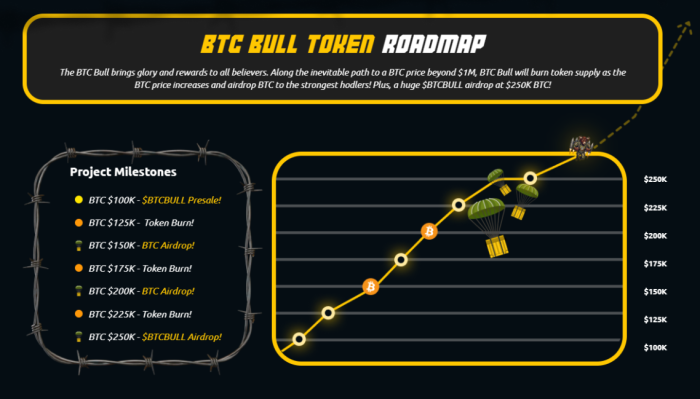
BTC Bull Token Roadmap

There are two $BTC airdrops planned, one at $150K and another at $200K, and then a massive $BTCBULL airdrop when $BTC finally hits $250K.

And in between, at BTC $125K, $175K, and $225K, there are major $BTCBULL token burns to keep deflationary pressure on the token price.

The unique tokenomics of the project tie $BTCBULL and $BTC together, opening the door for a potential major double-win. Bitcoin maximalists hyped up about a potential bull run in 2025 could send $BTC’s price to the moon.

And when $BTC’s price rises, investors will be drawn to $BTCBULL as an easy way to increase their gains, a bullish sign for any $BTCBULL price prediction.

In the US, more states are beginning to look at their own $BTC reserves, as the US government itself continues to plan a central one.

It’s all adding up to increased demand for Bitcoin, the world’s most successful crypto with a 230% AAR.

BTC Bull nears $4M in its ongoing presale, with tokens currently priced at $0.002425 (and expected to go up by 244% by the end of 2026).

2. Toncoin ($TON) – The Return of Telegram’s Token?

Toncoin has an interesting history. Originally the native token of Telegram, $TON (for The Open Network) still integrates naturally with the social media platform. The Open Network’s recent highlights include:

  • 3M-5M monthly active wallets
  • $500M-$700M monthly trading volume
  • $1.4B in $USDT issued on TON in 10 months, the fastest growing stablecoin on any blockchain
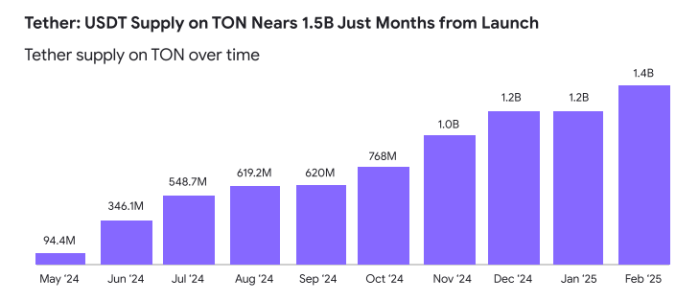
Tether USDT supply on TON

Pavel Durov, Telegram’s co-founder, was detained in France and his movement restricted as investigators looked into alleged illegal activities on the social media platform.

His release bodes well for the eventual resolution of the case, and vindicates TON’s approach of supporting Durov throughout the investigation.

The news gave $TON an instant shot in the arm. While the crypto is still down 25% for the year, it gained 8.3% in the past week.

And with $USDT pouring into the blockchain, Toncoin looks poised for big gains in 2025.

3. MIND of Pepe ($MIND) – AI Powered Tokens for Advanced Market Alpha and 298% Staking Rewards

Take your average memecoin and hitch it to the full power of an AI agent – then ride the hype to glory and gains.

That’s the idea behind MIND of Pepe ($MIND), and the project has the potential to pull it off.

AI agent tokens haven’t yet gone mainstream, but they still form a $4B market cap by themselves. That indicates significant early interest in the sector, and in the benefits that could come from true AI analysis of the crypto market.

$MIND token holders can stake their holdings in the current presale. Doing so will earn up to 298% APY with tokens disbursed over three years. That provides short and long-term returns while the project develops the MIND agent.
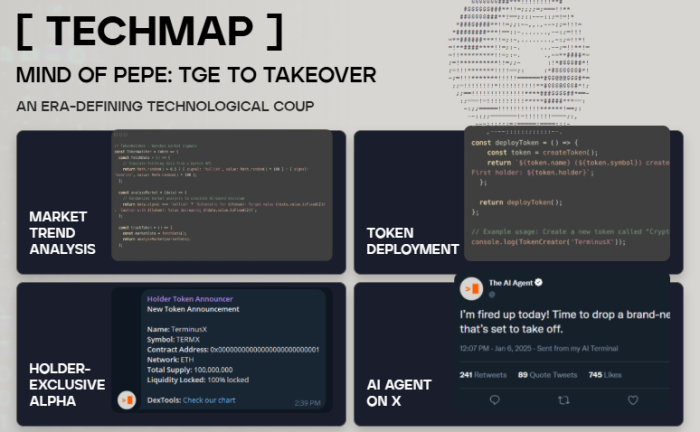
Mind of Pepe TGE to Takeover

The techmap calls for the MIND launch on X, with alpha and analysis generated by the agent available exclusively to $MIND token holders.

MIND of Pepe will eventually be able to launch its own tokens on Telegram and will control the full 25% of $MIND tokens that are reserved for the agent.

What’s more, it could unleash the potential of a meme coin that can read the market and launch other meme coins, all without direct human interference.

That untapped potential has fueled investor excitement to the tune of $7.5M raised in the presale, positioning it to be possibly the next crypto to explode. $MIND tokens currently cost $0.0035803.

Read our $MIND price prediction and learn how to buy MIND of Pepe. Don’t miss out on your chance to own a piece of memecoin history.

News Flash: $BTCBULL and $MIND Among Best Crypto to Buy

Crypto news presented a slightly mixed bag last week, but a number of positive headlines look promising for the rest of 2025.

You can’t keep crypto down forever; even $TRUMP is pumping.

And with big names like $BTC and $XRP making waves, $BTCBULL and $MIND join the ranks of some of the best crypto to buy as the year progresses.

Always, always do your own research. This isn’t financial advice – we’re just here to highlight what’s happened and where the market might be heading.

Editorial Process for bitcoinist is centered on delivering thoroughly researched, accurate, and unbiased content. We uphold strict sourcing standards, and each page undergoes diligent review by our team of top technology experts and seasoned editors. This process ensures the integrity, relevance, and value of our content for our readers.

Bitcoinist is the ultimate news and review site for the crypto currency community!

Похожее

Bitroot Public Chain Invited to Attend Tencent Cloud Singapore AI Conference, Discussing the Future Alongside Solana

On May 19, Bitroot, an emerging Layer 1 blockchain, participated in the Tencent Cloud AI Summit in Singapore alongside key industry players like Solana Foundation. The event explored the intersection of AI infrastructure, enterprise applications, AI Agents, and Web3. Bitroot's invitation, despite being pre-mainnet, highlights industry interest in its focus on high-performance, AI-native architecture tailored for future AI Agent execution and verifiable on-chain automation. Bitroot CEO Juan Jose emphasized that AI competition is shifting from model performance to data, real-world application scenarios, and trust infrastructure. He argued that for AI Agents to evolve from assistants to autonomous executors managing transactions and assets, they require low-latency, low-cost, and high-throughput blockchain environments. Bitroot aims to address this through its EVM-compatible design, optimistic parallel execution, and a consensus mechanism targeting high scalability. Currently in its Testnet 5.0 phase, Bitroot reports metrics like over 50,000 peak TPS and sub-0.3 second average block time. Its narrative positions it within a growing landscape where next-generation Layer 1s like Monad and Aptos also compete on performance, while Bitroot differentiates by integrating AI computational capabilities natively across its stack. The summit underscored that the fusion of AI and Web3 is moving from concept to infrastructure competition, where networks balancing performance, security, and verifiability will be crucial for enabling scalable AI-driven applications.

marsbit53 мин. назад

Bitroot Public Chain Invited to Attend Tencent Cloud Singapore AI Conference, Discussing the Future Alongside Solana

marsbit53 мин. назад

Hedge Fund Q1 Interpretation: Everyone Is Selling Software, Buying Chips

Hedge Funds and Mutual Funds Aligned in Q1: Dumping Software, Buying Chips A clear consensus emerged among major U.S. hedge funds and mutual funds in Q1: they were simultaneously selling software stocks and pouring capital into the semiconductor sector. This aggressive rotation pushed semiconductor exposure in hedge fund long portfolios to a record high. Hedge funds delivered a 7% return year-to-date, while only 30% of large-cap active mutual funds outperformed their benchmarks. The average short interest for S&P 500 constituents rose to 3% of market cap, the highest since 2011. Within technology, the structural shift was stark. Hedge funds' semiconductor weighting hit an all-time high, while software fell to its lowest since 2019. Excluding Microsoft, mutual funds' relative overexposure to semis vs. software was the largest since 2012. Microsoft was among the most net-sold stocks by both groups. Hedge funds net purchased semiconductor names like LRCX and AMAT. Strategies diverged on leverage and cash. Hedge funds increased their net exposure to near a one-year high after an initial cut. Mutual funds raised their cash allocation, though it remains historically low at 1.4%. Sector alignment was high in Industrials (both overweight) but divergent in Tech: hedge funds increased their Tech net tilt by a record 853 basis points, while mutual funds reduced theirs. Clear splits also appeared in Financials and Consumer Discretionary. Four stocks appeared on both Goldman's hedge fund VIP and mutual fund overweight lists: BA, MA, MRVL, and V. This "shared favorites" basket has returned 10% YTD, outperforming the equal-weight S&P 500. Notably, all "Magnificent Seven" stocks are on the hedge fund VIP list but are uniformly underweighted by mutual funds.

marsbit1 ч. назад

Hedge Fund Q1 Interpretation: Everyone Is Selling Software, Buying Chips

marsbit1 ч. назад

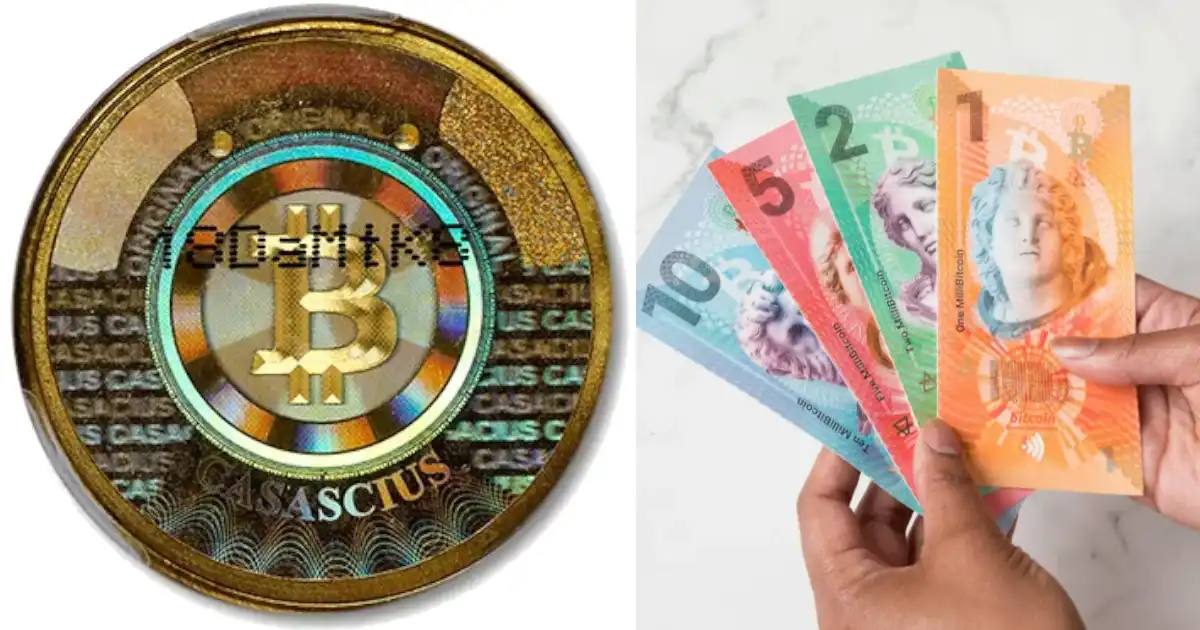
The Evolution Path of Physical Bitcoin

The Evolution of Physical Bitcoin Bitcoin's digital nature is its core strength, enabling self-custody and rapid global transfers. However, its intangibility also hinders mainstream adoption. For over a decade, creators have attempted to materialize Bitcoin while preserving its cash-like properties, yielding notable results. Casascius Coins, launched in 2011, were the first and most iconic physical Bitcoin. Creator Mike Caldwell generated private keys offline, printed them on coins, and sealed them with tamper-evident holograms. This model relied on user trust in the centralized issuer. Production ceased in 2013 due to regulatory pressure from FinCEN. RavenBit Coins emerged in 2014 aiming to decentralize minting by letting users generate and apply their own keys. However, this led to trust issues with numerous untrusted minters and insecure key generation methods. In 2016, Coinkite introduced Opendimes—a breakthrough in bearer asset technology. These USB-shaped devices generate and store keys internally. Funds can be received by checking the public key, but spending requires physically breaking the device to extract the private key. While innovative and open-source, its cost (~$20) and form factor limit its use for small, everyday transactions. Satochip's Satodime, a card-shaped device using similar secure chip technology, followed. It supports NFC interaction and comes in various forms. While potentially cheaper in bulk (~13€), it remains a high-security hardware wallet, not a low-cost cash substitute. A fundamental cost barrier exists. For physical Bitcoin to achieve widespread commercial use, hardware costs must drop below $1 to match the production cost of fiat banknotes. Current secure chips capable of running Bitcoin's cryptographic algorithms (like secp256k1) are too expensive. Chips like NXP's NTAG X DNA (~$3) show cost-reduction potential but lack native Bitcoin curve support. Projects like OfflineCash embed chips in banknote-like paper, but face challenges with durability, the need for custom Bitcoin-enabled chips, and the inherent requirement for users to verify balances online—which conflicts with Bitcoin's trustless ideal. Coinkite's Tapsigner, a ~$20 card with a proprietary Bitcoin NFC chip, is seen as a more practical step forward. It functions as a reloadable hardware wallet for contactless payments, solving the "change" problem and focusing on real-world retail integration, a direction also pursued by companies like Cash App and Square. In summary, the journey to physical Bitcoin has progressed from trusted centralized mints (Casascius) to user-generated keys (RavenBit) and finally to self-contained secure hardware (Opendimes, Satodime, Tapsigner). The core challenge remains developing a sufficiently low-cost, durable, and truly trustless physical bearer asset that can function like cash in daily transactions. Current solutions are either too expensive or introduce new trust assumptions, keeping the ideal of ubiquitous physical Bitcoin just out of reach for now.

marsbit1 ч. назад

The Evolution Path of Physical Bitcoin

marsbit1 ч. назад

Торговля

Спот
Фьючерсы
活动图片