Klarna Explores Crypto to Keep Up with PayPal, But Neither Offer the Best Crypto Wallet

bitcoinistОпубликовано 2025-02-11Обновлено 2025-02-11

Введение

Swedish payment giant Klarna plans to integrate crypto. The ‘last fintech in the world to embrace it,’ according to Klarna...

Swedish payment giant Klarna plans to integrate crypto. The ‘last fintech in the world to embrace it,’ according to Klarna CEO Sebastian Siemiatkowski.

While Siemiatkowski expected his post to ‘get a huge sign and two views,’ the community found it big news.

Why did Klarna delay this moment for so long, and what crypto services could it offer?

Let’s zoom in.

Buy Now, Pay Later… in Crypto? Klarna Explores Crypto Services

If the name ‘Klarna’ doesn’t ring the bell, how about ‘shop now, pay later’?

Klarna payments

Klarnas’s flexible payment system attracted over 85M users and 575K retailers globally.

But while competitors like Revolut and PayPal were actively exploring crypto (PayPal even launched its own stablecoin), Siemiatkowski considered Bitcoin a ‘decentralized Ponzi scheme.’

He also pointed out that crypto gas fees are sometimes worth more than the transaction – and while it’s true for Ethereum, Siemiatkowski evidently ignored all low-cost networks like XRP and Sui.

In Siemiatkowski’s defense, he admitted he had no idea how blockchain and mining work in 2021.

However, a lot can change in four years, and Klarna now wants to enter the crypto scene.

Siemiatkowski didn’t share any details, so we can only guess whether Klarna will enable flexible crypto payments or offer an entirely different service.

The entrepreneur also encouraged his followers to share their ideas. Some that received the most engagement were to:

  • Process transactions through Hedera Hashgraph, Solana, or XRPL
  • Settle transactions in stablecoins
  • Issue cashback in $BTC
  • Buy crypto and pay later (we wish)

We’ve yet to see if Klarna adopts any of these suggestions.

Beyond Basics: Why Best Wallet Outshines Traditional Fintech Apps

Fintechs like PayPal and Revolut may offer crypto services, but they mostly appeal to those only dipping their toes into digital assets.

For example, you can trade crypto with Revolut, but you can’t stake, buy new presale tokens, or store NFTs. It’s like a watered-down version of an advanced crypto trading platform, such as Best Wallet.

Best Wallet is, first and foremost, a secure storage solution. But beyond HODLing your assets and managing multiple wallets, it lets you swap, stake, track, and compare tokens across multiple chains.

On top of that, Best Wallet is the first and only app that lets you directly invest in hot presales. There’s no need to search for fresh tokens manually – Best Wallet presents a wide range of strictly vetoed projects in one user-friendly interface.
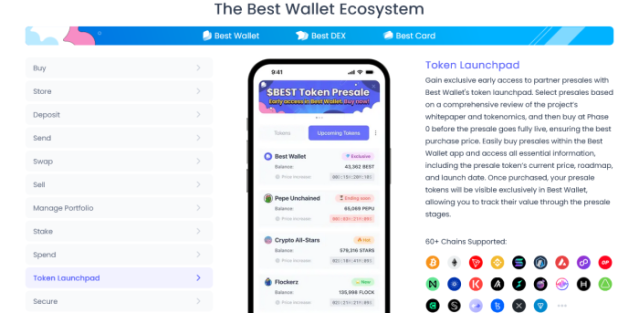
Best Wallet presale

The ecosystem’s native token, $BEST, now costs $0.02395 on presale. Its holders enjoy lower trading fees, higher stalking yields, and governance rights.

Just one day remains until the next price uptick, so this is the last chance to secure your share of tokens at such a discount.

Adapt or Fall Behind? The Fintech Industry’s Reality Check

Klarna’s pivot proves that no fintech can ignore the growing demand for crypto. Even the most stubborn heads are forced to adapt to changing consumer needs and adopt blockchain technology.

However, traditional fintechs have a hard time competing with crypto-first platforms like Best Wallet, which offer specialized features like crypto presale aggregator and staking. This unique functionality may help Best Wallet achieve its goal of capturing 40% of the market by 2026.

Meanwhile, we remind you to DYOR before participating in any crypto project. The market is extremely volatile, and no gains are guaranteed.

Bitcoinist

Bitcoinist

Bitcoinist is the ultimate news and review site for the crypto currency community!

Похожее

Morning Post | Michael Saylor Says This Week's Buy Was Bonds, Not Bitcoin; StablR Suffers Attack Losing Approximately $2.8 Million; US Congress Reintroduces Bitcoin Reserve Bill

This cryptocurrency industry digest covers key developments from May 25. MicroStrategy's Michael Saylor clarified the company purchased bonds, not Bitcoin, this week. In regulatory news, the US Congress reintroduced a Bitcoin reserve bill, with Republican backing aiming to accumulate 5% of global supply. The legal and audit firms for the collapsed FTX agreed to a $66 million settlement over fraud allegations. Several CFTC officials skeptical of prediction market oversight were reportedly suspended and forced out. On the security front, the StablR stablecoin was attacked and de-pegged, resulting in an estimated $2.8 million loss for the attacker. The Ethereum Foundation faced criticism, though a researcher defended its core protocol-building mission over influencing ETH's price. Market data from GMGN showed the top 24-hour trending meme tokens on ETH were HEX, SHIB, LINK, PEPE, and mUSD. On Solana, leaders were TROLL, neet, WORLDCUP, HANTA, and Buttcoin. Base chain's top tokens included TOSHI, KEYCAT, BRETT, CLANKER, and LUNA. Featured articles included an a16z analysis arguing tokenization, or real-world assets (RWA), is fundamentally transforming asset nature and financial systems, with the market growing tenfold to ~$34 billion in two years. Another piece deconstructed Hyperliquid's success through a five-layer financial stack framework, emphasizing the critical importance of building from a robust settlement layer upward.

链捕手1 ч. назад

Morning Post | Michael Saylor Says This Week's Buy Was Bonds, Not Bitcoin; StablR Suffers Attack Losing Approximately $2.8 Million; US Congress Reintroduces Bitcoin Reserve Bill

链捕手1 ч. назад

SuperEx's Mars Exploration Dream: Digital Currency is the Key to Unlocking Economic Exchanges in the Interstellar Era

SuperEx envisions digital currencies as the key to enabling economic exchange in the interstellar era. Inspired by humanity's enduring dream of space exploration, exemplified by Elon Musk’s Mars colonization plan and the UAE's Mars Science City project, SuperEx established a space fund to support such initiatives. The exchange positions itself not merely as a trading platform but as a contributor to humanity's future, claiming that user transactions help fuel the journey to Mars. The article argues that traditional sovereign currencies will be inadequate for interplanetary economies due to their limitations in free cross-border flow. In contrast, digital currencies, built on Web3.0 principles of decentralization, distributed ledgers, and smart contracts, possess the borderless, shared, and accessible attributes necessary for future interstellar trade. Examples like Bitcoin demonstrate this potential. SuperEx presents itself as the world's first Web3.0-based digital asset exchange, aiming to lay the groundwork for a future interstellar economic system. It reports over 10 million users, support for 1000+ trading pairs, and integration with a decentralized wallet (Super Wallet) for security. Its long-term goal is to evolve into a fully decentralized autonomous organization (DAO), with its existing SuperEx DAO already being one of the largest Web3.0 communities. Ultimately, SuperEx's vision is to create a free, borderless financial world, leveraging blockchain technology to empower individual value and freedom.

链捕手1 ч. назад

SuperEx's Mars Exploration Dream: Digital Currency is the Key to Unlocking Economic Exchanges in the Interstellar Era

链捕手1 ч. назад

Vitalik Finally Opens Up: ETH Is Ethereum's Most Important Product

In a recent statement, Ethereum co-founder Vitalik Buterin outlined his vision for the Ethereum Foundation's future direction. He stressed that Ethereum must not succumb to mainstream trends but instead must strive to be "impressive" by steadfastly upholding its core CROPS values: censorship resistance, openness, privacy, and security. Buterin clarified that the EF should not be seen as the "center" of Ethereum but as one specialized node among many, with a finite lifespan and resources. He highlighted that the EF holds only about 0.16% of all ETH, far less than foundations of other blockchains. Its renewed focus will be on tasks critical to CROPS that others are unlikely to undertake, even if this means narrowing its scope. Technically, Buterin argued that Ethereum's path to being impressive lies not in chasing maximal transaction speed but in excelling within the CROPS framework. Key technical goals include: building a provably bug-free Ethereum through AI-assisted formal verification; maintaining its unique hybrid consensus model for high liveness; and minimizing intermediaries in transaction submission to reduce systemic fragility. Buterin revealed that nearly 90% of his personal net worth is held in ETH, stating that "the highest-value 'product' of the Ethereum blockchain is the ETH asset." He acknowledged that supporting ETH's value requires work beyond the EF's mandate, necessitating collaboration with other ecosystem players. The future EF, according to Buterin, will be a more focused, opinionated, and enduring "small boat," dedicated to ensuring Ethereum delivers something meaningful to the world.

marsbit1 ч. назад

Vitalik Finally Opens Up: ETH Is Ethereum's Most Important Product

marsbit1 ч. назад

Торговля

Спот
Фьючерсы
活动图片