加密市场的杠铃策略:绝佳的平衡风险与回报

Odaily星球日报Опубликовано 2023-11-11Обновлено 2023-11-11

Введение

本文探索了杠铃策略在加密市场中的应用,以平衡风险与回报。

加密市场的杠铃策略:绝佳地平衡风险与回报

加密市场的高风险和高回报潜力吸引了越来越多的投资者。然而,这个市场也伴随着巨大的波动性和不确定性,使投资者面临着风险管理的挑战。在这种环境下,杠铃策略成为一种备受关注的投资方法,旨在平衡风险与回报,实现长期增长。

本文探索了杠铃策略在加密市场中的应用,以平衡风险与回报。首先介绍了什么是杠铃策略,并解释了其在投资领域的起源和原理。随后,分析了配置加密资产如何最大化发挥杠铃策略的优势,以实现平衡的风险与回报。重点是加密市场中的量化策略如何配置成杠铃组合,提供了减少投资组合波动性和增加长期增长机会的实用方法。最后总结了配置的方案。

第一部分:杠铃策略的原理

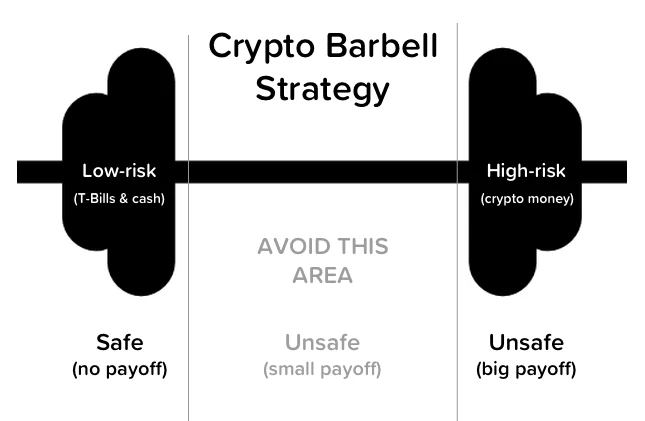
左低风险,右高风险
加密市场的杠铃策略:绝佳的平衡风险与回报

杠铃策略是一种投资策略,最初由知名风险分析学家、作家和投资者尼古拉斯·塔勒布(Nassim Nicholas Taleb)提出。该策略的灵感来源于健美世界记录保持者弗兰科·科尔曼(Franco Columbu)的训练方法,他将训练重点放在两端,即低重量和高重量,主张通过使用相对较轻的重量进行高强度的训练来刺激肌肉生长,同时也使用非常重的重量进行最大力量的提高,忽略中间的中等重量。

杠铃的中间地带可以理解为,既不极端,也不保守,在投资领域,在市场共识下进行看似安全的投资。这是一种看似安全实则危险的投资方式。经历过金融危机的重仓投资者或许最深有体会。

杠铃策略的原理是将投资组合的资产分配在两个极端,即保守资产和高风险资产之间,以实现风险的平衡。保守资产通常指的是相对稳定和低风险的投资,如债券、现金和抵押借贷。高风险资产则是指潜在回报较高但风险也较高的投资,如创新科技公司或加密货币等。

杠铃策略在投资组合中采取极端的资产配置,并将大部分资金分配给保守资产,以保护投资组合免受市场波动的冲击。同时,一小部分资金被分配给高风险资产,以寻求更高的回报。这种策略的目标是降低投资组合的整体波动性,同时提供一定的增长机会。

通过将资产分配在两个极端,杠铃策略实现了风险的分散。保守资产提供了稳定的收益和资本保护,以应对市场下跌和不利的经济环境。高风险资产则提供了增长的潜力和更高的回报,以应对市场上涨和积极的经济环境。这种资产配置的目的是降低整体投资组合的波动性,并在不同市场环境下实现平衡的风险与回报。

需要注意的是,杠铃策略并非适用于所有投资者和所有市场情况。它需要投资者有较好的风险管理能力和资产分析能力。此外,投资者还需要根据自身的投资目标、时间范围和风险承受能力来调整杠铃策略的具体配置。

在接下来的部分中,我们将探讨如何在加密市场中进行资产配置,以实现杠铃策略的目标,并平衡风险与回报。

第二部分:配置加密资产最大化发挥杠铃策略的优势

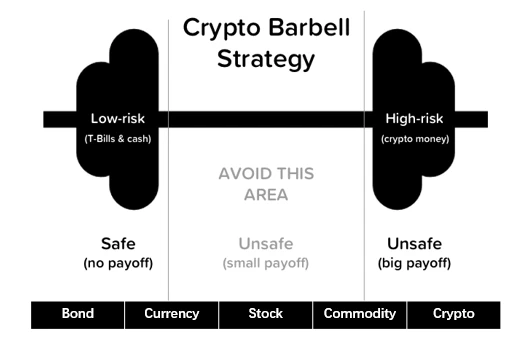
按资产类别配置:左债券,右加密
加密市场的杠铃策略:绝佳的平衡风险与回报

配置美债与加密货币的组合可以是一种利用杠铃策略的方式,也是目前在美债收益可观的条件下较流行的配置方案,以实现风险平衡和增长机会的目标。以下是一种可能的配置方案:

美债(保守资产):
 美国政府债券被认为是相对低风险的投资工具,通常在经济不稳定或市场下跌时表现较好。配置一部分资金投资于美债,可以提供稳定的现金流和资本保护。美债的回报相对较低,但在市场波动时可以充当投资组合的防御性资产。

加密货币(高风险资产):
 加密货币作为一种新兴资产类别,具有高度的波动性和潜在的高回报。在配置加密货币时,可以选择广为认可和流动性较好的加密货币,如比特币和以太坊。这些加密货币具有较高的市场份额和较强的生态系统支持,相对较为稳定。然而,需要注意的是,加密货币市场具有高度的不确定性和风险,投资者需要进行充分的研究和风险管理。

资产分配比例:
 具体的资产分配比例应根据投资者的风险承受能力、投资目标和时间范围来确定。一种常见的配置是将大部分资金分配给美债,如 80% 的资金,以保护投资组合免受市场波动的冲击。剩余的 20% 的资金可以配置给加密货币,以寻求更高的回报。这样的配置能够在保持相对稳定的同时,为投资组合提供一定的增长机会。

第三部分:加密市场中的量化策略如何配置成杠铃组合

按策略类别配置:左复利,右杠杆
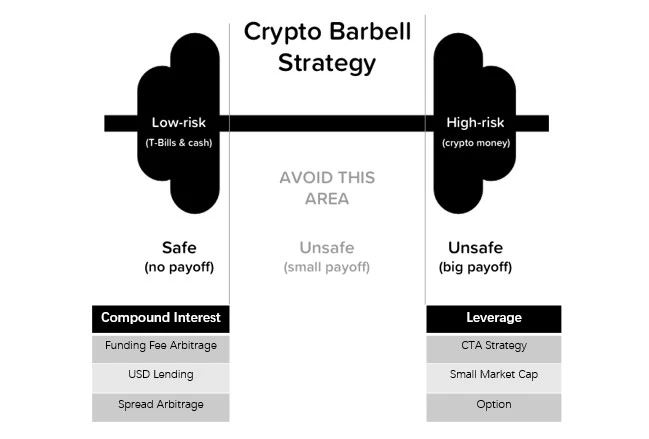
加密市场的杠铃策略:绝佳的平衡风险与回报

左边配置稳定的量化投资策略,包括资金费率套利、美元量化放贷和链上价差套利等,旨在产生复利效应。这些策略基于严谨的数据分析和算法模型,通过利用市场中的价格差异和利率差异,实现稳定的回报。无论市场处于上涨、下跌还是波动的状态,这些量化策略都能持续运作,为投资者提供持续增长的机会。通过配置稳定的量化投资策略,投资者可以享受长期复利效应,稳定增加投资组合的价值。

右边配置反脆弱类策略,包括 CTA 趋势策略、持有小市值币和买入期权等策略,旨在利用市场的趋势和波动性。这些策略通过捕捉市场的短期趋势和波动,寻求高风险高回报的机会。CTA 趋势策略在波动小的时候回有持续回撤;持有小市值币通常具有更大的成长潜力,但也伴随着较高的风险。期权交易则可以通过杠杆放大投资回报,并在市场波动时获得更大的利润。通过配置反脆弱类策略,投资者可以在市场大幅上涨或下跌时获得更高的回报,并利用杠杆提高资金使用效率。

这种左复利、右杠杆的配置方式可以帮助投资者平衡风险和回报。左边的稳定量化投资策略提供了稳定的增长,减少了整体投资组合的波动性,同时保护投资者免受市场的剧烈波动影响。右边的趋势类策略则为投资者提供了追求更高回报的机会,尤其在市场趋势明显时,可以快速获得较大的利润。通过将左复利和右杠杆策略相结合,投资者可以实现风险分散和增长机会的双重效益。

第四部分:总结

总而言之,传统投资者可以按资产类别适度配置加密货币或加密货币的量化策略作为右侧进攻,而加密市场信仰者可以借助量化投资策略的优势,配置左复利和右杠杆的组合,实现长期风险平衡和增长机会的投资目标。

然而,需要注意的是投资者许具备较高的风险承受能力和分析能力。投资者可以通过专业的量化机构进行投资,也应该对量化机构进行充分的研究和尽职调查,并根据自身的投资目标和风险偏好,合理配置资金。定期评估和调整策略的表现也是至关重要的,以保持投资组合的平衡和适应市场变化。

参考:

尼古拉斯·塔勒布(Nassim Nicholas Taleb) 书名: 反脆弱

Twitter: @DerivativesCN

Website: https://dcbot.ai/

Medium:https://medium.com/@DerivativesCN

Похожее

From Banning Doubao to Embracing Honor: Why Did WeChat Suddenly 'Change Its Face'?

The article explores the sudden shift in WeChat's strategy towards AI assistants from mobile phone manufacturers, transitioning from strict opposition to active collaboration. For over a year, WeChat fiercely resisted attempts by phone AI assistants (like ByteDance's Doubao in late 2025) to control its features via GUI automation ("simulated clicking"), citing security and data control concerns. This stance created a significant barrier for system-level AI integration. Now, Tencent has initiated A2A (Agent-to-Agent) partnerships with major phone brands like Honor, Xiaomi, OPPO, and vivo. This model allows a phone's system AI (e.g., Honor's YOYO) to parse a user's voice command and send a structured request directly to WeChat's own internal AI agent via secure APIs. WeChat then executes the action (e.g., sending a message) and returns the result. The article attributes Tencent's "change of face" to strategic pressure. While leading in social app usage, Tencent trails rivals like ByteDance and Alibaba in standalone AI app popularity. WeChat, with its vast mini-program ecosystem, is Tencent's key asset for an AI comeback. The upcoming WeChat AI agent aims to handle tasks like booking and payments within the app. However, phone system assistants remain the primary AI entry point for most users. The A2A collaboration allows Tencent to extend WeChat's AI reach to this crucial system layer while maintaining control over its core functions and data. For phone manufacturers, embracing A2A is a pragmatic move. The GUI route proved unviable due to WeChat's blocks. A2A offers a compliant path to integrate a vital service, enhancing their AI assistants' usefulness. It allows them to focus on developing their own AI ecosystems for other services while cooperating on WeChat access. The collaboration is framed as a mutual, strategic necessity: Tencent gains a distribution channel, and manufacturers gain a key functionality. The partnership relies on a "dual authorization" mechanism for security, requiring both user and app consent for each action. While questions about long-term data privacy practices remain, experts note A2A is more secure and compliant than GUI automation. Ultimately, this cooperation is seen as a tentative, calculated truce. Tencent's long-term goal is to make WeChat an AI-powered "service OS." Phone manufacturers aim to make their system AI the central user interface. Their paths may converge or clash in the future, but for now, the A2A deal represents the opening chapter in the battle for the AI-era user入口, driven by necessity and strategic calculus on both sides.

marsbit33 мин. назад

From Banning Doubao to Embracing Honor: Why Did WeChat Suddenly 'Change Its Face'?

marsbit33 мин. назад

On-Chain Figures on the Eve of Kickoff: 1.6 Billion Traded Before the World Cup Even Begins

"On-Chain Numbers on the Eve of the World Cup: $1.6 Billion Traded Before Kick-off" Analysis of on-chain markets before the 2026 FIFA World Cup reveals significant crypto integration into football. The most striking figure is the approximately **$1.6 billion** in total trading volume on the single "World Cup Winner" contract on the Polymarket prediction market platform, accumulated before a single match was played. This represents explosive growth for a sector whose annual volume surged from ~$16B in 2024 to ~$64B in 2025. The ecosystem is maturing beyond speculation. Key developments include: 1) **Infrastructure upgrades** like Polymarket's migration to native, regulated USDC stablecoin for settlements; 2) **Reliable data oracles**, such as Chainlink, being used to resolve real-world match outcomes on-chain; and 3) **Official recognition**, with FIFA appointing its first-ever "Prediction Markets" partner. Over 100 contracts now cover everything from the outright winner to individual match results and even non-sporting risks like venue relocation. This evolution marks a fundamental shift. While crypto firms are absent from FIFA's top-tier sponsor list, the technology has deeply penetrated the tournament's financial and predictive infrastructure through regulated stablecoin settlements, decentralized oracles, and new official partnership categories. The regulatory landscape remains complex and varies by jurisdiction, but on-chain markets for the World Cup are already a multi-billion-dollar reality.

marsbit1 ч. назад

On-Chain Figures on the Eve of Kickoff: 1.6 Billion Traded Before the World Cup Even Begins

marsbit1 ч. назад

From SpaceX's IPO to the Future of Crypto: Which Crypto Sectors Will Host the Trillion-Dollar Narrative?

From the SpaceX IPO, which targets a $750 billion raise at a $1.77 trillion valuation, we can extrapolate capital flow trends relevant to crypto. The focus shifts from speculative narratives to foundational infrastructure and real-world asset (RWA) integration. Key crypto sectors poised to benefit include: 1. **AI Infrastructure**: The narrative is moving from consumer-facing AI applications to underlying, scarce resources like compute power and decentralized GPU networks (e.g., TAO, RENDER, AKT, IO). These protocols are positioning as the essential "picks and shovels" providers for the AI economy. 2. **Real-World Assets (RWA)**: Beyond tokenized treasury bonds, RWA's future lies in on-chain equity and pre-IPO assets like SpaceX. This could democratize access to high-growth assets and reshape global capital flows, benefiting infrastructure projects like ONDO, LINK, and Plume that facilitate issuance, data, and liquidity. 3. **Core Financial Infrastructure**: Stablecoins, payment networks, and DePIN (Decentralized Physical Infrastructure Networks) are critical for settling the future on-chain economy. Their role expands from internal trading tools to foundational layers for global finance, AI systems, and real-world asset networks, leading to potential value reassessment. In summary, the next cycle may prioritize long-term infrastructure value—AI compute, asset tokenization networks, and settlement layers—over short-lived application hype, mirroring the broader market's shift towards funding the foundational systems of the future.

marsbit1 ч. назад

From SpaceX's IPO to the Future of Crypto: Which Crypto Sectors Will Host the Trillion-Dollar Narrative?

marsbit1 ч. назад

Торговля

Спот
Фьючерсы
活动图片