1.7 亿美元 APT 解锁在即,NEAR 与 Ton 峰会接踵而至

长文源:foresightnewsОпубликовано 2023-11-05Обновлено 2023-11-06

Введение

一览未来一周最值得关注的行业大事件及项目重要进展。

 一览未来一周最值得关注的行业大事件及项目重要进展。 


本周(11 月 6 日 - 11 月 12 日)Web3 大事件不容错过,以下是本周精彩预告:


  1. NEARCON 2023 将于 11 月 7 日至 10 日在里斯本举行。
  2. Reddit 计划终止其基于区块链的社区积分奖励服务。
  3. Ton 生态大会「The Gateway」将于 11 月 10 日 -11 日在迪拜举行。
  4. 泰国区块链周将于 11 月 11 日至 12 日 举行。
  5. Aptos 将于 11 月 12 日解锁 2480 万枚 APT 代币,价值约 1.729 亿美元。
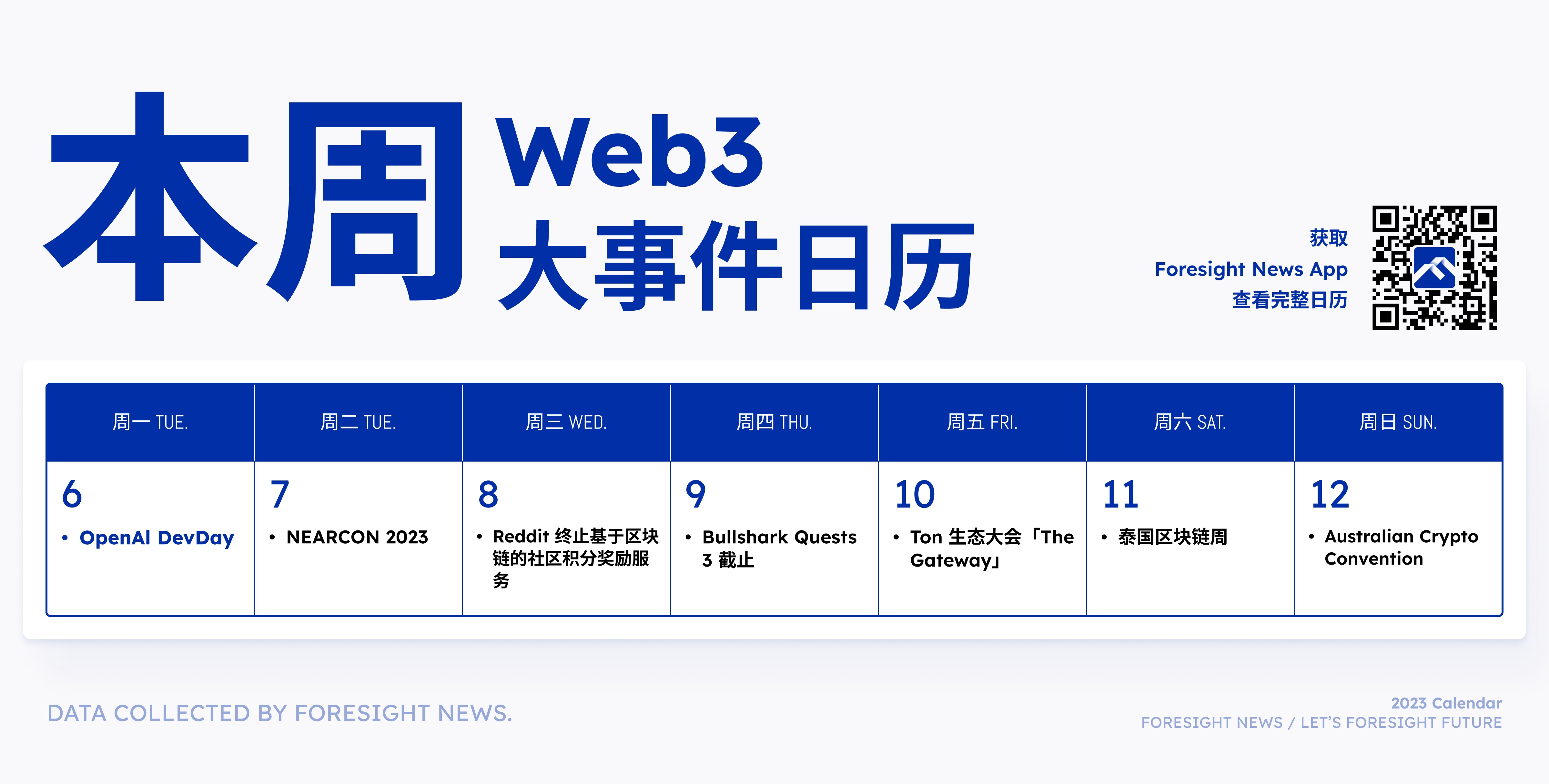


Foresight News 日历实时更新,访问更新更全 Web3 事件

点此 订阅 Foresight News 日历


重要事件


此前美国财政部和国税局于 8 月 29 日发布了针对经纪商的拟议加密货币法规,公开听证会定于 11 月 7 日举行,如有必要,第二次公开听证会将于 2023 年 11 月 8 日举行。拟议的规则将要求数字资产经纪人,包括交易平台、支付处理商和某些托管钱包提供商,报告自 2025 年 1 月 1 日起所有数字资产销售或交易的总收益,该要求将于 2026 年 1 月 1 日或之后生效。


Web3 社群聚集地之一 Reddit 计划于 11 月 8 日终止其基于区块链的社区积分奖励服务 Community Points,Reddit 表示关闭的原因是监管环境增加了可扩展性的限制,Reddit 作为加密社区活跃的一大社交巨头,其于 2020 年首次推出了 Community Points 奖励用户在某些 Reddit 子版块中进行的建设性活动,目的是提高用户参与度,用户获得的积分以 ERC-20 形式存储在 Reddit Vault 加密钱包中。


项目进展


本周,LSD 稳定币协议 Prisma Finance 推出追溯空投,将空投给 Prisma 积分持有者以及投票支持 Prisma 列入 Curve 白名单的地址。veCRV 持有者空投计划将于北京时间 11 月 6 日 17:00 进行,将获得总供应量 1% 的代币空投。Prisma 积分持有者的空投计划将于北京时间 11 月 9 日 17:00 进行,获得总供应量 2% 的代币空投。分配给空投的所有代币都被锁定为 vePRISMA,以刺激 Prisma DAO 的参与。veCRV 持有者 vePRISMA 被锁定 52 周,Prisma 积分持有者 vePRISMA 被锁定 26 周。


曾获得 Paradigm 领投 2300 万美元融资的 DAO 薪酬支付系统 Utopia 将于 11 月 6 日停止现有服务,当前无 Gas 交易将被关闭。Utopia 表示,该行为并不意味着关闭公司,而是要放弃现有的产品和现有的方向。 


此外,本周他项目的重要进展包括:固定利率借贷协议 Notional Finance 将于 11 月 6 日推出 V3 版本;托管流动性质押平台 ether.fi 也计划于 11 月 6 日发布主网;去中心化开源即时通讯平台 Status 将于 11 月 7 日发布新品牌和新网站;Layer1 区块链 Shardeum 白皮书将于 11 月 8 日发布;Mysten Labs 的 Bullshark Quests 3 持续到 11 月 9 日。


活动预告


虽然以太坊开发者大会 Devconnect 将于下周在土耳其伊斯坦布尔正式开启,但本周将有 13 场周边活动陆续召开,具体可点击 Foresight News 的 Event 功能查阅。


其中,由 Foresight X 和 OpenBuild 主办的 「Onboard to the Future Decentralized Society Hacker House」将于 11 月 10 日至 20 日在伊斯坦布尔 Devconnect 期间举办,本次 Hacker House 主题为 「Decentralized Society」,主要分为四大赛道:Social Relations、Live and Play、Co-living with AI、以及 Public Goods。Foresight X Hacker House 将为入选开发者提供为期十天的住宿及交流场所,同时为获奖开发者准备了奖金。此外,作为 Hacker House 的特别活动。


上周,随着 Solana 生态峰会 Breakpoint2023 的举行,SOL 价格大幅上涨,据 Lookonchain 数据,过去一个月 SOL 价格上涨约 80%,SOL 价格的上涨似乎与 Solana 生态峰会 Breakpoint2023 有关,2021 年和 2022 年 SOL 价格在 Breakpoint 处上涨至峰值,然后回落。本周各项目生态大会继续,是否能延续 SOL 涨势:NEARCON 2023 将于 11 月 7 日至 10 日在里斯本举行;Ton 生态大会「The Gateway」将于 11 月 10 日 -11 日在迪拜举行。


此外,值得关注的活动还包括:OpenAl 将于 11 月 6 日在旧金山亲举办首届开发者大会 OpenAl DevDay泰国区块链周将于 2023 年 11 月 11 日至 12 日 举行,主题为「Build in Bear, Rise in Bull」。


代币解锁


Token Unlocks 数据显示,11 月 6 日至 11 月 12 日,GLMR、HFT、EUL、1INCH、APT 代币将迎来一次性解锁,其中值得关注的大额解锁包括 Aptos 代币 APT 和 Hashflow 代币 HFT。


Aptos 将于 11 月 12 日解锁 2480 万枚 APT 代币,占其流通供应量的 10%,价值约 1.729 亿美元,大部分解锁资金(约 8270 万美元)将流向核心贡献者,其中 5860 万美元流向投资者,2230 万美元流向社区,930 万美元流向 Aptos 基金会。


Hashflow 将于 11 月 7 日解锁 1.604 亿枚 HFT 代币,价值约 4130 万美元,占其流通供应量的 73.9%,其中约 1610 万美元将分配给早期投资者,1270 万美元将用于生态系统开发,1240 万美元将分配给核心团队,10.7 万美元将分配给社区奖励。除此之外,目前每天还会释放价值约 44,000 美元的代币,用于生态系统开发和社区奖励。


投票治理


本周值得关注的重要治理活动包括 Aave DAO 关于「禁用所有网络中所有资产池的稳定借贷利率」的投票将于 3 天后结束。该提案称 11 月 4 日 Aave 收到了一份关于 Aave 错误赏金计划的报告,其中涉及影响 Aave v2 的高漏洞,该漏洞随后被提升为严重漏洞。于是社区开启治理提案 358 投票,对 v2 和 v3 的所有资产禁用稳定费率模式,解冻之前被 Aave Guardian 冻结的所有资产。


Arbitrum DAO 关于建立「The Arbitrum Coalition」的投票还剩 5 天,提案要求要求获得约 220 万 ARB,由 Blockworks Research、Gauntlet 和 Trail of Bits 组成一个为期 12 个月联盟,以促进提案从想法到实施的执行。

Osmosis DAO 「将最低 Gas 价格提高至 0.025 uOSMO 」的链上投票将剩 1 天结束,该提案旨在将协议强制执行的最低 Gas 价格提高 10 倍至 0.025 uOSMO,这是一项临时措施,当 Skip 提议的费用市场实施时可以恢复。


NFT 铸造


阿迪达斯(Adidas)和豪华汽车制造商布加迪(Bugatti)将于 11 月 8 日至 11 日联合拍卖 99 双配备数字孪生的足球鞋,限量版鞋有黑色和蓝色两种颜色,其灵感源自早期的布加迪大奖赛赛车。拍卖将使用加密货币进行,但潜在消费者仍可使用 MoonPay 用传统货币进行竞价。

Похожее

From Ethereum to AI's 'CROPS': What Exactly is This Set of 'Slow Variables' That Vitalik Repeatedly Emphasizes?

In recent discussions, Vitalik Buterin has frequently emphasized the concept of "CROPS," a framework defining core values for Ethereum's development. CROPS stands for Censorship Resistance, Capture Resistance, Open Source, Privacy, and Security. Initially outlined in the Ethereum Foundation's "EF Mandate," it represents a commitment to user sovereignty, ensuring that the network resists external control, remains open, protects privacy, and prioritizes security. The relevance of CROPS extends beyond Ethereum's foundational principles, becoming crucial in the context of AI integration. As AI agents begin handling wallet operations and automated transactions, the risk increases that users may cede control over their digital assets, privacy, and intentions to centralized AI service providers. A "CROPS AI" would therefore emphasize local execution where possible, privacy-preserving remote model calls (e.g., using zero-knowledge proofs), and transparent, verifiable processes to maintain user agency. Vitalik highlights a significant convergence between "CROPS Ethereum access layer" and "CROPS AI." Both address the same fundamental challenge: how users can access powerful services—be it blockchain data via RPCs or AI models—without exposing sensitive information or relinquishing ultimate control. This intersection points toward a future digital entry point that is more private, secure, and user-controlled. Ultimately, CROPS is not merely an abstract ideal but a practical guidepost. It steers development—from protocol resilience and wallet design to AI agent safety—towards a future where users retain self-sovereignty even as digital systems grow more complex and powerful. In an era of accelerating AI adoption, these "slow variables" of censorship resistance, openness, privacy, and security may define Ethereum's enduring value.

marsbit8 мин. назад

From Ethereum to AI's 'CROPS': What Exactly is This Set of 'Slow Variables' That Vitalik Repeatedly Emphasizes?

marsbit8 мин. назад

Silicon Valley 'Startup Guru' Steve Hoffman: Web3 + AI Could Be a Trap

Silicon Valley investor and "Godfather of Startups" Steve Hoffman warns that combining Web3 with AI is likely a trap, not a promising venture. In an interview, Hoffman argues that while AI is a foundational technology touching all industries, Web3 adds complexity, friction, and regulatory risk without solving mainstream consumer or business needs. He advises founders to focus on deep, specialized applications where startups can out-iterate giants, rather than on generic features easily replicated by large tech companies. Hoffman observes that Silicon Valley will lead foundational AI research, while China excels at rapid, large-scale application and commercialization, particularly in robotics. He stresses that AI-driven autonomous agents capable of collaborative, multi-step tasks are 2-4 years away, which will cause significant job displacement. The solution is not to slow AI but to redesign business models around human-AI collaboration and reform social systems like education and retraining. For startups, Hoffman recommends focusing on vertical, expertise-heavy domains to build defensibility. He sees major opportunities in AI fraud detection and cybersecurity. Key founder mindsets include systemic thinking over feature-focus, relentless customer centricity, building adaptive teams, and deeply understanding AI's capabilities and limits. Hoffman is also leading a non-profit initiative to establish university centers aimed at training future leaders in responsible, human-value-aligned AI innovation.

marsbit1 ч. назад

Silicon Valley 'Startup Guru' Steve Hoffman: Web3 + AI Could Be a Trap

marsbit1 ч. назад

Token Inefficient, Economy Tokenless

The article "Tokens Aren't Economical, Economics Aren't Tokenized" analyzes a pivotal shift in the AI industry from a technology-driven narrative to one dominated by capital efficiency. It highlights two concurrent trends: a severe capital shortage due to the exorbitant and recurring costs of compute (e.g., OpenAI's high burn rate) and a wave of corporate spin-offs where major tech companies are separating their AI units (like Kuaishou's Kling and Baidu's Kunlunxin). The core argument is that AI's "anti-internet" business model, where user growth increases costs rather than profits, has created a disconnect between high valuations and actual cash flow. Spin-offs address this by allowing AI assets to be valued independently. Within a parent company, they are seen as cost centers, but as standalone entities, they are priced based on their growth potential and scarcity in the primary market, leading to massive valuation premiums (e.g., Kling's estimated value tripling post-spin-off). The industry is at an inflection point, moving from "model worship" to "value realization." The competition is evolving from a pure compute (GPU) race to a broader focus on systemic efficiency and full-stack engineering (involving CPUs and orchestration) to achieve viable commercialization. The year 2026 is framed as a critical moment where the industry must definitively answer how to economically translate AI capability into tangible business value, reshaping the sector's future power structure.

marsbit1 ч. назад

Token Inefficient, Economy Tokenless

marsbit1 ч. назад

Crossing the 'Memory Wall': The Wafer-Level Revolution and Computing Power Routes in the AI Inference Era

In 2026, a historic shift occurred in AI as major cloud providers' inference spending surpassed training spending for the first time, signaling a move from "building large models" to "using large models." This shifts the core challenge from computing power to the "memory wall"—the bottleneck of data movement (model weights, activations, KV Cache) between external DRAM and processors, where energy and latency from data transfer far exceed computation itself. Companies like Nvidia face GPU idle time due to bandwidth limits. In contrast, Cerebras Systems adopts a radical "wafer-scale" approach with its Wafer-Scale Engine (WSE). Instead of cutting a silicon wafer into many chips, Cerebras uses almost the entire wafer as one massive chip (WSE-3). This design provides 44GB of on-chip SRAM, delivering memory bandwidth thousands of times higher than traditional HBM (e.g., 21 PB/s vs. Nvidia B200). For LLM inference, weights are streamed layer-by-layer from external MemoryX storage to the chip, avoiding HBM bottlenecks. This results in token generation speeds 1.5–5 times faster than Nvidia's B200 in some models and significant advantages in first-token latency and long-context tasks. Additionally, Cerebras's architecture offers much lower interconnect power consumption (0.15 pJ/bit vs. GPU's ~10 pJ/bit). However, Cerebras faces challenges: SRAM scaling has slowed with advanced nodes, limiting future capacity gains; the chip requires specialized liquid cooling and custom software stacks; and its external I/O bandwidth (150 GB/s) is low compared to NVLink, hindering multi-system scaling for very large models. Competition is intensifying. Major players are pursuing three paths: 1) Developing proprietary inference ASICs (e.g., Google TPU, Microsoft Maia), 2) Leveraging advanced packaging (e.g., TSMC's SoW) to democratize wafer-scale-like integration, potentially eroding Cerebras's process advantage within a few years, and 3) Exploring optical interconnects for ultimate bandwidth. Commercially, Cerebras is transitioning from a hardware vendor to a service provider, facing the immense challenge of building high-power, specialized data centers to meet large contracts (e.g., 250MW/year from 2026–2028). In conclusion, the AI inference era presents a fundamental architectural trade-off. Cerebras opts for extreme physical optimization for low-latency, single-task performance, while Nvidia prioritizes versatility and massive cluster throughput. The path forward remains uncertain, with technology and business models still evolving in the race toward advanced AI.

marsbit1 ч. назад

Crossing the 'Memory Wall': The Wafer-Level Revolution and Computing Power Routes in the AI Inference Era

marsbit1 ч. назад

Торговля

Спот
Фьючерсы
活动图片