Ethereum Merge a 'few months after' June: Dev clears up what’s going on

CointelegraphОпубликовано 2022-04-14Обновлено 2022-04-14

Введение

The long-awaited Ethereum Merge is set for yet another delay, with developers working on the upgrade estimating a completion time a “few months after” June.

The long-awaited Ethereum Merge is set for yet another delay, with developers working on the upgrade estimating a completion time a “few months after” June.
Owing to the success of testing, there was a general expectation the Merge would go through mid year, however the latest setback is unsurprising given that Proof of Stake has been delayed constantly ever since it was first proposed.
That said, the signs are promising that the Ethereum mainnet will actually merge with the beacon chain to become a Proof-of-Stake (PoS) network this year. For real.
Ethereum developer Tim Beiko provided the updated timeline via Twitter yesterday, tentatively stating that the core devs are into the final stretch:
“It won't be June, but likely in the few months after. No firm date yet, but we're definitely in the final chapter of PoW on Ethereum.”
After noting that his comments caused a stir amongst Ethereum proponents and haters alike, Beiko followed up today by observing “that it can be hard to parse the progress on The Merge when you aren't deep in the process.”
To provide further context, Beiko published a blog post with a deeper rundown.
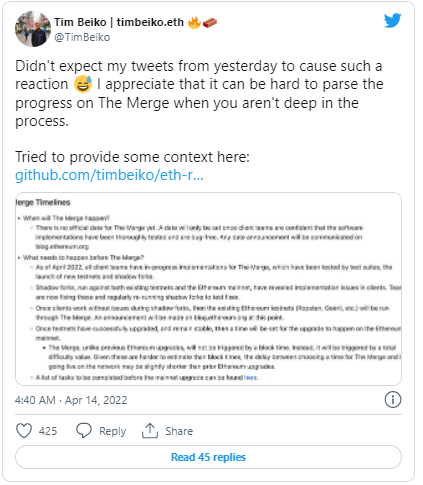
According to the developer, a specific date will not be set until “client teams are confident that the software implementations have been thoroughly tested and are bug-free.”
Central to these latter stages are the trial runs of public test nets such as Kiln, and the roll out of shadow forks which enable devs to test various merge/PoS-related implementations on the network.
Difficulty bomb ticking
Another important factor is the difficulty bomb (an automated increase in mining difficulty designed to make PoW mining less attractive), which Beiko says will start to be noticeable on Ethereum around May and make blocks “unbearably (read 15-20 seconds) slow by August.”
“If client developers do not think they can deploy The Merge to mainnet before block times are slowed too much, it will need to be delayed again,” he said.
Beiko put forward two ways in which the difficulty bomb could potentially be delayed to usher in the Merge upgrade beforehand, firstly combining a bomb delay with merge client releases to delay the “bomb at a certain block, restoring 13s block times, and then activate The Merge shortly after.”
Secondly to separate the bomb delay via network upgrade “which only delays the difficulty bomb” prior to the merge.
“The Merge, unlike previous Ethereum upgrades, will not be triggered by a block time. Instead, it will be triggered by a total difficulty value. Given these are harder to estimate than block times, the delay between choosing a time for The Merge and it going live on the network may be slightly shorter than prior Ethereum upgrades.”
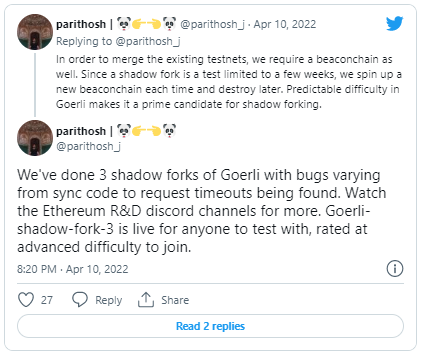
Earlier this week Ethereum Foundation developer Parithosh Jayanthi suggested there is still a fair amount of trial and error to go, after he noted that the testing of three shadow forks resulted in “bugs varying from sync code to request timeouts being found.”
Following the successful implementation of The Merge and transition to a PoS consensus mechanism, the final landmark on the road map for Ethereum (formerly known as Eth2) is the sharded chains upgrade slated to go live in early 2023. Until then however, the network will utilize Layer-2 networks like Polygon and Optimism to handle scalability and high transaction volumes.
The price of Ether (ETH) has seen a significant uptick over the past 30 days, gaining 20.5% to sit at $3,126 at the time of writing.


Похожее

How Much Debt Does Strategy Really Have? Is There a Risk of Implosion?

MicroStrategy's Debt Risk: A Turning Point in the "Never Sell" Strategy As of June 3, 2026, MicroStrategy holds 843,706 bitcoins (valued at ~$53.1B) but faces significant financial obligations. Its capital structure includes $6.75B in convertible notes and $15.48B in perpetual preferred stock (led by the $8.5B STRC series), creating an annual payout burden of ~$1.71B. With software revenue at only ~$500M, interest and dividend obligations far exceed operating income. A critical shift occurred in late May 2026 when the company sold 32 bitcoins for ~$2.5M to cover dividends, breaking CEO Michael Saylor's long-standing "never sell" pledge. This symbolic move triggered a sharp decline in both Bitcoin's price and MSTR stock, reflecting market fears about cash flow sustainability. The core of the strain is the STRC perpetual preferred stock, designed as a "permanent loan" with no maturity date but requiring high monthly dividends (currently 11.5%). Its business model relies on a three-part cycle: issuing new STRC shares, using proceeds to buy more Bitcoin and fund a USD reserve, and using that reserve to pay dividends. This cycle depends on continuous investor demand for STRC and Bitcoin's price appreciation. Analysis shows Bitcoin needs to appreciate at least 2.3% annually to cover the $1.71B in yearly obligations at current holdings. With Bitcoin price down ~22% from March 2026 highs, this pressure has intensified. The company's $900M USD reserve can only cover about 7 months of payments if STRC issuance stalls. Key risks are not immediate bankruptcy or forced Bitcoin liquidation (as BTC is not collateral), but rather: 1) The erosion of MSTR's premium to its Bitcoin holdings (mNAV), which would cripple its ability to raise cheap capital; 2) A vicious cycle where stagnant Bitcoin prices reduce STRC demand, draining the USD reserve and forcing BTC sales, further depressing prices. The period from February 2027 to September 2028 is a crucial test, with over $5.9B in convertible notes facing put options or maturity. In essence, MicroStrategy has evolved from a simple Bitcoin holder into a complex financial entity acting like a "private Bitcoin bank," leveraging its BTC holdings to create layered financial products. Its survival depends on maintaining Bitcoin's price trend, its stock premium, and market appetite for its preferred shares. The recent token sale marks not a betrayal of its Bitcoin thesis, but an admission that the leveraged strategy must eventually be paid for.

marsbit4 мин. назад

How Much Debt Does Strategy Really Have? Is There a Risk of Implosion?

marsbit4 мин. назад

Anthropic Cries Wolf: Is the AGI Threat Real, or Just an IPO Story?

Anthropic has published an article titled "When AI builds itself," discussing the emerging concept of "recursive self-improvement," where AI begins to actively participate in designing, training, testing, and optimizing its own subsequent versions. The company presents internal data showing that by May 2026, over 80% of code merged into its codebase was written by Claude, its AI model. Claude's capabilities have expanded to handling complex, open-ended engineering tasks, achieving a 76% success rate in such areas, and even contributing to research processes, such as optimizing code performance and conducting AI safety experiments. Anthropic outlines an evolution from human-driven development to AI-assisted workflows, culminating in the current stage where AI agents can autonomously write, run, and delegate code. The company cautions that the path toward a "closed loop," where AI continuously improves itself, is becoming visible. It calls for coordinated global mechanisms to potentially slow or pause frontier AI development to allow safety research and societal structures to catch up. However, the timing of this warning coincides with Anthropic's preparations for an IPO, framing the narrative not just as a safety concern but also as a demonstration of Claude's advanced capabilities and its integral role in accelerating Anthropic's own R&D—creating a potential "flywheel" effect for competitive advantage. This contrasts with OpenAI's recent, more policy-oriented discussion of the same risks, highlighting the competitive dynamics in the AI industry as companies position themselves in both the technological and regulatory landscape.

marsbit1 ч. назад

Anthropic Cries Wolf: Is the AGI Threat Real, or Just an IPO Story?

marsbit1 ч. назад

BIT Research: ETF Purchases Have Slowed, Strategy (MicroStrategy) Has Slowed, What Else Can Drive Bitcoin's Rise?

Market Refocus on Inflation and Rate Expectations Weighs on Bitcoin Currently, the market is in a phase of macro-repricing dominated by inflation and interest rate expectations. Bitcoin, which previously benefited from easy liquidity and low inflation, is seeing its core bullish drivers weaken. These drivers were market expectations for interest rate cuts and strong inflows from Bitcoin ETFs and institutions like MicroStrategy (referred to as "Strategy" in the text). The logic has shifted. Recent high inflation data (e.g., CPI hitting 3.8% in a May 2026 report) has caused the market to sharply reduce its rate cut expectations for 2025 and even price in potential hikes. This is a key constraint for Bitcoin, as it lacks cash flows and is highly sensitive to rate expectations. Concurrently, institutional capital flows have slowed significantly. Following the hot CPI data, Bitcoin ETFs saw accelerated outflows, with around $4.3 billion leaving over a period. MicroStrategy's ability to keep adding substantial Bitcoin to its balance sheet is also diminishing. Together, ETF and MicroStrategy holdings total roughly $110 billion, but their momentum as growth engines is cooling. In summary, Bitcoin's current pressure stems not from its own fundamentals but from a changing macro environment. As long as inflation stays elevated, Bitcoin is likely to remain in a consolidating phase. However, historically, inflation eventually peaks. Once it recedes and rate cut expectations rebuild, institutional capital could return, potentially fueling a new and more robust recovery phase for Bitcoin.

marsbit1 ч. назад

BIT Research: ETF Purchases Have Slowed, Strategy (MicroStrategy) Has Slowed, What Else Can Drive Bitcoin's Rise?

marsbit1 ч. назад

Торговля

Спот
Фьючерсы
活动图片