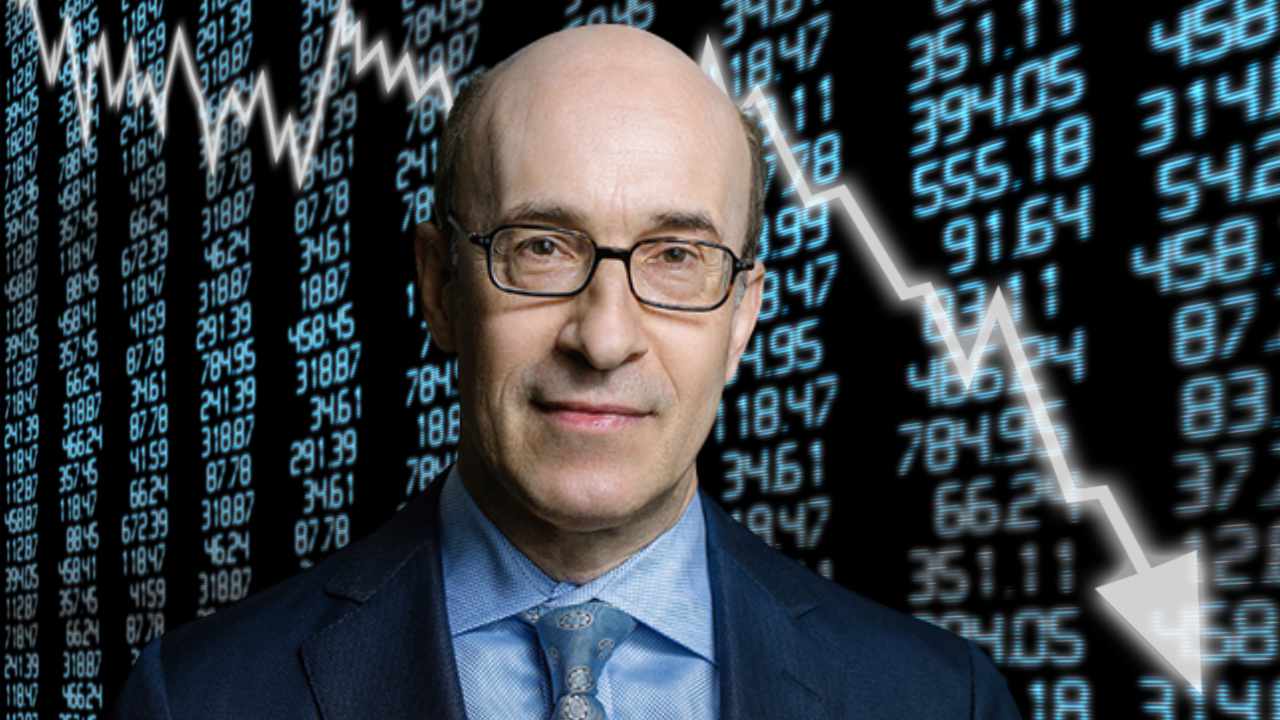
Harvard economics professor Kenneth Rogoff, who previously served as the chief economist at the International Monetary Fund (IMF), has warned that the U.S. defaulting on its debt obligations could spark a global financial crisis. “It’s a very perilous situation and we are in unknown waters,” he warned.
Harvard Professor of Economics Kenneth Rogoff on U.S. Default and Global Financial Crisis
Harvard economics professor Kenneth Rogoff shared his view on the U.S. economy, a possible U.S. default, and a global financial crisis in an interview with ET editor Srijana Mitra Das, published Thursday. Rogoff is a professor of Economics and Maurits C. Boas Chair of International Economics at Harvard University. From 2001–2003, he served as Chief Economist and Director of Research at the International Monetary Fund (IMF).
He was asked whether the current U.S. debt crisis and its potential default could “bring back the risks of a global recession.” Rugoff replied:
Absolutely. The risks exist anyway but if this worsens, it could pose a global financial crisis. I hope it won’t come to that — but it’s a very perilous situation and we are in unknown waters.
“Generally, when you navigate government spending, you consider one bill at a time. You look over all its details and then negotiate how to work these out,” he explained. However, he stressed that the Republicans are trying to get everything all at once, emphasizing that “No country runs its fiscal policy that way.”
He cautioned: “Typically, these negotiations do get resolved at midnight but there is a two to three percent chance at the moment here that we will discover what a U.S. default looks like.”
How the U.S. ‘Defaulted’ in the Past
Rogoff further detailed that the U.S. has “defaulted” in the past but “in a different way.” One example was in the early 1930s when American debt used to be payable in gold. President Franklin Roosevelt changed the gold price from $20 to $35. “We defaulted on the gold clause while we paid the debt in dollars, which was worth a lot less,” the Harvard professor noted.
Another example was “after the Revolutionary War when the U.S. was forming,” the economics professor described. “Alexander Hamilton, the first secretary of the U.S. Treasury, only paid some of the inherited colonial debt,” Rugoff explained, adding:
We’ve also had high inflation recently — so, if you’re a U.S. debt holder, the value of your holding has reduced markedly in the last two years. That is a kind of default since you weren’t expecting the loss of value but it is much less disruptive than this situation which is like facing a black hole.
U.S. Treasury Secretary Janet Yellen has said that the Treasury may not be able to pay all of the government’s bills as early as June 1 “if Congress does not raise or suspend the debt limit before that time.” However, some believe that raising the debt ceiling will make the problem worse, including economist Peter Schiff.
Like Yellen, the Congressional Budget Office similarly warned that the government could default on its debt in the first two weeks of June. The IMF cautioned last week that a U.S. default would have “very serious repercussions.” Meanwhile, former President and 2024 presidential candidate Donald Trump has urged Republican lawmakers to let the U.S. default on its debt if the Democrats do not agree to spending cuts.
Tags in this story
Kenneth Rogoff, Kenneth Rogoff US default, US debt default
Do you agree with Harvard economics professor Kenneth Rugoff? Let us know in the comments section below.

Kevin Helms
A student of Austrian Economics, Kevin found Bitcoin in 2011 and has been an evangelist ever since. His interests lie in Bitcoin security, open-source systems, network effects and the intersection between economics and cryptography.
Biden Appoints New Fed Vice Chair as Fedwatch Tool Shows Slim Chance of Rate Hike at June Meeting
ECONOMICS | 7 hours ago

10 Southeast Asian Nations Challenge Dollar Dominance With Push for Local Currencies
ECONOMICS | 23 hours ago
Image Credits: Shutterstock, Pixabay, Wiki Commons
Previous article
Hedge Fund Mogul Stanley Druckenmiller Warns of ‘Hard Landing’ for US Economy
Disclaimer: This article is for informational purposes only. It is not a direct offer or solicitation of an offer to buy or sell, or a recommendation or endorsement of any products, services, or companies. Bitcoin.com does not provide investment, tax, legal, or accounting advice. Neither the company nor the author is responsible, directly or indirectly, for any damage or loss caused or alleged to be caused by or in connection with the use of or reliance on any content, goods or services mentioned in this article.
Read disclaimer
Show comments
More Popular News
In Case You Missed It
Bitcoin ATM Operator Indicted in New York Allegedly Running Illegal Business Attracting Criminals
A bitcoin ATM operator has been indicted in New York for running an illegal business "marketed towards individuals engaged in criminal activity." The district attorney in charge described: "Robert Taylor allegedly went to great lengths to keep his bitcoin kiosk ... read more.
Argentinian Securities Regulator Launches Innovation Hub to Discuss Regulated Crypto Investments
Privacy-Centric Monero Plans for July Hard Fork, Plans Include Ring Signature, Bulletproof Upgrade
Fed's Bullard Wants to Raise Bank Rate to 3.5% by Year's End, Hints at 75 Basis Point Rate Hike
Terra's Algorithmic Dollar-Pegged Crypto UST Is Now the Third-Largest Stablecoin