Zaporizhzhia Nuclear Plant For Crypto Mining? Putin Claims US Interest

bitcoinistPublicado em 2025-12-27Última atualização em 2025-12-27

Resumo

Russian President Vladimir Putin has claimed the United States is interested in using the Zaporizhzhia Nuclear Power Plant’s electricity for crypto mining and supplying power to Ukraine, according to a report citing Russian media. The plant, Europe’s largest nuclear facility, was captured by Russian forces in 2022 and has since halted power generation. While crypto mining—an energy-intensive process—could utilize excess energy, reactivating the plant remains complex. All six reactors are shut down, and the International Atomic Energy Agency states that restart is impossible while military conflict continues. Meanwhile, Bitcoin trades around $88,600.

Russian President Vladimir Putin has reportedly said that the United States is interested in using Zaporizhzhia’s nuclear electricity for crypto mining.

US & Russia Are In Talks About Zaporizhzhia Nuclear Power Plant

Russia and the US are negotiating joint control of the Zaporizhzhia nuclear power plant, according to a report from Kyiv Post, citing Russian business newspaper Kommersant. The Zaporizhzhia nuclear power plant is located in Southeastern Ukraine and is the largest nuclear energy facility in Europe. It used to be responsible for more than a fifth of the electricity in Ukraine, but in 2022, Russian forces captured it, and it has since ceased power generation.

It would now appear that discussions have emerged about the future use of the power plant. As per the report, Vladimir Putin said at a meeting with major business figures on Christmas Eve that the US is interested in using the plant’s electricity for crypto mining and for supplying power to Ukraine.

Crypto mining, the most prominent example of which is Bitcoin mining, can be an energy-intensive process, leveraging computing power to solve mathematical puzzles that allow the operator to have a chance at adding the next block to the blockchain.

Crypto mining has features like portability and modularity that have made many consider its application in using waste or excess energy in power grids to produce value in the form of digital assets. On a global scale, Bitcoin mining has seen some rapid expansion during the past three years, with the Hashrate, a measure of the network’s total computing power, expanding by almost five times.
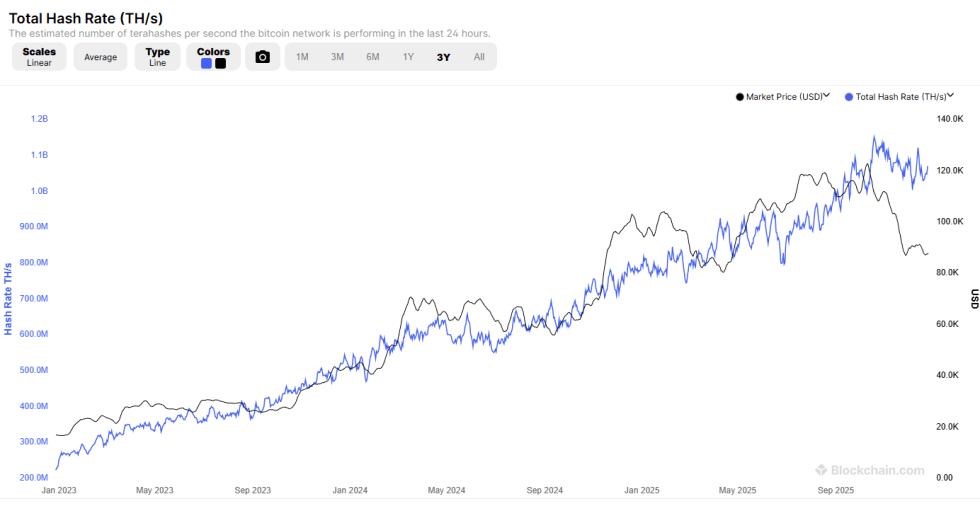
The data for the 7-day average Bitcoin Hashrate | Source: Blockchain.com

Restarting the Zaporizhzhia nuclear power plant for crypto mining, or any other purpose, however, wouldn’t be a simple task. By late 2022, all six reactors of the plant were shut down, with five of them being put in a state of cold shutdown.

One reactor was kept in hot shutdown to produce steam for nuclear safety purposes. Even so, the plant isn’t in a state where a restart is possible, according to the International Atomic Energy Agency (IAEA). As the IAEA wrote in a press release earlier this year:

Nuclear safety remains precarious at Ukraine’s Zaporizhzhya Nuclear Power Plant (ZNPP) and its six reactors cannot be restarted as long as the military conflict continues to jeopardize the situation at the site, Director General Rafael Mariano Grossi told IAEA Member States this week.

Given this context, it only remains to be seen whether any reported negotiations around the nuclear power plant will actually lead it to be used for any energy-related purpose, crypto mining or otherwise.

Bitcoin Price

At the time of writing, Bitcoin is trading around $88,600, up 1.3% over the last 24 hours.

Looks like the price of the coin has been moving sideways over the last few days | Source: BTCUSDT on TradingView

Perguntas relacionadas

QWhat did Vladimir Putin claim about the United States' interest in the Zaporizhzhia nuclear power plant?

AVladimir Putin claimed that the United States is interested in using the Zaporizhzhia nuclear power plant's electricity for crypto mining and for supplying power to Ukraine.

QWhat is the current operational status of the Zaporizhzhia nuclear power plant according to the IAEA?

AAccording to the International Atomic Energy Agency (IAEA), the Zaporizhzhia nuclear power plant is not in a state where a restart is possible, and its six reactors cannot be restarted as long as the military conflict continues to jeopardize the site's safety.

QWhat is the main reason crypto mining, like Bitcoin mining, is considered for using the plant's energy?

ACrypto mining is considered because of its features like portability and modularity, which make it suitable for using waste or excess energy in power grids to produce value in the form of digital assets.

QWhat was the Bitcoin price mentioned in the article at the time of writing?

AAt the time of writing, Bitcoin was trading around $88,600, up 1.3% over the last 24 hours.

QHow has the Bitcoin network's computing power, or Hashrate, changed in the past three years?

AOver the past three years, the Bitcoin network's Hashrate, a measure of its total computing power, has expanded by almost five times.

Leituras Relacionadas

Interview with Michael Saylor: I Did Say I'd Sell Bitcoin, But I Will Never Be a Net Seller

**Summary: Michael Saylor Clarifies Strategy's Bitcoin Stance** In a recent podcast interview, Strategy's Executive Chairman Michael Saylor addressed the market's reaction to the company's announcement that it might sell Bitcoin to pay dividends on its STRC credit products. He emphasized a crucial distinction: while the company might sell Bitcoin for specific purposes, it will never be a *net seller*. Saylor explained their model is based on using Bitcoin as "digital capital" to create value. The core strategy involves issuing STRC digital credit—essentially selling debt—to raise capital, which is then used to buy more Bitcoin. He estimates Bitcoin appreciates at roughly 40% annually. A small portion of these capital gains (e.g., ~2.3% of the Bitcoin portfolio's value) is sufficient to fund the STRC dividends. Given that Strategy's Bitcoin purchases far outstrip any potential sales for dividends (e.g., buying $3.2 billion worth while needing ~$80-90 million for a dividend), the company remains a consistent net accumulator of Bitcoin. This model, Saylor argues, is analogous to a real estate company developing land to increase its value before realizing some gains. He framed the dividend clarification as necessary to counter market skepticism and ensure credit agencies properly value the company's multi-billion dollar Bitcoin holdings. Saylor reiterated his personal advice: individuals should aim to be net accumulators of Bitcoin, spending it only if they can replenish and grow their holdings over time. Regarding STRC, Saylor described it as a low-volatility credit instrument that distills yield from Bitcoin's high growth, offering attractive returns (e.g., ~11-12% yield) for risk-averse investors. He noted that Strategy's STRC issuance now constitutes about 60% of the U.S. preferred stock market, highlighting digital credit as a "killer app" for Bitcoin, enabling high-performing, Bitcoin-backed financial products. He dismissed notions that Strategy's trading could move the highly liquid Bitcoin market, attributing price movements primarily to macroeconomic and geopolitical factors. Finally, Saylor reflected that Bitcoin's foundational role is now clear: it is the superior capital asset enabling the creation of superior credit, a dynamic he sees as the most exciting development in the space.

marsbitHá 1m

Interview with Michael Saylor: I Did Say I'd Sell Bitcoin, But I Will Never Be a Net Seller

marsbitHá 1m

380,000 Apps Exposed, 2,000+ Apps Leaked Secrets: AI Programming Turns 'Intranet' into Public Internet

Israeli cybersecurity firm RedAccess uncovered a severe data exposure trend linked to "vibe coding" or AI-powered software development tools. Their research found approximately 38,000 publicly accessible web applications built with platforms like Lovable, Base44, Netlify, and Replit. Of these, an estimated 2,000 apps exposed sensitive corporate and personal data, including medical records, financial information, internal strategic documents, and customer chat logs. In some cases, access even granted administrative privileges. The core issue stems from default privacy settings that make applications public by default, combined with a lack of built-in security controls (like authentication) in the AI-generated code. This allows employees without security expertise—"citizen developers"—to easily create and deploy applications that bypass standard corporate security reviews. The exposed apps, often indexed by search engines, are trivially discoverable. While some platform providers (Replit, Lovable, Wix/Base44) argue that security configuration is the user's responsibility and question the validity of some findings, security researchers confirm the widespread reality of such exposures. This pattern, also noted in prior studies, highlights a critical security gap as AI democratizes app creation, potentially leading to massive, unintentional data leaks.

marsbitHá 1h

380,000 Apps Exposed, 2,000+ Apps Leaked Secrets: AI Programming Turns 'Intranet' into Public Internet

marsbitHá 1h

Attracting Global Capital, Asia's New 'Super Cycle' Is Unfolding

Investors are turning to Asia as the next frontier for global equity growth, with a new "super cycle" unfolding across the region. Driven by the AI revolution, Asian markets, particularly South Korea, have seen significant rallies. According to Morgan Stanley analysis, the underlying drivers of Asia's industrial cycle are shifting from traditional sectors like real estate and manufacturing to massive investments in AI infrastructure, energy security and transition, and supply chain resilience. Fixed asset investment in Asia is projected to grow from around $11 trillion in 2025 to $16 trillion by 2030, with a 7% annual growth rate from 2026-2030. The AI wave is a primary catalyst, driving immense capital expenditure for chips, servers, data centers, and power systems. Asia is central to this hardware supply chain. In China, AI investment is focused on building a full-system domestic capability, with the local AI chip market potentially reaching $86 billion by 2030. Beyond AI, China's export story is expanding from EVs and batteries to robotics. The country already captures about half of new global industrial robot demand and over 90% of humanoid robot shipments. This growth phase mirrors the early stages of China's EV export boom. Simultaneously, energy security investments, spurred by AI's massive power needs, are rising, with China benefiting from its leadership in solar, batteries, and EVs. Regional defense spending is also increasing structurally, supporting demand for advanced manufacturing. The main beneficiaries are China, South Korea, and Japan, positioned in core supply chain areas. However, risks remain, including potential overcapacity, profit margin pressures from competition, persistent technological restrictions, geopolitical friction, and workforce displacement due to AI-driven automation. Market volatility is also expected to increase as investor expectations diverge on the realization of these capital investment and export themes.

marsbitHá 1h

Attracting Global Capital, Asia's New 'Super Cycle' Is Unfolding

marsbitHá 1h

Trading

Spot
Futuros

Artigos em Destaque

Como comprar US

Bem-vindo à HTX.com!Tornámos a compra de Talus Network (US) simples e conveniente.Segue o nosso guia passo a passo para iniciar a tua jornada no mundo das criptos.Passo 1: cria a tua conta HTXUtiliza o teu e-mail ou número de telefone para te inscreveres numa conta gratuita na HTX.Desfruta de um processo de inscrição sem complicações e desbloqueia todas as funcionalidades.Obter a minha contaPasso 2: vai para Comprar Cripto e escolhe o teu método de pagamentoCartão de crédito/débito: usa o teu visa ou mastercard para comprar Talus Network (US) instantaneamente.Saldo: usa os fundos da tua conta HTX para transacionar sem problemas.Terceiros: adicionamos métodos de pagamento populares, como Google Pay e Apple Pay, para aumentar a conveniência.P2P: transaciona diretamente com outros utilizadores na HTX.Mercado de balcão (OTC): oferecemos serviços personalizados e taxas de câmbio competitivas para os traders.Passo 3: armazena teu Talus Network (US)Depois de comprar o teu Talus Network (US), armazena-o na tua conta HTX.Alternativamente, podes enviá-lo para outro lugar através de transferência blockchain ou usá-lo para transacionar outras criptomoedas.Passo 4: transaciona Talus Network (US)Transaciona facilmente Talus Network (US) no mercado à vista da HTX.Acede simplesmente à tua conta, seleciona o teu par de trading, executa as tuas transações e monitoriza em tempo real.Oferecemos uma experiência de fácil utilização tanto para principiantes como para traders experientes.

375 Visualizações TotaisPublicado em {updateTime}Atualizado em 2025.12.11

Como comprar US

Discussões

Bem-vindo à Comunidade HTX. Aqui, pode manter-se informado sobre os mais recentes desenvolvimentos da plataforma e obter acesso a análises profissionais de mercado. As opiniões dos utilizadores sobre o preço de US (US) são apresentadas abaixo.

活动图片