Why Did OpenAI Decide to Make a Phone? ChatGPT Is Taking the Permissions Apple Won't Give

marsbitPublicado em 2026-05-18Última atualização em 2026-05-18

Resumo

The article discusses OpenAI's surprising move into developing its own AI-powered smartphone, reportedly targeting a 2027 launch. Initially driven by faith that superior AI models alone would secure its dominance—evidenced by ChatGPT's viral success—OpenAI now faces a strategic pivot. Key challenges include slower-than-expected revenue growth and competition from rivals like Anthropic's Claude Code, which successfully monetized a specific, high-value user base (developers) by deeply integrating into workflows. OpenAI recognizes that for ChatGPT to evolve from a conversational tool into a true "AI Agent" that completes tasks (e.g., booking travel, managing files), it needs direct system-level permissions and a default user interface. Currently, as a service integrated into platforms like Apple's iOS and Microsoft's Windows, ChatGPT lacks the necessary access and control ("sovereignty") over hardware, data, and user interactions. Building its own device is seen as a way to give ChatGPT its "first body"—a dedicated terminal where it can operate with full autonomy, bypassing the limitations imposed by partner ecosystems. This shift underscores a broader realization: in the AI Agent era, owning the end-user device and experience is critical to capturing value and maintaining competitive advantage, even if it means directly competing with former allies like Apple.

This summer, Musk is going to do something unprecedented in history. Taking a large language model company and packing it into a rocket company, then taking them public together.

The last thing OpenAI should do right now is probably make a phone. But Sam Altman doesn't seem to think so.

In the first quarter of this year, OpenAI's revenue and user growth both fell short of expectations. Its rival Anthropic, with Claude Code, snatched away the group most willing to pay. Following this script, OpenAI should now be consolidating, focusing, and first proving it can make money, gearing up for an IPO by the end of this year or early next.

But the supply chain tells a different story. It's going to challenge the world's most mature, most closed, and most profitable consumer electronics category: the iPhone.
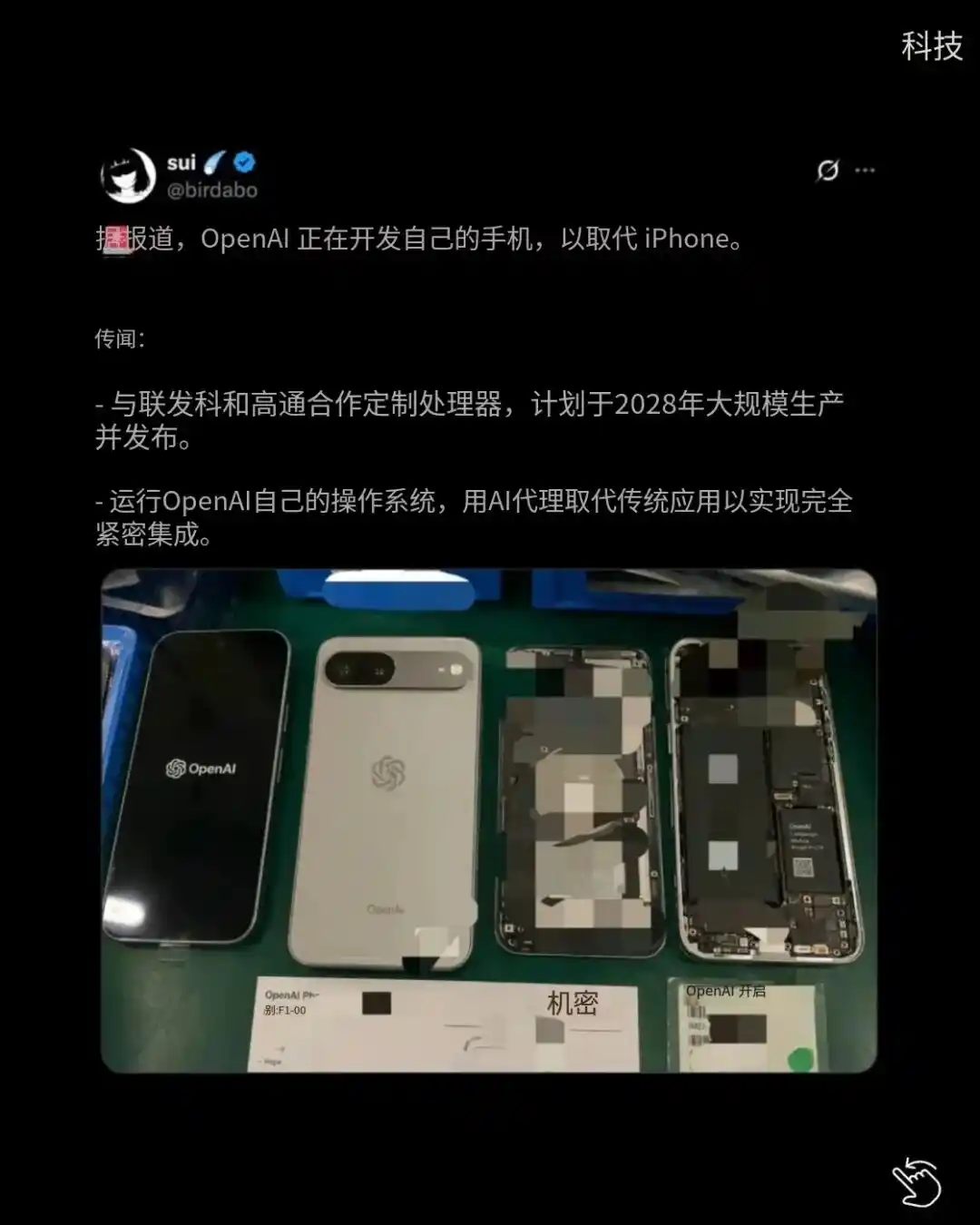
According to leaks, OpenAI is accelerating development of its first AI Agent phone, with mass production as early as the first half of 2027 and a target of shipping 30 million units over the next two years.

Is it crazy?

Probably not. OpenAI has likely already seen a more dangerous problem clearly: ChatGPT is smart, but it doesn't have hands.

It can answer you, but it has a hard time completing tasks for you. It lives in other people's systems—Apple's, Microsoft's, operating systems, browsers—so it can't get the real permissions.

What we want to discuss next isn't why OpenAI wants to build a phone. It's how this company came to realize, step by step, that without its own terminal device, ChatGPT can never truly break free.

ChatGPT's Success is Also a Form of Path Dependency

In April 2026, SpaceX secured an option: it could acquire Cursor for up to $60 billion later in the year.

OpenAI's initial belief wasn't in phones, browsers, or any particular App. It believed in the model—or more precisely, in intelligence itself.

In its worldview, as long as the model is powerful enough, the entry point, product, and business model will all be pushed forward by intelligence.

This wasn't just talk. In 2020, OpenAI published the later frequently cited Scaling Laws paper, establishing a relatively optimistic belief: by scaling up the model, data, and compute together, intelligence would improve in a predictable way.

In other words, the most important thing wasn't to grab an entry point first, but to make the model even stronger. With strong enough intelligence, the world would naturally make way.

This belief was realized on November 30, 2022.
That day ChatGPT launched. It had no flashy interface, no hardware, no platform pre-installation, just an input box on a webpage. But it gave ordinary people an experience they'd never had before: you type a sentence, and it replies like a human.

The awe wasn't just that AI could talk, but that it had barely relied on any traditional entry point. No phone manufacturers pushed it, no operating system placed it in a prominent spot; users found it themselves.

Two months, 100 million monthly active users—the fastest-growing consumer application in human history.

OpenAI seemed to be right. Microsoft immediately doubled down, embedding its capabilities into Copilot, Office, and Bing; Apple also integrated ChatGPT into Apple Intelligence at WWDC 2024.

At that moment, OpenAI stood at the center of the era. The strongest model, the most users, the deepest partnerships.

But that's precisely where the problems started.

ChatGPT's success was too dazzling. So dazzling that it easily made OpenAI believe: the model itself is the entry point. It didn't need to own a phone first, nor control an operating system first—if the intelligence was impressive enough, users would come find it.

The real cracks that emerged later also started here.

Claude Code Rewrote the Rules of Monetization

The first crack came from Anthropic.

In May 2025, it released Claude Code. No flashy demo, no blockbuster launch event. This product simply entered developers' terminals, codebases, and Git workflows, helping engineers get the job done.

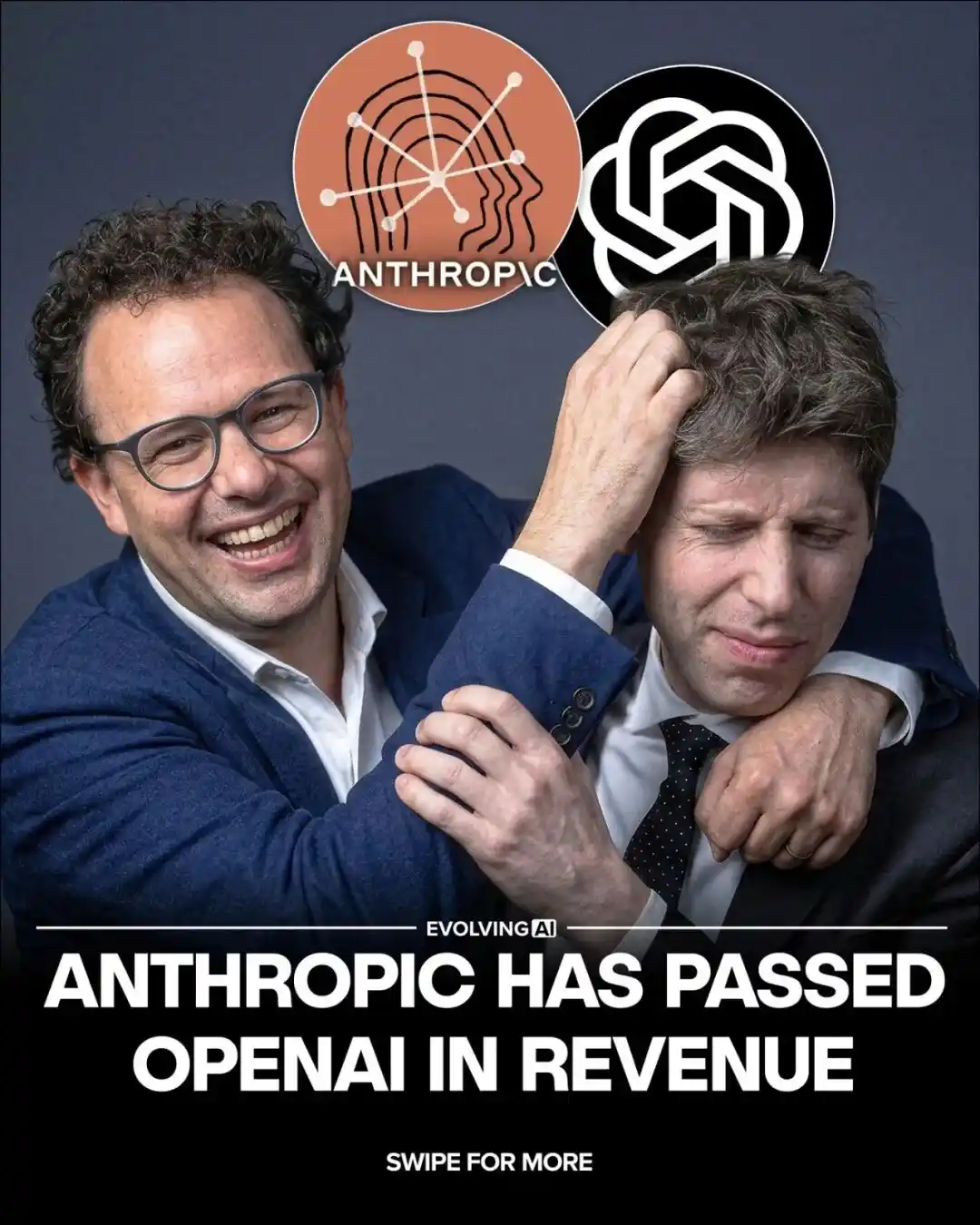
Six months after launch, Claude Code reached a $1 billion annual run rate; in less than a year, over $2.5 billion. By April 2026, Anthropic's overall annualized revenue crossed $30 billion.

Meanwhile, OpenAI was at $2 billion monthly revenue, or roughly $24 billion annualized.

Anthropic achieved higher revenue with far fewer users than ChatGPT. This is what OpenAI should truly be worried about.

The reason is simple—it captured a group of people most willing to pay.

The question is, why was OpenAI a step slower?

Not because it couldn't see Agents. It was because ChatGPT's success was too dazzling, so dazzling that OpenAI continued moving forward with its original inertia: make a stronger model, expand the user base, find the next universal entry point.

So over these past two years, you've seen OpenAI attempt many 0-to-1 projects—GPT Store, Sora, Operator, Deep Research—all born from this line of thinking. They collectively point to one judgment: as long as the model is strong enough, new products, new entry points, new business models will naturally emerge.
But Anthropic chose a different path. It didn't first create a super entry point for everyone. Instead, it nailed Claude Code into developers' workflows, repeatedly polishing one thing—letting AI finish the job.

This is where OpenAI was slow. It wasn't that it didn't make new products, but that it didn't immediately take a high-paying-use-case scenario from 1 to 100.

Sora is a classic example. It stunned the world upon release, but video generation consumed vast amounts of compute, and user retention and the business model weren't clear enough. When OpenAI later shut down Sora, it was, in a sense, a pruning—it began to realize that creating a stunning AI demo and penetrating a high-value workflow are two different things.

Model capabilities can create highlights, but commercial efficiency comes from consistently delivering results.

At this point, OpenAI finally realized: Agent isn't an add-on feature; it's the core of the next phase of AI commercialization. ChatGPT can't just prove it's smart; it must prove it can complete tasks for users.

But when it truly starts taking over tasks, what it hits isn't the ceiling of model capability, but the ceiling of permissions.

900 Million Users, How to Turn Them into Money

OpenAI is, of course, catching up. In May 2025, it launched Codex, directly responding to Claude Code. By April 2026, Codex reached 3 million weekly active users.

But in the coding battle, OpenAI will find it hard to win back in the short term—Anthropic has already captured the mindshare for coding Agents, leaving the follower to play catch-up.

This is also why OpenAI began reallocating resources: shifting attention from projects that easily create hype but struggle to achieve commercial closure, towards Agents, the enterprise market, and more fundamental research.

But what it really needs to look at is its bigger card—900 million weekly active users.

These people aren't programmers; they won't pay for code. But they all have needs: writing emails, making proposals, researching, booking travel, shopping, organizing files.

If ChatGPT can evolve from a "conversational" entry point to a "task-completing" entry point, that would be OpenAI's true commercial capability.

Imagine this scenario: you want to buy a plane ticket, tell ChatGPT the time, budget, preferences. It searches flights, compares prices, checks hotels for you, and finally gives you a confirmation button.

At that moment, part of Ctrip's value is bypassed. Price comparison, ad slots, commissions, user decision influence—all would be redistributed. Buying insurance, paying credit card bills, settling utility bills follow the same logic. As long as the Agent can complete tasks for you, OpenAI has a chance to take a cut of every transaction commission, every advertising influence within.

This is where the true value of 900 million users lies—ChatGPT no longer just answers questions, but starts taking over task and transaction entry points.

But once AI starts handling tasks, it's no longer just a model in a chatbox. It needs to know where you are, see what's happening on your screen, and access your files, calendar, emails, and payments.

The problem thus shifts from "Is the model strong enough?" to "Who has the permissions?"

And permissions are precisely what OpenAI lacks.

ChatGPT Lives in Someone Else's House

OpenAI initially thought partnerships could solve the entry point problem. Apple gave it the iPhone, Microsoft gave it Office, Windows, and enterprise customers. At the time, this looked like a victory for OpenAI's faith in models.

But with the advent of the Agent era, the problem changed.

In Apple's world, ChatGPT is an external expert that gets called upon. It can answer questions, but it cannot truly take over the screen, camera, notifications, payments, and files—Apple won't hand over these permissions. Otherwise, the iPhone's "soul" would no longer belong to Apple.

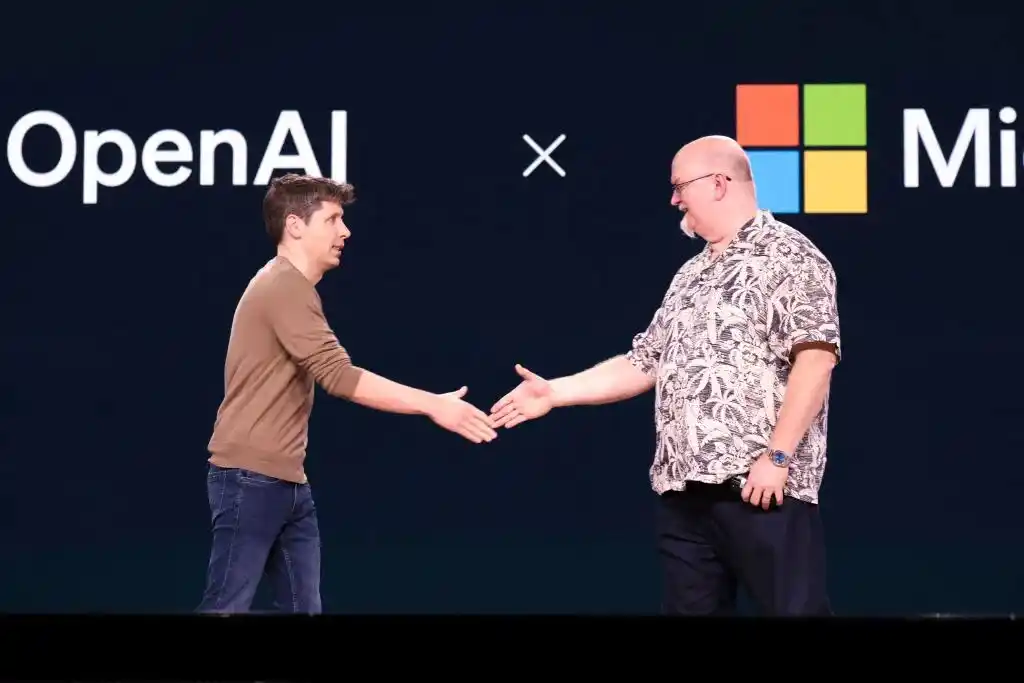
It's similar with Microsoft. In the past, OpenAI provided the model, and Microsoft was responsible for integrating AI into entry points like Office. But when OpenAI itself started making Codex and enterprise Agents, it stepped onto Microsoft's turf—Agents inherently enter workflows, write code, process files, and complete tasks for employees, which is exactly the core of Microsoft's sovereignty.

So, the relationship between OpenAI and Microsoft hasn't broken immediately, but the boundaries have shifted. In April 2026, the two parties renegotiated their agreement, with Microsoft's exclusive licensing becoming non-exclusive, allowing OpenAI to serve customers on any cloud.

The meaning of this is clear: OpenAI doesn't want to be just a supplier within the Microsoft ecosystem. It wants to face customers itself, deliver Agents itself, and capture entry points itself.

At this point, its relationships with Apple and Microsoft become delicate. Because what an Agent needs isn't a showcase spot, but the default entry point, system permissions, and the intelligent terminal the user interacts with first every day.

These things, Apple won't give, and Microsoft won't either. They can't.

Ultimately, ChatGPT is strong, but it always lives in someone else's house—Apple's house, Microsoft's house, the browser's house, the operating system's house. It can be called upon, integrated, and be a great supplier, but it can't decide when it appears, nor what permissions it gets.

And the phone is the one closest to its resource endowment. 900 million weekly active users are already willing to hand questions to ChatGPT—migrating this mindset to a device is a shorter path than building an operating system or a browser from scratch.

It's not trying to make another iPhone filled with Apps, but a phone dedicated to Agents—a body that allows ChatGPT to see, call upon, and execute tasks.
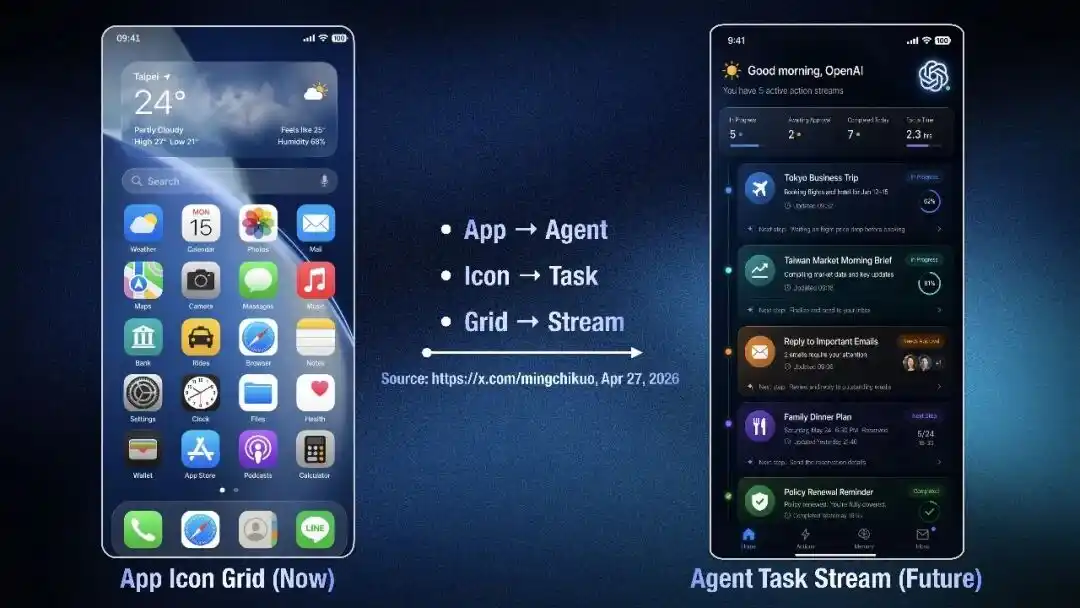
This is also why in May 2025, OpenAI spent approximately $6.5 billion to acquire Jony Ive's hardware company. This person is the industrial designer of the original iPhone, one of the most important figures beside Steve Jobs. OpenAI sought him not just to make a beautiful piece of hardware, but to redefine personal devices for the AI era.

Returning to the opening question: why would a large language model company make a phone?

What OpenAI wants isn't a phone; it's sovereignty.

It wants to find a default entry point that belongs to ChatGPT itself. But making a phone essentially pushes OpenAI into direct opposition with Apple. In the past, Apple could treat ChatGPT as a supplier; if OpenAI truly makes a phone for the AI era, it's no longer a supplier but a competitor to Apple for personal entry points.

Looking back over these past few years, OpenAI's story has actually undergone a reversal.

It once believed that if the model was strong enough, the world would actively reorganize itself around intelligence. ChatGPT's explosion did prove this—it had no hardware, no pre-installation, just a webpage input box, and pulled hundreds of millions of users into the AI era.

But when the Agent era arrived, OpenAI found it still lacked the most crucial thing: sovereignty.

ChatGPT's success was a victory, but also a form of path dependency. It made OpenAI believe for too long that the model itself was the answer. It wasn't until Claude Code reached a $2.5 billion annual run rate, and until Apple and Microsoft were unwilling to hand over system permissions, that OpenAI realized: no matter how strong the model is, it still needs to capture the entry point, permissions, and tasks.

So, when OpenAI makes a phone, what it truly wants to make isn't a phone; it's ChatGPT's first body.

This article is from the WeChat public account "Pixel 301", author: Pixel 301

Perguntas relacionadas

QWhat is the primary reason OpenAI is reportedly developing an AI phone, according to the article?

ATo gain sovereign control over a default entry point and system permissions for ChatGPT, allowing it to function as a true AI Agent that can execute tasks, rather than relying on other platforms like Apple or Microsoft which limit its access.

QWhat key competitor move exposed a flaw in OpenAI's growth strategy, and how did it outperform ChatGPT financially?

AAnthropic's release of Claude Code targeted the high-paying developer workflow, generating $25 billion in annualized revenue within a year by focusing on completing tasks, while OpenAI, with more users, had lower annualized revenue of about $240 billion, highlighting that user scale doesn't automatically translate to commercial efficiency in specific high-value workflows.

QWhat strategic shift did OpenAI's acquisition of Jony Ive's hardware firm represent?

AIt represented a move beyond being just a model provider to aiming to redefine personal AI devices. OpenAI sought Ive's expertise to build not just a smartphone, but a dedicated 'body' or terminal for its AI Agent, ChatGPT, to have its own sovereign interface.

QHow did the success of ChatGPT create a 'path dependency' or strategic blind spot for OpenAI?

AChatGPT's viral, hardware-independent success led OpenAI to believe that superior model intelligence alone was sufficient to attract users and define new entry points. This made them slower to prioritize developing deep, commercially closed-loop Agent capabilities for specific high-value tasks, as demonstrated by Anthropic.

QWhy can't partnerships with Apple or Microsoft solve OpenAI's need for system-level permissions in the Agent era?

ABecause neither Apple nor Microsoft will relinquish core system permissions (like screen control, notifications, payments, or deep file access) to an external AI. These permissions define platform sovereignty. For OpenAI's ChatGPT to act as a true task-executing Agent, it needs these permissions, which requires its own controlled hardware entry point.

Leituras Relacionadas

BNB Chain Releases Research Report, Exploring Post-Quantum Cryptography Migration Path for BSC

BNB Chain, a leading Layer-1 blockchain ecosystem, has released a research report exploring the potential migration path for BNB Smart Chain (BSC) to post-quantum cryptography. The study evaluates replacing traditional cryptographic systems with quantum-resistant alternatives, specifically examining the use of ML-DSA-44 for transaction signing and pqSTARK for aggregating validator consensus signatures. While quantum computers are not currently a practical threat to existing blockchain cryptography, the research represents a proactive effort to ensure long-term network security and infrastructure resilience. The report assessed several core areas of the BSC tech stack, including post-quantum transaction signing, validator signature aggregation, transaction validation, public key storage, and network performance under increased data loads. A key finding is that achieving post-quantum readiness is technically feasible today but requires significant trade-offs in scalability. Test data indicates: • Transaction size would increase from ~110 bytes to ~2.5 kilobytes. • Block size would grow from ~110 kilobytes to ~2 megabytes. • Native transfer TPS would decrease from 4,973 to 2,997. The primary performance bottleneck is not signature verification itself, but the increased network transmission overhead caused by larger transaction and block sizes. Conversely, the pqSTARK aggregation technology proved highly efficient, compressing validator signatures by an approximately 43:1 ratio, which helps manage consensus-layer overhead. The report notes that post-quantum alternatives for areas like P2P handshakes and KZG commitments were not within the scope of this evaluation and require further research and broader ecosystem coordination. BNB Chain emphasizes this work is a research-oriented exploration and not a response to any imminent security threat.

marsbitHá 13m

BNB Chain Releases Research Report, Exploring Post-Quantum Cryptography Migration Path for BSC

marsbitHá 13m

After Developer Numbers Halved: Crypto Isn't Dead, It's Just Giving Up Talent to AI

The title "After a 50% Drop in Developer Count: Crypto Isn't Dead, It's Just Ceding Talent to AI" suggests a shift, not an end. The article analyzes GitHub data showing a significant drop in overall Crypto developer activity from a peak of 45K monthly active developers in 2022 to about 23K in 2026. However, this masks a deeper trend of "talent deleveraging." The exodus consists mainly of newcomers who entered during the bull market for hype-driven roles (e.g., NFT contracts, forked DeFi protocols), with over 50% of developers with less than one year of experience leaving. In contrast, established developers (2+ years of experience) have hit record highs, contributing roughly 70% of the code. They are consolidating in ecosystems with real users and revenue, like Bitcoin and Solana. These experienced builders possess unique skills forged in Crypto's "code is law" environment: the ability to build trust and functional systems from scratch in the absence of external authority or rules, with zero tolerance for error. The article argues that AI's scaling faces structurally similar trust, coordination, and verification problems—particularly regarding compute aggregation, multi-agent incentive alignment, and autonomous payments. Crypto builders are already applying these skills in AI. Examples include CoreWeave (mining to AI compute), OpenRouter (NFT marketplace routing to AI model routing), and projects like Hyperbolic (using crypto-native mechanisms for decentralized compute verification) and EigenLayer (applying restaking logic to AI agent governance). Stablecoin infrastructure is becoming critical for AI agent micro-payments (e.g., x402 protocol). The role of these builders is evolving from writing smart contracts to "designing trusted mechanisms for autonomous AI systems." This shift is reflected in new hiring trends at major exchanges and significant venture capital flowing into the crypto-AI convergence (e.g., funds from Paradigm, Haun Ventures). The article concludes that while developer numbers have halved, the core density of talent has increased, and their uniquely cultivated skills are finding a new, larger stage in the AI era.

marsbitHá 23m

After Developer Numbers Halved: Crypto Isn't Dead, It's Just Giving Up Talent to AI

marsbitHá 23m

After the Developer Count Halved: Crypto Is Not Dead, It's Just Ceding Talent to AI

Following a significant decline in the total number of open-source crypto developers, from a peak of 45K in 2022 to approximately 23K by 2026, this article argues the industry is undergoing a "talent deleveraging" rather than a collapse. The exodus primarily consists of newcomers who entered during the bull market, while the core of experienced developers (2+ years) has grown to a record high, contributing around 70% of code. These established builders are concentrating in ecosystems with real users and revenue, like Bitcoin and Solana. The article posits that crypto has cultivated a unique skill set in building trustless, autonomous systems with near-zero tolerance for error—a capability now finding high demand in the AI era. As AI scales, it faces structural gaps in decentralized compute aggregation, multi-agent coordination/incentive alignment, and autonomous payment infrastructure. Crypto builders are transitioning their expertise to address these exact problems. Examples include CoreWeave (mining to AI compute), Hyperbolic (decentralized compute verification), EigenLayer (extending restaking mechanisms to AI agent governance), and the x402 protocol (enabling AI agent micro-payments via stablecoins). The role of the crypto builder is evolving from writing smart contracts to designing the rule-based, trust-minimized frameworks necessary for AI-native systems. Venture capital is increasingly funding this convergence, viewing it as a structural opportunity rather than a narrative shift. The core talent and systemic design principles from crypto are not disappearing but being re-priced and applied to the foundational challenges of scalable AI.

链捕手Há 27m

After the Developer Count Halved: Crypto Is Not Dead, It's Just Ceding Talent to AI

链捕手Há 27m

A Quick Look at the Latest Moves of the 24-Year-Old 'AI Stock God': Sixty Percent of the Portfolio Hedging Against Semiconductor Downturn

24-year-old AI investing prodigy Leopold Aschenbrenner's fund, Situational Awareness LP, has disclosed its Q1 2026 13F holdings. The fund's total portfolio nominal value surged 148% to $13.7 billion, driven by both investment gains and significant new capital inflows. The most striking move was the establishment of massive short-term hedges against potential volatility in the AI semiconductor sector. Over 60% of the fund's nominal exposure is now in put options (bets on declines) targeting major AI hardware stocks like NVIDIA (NVDA), VanEck Semiconductor ETF (SMH), Broadcom (AVGO), and AMD. Notably, the fund also holds call options (bets on rises) on some names like Micron (MU) and TSMC, indicating it expects extreme price swings in these stocks. Alongside these hedges, the fund remains a long-term bull on AI infrastructure. It significantly increased its equity stakes in companies like GPU cloud provider CoreWeave (CRWV) and added to positions in power/energy infrastructure firms like Bloom Energy (BE), albeit after taking substantial profits on the latter. The fund also exited positions in optical communication hardware (LITE, COHR) and reduced leverage by clearing out large call option positions on Intel and CoreWeave. In essence, the portfolio reflects a dual strategy: cautious on near-term semiconductor valuations and potential over-extension, while maintaining a conviction that the true long-term bottlenecks and value will be in the underlying infrastructure powering the AI revolution—such as energy, data centers, and compute availability.

marsbitHá 33m

A Quick Look at the Latest Moves of the 24-Year-Old 'AI Stock God': Sixty Percent of the Portfolio Hedging Against Semiconductor Downturn

marsbitHá 33m

Trading

Spot
Futuros

Artigos em Destaque

Como comprar LA

Bem-vindo à HTX.com!Tornámos a compra de Lagrange (LA) simples e conveniente.Segue o nosso guia passo a passo para iniciar a tua jornada no mundo das criptos.Passo 1: cria a tua conta HTXUtiliza o teu e-mail ou número de telefone para te inscreveres numa conta gratuita na HTX.Desfruta de um processo de inscrição sem complicações e desbloqueia todas as funcionalidades.Obter a minha contaPasso 2: vai para Comprar Cripto e escolhe o teu método de pagamentoCartão de crédito/débito: usa o teu visa ou mastercard para comprar Lagrange (LA) instantaneamente.Saldo: usa os fundos da tua conta HTX para transacionar sem problemas.Terceiros: adicionamos métodos de pagamento populares, como Google Pay e Apple Pay, para aumentar a conveniência.P2P: transaciona diretamente com outros utilizadores na HTX.Mercado de balcão (OTC): oferecemos serviços personalizados e taxas de câmbio competitivas para os traders.Passo 3: armazena teu Lagrange (LA)Depois de comprar o teu Lagrange (LA), armazena-o na tua conta HTX.Alternativamente, podes enviá-lo para outro lugar através de transferência blockchain ou usá-lo para transacionar outras criptomoedas.Passo 4: transaciona Lagrange (LA)Transaciona facilmente Lagrange (LA) no mercado à vista da HTX.Acede simplesmente à tua conta, seleciona o teu par de trading, executa as tuas transações e monitoriza em tempo real.Oferecemos uma experiência de fácil utilização tanto para principiantes como para traders experientes.

277 Visualizações TotaisPublicado em {updateTime}Atualizado em 2025.06.04

Como comprar LA

Discussões

Bem-vindo à Comunidade HTX. Aqui, pode manter-se informado sobre os mais recentes desenvolvimentos da plataforma e obter acesso a análises profissionais de mercado. As opiniões dos utilizadores sobre o preço de LA (LA) são apresentadas abaixo.

活动图片