Who Owns the Most Bitcoin in 2026

marsbitPublicado em 2026-03-29Última atualização em 2026-03-29

Resumo

Based on blockchain data analysis, the largest holder of Bitcoin in 2026 is its pseudonymous creator, Satoshi Nakamoto, who possesses approximately 1.096 million BTC (valued at ~$77 billion). The largest single wallet belongs to the Binance exchange cold wallet, holding nearly 250,000 BTC. The top entities by holdings are: * **Satoshi Nakamoto:** 1.096M BTC * **Coinbase (Exchange):** 982,000 BTC * **BlackRock (ETF Issuer):** 775,000 BTC * **Binance (Exchange):** 655,000 BTC * **US Government (via asset seizures):** 328,000 BTC Other major holders include Fidelity, other ETF issuers, and corporations like MicroStrategy, which holds 739,000 BTC. The analysis groups wallets into "entities" for a more accurate representation of ownership. The data highlights Bitcoin's evolution from a niche project to a significant global asset held by major financial institutions, corporations, and governments.

Article Compiled: Block unicorn

Preface

If different wallets are consolidated into a single entity, Satoshi Nakamoto, the anonymous creator of Bitcoin, is the largest holder, possessing 1.096 million BTC (approximately $77 billion). Arkham's labeling originates from a known mining pattern called the "Patoshi Pattern" and includes the only (known) address where Satoshi spent Bitcoin. Research indicates he obtained this Bitcoin as a reward for mining 22,000 blocks.

In terms of individual addresses, the wallet holding the most Bitcoin is Binance exchange's cold wallet, holding nearly 250,000 BTC.You can also view the entities holding the most Bitcoin. An entity refers to a confirmed collection of crypto addresses controlled by the same person or institution (e.g., an exchange, DeFi protocol, or company).

Bitcoin is a decentralized digital currency operating on a blockchain (a peer-to-peer network). Due to these characteristics, no one truly owns the entire Bitcoin network, but individuals can access and own Bitcoin through their private keys.

Bitcoin's price has risen significantly, reaching approximately $126,000 in October 2025, with a peak market capitalization of $2.48 trillion, creating multiple Bitcoin billionaires and other wealthy holders. In this article, we will examine some individuals, companies, and wallets that have become crypto whales based on on-chain data and their own public statements, and investigate the amount of Bitcoin they hold.

Summary

  • Satoshi Nakamoto is the largest Bitcoin holder, with approximately 1.1 million BTC, worth about $77 billion at current prices.

  • Coinbase is the second-largest entity, holding 982,000 BTC.BlackRock holds 775,000,Binance holds 655,000,Fidelity Custody holds 460,000, and Strategy holds 443,000 (although Strategy controls 738,000 BTC, due to its consolidated custody approach, some of this is attributed on-chain toFidelity Custody).

  • The U.S. government holds 328,000 BTC. These Bitcoins come from asset seizures from criminal organizations.

  • There are also multiple unidentified Bitcoin billionaires. There are numerous wallets, most of which have been inactive since the first inflows.

Largest Bitcoin Wallets

We group wallets associated with individuals or organizations into "entities." Entities are useful because, for security and operational reasons, large holders rarely keep all their assets in one wallet. By grouping all associated wallets into one entity, we can more accurately and completely represent that entity's total holdings and influence in the cryptocurrency market.

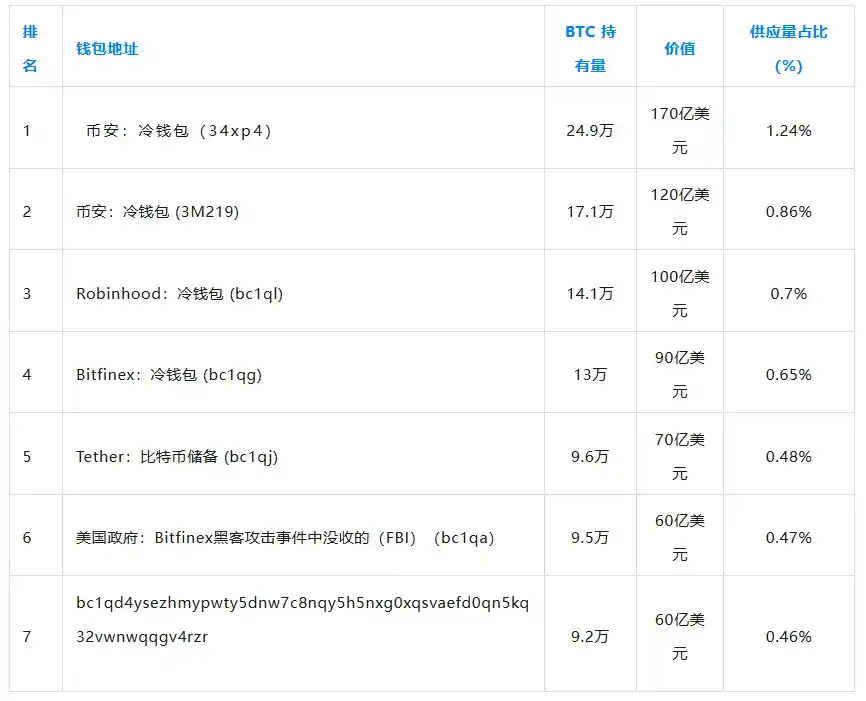
However, it is also possible to view individual wallets without categorizing them into their corresponding entities. The table below lists the largest individual wallets. The top four are all cold wallets controlled by the world's largest exchanges.

The fifth-largest wallet is controlled by the U.S. government,from seizures in the Bitfinex hack incident. The sixth-largest wallet is controlled by Tether for managing its Bitcoin reserves.
Top Holders by Category

Below are the top Bitcoin holders from various major entity categories (individuals, exchanges, ETF issuers, government agencies, publicly listed companies, and private companies).

Strategy's full holdings are listed in parentheses next to its on-chain confirmed positions.

Exchanges

Coinbase has the largest exchange holdings of Bitcoin, with its own and its customers' Bitcoin custodied at Coinbase. Coinbase also invests some of its net income in crypto assets and holds a certain amount of Bitcoin for operations, such as meeting customer withdrawal needs at any time.

Binance, Robinhood, and Upbit are also large exchange holders of Bitcoin. The cold wallets controlled by exchanges custody customer deposits and typically do not represent ownership by the exchange.

At the time of writing, Coinbase holds 5% of the total Bitcoin supply, while Binance holds 3.3%.

ETF Issuers

Since the launch of U.S. spot Bitcoin ETFs in January 2024, Arkham was the first to identify all ETF positions on-chain.

These include the following companies:

  • BlackRock

  • <极p>Fidelity

  • Grayscale

  • Bitwise

  • ARK Invest

Grayscale is an asset management company offering a range of products for the public markets. The company is a subsidiary of Digital Currency Group. All digital assets for Grayscale's financial products are also custodied at Coinbase. While Grayscale publicly discloses its Bitcoin balance, they declined to reveal the trust's on-chain addresses—we successfully found these addresses on-chain, distributed across over 1,750 different addresses, each holding no more than 1,000 BTC.

Governments

Many of the world's largest countries have confirmed holdings of Bitcoin or have held it in the past.

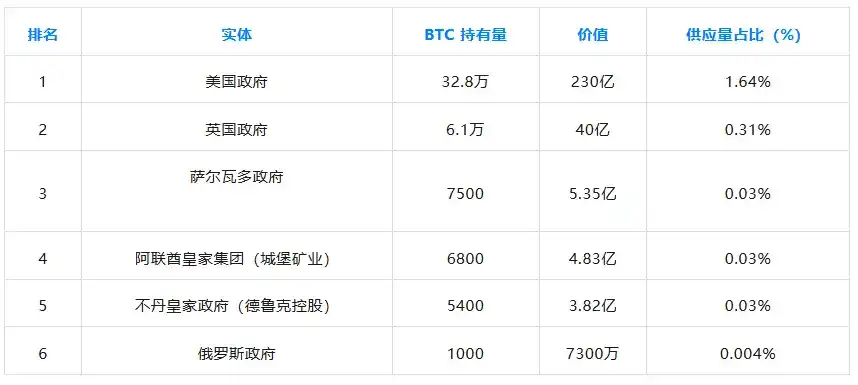
Data from our sources shows the following are the five governments with the most Bitcoin holdings verified on-chain. There may be more governments holding Bitcoin, but their holdings have not been verified.
Asset Seizures

The United States tops the list with a wallet size of 328,000 BTC. This Bitcoin was recovered by the U.S. Federal Bureau of Investigation (FBI) from the Bitfinex hack and seized from the Silk Road market and its hacker James Zhong. Recently, the U.S. government also obtained 127,000 BTC from the LuBian Hacker's address.

The United Kingdom holds 61,245 BTC. The UK's Metropolitan Police seized 61,000 BTC from Jian Wen and Zhimin Qian in 2018 and gained access to these seized Bitcoins in July 2021.

In November 2020, Chinese authorities confiscated 194,775 BTC from the operators of the PlusToken Ponzi scheme. These tokens were confiscated for local governments, but it is unclear whether China still holds them or has sold them.

Since the Russo-Ukrainian War, Ukraine has also received Bitcoin donations worth $22.8 million. According to data released by the Ukrainian government in April 2021, over 700,000 Ukrainian public officials declared holdings of Bitcoin, with some holding up to 18,000 BTC. Allegedly, Ukrainian public officials collectively hold 46,351 BTC. While officials' Bitcoin holdings are not strictly government assets, the large-scale public holding of Bitcoin by civil servants is still significant and unusual.

In January 2024, the German government seized 50,000 BTC from a movie piracy website called Movie2k. However, these Bitcoins were all sold in July 2024.

Sovereign Adoption

Unlike most countries that confiscate and hold Bitcoin through criminal arrests, El Salvador boldly recognizes Bitcoin as legal tender. El Salvador famously spent $108 million to purchase 2,546 BTC. Additionally, in November 2022, Salvadoran President Nayib Bukele announced that the country would also buy 1 Bitcoin daily.

Bhutan has been mining Bitcoin since 2019. In May 2023, Bhutan's sovereign wealth fund, Druk Holding & Investments, announced a $500 million partnership with Bitdeer to expand its Bitcoin mining operations. Given Bhutan's geographical advantages, the country has built numerous hydropower plants along its glacial rivers. Today, Bhutan will use its cheap and abundant hydropower for Bitcoin mining and invest the proceeds in national development.

The United Arab Emirates (UAE) is actively positioning itself as a global cryptocurrency hub. Recently, we discovered large-scale mining activity in the UAE. The UAE holds 6,800 BTC. This Bitcoin comes from Citadel's mining operations. Citadel is a listed mining company controlled by the UAE's Royal Group through IHC (International Holding Company).

Publicly Listed Companies

As Bitcoin's value as a digital asset becomes increasingly recognized and accepted, publicly listed companies are incorporating Bitcoin into their investment strategies or diversifying their corporate reserves.

Led by Michael Saylor, Strategy (formerly MicroStrategy) holds more Bitcoin than any other publicly listed company. The company has been accumulating Bitcoin since August 2020, making purchases of varying sizes every few weeks. Its total holdings are 739,000 BTC.

MARA is a listed Bitcoin mining company in North America and another company holding a significant amount of Bitcoin. The company operates 9 mining farms, with an average daily production of 22.7 BTC in September 2025. According to our data, MARA's on-chain wallets hold 13,000 BTC (worth $864 million). However, it is reported that the company also holds a treasury reserve of 53,200 BTC.

Tokyo-listed Metaplanet is hailed as "Japan's MicroStrategy." The company is acquiring Bitcoin as its primary reserve asset, citing it as a key hedge against the long-term depreciation of the yen and broader economic uncertainty. Metaplanet currently holds 35,100 BTC (approximately $2.4 billion).

Private Companies

According to verified on-chain data, the two private companies holding the most Bitcoin are Tether (96,300) and SpaceX (8,300).

SpaceX first purchased Bitcoin in 2021 and once held 28,000. However, its holdings have since significantly decreased. In August this year, SpaceX's Bitcoin was worth $1 billion.

According to the Bitcoin Treasuries website, Block.one is currently the private company holding the most Bitcoin, with 164,000. Block.one is a private technology and investment company known for developing the open-source blockchain software EOSIO. Its massive holdings cannot be verified on-chain.

Unattributed Wallets

To further explore these unattributed wallets, you can copy the addresses yourself and paste them into a data platform for search.

Conclusion

Bitcoin, which started as a niche project for cryptography enthusiasts, has evolved into a financial asset of global importance, held by numerous companies, individuals, and government agencies. Bitcoin's great appeal to users stems from its decentralized nature. This characteristic ensures that the Bitcoin network is not completely controlled by anyone; even the most determined attacker would find it almost impossible to control the entire network due to the extremely high cost.

Bitcoin's maximum supply of 21 million is a fundamental element of the project's design, ensuring it remains scarce and is not inflated to drive up its value. Considering that approximately 3.7 million BTC are permanently stuck in inaccessible wallets, the actual total supply of Bitcoin is even lower.

Criptomoedas em alta

Perguntas relacionadas

QWho is the largest holder of Bitcoin in 2026, and how much do they hold?

ASatoshi Nakamoto, the anonymous creator of Bitcoin, is the largest holder with 1.096 million BTC (worth approximately $77 billion).

QWhich exchange holds the most Bitcoin in its cold wallets, and what is the amount?

ABinance holds the most Bitcoin in its cold wallets, with nearly 250,000 BTC.

QWhat is the total amount of Bitcoin held by the US government, and how was it acquired?

AThe US government holds 328,000 BTC, which was seized from criminal organizations, including assets from the Bitfinex hack and the Silk Road market.

QWhich publicly traded company holds the most Bitcoin, and what is their strategy?

AMicroStrategy (now known as Strategy) holds the most Bitcoin among publicly traded companies, with 739,000 BTC. The company has been accumulating Bitcoin since August 2020 as a primary reserve asset.

QWhich country has adopted Bitcoin as legal tender, and how much have they purchased?

AEl Salvador has adopted Bitcoin as legal tender and has purchased 2,546 BTC, with plans to buy one Bitcoin daily starting from November 2022.

Leituras Relacionadas

Ethereum Q1 2026 Report: Fees Decline, Users and Transaction Volume Hit New Highs

Ethereum Q1 2026 Report: Fees Down, Users & Transactions Hit New Highs Token Terminal's Q1 2026 report on Ethereum presents a pivotal development: the network achieved record highs in monthly active users (13.2M, +85.9% YoY), total transactions (200.4M, +81.5% YoY), and throughput (25.78 TPS), while transaction fees on the mainnet plummeted by 47.9% quarter-over-quarter. This shift is attributed to the network's strategic move into a "low fees for scale" phase, exemplified by the Fusaka upgrade which increased data capacity and lowered block space costs, releasing pent-up demand (a manifestation of Jevons's Paradox). The report highlights a core narrative shift for Ethereum: from a DeFi-centric blockchain to a global financial settlement layer. It maintains a dominant position in tokenized assets, holding majority market shares among top chains in stablecoins (61.8%), tokenized funds (73.0%), and tokenized commodities (84.0%). Growth in tokenized funds (+73.1% YoY) and commodities (+325.9% YoY) was particularly strong, driven by institutions like BlackRock and JPMorgan entering the space. Contrasting these usage gains, several USD-denominated value metrics declined in Q1: fully diluted market cap fell 30.3% QoQ, total value locked (TVL) dropped 11.0%, and ecosystem transaction volume decreased 24.0%. The report interprets this as Ethereum prioritizing long-term network expansion and cementing its role as the default settlement layer for finance over short-term fee capture. The commentary from Etherealize argues that, much like the early internet, Ethereum's open, permissionless model is poised to win over closed alternatives as institutional tokenization accelerates.

marsbitHá 1h

Ethereum Q1 2026 Report: Fees Decline, Users and Transaction Volume Hit New Highs

marsbitHá 1h

He Just Raised 2.7 Billion, and Li Fei-Fei Also Invested

Pete Florence, a former senior research scientist at Google DeepMind and a key contributor to the Vision-Language-Action (VLA) model architecture, is deliberately distancing his startup, Generalist AI, from the trendy "world model" label. He argues that the industry should prioritize concrete goals over buzzwords. His goal is to create robots that can perform a vast range of unseen tasks with high speed and success rates, without needing task-specific training data. Recently, his company raised $400 million (¥2.7 billion) at a $2 billion valuation. Notable investors include NVIDIA's NVentures, Bezos Expeditions, NFDG, as well as Xiaomi co-founder Lin Bin, Zoom founder Eric Yuan, and renowned AI scientist Fei-Fei Li. Florence's approach stems from his academic background at MIT under Professor Russ Tedrake, focusing on understanding the physical world. After joining DeepMind, he developed models like Transporter Network and co-created the VLA framework. He left in 2025 to found Generalist AI. The company has launched two models: GEN-0, which demonstrated that scaling laws apply to physical motion, and GEN-1. GEN-1 was trained on over 500,000 hours of physical interaction data collected via a specialized wearable device. It achieves a 99% success rate on precise mechanical tasks like folding boxes and maintains performance three times faster than its predecessor. Florence believes GEN-1 is reaching a commercial utility threshold similar to the GPT-3 inflection point. The substantial funding round, following GEN-1's release, signifies strong investor confidence in Generalist AI's practical, goal-driven path to creating versatile, useful robots, regardless of the "world model" terminology.

marsbitHá 1h

He Just Raised 2.7 Billion, and Li Fei-Fei Also Invested

marsbitHá 1h

Two Legends Lost in Three Days: Is Google's AI Talent Dam Cracking?

In three days, Google lost two AI legends. On June 18, Noam Shazeer, co-author of the seminal "Attention is All You Need" paper and Gemini co-lead, left for OpenAI. Just 48 hours later, John Jumper, 2024 Nobel laureate and AlphaFold lead, departed DeepMind for Anthropic. This follows Andrej Karpathy joining Anthropic in May. These moves highlight a structural trend: top AI talent is concentrating at mission-driven, pre-IPO firms like OpenAI and Anthropic, while Google becomes a primary source. The exodus stems from a core mission mismatch. Google's ad-centric model often subordinates AI research to product and revenue goals, creating friction for pioneers like Shazeer, who returned in 2024 only to leave again. In contrast, OpenAI and Anthropic offer singular focus on pushing AI boundaries, whether towards AGI or safety-aligned models, which deeply appeals to top researchers like Jumper. Financial incentives amplify the pull. With both OpenAI and Anthropic nearing IPO, employees stand to gain immensely from equity, an upside Google's mature stock cannot match. Furthermore, the 2023 merger of Google Brain and DeepMind, intended to consolidate strength, has instead created cultural tension and slowed the path from research to product, as evidenced by Gemini's pace. This talent redistribution is reshaping the AI landscape. While Google retains vast data and compute resources, its true crisis is the quiet, continuous loss of the people who define the field's future. The real moat in AI is not infrastructure, but the concentration of brilliant minds—a battle Google is currently losing.

marsbitHá 3h

Two Legends Lost in Three Days: Is Google's AI Talent Dam Cracking?

marsbitHá 3h

Behind the AI Report Card, Lies a Chinese 'Exam Setter'

Beyond the familiar performance charts like MMLU-Pro and MMMU, which major AI models strive to ace, stands a key "examiner": Chinese-Canadian researcher Wenhu Chen. An assistant professor at the University of Waterloo and founder of TIGERLab, Chen addresses the crucial need for more rigorous AI evaluation. As models like GPT-4 began scoring near-perfect results on older benchmarks like MMLU, it became difficult to distinguish their true capabilities. In response, Chen introduced MMLU-Pro in 2024, featuring harder, more reasoning-focused questions with more answer choices, successfully reintroducing meaningful performance gaps. His work extends to multi-modal evaluation with MMMU and its enhanced version, MMMU-Pro. These benchmarks test a model's ability to understand and reason with complex information from images, charts, and text across diverse academic subjects, exposing the significant challenges even top models face in genuine comprehension. Chen's background in complex QA, table reasoning, and his experience at Google DeepMind on projects like Gemini inform his approach. He understands that effective benchmarks must anticipate how models might "cheat" by memorizing data or avoiding visual analysis. His lab also actively researches video understanding and generation models (e.g., UniVideo, Vamba), ensuring his evaluation work is grounded in practical model-building challenges. Now at Meta's Super Intelligence Lab, Chen continues his focus on multi-modal data and evaluation, representing the deep yet often unseen contributions of Chinese talent in shaping the fundamental tools of the AI industry.

marsbitHá 3h

Behind the AI Report Card, Lies a Chinese 'Exam Setter'

marsbitHá 3h

Trading

Spot
Futuros

Artigos em Destaque

O que é BITCOIN

Compreender o HarryPotterObamaSonic10Inu (ERC-20) e a Sua Posição no Espaço Cripto Nos últimos anos, o mercado de criptomoedas assistiu a um aumento na popularidade das moedas meme, cativando não apenas os traders, mas também aqueles que procuram envolvimento comunitário e valor de entretenimento. Entre estes tokens únicos está o HarryPotterObamaSonic10Inu (ERC-20), um projeto intrigante que mistura referências culturais no tecido das criptomoedas. Este artigo explora os principais aspetos do HarryPotterObamaSonic10Inu, examinando os seus mecanismos, a sua ética orientada pela comunidade e o seu envolvimento com o vasto panorama cripto. O que é o HarryPotterObamaSonic10Inu (ERC-20)? Como o nome sugere, o HarryPotterObamaSonic10Inu é uma moeda meme construída na blockchain Ethereum, classificada sob o padrão ERC-20. Ao contrário das criptomoedas tradicionais, que podem enfatizar a utilidade prática ou o potencial de investimento, este token prospera no valor de entretenimento e na força da sua comunidade. O projeto visa promover um ambiente onde utilizadores envolvidos possam reunir-se, partilhar ideias e participar em atividades inspiradas por diversos fenómenos culturais. Uma característica notável do HarryPotterObamaSonic10Inu é a zero taxa sobre transações. Este elemento atraente visa encorajar a negociação e o envolvimento da comunidade, isento de encargos adicionais que podem desencorajar os traders de pequena escala. A oferta total da moeda está fixada em mil milhões de tokens, uma cifra que marca a sua intenção de manter uma circulação substancial dentro da comunidade. Criador do HarryPotterObamaSonic10Inu (ERC-20) As origens do HarryPotterObamaSonic10Inu estão um pouco envoltas em mistério; os detalhes sobre o criador permanecem desconhecidos. O desenvolvimento deste token carece de uma equipa identificável ou de um plano explícito, o que não é raro no setor das moedas meme. Em vez disso, o projeto surgiu de forma orgânica, com o seu progresso a depender fortemente do entusiasmo e da participação da sua comunidade. Investidores do HarryPotterObamaSonic10Inu (ERC-20) No que diz respeito a investimentos externos e apoios, o HarryPotterObamaSonic10Inu também permanece ambíguo. O token não lista quaisquer fundações de investimento conhecidas ou apoio organizacional significativo. Em vez disso, o “sangue vital” do projeto é a sua comunidade de base, que informa o seu crescimento e sustentabilidade através da ação coletiva e do envolvimento no espaço cripto. Como Funciona o HarryPotterObamaSonic10Inu (ERC-20)? Como uma moeda meme, o HarryPotterObamaSonic10Inu opera principalmente fora dos quadros tradicionais que muitas vezes governam o valor dos ativos. Existem vários aspetos distintivos que definem como o projeto funciona: Transações Sem Taxas: Sem taxas sobre transações, os utilizadores podem comprar e vender o token livremente, sem a preocupação de custos ocultos. Envolvimento da Comunidade: O projeto prospera na interação da comunidade, aproveitando plataformas de redes sociais para criar entusiasmo e facilitar a participação. Discussões, partilha de conteúdo e envolvimento são elementos cruciais que ajudam a expandir o seu alcance e a fomentar a lealdade entre os apoiantes. Sem Utilidade Prática: Deve ser notado que o HarryPotterObamaSonic10Inu não oferece utilidade concreta dentro do ecossistema financeiro. Em vez disso, é classificado como um token principalmente para entretenimento e atividades comunitárias. Referência Cultural: O token incorpora de forma inteligente elementos da cultura popular para atrair interesse, conectando-se tanto com entusiastas de memes como com seguidores de criptomoedas. HarryPotterObamaSonic10Inu exemplifica como as moedas meme operam de forma diferente de projetos de criptomoedas mais tradicionais, entrando no mercado como construções sociais inovadoras em vez de ativos utilitários. Linha do Tempo do HarryPotterObamaSonic10Inu (ERC-20) A história do HarryPotterObamaSonic10Inu é marcada por vários marcos notáveis: Criação: O token surgiu de um meme viral, capturando a imaginação de muitos entusiastas de criptomoedas. Datas específicas de criação não estão disponíveis, sublinhando a sua ascensão orgânica. Listagem em Exchanges: O HarryPotterObamaSonic10Inu conseguiu entrar em várias exchanges, permitindo um acesso e negociação mais fáceis pela comunidade. Iniciativas de Envolvimento da Comunidade: Atividades contínuas direcionadas a melhorar a interação comunitária, incluindo concursos, campanhas em redes sociais e geração de conteúdo por fãs e defensores. Planos de Expansão Futura: O roteiro do projeto inclui o lançamento de uma coleção de NFTs, mercadorias e um site de eCommerce relacionado aos seus temas culturais, envolvendo ainda mais a comunidade e tentando adicionar mais dimensões ao seu ecossistema. Pontos-Chave sobre o HarryPotterObamaSonic10Inu (ERC-20) Natureza Orientada pela Comunidade: O projeto prioriza a contribuição coletiva e a criatividade, assegurando que o envolvimento dos utilizadores está na vanguarda do seu desenvolvimento. Classificação como Moeda Meme: Representa o epítome da criptomoeda baseada em entretenimento, destacando-se dos veículos de investimento tradicionais. Sem Afiliação Direta com o Bitcoin: Apesar da semelhança no nome do ticker, o HarryPotterObamaSonic10Inu é distinto e não tem qualquer relação com o Bitcoin ou outras criptomoedas estabelecidas. Foco na Colaboração: O HarryPotterObamaSonic10Inu é projetado para criar um espaço de colaboração e partilha de histórias entre os seus detentores, proporcionando uma via para a criatividade e o fortalecimento da comunidade. Perspectivas Futuras: A ambição de expandir além da sua premissa inicial para NFTs e mercadorias delineia um caminho para o projeto potencialmente entrar em avenidas mais mainstream dentro da cultura digital. À medida que as moedas meme continuam a capturar a imaginação da comunidade cripto, HarryPotterObamaSonic10Inu (ERC-20) destaca-se devido aos seus laços culturais e abordagem centrada na comunidade. Embora possa não se encaixar no molde típico de um token orientado para utilidade, a sua essência reside na alegria e camaradagem fomentadas entre os seus apoiantes, destacando a natureza em evolução das criptomoedas em uma era cada vez mais digital. À medida que o projeto continua a desenvolver-se, será importante observar como as dinâmicas comunitárias influenciam a sua trajetória no panorama em constante mudança da tecnologia blockchain.

1.7k Visualizações TotaisPublicado em {updateTime}Atualizado em 2024.12.03

O que é BITCOIN

Como comprar BTC

Bem-vindo à HTX.com!Tornámos a compra de Bitcoin (BTC) simples e conveniente.Segue o nosso guia passo a passo para iniciar a tua jornada no mundo das criptos.Passo 1: cria a tua conta HTXUtiliza o teu e-mail ou número de telefone para te inscreveres numa conta gratuita na HTX.Desfruta de um processo de inscrição sem complicações e desbloqueia todas as funcionalidades.Obter a minha contaPasso 2: vai para Comprar Cripto e escolhe o teu método de pagamentoCartão de crédito/débito: usa o teu visa ou mastercard para comprar Bitcoin (BTC) instantaneamente.Saldo: usa os fundos da tua conta HTX para transacionar sem problemas.Terceiros: adicionamos métodos de pagamento populares, como Google Pay e Apple Pay, para aumentar a conveniência.P2P: transaciona diretamente com outros utilizadores na HTX.Mercado de balcão (OTC): oferecemos serviços personalizados e taxas de câmbio competitivas para os traders.Passo 3: armazena teu Bitcoin (BTC)Depois de comprar o teu Bitcoin (BTC), armazena-o na tua conta HTX.Alternativamente, podes enviá-lo para outro lugar através de transferência blockchain ou usá-lo para transacionar outras criptomoedas.Passo 4: transaciona Bitcoin (BTC)Transaciona facilmente Bitcoin (BTC) no mercado à vista da HTX.Acede simplesmente à tua conta, seleciona o teu par de trading, executa as tuas transações e monitoriza em tempo real.Oferecemos uma experiência de fácil utilização tanto para principiantes como para traders experientes.

4.2k Visualizações TotaisPublicado em {updateTime}Atualizado em 2026.06.02

Como comprar BTC

O que é $BITCOIN

OURO DIGITAL ($BITCOIN): Uma Análise Abrangente Introdução ao OURO DIGITAL ($BITCOIN) OURO DIGITAL ($BITCOIN) é um projeto baseado em blockchain que opera na rede Solana, com o objetivo de combinar as características dos metais preciosos tradicionais com a inovação das tecnologias descentralizadas. Embora partilhe um nome com o Bitcoin, frequentemente referido como “ouro digital” devido à sua percepção como uma reserva de valor, o OURO DIGITAL é um token separado projetado para criar um ecossistema único dentro da paisagem Web3. O seu objetivo é posicionar-se como um ativo digital alternativo viável, embora os detalhes sobre as suas aplicações e funcionalidades ainda estejam em desenvolvimento. O que é o OURO DIGITAL ($BITCOIN)? OURO DIGITAL ($BITCOIN) é um token de criptomoeda explicitamente projetado para uso na blockchain Solana. Em contraste com o Bitcoin, que fornece um papel amplamente reconhecido como armazenamento de valor, este token parece focar em aplicações e características mais amplas. Aspectos notáveis incluem: Infraestrutura Blockchain: O token é construído na blockchain Solana, conhecida pela sua capacidade de lidar com transações de alta velocidade e baixo custo. Dinâmicas de Oferta: O OURO DIGITAL tem um fornecimento máximo limitado a 100 quatrilhões de tokens (100P $BITCOIN), embora os detalhes sobre o seu fornecimento circulante ainda não tenham sido divulgados. Utilidade: Embora as funcionalidades precisas não estejam explicitamente delineadas, existem indicações de que o token poderia ser utilizado para várias aplicações, potencialmente envolvendo aplicações descentralizadas (dApps) ou estratégias de tokenização de ativos. Quem é o Criador do OURO DIGITAL ($BITCOIN)? Neste momento, a identidade dos criadores e da equipa de desenvolvimento por trás do OURO DIGITAL ($BITCOIN) permanece desconhecida. Esta situação é típica entre muitos projetos inovadores no espaço da blockchain, particularmente aqueles alinhados com finanças descentralizadas e fenómenos de moedas meme. Embora tal anonimato possa fomentar uma cultura orientada pela comunidade, intensifica as preocupações sobre governança e responsabilidade. Quem são os Investidores do OURO DIGITAL ($BITCOIN)? As informações disponíveis indicam que o OURO DIGITAL ($BITCOIN) não tem apoiantes institucionais conhecidos ou investimentos proeminentes de capital de risco. O projeto parece operar num modelo peer-to-peer focado no apoio e adoção da comunidade, em vez de rotas de financiamento tradicionais. A sua atividade e liquidez estão principalmente situadas em exchanges descentralizadas (DEXs), como a PumpSwap, em vez de plataformas de negociação centralizadas estabelecidas, destacando ainda mais a sua abordagem de base. Como Funciona o OURO DIGITAL ($BITCOIN) A mecânica operacional do OURO DIGITAL ($BITCOIN) pode ser elaborada com base no seu design de blockchain e nas características da rede: Mecanismo de Consenso: Ao aproveitar o exclusivo proof-of-history (PoH) da Solana combinado com um modelo de proof-of-stake (PoS), o projeto assegura uma validação eficiente das transações, contribuindo para o alto desempenho da rede. Tokenomics: Embora mecanismos deflacionários específicos não tenham sido extensivamente detalhados, o vasto fornecimento máximo de tokens implica que pode atender a microtransações ou casos de uso de nicho que ainda estão por definir. Interoperabilidade: Existe o potencial para integração com o ecossistema mais amplo da Solana, incluindo várias plataformas de finanças descentralizadas (DeFi). No entanto, os detalhes sobre integrações específicas permanecem não especificados. Cronologia de Eventos Chave Aqui está uma cronologia que destaca marcos significativos relacionados ao OURO DIGITAL ($BITCOIN): 2023: O lançamento inicial do token ocorre na blockchain Solana, marcado pelo seu endereço de contrato. 2024: O OURO DIGITAL ganha visibilidade ao tornar-se disponível para negociação em exchanges descentralizadas como a PumpSwap, permitindo que os utilizadores o negociem contra SOL. 2025: O projeto testemunha atividade de negociação esporádica e potencial interesse em envolvimentos liderados pela comunidade, embora não tenham sido documentadas parcerias ou avanços técnicos notáveis até ao momento. Análise Crítica Forças Escalabilidade: A infraestrutura subjacente da Solana suporta altos volumes de transações, o que pode aumentar a utilidade do $BITCOIN em vários cenários de transação. Acessibilidade: O potencial preço de negociação baixo por token pode atrair investidores de retalho, facilitando uma participação mais ampla devido a oportunidades de propriedade fracionada. Riscos Falta de Transparência: A ausência de apoiantes, desenvolvedores ou um processo de auditoria publicamente conhecidos pode gerar ceticismo em relação à sustentabilidade e confiabilidade do projeto. Volatilidade do Mercado: A atividade de negociação depende fortemente do comportamento especulativo, o que pode resultar em volatilidade significativa dos preços e incerteza para os investidores. Conclusão O OURO DIGITAL ($BITCOIN) surge como um projeto intrigante, mas ambíguo, dentro do ecossistema em rápida evolução da Solana. Embora tente aproveitar a narrativa do “ouro digital”, a sua divergência do papel estabelecido do Bitcoin como reserva de valor sublinha a necessidade de uma diferenciação mais clara da sua utilidade pretendida e estrutura de governança. A aceitação e adoção futuras dependerão provavelmente da abordagem da atual opacidade e da definição mais explícita das suas estratégias operacionais e económicas. Nota: Este relatório abrange informações sintetizadas disponíveis até outubro de 2023, e desenvolvimentos podem ter ocorrido além do período de pesquisa.

96 Visualizações TotaisPublicado em {updateTime}Atualizado em 2025.05.13

O que é $BITCOIN

Discussões

Bem-vindo à Comunidade HTX. Aqui, pode manter-se informado sobre os mais recentes desenvolvimentos da plataforma e obter acesso a análises profissionais de mercado. As opiniões dos utilizadores sobre o preço de BTC (BTC) são apresentadas abaixo.

活动图片