Ethereum Q1 2026 Report: Fees Decline, Users and Transaction Volume Hit New Highs

marsbitPublicado em 2026-06-20Última atualização em 2026-06-20

Resumo

Ethereum Q1 2026 Report: Fees Down, Users & Transactions Hit New Highs Token Terminal's Q1 2026 report on Ethereum presents a pivotal development: the network achieved record highs in monthly active users (13.2M, +85.9% YoY), total transactions (200.4M, +81.5% YoY), and throughput (25.78 TPS), while transaction fees on the mainnet plummeted by 47.9% quarter-over-quarter. This shift is attributed to the network's strategic move into a "low fees for scale" phase, exemplified by the Fusaka upgrade which increased data capacity and lowered block space costs, releasing pent-up demand (a manifestation of Jevons's Paradox). The report highlights a core narrative shift for Ethereum: from a DeFi-centric blockchain to a global financial settlement layer. It maintains a dominant position in tokenized assets, holding majority market shares among top chains in stablecoins (61.8%), tokenized funds (73.0%), and tokenized commodities (84.0%). Growth in tokenized funds (+73.1% YoY) and commodities (+325.9% YoY) was particularly strong, driven by institutions like BlackRock and JPMorgan entering the space. Contrasting these usage gains, several USD-denominated value metrics declined in Q1: fully diluted market cap fell 30.3% QoQ, total value locked (TVL) dropped 11.0%, and ecosystem transaction volume decreased 24.0%. The report interprets this as Ethereum prioritizing long-term network expansion and cementing its role as the default settlement layer for finance over short-term fee capture....

Editor's Note: This Q1 2026 report on Ethereum from Token Terminal presents a set of seemingly contradictory yet crucial data points: while the number of users, transaction count, and throughput on the Ethereum mainnet all reached new historical highs simultaneously, transaction fees, TVL, trading volume, and ETH's fully diluted market cap saw quarter-over-quarter declines.

Ethereum is proactively entering a phase of "low fees for scale." Following the Fusaka upgrade which increased data capacity, block space has become cheaper, accelerating growth in users and transactions while temporarily suppressing fee capture. The report interprets this phenomenon as the Jevons Paradox: as the cost of using a resource falls, demand for the network may be further unleashed.

More significantly, Ethereum's core narrative is shifting from that of a DeFi-centric public blockchain to a global financial settlement layer. The report shows Ethereum still maintains dominance in tokenized assets: stablecoins, tokenized funds, tokenized commodities, and tokenized equities have all achieved scale on its network, with notable growth in funds and gold-related assets. The continued entry of institutions like BlackRock, JPMorgan, and Fidelity is also moving "institutional onboarding" from concept to product issuance and settlement practice.

The core value of this report lies not in proving how the ETH price might change in the short term, but in illustrating Ethereum's structural position as financial infrastructure: it is sacrificing short-term fee revenue through scaling on one hand, while on the other, attempting to solidify its network effects in stablecoins, tokenized funds, on-chain credit, and institutional settlement. For investors and industry observers, the key questions to focus on are: as more financial assets migrate on-chain, who will become the default settlement layer, and how will this settlement demand ultimately translate into value capture for ETH.

Below is the original text:

1) Executive Summary

Ethereum ($ETH) is a public, permissionless blockchain that provides global settlement and compute capacity for financial applications in an open economy. It runs a shared ledger that anyone can build on and no single party can shut down, using its native asset ETH to pay for transaction fees; simultaneously, through its staking mechanism, ETH is also used to secure the network.

The activities Ethereum facilitates have historically been constrained by the cost and throughput limitations of traditional financial infrastructure: settlements taking days, multiple intermediary layers adding friction, and counterparty risk at each hop. Tokenization and stablecoins are on-chain solutions emerging to address these frictions. As their regulatory frameworks matured through 2025 and into 2026, the conditions for institutional-scale on-chain activity moved from theory to reality.

Ethereum's role in this transition is that of the foundational settlement layer. Stablecoins, tokenized funds, tokenized commodities, and increasingly, tokenized equities, are being issued and settled on Ethereum; meanwhile, Layer 2 networks are responsible for scaling throughput and ultimately settling transactions back to Layer 1. As the asset that secures and pays for this settlement activity, ETH accrues value from it, and the staking market reflects how much of the ETH supply is committed to this role.

From a market positioning perspective, Ethereum remains the primary venue with the largest market capitalization for tokenized assets. On a cross-chain basis, Ethereum holds majority shares in categories like stablecoins, tokenized funds, commodities, and equities. Ethereum is developed by the Ethereum Foundation alongside a broad, independent community of client teams and researchers; concurrently, organizations like Etherealize help traditional finance better understand the network.

Q1 2026 can be clearly divided into two main narratives. On one hand, usage reached historical highs: monthly active users, transaction count, and throughput all set new records. On the other hand, value and fee metrics denominated in USD saw compression: fully diluted market cap, total value locked, trading volume, and both fee metrics declined quarter-over-quarter. Key events shaping the quarter impacted both narratives: the second Blob Parameters Only (BPO #2) fork within the Fusaka upgrade cycle in January increased data capacity; ERC-8004 went live on the mainnet in February, establishing a standard for AI Agent identity and reputation; the Ethereum Foundation finalized its 2026 Protocol Cluster priorities—scaling, improving user experience, and strengthening Layer 1; furthermore, events like the Institutional Ethereum Forum in March reflected growing institutional engagement.

Key Metrics (Q1 2026)

Ecosystem Total Value Locked: $316.2B (QoQ -11.0%, YoY +22.8%)

Ecosystem Active Loans: $21.8B (QoQ -16.6%, YoY +39.0%)

Ecosystem Trading Volume: $134.5B (QoQ -24.0%, YoY -31.2%)

Ecosystem Fees: $2.0B (QoQ -16.9%, YoY -7.8%)

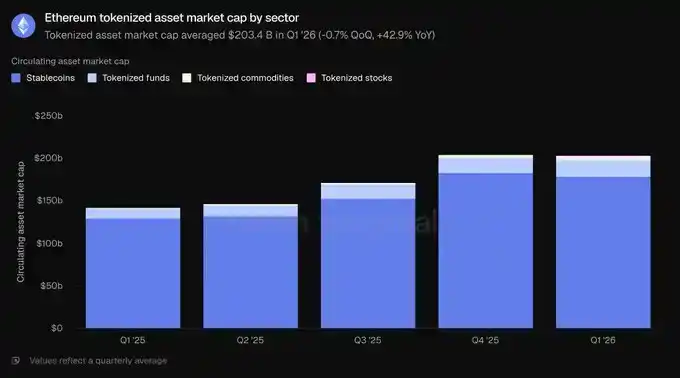
Tokenized Asset Market Cap: $203.4B (QoQ -0.7%, YoY +42.9%)

Stablecoins: $178.9B (QoQ -2.3%, YoY +37.6%)

Tokenized Funds: $19.4B (QoQ +4.9%, YoY +73.1%)

Tokenized Commodities: $4.7B (QoQ +60.0%, YoY +325.9%)

Tokenized Equities: $365.1M (QoQ +16.5%)

Monthly Active Users: 13.2M (QoQ +53.5%, YoY +85.9%)

Transactions: 200.4M (QoQ +38.0%, YoY +81.5%)

Transactions Per Second: 25.78 (QoQ +41.2%, YoY +81.7%)

Fees: $39.9M (QoQ -47.9%, YoY -81.9%)

Fully Diluted Market Cap: $290.0B (QoQ -30.3%, YoY -9.9%)

Stake Ratio: 0.31x (QoQ +0.03x, YoY +0.03x)

Token Holder Count: 292.8M (QoQ +8.1%, YoY +24.9%)

This report covers the Ethereum Layer 1 network, i.e., the mainnet. Layer 2 networks are treated as independent chains and are not included in Ethereum's own data.

2) Ecosystem

Total Value Locked (TVL) measures the value of assets deposited into various applications on a chain and is a leading indicator for revenue-generating activities like lending, trading, and staking. This statistic measures the capital deposited within the Ethereum ecosystem; depositors can typically withdraw these funds at any time.

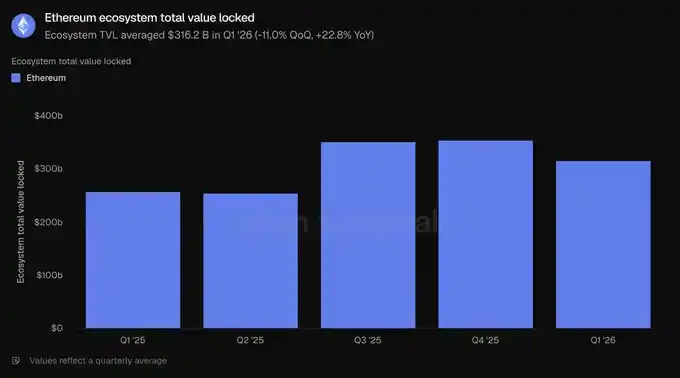
On this basis, the average ecosystem TVL in Q1 2026 was $316.2 billion, a quarter-over-quarter decrease of 11.0% but a year-over-year increase of 22.8%. The quarterly decline aligns with a broad pullback in asset prices, while the annual growth indicates the Ethereum ecosystem remains significantly larger than a year ago.
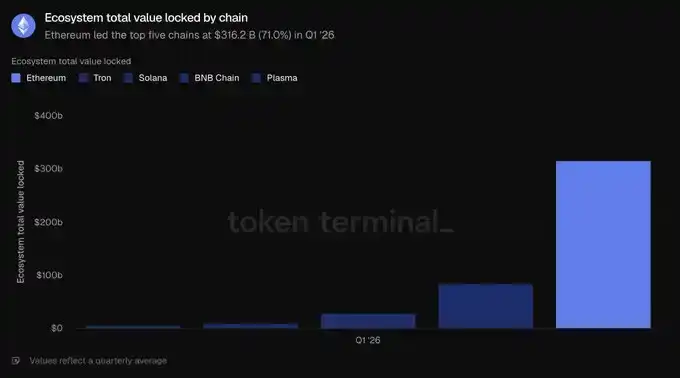
Among the top five chains, Ethereum leads significantly with $316.2B, exceeding the combined TVL of Tron ($84.5B), Solana ($28.8B), BNB Chain ($10.3B), and Plasma ($5.7B), accounting for 71.0% of the top five chains' total. The largest pools of this capital are concentrated in liquid staking, represented by projects like Lido, and lending, represented by projects like Aave. Restaking projects EigenLayer and ether.fi, along with synthetic dollar issuers Ethena and Sky, also rank among the largest applications by scale. Capital concentration remains Ethereum's clearest structural advantage.
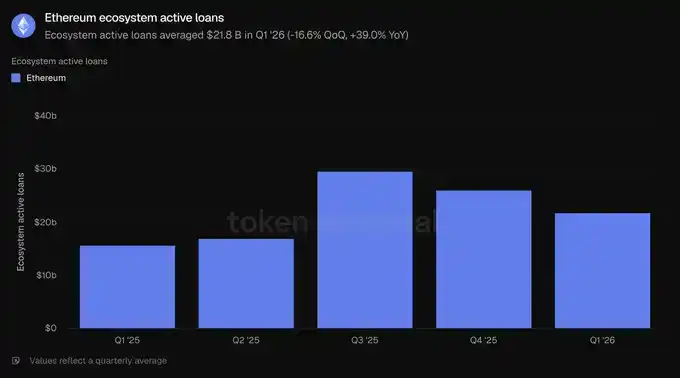
Active Loans measures the portion of deposits that have been lent to borrowers and are therefore generating interest; this metric is typically correlated with lending revenue. On Ethereum, it reflects the outstanding loans across all lending applications in the ecosystem.

In Q1 2026, the average ecosystem active loans were $21.8 billion, down 16.6% quarter-over-quarter but up 39.0% year-over-year. The loan balance contracted alongside TVL, consistent with reduced risk appetite, yet remained substantially higher than a year ago.
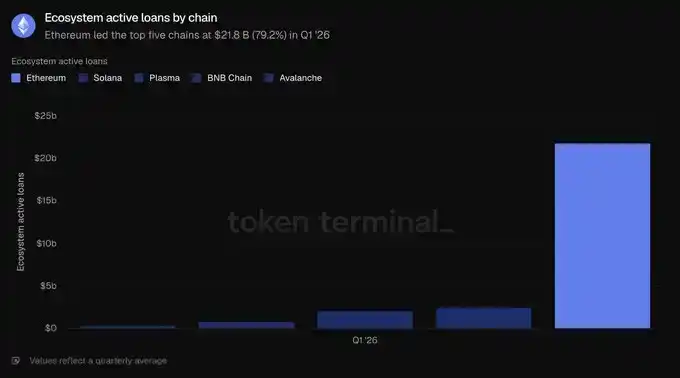
Lending activity on Ethereum is concentrated in a handful of money markets, with Aave dominating. At quarter-end, Aave's active loans were approximately $13.5B, accounting for the majority of the ecosystem total; followed by Morpho (~$1.9B), Sky's Spark (~$1.0B), and Maple (~$840M). The quarterly contraction was primarily driven by Aave, whose loan book shrank about 24% during the quarter as prices fell and borrowing demand cooled. Among the top five chains, Ethereum's $21.8B far exceeds Solana ($2.5B), Plasma ($2.1B), BNB Chain ($760.8M), and Avalanche ($392.4M), representing 79.2% of the top five chains' total. This is Ethereum's highest share across all metrics in this section.
Trading Volume measures the total value of trades executed on decentralized spot exchanges. As traders pay fees, this metric is typically correlated with the fees generated by these venues. This statistic measures the total DEX trading volume within the Ethereum ecosystem.

In Q1 2026, the total ecosystem trading volume was $134.5 billion, down 24.0% quarter-over-quarter and 31.2% year-over-year. Volume declined more sharply than locked capital, indicating a reduction in risk appetite during the quarter's pullback.
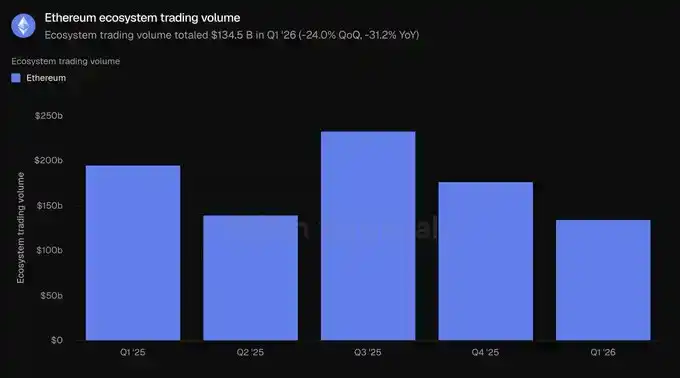
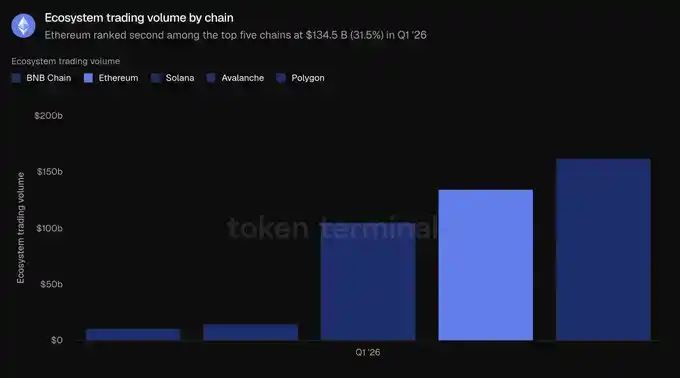
DEX activity on Ethereum is concentrated in a few deep liquidity venues. Uniswap processed approximately $85.5B in volume in Q1, accounting for about two-thirds of the ecosystem's trading volume; followed by Curve (~$22.1B) and CoW Swap (~$12.4B). Trading volume is the only metric in this section where Ethereum does not lead on a cross-chain basis: BNB Chain's volume of $162.5B was higher than Ethereum's $134.5B; Solana followed with $104.9B; then Avalanche ($14.5B) and Polygon ($10.7B). Ethereum's share of the top five chains' trading volume was 31.5%, ranking second behind BNB Chain's 38.0%.
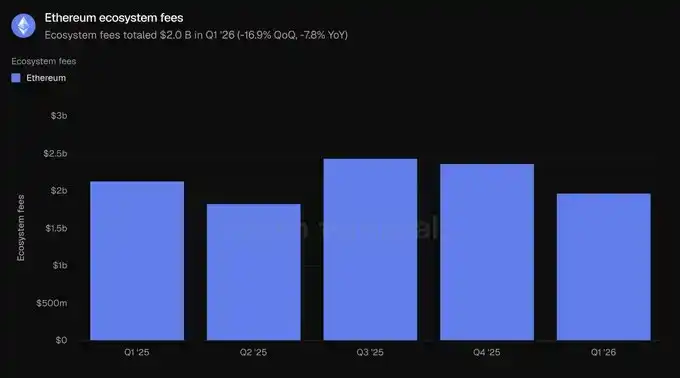
Fees measure the total value users pay to utilize a project's applications, such as interest paid by borrowers or trading fees paid by traders, reflecting the amount of economic value generated. This metric aggregates fees generated by applications within the Ethereum ecosystem.

In Q1 2026, total ecosystem fees were $2.0 billion, down 16.9% quarter-over-quarter and 7.8% year-over-year, consistent with weaker trading and lending activity.
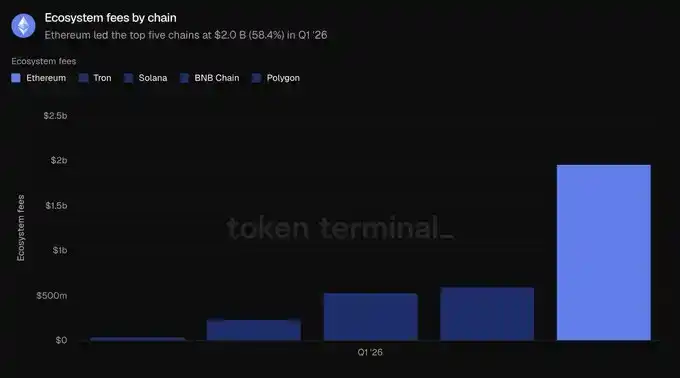
Ethereum generated $2.0B in fees, significantly more than Tron ($599.3M), Solana ($532.5M), BNB Chain ($231.9M), and Polygon ($38.8M), accounting for 58.4% of the top five chains' total fees. Despite the decline, Ethereum remains the single largest source of application fees. Overall, in this section, Ethereum leads in locked capital, credit, and fees, lagging only in trading volume.
3) Tokenized Assets

Circulating Asset Market Cap measures the total value of an asset after it has been tokenized on-chain, calculated as the circulating supply multiplied by the end-of-day price. For stablecoins, it refers to the outstanding supply; for tokenized funds, it refers to Assets Under Management (AUM) on-chain; for tokenized equities, it refers to the value of equities issued on-chain. This statistic measures assets issued on Ethereum.

In Q1 2026, the average market cap of tokenized assets on Ethereum was $203.4 billion, essentially flat quarter-over-quarter (-0.7%) but up 42.9% year-over-year. Stablecoins constituted the largest portion, representing 87.9% of the total, with the remainder composed of funds, commodities, and equities.
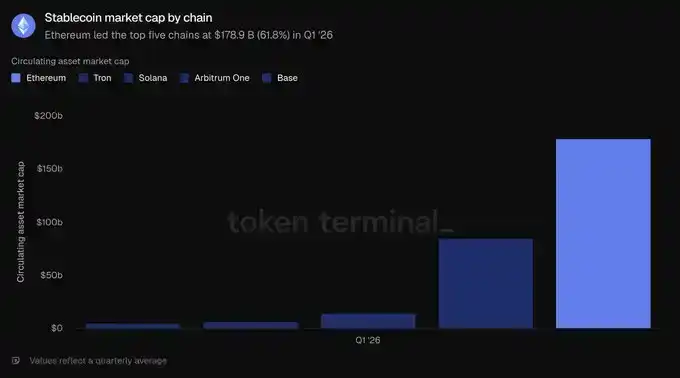
In Q1 2026, the average stablecoin market cap on Ethereum was $178.9 billion, down 2.3% quarter-over-quarter but up 37.6% year-over-year, making it the only sub-segment to decline during the quarter. Two issuers dominate: at quarter-end, Tether's USDT stood at $94.1B, and Circle's USDC at $54.5B, together accounting for the majority of the network's stablecoin market cap. They were followed by Sky's USDS ($12.4B), Ethena's USDe ($5.9B), and PayPal's PYUSD ($2.9B). Newer regulated entrants like Ripple's RLUSD ($1.1B) have also launched. Among the top five chains, Ethereum leads with $178.9B, exceeding Tron ($84.5B), Solana ($14.5B), Arbitrum One ($6.8B), and Base ($4.7B), accounting for 61.8% of the top five chains' total.
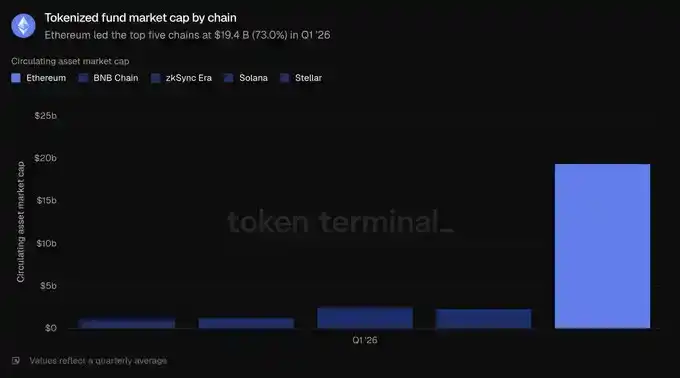
In Q1 2026, the average market cap of tokenized funds on Ethereum was $19.4 billion, up 4.9% quarter-over-quarter and 73.1% year-over-year. This segment can be divided into two parts: one is the interest-bearing on-chain USD category led by Sky's sUSDS (~$6.4B) and Ethena's sUSDe (~$3.5B); the other is regulated funds underpinning the institutional narrative, which have achieved scale growth, including BlackRock's BUIDL (issued via Securitize, ~$1.0B), WisdomTree's Government Money Market Fund (~$815M), and Superstate's USTB (~$620M), with Ondo's OUSG (~$320M) also following closely. Among the top five chains, Ethereum's $19.4B ranks first, ahead of zkSync Era ($2.5B), BNB Chain ($2.3B), Solana ($1.3B), and Stellar ($1.1B), accounting for 73.0% of the top five chains' total. This is the second-highest concentration among all asset categories in this section.
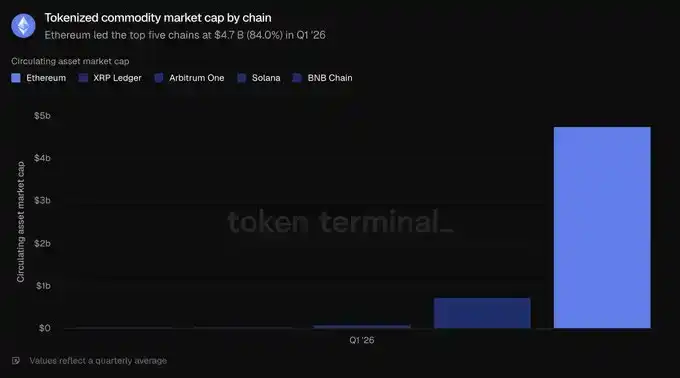
In Q1 2026, the average market cap of tokenized commodities on Ethereum was $4.7 billion, up 60.0% quarter-over-quarter and 325.9% year-over-year, making it the fastest-growing tokenized asset category. This category is almost entirely composed of gold: Tether Gold (XAUT, ~$2.6B) and Paxos' PAX Gold (PAXG, ~$2.4B) together constitute nearly the entire segment. Among the top five chains, Ethereum's $4.7B far exceeds the XRP Ledger ($736.6M), Arbitrum One ($95.9M), BNB Chain ($38.4M), and Solana ($29.8M), accounting for 84.0% of the top five chains' total. This is Ethereum's strongest lead in this section.
Tokenized equities remain the smallest category. In Q1 2026, the average market cap of tokenized equities on Ethereum was $365.1 million, a significant increase from a nearly negligible base a year ago, and up 16.5% quarter-over-quarter. This category is almost entirely dominated by Ondo Finance. Ondo's on-chain equities and ETFs, covering broad-based index funds like the S&P 500 and NASDAQ 100, as well as dozens of individual stocks, constitute the majority of the tokenized equity market cap on Ethereum. Among the top five chains, Ethereum leads with $365.1M, followed by Solana ($249.0M), BNB Chain ($150.5M), Arbitrum One ($29.0M), and Stellar ($4.2M). However, Ethereum's share of the top five chains' total is only 45.8%, its narrowest lead and the only tokenized category where Ethereum does not hold a clear majority.
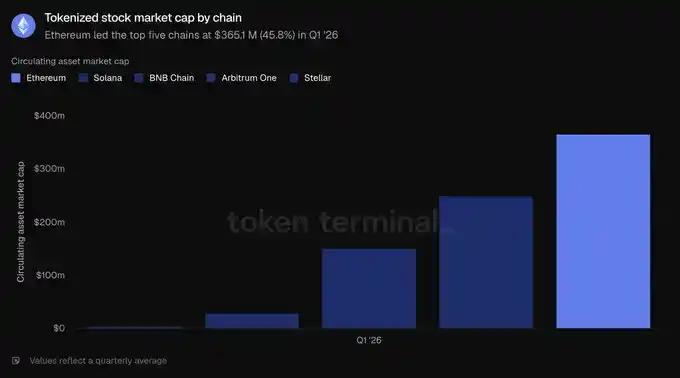
Overall, the quarter shows Ethereum's leadership in fund and commodity tokenization, even as stablecoin balances temporarily stagnated.

4) Usage

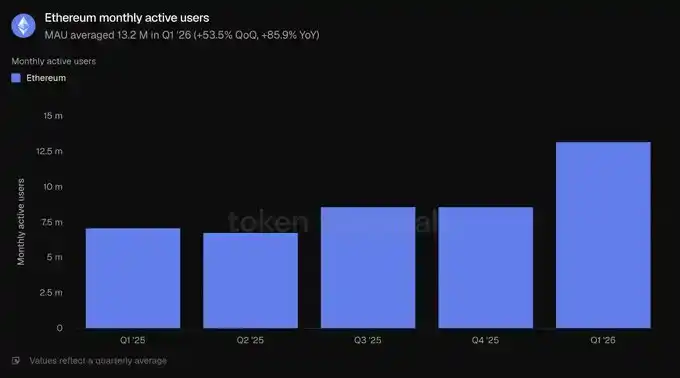
Monthly Active Users measures the number of unique addresses that have interacted with the network via revenue-generating transactions within a one-month window. On Ethereum, it counts distinct addresses transacting on the Layer 1 network.

In Q1 2026, the average monthly active users were 13.2 million, up 53.5% quarter-over-quarter and 85.9% year-over-year, setting a new historical high. After several quarters of relatively modest growth, user growth accelerated markedly.
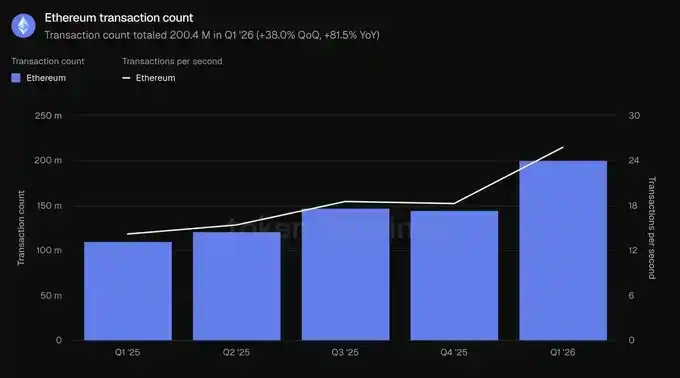
Transactions measures the number of transactions confirmed and added to the blockchain, reflecting user activity on the network; Transactions Per Second is the average rate at which these confirmed transactions are processed, measuring throughput and real-time usage. Both are measured here for the Ethereum Layer 1 network.

In Q1 2026, the total number of transactions was 200.4 million, up 38.0% quarter-over-quarter and 81.5% year-over-year; throughput increased to 25.78 transactions per second, up 41.2% quarter-over-quarter. Both metrics set new historical highs, confirming that user growth translated into substantial increases in on-chain activity.
Fees here refer to the transaction fees users pay to conduct transactions on the Ethereum Layer 1 network, i.e., the cost of using the base layer. This is distinct from the ecosystem-level application fees in Section 2.

On this basis, total fees in Q1 2026 were $39.9 million, down 47.9% quarter-over-quarter and 81.9% year-over-year. This contrasts sharply with usage metrics and represents the quarter's most critical data point: while transaction count grew 38.0%, total fees fell 47.9%, meaning the average cost per transaction decreased significantly as data capacity increased and block space prices fell.
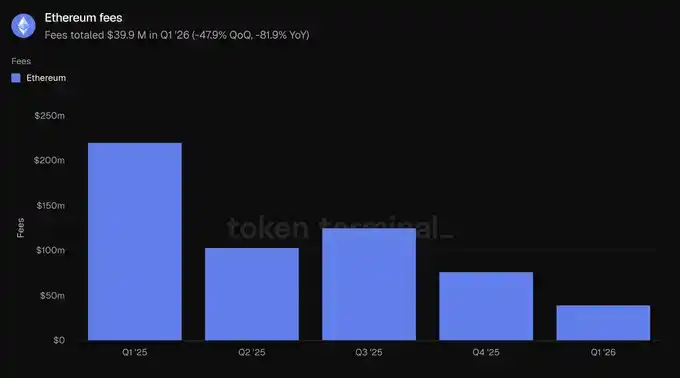
This section presents a scaling story: more users, more transactions, completed at a lower total cost. As throughput grows faster than demand, increased activity and decreased fees can coexist.

5) ETH

Fully Diluted Market Cap measures the valuation of ETH under a fully diluted assumption, calculated as the token price multiplied by the total supply under the current token economics, including circulating, locked, unvested, and future issuable tokens.

In Q1 2026, the average fully diluted market cap was $290.0 billion, down 30.3% quarter-over-quarter and 9.9% year-over-year. The quarterly decline is the largest among valuation metrics in this report and drove the decline in other USD-denominated metrics.
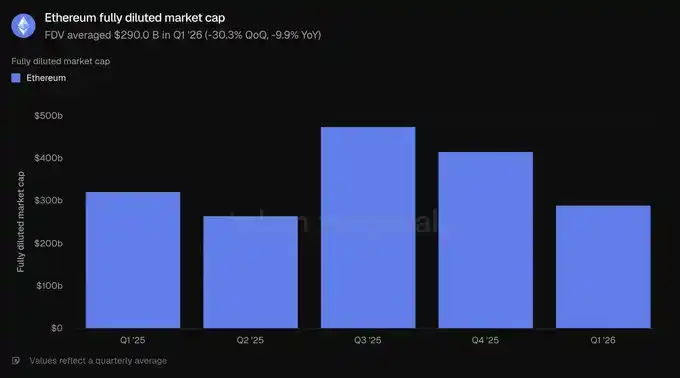
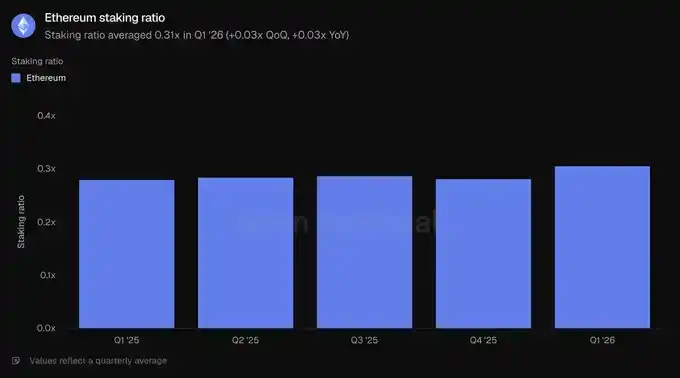
Stake Ratio measures the value of ETH committed to helping secure the proof-of-stake network relative to the total market cap of ETH. A reading of 0.31x means roughly 31% of the value is staked.

In Q1 2026, the average stake ratio was 0.31x, higher than the 0.28x in the previous quarter and a year ago. Even as ETH's market cap fell, the share of ETH dedicated to network security increased, indicating stable staking participation during the price retreat.
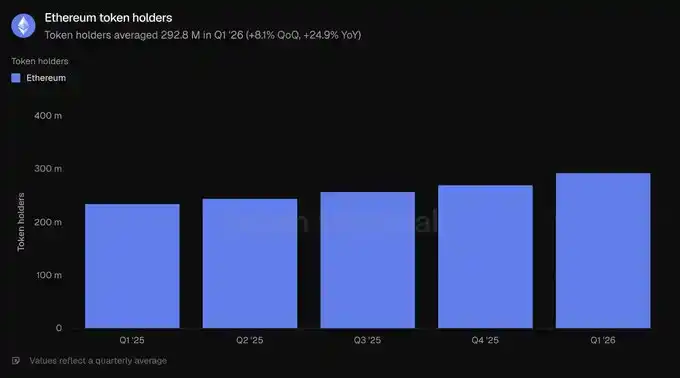
Token Holder Count measures the number of distinct addresses holding the network's native token. On Ethereum, it counts addresses holding ETH.

In Q1 2026, the average token holder count was 292.8 million, up 8.1% quarter-over-quarter and 24.9% year-over-year, continuing a steady upward trend over the past five quarters. Even as the fully diluted market cap declined, the holder base expanded, suggesting ETH ownership became more widespread during the price pullback.
6) Etherealize Team Commentary

"The most prominent tension this quarter is that Ethereum mainnet usage hit an all-time high while transaction fees declined. Ethereum is deliberately scaling the network at the expense of short-term fee capture, betting that cheaper block space will unlock more demand and ultimately generate more network revenue in the long run.

Token Terminal's 'Ethereum Q1 2026 Report' shows this bet is working. On a year-over-year basis, monthly active users grew 85.9%, transactions grew 81.5%, and throughput grew 81.7%. This is the Jevons Paradox in action. We expect the increase in total network demand to be sufficient to offset the impact of lower fees, similar to how the semiconductor industry today generates orders of magnitude more revenue than in 1975, when Intel co-founder Gordon Moore observed that the number of transistors on a microchip doubled roughly every two years. Furthermore, the returns from scaling lie ahead: the Glamsterdam upgrade, scheduled for Q3, plans to increase the gas limit by more than 3x, and Ethereum's roadmap points to achieving 10,000 TPS by 2029 and a 'fast Layer 1' network with second-level finality.

We agree with BlackRock CEO Larry Fink's assessment from last December. He wrote, 'Tokenization today is roughly where the internet was in 1996—when Amazon sold just $16 million worth of books.' The consensus back then was that Amazon was just a money-losing online bookstore propped up by the dot-com bubble. However, Jeff Bezos saw that the internet would reshape retail and prioritized optimizing for network effects and economies of scale over short-term profits. Ethereum is making a similar trade-off to cement its position as the global financial settlement layer.

Another lesson from the internet is that open, permissionless networks tend to win over closed networks. In 1995, Bill Gates published *The Road Ahead*, predicting digital commerce would run on proprietary corporate networks he called the 'information superhighway,' not the open internet. Microsoft was building MSN at the time. AOL, CompuServe, and Prodigy operated walled gardens with millions of paying subscribers. France's Minitel, as late as the end of 1996, still had more users than the entire World Wide Web. They all lost. No serious company wants to build on a network controlled by a competitor; perhaps more importantly, no company can keep pace with permissionless innovation indefinitely. We've seen this play out repeatedly: Linux surpassing proprietary Unix, open networks replacing corporate walled gardens, Wikipedia replacing Britannica. Each time, proprietary solutions started with an advantage—more focused product, stronger marketing, better business development teams—but each time, that lead eroded once the open system crossed the threshold of accumulated contributions, tooling maturity, and credible neutrality.

Now, we're seeing the same themes play out in financial infrastructure, and the data in this report show Ethereum has crossed that threshold and holds dominant market share across all key metrics. Institutions building tokenized finance choose Ethereum not out of ideology, but because the liquidity, composability, and institutional precedents are already there. As this report highlights, among the top five chains, Ethereum holds 79.2% of active DeFi loans, 61.8% of stablecoins, 73.0% of tokenized funds, and 84.0% of tokenized commodities. Each new tokenized asset deepens liquidity, attracting the next one; and the neutral base layer is the only sustainable equilibrium because large participants will never agree to settle on a competitor's infrastructure. Moreover, institutions are realizing that privacy, permissioning, KYC, and transfer restrictions can all be achieved on Ethereum through privacy-preserving environments and permissioned token standards without sacrificing access to public liquidity; conversely, grafting public liquidity and open application ecosystems onto a closed chain is impossible.

If anything, institutional momentum has accelerated further after the quarter ended. In May alone, BlackRock filed for two more tokenized funds; JPMorgan launched its second tokenized money market fund, JLTXX, on Ethereum; Fidelity International launched FILQ, a Moody's AAA-rated US dollar liquidity fund issued as an ERC-20 token. In the stablecoin space, the Japan Blockchain Foundation's yen stablecoin EJPY will launch on Ethereum; a consortium of twelve European banks, including BNP Paribas, ING, UniCredit, and BBVA, is also preparing to launch a regulated euro stablecoin.

The internet looked impossible in 1990 and inevitable by 2005. If Fink is right about where tokenization is in its lifecycle, the coming years could be among the most exciting in Ethereum's history. As we argued in our 'Productive Money' report, network fees provide a floor of intrinsic value for ETH, and the bull case is ETH absorbing the $30+ trillion monetary premium held by gold and Bitcoin because ETH has superior monetary properties. ETH doesn't need to rely on high fees to win."

7) Definitions

Metrics:

Ecosystem Total Value Locked: The USD value of assets deposited into applications within a chain's ecosystem, reported as the period average.

Ecosystem Active Loans: The USD value of outstanding loans within lending applications in the ecosystem, reported as the period average.

Ecosystem Trading Volume: The USD value of trades executed on decentralized exchanges within the ecosystem, reported as the period total.

Ecosystem Fees: The total fees paid by users to applications within the ecosystem, reported as the period total.

Circulating Asset Market Cap: The circulating USD value of a tokenized asset category, calculated as the circulating supply multiplied by the end-of-day price, reported as the period average.

Monthly Active Users: The number of distinct addresses interacting with Ethereum via revenue-generating transactions, reported as the average of monthly figures for the period.

Transactions: The number of transactions confirmed and settled on the Ethereum Layer 1 network, reported as the period total.

Transactions Per Second: The average rate at which the Ethereum Layer 1 network confirmed transactions during the period.

Fees: The total transaction fees paid on the Ethereum Layer 1 network, reported as the period total.

Fully Diluted Market Cap: ETH price multiplied by the total supply under the current token economics, reported as the period average.

Stake Ratio: The value of ETH staked to secure the network relative to the total market cap of ETH, reported as the period average.

Token Holder Count: The number of distinct addresses holding ETH, reported as the period average.

8) About This Report

This report is published quarterly and produced using Token Terminal's end-to-end on-chain data infrastructure. All metrics are sourced directly from blockchain data. The charts and datasets referenced in the report can be viewed in the corresponding Ethereum Q1 2026 report dashboard on Token Terminal.


Criptomoedas em alta

Perguntas relacionadas

QAccording to the report, what was the paradoxical data trend observed for Ethereum in Q1 2026?

AThe report highlighted a paradoxical trend where Ethereum's mainnet user count, transaction volume, and throughput all reached all-time highs, while key financial metrics like transaction fees, Total Value Locked (TVL), trading volume, and ETH's fully diluted market capitalization declined quarter-over-quarter.

QWhat is the 'Jevons Paradox' and how is it applied to explain Ethereum's current strategy as described in the report?

AThe Jevons Paradox is an economic principle stating that as the cost of using a resource decreases, demand for that resource can actually increase. The report uses this to explain Ethereum's strategy of reducing transaction fees through the Fusaka upgrade (which increased data capacity) to stimulate user and transaction growth, sacrificing short-term fee capture for long-term network expansion.

QHow is Ethereum's primary narrative shifting according to the analysis, and what data supports this shift?

AEthereum's primary narrative is shifting from being a DeFi-focused blockchain to a global financial settlement layer. This is supported by data showing Ethereum's dominant market share in tokenized assets among major chains: 61.8% of stablecoins, 73.0% of tokenized funds, 84.0% of tokenized commodities, and the growth in institutional adoption by firms like BlackRock, JPMorgan, and Fidelity launching tokenized products on Ethereum.

QWhich single key metric showed a significant decrease (47.9% QoQ) that contrasted sharply with the increase in usage metrics (users and transactions), and what was the primary reason for this decrease?

ALayer 1 transaction fees on the Ethereum mainnet decreased by 47.9% quarter-over-quarter, contrasting sharply with the 53.5% increase in monthly active users and 38.0% increase in transaction count. The primary reason was the Fusaka upgrade's increase in data capacity, which made block space cheaper, dramatically reducing the average cost per transaction.

QWhat historical analogy does the Etherealize team comment use to frame Ethereum's current strategic choices regarding fees and scale?

AThe Etherealize team comment draws an analogy to Amazon in 1996 and the early internet. It compares Ethereum's choice to prioritize scaling and network effects over short-term fee capture (profit) to Jeff Bezos's strategy of prioritizing long-term market dominance in retail over immediate profitability when Amazon was just an online bookstore.

Leituras Relacionadas

He Just Raised 2.7 Billion, and Li Fei-Fei Also Invested

Pete Florence, a former senior research scientist at Google DeepMind and a key contributor to the Vision-Language-Action (VLA) model architecture, is deliberately distancing his startup, Generalist AI, from the trendy "world model" label. He argues that the industry should prioritize concrete goals over buzzwords. His goal is to create robots that can perform a vast range of unseen tasks with high speed and success rates, without needing task-specific training data. Recently, his company raised $400 million (¥2.7 billion) at a $2 billion valuation. Notable investors include NVIDIA's NVentures, Bezos Expeditions, NFDG, as well as Xiaomi co-founder Lin Bin, Zoom founder Eric Yuan, and renowned AI scientist Fei-Fei Li. Florence's approach stems from his academic background at MIT under Professor Russ Tedrake, focusing on understanding the physical world. After joining DeepMind, he developed models like Transporter Network and co-created the VLA framework. He left in 2025 to found Generalist AI. The company has launched two models: GEN-0, which demonstrated that scaling laws apply to physical motion, and GEN-1. GEN-1 was trained on over 500,000 hours of physical interaction data collected via a specialized wearable device. It achieves a 99% success rate on precise mechanical tasks like folding boxes and maintains performance three times faster than its predecessor. Florence believes GEN-1 is reaching a commercial utility threshold similar to the GPT-3 inflection point. The substantial funding round, following GEN-1's release, signifies strong investor confidence in Generalist AI's practical, goal-driven path to creating versatile, useful robots, regardless of the "world model" terminology.

marsbitHá 1h

He Just Raised 2.7 Billion, and Li Fei-Fei Also Invested

marsbitHá 1h

Two Legends Lost in Three Days: Is Google's AI Talent Dam Cracking?

In three days, Google lost two AI legends. On June 18, Noam Shazeer, co-author of the seminal "Attention is All You Need" paper and Gemini co-lead, left for OpenAI. Just 48 hours later, John Jumper, 2024 Nobel laureate and AlphaFold lead, departed DeepMind for Anthropic. This follows Andrej Karpathy joining Anthropic in May. These moves highlight a structural trend: top AI talent is concentrating at mission-driven, pre-IPO firms like OpenAI and Anthropic, while Google becomes a primary source. The exodus stems from a core mission mismatch. Google's ad-centric model often subordinates AI research to product and revenue goals, creating friction for pioneers like Shazeer, who returned in 2024 only to leave again. In contrast, OpenAI and Anthropic offer singular focus on pushing AI boundaries, whether towards AGI or safety-aligned models, which deeply appeals to top researchers like Jumper. Financial incentives amplify the pull. With both OpenAI and Anthropic nearing IPO, employees stand to gain immensely from equity, an upside Google's mature stock cannot match. Furthermore, the 2023 merger of Google Brain and DeepMind, intended to consolidate strength, has instead created cultural tension and slowed the path from research to product, as evidenced by Gemini's pace. This talent redistribution is reshaping the AI landscape. While Google retains vast data and compute resources, its true crisis is the quiet, continuous loss of the people who define the field's future. The real moat in AI is not infrastructure, but the concentration of brilliant minds—a battle Google is currently losing.

marsbitHá 3h

Two Legends Lost in Three Days: Is Google's AI Talent Dam Cracking?

marsbitHá 3h

Behind the AI Report Card, Lies a Chinese 'Exam Setter'

Beyond the familiar performance charts like MMLU-Pro and MMMU, which major AI models strive to ace, stands a key "examiner": Chinese-Canadian researcher Wenhu Chen. An assistant professor at the University of Waterloo and founder of TIGERLab, Chen addresses the crucial need for more rigorous AI evaluation. As models like GPT-4 began scoring near-perfect results on older benchmarks like MMLU, it became difficult to distinguish their true capabilities. In response, Chen introduced MMLU-Pro in 2024, featuring harder, more reasoning-focused questions with more answer choices, successfully reintroducing meaningful performance gaps. His work extends to multi-modal evaluation with MMMU and its enhanced version, MMMU-Pro. These benchmarks test a model's ability to understand and reason with complex information from images, charts, and text across diverse academic subjects, exposing the significant challenges even top models face in genuine comprehension. Chen's background in complex QA, table reasoning, and his experience at Google DeepMind on projects like Gemini inform his approach. He understands that effective benchmarks must anticipate how models might "cheat" by memorizing data or avoiding visual analysis. His lab also actively researches video understanding and generation models (e.g., UniVideo, Vamba), ensuring his evaluation work is grounded in practical model-building challenges. Now at Meta's Super Intelligence Lab, Chen continues his focus on multi-modal data and evaluation, representing the deep yet often unseen contributions of Chinese talent in shaping the fundamental tools of the AI industry.

marsbitHá 3h

Behind the AI Report Card, Lies a Chinese 'Exam Setter'

marsbitHá 3h

Alliance Co-founder's Letter to Entrepreneurs: Written at the Moment Cursor Sold for $600 Billion

Alliance Co-founder's Letter to Entrepreneurs: On Cursor's $60 Billion Sale Many aspiring founders see massive exits like Cursor's $60B sale and wonder why they can't achieve the same, often concluding opportunities are exhausted. But great companies aren't built in obvious, crowded spaces. Cursor, like Stripe, Figma, and Shopify before it, started with a non-consensus belief about the future. Before ChatGPT, they believed AI would transform knowledge work. They focused on a genuinely exciting domain, became their own customer, and obsessed over power users. Their journey involved years of "glass-chewing" effort before the market was ready. The pattern is consistent: identify a long-term technological shift, find a missed entry point, and execute for years before the trend becomes obvious. First-generation products (PayPal, Adobe, Amazon) prove a market exists. Second-generation winners (Stripe, Figma, Shopify) rebuild that market around new insights, technology, or changing customer behaviors. Founders must identify their phase in the cycle. Early entrants like Coinbase or Cursor focus on making new technology usable for power users. Later entrants find the "yin" to the established "yang"—the blind spots incumbents miss as they grow distant from individual users. The key is deep market immersion. Use every product in your space. Talk to users. Build an audience. Stop looking for ideas and start *seeing* them everywhere. Then, choose one. The idea must offer a 10x improvement or solve a "hair-on-fire" pain point—something severe enough that users are already crafting workarounds. When building, avoid feature bloat. Ask: why would someone switch? Great startups rarely force new behaviors; they improve familiar workflows with drastically lower friction (e.g., Cursor forked VS Code instead of creating a new editor). Distribution is the underestimated moat. Before product-market fit, achieve distribution-market fit. How do customers discover new tools? Founders like those at Airbnb, Stripe, and Cursor did unscalable, manual work to recruit early users. The final, unteachable ingredient is resilience. Cursor built for years pre-market, faced rejection, and persisted. So did Airbnb, Nvidia, and Rain (which launched post-FTX collapse). The lesson isn't that these founders were smarter, but that they stayed in the game long enough for their insights to compound. Framework: Spot technological cycles. Cultivate unique insight. Obsess over your market. Talk to customers. Find a hair-on-fire problem. Build the simplest wedge. Win your distribution channel. Above all, don't quit when it gets hard. Most people won't do these things consistently. The few who do build the next generation of great companies. Go build.

marsbitHá 3h

Alliance Co-founder's Letter to Entrepreneurs: Written at the Moment Cursor Sold for $600 Billion

marsbitHá 3h

Trading

Spot
Futuros

Artigos em Destaque

O que é ETH 2.0

ETH 2.0: Uma Nova Era para o Ethereum Introdução ETH 2.0, amplamente conhecido como Ethereum 2.0, marca uma atualização monumental à blockchain do Ethereum. Esta transição não é meramente uma mudança estética; visa melhorar fundamentalmente a escalabilidade, segurança e sustentabilidade da rede. Com uma mudança do mecanismo de consenso em Proof of Work (PoW), intensivo em energia, para um Proof of Stake (PoS) mais eficiente, o ETH 2.0 promete uma abordagem transformadora ao ecossistema blockchain. O que é ETH 2.0? ETH 2.0 é um conjunto de atualizações distintas e interconectadas focadas na otimização das capacidades e desempenho do Ethereum. Esta reformulação foi projetada para abordar desafios críticos que o mecanismo atual do Ethereum enfrentou, particularmente em relação à velocidade das transações e à congestão da rede. Objetivos do ETH 2.0 Os principais objetivos do ETH 2.0 giram em torno da melhoria de três aspectos centrais: Escalabilidade: Com o objetivo de melhorar significativamente o número de transações que a rede pode manejar por segundo, o ETH 2.0 procura ultrapassar a limitação atual de aproximadamente 15 transações por segundo, alcançando potencialmente milhares. Segurança: Medidas de segurança melhoradas são integrais ao ETH 2.0, especialmente através da resistência aprimorada contra ciberataques e da preservação do ethos descentralizado do Ethereum. Sustentabilidade: O novo mecanismo PoS foi projetado não apenas para melhorar a eficiência, mas também para reduzir drasticamente o consumo de energia, alinhando a estrutura operacional do Ethereum com considerações ambientais. Quem é o Criador do ETH 2.0? A criação do ETH 2.0 pode ser atribuída à Ethereum Foundation. Esta organização sem fins lucrativos, que desempenha um papel crucial no apoio ao desenvolvimento do Ethereum, é liderada pelo co-fundador notável Vitalik Buterin. A sua visão de um Ethereum mais escalável e sustentável tem sido a força motriz por trás desta atualização, envolvendo contribuições de uma comunidade global de desenvolvedores e entusiastas dedicados a melhorar o protocolo. Quem são os Investidores do ETH 2.0? Embora os detalhes sobre os investidores do ETH 2.0 não tenham sido tornados públicos, é sabido que a Ethereum Foundation recebe apoio de várias organizações e indivíduos no espaço da blockchain e tecnologia. Esses parceiros incluem firmas de capital de risco, empresas de tecnologia e organizações filantrópicas que compartilham um interesse mútuo em apoiar o desenvolvimento de tecnologias descentralizadas e infraestrutura de blockchain. Como Funciona o ETH 2.0? ETH 2.0 é notável por introduzir uma série de características chave que o diferenciam do seu predecessor. Proof of Stake (PoS) A transição para um mecanismo de consenso PoS é uma das mudanças de destaque do ETH 2.0. Ao contrário do PoW, que depende da mineração intensiva em energia para a verificação de transações, o PoS permite que os utilizadores validem transações e criem novos blocos de acordo com a quantidade de ETH que apostam na rede. Isso leva a uma maior eficiência energética, reduzindo o consumo em aproximadamente 99,95%, tornando o Ethereum 2.0 uma alternativa consideravelmente mais ecológica. Shard Chains As shard chains são outra inovação crítica do ETH 2.0. Estas cadeias menores operam em paralelo com a cadeia principal do Ethereum, permitindo que várias transações sejam processadas simultaneamente. Esta abordagem melhora a capacidade geral da rede, abordando preocupações de escalabilidade que têm atormentado o Ethereum. Beacon Chain No coração do ETH 2.0 está a Beacon Chain, que coordena a rede e gere o protocolo PoS. Ela atua como uma espécie de organizador: supervisiona os validadores, garante que as shards permaneçam conectadas à rede e monitora a saúde geral do ecossistema blockchain. Linha do Tempo do ETH 2.0 A jornada do ETH 2.0 tem sido marcada por vários marcos chave que traçam a evolução desta atualização significativa: Dezembro de 2020: O lançamento da Beacon Chain marcou a introdução do PoS, preparando o caminho para a migração para o ETH 2.0. Setembro de 2022: A conclusão de “The Merge” representa um momento crucial em que a rede Ethereum fez a transição com sucesso de um quadro PoW para um PoS, anunciando uma nova era para o Ethereum. 2023: O lançamento esperado das shard chains visa melhorar ainda mais a escalabilidade da rede Ethereum, solidificando o ETH 2.0 como uma plataforma robusta para aplicações e serviços descentralizados. Características Chave e Benefícios Escalabilidade Melhorada Uma das vantagens mais significativas do ETH 2.0 é a sua escalabilidade melhorada. A combinação de PoS e shard chains permite que a rede expanda a sua capacidade, permitindo que acomode um volume de transações muito maior em comparação com o sistema legado. Eficiência Energética A implementação do PoS representa um enorme passo em direção à eficiência energética na tecnologia blockchain. Ao reduzir drasticamente o consumo de energia, o ETH 2.0 não só reduz os custos operacionais, mas também se alinha mais estreitamente com os objetivos globais de sustentabilidade. Segurança Aprimorada Os mecanismos atualizados do ETH 2.0 contribuem para uma segurança melhorada em toda a rede. O uso do PoS, juntamente com medidas de controle inovadoras estabelecidas através das shard chains e da Beacon Chain, assegura um maior grau de proteção contra potenciais ameaças. Custos Mais Baixos para os Utilizadores À medida que a escalabilidade melhora, os efeitos sobre os custos de transação também serão evidentes. Aumentada a capacidade e reduzida a congestão, espera-se que isso se traduza em taxas mais baixas para os utilizadores, tornando o Ethereum mais acessível para transações do dia a dia. Conclusão ETH 2.0 marca uma evolução significativa no ecossistema da blockchain do Ethereum. Ao abordar questões fundamentais como a escalabilidade, o consumo de energia, a eficiência das transações e a segurança geral, a importância desta atualização não pode ser subestimada. A transição para o Proof of Stake, a introdução das shard chains e o trabalho fundamental da Beacon Chain são indicativos de um futuro em que o Ethereum pode atender à crescente demanda do mercado descentralizado. Em uma indústria movida pela inovação e progresso, o ETH 2.0 representa um testemunho das capacidades da tecnologia blockchain em pavimentar o caminho para uma economia digital mais sustentável e eficiente.

106 Visualizações TotaisPublicado em {updateTime}Atualizado em 2024.12.03

O que é ETH 2.0

O que é ETH 3.0

ETH3.0 e $eth 3.0: Uma Análise Profunda do Futuro do Ethereum Introdução No ambiente em rápida evolução da criptomoeda e da tecnologia blockchain, o ETH3.0, frequentemente denotado como $eth 3.0, emergiu como um tema de considerável interesse e especulação. O termo abrange dois conceitos principais que merecem esclarecimento: Ethereum 3.0: Esta representa uma potencial atualização futura destinada a aumentar as capacidades da atual blockchain do Ethereum, focando especialmente na melhoria da escalabilidade e desempenho. ETH3.0 Meme Token: Este distinto projeto de criptomoeda procura aproveitar a blockchain do Ethereum na criação de um ecossistema centrado em memes, promovendo o envolvimento na comunidade de criptomoedas. Compreender esses aspectos do ETH3.0 é essencial não apenas para entusiastas de criptomoedas, mas também para aqueles que observam as tendências tecnológicas mais amplas no espaço digital. O que é ETH3.0? Ethereum 3.0 Ethereum 3.0 é promovido como uma atualização proposta para a rede Ethereum já estabelecida, que tem sido a espinha dorsal de muitas aplicações descentralizadas (dApps) e contratos inteligentes desde a sua criação. As melhorias vislumbradas concentram-se principalmente na escalabilidade—integrando tecnologias avançadas como sharding e provas de conhecimento zero (zk-proofs). Essas inovações tecnológicas visam facilitar um número sem precedentes de transações por segundo (TPS), potencialmente alcançando milhões, abordando assim uma das limitações mais significativas enfrentadas pela tecnologia blockchain atual. A melhoria não é meramente técnica, mas também estratégica; visa preparar a rede Ethereum para uma adoção generalizada e utilidade em um futuro marcado por uma maior demanda por soluções descentralizadas. ETH3.0 Meme Token Em contraste com o Ethereum 3.0, o ETH3.0 Meme Token aventura-se por um domínio mais leve e divertido, combinando a cultura dos memes da internet com a dinâmica das criptomoedas. Este projeto permite que os usuários comprem, vendam e negociem memes na blockchain do Ethereum, proporcionando uma plataforma que fomenta o envolvimento da comunidade através da criatividade e interesses compartilhados. O ETH3.0 Meme Token visa demonstrar como a tecnologia blockchain pode interseccionar com a cultura digital, criando casos de uso que são tanto divertidos quanto financeiramente viáveis. Quem é o Criador do ETH3.0? Ethereum 3.0 A iniciativa em direção ao Ethereum 3.0 é impulsionada principalmente por um consórcio de desenvolvedores e pesquisadores dentro da comunidade Ethereum, notavelmente incluindo Justin Drake. Conhecido por suas percepções e contribuições para a evolução do Ethereum, Drake tem sido uma figura proeminente nas discussões sobre a transição do Ethereum para uma nova camada de consenso, referida como “Beam Chain”. Esta abordagem colaborativa ao desenvolvimento significa que o Ethereum 3.0 não é fruto de um único criador, mas sim uma manifestação da engenhosidade coletiva focada no avanço da tecnologia blockchain. ETH3.0 Meme Token Os detalhes sobre o criador do ETH3.0 Meme Token são atualmente indetectáveis. A natureza dos tokens de meme frequentemente leva a uma estrutura mais descentralizada e impulsionada pela comunidade, o que poderia explicar a falta de atribuição específica. Isso alinha-se com a ethos da comunidade de criptomoedas mais ampla, onde a inovação geralmente surge de esforços colaborativos em vez de esforços individuais. Quem são os Investidores do ETH3.0? Ethereum 3.0 O apoio ao Ethereum 3.0 provém principalmente da Fundação Ethereum, juntamente com uma comunidade entusiástica de desenvolvedores e investidores. Esta associação fundacional proporciona um grau significativo de legitimidade e melhora as perspectivas de uma implementação bem-sucedida, uma vez que aproveita a confiança e credibilidade construída ao longo de anos de operações de rede. Em um clima em rápida mudança no mundo das criptomoedas, o apoio da comunidade desempenha um papel crucial no impulso ao desenvolvimento e adoção, posicionando o Ethereum 3.0 como um sério candidato a futuros avanços na blockchain. ETH3.0 Meme Token Embora as fontes atualmente disponíveis não forneçam informações explícitas sobre as fundações ou organizações de investimento que apoiam o ETH3.0 Meme Token, é indicativo do modelo típico de financiamento para tokens de meme, que frequentemente depende de apoio base e engajamento da comunidade. Os investidores em tais projetos costumam consistir em indivíduos motivados pelo potencial de inovação impulsionada pela comunidade e pelo espírito de cooperação encontrado dentro da comunidade cripto. Como Funciona o ETH3.0? Ethereum 3.0 As características distintivas do Ethereum 3.0 residem em sua proposta de implementação de sharding e tecnologia zk-proof. Sharding é um método de partição da blockchain em partes menores e gerenciáveis ou “shards”, que podem processar transações simultaneamente em vez de sequencialmente. Esta descentralização do processamento ajuda a prevenir congestionamentos e garante que a rede permaneça responsiva mesmo sob carga pesada. A tecnologia de prova de conhecimento zero (zk-proof) contribui com outra camada de sofisticação ao permitir a validação de transações sem revelar os dados subjacentes envolvidos. Este aspecto não apenas melhora a privacidade, mas também aumenta a eficiência geral da rede. Há também conversas sobre a incorporação de uma Máquina Virtual Ethereum de conhecimento zero (zkEVM) nesta atualização, amplificando ainda mais as capacidades e utilidade da rede. ETH3.0 Meme Token O ETH3.0 Meme Token distingue-se ao capitalizar sobre a popularidade da cultura dos memes. Estabelece um mercado para que os usuários participem da negociação de memes, não apenas para entretenimento, mas também para potencial ganho econômico. Ao integrar recursos como staking, provisão de liquidez e mecanismos de governança, o projeto fomenta um ambiente que incentiva a interação e participação da comunidade. Ao oferecer uma mistura única de entretenimento e oportunidade econômica, o ETH3.0 Meme Token visa atrair um público diversificado, variando de entusiastas de criptomoedas a conhecedores casuais de memes. Cronologia do ETH3.0 Ethereum 3.0 11 de novembro de 2024: Justin Drake sugere a próxima atualização do ETH 3.0, centrada nas melhorias de escalabilidade. Este anúncio sinaliza o início de discussões formais sobre a futura arquitetura do Ethereum. 12 de novembro de 2024: A proposta antecipada para Ethereum 3.0 deve ser revelada no Devcon em Bangkok, preparando o cenário para um feedback mais amplo da comunidade e potenciais próximos passos no desenvolvimento. ETH3.0 Meme Token 21 de março de 2024: O ETH3.0 Meme Token é oficialmente listado no CoinMarketCap, marcando sua entrada no domínio público das criptomoedas e aumentando a visibilidade de seu ecossistema baseado em memes. Pontos Chave Em conclusão, Ethereum 3.0 representa uma evolução significativa dentro da rede Ethereum, focando em superar limitações quanto à escalabilidade e desempenho através de tecnologias avançadas. As atualizações propostas refletem uma abordagem proativa às futuras demandas e usabilidade. Por outro lado, o ETH3.0 Meme Token encapsula a essência da cultura impulsionada pela comunidade no espaço das criptomoedas, aproveitando a cultura dos memes para criar plataformas envolventes que incentivam a criatividade e participação dos usuários. Compreender os distintos propósitos e funcionalidades do ETH3.0 e $eth 3.0 é fundamental para qualquer pessoa interessada nos desenvolvimentos contínuos dentro do espaço cripto. Com ambas as iniciativas a pavimentar caminhos únicos, elas sublinham coletivamente a natureza dinâmica e multifacetada da inovação em blockchain.

106 Visualizações TotaisPublicado em {updateTime}Atualizado em 2024.12.03

O que é ETH 3.0

Como comprar ETH

Bem-vindo à HTX.com!Tornámos a compra de Ethereum (ETH) simples e conveniente.Segue o nosso guia passo a passo para iniciar a tua jornada no mundo das criptos.Passo 1: cria a tua conta HTXUtiliza o teu e-mail ou número de telefone para te inscreveres numa conta gratuita na HTX.Desfruta de um processo de inscrição sem complicações e desbloqueia todas as funcionalidades.Obter a minha contaPasso 2: vai para Comprar Cripto e escolhe o teu método de pagamentoCartão de crédito/débito: usa o teu visa ou mastercard para comprar Ethereum (ETH) instantaneamente.Saldo: usa os fundos da tua conta HTX para transacionar sem problemas.Terceiros: adicionamos métodos de pagamento populares, como Google Pay e Apple Pay, para aumentar a conveniência.P2P: transaciona diretamente com outros utilizadores na HTX.Mercado de balcão (OTC): oferecemos serviços personalizados e taxas de câmbio competitivas para os traders.Passo 3: armazena teu Ethereum (ETH)Depois de comprar o teu Ethereum (ETH), armazena-o na tua conta HTX.Alternativamente, podes enviá-lo para outro lugar através de transferência blockchain ou usá-lo para transacionar outras criptomoedas.Passo 4: transaciona Ethereum (ETH)Transaciona facilmente Ethereum (ETH) no mercado à vista da HTX.Acede simplesmente à tua conta, seleciona o teu par de trading, executa as tuas transações e monitoriza em tempo real.Oferecemos uma experiência de fácil utilização tanto para principiantes como para traders experientes.

3.2k Visualizações TotaisPublicado em {updateTime}Atualizado em 2026.06.02

Como comprar ETH

Discussões

Bem-vindo à Comunidade HTX. Aqui, pode manter-se informado sobre os mais recentes desenvolvimentos da plataforma e obter acesso a análises profissionais de mercado. As opiniões dos utilizadores sobre o preço de ETH (ETH) são apresentadas abaixo.

活动图片