While Semiconductor Stocks Plunge, Anthropic Plans to Develop a 2nm Chip

链捕手Publicado em 2026-07-03Última atualização em 2026-07-03

Resumo

Anthropic, the AI company behind Claude, is exploring the development of its own custom AI chip, according to a report from The Information. The company is in early discussions with Samsung Electronics to manufacture the chip using Samsung's most advanced 2-nanometer process and packaging technology. While the project is still in preliminary stages, including defining chip specifications, and could be abandoned, it marks a strategic step for Anthropic. The move comes as the company seeks greater control over its computing costs and hardware optimization, particularly for inference tasks to run its models more efficiently and cheaply. Samsung's potential involvement follows its participation as a strategic investor in Anthropic's recent $65 billion funding round. For Samsung, partnering with a major AI lab represents a significant opportunity for its foundry business to compete with market leader TSMC in advanced semiconductor manufacturing. Anthropic's CEO, Dario Amodei, has previously highlighted the immense financial challenge of securing enough computing power for anticipated growth, making cost-effective inference a critical focus. The company would join other tech giants like Google, Amazon, Microsoft, Meta, and OpenAI in pursuing custom AI silicon. However, analysts note this trend creates deeper interdependencies rather than independence, as US AI labs become more tightly woven into Asian semiconductor supply chains. Despite this move, Anthropic remains heavily reli...

By Bo Yang, Tencent Tech

Anthropic is building its own chip, and like Musk, has chosen Samsung over TSMC.

The Information, citing three informed sources, reported that Anthropic has initiated early-stage work on a self-developed AI chip and is in discussions with Samsung to manufacture this chip using Samsung's most advanced 2-nanometer process and packaging technology.

The aforementioned sources said that Anthropic is also defining the chip's functions, performance metrics, and its integration scheme within servers or clusters. Currently, the company has begun discussions with several design service providers, but it is far from the detailed design, testing, and mass production stages. The sources also cautioned that Anthropic could still abandon the project midway.

Public information shows that Anthropic's chip team has begun forming. For instance, on June 9th, the company poached Clive Chan, an early member of OpenAI's custom chip team.
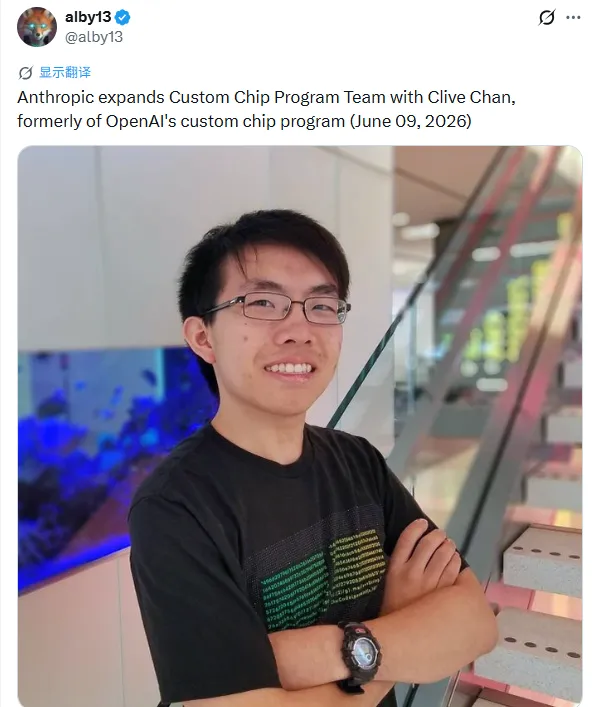
Clive Chan, an early member of OpenAI's custom chip team, has joined Anthropic

Anthropic has been extremely cautious in its external statements regarding self-developed chips, only emphasizing that future computing power expansion will still primarily rely on AWS's Trainium, Google's TPU, and NVIDIA's GPUs, while declining to comment on its own chip roadmap.

In fact, rumors about Anthropic's plans to develop its own chip emerged months ago. Reuters reported in April that Claude's computational demands were growing too rapidly, outpacing available computing power, leading Anthropic to consider building its own chips. However, at that time, it was just a preliminary consideration. Now, it appears the matter has moved a step forward.

It should be noted that the disclosure of Anthropic's entry into chip-making coincides with a two-day plunge in global semiconductor stocks. The Philadelphia Semiconductor Index fell nearly 12% over two sessions, its largest drop since June 5th. Memory chip stocks were hit particularly hard, with Samsung Electronics falling 9.1% and SanDisk dropping 14.1% overnight.

01 A Foreshadowing from a Funding Round, and Samsung Foundry's Breakout Battle

Samsung becoming Anthropic's partner is not surprising.

In May of this year, Anthropic completed a $650 billion Series H funding round, with Samsung Electronics participating as a strategic investor, alongside other memory chip giants SK Hynix and Micron Technology.

At that time, memory chip supply was tight, forcing consumer electronics manufacturers like Apple to raise prices. A direct benefit of this investment was binding Anthropic to the chip suppliers critical to its growth.

But Samsung's calculations extend beyond financial returns.

The company is a king in the memory chip sector, but has consistently lagged behind TSMC in the foundry business. TSMC's advanced production lines remain the industry standard for cutting-edge AI chips, but the current demand for AI chips is straining TSMC's capacity. This provides Samsung an opportunity to win customers with its 2nm technology.

According to The Information, Google is already considering having Samsung manufacture some of its future TPUs. If Samsung can also secure Anthropic, it would be a significant victory for its foundry business.

Two informed sources revealed that Anthropic is evaluating Samsung's 2nm manufacturing process and advanced packaging facilities. "2nm" is one of the most advanced chip manufacturing technologies, making processors denser and more energy-efficient. Advanced packaging places the main processor closer to high-speed memory, allowing data to travel faster within the chip.

Samsung is NVIDIA's manufacturing partner for HBM memory and LPU chips; conversely, Samsung relies on NVIDIA's software for chip production. The two companies are jointly building an AI chip factory in South Korea. If Anthropic joins the customer list, Samsung gains another chip in its efforts to catch up to TSMC in advanced process nodes.

Samsung's confidence in courting Anthropic is backed by South Korea's national-level bet on the semiconductor industry.

The South Korean government recently announced a decade-long investment plan led by the Samsung Group (Samsung Electronics' parent company) and SK Group (SK Hynix's parent company), with a combined investment of $518 billion to build four memory chip factories in South Korea.

Samsung alone announced on July 2nd an investment plan for the Chungcheong region exceeding 140 trillion won, approximately $90 billion. Under this plan, Samsung Electronics will build next-generation HBM production bases in Cheongju and Wonyang, adding five production lines. Since the AI boom, HBM has been in short supply; expansion could increase Samsung's revenue by tens of billions of dollars in the coming years. Samsung Electro-Mechanics is also expanding AI server packaging substrate capacity in Sejong City while simultaneously investing in advanced packaging technology R&D.

By participating in Anthropic's funding round, Samsung is betting on becoming the latter's long-term hardware partner.

02 Inference Chips: A Breakthrough Point for a Costly Cycle

Anthropic's first 2nm chip, like OpenAI's, is expected to focus on inference.

Custom inference chips would allow Anthropic's models to run faster, consume less power, reduce cloud bills, and be specifically hardware-optimized for Claude.

Previously, OpenAI selected Broadcom to design an inference chip codenamed "Jalapeño," aiming to run large language models more efficiently. OpenAI claimed the chip is more energy-efficient with better performance per watt than competitors.
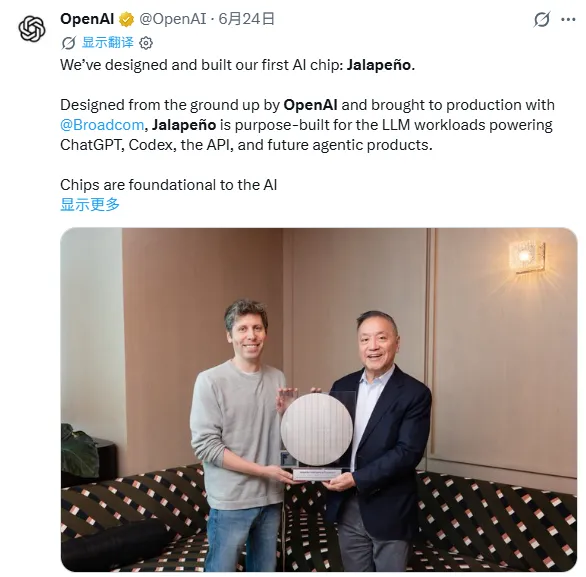
OpenAI partners with Broadcom to design an inference chip codenamed "Jalapeño"

Google has TPU, Amazon has Trainium, Microsoft has Maia, and Meta is also working on its own. Anthropic is almost the last major AI lab still fully reliant on others' chips. The allure of autonomy in this area is too strong.

In February of this year, Anthropic CEO Dario Amodei, in an interview with podcast host Dwarkesh Patel, discussed the logic behind compute strategy.

Amodei said: "If I assume revenue continues to grow 10x per year, then by the end of 2026 it's $100 billion, and by the end of 2027 it's $1 trillion. I could order $1 trillion worth of compute based on that. But what if I'm wrong? What if the growth multiplier is 5x instead of 10x? If revenue in 2027 is only $800 billion instead of $1 trillion, then I'm bankrupt. No hedge can save me."

Therefore, Amodei must find a balance for Anthropic: purchase enough compute to handle high-growth scenarios, but avoid over-expansion to the point where a slowdown in growth would crush the company under its upfront investments.

Amodei revealed that the global compute capacity built this year is roughly 10 to 15 gigawatts, approximately tripling annually. By 2028 or 2029, the industry's annual compute investment will reach several trillion dollars. He believes this is the trend the industry is following.

Developing its own chip is like raising the stakes in this gamble.

On one hand, any efficiency gain in inference from a self-developed chip can save substantial costs across clusters at the gigawatt scale. On the other hand, when everyone is scrambling for processors, data centers, and power, having its own chip provides extra leverage in negotiations.

03 Supply Chain "Nesting Doll": Who Depends on Whom?

Anthropic desires chip independence, but this web is becoming increasingly intricate.

Programmer Benny Lam pointed out a phenomenon on social media: every US AI lab is collaborating with Asian foundries for custom chips. The result is not independence but tighter entanglement of the supply chain.

Anthropic needs Samsung's fabs to reduce reliance on NVIDIA. NVIDIA needs Samsung's fabs to meet its expanding capacity demands. And Samsung needs to retain both major customers simultaneously to keep its foundry business competitive against TSMC.

The three are bound together; none can leave the others.

Lam commented that the trend towards custom chips was supposed to give AI labs more independence, but each new collaboration between a US lab and an Asian foundry makes this network denser and harder to disentangle.

Tech blogger Vaibhav Sisinty also noted Samsung's unique role in this chess game.

He wrote that Samsung's investment in Anthropic's $650 billion funding round wasn't just for financial returns. Samsung is a chip manufacturer, memory supplier, advanced packaging factory. Its investment bets on becoming Anthropic's hardware partner. With millions of queries daily, Anthropic pays for compute resources each time—its bill is astronomical. Whoever controls its own inference chip controls its scaling speed and cost.

04 NVIDIA's Fortress Remains Formidable

Designing a competitive AI chip is extremely complex. Architecture, software, manufacturing, testing, large-scale deployment—each step requires significant time. Anthropic cannot abandon its current hardware partners in the short term.

Looking at Anthropic's current compute layout, its strategy is clear. The company has consistently adhered to a multi-cloud leasing approach, unlike OpenAI or xAI which have individually tied themselves to NVIDIA hardware. It uses chips from Amazon, Google, and NVIDIA, and is negotiating chip cooperation with Microsoft and the UK startup Fractile.

Anthropic's ties with Amazon and Google are particularly deep.

In April 2026, Anthropic expanded its collaboration with AWS, committing to invest over $100 billion in the next decade, securing 5 gigawatts of new compute capacity, including custom chips like Trainium2, Trainium3, and Trainium4. Amazon's cumulative investment in Anthropic has reached tens of billions of dollars.

Simultaneously, Anthropic signed long-term agreements with Google and Broadcom to secure approximately 3.5 gigawatts of next-generation TPU compute starting in 2027. Previously in 2025, the two parties had already signed agreements worth hundreds of billions of dollars, involving millions of TPUs and over 1 gigawatt of capacity.

Claude is also one of the few frontier models simultaneously available on AWS, Google Cloud, and Azure.

And that's not all. In May 2026, Anthropic leased the entire capacity of the SpaceX Colossus 1 compute cluster from xAI.

Located in a Memphis data center, this cluster houses over 220,000 NVIDIA GPUs, consuming over 300 megawatts of power, with a monthly rent of approximately $1.25 billion. The total contract value is hundreds of billions of dollars, running until around 2029. The two parties have even discussed deploying multi-gigawatt compute capacity in orbit.

Wide-ranging deployment and multi-vendor parallelism is Anthropic's way of spreading risk.

But for now, NVIDIA remains the house in this game. According to The Information's estimates, despite the ongoing financing and design activities in the inference chip market, NVIDIA's market share has actually risen to 74% in recent years. CEO Jensen Huang consistently asserts that NVIDIA's chips are more efficient than any alternative for inference tasks.


Criptomoedas em alta

Perguntas relacionadas

QAccording to the article, why is Anthropic considering developing its own AI chip, and who is its potential manufacturing partner?

AAnthropic is considering developing its own AI chip to improve the speed and power efficiency of running its models (like Claude) and to reduce cloud costs. Its potential manufacturing partner is Samsung, specifically for using Samsung's most advanced 2-nanometer process and packaging technology.

QWhat strategic goal is Samsung aiming to achieve by partnering with Anthropic on chip development and having invested in the company?

ASamsung's strategic goal is to win a significant customer for its chip foundry business, helping it compete with the industry leader TSMC. By partnering with Anthropic, Samsung gains a foothold in the advanced AI chip market and strengthens its position in the global semiconductor supply chain.

QWhat type of chip is Anthropic's first 2nm project expected to focus on, and what are the potential benefits?

AAnthropic's first 2nm chip project is expected to focus on inference chips. The potential benefits include running large language models faster, with lower power consumption, and at a reduced cost, while also allowing for hardware specifically optimized for its Claude model.

QHow does the article describe the current interdependency in the AI chip supply chain, particularly involving Anthropic, Samsung, and Nvidia?

AThe article describes a complex interdependency: Anthropic needs Samsung's foundry to reduce reliance on Nvidia, Nvidia needs Samsung's foundry to meet its own capacity demands, and Samsung needs to retain both Anthropic and Nvidia as major customers to keep its foundry business competitive against TSMC. This creates a tightly knit network where each party relies on the others.

QDespite exploring custom chips, what is Anthropic's current strategy for securing computing power, and which companies are its key providers?

AAnthropic's current strategy is a multi-cloud, multi-vendor approach to secure computing power and分散风险. Its key providers are Amazon Web Services (using Trainium chips), Google Cloud (using TPUs), and Nvidia (GPUs). It also has significant contracts with these companies and has even leased a large GPU cluster from xAI.

Leituras Relacionadas

How Far Are We from the End of the Crypto Bear Market?

How Much Longer Until the Crypto Bear Market Ends? A persistent negative Coinbase Bitcoin Premium Index, reaching a record 46 consecutive days of negative values, underscores the ongoing crypto bear market. The downturn accelerated in late May/early June when MicroStrategy (referred to as "Strategy" in the text), a major BTC holder, sold a small amount of Bitcoin (32 BTC), shattering market confidence and triggering sharp declines in BTC, ETH, and SOL. This was compounded by sustained net outflows from US spot Bitcoin ETFs. June saw Bitcoin briefly fall below $60,000, its worst weekly performance since 2022, breaking below the critical 200-week moving average—a signal some analysts consider confirmation of a bear market. While some institutional analyses in mid-June suggested the bottom might be near (e.g., around $53,600 based on realized price, or a potential end during the 2026 World Cup summer), further price drops quickly disproved these optimistic forecasts. Key bear market indicators include: the severe de-pegging of MicroStrategy's preferred shares (STRC) from their $100 NAV, which later recovered partly due to company stabilization plans; a record number of BTC (over 10.83 million) and a significant portion of long-term ETH holders now in unrealized loss; and Bitcoin's price trading below its 200-week moving average. Predictions for the bear market's end vary. Some, like investor Yilihua, suggest July-August 2026 could present a final buying opportunity. Others, like miner Jiang Zhu'o'er, predict a bottom between $42,000-$44,000 in October-December 2026, based on the historical lag between MicroStrategy's mNAV ratio bottom and Bitcoin's price bottom. Technical indicators like the BTC 4-year average price index dipped briefly below 1, and the Coinbase Premium Index remains negative, suggesting a need for a price rebound to around $77,000 for a return to positive territory. In the absence of major external catalysts, the consensus leans toward the bear market persisting for another 2-3 months, with late September to early October 2026 being a potential turning point window.

Odaily星球日报Há 1h

How Far Are We from the End of the Crypto Bear Market?

Odaily星球日报Há 1h

Solana Ecosystem Shows Signs of Recovery: On-Chain Governance Upgrade, Tokenized Stocks and Meme Coins Heat Up

Solana Ecosystem Shows Signs of Revival: Governance Upgrades, Tokenized Stocks, and Memecoins Heat Up While the broader crypto market faces a downturn, Solana has shown relative strength with its price rising nearly 15% recently. This resilience is attributed to warming ecosystem activity, particularly in tokenized stocks and memecoins, coupled with a major upgrade to its on-chain governance. In the Real World Assets (RWA) sector, Solana now leads all public chains in both the number of unique holder wallets and the quantity of RWA assets. Its tokenized stock weekly trading volume has surged to a record $1.42 billion, capturing about 96% of the market share, largely driven by the Backpack exchange. Simultaneously, the Solana memecoin sector has reignited, fueled by the rapid ascent of the ANSEM token following endorsements from a prominent crypto influencer. This has boosted activity across platforms like Pump.fun and increased fee revenue for several Solana-based exchanges. A key development is the launch of Solana Governance Proposals (SGP), a new on-chain mechanism. It allows validators with at least 100,000 SOL delegated to submit proposals for community vote, enhancing decentralized decision-making. SGP will operate alongside the existing technical proposal process (SIMD), focusing on broader ecosystem governance. Despite these positive signals in specific areas, overall on-chain activity and transaction volumes still lag behind previous bull market peaks, indicating the recovery remains partial rather than ecosystem-wide.

marsbitHá 1h

Solana Ecosystem Shows Signs of Recovery: On-Chain Governance Upgrade, Tokenized Stocks and Meme Coins Heat Up

marsbitHá 1h

Korean Companies Following Strategy in Accumulating Cryptocurrency: From Bull Market to Delisting?

Title: Korean DAT Companies Following "Strategy" Bitcoin Hoarding Model Face Delisting Amid Bear Market Summary: Several Korean KOSDAQ-listed companies, known as Digital Asset Trusts (DATs), are at risk of being delisted due to a combination of stricter regulatory thresholds and a downturn in crypto markets. These firms, inspired by models like Strategy and Japan's Metaplanet, raised capital to buy Bitcoin, relying on a cycle of rising crypto prices to boost their stock value. However, recent reforms in Korea have raised the minimum market capitalization required to stay listed from 150 billion won to 200 billion won (approx. $1.3M), with a further increase to 300 billion won set for next January. The new rules also close loopholes like reverse stock splits used to artificially inflate share prices. The situation is exacerbated by a significant drop in Bitcoin's price from its 2025 peak and a weak KOSDAQ market. While the main KOSPI index has surged nearly 95% year-to-date, KOSDAQ has fallen about 10%, draining liquidity from smaller companies. Many DATs now hover near or below the new market cap thresholds and must also book substantial valuation losses on their Bitcoin holdings. Analysts suggest that without a sustained recovery in both crypto prices and broader market interest in KOSDAQ stocks, these companies have limited options to avoid delisting, marking a precarious moment for Korea's crypto-linked public companies.

marsbitHá 1h

Korean Companies Following Strategy in Accumulating Cryptocurrency: From Bull Market to Delisting?

marsbitHá 1h

Trading

Spot

Artigos em Destaque

Como comprar CHIP

Bem-vindo à HTX.com!Tornámos a compra de USD.AI (CHIP) simples e conveniente.Segue o nosso guia passo a passo para iniciar a tua jornada no mundo das criptos.Passo 1: cria a tua conta HTXUtiliza o teu e-mail ou número de telefone para te inscreveres numa conta gratuita na HTX.Desfruta de um processo de inscrição sem complicações e desbloqueia todas as funcionalidades.Obter a minha contaPasso 2: vai para Comprar Cripto e escolhe o teu método de pagamentoCartão de crédito/débito: usa o teu visa ou mastercard para comprar USD.AI (CHIP) instantaneamente.Saldo: usa os fundos da tua conta HTX para transacionar sem problemas.Terceiros: adicionamos métodos de pagamento populares, como Google Pay e Apple Pay, para aumentar a conveniência.P2P: transaciona diretamente com outros utilizadores na HTX.Mercado de balcão (OTC): oferecemos serviços personalizados e taxas de câmbio competitivas para os traders.Passo 3: armazena teu USD.AI (CHIP)Depois de comprar o teu USD.AI (CHIP), armazena-o na tua conta HTX.Alternativamente, podes enviá-lo para outro lugar através de transferência blockchain ou usá-lo para transacionar outras criptomoedas.Passo 4: transaciona USD.AI (CHIP)Transaciona facilmente USD.AI (CHIP) no mercado à vista da HTX.Acede simplesmente à tua conta, seleciona o teu par de trading, executa as tuas transações e monitoriza em tempo real.Oferecemos uma experiência de fácil utilização tanto para principiantes como para traders experientes.

360 Visualizações TotaisPublicado em {updateTime}Atualizado em 2026.06.02

Como comprar CHIP

Discussões

Bem-vindo à Comunidade HTX. Aqui, pode manter-se informado sobre os mais recentes desenvolvimentos da plataforma e obter acesso a análises profissionais de mercado. As opiniões dos utilizadores sobre o preço de CHIP (CHIP) são apresentadas abaixo.

活动图片











