Treasury Secretary's Move to Suppress Treasury Yields Ignites 'Currency Debasement Trade'! Gold Hits Three-Month High, Bitcoin Surges Over 25% in a Single Week

华尔街日报Publicado em 2026-08-21Última atualização em 2026-08-21

Resumo

US Treasury Secretary Besant's efforts to lower long-term Treasury yields by announcing expanded buybacks had only a brief market impact. However, this move fueled a "currency devaluation trade," weakening the US dollar while boosting both gold (to a three-month high) and Bitcoin (up over 25% for the week). Analysts attribute this reaction to deepening market concerns over the massive US fiscal deficit and structural pressures keeping long-term rates elevated, including fierce competition for capital from global government borrowing and massive AI sector financing. Despite the Treasury's actions, fundamental forces like growth, inflation, and capital demand are seen as limiting its ability to sustainably suppress yields. Bitcoin's strong positive correlation with gold has reinforced its narrative as a hedge against devaluation. While equity markets have shown resilience, some strategists warn that Treasury yields nearing 5% increase pressure on the dollar and high-leverage assets. Figures like Ray Dalio have advised reducing bond exposure in favor of gold and some Bitcoin, citing US debt risks. Market opinions are divided on the sustainability of the devaluation trade, with some noting the lack of a near-term catalyst for its next leg higher. The underlying tension between the Treasury's desire for lower borrowing costs and the Federal Reserve's focus on inflation and reducing market intervention remains a key theme. Upcoming events like Nvidia's earnings and the Jackson Ho...

U.S. Treasury Secretary Besant's efforts to suppress long-end Treasury yields had a direct market impact lasting less than a day.

Yet this move pushed the dollar lower, with gold and Bitcoin both rising – reinforcing the logic of this "currency debasement trade," driven by the forces of a ballooning U.S. fiscal deficit and deeper market concerns about the direction of U.S. economic policy.

After announcing an expansion of buybacks, Besant said in an interview that the market was "overreacting a bit," and emphasized that the Treasury has a "strong toolkit."

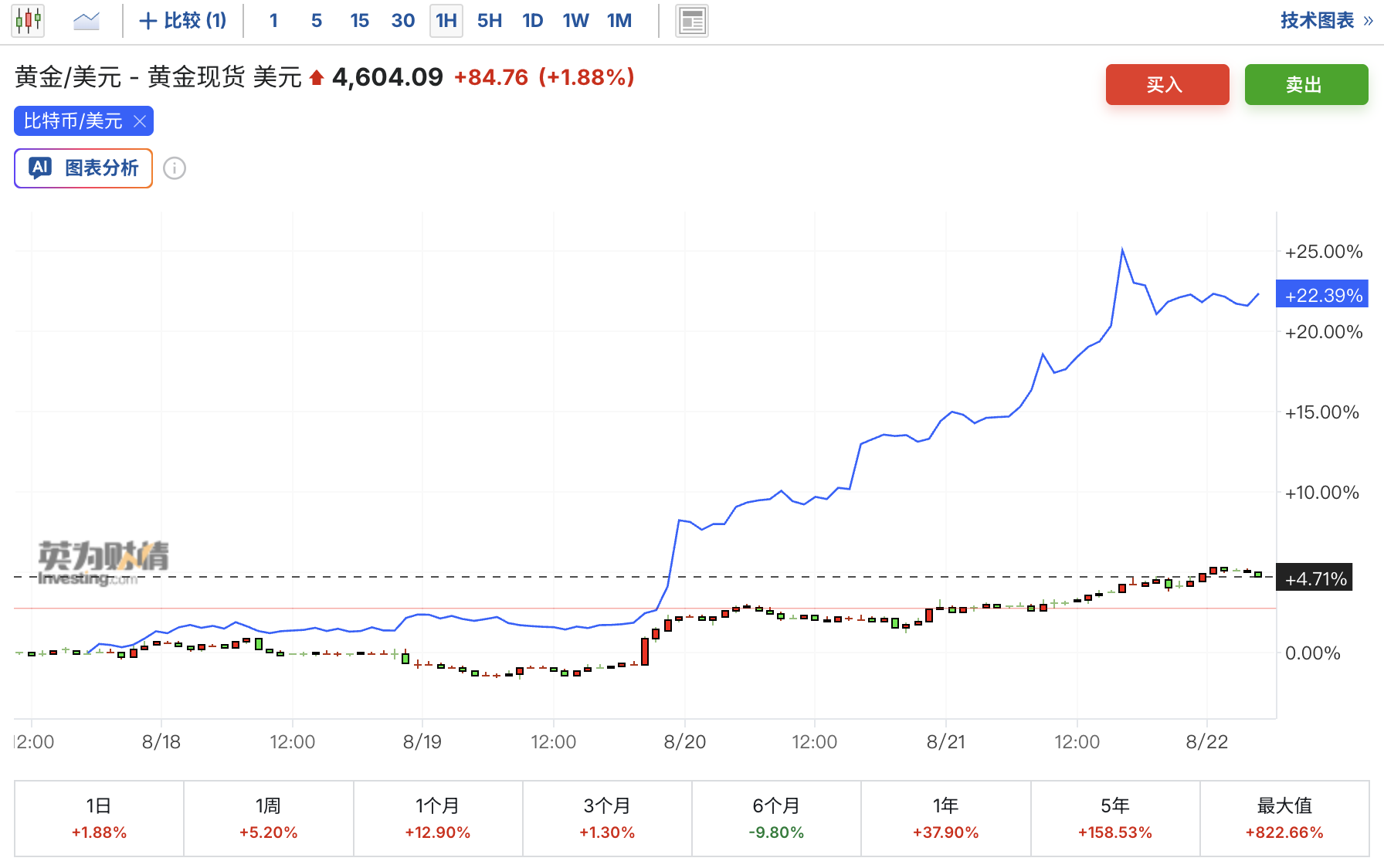
However, long-end Treasury yields only briefly retreated before coming under pressure again, ending the week largely flat. Meanwhile, Bitcoin surged over 25% this week, breaking above $78,000, while gold climbed to a three-month high.
This market reaction reveals a deeper dilemma in Washington: the U.S. government wants to lower financing costs, but inflation remains a constraint on the Federal Reserve. At the same time, governments and corporations worldwide are competing for capital more intensely than ever—from massive fiscal borrowing to the huge financing needs in the artificial intelligence sector. The structural upward pressure on long-end rates has not dissipated.

Charlie McElligott of Nomura Securities characterized this week's combination of rising gold, a falling dollar, and simultaneous Bitcoin strength as a "pressure relief valve"—when U.S. authorities try to stabilize long-end rates, market anxiety vents elsewhere.

Barclays strategists believe the dollar is the "biggest loser" from this yield-suppression action, with renewed fiscal concerns stoking safe-haven demand for gold.

The 90-day correlation between Bitcoin and gold is currently at its highest level since the pandemic, further reinforcing the narrative logic of cryptocurrencies as a "debasement hedge"—though this week's crypto rally also had its own specific catalysts.

Nathan Thooft, Senior Portfolio Manager at Manulife Investment Management, noted: "The Treasury can influence liquidity and market sentiment, but it cannot sustainably suppress the fundamental forces of growth, inflation, deficits, and supply."

The U.S. government's current fiscal deficit is nearing $2 trillion, rising oil prices are exacerbating inflation risks, and governments globally continue to expand borrowing for defense, energy, and social spending.

Barclays strategists also pointed out that rising corporate bond issuance—especially by mega-cap tech companies financing AI investments—is adding extra pressure on long-end rates. The conclusion: the Treasury can adjust duration supply, but it cannot eliminate the demand for capital.

The AI frenzy plays a dual role in this capital competition: on one hand, financing for AI creates enormous demand in the bond market; on the other, investor expectations of high AI returns are helping stocks remain resilient despite rising funding costs.

Besant expressed clear displeasure in an interview Thursday regarding AI companies' borrowing behavior, saying the debt issuance strategy of such firms is "almost yield-insensitive because they believe the returns from building AI will be so great that they don't care what rate they pay."

Priya Misra, Portfolio Manager at J.P. Morgan Asset Management, said, "A global fight for capital is driving up the discount rate for equities—from governments financing defense, energy security, and social programs, to the financing needs of the entire AI ecosystem."

Florian Ielpo of Lombard Odier believes the key figure supporting stocks is not the Treasury's $4 billion-scale buyback operation, but rather "2026's 20% earnings beat." This partly explains why the stock market has largely "looked through" Besant's actions and the renewed pressure in bond markets.

Despite stock market resilience, U.S. Treasury yields approaching 5% are becoming increasingly difficult for highly valued stocks to ignore as a source of competitive pressure.

Bank of America strategist Michael Hartnett views the 5% level on the 30-year Treasury yield as a key dividing line, arguing that failure to break below it would increase pressure on the dollar and high-leverage areas—including AI hyperscalers and private credit.

On Friday, Ray Dalio, founder of Bridgewater Associates, issued a more severe warning to markets, advising investors to reduce bond exposure and hold some gold and Bitcoin as a hedge against a potential U.S. debt crisis.

Misra also noted that markets are digesting policy disruptions faster: "The speed at which markets fade policy moves is increasing because there's some expectation of 'equity market protection' from this administration—time and again, whenever there's turmoil in risk assets or bond markets, we've seen Trump or the Treasury step in."

The advantage of the debasement trade over bonds lies in its more compelling narrative logic. But there is disagreement over whether this trade can be sustained.

Brent Donnelly, President of Spectra Markets, initially interpreted Besant's announcement as a signal to buy Bitcoin and sell the dollar against the Swiss franc. But the buyback scale is minuscule relative to the entire Treasury market, causing him to later waver.

"I think the big moves in the dollar, gold, and Bitcoin are likely to cool off significantly from here," he said. "Besant's move reinforced structural themes, but those themes aren't new, and there isn't any near-term catalyst to trigger the next leg higher for the debasement trade."

At a deeper institutional level, the tension between the Treasury and the Fed is also noteworthy. The Treasury can adjust the volume and maturity structure of bond issuance, but it cannot create money out of thin air—that's the Fed's power.

However, Fed Chairman Warsh's emphasis on scaling back the central bank's market intervention leaves Washington facing the reality of resilient economic growth, persistent inflation, and large-scale capital expenditures all pushing rates higher, even as it hopes to lower borrowing costs.

Next week's market moves may further test this tension: Nvidia's earnings will reveal whether AI company profits can continue to support stocks, while at the Jackson Hole meeting, investors will watch closely for any signs of the Fed aligning with Washington on easier financial conditions.


Criptomoedas em alta

Perguntas relacionadas

QWhat market reaction was described as a 'pressure release valve' in the article, and who provided that characterization?

AThe combination of rising gold, a falling dollar, and a simultaneous strong performance in Bitcoin was described as a 'pressure release valve'. This characterization was provided by Charlie McElligott of Nomura Securities.

QAccording to the article, what is the current 90-day correlation between Bitcoin and gold at, and what narrative does this strengthen?

AThe 90-day correlation between Bitcoin and gold is at its highest level since the pandemic. This strengthens the narrative of cryptocurrencies acting as a 'depreciation hedge tool'.

QWhat did Bridgewater founder Ray Dalio reportedly advise investors to do in response to a potential U.S. debt crisis?

ARay Dalio reportedly advised investors to reduce their bond exposure and hold gold and some Bitcoin to guard against a potential U.S. debt crisis.

QWhat two major events next week does the article suggest will test the market's tension between high rates and growth narratives?

AThe article suggests that Nvidia's earnings report, which will reveal if AI company profits can continue to support the stock market, and the Jackson Hole meeting, where investors will watch for signs of alignment between the Fed and Washington on easing financial conditions, will test the market tension.

QWhat key difference in authority does the article highlight between the U.S. Treasury and the Federal Reserve in influencing markets?

AThe article highlights that the Treasury can adjust the volume and maturity structure of bond issuance, but it cannot create money out of thin air—that is the power of the Federal Reserve.

Leituras Relacionadas

Alexander Shokhin: Business Needs an Interest Rate Below 10% and the Dollar at 90-95 Rubles

Alexander Shokhin, head of the Russian Union of Industrialists and Entrepreneurs (RSPP), has advocated for potentially using "non-market" tools to keep the ruble within a target exchange rate corridor. This, he argues on August 21, would help avoid excessive volatility, though he called the topic a separate discussion. Shokhin had previously raised the idea of a currency corridor in late May, noting the ruble's current exchange rate is not fully market-driven due to a limited currency segment and reduced foreign currency demand. He stated that many business community colleagues propose fixing a corridor, even through non-market methods, to ensure predictability. The business community's key targets, as outlined by Shokhin in late December 2025, are a Central Bank key rate of 12%, inflation of 4–5%, and a US dollar exchange rate of 90–95 rubles by the end of 2026. A turning point for investment, he said, would be lowering the rate to 12% with 6% inflation, though truly comfortable business conditions would require a rate below 10%. He stressed the critical importance of currency predictability for corporate investment decisions. From a data analysis perspective, the idea of a ruble corridor is not new. A similar mechanism was used in Russia from 1995 to 1998, where the central bank held the dollar within fixed boundaries through regular interventions. This regime lasted three years before ending abruptly during the 1998 default, illustrating the fragility of rigid targets under external shocks. The macro-economic link is clear: stricter corridors require more reserves to defend against currency pressure. The key unresolved technical aspect is the specific sources and volume of such interventions given the current market's limited liquidity. Whether this discussion remains theoretical or leads to concrete corridor parameters will be seen in the coming months.

cryptonews.ruHá 2h

Alexander Shokhin: Business Needs an Interest Rate Below 10% and the Dollar at 90-95 Rubles

cryptonews.ruHá 2h

Trading

Spot

Artigos em Destaque

Como comprar MOVE

Bem-vindo à HTX.com!Tornámos a compra de Movement (MOVE) simples e conveniente.Segue o nosso guia passo a passo para iniciar a tua jornada no mundo das criptos.Passo 1: cria a tua conta HTXUtiliza o teu e-mail ou número de telefone para te inscreveres numa conta gratuita na HTX.Desfruta de um processo de inscrição sem complicações e desbloqueia todas as funcionalidades.Obter a minha contaPasso 2: vai para Comprar Cripto e escolhe o teu método de pagamentoCartão de crédito/débito: usa o teu visa ou mastercard para comprar Movement (MOVE) instantaneamente.Saldo: usa os fundos da tua conta HTX para transacionar sem problemas.Terceiros: adicionamos métodos de pagamento populares, como Google Pay e Apple Pay, para aumentar a conveniência.P2P: transaciona diretamente com outros utilizadores na HTX.Mercado de balcão (OTC): oferecemos serviços personalizados e taxas de câmbio competitivas para os traders.Passo 3: armazena teu Movement (MOVE)Depois de comprar o teu Movement (MOVE), armazena-o na tua conta HTX.Alternativamente, podes enviá-lo para outro lugar através de transferência blockchain ou usá-lo para transacionar outras criptomoedas.Passo 4: transaciona Movement (MOVE)Transaciona facilmente Movement (MOVE) no mercado à vista da HTX.Acede simplesmente à tua conta, seleciona o teu par de trading, executa as tuas transações e monitoriza em tempo real.Oferecemos uma experiência de fácil utilização tanto para principiantes como para traders experientes.

579 Visualizações TotaisPublicado em {updateTime}Atualizado em 2026.08.21

Como comprar MOVE

Discussões

Bem-vindo à Comunidade HTX. Aqui, pode manter-se informado sobre os mais recentes desenvolvimentos da plataforma e obter acesso a análises profissionais de mercado. As opiniões dos utilizadores sobre o preço de MOVE (MOVE) são apresentadas abaixo.

活动图片