Author: Long Yue
Source: Wall Street News
The sharper the market rallies, the harder it becomes to find reasons for a decline — but the risks have not disappeared; they are merely hidden deeper.
On May 14, Bloomberg market analyst Jon-Patrick Barnert pointed out in an article that while the current U.S. stock market rally has surged significantly, the cost and timing for shorting remain difficult to gauge. More troublingly, even the question of "what the most compelling reason to short is" has become blurry.
The core contradiction of this rally is: positioning has become extremely crowded, yet the fundamental narrative — especially AI — continues to support market sentiment. Between these two, which will crack first?
Positioning: The Market is Approaching "Max Long"
From a pure price action perspective, signals for a pullback are already quite evident.
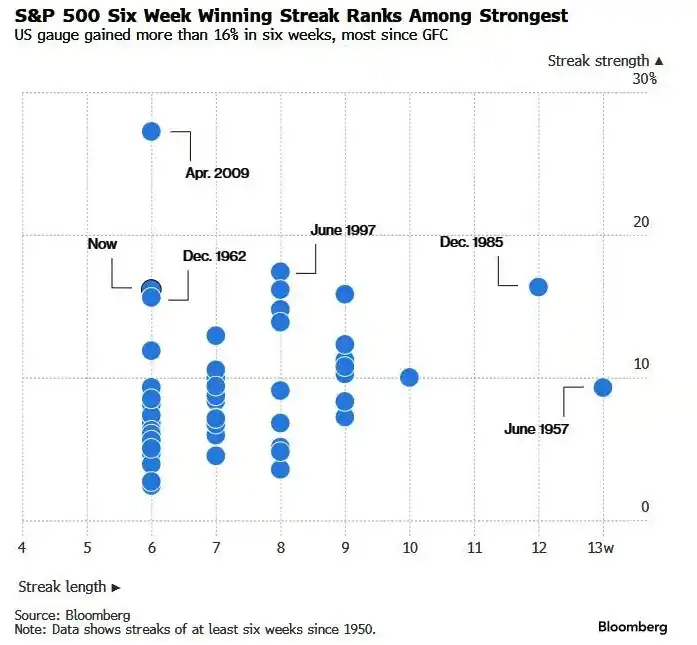
The S&P 500's six-week winning streak is not only one of the longest such runs in over 70 years, but the magnitude of gains also ranks among the strongest in history. Barnert stated that "taking a breather" would be perfectly normal for this market.
Goldman Sachs's Risk Appetite Indicator has risen back to 1, the first time since the beginning of the year. It is extremely rare for this indicator to exceed 1, and historically, it has often signaled a potential pullback. The last time it breached this threshold was in 2021, after which the market entered a bear phase.
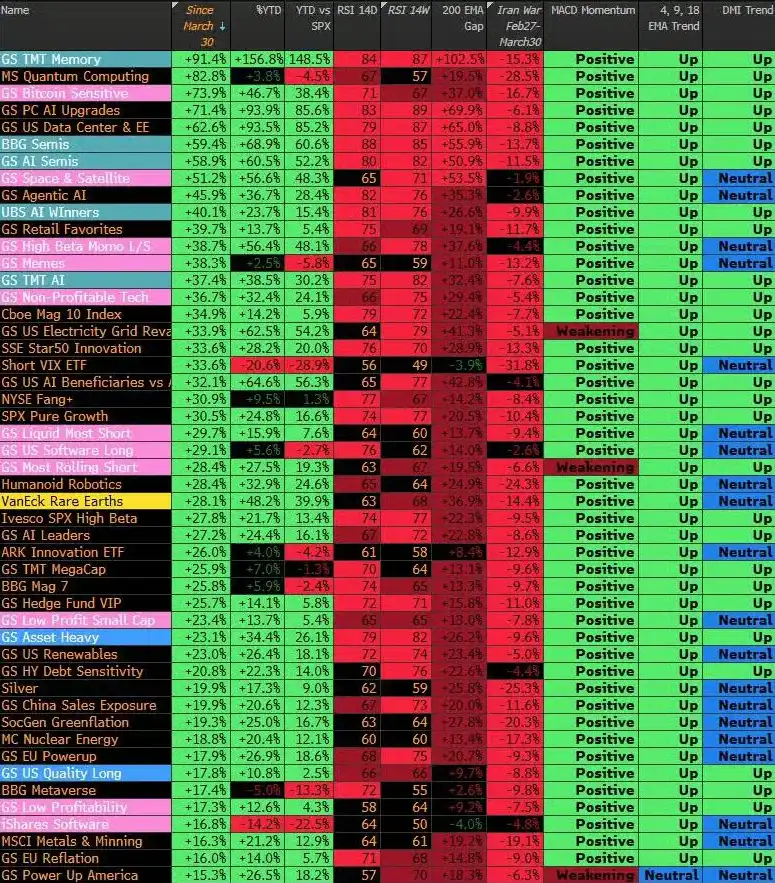
Looking at the hottest thematic stocks, Barnert describes a market where "everything is overbought," with some of the most popular sectors reaching extreme overbought levels. Combined with mechanical fund inflows — which currently appear to be at or near maximum long positioning — the overall picture is: limited upside, and significant potential pressure from positioning resets.
However, shorting is not easy. Barnert points out that position adjustments can be completed within a single day, making the entry and exit timing for short trades extremely difficult to manage. If the market chooses to "decline slowly," volatility positions would quietly become ineffective in a mild environment. A more likely scenario is: overall sentiment remains bullish, and if short sellers are forced to cover their positions, it could trigger another round of short squeezes, pushing prices higher and faster than anyone expected.
Fund flows in some popular ETFs have begun to show subtle shifts — leaning towards "locking in gains" rather than "chasing highs." But Barnert also admits this trend has persisted for weeks and has not yet had a material impact on market direction.
Narrative: Without AI, The Market is Nothing
If positioning is a technical vulnerability, the narrative level currently appears even more solid.
Barnert notes that there is currently a lack of clear signals triggering a fundamental bear market. Corporate earnings remain strong, inflation expectations have risen slightly but not to extreme levels. The market has digested the shocks of high oil prices and Middle East tensions, and the latest U.S. jobs data has alleviated recession fears. As for interest rate hike expectations, they are no longer a catalyst suppressing stocks.
But one issue cannot be ignored: the concentration of this rally has become highly focused on "the concentration itself."
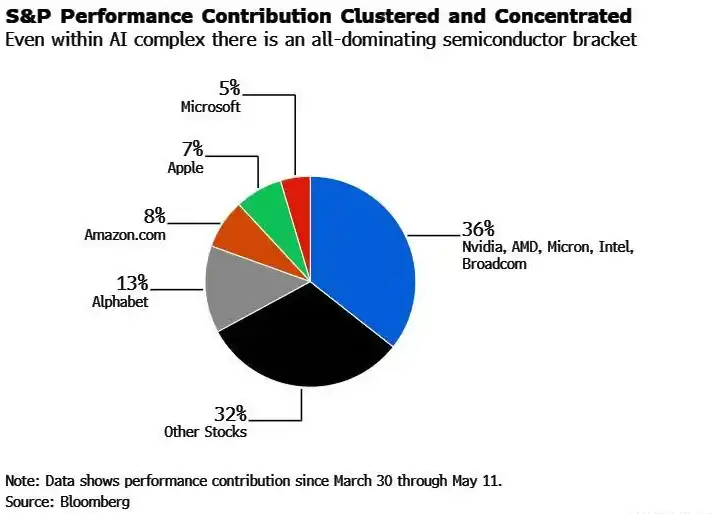
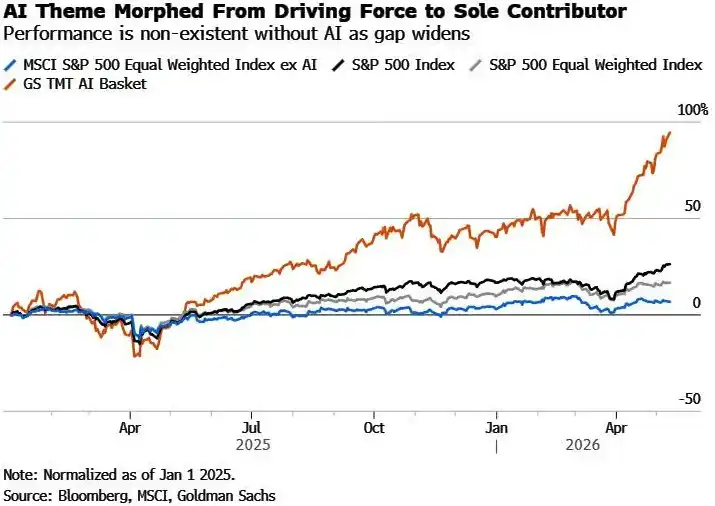
Barnert points out that whether comparing the performance of indices with and without AI, or dissecting the sources of gains since March, the conclusion points in the same direction: without AI, this market's performance can only be described as "mediocre." More notably, the semiconductor sector alone contributed nearly 40% of the gains since March.
The market narrative surrounding AI has once again entered a "greed mode," a stage of pursuing unreasonable returns rather than rational, reasonable gains. The concerns widely discussed just months ago — whether AI computing costs can be offset by layoff savings, data center energy supply bottlenecks, AI pricing wars eroding profit margins, new competitors disrupting the landscape with lower costs, massive growth in capital expenditures while stock buybacks stall, AI security risks — now seem to have been collectively forgotten by the market.
The Risk of a "DeepSeek Moment" Repeat
Nomura Securities strategist Charlie McElligott issued the most direct warning on this matter.
He stated: "Given the current market structure and thematic overlap, if another fully-fledged, system-wide shock catalyst like a 'DeepSeek-style' event emerges one day, it could directly trigger a Nasdaq-level limit-down style of trade."
McElligott further noted that in such a scenario, semiconductor ETFs could easily drop 15% in a single day — because "the hypothetical reversal of reflexive, mechanical fund flows would create large-scale overshooting on the downside."
In other words, the very same mechanical fund flows (like CTA strategies, risk parity funds, etc.) that kept buying on the way up would, once triggered to reverse, become amplifiers accelerating the decline.
The AI bull market faces two major risks: one technical (overly crowded positioning), and one narrative-based (whether the AI story can hold). The former could trigger at any time; the latter, once broken, would deliver a deeper shock. Combined, they constitute the most noteworthy structural vulnerability in the current market.