Vitalik: Building Index-Tracking Assets Based on Options Rather Than Debt

marsbitPublicado em 2026-06-02Última atualização em 2026-06-02

Resumo

Vitalik Buterin proposes constructing index-tracking assets using synthetic options rather than debt-based mechanisms. The core problem is enabling exposure to a price index (T, e.g., USD/ETH) in a trust-minimized environment where only ETH is a trustless asset, relying solely on a decentralized oracle. Traditional approaches, like algorithmic stablecoins, use debt positions and require real-time, binding oracles for liquidations, which are difficult to secure. This article suggests a paradigm shift: eliminating liquidation and using options as the fundamental building block, requiring only a "slow" oracle. The design defines two synthetic assets, P and N, with parameters for the index T, a strike price S, and an expiry M. At any time, 1 ETH can be split to create a (P, N) pair or merged back. At expiry M, the oracle determines T's value x. P receives min(1, S/x) ETH, and N receives max(0, 1 - S/x) ETH. This structure inherently avoids insolvency risk (P+N=1) and can share an oracle with prediction markets. To gain stable exposure to T (e.g., USD), a user would hold deeply "in-the-money" P options (with S significantly below the current price) and periodically "roll" them to lower strikes as the price approaches the current strike, rebalancing their portfolio. This transfers the decision of *when* to act from a protocol-enforced liquidation (requiring a real-time oracle) to the user or an automated wrapper. Users can manage MEV risk and oracle dependency by choosing their ...

Original article by Ethereum founderVitalik Buterin

Compiled by | Odaily Planet Daily QIN Xiaofeng (@QinXiaofeng 888 )
Special thanks to Vladimir Novakovski, Curve developers, and others who provided feedback and review for this article.

Suppose you have a price index code T, which represents a certain price index priced in ETH. For example, T could be the USD/ETH price (i.e., the reciprocal of ETH/USD), or CPI/ETH (i.e., CPI/USD * USD/ETH), or the price index of any other commodity, or even more exotic indices (such as the average rent in a city). You want users to be able to gain exposure to T.

Simply put, your goal is to create a synthetic asset that tracks T in an ecosystem where only ETH is a "trustless" asset (or this can be extended to other trustless assets), without relying on a centralized issuer. The only trust dependency is the oracle, but oracles can be made trust-minimized, whereas issuers cannot.

If T is considered the USD/ETH price, then this problem is essentially the same as that of "algorithmic stablecoins." But in reality, it's about perpetual futures.

All methods attempting to provide this functionality must face a fundamental problem: the entire system can only hold ETH, and the sum of its assets and liabilities denominated in T must be zero. Therefore, for every user holding a positive T position, there must be another user holding an equal amount of negative T position. What if T rises too high, causing the negative T holders to become "insolvent"?
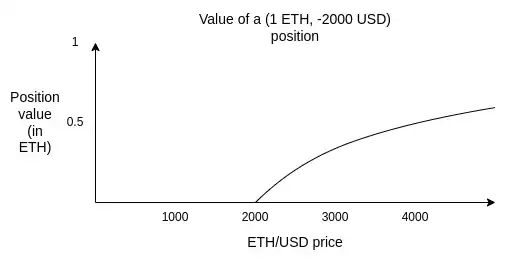
In traditional algorithmic stablecoins, this problem is solved through forced liquidations.

For example, assume the ETH price is $2500, and a user holds a position (1 ETH, -$2000). If the ETH price falls to $2000 (in practice, for a safety margin, it would trigger at a slightly higher price), the system must be able to "force liquidate" that user: allow anyone else to contribute $2000 and receive the underlying 1 ETH, ensuring the entire system doesn't get stuck with an undercollateralized $2000 debt.

The problem with relying on liquidations is that liquidation relies on real-time oracles. You need an oracle that can provide a binding ETH/USD price value and do so in real time.

Real-time oracles are difficult to secure. You can only rely on a limited number of participants who observe real-time signals in an automated manner. You cannot use any mechanism with recourse. You also cannot employ the currently most effective technique for building secure and cheap oracles: placing a prediction market in front of a secure but expensive oracle and only using that expensive oracle when serious disagreements arise.

This article proposes a disruptive idea that can allow synthetic assets to rely only on "slow" oracles: we completely remove the concept of liquidation and change the system's "basic building block" from debt to options. On this foundation, you can choose to build an asset that tracks an index as a higher-level structure, or not do so at all, letting users rebalance themselves. Decoupling these two mechanisms leads to greater stability and flexibility.

Synthetic Options

We define two assets: P and N.

The parameters include: (i) code T, (ii) strike price S, (iii) expiration date M.

At any time, a pair (P, N) can be generated by splitting 1 ETH. Similarly, you can always merge P and N to get back 1 ETH.

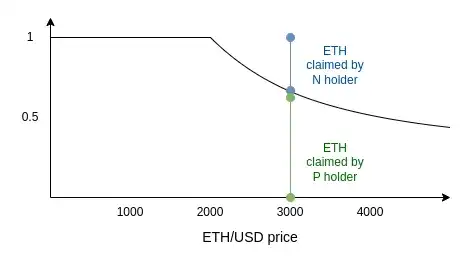
At time M, an oracle is invoked to determine the value of T. Let that value be x. After the oracle is determined:

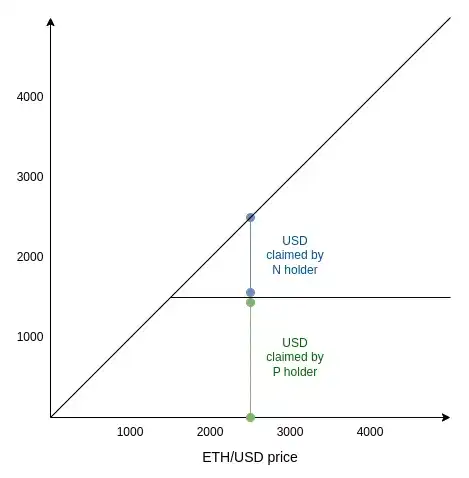
  • P receives min(1, S / x) ETH
  • N receives max(0, 1 - S / x) ETH

Note: P + N = 1. Therefore, there is no possibility of liquidation.

Also, for ease of understanding, here is the same chart denominated in USD:
An interesting feature of this design is that it is "in effect" a prediction market, and such prediction markets have already existed and been traded for years. See: Scalar Markets | Seer.

This means the design can share the same oracle as a prediction market system, improving security.

How to Use Synthetic Options

Suppose the current price is 2500, and you, as a user, want to construct a portfolio with a certain USD exposure. You buy some (P 1500), which is a P asset with a strike price far below 2500 (here, 1500). Is this enough?

Not quite. Even though the current price is far above 1500, by the expiration date, the price could still fall below 1500. The greater this risk, the more the USD-denominated value of (P 1500) deviates from its maximum value. In fact, it begins to deviate from $1 in a quadratic form. Chart as follows:
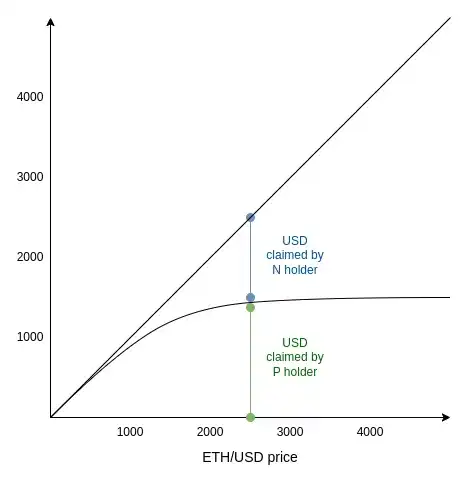
Note that this is just a smoothed version of the curve above. The degree of smoothness depends both on the gap between the current price and 1500 and on the market's expectation of future price volatility.

To understand the principle, assume M is two weeks from now, and the current price is 1499. How much is (P 1500) worth at this time? It corresponds to the possibility that "the ETH/USD price will be above 1500 two weeks from now." ETH can be quite volatile at times, so this value could be high or low, say $50. What if the current price drops to 1399? The price of P would fall but not go to zero completely, as the price could still recover above 1500 before M arrives.

When ETH/USD is far below 1500, N's value approaches zero. When ETH/USD is far above 1500, N's value approaches Price - 1500. In the middle region, it is a smooth curve transitioning from one pattern to the other.

The Black-Scholes equation is a formalized method attempting to estimate a reasonable price for (P 1500) (at least when the index T represents some price, rather than more exotic underlying assets like weather). However, since 2008, the Black-Scholes equation has become synonymous with catastrophic fragility caused by over-reliance on mathematical models—and not without reason. Therefore, we should not overly fetishize the specific details of the curve, at least because we do not want to introduce another oracle that needs to measure expected volatility, skewness, or kurtosis.

Instead, we should remember the following chart, which is the derivative of the previous chart. It tells you: at the current price level, how much ETH exposure does each unit of (P 1500) correspond to?
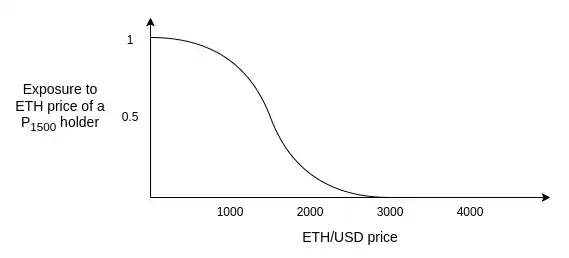
Remember, as a holder of (P 1500), your goal is to "hold" dollars without any exposure to ETH. This chart tells you the strategy: the safe approach is to hold deep "in-the-money" options, and then roll them into options with lower strike prices once the price approaches the strike.

For example, you could follow an algorithm like this: if the current price is X, buy PS with strike price S < X/2 and expiration date 1-2 months in the future. If the price falls below S * 1.5, then roll into PS' with strike price S' < X/4. Do not hold until expiration, because you would be exposed to ETH risk when the oracle determines the price.

Let speculators and market makers hold N and provide liquidity for you.

We can compare the properties of liquidation-based synthetic assets with option-based synthetic assets as follows:
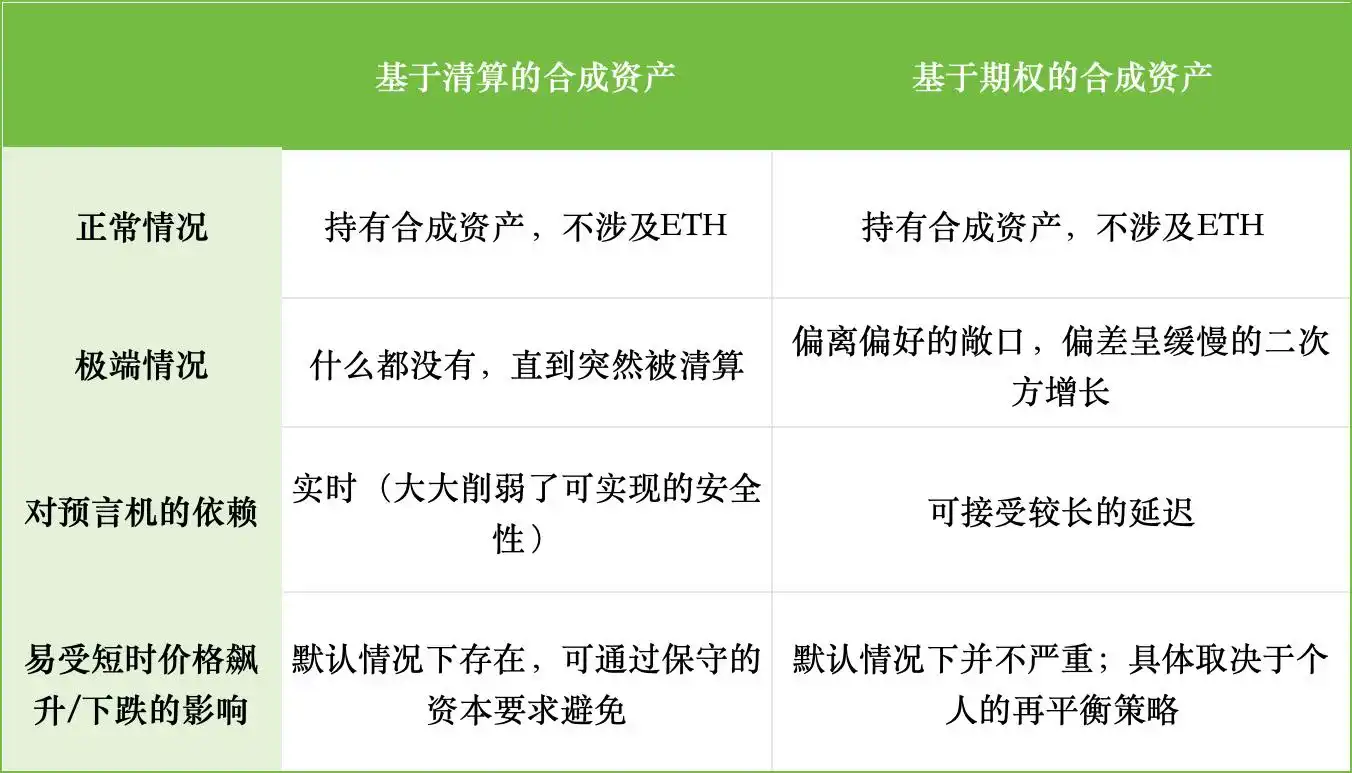
In both systems, action needs to be taken for large price fluctuations: in one system, the protocol liquidates; in the other, users rebalance. The key difference in option-based synthetic assets is that users can choose how to execute this action.

Rebalancing could be done by a fully automated on-chain DAO (Note: fully automated. All rules are set by the DAO, no voting, no AI required). Such a DAO would be a "wrapper" for the option system and provide a "stablecoin." Alternatively, users could choose to rebalance locally using a daemon on their own device.

By shifting the decision point of "when to {liquidate/rebalance}" from an on-chain tool to the user's hands, we gain two advantages:

  1. Reduce users' MEV risk because trades are not visible in advance.
  2. Eliminate reliance on a global canonical oracle. Users still need to rely on oracles that respond faster than (for example) two weeks, but users can hide which oracle they use (e.g., a locally running proxy queries dozens of financial news sites, no one knows which ones, and then takes the median). This helps protect the system from oracle attacks.

The user's main choice lies in timing and threshold. If users rebalance frequently, they are more vulnerable to short-term price fluctuations from counterparties. If users rebalance conservatively, they bear more quadratic drift.

I believe accepting a moderate degree of quadratic drift (e.g., annualized standard deviation around 1-4%) is an underrated strategy. This cost is indeed significant, and it is counterintuitive, making this design unusable as an "accounting stablecoin" (i.e., unable to let receivers, senders, or capital gains tax authorities "pretend it is a dollar").

However, if you view it not from the perspective of "I want to simulate the dollar," but from "I want price stability" (i.e., the ability to pay future known amounts of expenditure), it becomes much more reasonable. The annualized volatility between fiat currencies far exceeds 1-4%. The annualized volatility of expected future expenditures, denominated in their local fiat currency, for each individual or business also far exceeds 1-4%. Furthermore, the equilibrium return rates of algorithmic stablecoins (like RAI) also often fluctuate by roughly comparable magnitudes.

An important decision that needs to be made is: even if you rebalance conservatively, what is the market mechanism through which rebalancing occurs? Losing 2% or more per year in multiple rounds of slippage is very easy, and this is the greatest risk of the entire scheme becoming uncompetitive.

Fortunately, users' time preferences are almost always very low. Users do not care whether they rebalance today, tomorrow, or in three days. We should leverage this to design an ideal market structure with slippage far lower than traditional automated market makers. Rebalancing would then be more like one-sided market making than instant selling.


Perguntas relacionadas

QWhat is the fundamental problem that all methods trying to provide a synthetic asset tracking a price index T must face?

AThe entire system can only hold ETH, and the total assets and liabilities denominated in T must sum to zero. Therefore, for every user holding a positive T position, there must be another user holding an equal negative T position. The core problem is the risk of negative T holders becoming 'insolvent' if T rises too high.

QWhat is the key limitation of the traditional liquidation-based approach for algorithmic stablecoins?

ALiquidations depend on a real-time oracle. This requires a trust-minimized oracle that can provide a binding ETH price value in real-time, which is very difficult to secure robustly. Real-time oracles are vulnerable and can't easily use the safest techniques like prediction markets with fallback to a slower, expensive oracle only in case of serious disagreement.

QWhat are the two synthetic assets defined by Vitalik, and what is their core mechanism?

AThe two assets are P and N. A pair (P, N) can always be created by splitting 1 ETH, and merged back into 1 ETH. At maturity M, using an oracle-determined value x for the index T, P receives min(1, S/x) ETH and N receives max(0, 1 - S/x) ETH, where S is the strike price. This ensures P + N = 1, eliminating the possibility of liquidation.

QAccording to the article, what is a significant advantage of decoupling the stabilization mechanism (using options) from the user's rebalancing strategy?

AIt removes the dependency on a canonical, real-time global oracle. The decision of *when* to rebalance shifts from the protocol to the user. Users can rely on oracles that are faster than the option's expiry (e.g., two weeks) but can hide which specific oracles they use (e.g., a local agent querying many news sites), making the system more resilient to oracle attacks. It also reduces user MEV risk.

QWhat is a potential major risk for the competitiveness of the option-based synthetic asset system, even if rebalancing is done conservatively?

AThe market mechanism for rebalancing itself. It is very easy to lose 2% or more per year across multiple rounds of slippage. Designing a market structure with much lower slippage than traditional automated market makers is crucial, leveraging the fact that user time preferences for rebalancing are typically very low.

Leituras Relacionadas

BitMart Research Institute Weekly Highlights: ETF Continued Outflows + AI Drain, Crypto Market Seeks Bottom Amid Volatility

**BitMart Research Weekly Highlights: ETF Outflows and AI Demand Weigh on Crypto Market** The crypto market saw a correction this past week, diverging from the all-time highs in U.S. equity markets. Bitcoin (BTC) fell roughly 6%, while Ethereum (ETH) declined about 4.5%. The primary pressure point was significant and sustained outflows from U.S. spot Bitcoin ETFs, which experienced a record nine consecutive days of net redemptions totaling approximately $2.8 billion. Spot Ethereum ETFs also faced continuous outflows. This weakness in digital assets contrasted with the continued surge in traditional markets, particularly AI-related stocks. The news of Anthropic's secret IPO filing, targeting a potential $750B IPO, and Alphabet's major new AI infrastructure funding further fueled the tech rally. The analysis suggests a potential "liquidity siphon" effect, where capital is being diverted from crypto into the dominant AI investment narrative. Other notable developments include DTCC's DTC announcing plans to integrate Stellar for tokenized asset services, signaling a major step for tokenized equities. Meanwhile, MicroStrategy paused its primary mechanism for funding Bitcoin purchases to focus on debt management, removing a key institutional buyer from the market. The report concludes that the crypto market remains under pressure from the competing AI narrative and major upcoming IPOs, with a potential for a broader market bottom if an AI-driven correction occurs later this cycle.

marsbitHá 13m

BitMart Research Institute Weekly Highlights: ETF Continued Outflows + AI Drain, Crypto Market Seeks Bottom Amid Volatility

marsbitHá 13m

The Death of the Three-Act Play: AI Ushers Enterprise Software Startups into the ‘Speedrun Era’

The Death of the Three-Act Play: How AI is Ushering in a 'Speedrun Era' for Enterprise Software Startups The traditional three-act play for building an enterprise software company—first, a niche wedge product; second, an expanded suite; third, a dominant platform—is becoming obsolete in the AI era. Previously, startups would spend 3-5 years perfecting a single-point solution to reach tens of millions in ARR (Act 1: The Wedge). Then, over another few years, they'd build adjacent products to form a suite and cross the $100M ARR threshold (Act 2: The Suite). Finally, with scale and user engagement, they could aim to become a foundational platform themselves (Act 3: The Platform). This model assumed a timeline measured in years. However, AI-driven tools have dramatically compressed software development costs and timelines. Companies like Cursor, Clay, and Harvey have scaled from near zero to approaching or surpassing $100M ARR in remarkably short periods, demonstrating a new competitive pace. The core argument is that in this rapidly changing market, relying on a small, "safe" wedge as a protective harbor may now be a conservative, even risky, strategy. The plummeting cost of building software means the time required for Acts 1 and 2 is approaching zero. Consequently, rational strategy now favors planning to build the entire vision from the outset. This shift changes the calculus for early-stage investment. The emphasis is moving from finding a defensible niche to backing founders with "unreasonable, relentless ambition" to reimagine entire workflows or replace incumbent platforms from day one. The age of gradual expansion is giving way to an era of immediate, full-scale ambition.

marsbitHá 32m

The Death of the Three-Act Play: AI Ushers Enterprise Software Startups into the ‘Speedrun Era’

marsbitHá 32m

After the 'Golden Finger' Points to IBM, the Stock God Trump's Next Target Emerges

The White House occupant is being called a "stock god." Financial disclosures show former President Trump executed 3,642 stock trades in Q1 2026, averaging 58 per trading day. More significantly, a pattern has emerged where companies he publicly praises often see their stock prices rise and frequently overlap with his personal portfolio holdings, government industrial policy, and federal funding. Since a high-profile Tesla event in March 2025, Trump has publicly endorsed at least nine companies, including Intel, Dell, Micron, Palantir, IBM, Apple, Thermo Fisher, Nvidia, and AMD. These "Trump concept stocks" share key traits: they are tied to AI, semiconductors, quantum computing, or "Made in America" narratives; they often receive government contracts, subsidies (like CHIPS Act funding), or regulatory favors; and their CEOs typically have strong personal or political ties to Trump. Timing raises questions. In several instances, such as with Palantir and Dell, Trump's personal account established or increased positions weeks before his public endorsements, which were followed by significant stock price jumps. While his assets are reportedly held in a blind trust managed by his children, the correlation is notable. Based on this pattern, analysis suggests the next companies likely to be endorsed are those where the US government has already taken a strategic equity stake but which haven't yet received a high-profile "call-out." Prime candidates include MP Materials (rare earths, 15% DoD interest), Lithium Americas (lithium, DoE-backed), and quantum computing firms like IonQ, Rigetti, and D-Wave, which are reportedly in talks for government equity-for-funding deals. Other potential names are Oracle (deep political ties) and GlobalFoundries (semiconductors and quantum funding). These stocks carry high political premium, meaning their valuations are highly sensitive to political favor, which can be volatile.

marsbitHá 57m

After the 'Golden Finger' Points to IBM, the Stock God Trump's Next Target Emerges

marsbitHá 57m

Trading

Spot
Futuros

Artigos em Destaque

O que é ETH 2.0

ETH 2.0: Uma Nova Era para o Ethereum Introdução ETH 2.0, amplamente conhecido como Ethereum 2.0, marca uma atualização monumental à blockchain do Ethereum. Esta transição não é meramente uma mudança estética; visa melhorar fundamentalmente a escalabilidade, segurança e sustentabilidade da rede. Com uma mudança do mecanismo de consenso em Proof of Work (PoW), intensivo em energia, para um Proof of Stake (PoS) mais eficiente, o ETH 2.0 promete uma abordagem transformadora ao ecossistema blockchain. O que é ETH 2.0? ETH 2.0 é um conjunto de atualizações distintas e interconectadas focadas na otimização das capacidades e desempenho do Ethereum. Esta reformulação foi projetada para abordar desafios críticos que o mecanismo atual do Ethereum enfrentou, particularmente em relação à velocidade das transações e à congestão da rede. Objetivos do ETH 2.0 Os principais objetivos do ETH 2.0 giram em torno da melhoria de três aspectos centrais: Escalabilidade: Com o objetivo de melhorar significativamente o número de transações que a rede pode manejar por segundo, o ETH 2.0 procura ultrapassar a limitação atual de aproximadamente 15 transações por segundo, alcançando potencialmente milhares. Segurança: Medidas de segurança melhoradas são integrais ao ETH 2.0, especialmente através da resistência aprimorada contra ciberataques e da preservação do ethos descentralizado do Ethereum. Sustentabilidade: O novo mecanismo PoS foi projetado não apenas para melhorar a eficiência, mas também para reduzir drasticamente o consumo de energia, alinhando a estrutura operacional do Ethereum com considerações ambientais. Quem é o Criador do ETH 2.0? A criação do ETH 2.0 pode ser atribuída à Ethereum Foundation. Esta organização sem fins lucrativos, que desempenha um papel crucial no apoio ao desenvolvimento do Ethereum, é liderada pelo co-fundador notável Vitalik Buterin. A sua visão de um Ethereum mais escalável e sustentável tem sido a força motriz por trás desta atualização, envolvendo contribuições de uma comunidade global de desenvolvedores e entusiastas dedicados a melhorar o protocolo. Quem são os Investidores do ETH 2.0? Embora os detalhes sobre os investidores do ETH 2.0 não tenham sido tornados públicos, é sabido que a Ethereum Foundation recebe apoio de várias organizações e indivíduos no espaço da blockchain e tecnologia. Esses parceiros incluem firmas de capital de risco, empresas de tecnologia e organizações filantrópicas que compartilham um interesse mútuo em apoiar o desenvolvimento de tecnologias descentralizadas e infraestrutura de blockchain. Como Funciona o ETH 2.0? ETH 2.0 é notável por introduzir uma série de características chave que o diferenciam do seu predecessor. Proof of Stake (PoS) A transição para um mecanismo de consenso PoS é uma das mudanças de destaque do ETH 2.0. Ao contrário do PoW, que depende da mineração intensiva em energia para a verificação de transações, o PoS permite que os utilizadores validem transações e criem novos blocos de acordo com a quantidade de ETH que apostam na rede. Isso leva a uma maior eficiência energética, reduzindo o consumo em aproximadamente 99,95%, tornando o Ethereum 2.0 uma alternativa consideravelmente mais ecológica. Shard Chains As shard chains são outra inovação crítica do ETH 2.0. Estas cadeias menores operam em paralelo com a cadeia principal do Ethereum, permitindo que várias transações sejam processadas simultaneamente. Esta abordagem melhora a capacidade geral da rede, abordando preocupações de escalabilidade que têm atormentado o Ethereum. Beacon Chain No coração do ETH 2.0 está a Beacon Chain, que coordena a rede e gere o protocolo PoS. Ela atua como uma espécie de organizador: supervisiona os validadores, garante que as shards permaneçam conectadas à rede e monitora a saúde geral do ecossistema blockchain. Linha do Tempo do ETH 2.0 A jornada do ETH 2.0 tem sido marcada por vários marcos chave que traçam a evolução desta atualização significativa: Dezembro de 2020: O lançamento da Beacon Chain marcou a introdução do PoS, preparando o caminho para a migração para o ETH 2.0. Setembro de 2022: A conclusão de “The Merge” representa um momento crucial em que a rede Ethereum fez a transição com sucesso de um quadro PoW para um PoS, anunciando uma nova era para o Ethereum. 2023: O lançamento esperado das shard chains visa melhorar ainda mais a escalabilidade da rede Ethereum, solidificando o ETH 2.0 como uma plataforma robusta para aplicações e serviços descentralizados. Características Chave e Benefícios Escalabilidade Melhorada Uma das vantagens mais significativas do ETH 2.0 é a sua escalabilidade melhorada. A combinação de PoS e shard chains permite que a rede expanda a sua capacidade, permitindo que acomode um volume de transações muito maior em comparação com o sistema legado. Eficiência Energética A implementação do PoS representa um enorme passo em direção à eficiência energética na tecnologia blockchain. Ao reduzir drasticamente o consumo de energia, o ETH 2.0 não só reduz os custos operacionais, mas também se alinha mais estreitamente com os objetivos globais de sustentabilidade. Segurança Aprimorada Os mecanismos atualizados do ETH 2.0 contribuem para uma segurança melhorada em toda a rede. O uso do PoS, juntamente com medidas de controle inovadoras estabelecidas através das shard chains e da Beacon Chain, assegura um maior grau de proteção contra potenciais ameaças. Custos Mais Baixos para os Utilizadores À medida que a escalabilidade melhora, os efeitos sobre os custos de transação também serão evidentes. Aumentada a capacidade e reduzida a congestão, espera-se que isso se traduza em taxas mais baixas para os utilizadores, tornando o Ethereum mais acessível para transações do dia a dia. Conclusão ETH 2.0 marca uma evolução significativa no ecossistema da blockchain do Ethereum. Ao abordar questões fundamentais como a escalabilidade, o consumo de energia, a eficiência das transações e a segurança geral, a importância desta atualização não pode ser subestimada. A transição para o Proof of Stake, a introdução das shard chains e o trabalho fundamental da Beacon Chain são indicativos de um futuro em que o Ethereum pode atender à crescente demanda do mercado descentralizado. Em uma indústria movida pela inovação e progresso, o ETH 2.0 representa um testemunho das capacidades da tecnologia blockchain em pavimentar o caminho para uma economia digital mais sustentável e eficiente.

100 Visualizações TotaisPublicado em {updateTime}Atualizado em 2024.12.03

O que é ETH 2.0

O que é ETH 3.0

ETH3.0 e $eth 3.0: Uma Análise Profunda do Futuro do Ethereum Introdução No ambiente em rápida evolução da criptomoeda e da tecnologia blockchain, o ETH3.0, frequentemente denotado como $eth 3.0, emergiu como um tema de considerável interesse e especulação. O termo abrange dois conceitos principais que merecem esclarecimento: Ethereum 3.0: Esta representa uma potencial atualização futura destinada a aumentar as capacidades da atual blockchain do Ethereum, focando especialmente na melhoria da escalabilidade e desempenho. ETH3.0 Meme Token: Este distinto projeto de criptomoeda procura aproveitar a blockchain do Ethereum na criação de um ecossistema centrado em memes, promovendo o envolvimento na comunidade de criptomoedas. Compreender esses aspectos do ETH3.0 é essencial não apenas para entusiastas de criptomoedas, mas também para aqueles que observam as tendências tecnológicas mais amplas no espaço digital. O que é ETH3.0? Ethereum 3.0 Ethereum 3.0 é promovido como uma atualização proposta para a rede Ethereum já estabelecida, que tem sido a espinha dorsal de muitas aplicações descentralizadas (dApps) e contratos inteligentes desde a sua criação. As melhorias vislumbradas concentram-se principalmente na escalabilidade—integrando tecnologias avançadas como sharding e provas de conhecimento zero (zk-proofs). Essas inovações tecnológicas visam facilitar um número sem precedentes de transações por segundo (TPS), potencialmente alcançando milhões, abordando assim uma das limitações mais significativas enfrentadas pela tecnologia blockchain atual. A melhoria não é meramente técnica, mas também estratégica; visa preparar a rede Ethereum para uma adoção generalizada e utilidade em um futuro marcado por uma maior demanda por soluções descentralizadas. ETH3.0 Meme Token Em contraste com o Ethereum 3.0, o ETH3.0 Meme Token aventura-se por um domínio mais leve e divertido, combinando a cultura dos memes da internet com a dinâmica das criptomoedas. Este projeto permite que os usuários comprem, vendam e negociem memes na blockchain do Ethereum, proporcionando uma plataforma que fomenta o envolvimento da comunidade através da criatividade e interesses compartilhados. O ETH3.0 Meme Token visa demonstrar como a tecnologia blockchain pode interseccionar com a cultura digital, criando casos de uso que são tanto divertidos quanto financeiramente viáveis. Quem é o Criador do ETH3.0? Ethereum 3.0 A iniciativa em direção ao Ethereum 3.0 é impulsionada principalmente por um consórcio de desenvolvedores e pesquisadores dentro da comunidade Ethereum, notavelmente incluindo Justin Drake. Conhecido por suas percepções e contribuições para a evolução do Ethereum, Drake tem sido uma figura proeminente nas discussões sobre a transição do Ethereum para uma nova camada de consenso, referida como “Beam Chain”. Esta abordagem colaborativa ao desenvolvimento significa que o Ethereum 3.0 não é fruto de um único criador, mas sim uma manifestação da engenhosidade coletiva focada no avanço da tecnologia blockchain. ETH3.0 Meme Token Os detalhes sobre o criador do ETH3.0 Meme Token são atualmente indetectáveis. A natureza dos tokens de meme frequentemente leva a uma estrutura mais descentralizada e impulsionada pela comunidade, o que poderia explicar a falta de atribuição específica. Isso alinha-se com a ethos da comunidade de criptomoedas mais ampla, onde a inovação geralmente surge de esforços colaborativos em vez de esforços individuais. Quem são os Investidores do ETH3.0? Ethereum 3.0 O apoio ao Ethereum 3.0 provém principalmente da Fundação Ethereum, juntamente com uma comunidade entusiástica de desenvolvedores e investidores. Esta associação fundacional proporciona um grau significativo de legitimidade e melhora as perspectivas de uma implementação bem-sucedida, uma vez que aproveita a confiança e credibilidade construída ao longo de anos de operações de rede. Em um clima em rápida mudança no mundo das criptomoedas, o apoio da comunidade desempenha um papel crucial no impulso ao desenvolvimento e adoção, posicionando o Ethereum 3.0 como um sério candidato a futuros avanços na blockchain. ETH3.0 Meme Token Embora as fontes atualmente disponíveis não forneçam informações explícitas sobre as fundações ou organizações de investimento que apoiam o ETH3.0 Meme Token, é indicativo do modelo típico de financiamento para tokens de meme, que frequentemente depende de apoio base e engajamento da comunidade. Os investidores em tais projetos costumam consistir em indivíduos motivados pelo potencial de inovação impulsionada pela comunidade e pelo espírito de cooperação encontrado dentro da comunidade cripto. Como Funciona o ETH3.0? Ethereum 3.0 As características distintivas do Ethereum 3.0 residem em sua proposta de implementação de sharding e tecnologia zk-proof. Sharding é um método de partição da blockchain em partes menores e gerenciáveis ou “shards”, que podem processar transações simultaneamente em vez de sequencialmente. Esta descentralização do processamento ajuda a prevenir congestionamentos e garante que a rede permaneça responsiva mesmo sob carga pesada. A tecnologia de prova de conhecimento zero (zk-proof) contribui com outra camada de sofisticação ao permitir a validação de transações sem revelar os dados subjacentes envolvidos. Este aspecto não apenas melhora a privacidade, mas também aumenta a eficiência geral da rede. Há também conversas sobre a incorporação de uma Máquina Virtual Ethereum de conhecimento zero (zkEVM) nesta atualização, amplificando ainda mais as capacidades e utilidade da rede. ETH3.0 Meme Token O ETH3.0 Meme Token distingue-se ao capitalizar sobre a popularidade da cultura dos memes. Estabelece um mercado para que os usuários participem da negociação de memes, não apenas para entretenimento, mas também para potencial ganho econômico. Ao integrar recursos como staking, provisão de liquidez e mecanismos de governança, o projeto fomenta um ambiente que incentiva a interação e participação da comunidade. Ao oferecer uma mistura única de entretenimento e oportunidade econômica, o ETH3.0 Meme Token visa atrair um público diversificado, variando de entusiastas de criptomoedas a conhecedores casuais de memes. Cronologia do ETH3.0 Ethereum 3.0 11 de novembro de 2024: Justin Drake sugere a próxima atualização do ETH 3.0, centrada nas melhorias de escalabilidade. Este anúncio sinaliza o início de discussões formais sobre a futura arquitetura do Ethereum. 12 de novembro de 2024: A proposta antecipada para Ethereum 3.0 deve ser revelada no Devcon em Bangkok, preparando o cenário para um feedback mais amplo da comunidade e potenciais próximos passos no desenvolvimento. ETH3.0 Meme Token 21 de março de 2024: O ETH3.0 Meme Token é oficialmente listado no CoinMarketCap, marcando sua entrada no domínio público das criptomoedas e aumentando a visibilidade de seu ecossistema baseado em memes. Pontos Chave Em conclusão, Ethereum 3.0 representa uma evolução significativa dentro da rede Ethereum, focando em superar limitações quanto à escalabilidade e desempenho através de tecnologias avançadas. As atualizações propostas refletem uma abordagem proativa às futuras demandas e usabilidade. Por outro lado, o ETH3.0 Meme Token encapsula a essência da cultura impulsionada pela comunidade no espaço das criptomoedas, aproveitando a cultura dos memes para criar plataformas envolventes que incentivam a criatividade e participação dos usuários. Compreender os distintos propósitos e funcionalidades do ETH3.0 e $eth 3.0 é fundamental para qualquer pessoa interessada nos desenvolvimentos contínuos dentro do espaço cripto. Com ambas as iniciativas a pavimentar caminhos únicos, elas sublinham coletivamente a natureza dinâmica e multifacetada da inovação em blockchain.

102 Visualizações TotaisPublicado em {updateTime}Atualizado em 2024.12.03

O que é ETH 3.0

Como comprar ETH

Bem-vindo à HTX.com!Tornámos a compra de Ethereum (ETH) simples e conveniente.Segue o nosso guia passo a passo para iniciar a tua jornada no mundo das criptos.Passo 1: cria a tua conta HTXUtiliza o teu e-mail ou número de telefone para te inscreveres numa conta gratuita na HTX.Desfruta de um processo de inscrição sem complicações e desbloqueia todas as funcionalidades.Obter a minha contaPasso 2: vai para Comprar Cripto e escolhe o teu método de pagamentoCartão de crédito/débito: usa o teu visa ou mastercard para comprar Ethereum (ETH) instantaneamente.Saldo: usa os fundos da tua conta HTX para transacionar sem problemas.Terceiros: adicionamos métodos de pagamento populares, como Google Pay e Apple Pay, para aumentar a conveniência.P2P: transaciona diretamente com outros utilizadores na HTX.Mercado de balcão (OTC): oferecemos serviços personalizados e taxas de câmbio competitivas para os traders.Passo 3: armazena teu Ethereum (ETH)Depois de comprar o teu Ethereum (ETH), armazena-o na tua conta HTX.Alternativamente, podes enviá-lo para outro lugar através de transferência blockchain ou usá-lo para transacionar outras criptomoedas.Passo 4: transaciona Ethereum (ETH)Transaciona facilmente Ethereum (ETH) no mercado à vista da HTX.Acede simplesmente à tua conta, seleciona o teu par de trading, executa as tuas transações e monitoriza em tempo real.Oferecemos uma experiência de fácil utilização tanto para principiantes como para traders experientes.

3.1k Visualizações TotaisPublicado em {updateTime}Atualizado em 2026.06.02

Como comprar ETH

Discussões

Bem-vindo à Comunidade HTX. Aqui, pode manter-se informado sobre os mais recentes desenvolvimentos da plataforma e obter acesso a análises profissionais de mercado. As opiniões dos utilizadores sobre o preço de ETH (ETH) são apresentadas abaixo.

活动图片