US Stock Registration Giant Acquired by Cryptocurrency Exchange, Accelerating Stock Tokenization

marsbitPublicado em 2026-05-09Última atualização em 2026-05-09

Resumo

Bullish (NYSE: BLSH), a crypto asset trading platform, announced a $4.2 billion acquisition of Equiniti, a major Wall Street transfer agent serving nearly 3,000 public companies. This move aims to accelerate stock tokenization by securing a critical, regulated piece of financial infrastructure that maintains official shareholder records and handles dividends. The deal signals intensifying competition in the tokenization race. True "native" on-chain securities require a licensed transfer agent for legal ownership registration—a bottleneck Bullish now aims to solve. The acquisition positions Bullish to bridge traditional equity markets with blockchain, leveraging Equiniti's extensive client network and compliance credentials. This follows recent key developments: ICE (NYSE's parent) plans a new tokenized securities platform, and the SEC approved Nasdaq's tokenized stock pilot. Bullish's strategy is to establish a neutral, cross-platform infrastructure ahead of these initiatives. The combined company expects high growth from its tokenization business, targeting the vast U.S. equity market. The narrative is shifting from "crypto vs. Wall Street" to convergence, where legacy infrastructure is upgraded onto blockchain rails. The next 18 months will be crucial for observing the rollout of NYSE's platform, Bullish-Equiniti integration, and the broader adoption of tokenized securities by institutions.

Author: Chloe, ChainCatcher

May 5, 2026 – Cryptocurrency trading platform Bullish (NYSE: BLSH) announced that it will acquire Equiniti, a company considered the "behind-the-scenes nervous system" of the entire U.S. stock market on Wall Street, from private equity firm Siris Capital for $4.2 billion. Upon the news, Bullish's stock price surged, rising by approximately 20% at one point.
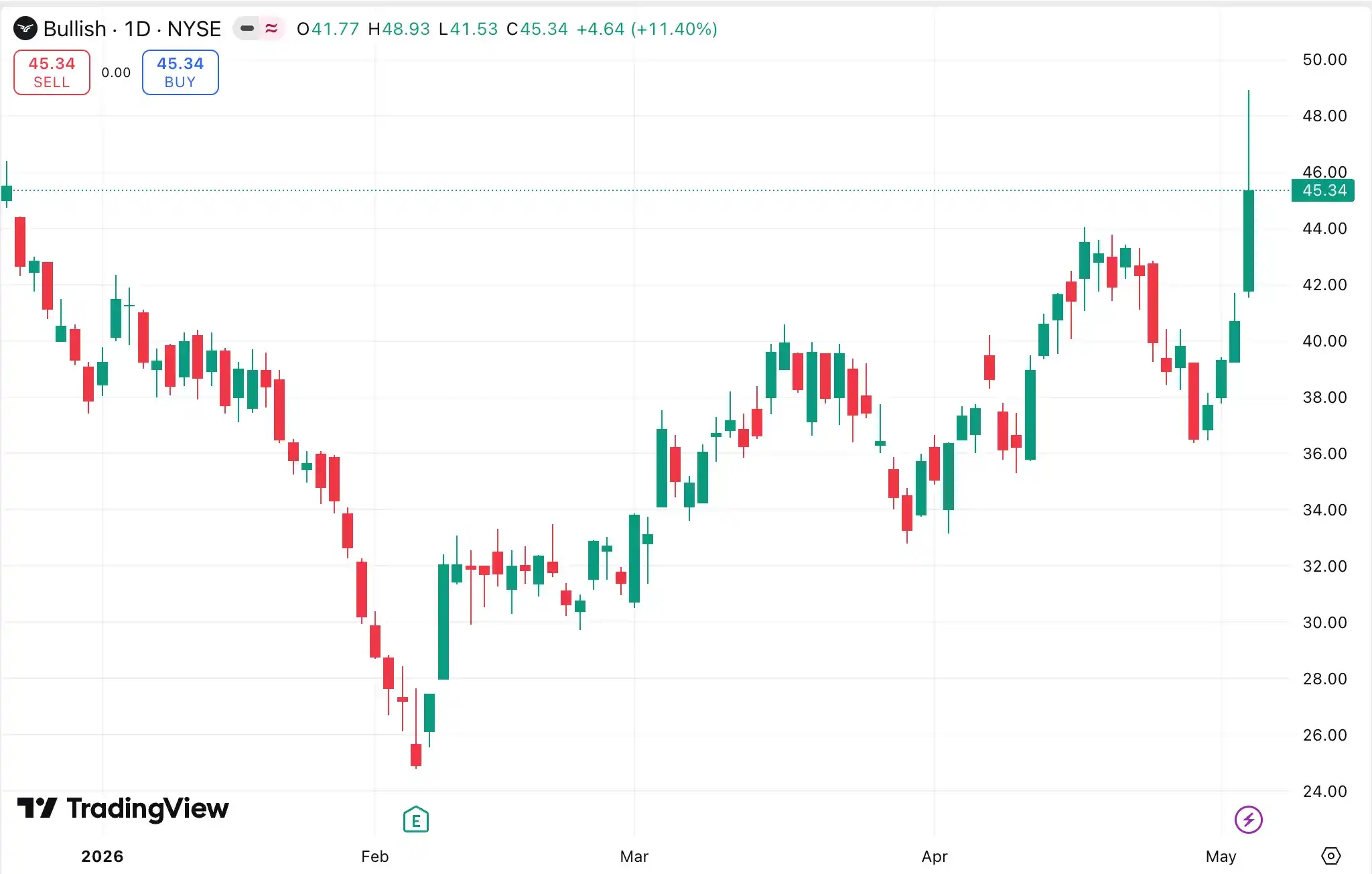
Bullish's acquisition of Equiniti aims to leverage the role of a Transfer Agent to insert itself into the competition and cooperation between traditional exchanges and cryptocurrency platforms. Now, when Wall Street's oldest infrastructure is being acquired by a crypto exchange, what is this arms race really about? And who will be the winner?

Wall Street Tokenization Race Heats Up

Equiniti serves nearly 3,000 listed companies globally, maintains records for 20 million shareholders, and handles $500 billion in dividends and payment flows annually. It is a well-known "transfer agent agency" on Wall Street. The shareholder registry for the well-known Berkshire Hathaway is maintained by it, Rolls-Royce dividends are paid by it; Equiniti is the choice for many traditional enterprises.

When a crypto exchange is willing to spend $4.2 billion (including $1.85 billion in assumed debt and approximately $2.35 billion in Bullish stock consideration) to acquire such a financial infrastructure company, it no longer represents a simple merger and acquisition story. This is a critical signal flare indicating that Wall Street's tokenization race has entered a white-hot stage.

Why Buy Equiniti? Is the Transfer Agent the "Final Piece of the Puzzle" for Tokenization?

To understand the strategic significance of this deal, one must first grasp a concept: the real bottleneck for Tokenized Securities lies not in the issuance side, but in the registration side.

In traditional capital markets, when a company issues stock, the entity that truly records "who owns how many shares" is not the exchange, nor the brokerage, but the transfer agent. It is responsible for:

  • Maintaining the shareholder register (who is a shareholder, how many shares are held)

  • Processing dividend and interest payments

  • Managing corporate actions such as stock splits, stock repurchases, mergers

  • Completing the legal registration of ownership when shares change hands

In other words, the transfer agent is the legal "System of Record" for a listed company's shareholder records. In most major markets, this is a mandatory role that listed companies must have.

Why Has This Become a Key Competitive Factor in the Tokenization Track?

Over the past few years, the market has seen many attempts at "tokenized stocks." Securitize CEO Carlos Domingo once pinpointed the issue in one sentence: most so-called tokenized stocks currently are actually derivatives or price-tracking tools, not truly native equity issued on the blockchain.

Truly "on-chain native securities" require a regulated, legally recognized transfer agent that can update the shareholder register in real-time on the blockchain, handle compliance restrictions, and execute dividend distributions.

Bullish CEO Tom Farley (former NYSE president) mentioned in the deal announcement: Tokenization is the most important infrastructure shift in capital markets in the next 25 years. To implement it on an institutional scale, three conditions must be met, including end-to-end tokenization services, a unified ledger, and large-scale issuer relationships. Acquiring Equiniti gives Bullish a stronger foothold on Wall Street.

The combined company is expected to generate approximately $1.3 billion in adjusted revenue and over $500 million in adjusted EBITDA (after capital expenditures) in 2026. More notably, the company expects overall revenue growth of 6%–8% annually from 2027 to 2029, while the tokenization and blockchain business itself is projected to grow at a rate of 20% annually.

This means Bullish is betting not on how much profit Equiniti's existing traditional business will generate, but on using this 30-year-old infrastructure with accumulated client relationships and regulatory licenses as a "springboard" to penetrate the $70 trillion U.S. stock market.

The timing of this deal is extremely precise. Looking back at the first four months of 2026, the tokenization timeline has almost progressed week by week:

January 19: NYSE Parent ICE Announces Plan to Build Tokenized Trading Platform

Intercontinental Exchange (ICE), parent of the NYSE, announced it will develop a new tokenized securities trading and on-chain settlement platform:

  • 24/7 Trading: Breaking the 9:30 AM–4:00 PM time limit of U.S. stocks

  • Real-time On-Chain Settlement: Replacing the current T+1 settlement

  • Ordering by Dollar Amount: Supporting fractional share trading

  • Stablecoins as a Funding Source: Allowing crypto funds to directly enter the stock market

This platform will combine NYSE's existing Pillar matching engine with a blockchain backend settlement system, supporting multiple chains for settlement and custody.

March 18: SEC Approves Nasdaq Tokenized Stock Pilot

The U.S. Securities and Exchange Commission (SEC), in Release No. 34-105047, approved the proposal Nasdaq submitted in September 2025. Upon approval, eligible Nasdaq market participants can choose to settle Russell 1000 component stocks and ETFs tracking the S&P 500 and Nasdaq 100 in either tokenized form or traditional form.

It's worth noting that Nasdaq's strategy differs from NYSE's. Nasdaq is integrating tokenization into the existing exchange, allowing dealers to choose between traditional equity or tokenized form on the backend. NYSE, on the other hand, is building a separate digital trading platform, even bypassing DTCC to settle directly on the blockchain.

March 24: NYSE Signs MOU with Securitize to Jointly Build Tokenization Infrastructure

Less than a week after the SEC approved Nasdaq's proposal, NYSE immediately announced signing a memorandum of understanding with Securitize (invested in by BlackRock and Ark Invest) to co-develop infrastructure for its digital trading platform.

Securitize, an SEC-registered transfer agent, will become one of the first companies qualified to mint tokenized stocks and ETFs on this platform. This cooperation also includes designing a "Digital Transfer Agent Program" to set standards for other transfer agents to enter the tokenization market.

May 5: Bullish Spends $4.2 Billion to Acquire Equiniti

Looking at this timeline side by side reveals something particularly interesting: Bullish is not just acquiring a transfer agent; it is aiming to seize the neutral infrastructure positioning of "cross-platform, non-partisan" before the NYSE/Nasdaq competition unfolds further.

Equiniti serves 3,000 issuers and has business dealings with NYSE, Nasdaq, London Stock Exchange, Hong Kong Exchanges, and others. Acquiring it is equivalent to simultaneously holding the client lists and regulatory compliance licenses of both NYSE and Nasdaq.

This is Not "Crypto vs. Wall Street," But a Convergence of the Two

A few years ago, we were talking about "whether crypto can replace traditional finance." But the deals in 2026 tell us the real story is: Traditional financial infrastructure is being refurbished onto the blockchain track. And in this process, whoever holds the licenses and the customers will define the capital markets for the next 25 years.

The essence of Bullish's acquisition of Equiniti is binding the "20th-century shareholder register" with "21st-century smart contracts." Once this bridge is built, institutional investors can trade Apple stock on weekends, retail investors can buy fractional ETF shares with USDC, listed companies can see real-time changes in their shareholder structure, and cross-border equity transactions can be shortened from T+2 to a few seconds.

NYSE plans to launch in the second half of 2026, Nasdaq's pilot has been approved, and Bullish-Equiniti is expected to complete the deal in early 2027. The next 18 months will be a critical window to judge whether this tokenization revolution is "real or hype." For investors, four things are worth closely tracking: first, the progress of SEC approval for NYSE's digital trading platform; second, the integration execution of Bullish-Equiniti, especially the acceptance of tokenization services by Equiniti's existing clients; third, the next steps of crypto exchanges like Coinbase and Kraken in terms of "institutionalization" and "compliance"; and finally, whether the path between Securitize and Equiniti will lead to cooperation or competition.

For Bullish, $4.2 billion is a heavy bet. But for Wall Street, this is just the prologue to the tokenization story.


Perguntas relacionadas

QWhat is the strategic significance of Bullish acquiring Equiniti, according to the article?

AThe strategic significance lies in acquiring a key piece of financial infrastructure—a major transfer agent. This gives Bullish direct access to the legal system of record for shareholder ownership (the shareholder registry), which is a mandatory role for public companies. The acquisition positions Bullish to bridge traditional equity markets with blockchain technology, enabling true native tokenized securities by solving the bottleneck at the registration end, not just the issuance end.

QWhat critical role does a transfer agent like Equiniti play in the traditional capital markets?

AA transfer agent serves as the official system of record for a public company's shareholders. Its core functions include maintaining the shareholder registry (recording who owns how many shares), processing dividend and interest payments, managing corporate actions like stock splits and buybacks, and legally recording ownership changes when shares are traded.

QHow does the article differentiate between most current 'tokenized stocks' and true 'native on-chain securities'?

AThe article states that most current 'tokenized stocks' are often just derivatives or price-tracking instruments linked to the underlying stock. True 'native on-chain securities' require a regulated, legally recognized transfer agent to maintain the shareholder registry directly on a blockchain in real-time, handle compliance restrictions, and execute distributions like dividends, thereby representing actual legal ownership.

QWhat were two key developments in the tokenization race mentioned in the article that occurred in early 2026 before the Bullish-Equiniti deal?

AFirst, in January, NYSE's parent company ICE announced plans to build a new tokenized securities trading and on-chain settlement platform featuring 24/7 trading and real-time settlement. Second, in March, the SEC approved Nasdaq's pilot program allowing qualified participants to settle trades for certain stocks and ETFs in tokenized form alongside the traditional method.

QWhat does the article suggest is the broader narrative shift, as illustrated by deals like Bullish acquiring Equiniti?

AThe article suggests the narrative has shifted from 'crypto versus Wall Street' to a convergence of the two. The core story is now about rebuilding and upgrading traditional financial infrastructure onto blockchain rails. In this process, the entities that control critical licenses, client relationships, and infrastructure—like transfer agents—are positioned to define the next era of capital markets.

Leituras Relacionadas

The Value Distribution of Stablecoins

**Summary: The Value Distribution of Stablecoins** The article argues that stablecoins are evolving from mere trading tools into broader channels for dollar access. It divides the stablecoin ecosystem into four layers to analyze how value is distributed: 1. **Issuance Layer:** Mints stablecoins, holds reserve assets, and captures the spread between reserve yield and user costs (e.g., Tether, Circle). This layer currently earns the largest profit margin. 2. **Infrastructure Layer:** Connects stablecoins to the traditional financial system, handling fiat on/off-ramps, banking integration, compliance (KYC/AML), and asset management (e.g., Bridge, BVNK). This is the "unglamorous" but critical work, building the essential bridges between crypto and real-world finance. 3. **Acquiring/Distribution Layer:** Integrates stablecoins into merchant systems, manages payment flows, and provides enterprise financial software (e.g., Stripe, Coinbase). They act as the access point for businesses. 4. **Application Layer:** The end-users and businesses that ultimately use stablecoins for payments, settlements, or as a store of value. They benefit from convenience but have little pricing power. The core thesis is that while the issuance layer currently dominates profits, the often-overlooked **infrastructure layer holds significant long-term potential**. The real challenge and barrier to mass adoption is not the on-chain transfer of stablecoins (which is simple), but the complex "last mile" integration into existing business workflows, banking systems, and regulatory frameworks across different countries. Companies in this layer are currently in a "land grab" phase, investing heavily to build networks, secure bank partnerships, and establish compliance pathways. While their position is currently pressured by the profitable issuers above and distribution platforms below, the article suggests that if stablecoins become a default financial rail for businesses, the infrastructure providers who have done the hard work of integration will ultimately gain strong pricing power and become entrenched, essential players.

marsbitHá 15m

The Value Distribution of Stablecoins

marsbitHá 15m

The Value Distribution of Stablecoins

The Value Distribution of Stablecoins The article argues that stablecoins are evolving from a mere trading tool into a broad "dollar channel." It analyzes the industry's value chain through four layers: 1. **Issuance Layer (e.g., Tether, Circle):** The top layer that mints stablecoins, holds reserve assets, and captures the thickest interest rate spread. 2. **Infrastructure Layer (e.g., Bridge, BVNK):** Connects stablecoins to the traditional financial system, handling critical but complex "dirty work" like fiat on/off-ramps, banking integration, compliance (KYC/AML), and cross-border settlement. 3. **Acquiring/Distribution Layer (e.g., Stripe, Coinbase):** Embeds stablecoins into merchant systems, manages payment flows, and integrates with enterprise software. 4. **Application Layer:** End-users and businesses that ultimately use stablecoins for payments, settlement, or storing value. The author posits that while the issuance layer currently captures the most profit, the most overlooked and potentially critical layer is infrastructure. The core challenge for stablecoin adoption isn't the on-chain transfer (which is simple), but bridging the gap between blockchain and the real-world financial system. This involves solving practical problems for businesses: fiat conversion, reconciliation, tax handling, and user onboarding. Infrastructure companies are currently in a difficult "land-grab" phase—building networks, securing banking relationships, and achieving compliance country-by-country. They face pressure from both the profitable issuance layer above and distribution platforms below. However, the author suggests this layer is building a crucial moat. Once stablecoins become a default business rail, the infrastructure players who have done the hard work of integration may gain significant, durable value and pricing power.

链捕手Há 19m

The Value Distribution of Stablecoins

链捕手Há 19m

How to Do Research Well: Deliberately Practice the Real Skills That Matter

No one truly teaches you how to do research. You're often given a desk, a pre-selected problem, and vague instructions to "create something new." Consequently, many people reverse-engineer the job based on visible outputs—papers, posts, announcements—learning only how to *appear* like a researcher rather than how to *become* one. True research capability is built from stacking small, trainable skills, nearly all of which can be developed through deliberate practice. **Pick Your Own Problem:** Most researchers absorb problems from advisors or trends, lacking the underlying reasoning. Choosing a problem you genuinely care about, as John Schulman advises, leads to original work. Develop "taste" like a muscle: predict experiment outcomes, guess paper results from methods, and track which findings remain important over time. **Upgrade Your Inputs:** Relying on shared reading lists (arXiv hot lists, filtered group chats) leads to unoriginal conclusions. Undervalued old literature often holds crucial insights (e.g., MoE, LSTM, backpropagation). Richard Sutton's "The Bitter Lesson" or Claude Shannon's 1952 talk on creative thinking are more predictive than lengthy modern surveys. Breadth matters as much as depth: draw from neuroscience, mechanism design, hardware knowledge, and honest statistics. Read papers directly, especially appendices and limitations sections. **Write Everything Down:** As Paul Graham noted, writing exposes flaws in seemingly mature ideas. Writing is the cheapest defense against self-deception. Following Feynman's principle, Darwin programmatically wrote down facts contradicting his theory to combat memory bias. Maintain a detailed log of hypotheses, setups, predictions, results, and updated understandings. Reviewing past logs fosters essential humility.

marsbitHá 2h

How to Do Research Well: Deliberately Practice the Real Skills That Matter

marsbitHá 2h

Trading

Spot
Futuros
活动图片