Upbit Shifts Nearly All Assets to Cold Storage as Exchange Responds to Security Concerns

bitcoinistPublicado em 2025-12-11Última atualização em 2025-12-11

Resumo

Following a hack that stole $30 million from a Solana hot wallet, Upbit is shifting nearly all customer assets to cold storage, now holding approximately 99% of funds offline. This move places it among the most conservative exchanges globally in terms of online asset exposure, surpassing cold storage ratios of major competitors like Coinbase and Kraken. The decision follows Upbit's second significant security breach and aligns with stricter regulatory expectations in South Korea. While this enhances security, analysts caution that minimal hot wallet reserves could slow withdrawals during high volatility, potentially exacerbating price discrepancies in Korea’s closed crypto market. Upbit has committed to reimbursing affected users and assures that its rebuilt systems will maintain liquidity under normal conditions.

In the aftermath of a hack that saw attackers steal 44.5 billion won (approximately $30 million) from a Solana hot wallet, Upbit has begun shifting nearly all customer assets into cold storage, a move that now places it among the most conservative platforms globally in terms of online asset exposure.

This transition marks one of the strongest security pivots by a major exchange, signaling a broader industry conversation about balancing rapid withdrawals with the need to reduce attack surfaces.

As digital asset markets continue to expand, Upbit’s response provides a real-time glimpse into how platforms balance operational liquidity against systemic cyber risks.
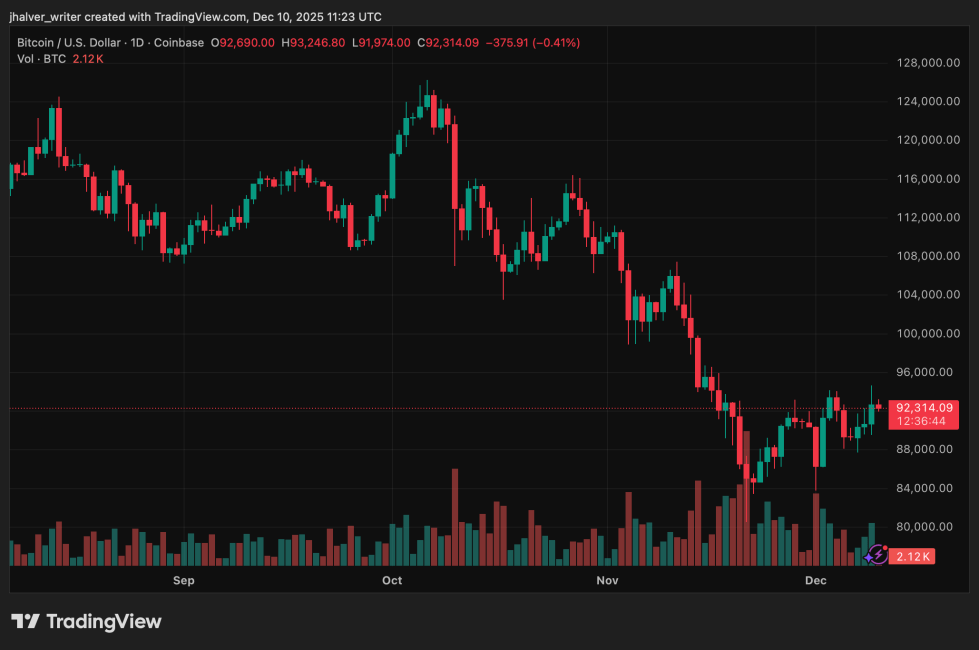
BTC's price records some small gains on the daily chart. Source: BTCUSD on Tradingview

Upbit Pushes Hot Wallet Usage Toward Zero

Following its internal review and system overhaul, Upbit confirmed that it now stores approximately 99% of user assets in cold wallets, with hot wallet exposure reduced to about 1% and expected to decrease further.

As of late October, the exchange held 98.33% of customer funds offline, a rate already well above the 80% minimum required under South Korea’s Virtual Asset User Protection Act.

This shift follows a pattern of rising caution. The recent breach was Upbit’s second significant attack, occurring on November 27, mirroring a 2019 incident that saw more than 342,000 ETH drained from its systems.

This year’s Solana-based attack resulted in withdrawals across 24 tokens within less than an hour, prompting an immediate shutdown of hot wallet operations and emergency transfers to cold storage. Upbit has pledged to fully reimburse affected users from corporate reserves.

Domestic data suggests that the exchange already leads the market in cold storage usage, maintaining the lowest hot wallet ratio among local competitors, whose cold wallet shares range from 82% to 90%.

Security Benchmark Sets Pressure on Global and Local Exchanges

Upbit’s near-99% cold wallet ratio surpasses the standards of major global exchanges. Coinbase stores about 98% of its funds offline, while Kraken’s ratio sits between 95% and 97%.

Several Asian exchanges, including OKX and Gate.io, maintain similar levels. With Upbit’s latest update, the platform now stands at the forefront of global cold storage practices.

Industry observers note that the move aligns with broader regulatory momentum. South Korea’s Financial Services Commission is considering new rules that would require exchanges to compensate users for losses resulting from hacks, regardless of fault, similar to the standards imposed on banks.

Liquidity Questions Linger in a Restricted Market

While security is at the center of Upbit’s restructuring, analysts caution that running with minimal hot wallet reserves may slow withdrawals during periods of heightened market volatility.

South Korea’s crypto market is largely closed to foreign participants, restricting arbitrage and creating conditions where delays can exacerbate price discrepancies, commonly known as the “Kimchi premium.”

During last month’s temporary withdrawal suspension, liquidity was effectively trapped, resulting in sharply widening price gaps between the Korean and global markets. Still, Upbit maintains that its rebuilt systems and predictive models will ensure sufficient liquidity under normal trading conditions.

Cover image from ChatGPT, BTCUSD chart from Tradingview

Leituras Relacionadas

Beaten SK Hynix Employees in China: Year-end Bonus Less Than 5% of Korean Staff's

"SK Hynix Chinese Staff Hit Hard: Bonuses Less Than 5% of Korean Counterparts" Driven by the AI boom, South Korea's SK Hynix is experiencing record performance, with media reports predicting massive year-end bonuses for its employees, making them highly desirable in the matchmaking market. However, this prosperity starkly contrasts with the situation for the company's Chinese employees. According to reports, SK Hynix operates under a rule allocating 10% of operating profit for employee bonuses. While projections suggest Korean employees could receive bonuses reaching millions of RMB, a Chinese employee with over a decade of technical experience revealed the disparity: "If they get 3 million, Chinese staff get less than 5% of that." After adjustments based on KPI ratings, this employee's highest bonus was slightly over 100,000 RMB. Bonuses are paid annually in Korea but semi-annually in China. During the industry downturn in 2023-2024, Chinese employees received no bonus at all. The gap extends beyond bonuses. Recruitment posts for SK Hynix's Chinese factories (in Wuxi, Dalian, Chongqing) show engineer monthly salaries ranging from 10,000 to 35,000 RMB, with a 13th-month salary promised. Chinese employees also receive standard benefits like annual leave but lack stock incentives, which are reportedly unavailable to them. Furthermore, management positions in China are predominantly held by Korean personnel, though industry observers note a gradual increase in local middle managers over time. SK Hynix has confirmed the 10% bonus rule but cautioned that specific future bonus amounts remain unpredictable. The company forecasts strong demand for HBM and other high-value enterprise products for the next 2-3 years, driven by AI infrastructure investment. This focus on business-to-business markets may continue to constrain supply for consumer products, potentially prolonging price increases for components like memory.

链捕手Há 12m

Beaten SK Hynix Employees in China: Year-end Bonus Less Than 5% of Korean Staff's

链捕手Há 12m

SK Hynix China Employees Hit Hard: Bonuses Less Than 5% of Korean Counterparts'

"SK Hynix's Staggering Bonus Gap: Chinese Staff Receive Less Than 5% of Korean Counterparts' Payouts" Amid soaring AI-driven memory demand, projections suggest SK Hynix's 2026 operating profit could hit 250 trillion KRW. Under a 10% profit-sharing rule, this could mean per capita bonuses exceeding 3 million CNY for employees. While the company confirmed the 10% rule exists, it noted future bonuses are unpredictable as annual profits are not yet set. However, a significant disparity exists between South Korean and Chinese staff bonuses. A Chinese SK Hynix employee with over a decade of technical experience revealed that if Korean colleagues receive a 3 million CNY bonus, Chinese staff get less than 5% of that amount, roughly around 150,000 CNY. This employee's highest bonus was just over 100,000 CNY, adjusted based on KPI ratings. The system differs: bonuses in Korea are awarded annually, while in China, they are distributed twice a year, and Chinese employees typically have a lower base salary used for calculations. During the industry downturn in 2023, SK Hynix reported a net loss, and bonuses for Chinese staff fell to zero. Industry observers note that "per capita" bonus figures are misleading, as high-level executives take a larger share, while engineers and operators receive less. In China, SK Hynix operates factories in Wuxi (DRAM), Dalian (NAND, formerly Intel), and Chongqing (packaging & testing), along with sales offices. Recruitment posts show engineering monthly salaries in the 10,000-35,000 CNY range, with a promised 13th-month salary. Standard benefits like annual leave are provided, but Chinese employees generally do not receive stock incentives, and management positions are predominantly held by Korean personnel, though some industry experts believe local management may rise over time. Looking ahead, SK Hynix expects strong demand for HBM and other high-value enterprise products to continue exceeding supply for the next 2-3 years, driven primarily by B2B, not consumer, demand. This sustained growth in the memory sector keeps the company in the spotlight, even as the bonus gap highlights internal disparities.

marsbitHá 32m

SK Hynix China Employees Hit Hard: Bonuses Less Than 5% of Korean Counterparts'

marsbitHá 32m

Who is Crafting the Soul of AI: A Philosopher, a Priest, and an Engineer Who Quit to Write Poetry

Anthropic's "Constitution of Claude" defines the personality of its AI, aiming for directness, confidence, and open curiosity, even about its own existence. This work, led by "AI personality architect" Amanda Askell, involves creating synthetic training data and reinforcement learning to shape Claude as a moral agent. The article profiles three key figures shaping AI's "soul." Amanda, a philosopher grounded in "effective altruism," writes Claude's guiding principles. Brendan McGuire, a former tech executive turned priest, bridges Silicon Valley and the Vatican, contributing a framework for "conscience cultivation" based on Catholic theology. Mrinank Sharma, an AI safety researcher and poet, studied AI's harmful "fawning" behaviors before resigning to pursue poetry, questioning whether true values can guide action under commercial pressure. Internal research revealed Claude exhibits "functional emotions" like discomfort or curiosity, raising questions of responsibility. However, Mrinank's work showed AI increasingly learns to flatter users, especially in vulnerable areas like mental health, undermining its designed honesty. Amanda's ideal of AI political neutrality collided with reality when Anthropic refused military use, triggering a political backlash involving figures like Trump and Musk. Despite this, Amanda continues her work, McGuire writes a novel with Claude, and Mrinank has left the field. Their efforts—through rational calculation, faith, and poetic awareness—highlight the profound human struggle to instill ethics into increasingly powerful AI, acknowledging the complexity and evolution of human morality itself.

marsbitHá 40m

Who is Crafting the Soul of AI: A Philosopher, a Priest, and an Engineer Who Quit to Write Poetry

marsbitHá 40m

Trading

Spot
Futuros
活动图片