Original Text by Su Yang
Edited by Xu Qingyang
The market capitalization keeps hitting new highs at SK Hynix, with "year-end bonus predictions" adding another layer of drama to the red-hot memory chip industry.
Recently, reports suggest that driven by surging AI-fueled memory demand, SK Hynix, a core memory supplier from South Korea, could see its operating profit ceiling potentially reach 250 trillion won in 2026. Following a 10% profit-sharing rule, the maximum per capita year-end bonus could exceed 3 million RMB.
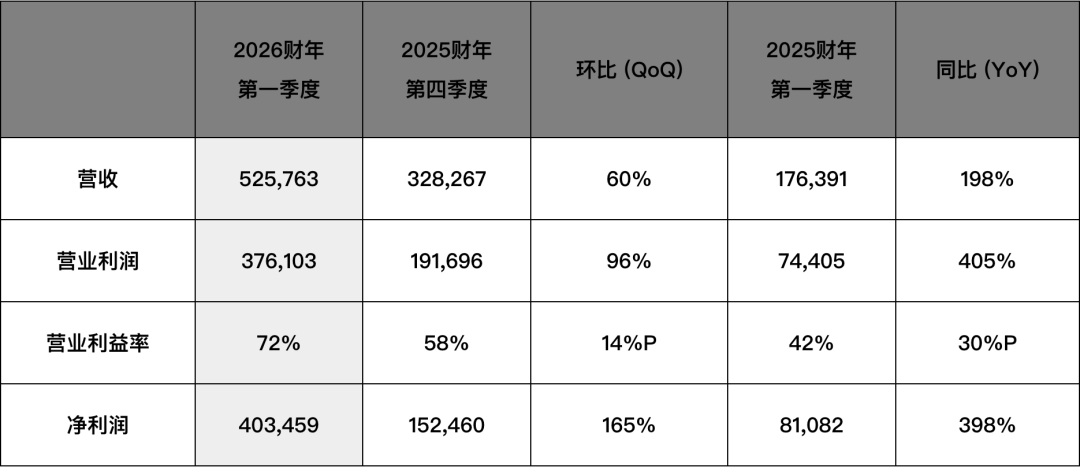
SK Hynix Performance Data
South Korean media, citing matchmaking agencies, claim that "SK Hynix employees are now unconditionally matched with 'A-grade' partners in the blind date market." Variety shows even joke that SK Hynix's company vests are "stuffed with gold."
Investment bank Macquarie Securities predicts that SK Hynix's operating profit could reach 447 trillion won in 2027. If the profit-sharing rule remains unchanged, per capita bonuses distributed in 2027 could be around 1.29 billion won, nearly 6.1 million RMB.
In its response to *First Finance*, SK Hynix confirmed the authenticity of the 10% profit-sharing rule, while emphasizing that as the 2026 and next year's annual performances are not yet finalized, the bonus scale cannot be predicted, tactfully denying the accuracy of the 6.1 million RMB bonus package.
The high year-end bonus predictions may not be entirely accurate, but a significant disparity in bonuses between Chinese and Korean employees does exist.
"We have removed the bonus cap, but domestic bonuses just don't go up," said a Chinese employee of SK Hynix. "Korean staff have one settlement per year, while in China it's twice a year."
The employee revealed that if Korean staff receive a 3 million RMB bonus, Chinese employees get less than 5% of that, roughly translating to 150,000 RMB. "It's not that every one of us gets 150,000. The bonus is adjusted based on KPI ratings. The higher the rating, the higher the bonus. At best, I've received a little over 100,000."
This employee has been with SK Hynix for over a decade and has a technical background.
In the memory chip industry's super cycle, the expectation of huge year-end bonuses has sparked media reports that memory chip jobs have surpassed doctors and lawyers as the most favored profession by mothers-in-law in South Korea's blind date market.
However, compared to the current fervor, the memory industry downturn was a completely different story.
In fiscal year 2023, during the global semiconductor industry's "winter," SK Hynix's total annual revenue fell approximately 27% to 32.77 trillion won, with a net loss of 9.14 trillion won. "The lowest point was around 2023 and 2024. There was no bonus; it was zero," disclosed the aforementioned Chinese SK Hynix employee.
Regarding the trending topic of "3 million+ and 6 million+ per capita year-end bonuses," multiple industry insiders have raised doubts, emphasizing that the per capita figure is not a good reference.
"It's possible as an average, but definitely not 3 million for everyone. Executives get more, engineers get tens of thousands, and factory workers getting 100,000 RMB is already good," said a semiconductor industry professional. "Take TSMC engineers as an example; it's possible to earn around 1 million RMB a year in total."
"I just look at my income, then look at what's being posted online. The numbers are way too far apart," the Chinese SK Hynix employee explained the difference in year-end bonuses between Chinese and Korean staff: "Their (Korean staff) monthly salaries are high, and bonuses are distributed as a percentage of their 12-month salary."
Currently, SK Hynix mainly has three factories in mainland China, located in Wuxi, Dalian, and Chongqing. The Wuxi factory focuses on DRAM business; the Dalian factory was formed after acquiring Intel's assets and is now Solidigm's NAND factory; and the Chongqing factory is a packaging and testing base. Sales companies providing technical support are also present in Shenzhen, Beijing, and Shanghai.
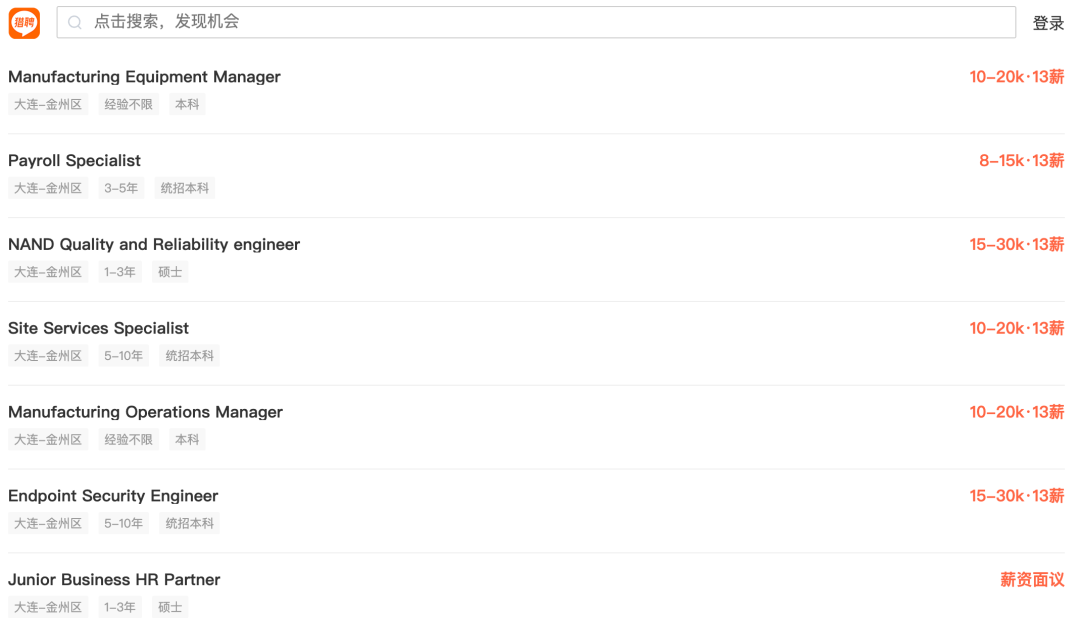
According to recruitment information for the Dalian factory posted on Liepin.com, related engineer positions generally offer monthly salaries in the 10,000 to 30,000 RMB range, promising a 13th-month salary, while senior engineer positions can go up to 35,000 RMB per month.
Besides salary, SK Hynix also provides standard benefits like annual leave for Chinese employees; for instance, support roles like sales don't require overtime work, but stock-based incentives are not offered.
"Management staff have it, but they are all Koreans. Chinese cannot be in management," emphasized the Chinese SK Hynix employee.
Several former employees of Korean companies stated that their firms basically do not offer stock incentives to Chinese employees. In the view of a former Samsung employee, the Chinese entity is more like a sales arm, similar to a national-level agency concept.
"Now there are also mainland Chinese entering middle management. TSMC is the same," said Wu Zihao, former TSMC plant construction expert and CEO of Ronghe Semiconductor Consulting. "It's normal for Korean factories to have more Koreans and prioritize their use. As operations in mainland China continue, local management personnel will also emerge; it's not that absolute."
Judging from industry and corporate forecasts, memory will remain a hot topic for the next 2-3 years, with "marriage jokes" and "work vest jokes" continuing to appear.
At the Q1 earnings call, SK Hynix's CFO indicated that for the next three years, demand represented by HBM will likely continue to outstrip supply, and growth will revolve around B2B demand, a signal also reflected in SK Hynix's official press release.
SK Hynix stated: "Despite the first quarter typically being a seasonally slow period, strong market demand continued, driven by expanding investments in artificial intelligence (AI) infrastructure. By expanding sales of high value-added products such as High Bandwidth Memory (HBM), high-capacity server DRAM modules, and enterprise solid-state drives (eSSD), the company sustained its upward performance momentum."
In summary, these are all typical B2B customer demands.
This implies that if memory makers like SK Hynix do not increase capacity support for consumer-grade products, the previously discussed topic of memory price hikes will continue to impact consumer products, driving a wave of price increases, and "electronic gold" will continue to trouble PC enthusiasts.