Tokenization benefits ‘light at first,’ but will expand if democratized: NYDIG

cointelegraphPublicado em 2025-12-12Última atualização em 2025-12-12

Resumo

NYDIG's Global Head Greg Cipolaro states that while tokenizing real-world assets (RWAs) like stocks offers limited initial benefits to crypto networks, its advantages could grow significantly with greater democratization and integration. Initially, blockchains like Ethereum would gain from transaction fees and network effects. However, broader benefits—such as composability in DeFi for lending, borrowing, or trading—depend on improved technology, infrastructure, and favorable regulations. Tokenized assets vary widely in design and are hosted on both public and private networks, with significant value already on platforms like the Canton Network and Ethereum. Despite relying on traditional financial structures, blockchain offers near-instant settlement and operational efficiency. Cipolaro advises investors to monitor the space, as regulatory progress could expand the reach and utility of tokenized RWAs.

The tokenization of stocks won’t immediately be of immense benefit to the crypto market, but the benefits could increase if such assets are allowed to better integrate on blockchains, says NYDIG.

“The benefits to networks these assets reside on, such as Ethereum, are light at first, but increase as their access and interoperability and composability increase,” NYDIG global head of research Greg Cipolaro said in a note on Friday.

The initial benefits will be the transaction fees charged for using tokenized assets, and the blockchain hosting them will “enjoy increasing network effects” for storing them, Cipolaro added.

Tokenizing real-world assets, or RWAs, such as US stocks, has become a hot topic in the crypto industry, with major exchanges, including Coinbase and Kraken, wanting to launch tokenized stock platforms in the US after their success overseas.

Securities and Exchange Commission chair Paul Atkins said earlier this month that the US financial system could embrace tokenization in a “couple of years,” which Cipolaro said shows that “tokenization is likely going to be a big trend.”
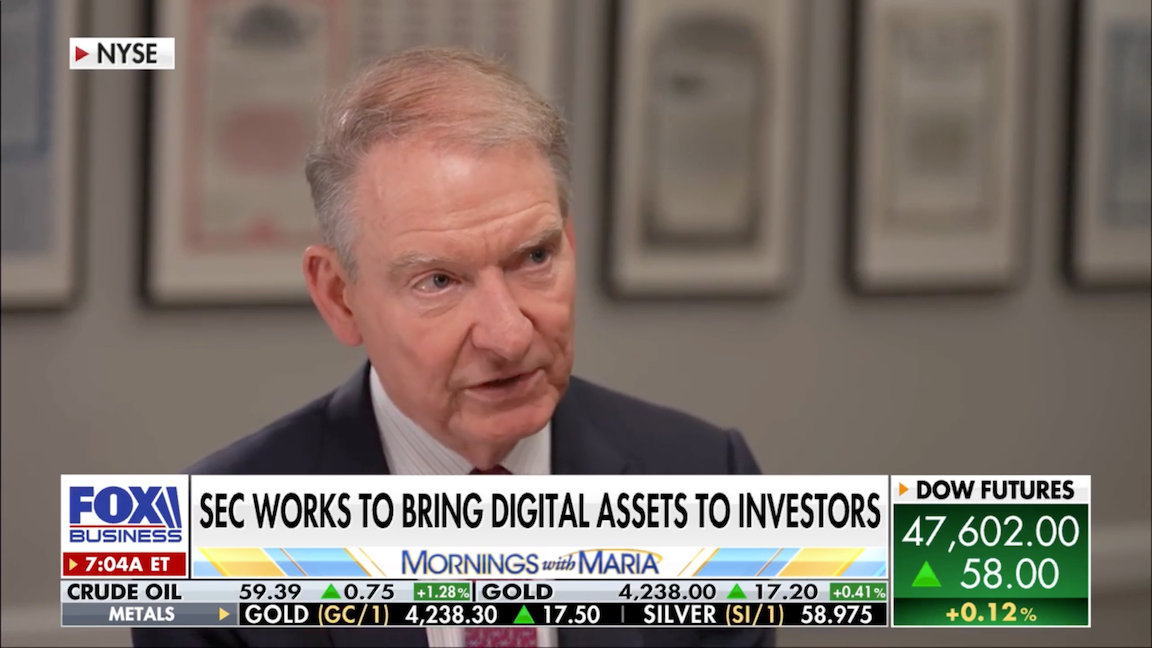
Paul Atkins speaking to Fox Business earlier in December on tokenized US stocks. Source: Fox Business

“In the future, one could see these RWAs being part of DeFi (composability), either as collateral for borrowing, an asset to be lent out, or for trading,” he added. “This will take time as technology develops, infrastructure is built out, and rules and regulations evolve.”

Tokenized assets can “differ greatly”

Cipolaro noted that making composable and interoperable tokenized assets isn’t straightforward, as “their form and function differ greatly” and are hosted on public and non-public networks.

The Canton Network, a non-public blockchain created by the company Digital Asset Holdings, is currently the largest blockchain for tokenized assets with $380 billion, or “91% of the total ‘represented value’ of all RWAs,” Cipolaro explained.

Ethereum, meanwhile, is “by far and away” the most popular public blockchain for tokenized assets, with $12.1 billion of RWAs deployed on it, he added.

Related: US financial markets ‘poised to move onchain’ amid DTCC tokenization greenlight

“But even on an open, permissionless network such as Ethereum, the design of the specific tokenized asset can vary greatly,” Cipolaro said. “These RWAs are often securities, broker-dealers, KYC/investor accreditation, whitelisted wallets, transfer agents, and other structures from traditional finance are required.”

He added that even though tokenized assets still need traditional financial structures, companies are using blockchain technology for the benefit of “near instant settlement, 24/7 operations, programmatic ownership, transparency, auditability, and collateral efficiency.”

“In the future, if things become more open and regulations become more favorable, as Chairman Atkins suggests, access to these assets should become more democratized, and thus these RWAs would enjoy expanded reach,” Cipolaro said.

“Investors should pay attention,” he added, “even if the economic impacts to traditional cryptocurrencies are minimal today.”

Magazine: Can Robinhood or Kraken’s tokenized stocks ever be truly decentralized?

Criptomoedas em alta

Leituras Relacionadas

9.42 Million Retail Investors Compete for Changxin Technology, Who Got Allotted?

Evergreen Technology's IPO subscription results are now available. On July 20, the domestic memory chip giant announced the offline preliminary allotment results and online lottery results for its IPO. A total of approximately 9.43 million retail investors participated in the online subscription, generating 770,000 winning lots with a final winning rate of about 0.4714%, setting a record for new shares on the STAR Market. After triggering a clawback mechanism from institutional to retail investors, the online retail allocation was significantly increased to 3.851 billion shares. Simultaneously, 285 institutional investors participated in the offline subscription, ultimately receiving 2.173 billion shares at an allotment rate of approximately 0.1756%. Leading insurers and public funds were among the major recipients. Notably, Liang Wenfeng, founder of the major AI model company DeepSeek, through his quantitative investment firms Ningbo Huanfang Quantitative and Zhejiang Jiuzhang Asset, secured the largest share among private funds, with a total allotment worth approximately 175 million yuan. Estimates suggest potential profits could reach 730 million yuan if Evergreen Technology's market capitalization reaches 3 trillion yuan post-listing. The company is expected to list on July 27 and could become the highest-valued tech stock on the A-share market, with various brokerages providing valuations ranging from 1 trillion to over 4 trillion yuan. However, recent significant corrections in global tech stocks may impact its post-listing performance. (Character count: 1,196)

marsbitHá 41m

9.42 Million Retail Investors Compete for Changxin Technology, Who Got Allotted?

marsbitHá 41m

L2 'Recalibration': When L1 Becomes Its Own Rollup, What Is Ethereum's Endgame?

The article discusses the evolving relationship between Ethereum's Layer 1 (L1) and Layer 2 (L2) solutions, moving beyond the initial "L2 for scaling" model. As Ethereum L1 itself scales (increasing Gas Limit, statelessness, zkEVM), the unique value proposition of L2s shifts from merely providing cheap execution to offering differentiated features like application-specific optimization, privacy, and flexible governance. The piece explores three key themes: 1. **L2's New Role:** L2s are transitioning from a pure scaling technology to a spectrum of execution environments with varying degrees of security inheritance from Ethereum L1. 2. **Interoperability as State Trust:** Solving L2 fragmentation is less about cross-chain bridges and more about enabling faster, trust-minimized state verification between environments. This involves initiatives like faster L1 finality, intent-based architectures (Open Intents Framework), and native account abstraction. 3. **Blurring Layers:** With the potential integration of zk-proofs into L1 validation (making L1 akin to its own "Rollup") and the concept of "Native Rollups," the rigid boundary between L1 and L2 may fade. The future could be a unified system with multiple execution domains (for DeFi, gaming, privacy, etc.) sharing a common security, settlement, and state framework. In conclusion, Ethereum's goal is not to abandon L2s or re-centralize everything on L1, but to re-integrate the fragmented user experience—liquidity, accounts, applications—while preserving the scaling benefits of a multi-environment ecosystem. The endgame is a cohesive "one chain" feeling for users, powered by diverse but securely interconnected execution layers.

marsbitHá 1h

L2 'Recalibration': When L1 Becomes Its Own Rollup, What Is Ethereum's Endgame?

marsbitHá 1h

Trading

Spot

Artigos em Destaque

Como comprar T

Bem-vindo à HTX.com!Tornámos a compra de Threshold Network Token (T) simples e conveniente.Segue o nosso guia passo a passo para iniciar a tua jornada no mundo das criptos.Passo 1: cria a tua conta HTXUtiliza o teu e-mail ou número de telefone para te inscreveres numa conta gratuita na HTX.Desfruta de um processo de inscrição sem complicações e desbloqueia todas as funcionalidades.Obter a minha contaPasso 2: vai para Comprar Cripto e escolhe o teu método de pagamentoCartão de crédito/débito: usa o teu visa ou mastercard para comprar Threshold Network Token (T) instantaneamente.Saldo: usa os fundos da tua conta HTX para transacionar sem problemas.Terceiros: adicionamos métodos de pagamento populares, como Google Pay e Apple Pay, para aumentar a conveniência.P2P: transaciona diretamente com outros utilizadores na HTX.Mercado de balcão (OTC): oferecemos serviços personalizados e taxas de câmbio competitivas para os traders.Passo 3: armazena teu Threshold Network Token (T)Depois de comprar o teu Threshold Network Token (T), armazena-o na tua conta HTX.Alternativamente, podes enviá-lo para outro lugar através de transferência blockchain ou usá-lo para transacionar outras criptomoedas.Passo 4: transaciona Threshold Network Token (T)Transaciona facilmente Threshold Network Token (T) no mercado à vista da HTX.Acede simplesmente à tua conta, seleciona o teu par de trading, executa as tuas transações e monitoriza em tempo real.Oferecemos uma experiência de fácil utilização tanto para principiantes como para traders experientes.

500 Visualizações TotaisPublicado em {updateTime}Atualizado em 2026.06.02

Como comprar T

Discussões

Bem-vindo à Comunidade HTX. Aqui, pode manter-se informado sobre os mais recentes desenvolvimentos da plataforma e obter acesso a análises profissionais de mercado. As opiniões dos utilizadores sobre o preço de T (T) são apresentadas abaixo.

活动图片