They Missed $2 Million Because Maduro Wasn't Supposed to Be Home for the New Year

marsbitPublicado em 2026-01-04Última atualização em 2026-01-04

Resumo

On the early morning of January 3, 2026, US special forces captured Venezuelan President Nicolás Maduro at his residence and extradited him to the United States. Prior to the raid, several anonymous accounts on the prediction market platform Polymarket placed large bets on the highly unlikely outcome that Maduro would lose power before January 31, 2026, turning a significant profit once the operation succeeded. Three new wallets, with no prior history, collectively gained over $600,000, suggesting possible insider trading based on confidential intelligence. Further analysis revealed that the operation was originally scheduled for December 29, 2025, but was delayed due to severe weather. Two other traders who had placed early large bets on Maduro’s removal in 2025 suffered major losses when the operation was postponed. However, after learning the raid was rescheduled for January 3, they placed new bets and managed to recover some profits. One trader, Chiwawas, missed out on potential earnings of $750,000 due to the delay. The incident highlights how Polymarket has become a platform where individuals with privileged information can exploit timing and knowledge gaps for financial gain.

At 2 a.m. local time on Saturday in Venezuela, while President Nicolás Maduro was still asleep during the New Year holiday, U.S. special forces completed a raid within an hour, apprehending Maduro and transporting him to the United States via aircraft.

This world-shocking "blitzkrieg" seemed to come without warning, but on the leading prediction market platform Polymarket, it appeared to have become a profit-making tool for several insiders well before the operation.

3 Pentagon Employees "Placing Bets While Working Overtime"

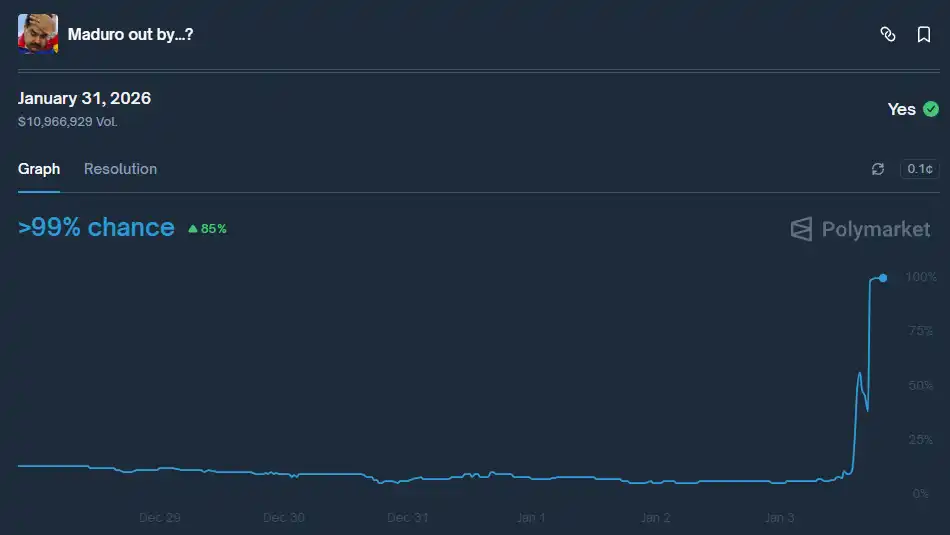
Hours before the operation began, three new wallets with no prior history on Polymarket suddenly started heavily betting "Yes" on the highly improbable market "Maduro loses power before January 31, 2026".

At that time, the mainstream market view was still that Trump would adopt a温和的围城策略 (mild siege strategy) to force Maduro to compromise, and the probability for "Yes" on this market was only 5%. However, as Maduro was loaded onto the plane, these three mysterious accounts instantly reaped profits exceeding $500,000.

It was only after the fact that people began to redefine the trio's purchases hours before the airstrike: only those with reliable intelligence could execute such a "dimensionality reduction strike" with such precise timing using new accounts.

These three insiders were:

0xa72db1749e9ac2379d49a3c12708325ed17febd4, profit $74,982.34;

0x6baf05d193692bb208d616709e27442c910a94c5, profit $145,619.92;

0x31a56e9e690c621ed21de08cb559e9524cdb8ed9, profit $409,882.03.

But the news from Polymarket goes far beyond this.

Maduro's "Flight Delay": The U.S. Operation Was Originally Scheduled for 4 Days Earlier

There are two very representative addresses; although they profited from this event, they actually lost significant potential earnings because they received the information too early.

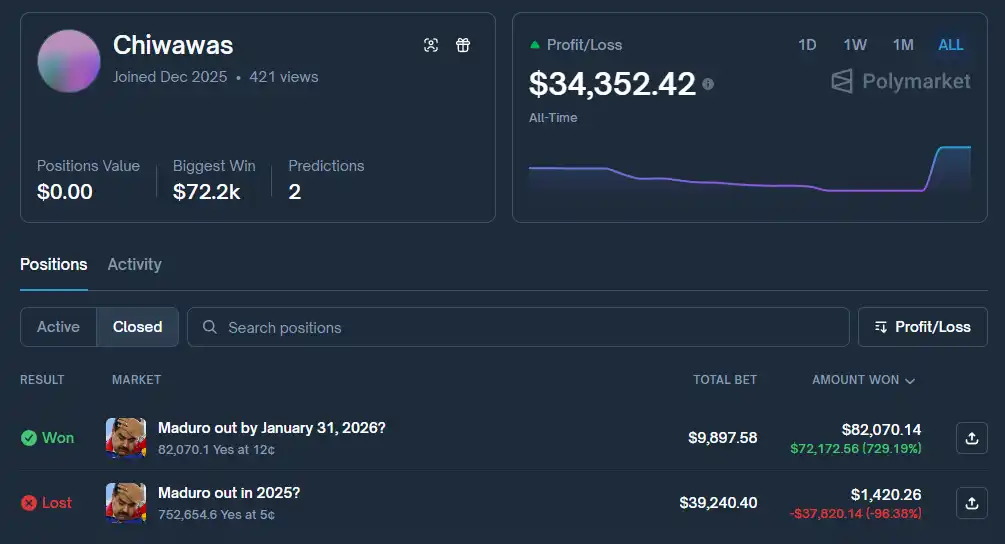
Like the three insiders mentioned above, Chiwawas also placed a precise bet of $10,000 three hours before the airstrike, profiting over $70,000.

But in fact, Chiwawas had already heavily bet nearly $40,000 on the market "Maduro loses power within 2025" on the evening of December 26th.

Assuming he was an insider, he must have received accurate information to make such a heavy bet. Unfortunately, the arrest operation, originally scheduled for December 29th, was canceled due to weather. Thunderstorm clouds over the Caribbean Sea forced the U.S. military to abort for tactical safety reasons.

This was confirmed in Trump's recent speech regarding the operation: "The airstrike against Maduro was originally scheduled for 4 days ago (i.e., the night of December 29 to the early morning of December 30, 2025)."

Therefore, since the market settled as "No" on the last day of 2025, this trade resulted in his account facing huge losses as 2026 arrived.

If everything had gone according to the script Chiwawas possessed, his account should have settled with a whopping $750,000 return on December 30th.

Unfortunately, the weather did not cooperate. The thunderstorm clouds over the sea not only disrupted the U.S. military's original airstrike plans but also shattered Chiwawas's dream of using military intelligence to make a fortune during the Christmas holiday.

Fortunately, upon learning that the U.S. military would restart the operation on the night of January 3rd, he rallied, depositing funds and placing bets again. This final gamble, while unable to make up for the missed $750,000, ultimately brought his total account profit back into positive territory, reaching $34,000.
Besides Chiwawas, another account also missed massive profits due to the weather. Since late last month, he had bet approximately $20,000 across multiple related markets like "Military conflict between US and Venezuela occurs within the year" and "Nothing happens: National leader loses power," convinced that a US-Venezuela conflict would occur in the remaining days of 2025 and that Maduro would fall because of it.

If not for the weather impact, he should have received a huge profit of $1.04 million on the 30th.

Like Chiwawas, after suffering significant losses, he bet on "US-Venezuela conflict occurs before 2026.1.15" three hours before the airstrike and profited over $40,000.

Conclusion

Only three days into 2026, we have already seen that Polymarket is not just a prediction platform but also an automatic teller machine for individuals across various industries with information advantages to疯狂套现 (cash out疯狂ly) using "knowledge gaps" and "time gaps."

As Polymarket's popularity continues to grow, one wonders what other surreal insider stories will play out here this year?
Perguntas relacionadas

QWhat was the outcome of the US special forces operation against Venezuelan President Nicolás Maduro on the early morning of January 3rd, 2026?

AUS special forces conducted a raid, captured President Nicolás Maduro within an hour, and transported him to the United States via a transport aircraft.

QHow did three new wallets on Polymarket profit from the event before it occurred?

AThree new wallets with no prior history placed large bets on the highly unlikely outcome 'Maduro loses power before January 31, 2026' just hours before the raid, when the probability was only 5%. They collectively profited over $500,000 when the event happened.

QWhy did the US military's operation to capture Maduro get delayed from its original date?

AThe operation, originally planned for December 29th, 2025, was canceled due to thunderstorm clouds over the Caribbean Sea, which forced the US military to postpone for tactical safety reasons.

QHow much potential profit did the user 'Chiwawas' miss due to the weather-related delay of the operation?

AChiwawas missed a potential profit of $750,000 because the operation was delayed past the December 31st, 2025 settlement date for his bet on 'Maduro loses power within 2025'.

QWhat does the article suggest about the nature of Polymarket as a platform?

AThe article suggests that Polymarket has become a platform where individuals with insider information or a significant 'knowledge and time advantage' can use it to profit, effectively turning it into an 'ATM' for such actors.

Leituras Relacionadas

KOL's Perspective: Why Is SOL Set to Rise from This Point?

**Summary: Why SOL is Positioned for Growth at This Level** The article argues that SOL is poised for an upward move from its current price point, citing several key factors. Primarily, SOL has just broken out of a 4-month consolidation phase. This breakout signals a return of risk appetite to the broader crypto market, as SOL is seen as a key indicator of overall crypto health. The token's ownership has reportedly shifted from short-term traders and tourists to long-term accumulators, leading to low volume. Any meaningful increase in trading activity could thus trigger significant upward momentum. Fundamental strengths include strong institutional adoption, integration with DeFi and RWAs (Real-World Assets), and the potential benefits from the Clarity Act. Despite its high volatility—having dropped 70% from its all-time high but still up 12x from its bear market low—SOL is highlighted as one of the few tokens from the last cycle to reach new highs. It boasts a robust ecosystem of applications, users, and protocols. Future catalysts include the expected influx of AI developers following the Miami Accelerate conference, which focused on AI on Solana. Furthermore, Solana is positioned as the premier chain for memecoin activity, a trend expected to continue and drive network usage and fees. The article concludes that recent price action reflects a healthy transfer to long-term holders, setting the stage for growth.

marsbitHá 26m

KOL's Perspective: Why Is SOL Set to Rise from This Point?

marsbitHá 26m

Those Pre-Bitcoin PoW Protocols Have Recently Been Reimplemented

This article details a recent surge in replicating pre-Bitcoin Proof-of-Work (PoW) protocols, specifically focusing on Hal Finney's 2004 RPOW (Reusable Proofs of Work). Within five days in May 2026, multiple independent builders in the Bitcoin/cypherpunk community launched projects inspired by this early electronic cash proposal. The initiative began with Fred Krueger's `rpow2.com`, a centralized but auditable system that replaced RPOW's original IBM 4758 hardware with Ed25519 signatures. Initially a faithful replica, it later adopted Bitcoin-like features (21M supply cap, difficulty adjustment) and a controversial 5.24% founder allocation. This sparked rapid forks, including `rpow4.com` which incorporated full Bitcoin parameters, a prediction market (`rpowmarket.com`), and a DEX (`rpow2swap.com`). Concurrently, Mike In Space created a prototype of Wei Dai's 1998 b-money proposal (`b-money.replit.app`), pushing the historical exploration even further back. The article contrasts these centralized, server-dependent experiments with Bitcoin's core innovation of decentralized, trustless consensus. It also highlights a parallel development: the `HASH` project on Ethereum, which uses smart contract hooks to enable a purely fair-launch, browser-mineable PoW token with 0% allocations to team or VCs. The collective activity is framed as a meme-driven, educational exploration of cypherpunk history rather than a serious financial movement, with all projects heavily disclaiming any investment value.

marsbitHá 31m

Those Pre-Bitcoin PoW Protocols Have Recently Been Reimplemented

marsbitHá 31m

South Korean Exchanges 'Battle' Regulators, Challenging the Boundaries of Enforcement and Legislation

South Korea's cryptocurrency industry is engaged in a rare, direct confrontation with regulators. The Financial Intelligence Unit (FIU), the primary anti-money laundering (AML) watchdog, has recently imposed heavy penalties on major exchanges like Upbit and Bithumb for alleged violations involving unregistered overseas VASPs and AML procedures. However, exchanges are now actively challenging these actions in court and through industry associations. In a significant shift, the Seoul Administrative Court ruled in favor of Upbit's operator, Dunamu, overturning part of an FIU-ordered business suspension. The court found the FIU's penalty criteria and justification insufficiently clear. Similarly, the court suspended the enforcement of a six-month business suspension against Bithumb pending a final ruling, citing potential irreversible harm to the exchange. Beyond legal battles, the industry is contesting proposed legislative amendments. The Digital Asset eXchange Alliance (DAXA) strongly opposes a draft rule that would mandate Suspicious Transaction Reports (STRs) for all crypto transfers over 10 million KRW (~$6,800). DAXA argues this "poison pill" clause violates legal principles and would overwhelm the STR system, increasing reports from 63,000 to an estimated 5.45 million annually for major exchanges, thereby crippling effective AML monitoring. This conflict highlights a structural tension in South Korea's crypto governance: comprehensive digital asset laws are still developing, while regulators rely heavily on AML enforcement. The industry's move from passive compliance to active legal and legislative challenges signifies a new phase, pressing for clearer rules and more proportionate enforcement. While short-term disputes may intensify, this clash could ultimately lead to a more mature and sustainable regulatory framework for South Korea's vibrant crypto market.

marsbitHá 1h

South Korean Exchanges 'Battle' Regulators, Challenging the Boundaries of Enforcement and Legislation

marsbitHá 1h

After 50x Storage Surge, Justin Sun Always Looks to the Next Decade

Sun Yuchen, known for his controversial stunts like a $30 million lunch with Warren Buffett (canceled due to a kidney stone) and eating a $6.2 million duct-taped banana, is often overshadowed by a significant fact: his decade-long track record of spotting major investment trends. In 2016, he famously advised young people to invest in Bitcoin, Nvidia, Tesla, and Tencent instead of buying property. A hypothetical $20,000 investment in Nvidia and Tesla from that list would now be worth over 50 million RMB. His latest major call was on November 6, 2025, predicting a "50x storage opportunity" tied to the AI boom, which materialized with Sandisk's stock surging nearly 50-fold by 2026. Looking ahead, Sun now focuses on the next frontier: Physical AI. He identifies four key areas: 1. **Embodied AI/Robotics**: He sees this reaching its "iPhone moment," with companies like UBTech and Galaxy General leading in commercialization. 2. **Drones**: Viewed as the first commercially viable form of Physical AI, revolutionizing sectors from warfare (e.g., AeroVironment's Switchblade) to logistics. 3. **Spatial Computing**: Beyond VR, it's about AI understanding physical space, a foundational technology for robotics and autonomous systems, exemplified by Apple's Vision Pro. 4. **Space Exploration**: After a 2025 suborbital flight with Blue Origin, Sun advocates for space as the ultimate frontier, discussing blockchain's potential role in space asset management and data transactions. His investment philosophy involves betting on entire, inevitable trends rather than single companies. For robotics, he sees Tesla (the body/manufacturer) and Nvidia (the brain/AI platform) as complementary plays. In defense drones, he highlights companies making tanks obsolete (AeroVironment) and those augmenting fighter jets (Kratos). For space, he participated in Blue Origin's flight and anticipates SpaceX's potential IPO to redefine the sector's valuation. Sun Yuchen's vision frames the next two decades not as a revolution in information flow (like the internet), but in the fundamental operation of the physical world through AI-powered robots, autonomous systems, and spatial intelligence, ultimately extending human and AI activity into space. While many still focus on conventional assets, he continues to look toward the next technological horizon.

marsbitHá 2h

After 50x Storage Surge, Justin Sun Always Looks to the Next Decade

marsbitHá 2h

Trading

Spot
Futuros

Artigos em Destaque

Como comprar HOME

Bem-vindo à HTX.com!Tornámos a compra de Defi.app (HOME) simples e conveniente.Segue o nosso guia passo a passo para iniciar a tua jornada no mundo das criptos.Passo 1: cria a tua conta HTXUtiliza o teu e-mail ou número de telefone para te inscreveres numa conta gratuita na HTX.Desfruta de um processo de inscrição sem complicações e desbloqueia todas as funcionalidades.Obter a minha contaPasso 2: vai para Comprar Cripto e escolhe o teu método de pagamentoCartão de crédito/débito: usa o teu visa ou mastercard para comprar Defi.app (HOME) instantaneamente.Saldo: usa os fundos da tua conta HTX para transacionar sem problemas.Terceiros: adicionamos métodos de pagamento populares, como Google Pay e Apple Pay, para aumentar a conveniência.P2P: transaciona diretamente com outros utilizadores na HTX.Mercado de balcão (OTC): oferecemos serviços personalizados e taxas de câmbio competitivas para os traders.Passo 3: armazena teu Defi.app (HOME)Depois de comprar o teu Defi.app (HOME), armazena-o na tua conta HTX.Alternativamente, podes enviá-lo para outro lugar através de transferência blockchain ou usá-lo para transacionar outras criptomoedas.Passo 4: transaciona Defi.app (HOME)Transaciona facilmente Defi.app (HOME) no mercado à vista da HTX.Acede simplesmente à tua conta, seleciona o teu par de trading, executa as tuas transações e monitoriza em tempo real.Oferecemos uma experiência de fácil utilização tanto para principiantes como para traders experientes.

298 Visualizações TotaisPublicado em {updateTime}Atualizado em 2025.06.10

Como comprar HOME

Discussões

Bem-vindo à Comunidade HTX. Aqui, pode manter-se informado sobre os mais recentes desenvolvimentos da plataforma e obter acesso a análises profissionais de mercado. As opiniões dos utilizadores sobre o preço de HOME (HOME) são apresentadas abaixo.

活动图片













