They Missed $2 Million Because Maduro Wasn't Supposed to Be Home for the New Year

marsbitPublicado em 2026-01-04Última atualização em 2026-01-04

Resumo

On the early morning of January 3, 2026, US special forces captured Venezuelan President Nicolás Maduro at his residence and extradited him to the United States. Prior to the raid, several anonymous accounts on the prediction market platform Polymarket placed large bets on the highly unlikely outcome that Maduro would lose power before January 31, 2026, turning a significant profit once the operation succeeded. Three new wallets, with no prior history, collectively gained over $600,000, suggesting possible insider trading based on confidential intelligence. Further analysis revealed that the operation was originally scheduled for December 29, 2025, but was delayed due to severe weather. Two other traders who had placed early large bets on Maduro’s removal in 2025 suffered major losses when the operation was postponed. However, after learning the raid was rescheduled for January 3, they placed new bets and managed to recover some profits. One trader, Chiwawas, missed out on potential earnings of $750,000 due to the delay. The incident highlights how Polymarket has become a platform where individuals with privileged information can exploit timing and knowledge gaps for financial gain.

At 2 a.m. local time on Saturday in Venezuela, while President Nicolás Maduro was still asleep during the New Year holiday, U.S. special forces completed a raid within an hour, apprehending Maduro and transporting him to the United States via aircraft.

This world-shocking "blitzkrieg" seemed to come without warning, but on the leading prediction market platform Polymarket, it appeared to have become a profit-making tool for several insiders well before the operation.

3 Pentagon Employees "Placing Bets While Working Overtime"

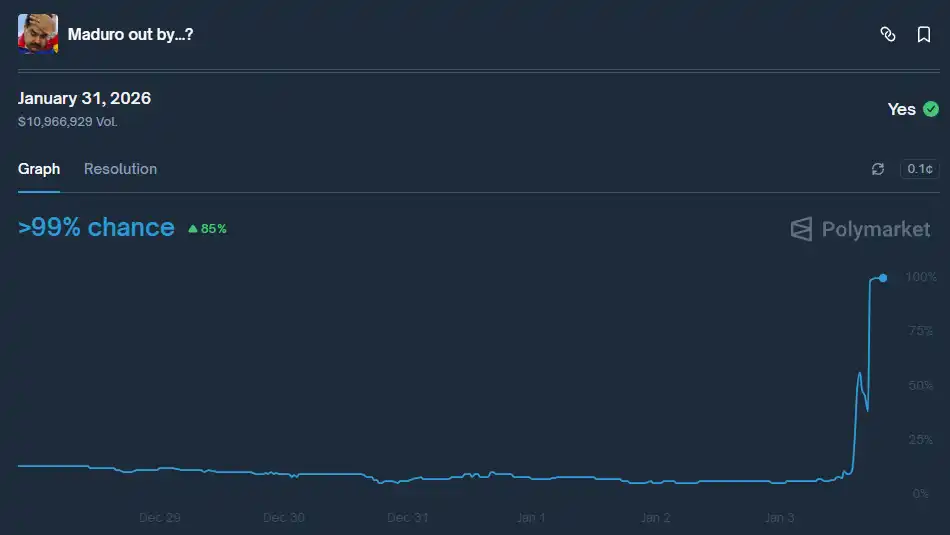
Hours before the operation began, three new wallets with no prior history on Polymarket suddenly started heavily betting "Yes" on the highly improbable market "Maduro loses power before January 31, 2026".

At that time, the mainstream market view was still that Trump would adopt a温和的围城策略 (mild siege strategy) to force Maduro to compromise, and the probability for "Yes" on this market was only 5%. However, as Maduro was loaded onto the plane, these three mysterious accounts instantly reaped profits exceeding $500,000.

It was only after the fact that people began to redefine the trio's purchases hours before the airstrike: only those with reliable intelligence could execute such a "dimensionality reduction strike" with such precise timing using new accounts.

These three insiders were:

0xa72db1749e9ac2379d49a3c12708325ed17febd4, profit $74,982.34;

0x6baf05d193692bb208d616709e27442c910a94c5, profit $145,619.92;

0x31a56e9e690c621ed21de08cb559e9524cdb8ed9, profit $409,882.03.

But the news from Polymarket goes far beyond this.

Maduro's "Flight Delay": The U.S. Operation Was Originally Scheduled for 4 Days Earlier

There are two very representative addresses; although they profited from this event, they actually lost significant potential earnings because they received the information too early.

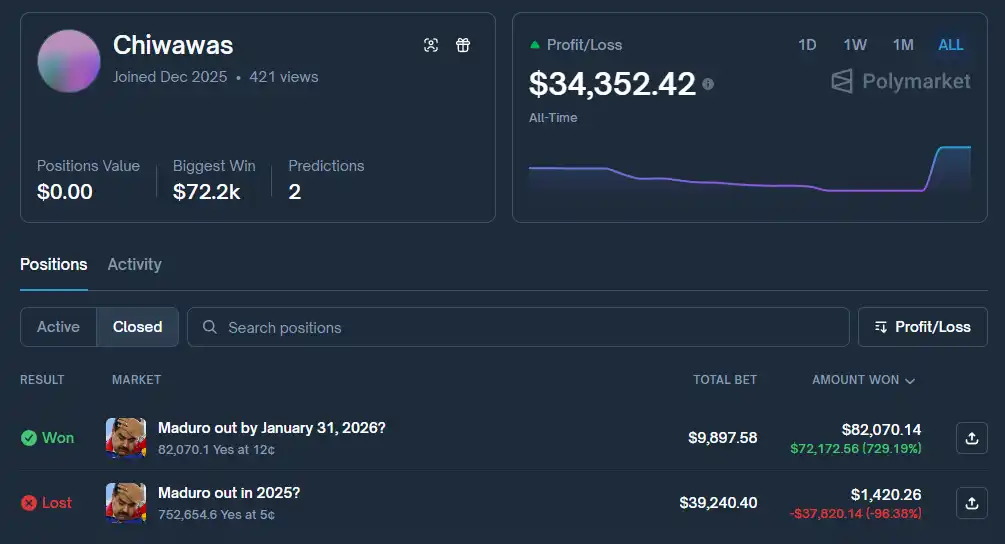
Like the three insiders mentioned above, Chiwawas also placed a precise bet of $10,000 three hours before the airstrike, profiting over $70,000.

But in fact, Chiwawas had already heavily bet nearly $40,000 on the market "Maduro loses power within 2025" on the evening of December 26th.

Assuming he was an insider, he must have received accurate information to make such a heavy bet. Unfortunately, the arrest operation, originally scheduled for December 29th, was canceled due to weather. Thunderstorm clouds over the Caribbean Sea forced the U.S. military to abort for tactical safety reasons.

This was confirmed in Trump's recent speech regarding the operation: "The airstrike against Maduro was originally scheduled for 4 days ago (i.e., the night of December 29 to the early morning of December 30, 2025)."

Therefore, since the market settled as "No" on the last day of 2025, this trade resulted in his account facing huge losses as 2026 arrived.

If everything had gone according to the script Chiwawas possessed, his account should have settled with a whopping $750,000 return on December 30th.

Unfortunately, the weather did not cooperate. The thunderstorm clouds over the sea not only disrupted the U.S. military's original airstrike plans but also shattered Chiwawas's dream of using military intelligence to make a fortune during the Christmas holiday.

Fortunately, upon learning that the U.S. military would restart the operation on the night of January 3rd, he rallied, depositing funds and placing bets again. This final gamble, while unable to make up for the missed $750,000, ultimately brought his total account profit back into positive territory, reaching $34,000.
Besides Chiwawas, another account also missed massive profits due to the weather. Since late last month, he had bet approximately $20,000 across multiple related markets like "Military conflict between US and Venezuela occurs within the year" and "Nothing happens: National leader loses power," convinced that a US-Venezuela conflict would occur in the remaining days of 2025 and that Maduro would fall because of it.

If not for the weather impact, he should have received a huge profit of $1.04 million on the 30th.

Like Chiwawas, after suffering significant losses, he bet on "US-Venezuela conflict occurs before 2026.1.15" three hours before the airstrike and profited over $40,000.

Conclusion

Only three days into 2026, we have already seen that Polymarket is not just a prediction platform but also an automatic teller machine for individuals across various industries with information advantages to疯狂套现 (cash out疯狂ly) using "knowledge gaps" and "time gaps."

As Polymarket's popularity continues to grow, one wonders what other surreal insider stories will play out here this year?
Perguntas relacionadas

QWhat was the outcome of the US special forces operation against Venezuelan President Nicolás Maduro on the early morning of January 3rd, 2026?

AUS special forces conducted a raid, captured President Nicolás Maduro within an hour, and transported him to the United States via a transport aircraft.

QHow did three new wallets on Polymarket profit from the event before it occurred?

AThree new wallets with no prior history placed large bets on the highly unlikely outcome 'Maduro loses power before January 31, 2026' just hours before the raid, when the probability was only 5%. They collectively profited over $500,000 when the event happened.

QWhy did the US military's operation to capture Maduro get delayed from its original date?

AThe operation, originally planned for December 29th, 2025, was canceled due to thunderstorm clouds over the Caribbean Sea, which forced the US military to postpone for tactical safety reasons.

QHow much potential profit did the user 'Chiwawas' miss due to the weather-related delay of the operation?

AChiwawas missed a potential profit of $750,000 because the operation was delayed past the December 31st, 2025 settlement date for his bet on 'Maduro loses power within 2025'.

QWhat does the article suggest about the nature of Polymarket as a platform?

AThe article suggests that Polymarket has become a platform where individuals with insider information or a significant 'knowledge and time advantage' can use it to profit, effectively turning it into an 'ATM' for such actors.

Leituras Relacionadas

Google and Amazon Simultaneously Invest Heavily in a Competitor: The Most Absurd Business Logic of the AI Era Is Becoming Reality

In a span of four days, Amazon announced an additional $25 billion investment, and Google pledged up to $40 billion—both direct competitors pouring over $65 billion into the same AI startup, Anthropic. Rather than a typical venture capital move, this signals the latest escalation in the cloud wars. The core of the deal is not equity but compute pre-orders: Anthropic must spend the majority of these funds on AWS and Google Cloud services and chips, effectively locking in massive future compute consumption. This reflects a shift in cloud market dynamics—enterprises now choose cloud providers based on which hosts the best AI models, not just price or stability. With OpenAI deeply tied to Microsoft, Anthropic’s Claude has become the only viable strategic asset for Google and Amazon to remain competitive. Anthropic’s annualized revenue has surged to $30 billion, and it is expanding into verticals like biotech, positioning itself as a cross-industry AI infrastructure layer. However, this funding comes with constraints: Anthropic’s independence is challenged as it balances two rival investors, its safety-first narrative faces pressure from regulatory scrutiny, and its path to IPO introduces new financial pressures. Globally, this accelerates a "tri-polar" closed-loop structure in AI infrastructure, with Microsoft-OpenAI, Google-Anthropic, and Amazon-Anthropic forming exclusive model-cloud alliances. In contrast, China’s landscape differs—investments like Alibaba and Tencent backing open-source model firm DeepSeek reflect a more decoupled approach, though closed-source models from major cloud providers still dominate. The $65 billion bet is ultimately about securing a seat at the table in an AI-defined future—where missing the model layer means losing the cloud war.

marsbitHá 16m

Google and Amazon Simultaneously Invest Heavily in a Competitor: The Most Absurd Business Logic of the AI Era Is Becoming Reality

marsbitHá 16m

Computing Power Constrained, Why Did DeepSeek-V4 Open Source?

DeepSeek-V4 has been released as a preview open-source model, featuring 1 million tokens of context length as a baseline capability—previously a premium feature locked behind enterprise paywalls by major overseas AI firms. The official announcement, however, openly acknowledges computational constraints, particularly limited service throughput for the high-end DeepSeek-V4-Pro version due to restricted high-end computing power. Rather than competing on pure scale, DeepSeek adopts a pragmatic approach that balances algorithmic innovation with hardware realities in China’s AI ecosystem. The V4-Pro model uses a highly sparse architecture with 1.6T total parameters but only activates 49B during inference. It performs strongly in agentic coding, knowledge-intensive tasks, and STEM reasoning, competing closely with top-tier closed models like Gemini Pro 3.1 and Claude Opus 4.6 in certain scenarios. A key strategic product is the Flash edition, with 284B total parameters but only 13B activated—making it cost-effective and accessible for mid- and low-tier hardware, including domestic AI chips from Huawei (Ascend), Cambricon, and Hygon. This design supports broader adoption across developers and SMEs while stimulating China's domestic semiconductor ecosystem. Despite facing talent outflow and intense competition in user traffic—with rivals like Doubao and Qianwen leading in monthly active users—DeepSeek has maintained technical momentum. The release also comes amid reports of a new funding round targeting a valuation exceeding $10 billion, potentially setting a new record in China’s LLM sector. Ultimately, DeepSeek-V4 represents a shift toward open yet realistic infrastructure development in the constrained compute landscape of Chinese AI, emphasizing engineering efficiency and domestic hardware compatibility over pure model scale.

marsbitHá 53m

Computing Power Constrained, Why Did DeepSeek-V4 Open Source?

marsbitHá 53m

Trading

Spot
Futuros

Artigos em Destaque

Como comprar HOME

Bem-vindo à HTX.com!Tornámos a compra de Defi.app (HOME) simples e conveniente.Segue o nosso guia passo a passo para iniciar a tua jornada no mundo das criptos.Passo 1: cria a tua conta HTXUtiliza o teu e-mail ou número de telefone para te inscreveres numa conta gratuita na HTX.Desfruta de um processo de inscrição sem complicações e desbloqueia todas as funcionalidades.Obter a minha contaPasso 2: vai para Comprar Cripto e escolhe o teu método de pagamentoCartão de crédito/débito: usa o teu visa ou mastercard para comprar Defi.app (HOME) instantaneamente.Saldo: usa os fundos da tua conta HTX para transacionar sem problemas.Terceiros: adicionamos métodos de pagamento populares, como Google Pay e Apple Pay, para aumentar a conveniência.P2P: transaciona diretamente com outros utilizadores na HTX.Mercado de balcão (OTC): oferecemos serviços personalizados e taxas de câmbio competitivas para os traders.Passo 3: armazena teu Defi.app (HOME)Depois de comprar o teu Defi.app (HOME), armazena-o na tua conta HTX.Alternativamente, podes enviá-lo para outro lugar através de transferência blockchain ou usá-lo para transacionar outras criptomoedas.Passo 4: transaciona Defi.app (HOME)Transaciona facilmente Defi.app (HOME) no mercado à vista da HTX.Acede simplesmente à tua conta, seleciona o teu par de trading, executa as tuas transações e monitoriza em tempo real.Oferecemos uma experiência de fácil utilização tanto para principiantes como para traders experientes.

289 Visualizações TotaisPublicado em {updateTime}Atualizado em 2025.06.10

Como comprar HOME

Discussões

Bem-vindo à Comunidade HTX. Aqui, pode manter-se informado sobre os mais recentes desenvolvimentos da plataforma e obter acesso a análises profissionais de mercado. As opiniões dos utilizadores sobre o preço de HOME (HOME) são apresentadas abaixo.

活动图片













