They Knew the TGA Game of the Year Winner in Advance and Made Tens of Thousands of Dollars

marsbitPublicado em 2025-12-12Última atualização em 2025-12-12

Resumo

Summary: The 2025 TGA (The Game Awards) ceremony concluded with the indie game "Light & Shadow: Expedition 33" making history by winning both "Best Independent Game" and the coveted "Game of the Year (GOTY)" award, breaking a long-standing TGA curse. Prior to the event, the prediction market platform Polymarket had already listed the topic, with "Light & Shadow's" probability of winning GOTY consistently above 80% for over a month. Several traders, including users DieselDiesel, trumpnogo, and kasae, placed unusually large, concentrated bets on this outcome weeks in advance, a move that would have resulted in massive losses if wrong. Their bets appeared to be "all-in" convictions rather than calculated risks. Just three hours before the GOTY announcement, after the "Best Indie" award was given to the same game, a mysterious user (bobo9997) deposited $10,000 and bet it all on "Yes" for "Light & Shadow" winning GOTY at a price of $0.98 per share—a bet that would yield less than $200 in profit if correct. The final award confirmed the predictions. The early traders realized significant profits, with their winnings from this single event representing a large percentage of their total historical earnings on the platform (e.g., 176% for DieselDiesel). The article suggests these traders likely had insider knowledge of the results, using the prediction market as a anonymous, low-risk method to monetize their confidential information, turning a guaranteed outcome into thousands of d...

Today, the highly anticipated The Game Awards (TGA) ceremony finally concluded.

Let's jump back to 3 hours before the awards ended. At that time, the "Best Independent Game" had just been awarded to the popular title "Light & Shadow: Expedition 33," but this instead made many fans worried: historically, no game has ever won both the "Best Independent Game" and the "Game of the Year (GOTY)" awards at TGA. As a GOTY favorite, "Light & Shadow" now needed to break the curse that had existed since TGA's inception and create an unprecedented moment in gaming history.

Just as everyone was filled with anxiety, a mysterious individual registered an account on a seemingly unrelated "prediction market" platform and deposited ten thousand dollars. He found the topic "Will Light & Shadow win the 2025 GOTY?" on the platform and bet the entire ten thousand dollars on "Yes." At that time, the price for "Yes" was $0.98 per share, meaning that even if "Light & Shadow" did indeed make gaming history by winning both awards, his ten-thousand-dollar bet would only yield a profit of less than two hundred dollars. However, if "Light & Shadow" failed to break the TGA curse, the probability of the topic would instantly drop to 0, which meant his newly deposited ten thousand dollars would be wiped out. What kind of狂热 fan of "Light & Shadow" would take such a reckless risk? And how do prediction markets attract game fans from around the world to guess the winners in advance?

The "Pre-Determined" Script

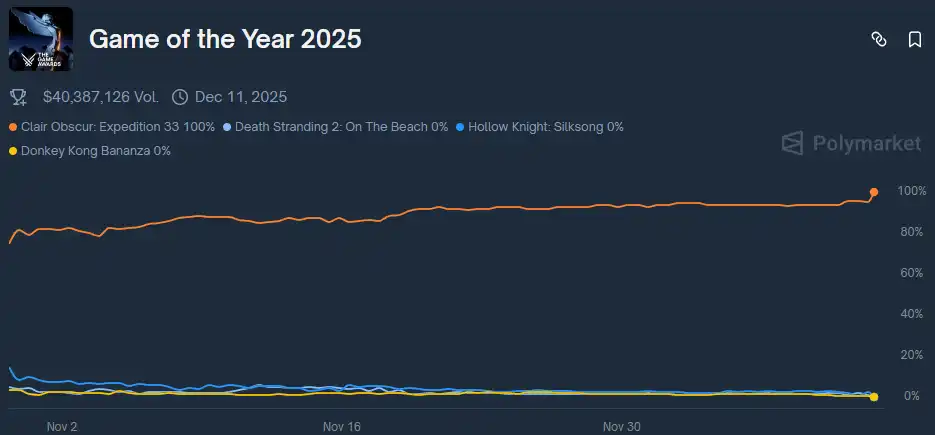
As early as October 30th, a month and a half before the awards ceremony, the prediction market Polymarket had already launched the topic for "2025 Game of the Year." The probability of "Light & Shadow" winning was firmly pinned above 80% from the start, while the probabilities of other highly anticipated AAA titles winning were suppressed below 10%. Because such a one-sided situation usually only occurs in events where the outcome is already certain, this anomaly made many traders smell something unusual: this wasn't just optimism, this was certainty.

Among these traders with a "certain" attitude, a few operated in an extremely unified style, hinting at the possibility of insider trading. DieselDiesel, trumpnogo, and kasae all bet on "Light & Shadow wins TGA 2025 GOTY" when the probability was around 85%, and the amounts they bet were dozens or even hundreds of times larger than their usual bets. This highly concentrated,反常 betting behavior meant they faced enormous risks: if "Light & Shadow" ultimately did not win, they would not only have to give up all past profits but also suffer huge losses.

As time progressed and the probability of "Light & Shadow" winning increased, they did not sell any of their held shares to realize profits. Even 3 hours before the award announcement, after the "Best Independent Game" award had been announced, they, already significantly浮盈, remained motionless as if they knew the future, betting their entire account balance alongside the mysterious individual mentioned at the beginning for that final, tiny profit.

The Historic Award Moment and the Cashing Out of Insiders

Amid doubts and unease, TGA played out exactly like the script these few traders had arranged over a month ago, dispelling the final suspense: the highly anticipated "Light & Shadow," having already won the "Best Independent Game" award, broke the historical curse and won the Game of the Year award.

And while players on one side cheered and celebrated, the mystery was solved in the prediction market on the other side: the three traders who had been convinced since a month ago that "Light & Shadow" would win confirmed their role of "foreseeing the future" and realized huge profits:

DieselDiesel made a profit of $5,357 in this event, accounting for 176% of all his other trading profits;

trumpnogo made a profit of $2,958 in this event, accounting for 62% of all his other trading profits;

kasae made a profit of $1,658 in this event, accounting for 220% of all his other trading profits.

And the mysterious individual (bobo9997) mentioned at the beginning, because he was certain that "Light & Shadow" would make history," used ten thousand dollars to win a "whopping" $200.
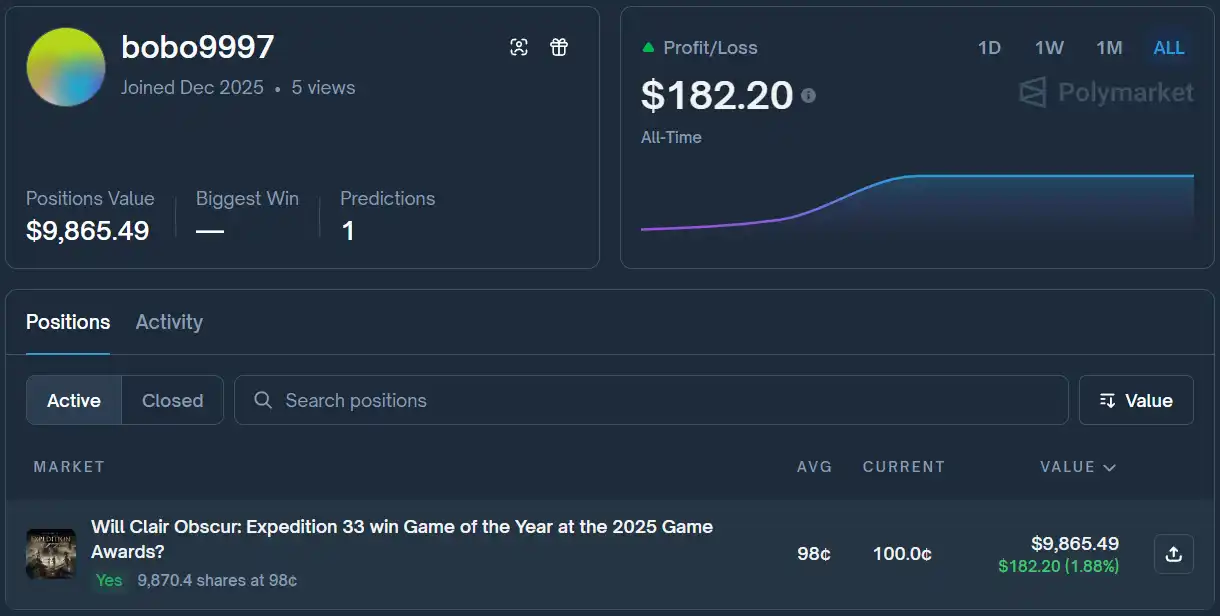
"Even Those Who Foresee the Future Need to Eat"

The most noteworthy common point among these four traders is that while many players doubted whether "Light & Shadow" could break the historical curse, they were "willing to risk" nearly $100,000 in positions to "gamble" on this historic moment happening, and this "gamble" brought them less than two thousand dollars in combined profits.

Now, let's assume these "foreseers" are TGA vote auditing staff. As insiders with an annual income of $100,000, if they wanted to monetize the information in a traditional way, they would need to sell the insider information to media platforms, but this represents various potential fines, dismissal, and even imprisonment. However, with the emergence of prediction markets, they can use anonymity to convert information asymmetry into real money equivalent to 1 to 3 months of their disposable income.

When we view them as assumed insiders who already knew the result in advance, everything becomes clear: being 100% sure that "Light & Shadow" would be GOTY, their final "bet" was just using the one-hour wait time before the announcement to换取 seemingly huge risks but实际上毫无变数的 two thousand dollars in profit. This kind of seemingly high-risk but实际上毫无变数的赚钱 "bet" was almost impossible to encounter before platforms like prediction markets appeared.

However, with the popularity of Polymarket, how many people can resist converting information into real money anonymously?
Perguntas relacionadas

QWhat is the name of the prediction market platform mentioned in the article where users bet on the TGA 2025 Game of the Year outcome?

AThe prediction market platform mentioned is Polymarket.

QWhich game won both the 'Best Indie Game' and 'Game of the Year (GOTY)' awards at TGA 2025, breaking a historical curse?

AThe game that won both awards is 'Light and Shadow: Expedition 33'.

QWhat were the usernames of the three traders who made unusually large bets on 'Light and Shadow' winning GOTY and profited significantly?

AThe three traders were DieselDiesel, trumpnogo, and kasae.

QHow much did the mysterious user 'bobo9997' profit from betting $10,000 on 'Light and Shadow' winning GOTY at the last moment?

AThe user 'bobo9997' profited approximately $200 from the bet.

QWhat is the suggested explanation in the article for the traders' confident and large bets on 'Light and Shadow' winning GOTY?

AThe article suggests that the traders likely had insider information, possibly from being involved in the TGA vote auditing process, which they anonymously monetized through the prediction market.

Leituras Relacionadas

Vitalik: We Need to Create Sanctuaries, Not Fight AI

In a recent interview, Vitalik Buterin, founder of Ethereum, addresses the central anxiety of the AI era. He argues the primary risk isn't AI's intelligence, but human passivity—ceding decisions, privacy, and agency to centralized systems or "super AIs" for a sense of "disempowering safety." His solution is not to fight AI, but to build "sanctuary technologies." These are optional, non-totalizing spaces that protect users while preserving their sovereignty and privacy. Ethereum is presented as a prime example, offering a parallel financial system one can freely choose, not a fix for the old one. Reflecting on his journey from a 19-year-old on "autopilot" to an active "pilot," Vitalik notes the world reinvents itself every 5-10 years. To keep up, individuals must actively pilot their lives, not be passive passengers. He stresses that active learning vastly outperforms passive learning, even with equal time invested. His practical advice for builders and individuals in the AI age includes: periodically forcing oneself to do tasks manually to keep the mind engaged; prioritizing active learning and verification over outsourcing answers; building tools that help retain human agency; not outsourcing all strategic thinking to AI; and preserving serendipity through real-world interactions. Ultimately, Buterin redefines Ethereum/crypto's role: not to win against or fix the old world, but to provide a free, optional alternative. The core message is that as AI grows more powerful, the truly scarce resource will be proactive humans who retain their sovereignty, privacy, and capacity for independent thought. The era demands not less tool use, but more intentional and active use of technology.

链捕手Há 35m

Vitalik: We Need to Create Sanctuaries, Not Fight AI

链捕手Há 35m

Conversation with Patagon Founder: Revealing the Inside Story of Anthropic's Secondary Market

**Summary: Inside Anthropic's Massive, Opaque Secondary Market** In a revealing interview, Patagon founder Dio Casares pulls back the curtain on the booming, high-risk secondary market for shares in companies like Anthropic. This private market, fueled by companies staying private longer and massive funding rounds, is estimated to involve hundreds of billions of dollars. Casares distinguishes between two types of "secondary" trading: 1. **Company-approved SPV (Special Purpose Vehicle) sales:** Where new capital flows into the company, often facilitated by select private equity firms. Anthropic supports this to manage liquidity and pre-IPO selling pressure. 2. **The "gray" market:** Platforms like Hive and Forge that match buyers and sellers, often creating pricing confusion and competing with official funding rounds. These intermediaries are widely disliked by companies. The market structure is complex and fragmented, relying heavily on personal connections. Brokers connect buyers and sellers, often layering multiple SPVs to pool capital, with single transaction fees as high as 10%. Strikingly, some finance professionals earn more from this trading than from their primary investment roles. **Key risks highlighted include:** * **High Fraud Rates:** An estimated 10-20% of transactions involve fake stock certificates or sellers who take payment without having the shares. * **Complex, Risky Structures:** Nested SPVs, "forward contracts" on employee equity, and tokenized private equity create layers of opacity. This is exemplified by a recent incident where an xAI employee's shares were revoked after an espionage allegation, leaving buyers empty-handed. * **Post-IPO "Settlement Hell":** After an IPO, delays in distributing shares through multiple SPV layers and decisions by fund managers to hold onto shares could trigger years of lawsuits as downstream investors are locked out. **For small investors** holding positions through tokenized vehicles or layered SPVs, it's often impossible to verify the underlying asset. Casares advises caution: if the investment feels wrong, consider exiting. As the private market now surpasses IPO fundraising, this "wild west" ecosystem faces a looming reckoning. While it will likely professionalize, the post-IPO period for a company like Anthropic could unleash a wave of disputes, exposing the vulnerabilities built into this frenzied, largely unregulated marketplace.

marsbitHá 2h

Conversation with Patagon Founder: Revealing the Inside Story of Anthropic's Secondary Market

marsbitHá 2h

Trading

Spot
Futuros
活动图片





