The Next Memecoin Script: The Era of Flash in the Pan

marsbitPublicado em 2025-12-15Última atualização em 2025-12-15

Resumo

The memecoin market is evolving from a period of frenzy to a more mature, fast-paced "flash in the pan" era. While activity has cooled since the 2024 peak, it remains a key arena for attention-based speculation. Key shifts are defining this new phase: dominance has moved beyond Solana (now holding 57% of new token launches) to chains like Base and BNB Chain; the market cap ceiling for successful memes has lowered, with mid-to-small cap coins like BRETT and TOSHI becoming the norm; and the lifecycle of new coins has drastically accelerated. Driven by AI and social media algorithms, tokens can peak within 24-48 hours of launch before rapidly fading. Recent trending memecoins like $Franklin (inspired by a political meme), $DOYR (a typo-driven coin), and $Horse_Success (a Chinese community meme) exemplify this trend—all saw rapid, short-lived pumps. The market is maturing from pure jokes into a "cultural index" of social trends. While established memes like DOGE and SHIB are building utility, new launches are purely driven by social hype and data, offering high-risk, granular opportunities. This structural shift demands faster reflexes and deeper research (DYOR) from participants.

Against a backdrop of a somewhat fatigued market, Memecoins, though no longer frenzied, remain a battleground in the attention economy.

Memecoins Haven't Reached the End, They've Changed Direction

Compared to the scene in 2024 where Memecoins stole the show, they have indeed quieted down a lot after $TRUMP this year. However, this is not the end, but rather the market evolving to the next stage.

From Solana to Base, BNB Chain: Initially, Solana monopolized 90% of the new token issuance share with its low fees and high speed. The launch of Pump.fun, in particular, significantly decentralized the power to issue tokens, catalyzing a year-long Meme frenzy in 2024. However, with multi-chain expansion and the continued efforts of other public chains, Solana's share has now dropped to 57%, with BNB Chain, Base Chain, and others continuously grabbing on-chain market share.
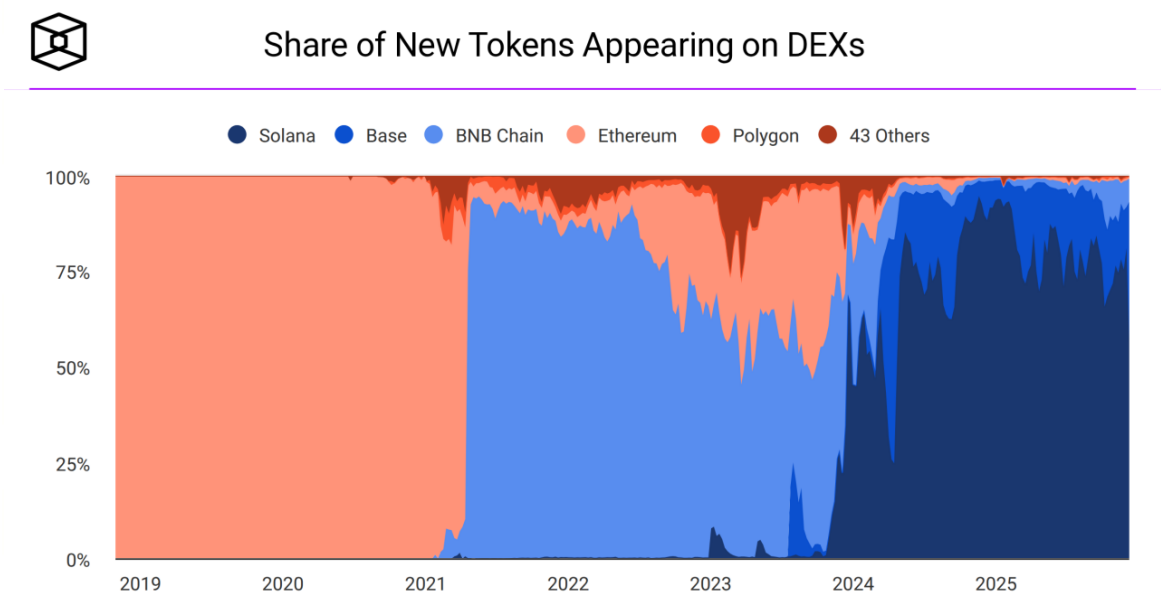
Source : https://www.theblock.co/data/decentralized-finance/dex-non-custodial/share-of-new-tokens-appearing-on-dexs

Small and Medium-Sized Memes Become Mainstream: The Memecoin market narrative has shifted from being dominated by Ethereum chain tokens with multi-billion dollar market caps like DOGE, SHIB, and PEPE, to Solana chain birthing large Memecoins with multi-billion dollar market caps like BONK, WIF, FARTCOIN, and TRUMP, and now to small and medium-sized Memecoins with tens of millions in market cap born on various chains, such as BRETT and TOSHI on Base chain, and Binance Life, BROCCOLI on BNB Chain. This indicates the market cap ceiling for Memecoins is continuously lowering, and the market is maturing.

Accelerated Rotation Pace: With limited liquidity growth and an accelerating trend in the number of Memecoins, the market rotation pace has shifted from "weekly" to "hourly." Particularly thanks to the proliferation of AI tools and upgrades in social media algorithms, the speed of viral spread and decay has increased dramatically. This results in a large number of new coins reaching their peak within just 24-48 hours of launch, with a lifecycle far shorter than the previous weekly cycles.

Recent Hot Memecoins: Social Media Hype + Small/Mid Cap

Browsing recent popular Memecoins undoubtedly confirms the above changes.

$Franklin: Franklin The Turtle was originally a classic children's character from a series of books and TV shows in Canada in the 1980s and 1990s. The current U.S. Secretary of Defense recently posted a politically satirical image on X, expressing a tough stance on U.S. cross-border military anti-drug operations. Subsequently, the同名 Memecoin portrayed Franklin the Turtle as a satirical, militarized anti-drug warrior. The coin launched on December 1st, reached a peak FDV of $24.36M by the 10th, and has currently retraced to $5.4M.

$DOYR: The起因 (cause) was that DYOR was misspelled as DOYR. Then, spurred by a reply post saying "DOYR = DO YouR meme?", the BNB Chain community quickly launched a同名 Memecoin. The coin launched on December 6th, reached a peak FDV of $31.34M the next day, and has currently retraced to $3.4M.

$马到成功 (Horse Success): Originating from the Chinese community's blessing phrase "马到成功" (meaning immediate success), it is a popular Chinese Memecoin following others like "Binance Life" and "Vulgar Penguin". The coin launched on November 15th, reached a peak FDV of $5.03M on December 2nd, and has currently retraced to $2.6M.

$jesse: A personal Memecoin issued by Base co-founder Jesse in November. The coin launched on November 21st, reached a peak FDV of $28.08M on the same day, and has currently retraced to $10M.

Opportunities in the Structural Changes of Memecoins

Starting from DOGE's dog meme to today's vast ecosystem where any topic can become a coin, Memecoins are no longer just simple internet jokes, but a perfect fusion of community narrative, attention propagation, and speculative frenzy.

This year's Memecoin market has been as刺激 (stimulating) as a roller coaster: accelerated rotation, smaller scale, multi-chain expansion—all marking a transition from狂欢 (carnival) to成熟 (maturity).
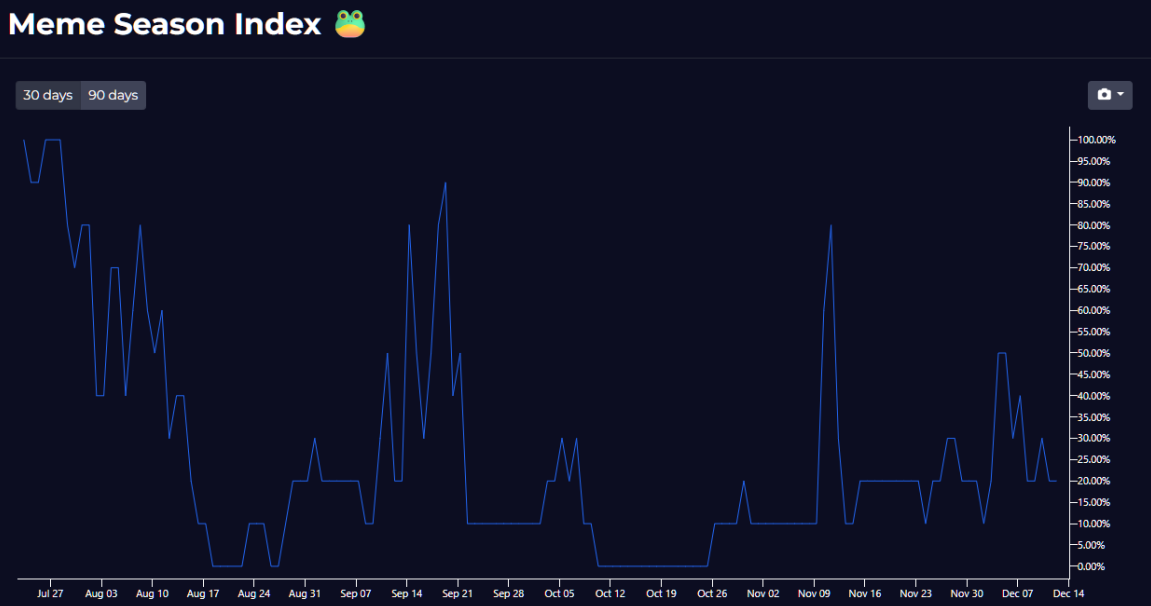
Source : https://whaleportal.com/meme-season-index/

It is foreseeable that, regardless of bull or bear markets, the Memecoin market will not fall silent, because as long as there is attention, someone will go all-in on a dog picture to spread emotion.

However, in the flash-in-the-pan era, Memecoins are beginning to transform from "jokes" into "cultural indices." For example, older tokens like DOGE, SHIB, and BONK are shedding their religious constraints, continuously undergoing technical upgrades, and applications are empowering the Meme. Meanwhile, more newly produced small and medium Memecoins are turning to "social media heat + data-driven," which carries higher risks but offers more refined opportunities. The rise and fall of these Memecoins also represent the ebb and flow of heat around certain social topics.

No matter how you look at it, this structural change will reshape investment logic, bringing more opportunities for participants while also demanding greater DYOR.

* This article is provided by WEEX Labs, intended solely for the purpose of trend research and discussion, and does not constitute any form of investment advice or commitment. The content, data, and opinions involved in the article are for reference only. Investors need to make their own judgments and bear the corresponding risks.


Perguntas relacionadas

QAccording to the article, what is the main trend in the current Memecoin market cycle?

AThe market has evolved into a 'Flash Era' characterized by faster rotation speeds, smaller market caps, and multi-chain expansion, moving from a 'weekly' to an 'hourly' cycle.

QWhich blockchain was initially dominant for new token launches, and what has changed?

ASolana initially monopolized about 90% of new token launches, but its share has now decreased to 57% as other chains like Base and BNB Chain have gained market share.

QWhat are two key characteristics of popular recent Memecoins mentioned in the article?

AThey are typically small to medium market cap coins and are heavily driven by social media热度 (heat/hype).

QName one specific Memecoin example from the article that was created due to a typo or misspelling.

A$DOYR, which was created on BNB Chain after the common crypto acronym 'DYOR' (Do Your Own Research) was misspelled.

QHow is the role of older, established Memecoins like DOGE and SHIB changing according to the article?

AThey are shedding their 'religious' or purely cultural baggage and are undergoing technical upgrades and application development to add more utility and value to the meme.

Leituras Relacionadas

Gensyn AI: Don't Let AI Repeat the Mistakes of the Internet

In recent months, the rapid growth of the AI industry has attracted significant talent from the crypto sector. A persistent question among researchers intersecting both fields is whether blockchain can become a foundational part of AI infrastructure. While many previous AI and Crypto projects focused on application layers (like AI Agents, on-chain reasoning, data markets, and compute rentals), few achieved viable commercial models. Gensyn differentiates itself by targeting the most critical and expensive layer of AI: model training. Gensyn aims to organize globally distributed GPU resources into an open AI training network. Developers can submit training tasks, nodes provide computational power, and the network verifies results while distributing incentives. The core issue addressed is not decentralization for its own sake, but the increasing centralization of compute power among tech giants. In the era of large models, access to GPUs (like the H100) has become a decisive bottleneck, dictating the pace of AI development. Major AI companies are heavily dependent on large cloud providers for compute resources. Gensyn's approach is significant for several reasons: 1) It operates at the core infrastructure layer (model training), the most resource-intensive and technically demanding part of the AI value chain. 2) It proposes a more open, collaborative model for compute, potentially increasing resource utilization by dynamically pooling idle GPUs, similar to early cloud computing logic. 3) Its technical moat lies in solving complex challenges like verifying training results, ensuring node honesty, and maintaining reliability in a distributed environment—making it more of a deep-tech infrastructure company. 4) It targets a validated, high-growth market with genuine demand, rather than pursuing blockchain integration without purpose. Ultimately, the boundaries between Crypto and AI are blurring. AI requires global resource coordination, incentive mechanisms, and collaborative systems—areas where crypto-native solutions excel. Gensyn represents a step toward making advanced training capabilities more accessible and collaborative, moving beyond a niche controlled by a few giants. If successful, it could evolve into a fundamental piece of AI infrastructure, where the most enduring value in the AI era is often created.

marsbitHá 2h

Gensyn AI: Don't Let AI Repeat the Mistakes of the Internet

marsbitHá 2h

Why is China's AI Developing So Fast? The Answer Lies Inside the Labs

A US researcher's visit to China's top AI labs reveals distinct cultural and organizational factors driving China's rapid AI development. While talent, data, and compute are similar to the West, Chinese labs excel through a pragmatic, execution-focused culture: less emphasis on individual stardom and conceptual debate, and more on teamwork, engineering optimization, and mastering the full tech stack. A key advantage is the integration of young students and researchers who approach model-building with fresh perspectives and low ego, prioritizing collective progress over personal credit. This contrasts with the US culture of self-promotion and "star scientist" narratives. Chinese labs also exhibit a strong "build, don't buy" mentality, preferring to develop core capabilities—like data pipelines and environments—in-house rather than relying on external services. The ecosystem feels more collaborative than tribal, with mutual respect among labs. While government support exists, its scale is unclear, and technical decisions appear driven by labs, not state mandates. Chinese companies across sectors, from platforms to consumer tech, are building their own foundational models to control their tech destiny, reflecting a broader cultural drive for technological sovereignty. Demand for AI is emerging, with spending patterns potentially mirroring cloud infrastructure more than traditional SaaS. Despite challenges like a less mature data industry and GPU shortages, Chinese labs are propelled by vast talent, rapid iteration, and deep integration with the open-source community. The competition is evolving beyond a pure model race into a contest of organizational execution, developer ecosystems, and industrial pragmatism.

marsbitHá 3h

Why is China's AI Developing So Fast? The Answer Lies Inside the Labs

marsbitHá 3h

3 Years, 5 Times: The Rebirth of a Century-Old Glass Factory

Corning, a 175-year-old glass company, is experiencing a dramatic revival as a key player in AI infrastructure, driven by surging demand for high-performance optical fiber in data centers. AI data centers require vastly more fiber than traditional ones—5 to 10 times as much per rack—to handle high-speed data transmission between GPUs. This structural demand shift, coupled with supply constraints from the lengthy expansion cycle for fiber preforms, has created a significant supply-demand gap. Nvidia has invested in Corning, along with Lumentum and Coherent, in a $4.5 billion total commitment to secure the optical supply chain for AI. Corning's competitive edge lies in its expertise in producing ultra-low-loss, high-density, and bend-resistant specialty fiber, which is critical for 800G+ and future 1.6T data rates. Its deep involvement in co-packaged optics (CPO) with partners like Nvidia further solidifies its position. While not the largest fiber manufacturer globally, Corning's revenue from enterprise/data center clients now exceeds 40% of its optical communications sales, and it has secured multi-year supply agreements with major hyperscalers including Meta and Nvidia. Financially, Corning's optical communications revenue has surged, doubling from $1.3 billion in 2023 to over $3 billion in 2025. Its stock price has risen nearly 6-fold since late 2023. Key future catalysts include the rollout of Nvidia's CPO products and the scale of undisclosed customer agreements. However, risks include high current valuations and potential disruption from next-generation technologies like hollow-core fiber. The company's long-term bet on light over electricity, maintained even through the telecom bubble crash, is now being validated by the AI boom.

marsbitHá 4h

3 Years, 5 Times: The Rebirth of a Century-Old Glass Factory

marsbitHá 4h

Trading

Spot
Futuros

Artigos em Destaque

Como comprar ERA

Bem-vindo à HTX.com!Tornámos a compra de Caldera (ERA) simples e conveniente.Segue o nosso guia passo a passo para iniciar a tua jornada no mundo das criptos.Passo 1: cria a tua conta HTXUtiliza o teu e-mail ou número de telefone para te inscreveres numa conta gratuita na HTX.Desfruta de um processo de inscrição sem complicações e desbloqueia todas as funcionalidades.Obter a minha contaPasso 2: vai para Comprar Cripto e escolhe o teu método de pagamentoCartão de crédito/débito: usa o teu visa ou mastercard para comprar Caldera (ERA) instantaneamente.Saldo: usa os fundos da tua conta HTX para transacionar sem problemas.Terceiros: adicionamos métodos de pagamento populares, como Google Pay e Apple Pay, para aumentar a conveniência.P2P: transaciona diretamente com outros utilizadores na HTX.Mercado de balcão (OTC): oferecemos serviços personalizados e taxas de câmbio competitivas para os traders.Passo 3: armazena teu Caldera (ERA)Depois de comprar o teu Caldera (ERA), armazena-o na tua conta HTX.Alternativamente, podes enviá-lo para outro lugar através de transferência blockchain ou usá-lo para transacionar outras criptomoedas.Passo 4: transaciona Caldera (ERA)Transaciona facilmente Caldera (ERA) no mercado à vista da HTX.Acede simplesmente à tua conta, seleciona o teu par de trading, executa as tuas transações e monitoriza em tempo real.Oferecemos uma experiência de fácil utilização tanto para principiantes como para traders experientes.

452 Visualizações TotaisPublicado em {updateTime}Atualizado em 2025.07.17

Como comprar ERA

Discussões

Bem-vindo à Comunidade HTX. Aqui, pode manter-se informado sobre os mais recentes desenvolvimentos da plataforma e obter acesso a análises profissionais de mercado. As opiniões dos utilizadores sobre o preço de ERA (ERA) são apresentadas abaixo.

活动图片