The Macroeconomic Underpinnings of Africa's Payment Market Landscape

链捕手Publicado em 2026-06-05Última atualização em 2026-06-05

Resumo

The African payments market, characterized by the world's highest mobile money penetration and fastest-growing cryptocurrency adoption, is not a coincidence but a macroeconomic necessity driven by deep structural factors. Two key drivers create this landscape: (1) Africa's heavy reliance on commodity exports, trade, and remittances, generating massive cross-border settlement and remittance demand; and (2) chronically underdeveloped financial infrastructure, exacerbated by international bank de-risking, foreign exchange mismanagement, and persistent inflation. This vacuum has allowed mobile money and crypto to thrive. Mobile money platforms replace banks for domestic payments, while cryptocurrencies serve as a store of value against local currency depreciation and a low-cost medium for cross-border exchange. A crucial division lies along the Sahara Desert. North Africa is integrated into the oil-anchored MENA framework, while Sub-Saharan Africa (SSA), plagued by dollar shortages and fragmented currencies, has become a natural, massive market for mobile money and crypto. Nigeria, Kenya, and South Africa are global leaders in adoption. The SSA economy is deeply dollarized due to currency instability, yet suffers from a severe "dollar shortage" caused by trade deficits and limited export capacity. This creates parallel forex markets and high remittance costs. Cryptocurrencies, particularly stablecoins, fill this gap by providing access to dollar liquidity, cheaper cross-border...

Africa's payment market exhibits distinct characteristics, boasting the world's highest mobile money penetration rate and fastest cryptocurrency adoption growth. This is not a coincidence at the market level, but an inevitability stemming from the long-term evolution of its macroeconomic structure.

This article analyzes the two underlying structural drivers behind this inevitability: (1) Africa's long-term reliance on resource exports, trade flows, and remittances creates immense demand for cross-border settlement and money transfers; (2) Africa's local financial infrastructure is underdeveloped, plagued by international bank de-risking and mismanaged foreign exchange controls, leading to a chronic banking sector gap and persistent inflationary pressures.

These two forces jointly create a vacuum where mobile money and cryptocurrencies have flourished: mobile money platforms replace banks as daily payment channels, while cryptocurrencies assume roles traditionally held by local fiat currencies or the US dollar in emerging economies, serving both as a store of value against currency depreciation and as a low-cost cross-border exchange medium.

On this continent, the key dividing line is the Sahara Desert: north of it integrates into the Middle East and North Africa (MENA) framework anchored by oil and aligned with the Middle East; while Sub-Saharan Africa (SSA), amid severe dollar shortages and fragmented currency systems, has given rise to a vast market with an inherent need for mobile money and cryptocurrencies. SSA countries represented by Nigeria, Kenya, and South Africa are among the global leaders in mobile money and cryptocurrency adoption.

1 Africa's Macroeconomic Panorama: A Large, Young, Yet Commodity-Dependent Primary Economy

1.1 Demographic Structure

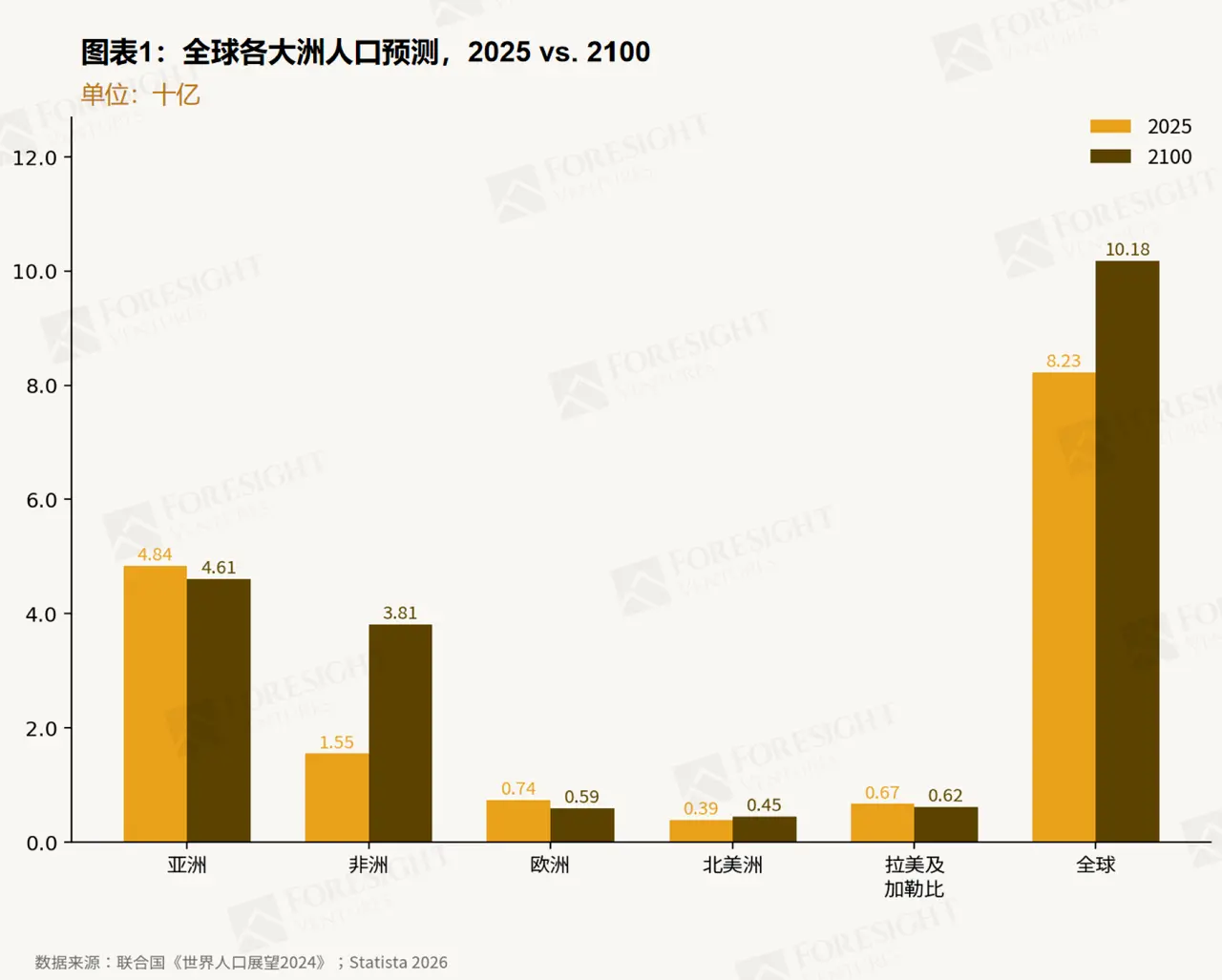
In 2025, Africa's population reached approximately 1.55 billion, accounting for about 19% of the global total. It is the world's youngest continent, with a median age of only 19, and also the fastest-growing continent, with an annual growth rate of around 2%, unmatched by other continents.

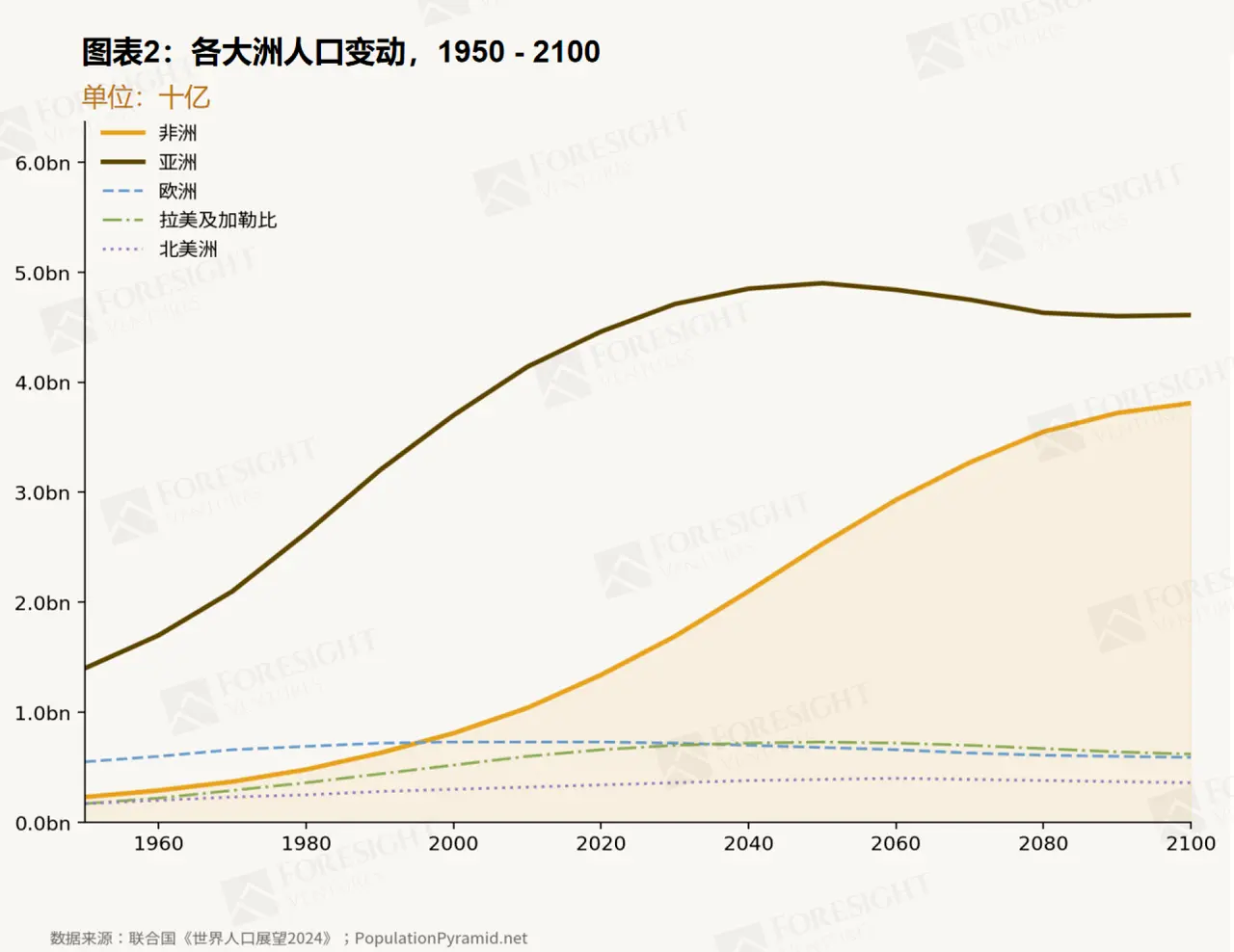
By 2100, Africa's population is projected to nearly triple to 3.81 billion, constituting 37% of humanity. In stark contrast, Asia's population is expected to peak mid-century before declining, while Europe and Latin America face absolute shrinkage; only Africa will experience substantial growth throughout the century (see Figures 1 and 2).

This demographic trend has profound implications for payment infrastructure. With traditional bank coverage still relatively low, large numbers of young, urbanizing, mobile-native cohorts are entering the labor market and consumer economy at scale. Consequently, demand for convenient, low-cost financial services (including payments, savings, and credit) will only intensify.
1.2 Resource Endowment and Industrial Structure

Africa possesses exceptionally rich natural resources. According to OPEC's Annual Statistical Bulletin, as of 2024, Africa's proven crude oil reserves were approximately 119.4 billion barrels, accounting for about 7.6% of the global total, with the largest reserves concentrated in Libya, Nigeria, Algeria, and Angola. Beyond hydrocarbons, Africa's mineral resources hold significant global importance and dominate several categories: the continent is the world's primary diamond-producing region, holds about 49% of global cobalt reserves, and is the absolute source for platinum group metals (PGMs), with South Africa alone controlling around 78% of global PGM reserves. These endowments make Africa a crucial node in the global commodity supply chain.

However, much of this wealth is still extracted and exported as raw materials, with minimal downstream processing or value addition. Concurrently, local manufacturing and agriculture are underdeveloped, infrastructure is severely lacking, and finished goods like refined petroleum and processed foods remain import-dependent. This economic structure of being "large in both imports and exports" locks the continent into the trade dependency pattern discussed next.

1.3 Trade Dependency and Remittance Flows

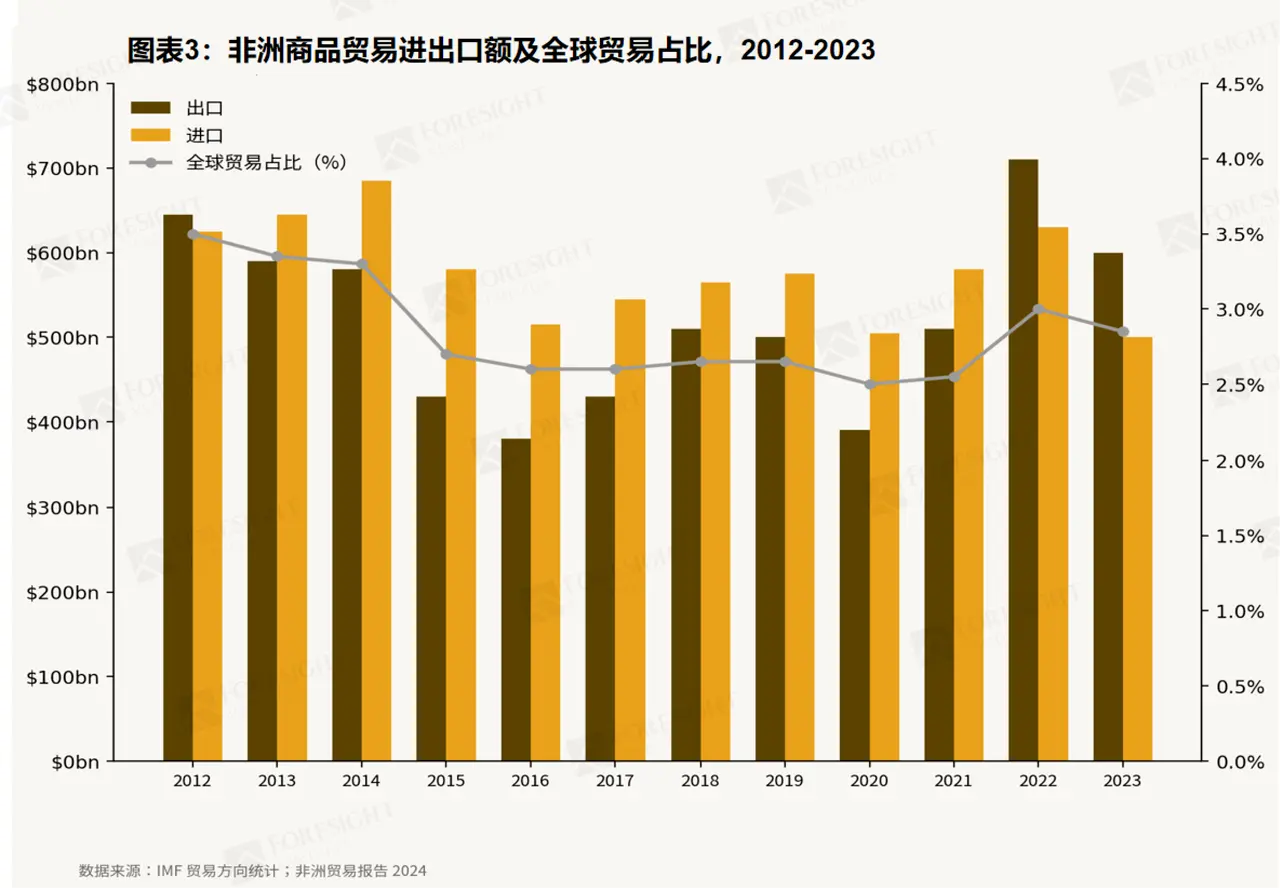
The African economy is deeply intertwined with global trade and overseas remittances. In 2023, Africa's cross-border merchandise exports and imports reached $604.5 billion and $684.5 billion, respectively, while remittance inflows stood at $52.16 billion. For reference, Africa's total GDP in 2023 was approximately $2.96 trillion. These two pillars—trade and remittances—are pivotal in Africa's economic structure and have generated massive demand for B2B cross-border trade settlement and C2C cross-border money transfers, respectively.

Cross-border trade is a vital pillar of the African economy, but its commodity-dependent export structure and persistent trade deficits make it highly sensitive to global macro cycles. In 2023, African merchandise exports totaled $604.5 billion (down 15.1% year-on-year), imports were $684.5 billion (down 1.6% year-on-year), resulting in a trade deficit of about $80 billion (see Figure 3). Over a ten-year trend, Africa is extremely sensitive to global commodity cycle volatility. The 2015–2016 oil price plunge pushed African trade volumes to a two-decade low, stalling resource-dependent economies (e.g., oil exporters like Nigeria, Angola) while non-resource economies maintained 7%–8% growth, creating a clear divergence. The 2020 COVID-19 shock triggered another collapse: global commodity prices plummeted, African GDP growth fell to -2%, followed by a V-shaped recovery in 2021. Most recently, in 2022–2023, driven by the commodity price surge from the Russia-Ukraine conflict, African exports briefly spiked. However, simultaneously, the Fed's aggressive rate hike cycle boosted the dollar and tightened global liquidity, subjecting the continent to severe imported inflation and currency depreciation.
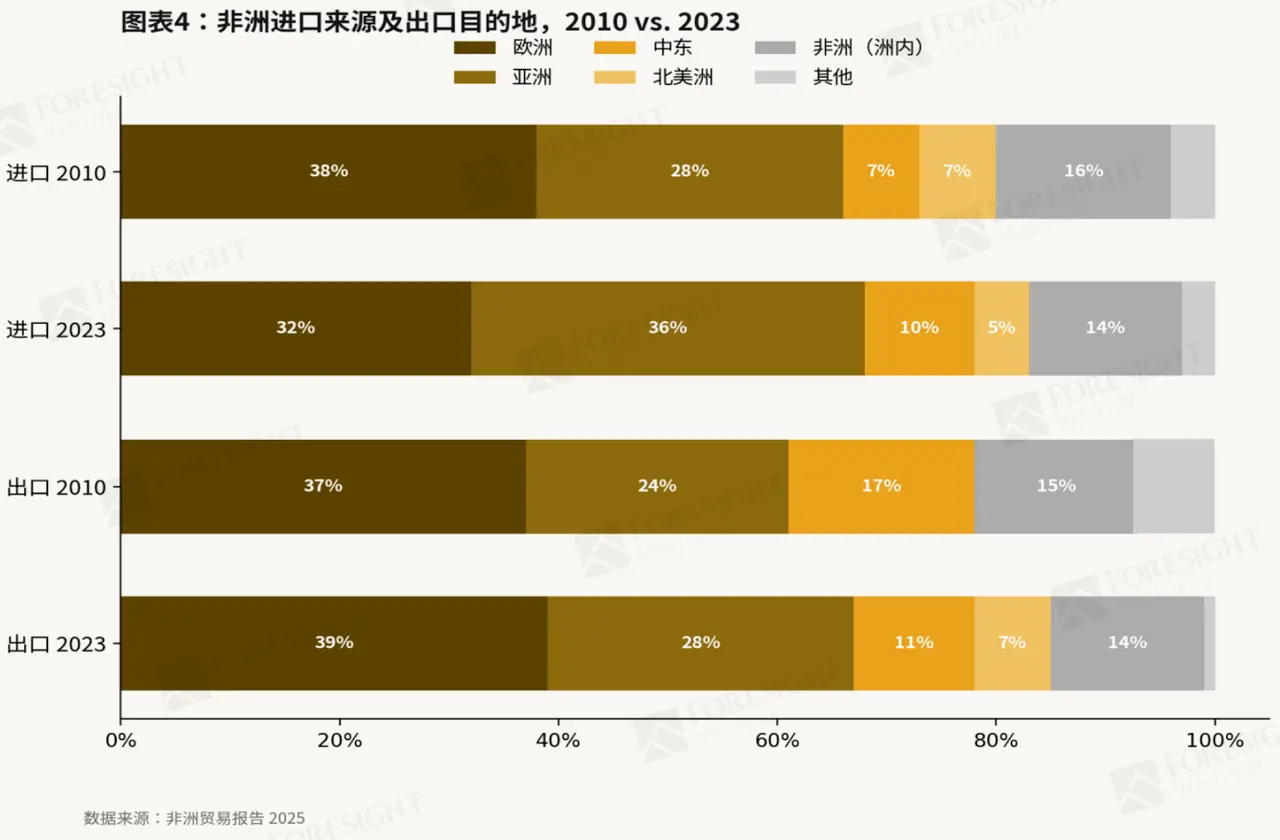
Africa's trade partner structure has shifted significantly over the past decade (see Figure 4). Asia, led by China and India, has surpassed Europe to become Africa's largest source of imports—its share of Africa's total imports rose from 28% in 2010 to 36% in 2023, while Europe's share fell from 38% to 32%. On the export side, Europe remains the top destination with a 39% share, but Asia's share grew from 24% to 28%, and the Middle East's share expanded sharply from 3% to 11%. North America's role has shrunk on both ends. These changes reflect the deepening commodity trade corridor with China and the growing importance of Gulf states as energy buyers and investment partners.

Beyond intercontinental trade, Intra-Africa Trade is also growing rapidly, but barriers such as currencies and languages between countries remain bottlenecks to be overcome. Intra-African trade volume reached $192.2 billion in 2023, up 3.8%. However, intra-regional trade accounts for only 18% of Africa's total exports, compared to 70% for Europe and 52% for Asia. This reflects persistent barriers like tariff fragmentation, currency inconvertibility, and weak cross-border infrastructure. Against this backdrop, the African Continental Free Trade Area (AfCFTA) began operation in 2021, aiming to boost intra-regional trade by 52% upon full implementation, but progress has been slow.

Remittances are another lifeline for the African economy and a source of massive C2C payment demand. According to World Bank data, remittance inflows to Africa were $52.2 billion in 2023. The top five remittance corridors were Saudi Arabia → Egypt, UAE → Egypt, USA → Nigeria, Kuwait → Egypt, France → Morocco. African labor export to the Gulf, North America, and Europe creates a continuous reverse flow of income to households. These corridors constitute one of the largest sources of cross-border C2C remittance demand and also feel the acute pain points of the traditional financial system in cross-border transfers—high cost, long time, and opaque progress—issues that will be discussed in detail in the next chapter.
2 The Deep Mismatch Between Trade/Remittance Demand and the Underdeveloped Financial System

2.1 Low Bank Coverage, Massive Unbanked Population Gap

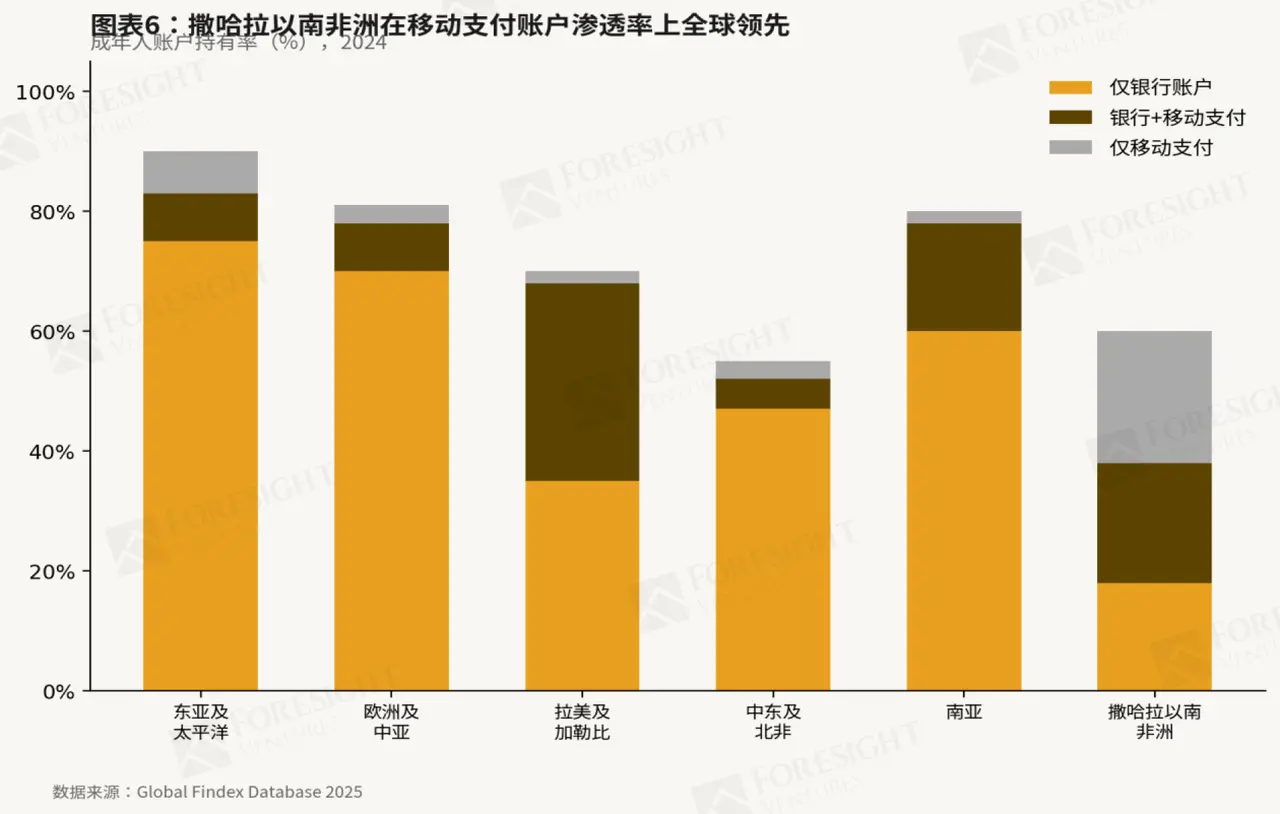
Africa's formal financial system covers only a minority. According to the World Bank's Global Findex Database 2021–2022, only 49% of adults in Sub-Saharan Africa had a financial account; by 2024, this figure rose to 58%, still among the lowest globally. Beyond low coverage, bank branch density in Africa is also lagging. The IMF's Financial Access Survey shows Kenya has only 4.4 bank branches per 100,000 adults, Morocco has 22.2, and even South Africa, Africa's most developed banking system, has only 38.7, all well below the global average. The result is massive unmet demand for basic financial services: payments, savings, credit, and insurance.

2.2 International De-risking and Correspondent Banking Withdrawal

Africa's second major obstacle stems from the retreat of the international financial system itself. Due to concerns over anti-money laundering (AML) and know-your-customer (KYC) compliance risks, compounded by local realities like lack of formal ID, fixed addresses, incomplete tax records, and a high cash economy share, global major banks have engaged in a wave of de-risking. Since 2016, correspondent banking relationships have contracted sharply. According to SWIFT data, South Africa lost over 10% of its overseas correspondent banks, while Angola's decline reached 37%. This withdrawal directly increases the cost of legitimate cross-border transactions and excludes smaller African financial institutions from the global financial system.

2.3 Mismanaged Forex Controls and Chronic Inflation

Currency system fragility further amplifies these structural flaws. Due to fiscal deficits and a weak tax base, many African central banks resort to printing money to finance government spending, fueling persistent imported inflation. Food, fuel, and raw material prices for manufactured goods rise sharply due to currency depreciation. Concurrently, shallow capital markets, a highly concentrated banking sector, and a historical deficit in central bank independence lead to a broken monetary policy transmission mechanism, making interest rate hikes ineffective at curbing inflation or stabilizing exchange rates. In 2024, Africa's overall inflation rate reached 20.1%, the highest among major global regions, severely eroding the real value of local currency savings.

2.4 Consequence: Cash Dominance and Payment System Failure

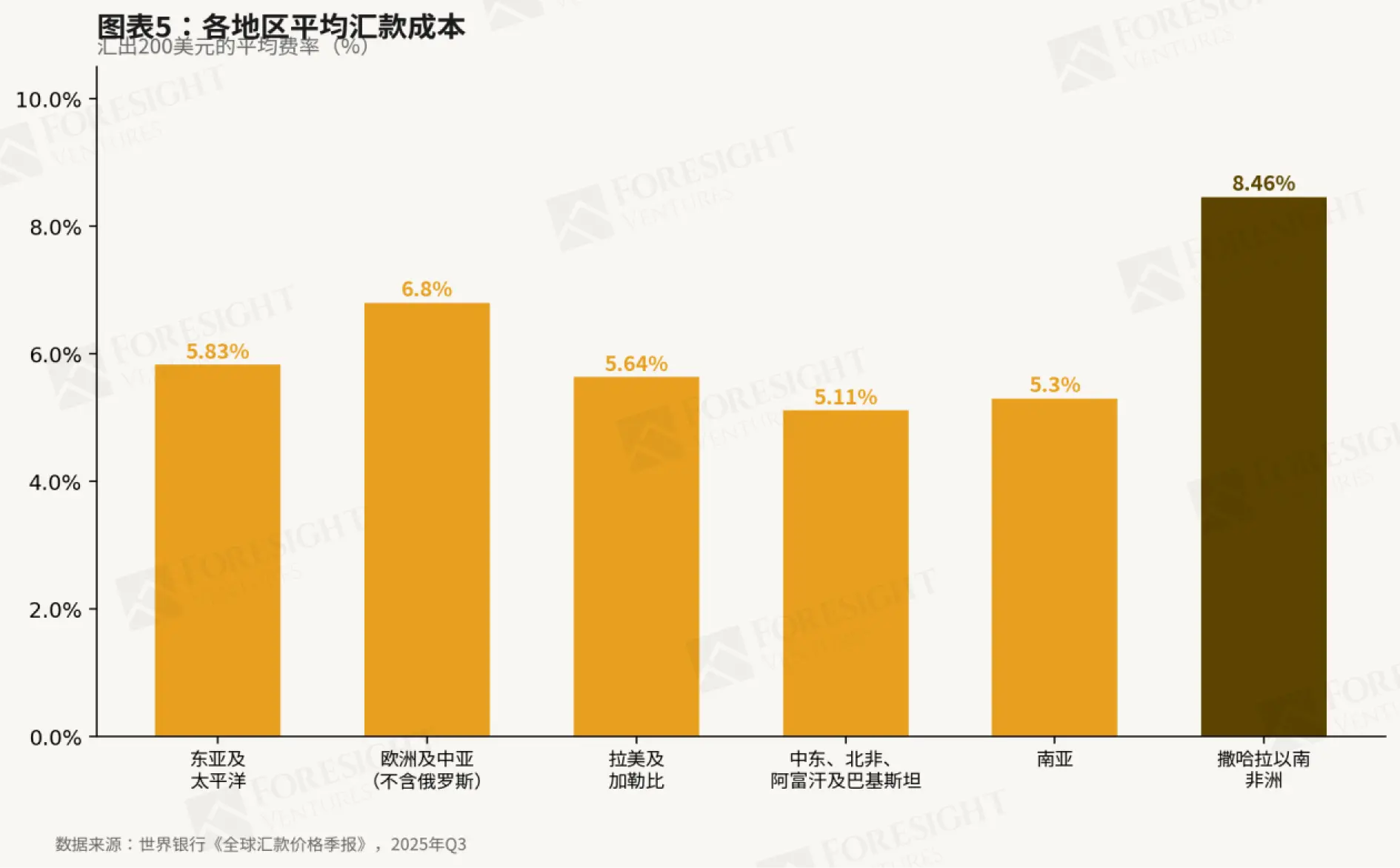
The triple failure of banking exclusion, de-risking, and monetary instability leads to evident consequences. The vast majority of Africans still rely on cash for daily transactions; Sub-Saharan Africa has the world's highest remittance costs, averaging 8.46% per transfer according to the World Bank's Q3 2025 Global Remittance Price Report; and ordinary citizens lack effective inflation-hedging stores of value. The banking system comprehensively fails on three dimensions: access convenience, affordability, and currency stability, thus creating a market vacuum rapidly being filled by emerging payment channels and cryptocurrencies.
3 In the Vacuum Left by the Traditional Financial System, Mobile Money and Cryptocurrencies Flourish

In the gap created by an absent banking system, forced by severe inflation and currency depreciation pressures, Africa has developed the world's most vibrant mobile money and cryptocurrency markets. The emergence of these alternative payment channels is not a matter of choice but of necessity—they solve real problems the banking system cannot address: accessibility, affordability, and stability.

3.1 Mobile Money: Africa Leads the World

Africa accounts for the majority of global mobile money transactions. According to the 2025 Global Findex database, about 40% of adults in Sub-Saharan Africa use a mobile money account as their primary (or only) formal financial service. Kenya's M-Pesa platform is the archetype: leveraging ubiquitous USSD technology (accessible via basic feature phone keypads), it built a network of millions of offline agent points, supported by near-universal mobile coverage, ultimately capturing 90.8% of Kenya's mobile money market share, and successfully expanded to seven other African countries including Tanzania, Ghana, and Egypt. This architecture based on offline agents and low-tech barriers proves far more scalable and inclusive than traditional branch-based banking, accumulating a massive user base across urban and rural Africa.
3.2 Widespread Cryptocurrency Adoption Across the Continent

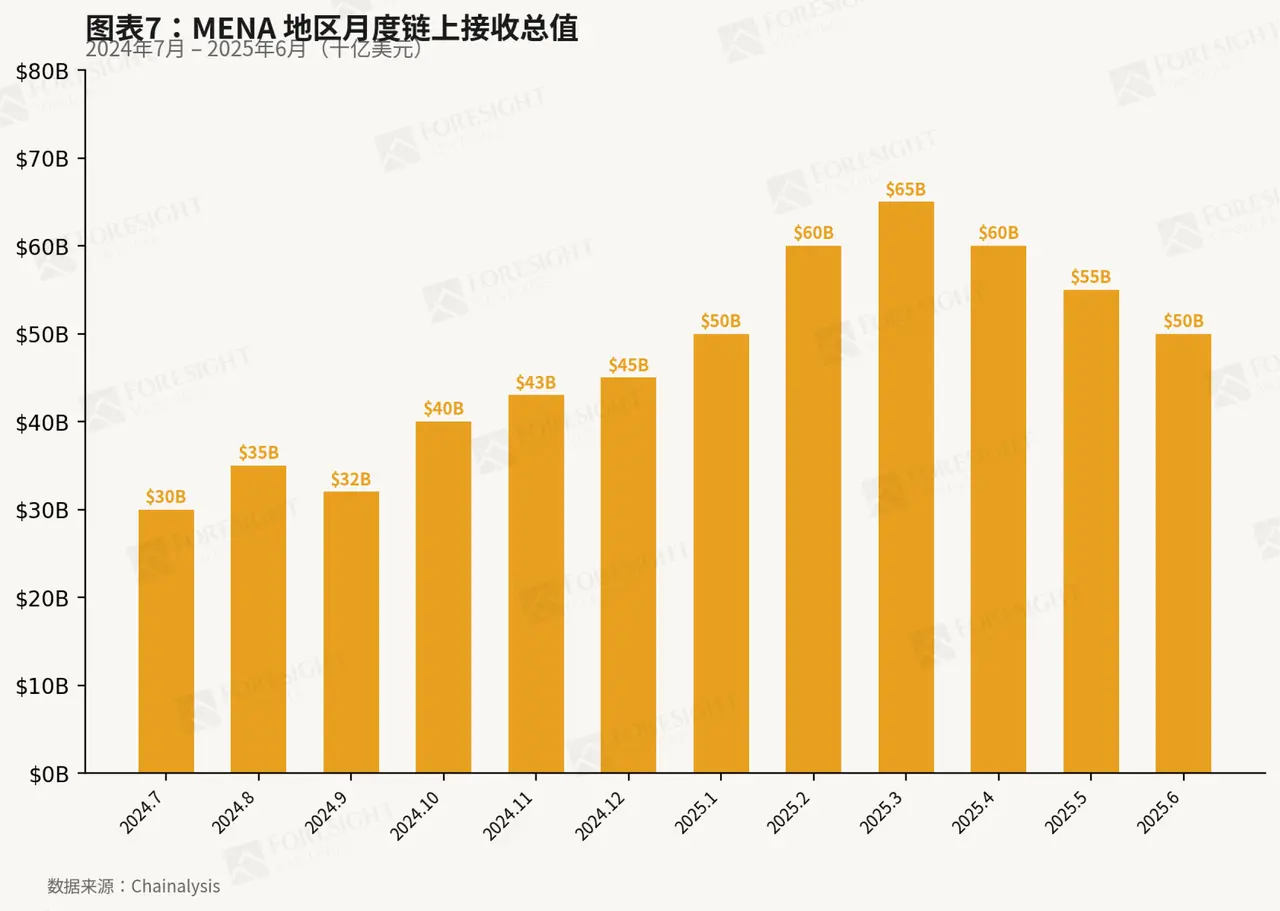
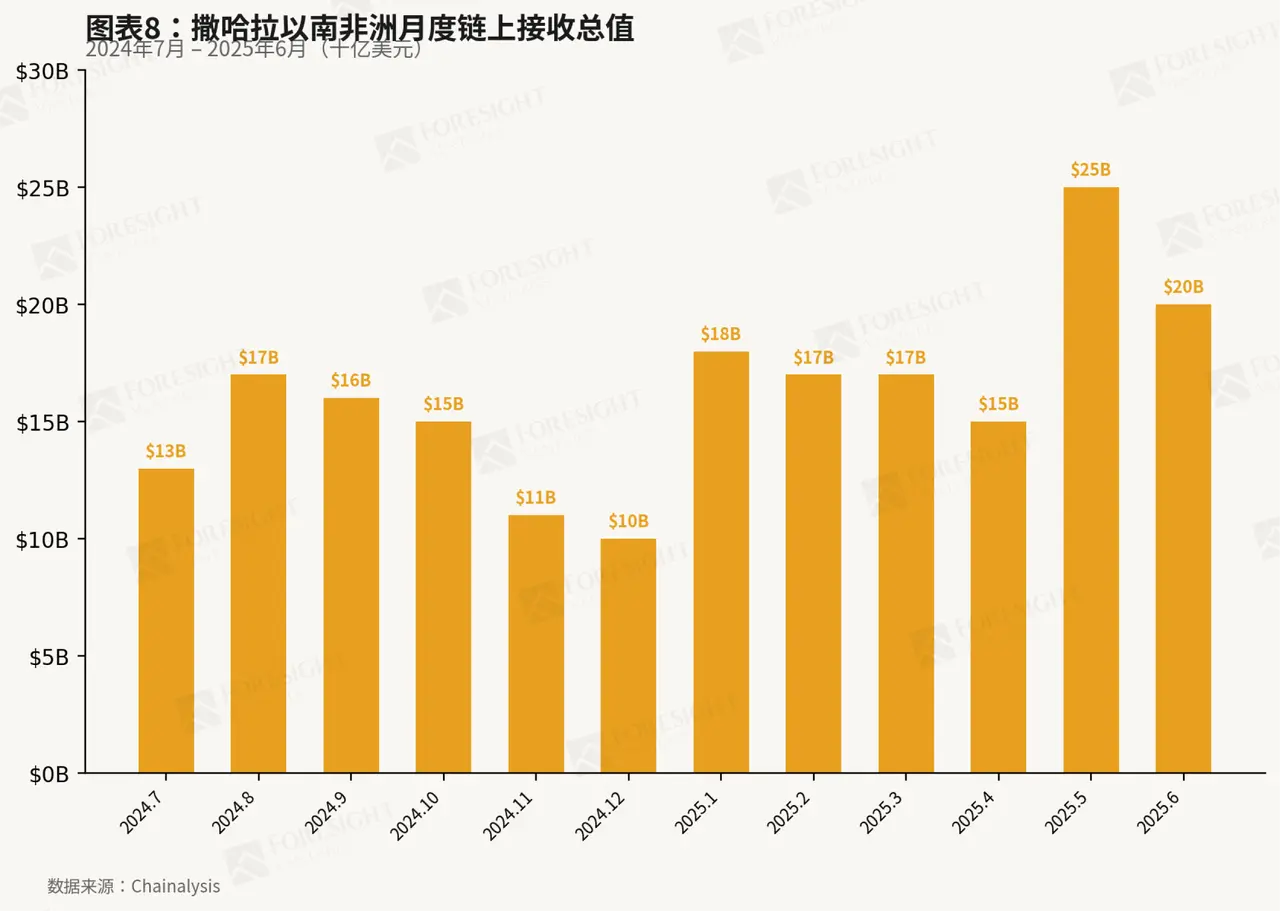
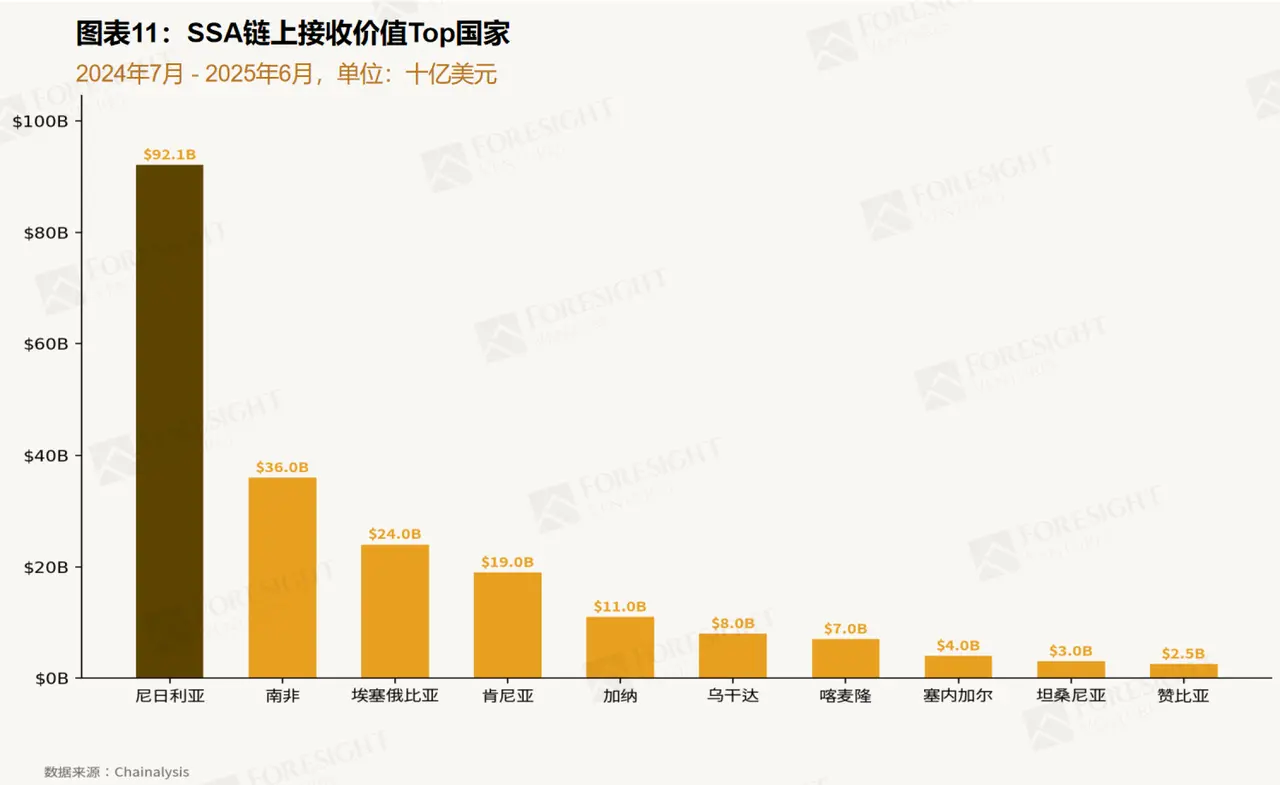
Cryptocurrency adoption rates in Africa are globally leading and rising sharply. In the Middle East and North Africa region, the total on-chain value received between July 2024 and June 2025 was approximately $600 billion; Sub-Saharan Africa recorded $200 billion in the same period, a 52% year-on-year growth, primarily driven by retail users and concentrated in a few countries (Nigeria, South Africa, Ethiopia, Kenya). Cryptocurrencies effectively meet the dual needs of African businesses and individuals for a store of value against inflation and low-cost cross-border settlement, precisely the needs that neither mobile money nor the formal banking system can adequately fulfill.
4 Heterogeneity Within the African Continent

4.1 Why Understanding Internal Divergence Within Africa is Crucial

Africa's 54 countries span 42 different currency systems and belong to multiple language spheres: Francophone, Anglophone, Arabophone, Lusophone, and Hispanophone. This linguistic and monetary fragmentation is not merely a cultural distinction but deeply embedded in cross-border trade, financial flows, and regulatory systems: payment networks are disjointed, regulatory frameworks are independent, and market opportunities are highly fragmented. Therefore, beyond establishing a holistic understanding of the continent's macroeconomic environment, it is essential to recognize the differences in culture, regulation, and financial systems across its internal sub-regions.

4.2 Dividing by the Sahara: MENA vs. Sub-Saharan Africa (SSA)

The most common analytical framework currently divides Africa by the Sahara Desert into two major systems: the Middle East and North Africa (MENA) and Sub-Saharan Africa (SSA).

North Africa is highly integrated with the Arab world in culture, institutions, and economic structure, with its economy centered on oil and gas resources and deeply embedded in the global energy market. Correspondingly, its financial system and policy frameworks operate more within the MENA ecosystem, with a relatively mature banking sector and lower financial exclusion.

In contrast, Sub-Saharan Africa largely operates outside this system. It is precisely this market, long plagued by deep-seated financial system inadequacies, dollar shortages, and monetary instability, that drives the explosive growth of crypto and mobile money. SSA currently accounts for nearly 60% of global mobile money transaction volume and is also the world's fastest-growing region for cryptocurrency adoption.

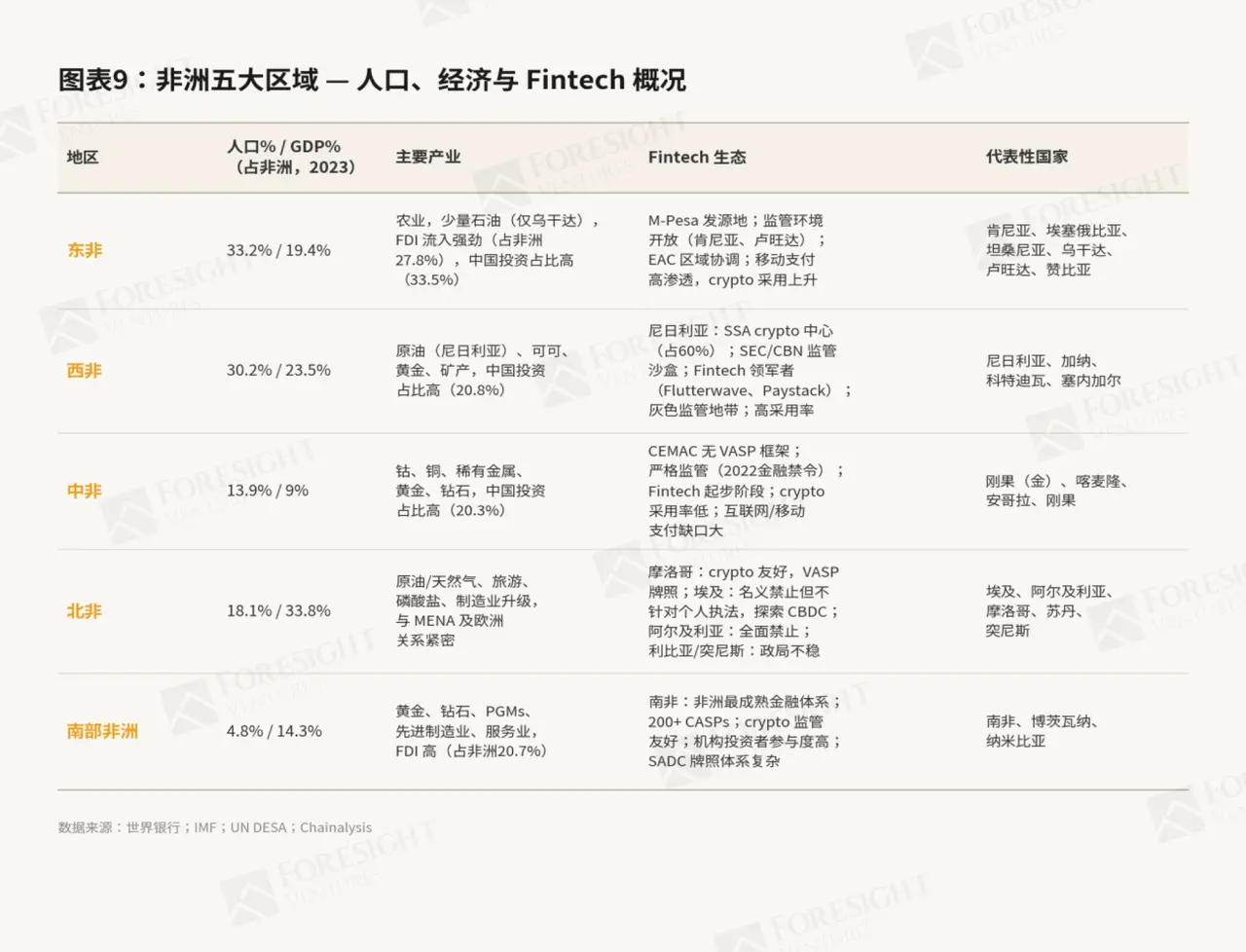
4.3 The Five-Region Framework: Divergence in Demographics, Economy, and Fintech Ecosystems

For further granularity, Africa can be divided into five regions, each exhibiting distinct macroeconomic characteristics. North Africa and Southern Africa have the highest GDP per capita; West Africa and Central Africa are relatively less developed; East Africa has the lowest per capita income. However, economic growth rates exhibit an inverse relationship with wealth levels: East Africa grows the fastest, followed by Central Africa, North Africa, West Africa, and Southern Africa.

Cryptocurrency adoption patterns show similar features. Nigeria alone (in West Africa) accounts for most SSA crypto transaction volume; simultaneously, East Africa, South Africa, and North Africa also show high cryptocurrency adoption. Central Africa and broader West Africa are still largely in early-stage markets. This divergence essentially reflects differences in financial exclusion levels, dollar shortage pressures, and regulatory environments across regions.
5 The "Dollarization" and "Dollar Shortage" Behind Sub-Saharan Africa's Payment Market

5.1 Dollarization in Sub-Saharan Africa

Sub-Saharan African economies exhibit a high degree of dollarization, far exceeding most other regions globally. The share of US dollar deposits and loans serve as key proxy indicators for dollarization levels: in Nigeria, dollar deposits once accounted for up to 40% of total deposits, and over 80% of external debt is dollar-denominated; in Ghana, dollar deposits have also reached relatively high levels of 20%–30%. This dollarization is not accidental but a manifestation of rational economic behavior in the face of long-term monetary instability.

5.2 Three Structural Drivers of Dollarization

Dollarization in Sub-Saharan Africa stems from three distinct economic pressures.

First, Store of Value: Due to fiscal deficits and external imbalances forcing central banks to print money, local currencies depreciate continuously, and the dollar provides a stable measure of value.

Second, Medium of Exchange: Commodity prices (oil, minerals, food) are globally priced in dollars, and intra-African trade, even between African countries, is often settled in dollars—because the dollar is more stable than any single local currency.

Third, Financing Channel: Shallow local capital markets mean businesses and governments must borrow dollars from international creditors; when dollar debt becomes too large relative to dollar income, exchange rate risk becomes acute, further pushing more funds into dollar deposits.

5.3 Causes of the "Dollar Shortage"

The real pain point in Sub-Saharan Africa's current payment market is the dollar shortage. Limited foreign exchange earnings from exports (due to commodity dependency and weak manufacturing exports), coupled with huge trade deficits and debt servicing pressures, continuously drain government foreign exchange reserves. Consequently, central banks can only ration official forex supply through administrative controls. This scarcity breeds a parallel black market where dollars trade at a significant premium—sometimes 50% to 100% above the official rate. Residents and businesses unable to access forex through official channels turn to informal channels: global remittance companies like Western Union, informal exchange houses, and increasingly, stablecoins and cryptocurrencies. The gap between the official and parallel market exchange rates is precisely the crack through which alternative payment systems can wedge.

5.4 Why Cryptocurrencies Thrive in This Vacuum

Stablecoins and other cryptocurrencies perform three key functions missing from the formal banking system. They bypass capital controls, providing access to dollars via parallel markets; they complete cross-border transactions at costs lower than banks and traditional remittance corridors; and they offer a globally liquid store of value unaffected by local currency risks. Therefore, cryptocurrency adoption in Sub-Saharan Africa is overwhelmingly retail-driven, with small individual transaction amounts. As shown in Figure 11, compared to other global regions, Sub-Saharan Africa has a higher proportion of transfers in the $1,000 to $10,000 range, reflecting small-scale remittances, informal business trade settlement, and individual savings flows. Nigeria dominates the region, accounting for about 45% of Sub-Saharan Africa's on-chain transaction volume (as shown in Figure 12), but Kenya, South Africa, and Ethiopia are also important regional hubs.
5.5 De-dollarization Attempts and Their Structural Limitations

African policymakers and regional institutions have attempted to reduce dollar dependence. The Pan-African Payment and Settlement System (PAPSS) aims to settle intra-African trade in local currencies and reduce forex costs; the planned West African "Eco" currency zone seeks stability through monetary union; central banks have also employed aggressive interest rate hikes and capital controls. However, all these efforts face a fundamental constraint: Sub-Saharan Africa's structural trade dependency. As long as the continent imports more than it exports, runs persistent external account deficits, and earns most foreign exchange from commodities, dollar demand will persistently outstrip supply. De-dollarization requires industrialization and trade rebalancing, a multi-decade transformation process that policy alone cannot achieve. In the interim, mobile money and cryptocurrencies will continue to play a significant role, filling gaps left by the traditional financial system.

Conclusion

Africa's standout performance in mobile money and cryptocurrency adoption is not a market coincidence but a macroeconomic inevitability.

The continent's young demographic structure, abundant natural resources, and deep integration into global commodity markets have spawned massive cross-border payment flows. However, its weak financial system, chronic monetary instability, and severe dollar shortage render the formal banking system fundamentally incapable of meeting this demand.

Mobile money solves domestic payment issues; cryptocurrencies are solving cross-border value transfer and inflation hedging issues. These are not niche applications or speculative holdings, but critical financial infrastructure filling the vacuum left by structural economic constraints. The crucial point is that these constraints are not cyclical; they are rooted in Africa's resource dependence, limited industrialization, and underdeveloped financial markets.

De-dollarization requires trade rebalancing and industrialization, both multi-decade transformations. Until then, and likely long after, alternative payment channels and currencies will remain at the heart of the African economy.

Original article link

Perguntas relacionadas

QWhat are the two main macroeconomic structural drivers that have led to Africa's unique payments market landscape, characterized by high mobile money and crypto adoption?

AThe two main drivers are: (1) Africa's heavy reliance on commodity exports, trade flows, and remittances, creating massive demand for cross-border settlements and payments. (2) The continent's underdeveloped traditional financial infrastructure, which suffers from issues like 'de-risking' by international banks and poor foreign exchange management, leading to a chronic absence of reliable banking services and persistent inflationary pressures.

QHow does the economic and payments landscape differ between North Africa (MENA) and Sub-Saharan Africa (SSA)?

ANorth Africa (MENA) is economically integrated with the Middle East, anchored by oil, and has a relatively more developed banking system. Sub-Saharan Africa (SSA), in contrast, suffers from severe US dollar shortages and fragmented monetary systems. This makes SSA a market with a natural, acute demand for mobile payments and cryptocurrencies, which have seen the fastest adoption rates in the world here.

QWhy have cryptocurrencies seen such rapid adoption in Sub-Saharan Africa, and what specific needs do they fulfill?

ACryptocurrencies have seen rapid adoption in SSA because they fulfill critical needs left unmet by traditional finance: (1) They act as a store of value against local currency depreciation and inflation. (2) They serve as a low-cost medium for cross-border exchange and remittances, bypassing expensive and restrictive official channels. They effectively fill the vacuum created by a lack of dollar access, capital controls, and unstable local currencies.

QWhat is 'dollarization' in the context of Sub-Saharan Africa, and what are its three structural drivers?

ADollarization in SSA refers to the widespread use of the US dollar alongside or instead of local currencies. Its three structural drivers are: (1) Store of Value: The US dollar provides stability against chronic local currency devaluation. (2) Medium of Exchange: Commodities are priced in dollars, and even intra-African trade is often dollar-denominated for stability. (3) Financing Channel: Shallow local capital markets force governments and firms to borrow in dollars, reinforcing dollar dependency.

QWhat role does mobile money (like M-Pesa) play in Africa's financial ecosystem, and how does it differ from the role of cryptocurrencies?

AMobile money (e.g., M-Pesa) primarily solves the problem of domestic financial inclusion and daily payments. It provides accessible, low-cost payment, savings, and transfer services via basic mobile phones, effectively replacing banks for everyday transactions. Cryptocurrencies, on the other hand, primarily address the problems of cross-border value transfer (remittances, trade) and inflation hedging. They function as a store of value and a global settlement network, filling gaps that mobile money and traditional banks cannot.

Leituras Relacionadas

Near Returns to the AI Stage: Transformation into a Public Chain Due to 'Payroll Difficulties,' Agent and Privacy Emerge as New Growth Narratives

NEAR Returns to AI Origins: From Payroll Struggles to Blockchain, Now Focusing on AI Agents and Privacy NEAR Protocol's journey began not with grand blockchain ambitions, but from a practical hurdle: its AI startup founders, including Transformer paper co-author Illia Polosukhin, couldn't efficiently pay international developers in 2017. This led them to pivot and build a high-performance, scalable blockchain. After years navigating various crypto narratives like sharding and cross-chain interoperability, NEAR is now leveraging its AI roots to re-enter the AI arena. A key driver is its "NEAR Intents" layer, which abstracts complex cross-chain transactions. Users simply state their goal (e.g., swap BTC for ETH), and a solver network finds the optimal route. This system has processed over $20B in cross-chain volume, generating significant fee revenue. A major growth area is private transactions via "Confidential Intents/Swaps," which hide trade details until settlement to protect against MEV and front-running. Remarkably, private swaps recently accounted for over 40% of NEAR's transaction volume, highlighting strong demand but also potential regulatory scrutiny. With its AI-founder pedigree, NEAR is positioning itself at the intersection of blockchain, AI agents, and privacy, aiming to become infrastructure for the emerging agent economy while navigating the challenges of its rapid adoption.

marsbitHá 1h

Near Returns to the AI Stage: Transformation into a Public Chain Due to 'Payroll Difficulties,' Agent and Privacy Emerge as New Growth Narratives

marsbitHá 1h

From Ethereum to AI's 'CROPS': What Exactly is This Set of 'Slow Variables' That Vitalik Repeatedly Emphasizes?

In recent discussions, Vitalik Buterin has frequently emphasized the concept of "CROPS," a framework defining core values for Ethereum's development. CROPS stands for Censorship Resistance, Capture Resistance, Open Source, Privacy, and Security. Initially outlined in the Ethereum Foundation's "EF Mandate," it represents a commitment to user sovereignty, ensuring that the network resists external control, remains open, protects privacy, and prioritizes security. The relevance of CROPS extends beyond Ethereum's foundational principles, becoming crucial in the context of AI integration. As AI agents begin handling wallet operations and automated transactions, the risk increases that users may cede control over their digital assets, privacy, and intentions to centralized AI service providers. A "CROPS AI" would therefore emphasize local execution where possible, privacy-preserving remote model calls (e.g., using zero-knowledge proofs), and transparent, verifiable processes to maintain user agency. Vitalik highlights a significant convergence between "CROPS Ethereum access layer" and "CROPS AI." Both address the same fundamental challenge: how users can access powerful services—be it blockchain data via RPCs or AI models—without exposing sensitive information or relinquishing ultimate control. This intersection points toward a future digital entry point that is more private, secure, and user-controlled. Ultimately, CROPS is not merely an abstract ideal but a practical guidepost. It steers development—from protocol resilience and wallet design to AI agent safety—towards a future where users retain self-sovereignty even as digital systems grow more complex and powerful. In an era of accelerating AI adoption, these "slow variables" of censorship resistance, openness, privacy, and security may define Ethereum's enduring value.

marsbitHá 1h

From Ethereum to AI's 'CROPS': What Exactly is This Set of 'Slow Variables' That Vitalik Repeatedly Emphasizes?

marsbitHá 1h

Silicon Valley 'Startup Guru' Steve Hoffman: Web3 + AI Could Be a Trap

Silicon Valley investor and "Godfather of Startups" Steve Hoffman warns that combining Web3 with AI is likely a trap, not a promising venture. In an interview, Hoffman argues that while AI is a foundational technology touching all industries, Web3 adds complexity, friction, and regulatory risk without solving mainstream consumer or business needs. He advises founders to focus on deep, specialized applications where startups can out-iterate giants, rather than on generic features easily replicated by large tech companies. Hoffman observes that Silicon Valley will lead foundational AI research, while China excels at rapid, large-scale application and commercialization, particularly in robotics. He stresses that AI-driven autonomous agents capable of collaborative, multi-step tasks are 2-4 years away, which will cause significant job displacement. The solution is not to slow AI but to redesign business models around human-AI collaboration and reform social systems like education and retraining. For startups, Hoffman recommends focusing on vertical, expertise-heavy domains to build defensibility. He sees major opportunities in AI fraud detection and cybersecurity. Key founder mindsets include systemic thinking over feature-focus, relentless customer centricity, building adaptive teams, and deeply understanding AI's capabilities and limits. Hoffman is also leading a non-profit initiative to establish university centers aimed at training future leaders in responsible, human-value-aligned AI innovation.

marsbitHá 3h

Silicon Valley 'Startup Guru' Steve Hoffman: Web3 + AI Could Be a Trap

marsbitHá 3h

Token Inefficient, Economy Tokenless

The article "Tokens Aren't Economical, Economics Aren't Tokenized" analyzes a pivotal shift in the AI industry from a technology-driven narrative to one dominated by capital efficiency. It highlights two concurrent trends: a severe capital shortage due to the exorbitant and recurring costs of compute (e.g., OpenAI's high burn rate) and a wave of corporate spin-offs where major tech companies are separating their AI units (like Kuaishou's Kling and Baidu's Kunlunxin). The core argument is that AI's "anti-internet" business model, where user growth increases costs rather than profits, has created a disconnect between high valuations and actual cash flow. Spin-offs address this by allowing AI assets to be valued independently. Within a parent company, they are seen as cost centers, but as standalone entities, they are priced based on their growth potential and scarcity in the primary market, leading to massive valuation premiums (e.g., Kling's estimated value tripling post-spin-off). The industry is at an inflection point, moving from "model worship" to "value realization." The competition is evolving from a pure compute (GPU) race to a broader focus on systemic efficiency and full-stack engineering (involving CPUs and orchestration) to achieve viable commercialization. The year 2026 is framed as a critical moment where the industry must definitively answer how to economically translate AI capability into tangible business value, reshaping the sector's future power structure.

marsbitHá 3h

Token Inefficient, Economy Tokenless

marsbitHá 3h

Trading

Spot
Futuros

Artigos em Destaque

O que é $S$

Compreender o SPERO: Uma Visão Abrangente Introdução ao SPERO À medida que o panorama da inovação continua a evoluir, o surgimento de tecnologias web3 e projetos de criptomoeda desempenha um papel fundamental na formação do futuro digital. Um projeto que tem atraído atenção neste campo dinâmico é o SPERO, denotado como SPERO,$$s$. Este artigo tem como objetivo reunir e apresentar informações detalhadas sobre o SPERO, para ajudar entusiastas e investidores a compreender as suas bases, objetivos e inovações nos domínios web3 e cripto. O que é o SPERO,$$s$? O SPERO,$$s$ é um projeto único dentro do espaço cripto que procura aproveitar os princípios da descentralização e da tecnologia blockchain para criar um ecossistema que promove o envolvimento, a utilidade e a inclusão financeira. O projeto é concebido para facilitar interações peer-to-peer de novas maneiras, proporcionando aos utilizadores soluções e serviços financeiros inovadores. No seu núcleo, o SPERO,$$s$ visa capacitar indivíduos ao fornecer ferramentas e plataformas que melhoram a experiência do utilizador no espaço das criptomoedas. Isso inclui a possibilidade de métodos de transação mais flexíveis, a promoção de iniciativas impulsionadas pela comunidade e a criação de caminhos para oportunidades financeiras através de aplicações descentralizadas (dApps). A visão subjacente do SPERO,$$s$ gira em torno da inclusão, visando fechar lacunas dentro das finanças tradicionais enquanto aproveita os benefícios da tecnologia blockchain. Quem é o Criador do SPERO,$$s$? A identidade do criador do SPERO,$$s$ permanece algo obscura, uma vez que existem recursos publicamente disponíveis limitados que fornecem informações detalhadas sobre o(s) seu(s) fundador(es). Esta falta de transparência pode resultar do compromisso do projeto com a descentralização—uma ética que muitos projetos web3 partilham, priorizando contribuições coletivas em vez de reconhecimento individual. Ao centrar as discussões em torno da comunidade e dos seus objetivos coletivos, o SPERO,$$s$ incorpora a essência do empoderamento sem destacar indivíduos específicos. Assim, compreender a ética e a missão do SPERO é mais importante do que identificar um criador singular. Quem são os Investidores do SPERO,$$s$? O SPERO,$$s$ é apoiado por uma diversidade de investidores que vão desde capitalistas de risco a investidores-anjo dedicados a promover a inovação no setor cripto. O foco desses investidores geralmente alinha-se com a missão do SPERO—priorizando projetos que prometem avanço tecnológico social, inclusão financeira e governança descentralizada. Essas fundações de investidores estão tipicamente interessadas em projetos que não apenas oferecem produtos inovadores, mas que também contribuem positivamente para a comunidade blockchain e os seus ecossistemas. O apoio desses investidores reforça o SPERO,$$s$ como um concorrente notável no domínio em rápida evolução dos projetos cripto. Como Funciona o SPERO,$$s$? O SPERO,$$s$ emprega uma estrutura multifacetada que o distingue de projetos de criptomoeda convencionais. Aqui estão algumas das características-chave que sublinham a sua singularidade e inovação: Governança Descentralizada: O SPERO,$$s$ integra modelos de governança descentralizada, capacitando os utilizadores a participar ativamente nos processos de tomada de decisão sobre o futuro do projeto. Esta abordagem promove um sentido de propriedade e responsabilidade entre os membros da comunidade. Utilidade do Token: O SPERO,$$s$ utiliza o seu próprio token de criptomoeda, concebido para servir várias funções dentro do ecossistema. Esses tokens permitem transações, recompensas e a facilitação de serviços oferecidos na plataforma, melhorando o envolvimento e a utilidade gerais. Arquitetura em Camadas: A arquitetura técnica do SPERO,$$s$ suporta modularidade e escalabilidade, permitindo a integração contínua de funcionalidades e aplicações adicionais à medida que o projeto evolui. Esta adaptabilidade é fundamental para manter a relevância no panorama cripto em constante mudança. Envolvimento da Comunidade: O projeto enfatiza iniciativas impulsionadas pela comunidade, empregando mecanismos que incentivam a colaboração e o feedback. Ao nutrir uma comunidade forte, o SPERO,$$s$ pode melhor atender às necessidades dos utilizadores e adaptar-se às tendências do mercado. Foco na Inclusão: Ao oferecer taxas de transação baixas e interfaces amigáveis, o SPERO,$$s$ visa atrair uma base de utilizadores diversificada, incluindo indivíduos que anteriormente podem não ter participado no espaço cripto. Este compromisso com a inclusão alinha-se com a sua missão abrangente de empoderamento através da acessibilidade. Cronologia do SPERO,$$s$ Compreender a história de um projeto fornece insights cruciais sobre a sua trajetória de desenvolvimento e marcos. Abaixo está uma cronologia sugerida que mapeia eventos significativos na evolução do SPERO,$$s$: Fase de Conceituação e Ideação: As ideias iniciais que formam a base do SPERO,$$s$ foram concebidas, alinhando-se de perto com os princípios de descentralização e foco na comunidade dentro da indústria blockchain. Lançamento do Whitepaper do Projeto: Após a fase conceitual, um whitepaper abrangente detalhando a visão, os objetivos e a infraestrutura tecnológica do SPERO,$$s$ foi lançado para atrair o interesse e o feedback da comunidade. Construção da Comunidade e Primeiros Envolvimentos: Esforços ativos de divulgação foram feitos para construir uma comunidade de primeiros adotantes e investidores potenciais, facilitando discussões em torno dos objetivos do projeto e angariando apoio. Evento de Geração de Tokens: O SPERO,$$s$ realizou um evento de geração de tokens (TGE) para distribuir os seus tokens nativos a apoiantes iniciais e estabelecer liquidez inicial dentro do ecossistema. Lançamento da dApp Inicial: A primeira aplicação descentralizada (dApp) associada ao SPERO,$$s$ foi lançada, permitindo que os utilizadores interagissem com as funcionalidades principais da plataforma. Desenvolvimento Contínuo e Parcerias: Atualizações e melhorias contínuas nas ofertas do projeto, incluindo parcerias estratégicas com outros players no espaço blockchain, moldaram o SPERO,$$s$ em um jogador competitivo e em evolução no mercado cripto. Conclusão O SPERO,$$s$ é um testemunho do potencial do web3 e das criptomoedas para revolucionar os sistemas financeiros e capacitar indivíduos. Com um compromisso com a governança descentralizada, o envolvimento da comunidade e funcionalidades inovadoras, abre caminho para um panorama financeiro mais inclusivo. Como em qualquer investimento no espaço cripto em rápida evolução, potenciais investidores e utilizadores são incentivados a pesquisar minuciosamente e a envolver-se de forma ponderada com os desenvolvimentos em curso dentro do SPERO,$$s$. O projeto demonstra o espírito inovador da indústria cripto, convidando a uma exploração mais aprofundada das suas inúmeras possibilidades. Embora a jornada do SPERO,$$s$ ainda esteja a desenrolar-se, os seus princípios fundamentais podem, de facto, influenciar o futuro de como interagimos com a tecnologia, as finanças e uns com os outros em ecossistemas digitais interconectados.

69 Visualizações TotaisPublicado em {updateTime}Atualizado em 2024.12.17

O que é $S$

O que é AGENT S

Agent S: O Futuro da Interação Autónoma no Web3 Introdução No panorama em constante evolução do Web3 e das criptomoedas, as inovações estão constantemente a redefinir a forma como os indivíduos interagem com plataformas digitais. Um projeto pioneiro, o Agent S, promete revolucionar a interação humano-computador através do seu framework aberto e agente. Ao abrir caminho para interações autónomas, o Agent S visa simplificar tarefas complexas, oferecendo aplicações transformadoras em inteligência artificial (IA). Esta exploração detalhada irá aprofundar-se nas complexidades do projeto, nas suas características únicas e nas implicações para o domínio das criptomoedas. O que é o Agent S? O Agent S é um framework aberto e agente, especificamente concebido para abordar três desafios fundamentais na automação de tarefas computacionais: Aquisição de Conhecimento Específico de Domínio: O framework aprende inteligentemente a partir de várias fontes de conhecimento externas e experiências internas. Esta abordagem dupla capacita-o a construir um rico repositório de conhecimento específico de domínio, melhorando o seu desempenho na execução de tarefas. Planeamento ao Longo de Longos Horizontes de Tarefas: O Agent S emprega planeamento hierárquico aumentado por experiência, uma abordagem estratégica que facilita a decomposição e execução eficientes de tarefas intrincadas. Esta característica melhora significativamente a sua capacidade de gerir múltiplas subtarefas de forma eficiente e eficaz. Gestão de Interfaces Dinâmicas e Não Uniformes: O projeto introduz a Interface Agente-Computador (ACI), uma solução inovadora que melhora a interação entre agentes e utilizadores. Utilizando Modelos de Linguagem Multimodais de Grande Escala (MLLMs), o Agent S pode navegar e manipular diversas interfaces gráficas de utilizador de forma fluida. Através destas características pioneiras, o Agent S fornece um framework robusto que aborda as complexidades envolvidas na automação da interação humana com máquinas, preparando o terreno para uma infinidade de aplicações em IA e além. Quem é o Criador do Agent S? Embora o conceito de Agent S seja fundamentalmente inovador, informações específicas sobre o seu criador permanecem elusivas. O criador é atualmente desconhecido, o que destaca ou o estágio nascente do projeto ou a escolha estratégica de manter os membros fundadores em anonimato. Independentemente da anonimidade, o foco permanece nas capacidades e no potencial do framework. Quem são os Investidores do Agent S? Como o Agent S é relativamente novo no ecossistema criptográfico, informações detalhadas sobre os seus investidores e financiadores não estão explicitamente documentadas. A falta de informações disponíveis publicamente sobre as fundações de investimento ou organizações que apoiam o projeto levanta questões sobre a sua estrutura de financiamento e roteiro de desenvolvimento. Compreender o apoio é crucial para avaliar a sustentabilidade do projeto e o seu impacto potencial no mercado. Como Funciona o Agent S? No núcleo do Agent S reside uma tecnologia de ponta que lhe permite funcionar eficazmente em diversos ambientes. O seu modelo operacional é construído em torno de várias características-chave: Interação Humano-Computador Semelhante: O framework oferece planeamento avançado em IA, esforçando-se para tornar as interações com computadores mais intuitivas. Ao imitar o comportamento humano na execução de tarefas, promete elevar as experiências dos utilizadores. Memória Narrativa: Utilizada para aproveitar experiências de alto nível, o Agent S utiliza memória narrativa para acompanhar os históricos de tarefas, melhorando assim os seus processos de tomada de decisão. Memória Episódica: Esta característica fornece aos utilizadores orientações passo a passo, permitindo que o framework ofereça suporte contextual à medida que as tarefas se desenrolam. Suporte para OpenACI: Com a capacidade de funcionar localmente, o Agent S permite que os utilizadores mantenham o controlo sobre as suas interações e fluxos de trabalho, alinhando-se com a ética descentralizada do Web3. Fácil Integração com APIs Externas: A sua versatilidade e compatibilidade com várias plataformas de IA garantem que o Agent S possa integrar-se perfeitamente em ecossistemas tecnológicos existentes, tornando-o uma escolha apelativa para desenvolvedores e organizações. Estas funcionalidades contribuem coletivamente para a posição única do Agent S no espaço cripto, à medida que automatiza tarefas complexas e em múltiplos passos com mínima intervenção humana. À medida que o projeto evolui, as suas potenciais aplicações no Web3 podem redefinir a forma como as interações digitais se desenrolam. Cronologia do Agent S O desenvolvimento e os marcos do Agent S podem ser encapsulados numa cronologia que destaca os seus eventos significativos: 27 de Setembro de 2024: O conceito de Agent S foi lançado num artigo de pesquisa abrangente intitulado “Um Framework Agente Aberto que Usa Computadores como um Humano”, mostrando a base para o projeto. 10 de Outubro de 2024: O artigo de pesquisa foi disponibilizado publicamente no arXiv, oferecendo uma exploração aprofundada do framework e da sua avaliação de desempenho com base no benchmark OSWorld. 12 de Outubro de 2024: Uma apresentação em vídeo foi lançada, proporcionando uma visão visual das capacidades e características do Agent S, envolvendo ainda mais potenciais utilizadores e investidores. Estes marcos na cronologia não apenas ilustram o progresso do Agent S, mas também indicam o seu compromisso com a transparência e o envolvimento da comunidade. Pontos-Chave Sobre o Agent S À medida que o framework Agent S continua a evoluir, várias características-chave destacam-se, sublinhando a sua natureza inovadora e potencial: Framework Inovador: Concebido para proporcionar um uso intuitivo de computadores semelhante à interação humana, o Agent S traz uma abordagem nova à automação de tarefas. Interação Autónoma: A capacidade de interagir autonomamente com computadores através de GUI significa um avanço em direção a soluções computacionais mais inteligentes e eficientes. Automação de Tarefas Complexas: Com a sua metodologia robusta, pode automatizar tarefas complexas e em múltiplos passos, tornando os processos mais rápidos e menos propensos a erros. Melhoria Contínua: Os mecanismos de aprendizagem permitem que o Agent S melhore a partir de experiências passadas, aprimorando continuamente o seu desempenho e eficácia. Versatilidade: A sua adaptabilidade em diferentes ambientes operacionais, como OSWorld e WindowsAgentArena, garante que pode servir uma ampla gama de aplicações. À medida que o Agent S se posiciona no panorama do Web3 e das criptomoedas, o seu potencial para melhorar as capacidades de interação e automatizar processos significa um avanço significativo nas tecnologias de IA. Através do seu framework inovador, o Agent S exemplifica o futuro das interações digitais, prometendo uma experiência mais fluida e eficiente para os utilizadores em diversas indústrias. Conclusão O Agent S representa um ousado avanço na união da IA e do Web3, com a capacidade de redefinir a forma como interagimos com a tecnologia. Embora ainda esteja nas suas fases iniciais, as possibilidades para a sua aplicação são vastas e cativantes. Através do seu framework abrangente que aborda desafios críticos, o Agent S visa trazer interações autónomas para o primeiro plano da experiência digital. À medida que avançamos mais profundamente nos domínios das criptomoedas e da descentralização, projetos como o Agent S desempenharão, sem dúvida, um papel crucial na formação do futuro da tecnologia e da colaboração humano-computador.

667 Visualizações TotaisPublicado em {updateTime}Atualizado em 2025.01.14

O que é AGENT S

Como comprar S

Bem-vindo à HTX.com!Tornámos a compra de Sonic (S) simples e conveniente.Segue o nosso guia passo a passo para iniciar a tua jornada no mundo das criptos.Passo 1: cria a tua conta HTXUtiliza o teu e-mail ou número de telefone para te inscreveres numa conta gratuita na HTX.Desfruta de um processo de inscrição sem complicações e desbloqueia todas as funcionalidades.Obter a minha contaPasso 2: vai para Comprar Cripto e escolhe o teu método de pagamentoCartão de crédito/débito: usa o teu visa ou mastercard para comprar Sonic (S) instantaneamente.Saldo: usa os fundos da tua conta HTX para transacionar sem problemas.Terceiros: adicionamos métodos de pagamento populares, como Google Pay e Apple Pay, para aumentar a conveniência.P2P: transaciona diretamente com outros utilizadores na HTX.Mercado de balcão (OTC): oferecemos serviços personalizados e taxas de câmbio competitivas para os traders.Passo 3: armazena teu Sonic (S)Depois de comprar o teu Sonic (S), armazena-o na tua conta HTX.Alternativamente, podes enviá-lo para outro lugar através de transferência blockchain ou usá-lo para transacionar outras criptomoedas.Passo 4: transaciona Sonic (S)Transaciona facilmente Sonic (S) no mercado à vista da HTX.Acede simplesmente à tua conta, seleciona o teu par de trading, executa as tuas transações e monitoriza em tempo real.Oferecemos uma experiência de fácil utilização tanto para principiantes como para traders experientes.

1.2k Visualizações TotaisPublicado em {updateTime}Atualizado em 2026.06.02

Como comprar S

Discussões

Bem-vindo à Comunidade HTX. Aqui, pode manter-se informado sobre os mais recentes desenvolvimentos da plataforma e obter acesso a análises profissionais de mercado. As opiniões dos utilizadores sobre o preço de S (S) são apresentadas abaixo.

活动图片