The Eve of the Storm: Powell Holds Rates, Trump Announces New Fed Chair?

Odaily星球日报Publicado em 2026-01-28Última atualização em 2026-01-28

Resumo

The Federal Reserve is widely expected to hold interest rates steady in its first policy decision of 2026, with markets pricing in a near-100% probability of no change. While this outcome is largely anticipated, the focus has shifted to future policy direction and the potential announcement of a new Fed Chair by former President Trump. Key uncertainties remain regarding the pace of potential rate cuts in 2026. Although the Fed began a rate-cutting cycle in late 2025 due to a softening labor market, persistent inflation at 2.8%—above the 2% target—has led to a more cautious stance. The composition of the voting members on the Federal Open Market Committee (FOMC) has also shifted, with two new "hawkish" regional bank presidents joining, which may influence future decisions. Chair Powell’s post-meeting remarks will be closely watched for signals on the duration of the pause and the likelihood of further easing. Simultaneously, Trump has indicated he may soon nominate a new Fed Chair, with candidates narrowed down to four individuals. Rick Rieder, BlackRock’s Global Chief Investment Officer of Fixed Income and a proponent of lower rates, is currently the betting favorite. Trump may choose to announce his nominee around the time of the FOMC meeting to shift market attention away from any potentially hawkish signals from Powell and instead emphasize a more dovish long-term outlook. The timing and choice of nominee could significantly influence market sentiment and expectations fo...

Original | Odaily Planet Daily (@OdailyChina)

Author | Golem (@web 3_golem)
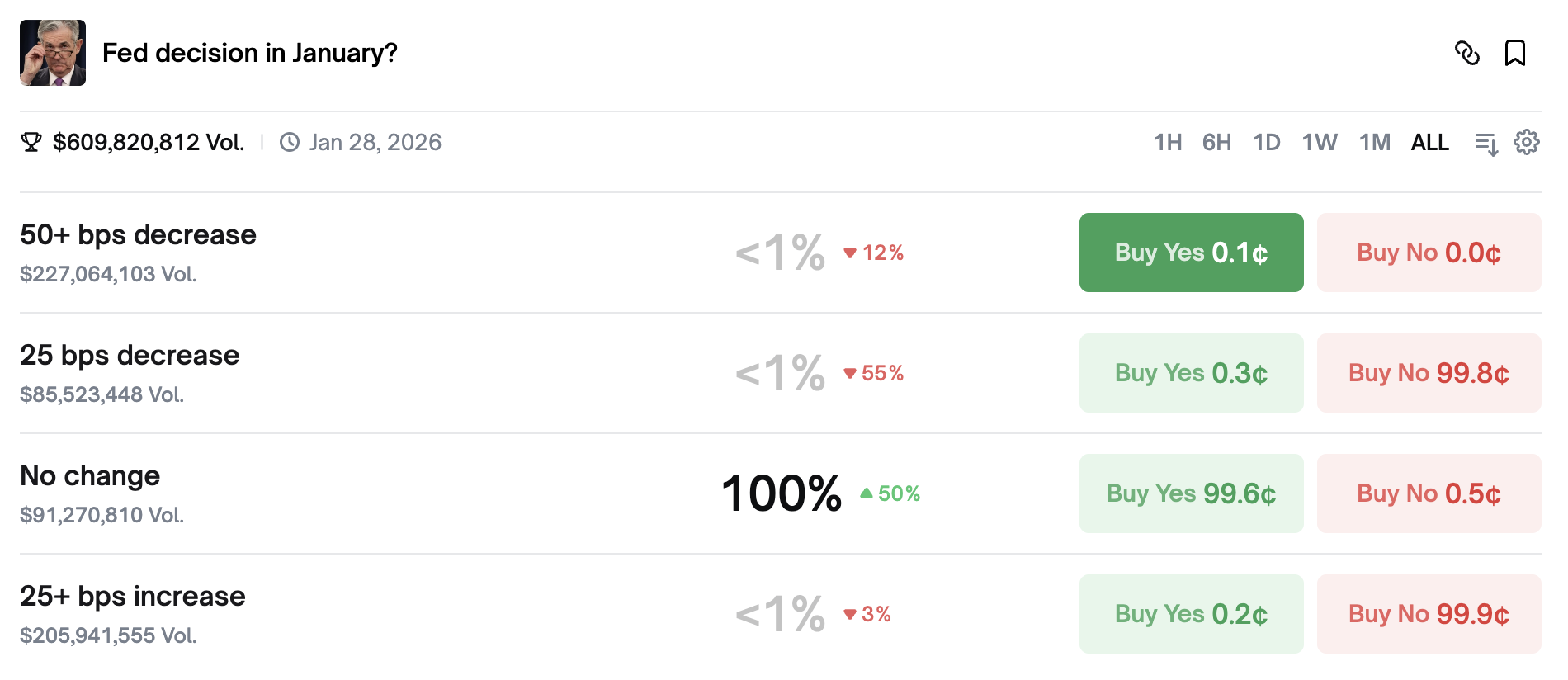
At 3:00 AM Beijing time on January 29 (this Thursday), the Federal Reserve is set to announce its first interest rate decision of 2026; half an hour later, current Fed Chair Jerome Powell will hold a monetary policy press conference. However, there is little suspense surrounding this Fed rate decision, as the market widely expects the Fed to keep rates unchanged. Data from Polymarket shows that the probability of maintaining rates is close to 100%.
Such a high probability has allowed the market to digest in advance the negative impact of the Fed's announcement of "no rate cut" this time. OKX data shows that BTC has fallen by only 0.39% in the past 7 days, basically in a sideways trend, but this period of market "silence" may be broken tonight.

On one hand, although the market almost unanimously believes the Fed will keep rates unchanged this week, there is significant divergence regarding the fiscal path for the remainder of 2026, making this still an important meeting to watch. The Fed's future key policy tendencies, such as whether it will continue to cut rates in 2026 and the frequency of cuts, will affect the market. Should Powell make hawkish remarks like "further observation is needed" during his speech, the market might "drop in response."

On the other hand, the announcement of the successor to the Fed Chair will also have a long-term impact on the market. The shortlist has been narrowed down to four individuals. Trump previously stated he has a preferred candidate but is waiting for the right time to announce, and this right time could very well be tonight.

2026 Rate Cut Direction Remains Uncertain

Since last September, the Federal Reserve initiated a new rate-cutting cycle, implementing three consecutive rate cuts. If rates are held unchanged this week, it would be the first pause since the cycle began. At this point, the market is not concerned about the reasons for holding rates steady, but rather whether this is a brief pause to observe before continuing rate cuts, or the beginning of a prolonged pause, or even the start of a rate-hiking cycle?

Previously, the general market view was that 2026 would be a year of further quantitative easing by the Fed.

Reason one: From a data perspective, the US labor market indeed shows signs of weakness. Non-farm payrolls increased by only 50,000 in December 2025, with an unemployment rate of 4.4%. While there hasn't been "massive layoffs," it remains in a state of "low hiring and cooling demand." Reason two: The Fed might still believe that Trump's tariff policies will not have a long-term impact on inflation (Odaily: Powell cut rates in September 2025 based on this factor). Reason three: Trump has publicly stated that he would choose a "dovish" figure as the next Fed Chair.

However, some in the market believe there is uncertainty about the Fed continuing to cut rates in 2026. Some analysts argue that unless the job market deteriorates significantly, it will be difficult to see rate cuts before mid-year, as the pace of inflation decline is not sufficient to convince hawkish members.

The Fed's mandate, simply put, is to curb inflation and promote employment. However, in 2025, the US experienced a phenomenon of both a weak labor market and high inflation. The Fed ultimately chose to prioritize the employment issue, thus initiating the rate-cutting cycle. Yet, the reality is that the US inflation rate remains stuck at 2.8%, far above the Fed's 2% target, forcing the Fed to reconsider the impact of tariffs on inflation. Holding rates unchanged this week would also indicate the Fed is beginning to "observe."

Furthermore, although the next Fed Chair chosen by Trump is destined to be "dovish," the new rotating chairs of the Fed's rate-setting committee are predominantly "hawkish." At the beginning of each year, four of the 12 regional Fed presidents rotate onto the rate-setting committee and gain voting rights for the next eight policy meetings. This year's rotating members include Dallas Fed President Lorie Logan, Cleveland Fed President Loretta Mester (referred to as Hammack in the text, likely a reference to Mester's previous role or a mistranslation; Mester is known as a hawk), Philadelphia Fed President Patrick Harker (referred to as Paulson in the text, likely a mistranslation; Harker is considered moderate), and Minneapolis Fed President Neel Kashkari.

Among them, Logan and Mester are seen as "hawkish" figures, both having publicly stated that the Fed should focus on inflation. Harker is seen as "dovish," having expressed a "cautiously optimistic attitude" towards inflation. Kashkari's stance is relatively neutral. The addition of new "hawkish" members might disrupt the previous balance of policy inclinations within the Fed. Even if Trump chooses a "dovish" Chair, they may not be able to sway the entire rate-setting committee.

Moreover, the Fed Chair might not completely follow Trump's wishes in leading rate cuts. Years ago, Trump personally appointed Powell as Fed Chair, but last year, even though Trump promoted Powell, Powell did not "repay" Trump with sustained and significant rate cuts. Under US law, the Fed is independent and can make interest rate decisions based on the current economic situation, not government wishes. Therefore, even if the new Fed Chair promises Trump rate cuts, they might "go their own way" once in office.

This kind of meaningless "political promise" is also a concern for Trump. Last week, Trump said in a speech at the World Economic Forum in Davos, Switzerland, "It's amazing how people change once they get this job," meaning candidates say what sounds good during the interview but emphasize their independence once confirmed.

Considering these factors, Powell's speech after tonight's FOMC meeting will also be closely watched by investors for hints on how long the Fed might pause rate cuts.

This Week's FOMC Meeting Could Be One of the Best Times for Trump to Announce the Fed Chair Successor

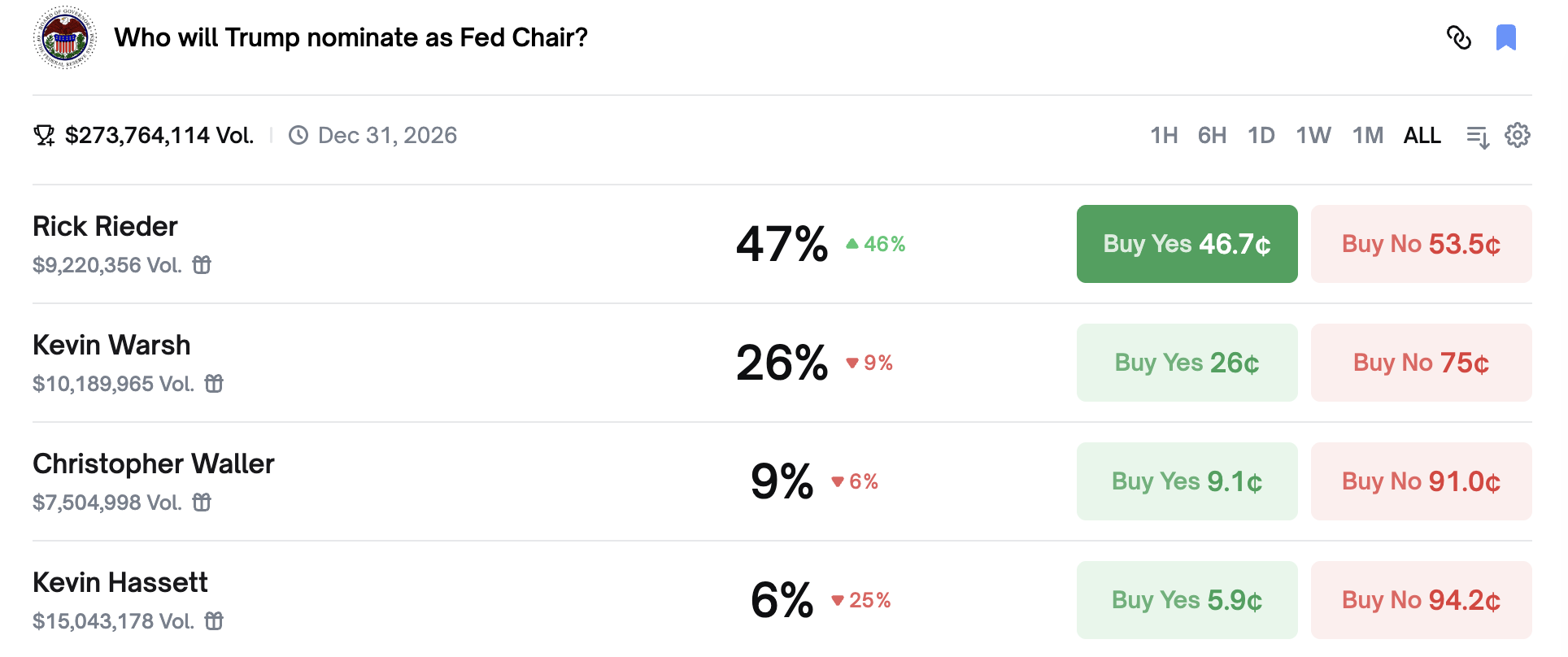
Besides this week's FOMC meeting, the successor to the Fed Chair is another macro event that can influence the market. The shortlist has been narrowed down to four: Kevin Hassett, Kevin Warsh, Rick Rieder, and Christopher Waller. According to Polymarket data, Rick Rieder currently has the highest probability of being nominated by Trump at 47%; Kevin Hassett has the lowest probability at 6%.
Rick Rieder is BlackRock's Chief Investment Officer of Global Fixed Income. Although he doesn't have much government experience, he has consistently advocated for supporting low interest rates based on his understanding of the market rather than politics. This resume might attract Trump, who is worried about the new Fed Chair becoming "disobedient" upon taking office. Economists at Evercore ISI, including Krishna Guha, even believe that "if Rick Rieder becomes the new Fed Chair, he might advocate for three rate cuts this year." (Odaily Note: For more information on Rick Rieder, read 《The Last Seat on the Fed Chair Candidate List, What is Rick Rieder's Attitude Towards Crypto?》)

Hassett was once considered the most likely candidate to become the new Fed Chair, with a probability一度 (once) over 80%. But Hassett is Trump's economic advisor, and there were外界 (external) concerns that nominating Hassett would damage the Fed's independence. Additionally, Trump publicly stated that he did not want to lose Hasset within his administration. Therefore, Hassett's probability of selection has declined, though some still believe his nomination probability is higher than 6%.

Trump has repeatedly publicly stated that he would announce his nominee in January. In late December 2025, Trump told reporters in Florida that he would announce the next Fed Chair人选 (candidate) sometime in January; On January 14, 2026, Trump said in an interview with Reuters that he would announce the candidate within the next few weeks; Two weeks later, on January 27, Trump said in a speech in Iowa that he would announce the new Fed Chair candidate soon, but has not done so yet.

Although Trump's answers have been vague each time, it is almost certain that the probability of an announcement in January is very high, and the best timing for the announcement could very well be during this week's FOMC meeting.

As mentioned earlier, Powell's speech tonight will be a key focus for investors. If Powell does not make dovish-leaning remarks, financial markets could suffer, a scenario Trump显然 (obviously) does not want to see. Therefore, if Trump wishes to shift market attention away from the uncertain Powell, he might announce his nominee for the next Fed Chair during tonight's FOMC meeting. This would release the positive news of a "dovish chair" to the market, reducing attention on Powell's speech or mitigating potential negative market impacts.

Tonight, let's wait and see!

Perguntas relacionadas

QWhat is the market's expectation for the Federal Reserve's interest rate decision on January 29, 2026, and why?

AThe market widely expects the Federal Reserve to maintain the current interest rate, with Polymarket data showing the probability of no rate change is close to 100%. This is because the decision is highly anticipated and already priced in by investors.

QWhat are the two main factors discussed in the article that could break the market's 'silent period'?

AThe two main factors are: 1) The future policy direction for the remainder of 2026, including the frequency of potential rate cuts, which could cause market volatility if Chair Powell's remarks are perceived as hawkish. 2) The announcement of the new Federal Reserve Chair nominee by former President Trump, which could have long-term market impacts.

QAccording to the article, who is the most likely candidate to be nominated as the next Federal Reserve Chair based on Polymarket data, and what is his background?

ABased on Polymarket data, Rick Rieder is the most likely candidate with a 47% probability. He is the Chief Investment Officer of Global Fixed Income at BlackRock, advocates for low interest rates based on market understanding rather than politics, and has limited government experience.

QWhy might the Federal Reserve's decision to pause rate cuts be more than just a temporary观望, according to the analysis in the article?

AThe pause might not be temporary due to persistent inflation at 2.8% (above the 2% target), leading the Fed reassessing the impact of tariffs on inflation. Additionally, new 'hawkish' members rotating into the利率决策委员会 could shift internal policy balance, making further rate cuts less likely.

QWhy does the article suggest that Trump might announce his Fed Chair nominee during the FOMC meeting?

ATrump might announce the nominee during the FOMC meeting to shift market attention away from any potentially hawkish or uncertain remarks by Chair Powell. This could release a 'dovish'利好 to the market, mitigating potential negative impacts and reducing focus on Powell's speech.

Leituras Relacionadas

Borrowing Money from a Hundred Years Later, Building Incomprehensible AI

Tech giants like Alphabet, Amazon, Meta, and Microsoft are undergoing a radical financial transformation due to AI. Their traditional "light-asset, high-free-cash-flow" model is being dismantled by staggering capital expenditures on AI infrastructure—data centers, GPUs, and power. Combined 2026 guidance exceeds $700 billion, a 4.5x increase from 2022, causing free cash flow to plummet (e.g., Amazon's fell 95%). To fund this, they are borrowing unprecedented sums through long-dated, multi-currency bonds (e.g., Alphabet's 100-year bond). The world's most conservative capital—pensions, insurers—is now funding Silicon Valley's most speculative bet. This shift makes these companies resemble heavy-asset industrials (railroads, utilities) rather than software firms, threatening their premium valuations. Historically, such infrastructure booms (railroads, fiber optics) followed a pattern: genuine technology, overbuilding fueled by competitive frenzy, aggressive debt financing, and a crash triggered by financial conditions—not technology failure. The infrastructure remained, but many original builders and financiers did not survive. The core gamble is a "time arbitrage": using cheap debt today to build scale and lock in customers before AI capabilities commoditize. They are betting that AI revenue will materialize before debt comes due. Their positions vary: Amazon is under immediate cash pressure; Meta's path to monetization is unclear; Alphabet has a robust core business buffer; Microsoft has the shortest path from infrastructure to revenue. The contract is set: the most risk-averse global capital has lent its time to Silicon Valley, awaiting a future that is promised but uncertain.

marsbitHá 30m

Borrowing Money from a Hundred Years Later, Building Incomprehensible AI

marsbitHá 30m

The 'VVV' Concept Soars 9x in Half a Year, The New AI Narrative on Base Chain

"The article explores the 'VVV' concept as the new AI-focused narrative within the Base ecosystem, centered around the token $VVV of the privacy-focused, uncensored generative AI platform Venice, led by crypto veteran Erik Voorhees. Venice has seen significant growth in 2026, with its API users surging, partly attributed to exposure from OpenClaw. The platform now boasts over 2 million total users and 55,000 paid subscribers. Correspondingly, the $VVV token price has risen over 9x this year. Key to its performance are tokenomics designed for value accrual: reduced annual emissions, subscription revenue used for buyback-and-burn, and a unique staking mechanism. Staking $VVV yields $sVVV, which can be used to mint $DIEM tokens. Each staked $DIEM provides a daily $1 credit for using Venice's API services, creating tangible utility. The article also highlights other tokens associated with the 'VVV' narrative. $POD, the token of distributed AI network Dolphin (which co-developed Venice's default AI model), saw a massive price surge. $cyb3rwr3n, a project for a Venice credit auction market, gained attention due to perceived connections to Venice's team despite official denials. Finally, $SR of robotics platform STRIKEROBOT.AI rose after announcing a partnership with Venice for robot vision-language model development. Overall, the 'VVV' ecosystem combines AI platform growth, deflationary tokenomics, and innovative utility mechanisms, driving significant investor interest and price action in related tokens."

marsbitHá 39m

The 'VVV' Concept Soars 9x in Half a Year, The New AI Narrative on Base Chain

marsbitHá 39m

Anthropic and OpenAI Have Single-Handedly Severed the Logic of Pre-IPO Stock Tokenization

The pre-IPO stock token market is experiencing significant turmoil following strong statements from AI giants Anthropic and OpenAI. Both companies have updated their official policies, declaring that any transfer of their company shares—including sales, transfers, or assignments of share interests—without prior board approval is "invalid" and will not be recognized in their corporate records. This means buyers in such unauthorized transactions would not be recognized as shareholders and would have no shareholder rights. A major point of contention is the use of Special Purpose Vehicles (SPVs), which are legal entities commonly used by pre-IPO token platforms to pool investor funds and indirectly acquire shares from employees or early investors. The companies explicitly state they do not permit SPVs to acquire their shares, and any such transfer violates their restrictions. They warn that third parties selling shares through SPVs, direct sales, forward contracts, or stock tokens are likely engaged in fraud or are offering worthless investments due to these transfer limits. This stance directly threatens the core model of many pre-IPO token platforms, which rely on SPV structures. The announcement revealed additional risks within this model, such as complex "SPV-within-SPV" layering that obscures legal transparency, increases management fees, and creates a chain reaction risk of invalidation. Following the news, tokens like ANTHROPIC and OPENAI on platforms like PreStocks fell sharply (over 20%). The market reaction highlights a divergence: while asset-backed pre-IPO tokens plummeted, purely speculative pre-IPO futures contracts, which are bilateral bets on future IPO prices with no claim to actual shares, remained relatively stable as they are unaffected by the transfer restrictions. The industry is split on the implications. Some believe the fundamental logic of pre-IPO token trading is broken if leading companies reject SPV-held shares, potentially causing a domino effect. Others, like Rivet founder Nick Abouzeid, argue that buyers of such unofficial tokens always knowingly accepted the risk of non-recognition by the company. The statements serve as a stark risk warning and a corrective measure for a market where valuations for some AI-related pre-IPO tokens had soared to irrational levels, far exceeding recent funding round valuations.

marsbitHá 1h

Anthropic and OpenAI Have Single-Handedly Severed the Logic of Pre-IPO Stock Tokenization

marsbitHá 1h

Anthropic and OpenAI Personally Sever the Logic of Pre-IPO Crypto-Stocks

The pre-IPO token market has been rocked by strong statements from Anthropic and OpenAI. Both AI giants have updated official warnings, declaring that any sale or transfer of their company shares without explicit board approval is "invalid" and will not be recognized on their corporate records. This directly targets Special Purpose Vehicles (SPVs), the common legal structure used by pre-IPO token platforms. These platforms typically use an SPV to acquire shares from employees or early investors, then issue blockchain-based tokens representing a claim on the SPV's economic benefits. Anthropic and OpenAI's position means that if an SPV's share purchase lacked authorization, the underlying asset could be deemed worthless, nullifying the token's value. Anthropic explicitly warned that any third party selling its shares—via direct sales, forwards, or tokens—is likely fraudulent or offering a valueless investment. The crackdown highlights risks in the popular SPV model, including complex multi-layered "Russian doll" SPV structures that obscure legal ownership, add fees, and concentrate risk. If one layer is invalidated, the entire chain could collapse. Following the announcements, tokens like ANTHROPIC and OPENAI on platforms like PreStocks fell sharply (over 20%). In contrast, purely speculative pre-IPO prediction contracts remained stable, as they involve no actual share ownership. The move is seen as a corrective measure amid a market frenzy where some pre-IPO token valuations (e.g., Anthropic's token hitting a $1.4 trillion implied valuation) far exceeded recent official funding rounds. Opinions are split: some believe this undermines the core logic of pre-IPO token trading if top companies reject SPVs, while others argue buyers always assumed this legal risk when accessing unofficial channels. The statements serve as a stark warning and a potential catalyst for market de-leveraging and clearer boundaries.

Odaily星球日报Há 1h

Anthropic and OpenAI Personally Sever the Logic of Pre-IPO Crypto-Stocks

Odaily星球日报Há 1h

Trading

Spot
Futuros
活动图片





