Borrowing Money from a Hundred Years Later, Building Incomprehensible AI

marsbitPublicado em 2026-05-12Última atualização em 2026-05-12

Resumo

Tech giants like Alphabet, Amazon, Meta, and Microsoft are undergoing a radical financial transformation due to AI. Their traditional "light-asset, high-free-cash-flow" model is being dismantled by staggering capital expenditures on AI infrastructure—data centers, GPUs, and power. Combined 2026 guidance exceeds $700 billion, a 4.5x increase from 2022, causing free cash flow to plummet (e.g., Amazon's fell 95%). To fund this, they are borrowing unprecedented sums through long-dated, multi-currency bonds (e.g., Alphabet's 100-year bond). The world's most conservative capital—pensions, insurers—is now funding Silicon Valley's most speculative bet. This shift makes these companies resemble heavy-asset industrials (railroads, utilities) rather than software firms, threatening their premium valuations. Historically, such infrastructure booms (railroads, fiber optics) followed a pattern: genuine technology, overbuilding fueled by competitive frenzy, aggressive debt financing, and a crash triggered by financial conditions—not technology failure. The infrastructure remained, but many original builders and financiers did not survive. The core gamble is a "time arbitrage": using cheap debt today to build scale and lock in customers before AI capabilities commoditize. They are betting that AI revenue will materialize before debt comes due. Their positions vary: Amazon is under immediate cash pressure; Meta's path to monetization is unclear; Alphabet has a robust core business buffer; ...

On February 10, 2026, Alphabet, Google's parent company, issued a bond in London with a maturity date a hundred years in the future.

A hundred years.

Anyone buying this bond is betting that by the time their grandchildren retire, this company will still be alive and have the money to pay it back.

Historically, century bonds are extremely rare. Disney issued one in 1993, Coca-Cola did, and further back, Norfolk Southern Railway did. In fact, this term length was standard for 19th-century railroad companies because laying tracks, digging tunnels, and building bridges had investment payback periods so long they had to be calculated in 'centuries'.

But now, an internet company is borrowing money like a railroad company. Why?

Over the past eighteen months, the answer has gradually emerged. It's not in the PPT of any AI launch event, not on the benchmark leaderboards, and not in the debates about 'when AGI will arrive'. It's hidden in the capital expenditure line of financial reports, in the spread changes of bond issuances, in the cliff-like plunge of free cash flow.

To understand this answer, you first need to see what has disappeared.

The Money-Printing Machine Smashed by Its Own Hand

First, we need to understand that over the past two decades, what Wall Street believed in most was not a particular tech company itself, but a financial structure adopted by this cohort of companies.

These tech companies' revenue came from advertising, cloud services, platform commissions—all delivered digitally, with marginal costs approaching zero. No factories needed, no inventory, no mines or oil wells. The more users, the thinner the cost spread, the higher the profit margin.

The direct product of this structure is free cash flow. Unlike net profit, which on the income statement can be polished by accounting rules, free cash flow is the real money flowing into bank accounts, money that can be used for stock buybacks, dividends, and investing in the future. This is why US tech stocks get premium valuations.

There was an old joke about Apple sitting on over $200 billion in cash not knowing how to spend it; Google generating tens of billions in free cash flow year after year, as if the search box was directly connected to a gold mine; Amazon, under the guise of a low-margin e-commerce business, having a cloud computing money printer underneath; Meta making heaps of money from over two billion people seeing ads every day.

Investors weren't just buying growth; they were buying the 'light-asset, high-cash-flow' narrative because it promised these companies would never be dragged down by factories like General Motors, crushed by infrastructure debt like AT&T, or tortured by the capital expenditure cycles of oil companies. They could directly ignore the gravity of industrial capitalism.

Then AI arrived. And AI brought a surprisingly counterintuitive result.

At the end of April this year, Amazon released its Q1 earnings. Revenue, profit, AWS growth were all decent. Over the past twelve months, Amazon's operating cash flow was $148.5 billion, up 30% year-over-year, looking good. But during the same period, free cash flow dropped from $25.9 billion to $1.2 billion, evaporating by 95%.
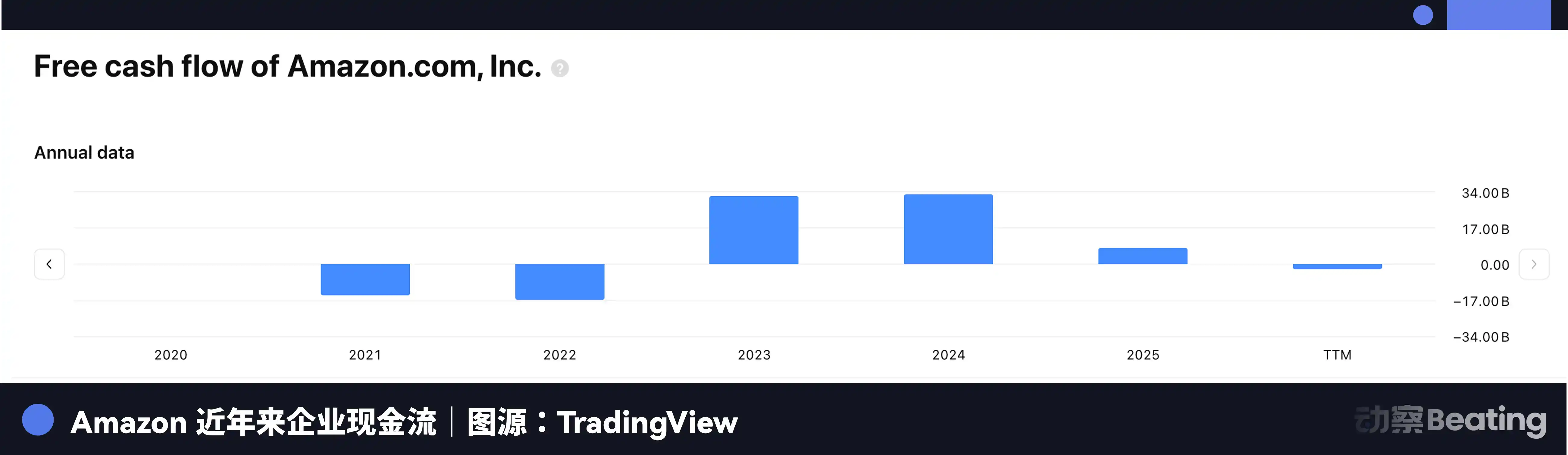
Where did the money go? Amazon's Q1 capital expenditure alone was $44.2 billion, up 76.7% year-over-year, with full-year guidance around $200 billion. Almost all of this money is being thrown into AI infrastructure—data centers, GPUs, networking equipment, power contracts.

Amazon isn't making less money; on the contrary, they're making more than before. It's just that they're throwing almost every penny of it into the bottomless pit of AI. Operating cash flow is the Yangtze River, capital expenditure is the Three Gorges Dam, and free cash flow has become a trickle downstream.

The others aren't much better.

In 2026, the combined capital expenditure guidance for the four giants is $700 to $725 billion: Amazon ~$200B, Microsoft ~$190B, Alphabet ~$185B, Meta $125-145B. In 2022, the four combined spent $162 billion, a 4.5x increase in four years. Just in Q1 2026 alone, the four spent over $130 billion combined, more than the annual GDP of many countries.
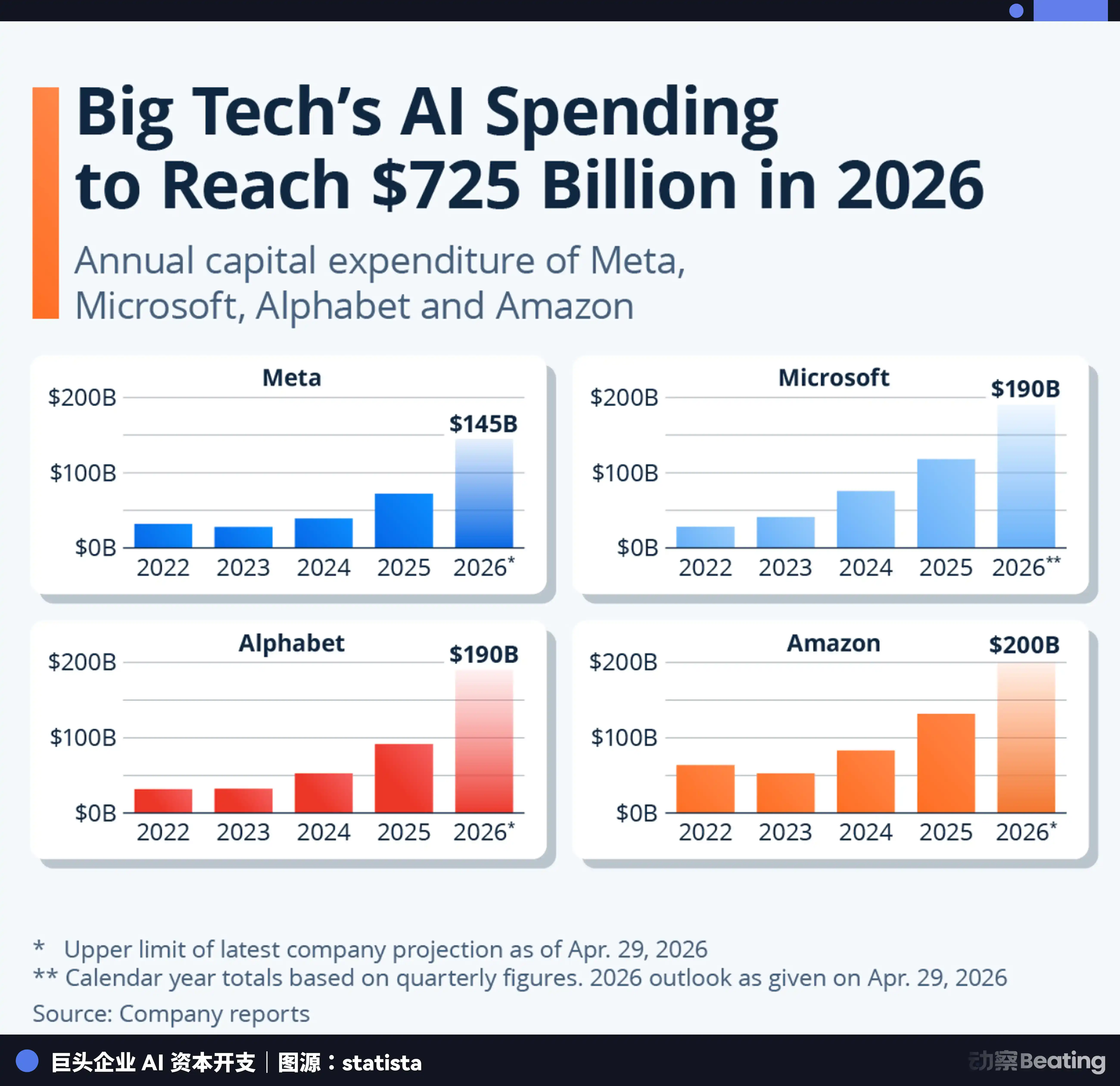
On the surface, these companies still look shiny. Revenue is growing, profit margins are holding up well, and the AI launch events are still lively. But 'Free Cash Flow' doesn't agree.

'Profit' is, ultimately, an opinion. How depreciation periods are set, how R&D is capitalized, how revenue is recognized—all have room for creative accounting. But 'Cash Flow' is a fact. Money in, money out, clear as day. Profit tells a story; cash flow tells the truth.

So the truth is that the core financial advantage of being 'light-asset, high-cash-return' that these companies built over two decades is being eaten away, bite by bite, by AI capital expenditures.

The immediate question follows: Free cash flow is at rock bottom, yet their investments are ramping up. So where is this money coming from?

Borrowing. And the way they're borrowing now is unprecedented.

In Three Months, Borrowing Half the World's Money

Alphabet borrowed $32 billion in February.

One month later, in March, Amazon completed a $36.9 billion bond issuance, with 11 tranches ranging from two-year to fifty-year maturities. Investor orders totaled $126 billion, 3.4 times oversubscribed. After this bond, Amazon's total debt nearly doubled in a year. Another month later. On April 30, Meta issued $25 billion in bonds.

Another month later, on May 11, Alphabet announced it was preparing its first yen-denominated bond. This is interesting; Alphabet's February bond issuance wasn't just in dollars, it also included 3.1 billion Swiss francs.

This is a company based in California, USA, with revenue almost entirely in US dollars, yet it went to Switzerland to borrow money. And in May, it set its sights on the yen. Amazon's March deal also included euro tranches.

This isn't currency diversification by the giants' finance departments for appearances; this is forced.

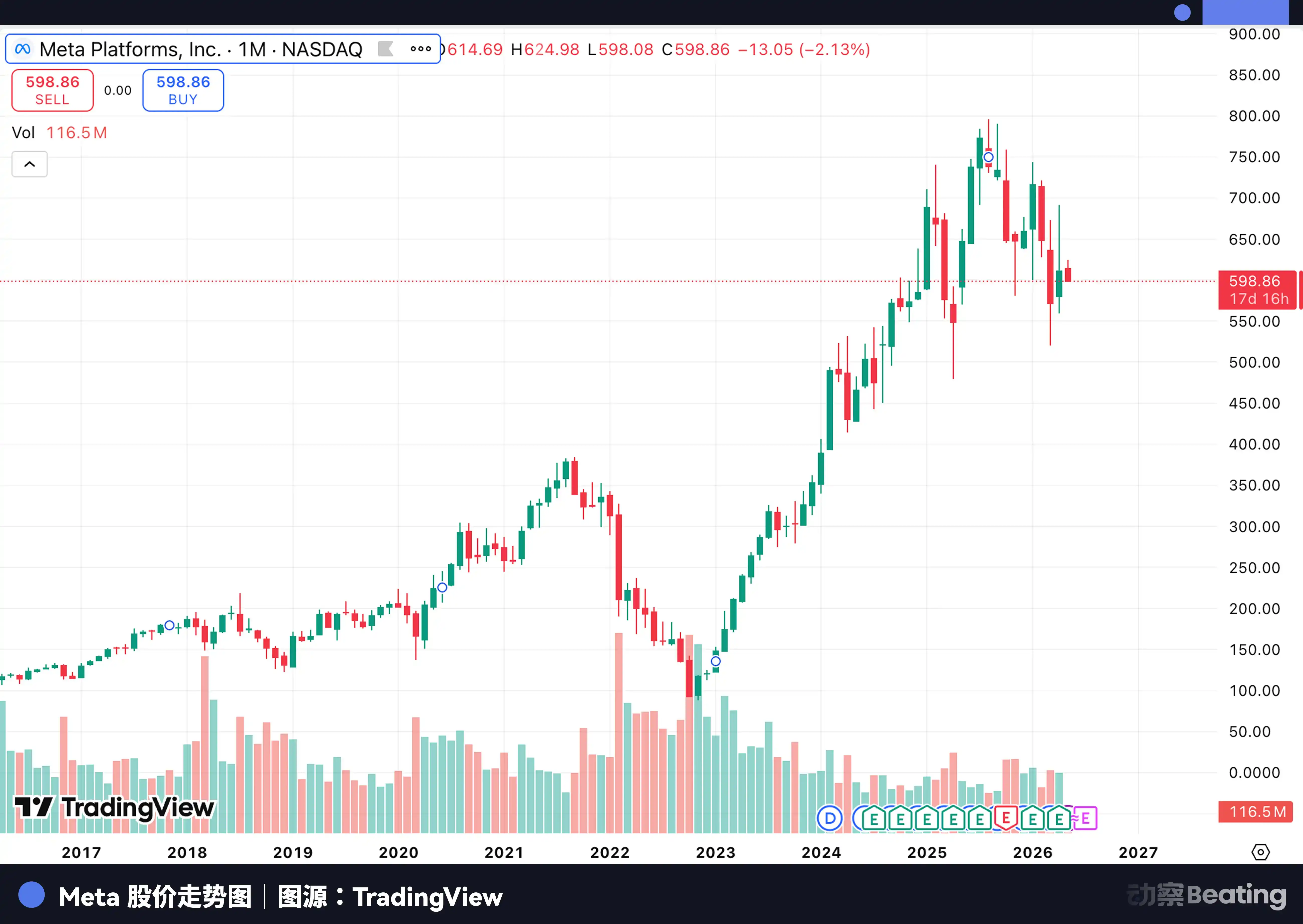
Look at Meta. Its April $25 billion bond, the longest 2066 maturity tranche was priced at a spread of 1.47 percentage points—the risk premium investors demanded over US Treasuries. Six months earlier, in October 2025, when Meta issued a similar forty-year tranche, the spread was only 1.10. It widened by 37 basis points in six months, and not just for the longest tranche; the premium for almost all six tranches it issued was higher than the last round.
So, these giants need to find places with lower interest rates. The Swiss National Bank's policy rate is the lowest among major economies, and Swiss franc bond yields are far lower than dollar ones. Japan, while having ended the negative interest rate era, still offers a huge advantage in yen financing costs. More critically, investors in Zurich and Tokyo aren't yet flooded with Silicon Valley tech debt; their appetite is fresh, not as picky as New York's. For a top-tier borrower like Alphabet, borrowing elsewhere is both cheaper and avoids the queue.

AI's capital expenditures land in the US (data centers) and Taiwan, China (chips), but the money to pay for it is pulled from Switzerland, from Japan, from Europe. Silicon Valley globalized technologically for two decades; now it's globalizing in debt.

And the buyers of these bonds aren't hedge funds or venture capital. Those who can digest century, fifty-year bonds are pension funds, insurance companies, sovereign wealth funds—the most risk-averse money in the global financial system. Their mission is capital preservation, stability, beating inflation, not taking risks.

But now, the pension fund of a retired teacher in Zurich, the reserves a Tokyo insurance company sets aside for life insurance policies, are flowing through the transmission chain of the bond market into a data center in Oregon or Virginia, turning into GPUs on racks and cooling towers on roofs. Most of these holders don't know the underlying assets of their bonds. Their fund managers buy 'Alphabet Aa2 credit', 'Amazon A1 credit'; the rating agencies' letters give a sense of security. As for what buildings this money ultimately builds, what equipment it installs, what models it runs, whether those models can earn enough to repay the debt—there are too many intermediate layers; it's impossible to see clearly from Zurich and Tokyo.

The world's most conservative money is now funding the world's most radical technology bet.

When Internet Companies Grow Smokestacks

But this money hasn't become ad spending, user subsidies, or stock buybacks. None of the usual ways tech companies spent money over the past two decades have been followed this time.

This money has turned into concrete, steel, copper wire, transformers, and cooling pipes.

Amazon's $200 billion 2026 capital expenditure guidance means it spends $550 million per day, $23 million per hour, $380,000 per minute. Microsoft announced plans to invest $10 billion in AI infrastructure in Japan alone from 2026 to 2029.

This isn't a software company's expansion pace; this is infrastructure.

And the essence of infrastructure is making a company heavy.

The construction cycle, investment scale, and operational complexity of a large data center are on the same order of magnitude as an auto assembly plant or a semiconductor fab. Site selection, environmental impact assessment, power connection agreements, water source guarantees, physical security—the whole process has to be run through.

GPUs in AI play a role similar to high-end machine tools in manufacturing: expensive, capacity-constrained, rapidly depreciating. The chips bought with heavy money today may be obsolete in two or three years, but you can't wait, because your competitors won't.

Electricity has become a strategic resource. A large AI data center's power consumption is equivalent to a mid-sized city. Giants are signing long-term power purchase agreements, investing in nuclear power, negotiating dedicated power lines with utility companies.

Cooling water is starting to compete with residents for water rights; many communities in arid regions find an unwelcome guest on their water usage rankings.

These scenes were impossible for tech companies twenty years ago. Site negotiations, grid access, water rights disputes, local tax incentives—these are things railroad companies, power companies, and refineries do. And century bonds, fifty-year bonds, cross-currency issuances—the last time these financial instruments were used intensively was also during the great era of railroad and telecom construction.

Opening the 2026 balance sheets and cash flow statements, these companies' numbers now look closer to TSMC, Duke Energy, or Union Pacific Railroad than they do to their own ten years ago.

This touches on valuation. The core assumption of the past investor pricing logic for tech giants was marginal cost decrease—one more user, one more ad, incremental cost near zero, so profit margins would keep expanding. But the AI infrastructure layer isn't like that. Every additional model trained, every inference cluster deployed, every data center built requires real money invested. Whether the investment pays off depends on whether customers will pay, how model efficiency evolves, and how the competitive landscape changes.

And all of this is uncertain.

This is more like semiconductors: each new process node requires a bigger fab, and returns depend on yield and the market. It's also like power: generation capacity is built first, and returns depend on electricity prices and demand. And it's like railroads: tracks are laid first, and returns depend on whether the economy along the line develops.

So, since tech giants' financial structures are becoming more like heavy-asset companies, the valuation multiples the market gives them will eventually converge toward those of heavy-asset companies.

Some might say once the infrastructure is built, they'll return to a light-asset model. Too naive. Railroads have been built for over a hundred years and are still being built; power grids have been built for a century without stopping; semiconductor fabs need upgrades every few years. The infrastructure of a general-purpose technology has never been 'finished.'

AI may not be a continuation of the internet; it might be a resurgence of industrial capitalism, wearing a cloak of code and standing on a concrete foundation. The internet spent twenty years letting tech companies escape gravity; AI is pulling them back in two years.

Every General-Purpose Technology Revolution

In 1840s Britain, railroads were the AI of that era. Freight speed jumped from a few miles per hour with horse-drawn carriages to tens of miles per hour with trains—an order-of-magnitude efficiency leap, also quite exaggerated.

Capital flooded in. In 1846, the total railway investment authorized by the British Parliament was about £600 million, while Britain's annual GDP was only around £500 million. A nation bet more than a full year's national income on a new technology. Today, that's like the US throwing over $25 trillion into AI.

Early railroads mainly relied on selling stock for financing. Buyers were filled with imagination about the future. Later, as construction scale snowballed and returns were delayed, with later projects deteriorating in quality, equity financing wasn't enough; debt financing stepped into the spotlight. Railway companies began issuing bonds, mortgaging future revenues from uncompleted lines. Financing became increasingly aggressive, from domestic to international borrowing.

What killed the boom wasn't a problem with railway technology; it was interest rates. In 1846, the Bank of England tightened monetary policy, triggered by grain imports and gold outflows due to the Irish famine, which had nothing to do with railways. But interest rates don't care about the reason; they just kill the borrowers with the weakest cash flow. Railway stocks crashed, and many railway companies went bankrupt.

But fortunately, the railways themselves remained. Tracks, stations, tunnels, bridges didn't disappear because investors lost money. They were taken over at a discount by later players, integrated, and operated, eventually becoming the arteries of the British Industrial Revolution. The rise and fall of cities, industrial layouts, and population flows were rearranged along the tracks.

Twenty years later, the same play repeated across the Atlantic. After the US Civil War, the federal government encouraged western railroad construction with land grants and loan guarantees. Over 35,000 miles of new track were laid during the boom. Railway bond yields of 6.4% to 6.7% were the most attractive fixed-income product at the time. Money poured in from the East Coast, from Europe, into the wilderness of the American West.

In 1873, Jay Cooke & Company, the main financier of the Northern Pacific Railway and one of the largest investment banks in the US at the time, declared bankruptcy. The chain reaction ultimately led to 18,000 businesses failing within two years, with 89 railroads going bankrupt over six years.

But America's railway network was ultimately built. It became the physical foundation for the US becoming a 20th-century super industrial power. However, the people who built the railroads and the people who ultimately made money from them were not the same people.

Fiber optics were similar.

In the late 1990s, the rise of the internet fueled huge imaginations about bandwidth. Telecom companies began laying fiber optics frantically, not just connecting cities but also linking continents and crossing oceans. Between 1996 and 2001, US telecom companies issued over $500 billion in new bonds to finance this construction, burying tens of millions of miles of fiber optic cable underground and on seabeds.

But the laying speed far outpaced demand. When the bubble burst, only about 5% of the fiber laid across the US was connected to equipment and carrying data. The remaining 95% was 'dark fiber,' lying underground, waiting for an unknown future.

WorldCom, the second-largest US long-distance operator, with $107 billion in assets, filed for bankruptcy in 2002—the largest bankruptcy in US history at the time. Global Crossing, which built one of the world's largest fiber networks, also fell that year. Winstar, 360networks, McLeodUSA—a string of names fell on the excess of dark fiber.

But fiber optics also ultimately remained. Those undersea cables and metropolitan networks ridiculed as overbuilt in the 1990s became the backbone of the entire internet economy over the next two decades. Netflix streaming, Google search, Amazon's cloud all ran on that fiber, or on its upgraded versions.

The same logical chain appears repeatedly in these three historical episodes.

First, the technology itself is real. Railroads were indeed faster than carriages, fiber optics were indeed faster than copper wires, and AI indeed can do things previously impossible. No one denies the value of the technology itself in hindsight.

But the construction speed far exceeded short-term demand because competition among peers didn't allow anyone to stop and wait for demand to catch up. You believed it was a winner-take-all game where the first to build locked in customers and ecosystems, so you had to keep running.

Everyone was running, leading to collective overbuilding. To sustain the overbuilding speed, financing became increasingly aggressive: equity wasn't enough, so debt was used; short-term wasn't enough, so long-term was used; domestic currency wasn't enough, so foreign currency was used. Railroads were like this, fiber optics were like this, and Swiss franc bonds, yen bonds, century bonds are also like this.

What ultimately triggered the correction was often not a problem with the technology, but a change in financial conditions. In 1846, it was rising interest rates; in 1873, it was an investment bank's bankruptcy triggering a credit chain break; in 2001, it was the dot-com bubble combined with recession. The technology kept advancing, but companies couldn't hold on.

In the end, the infrastructure remained, but a significant portion of the builders did not. The beneficiaries of the railroads were the cities and factories along the lines, not necessarily the original shareholders of the railroad companies. The beneficiaries of the fiber optics were Google, Netflix, Amazon, not WorldCom's bondholders.

Of course, we can't directly equate today's tech giants with 19th-century railroad tycoons or 1990s telecom adventurers. The difference is that today's companies have massive, still-growing core business cash flows. Amazon has AWS and e-commerce; Alphabet has Search and YouTube; Meta has the world's largest social advertising network; Microsoft has Office and Azure.

They aren't startups building data centers by burning investor money; they are giants with real profits mortgaging their own futures.

So the question is whether the payback period for capital expenditure can outrun the repayment period of the debt. Railroads were good, but borrowing money for six years to build lines that take twenty years to pay back can kill you just the same. Fiber optics were good, but borrowing for five years to lay cables only 5% of which are used can't save a balance sheet either.

AI data centers are certainly good. But what scale of AI revenue is needed to break even on $200 billion in annual capital expenditure? How many years are needed to recoup $700 billion in combined investment? If model efficiency advances faster than expected—say, a new architecture makes the same task require one-tenth the computing power—could the computing power built at great cost today become the new generation of dark fiber?

All Bonds Issued Are Buying the Same Thing

Back to that century bond at the beginning.

The institutional investor who bought it—maybe a Swiss pension fund, maybe a British insurance company—made a decision that day: lend money to Alphabet, to be repaid in a hundred years.

Behind this decision is a chain of beliefs: believing AI will be widely adopted, Alphabet will survive this race, its Search and advertising businesses will continue to generate cash, the data centers it builds will be fully utilized, and no disaster will destroy this company over the next century in the global economy.

The holders of Amazon's fifty-year bonds have a similar, though perhaps slightly shorter, chain of beliefs in their minds. Meta's bondholders accepted record-high CDS premiums, but the chain is shorter because the market is clearly giving Meta a narrower credit window than the others.

The chains vary in length, but they are buying the same thing. Not GPUs, not data centers, not fiber optics and transformers—those are intermediates. What they are truly buying is time.

AI models are trending towards homogenization. Open source is catching up with closed source; small models are approaching large models; the capability gap is narrowing. Before this window closes, before everyone can run similar models, whoever can first scale up computing power and lock enterprise customers onto their cloud can turn temporary technological leadership into a lasting commercial moat.

So the giants aren't betting on 'whose model is smartest,' but on a more fundamental proposition: before AI capabilities fully diffuse, can I build infrastructure and customer relationships to a scale others can't catch up with?

This is time arbitrage—using today's low-cost money to buy tomorrow's market position.

Time arbitrage has a cruel prerequisite: the future must arrive on time.

The four companies face different time pressures.

Amazon is the most urgent. Free cash flow has been swallowed by capital expenditure to a mere $1.2 billion. AWS's AI service revenue must reach scale within two or three years; otherwise, debt pressure will seep from the balance sheet into the income statement.

Meta is the most fragile. Social advertising profits are rich, but there's a missing bridge between them and the commercialization of AI infrastructure. Azure and AWS can directly sell computing power to enterprise clients. After Meta spends over a hundred billion building infrastructure, what it turns into, who it sells to, and how it charges—the story isn't fully fleshed out yet. The market's impatience is already written in its stock price and CDS.

Alphabet is the most composed. Search and YouTube require little maintenance to keep generating cash. Even if AI yields no short-term returns, the core business can provide a safety net. The market gave it century-long credit—the longest time window among the four. But $185 billion in capital expenditure is 2.5 times last year's; the acceleration itself consumes patience. Composure doesn't equal safety.

Microsoft is the clearest. Its deep tie-up with OpenAI has made Azure a direct beneficiary of AI commercialization. Copilot is already charging; GitHub Copilot is one of the highest-paid-for AI products among programmers. The path from infrastructure to revenue is the shortest. But $190 billion in capital expenditure means that even with a clear path, the bet's size is so large that everything must go according to script to break even.

All four are betting on the same thing, which in a nutshell is: borrowing money from the future to build something not fully understood today, betting that use cases explode before the debt comes due.

This road has been traveled by railroads, by fiber optics. Each time, the technology ultimately proved its worth, and the infrastructure remained. But each time, there were also a group—sometimes a large group—of people who paid for the construction and didn't live to see it pay off. The technology was right, the timing was wrong, and financial markets don't give wrong timing a second chance.

No one knows if AI's 'future' will arrive on time. The only certainty is this: the world's most conservative pool of money has already, by buying these century, fifty-year, forty-year bonds, signed a contract with Silicon Valley.

The contract's terms are simple: We lend you time, you give us the future.

As for whether the future will keep its promise, no one can say for sure now.

Perguntas relacionadas

QAccording to the article, what fundamental financial transformation has the rise of AI caused for major tech companies?

AThe rise of AI has forced major tech companies (Amazon, Microsoft, Alphabet, Meta) to fundamentally transform from a 'light-asset, high-cash-flow' model to a 'heavy-asset' model, reminiscent of traditional infrastructure or industrial companies. Their massive, skyrocketing capital expenditures on AI infrastructure (data centers, GPUs) are consuming their once-plentiful free cash flow, leading them to finance this buildout through unprecedented debt issuance.

QWhy are these tech giants issuing long-term bonds in foreign currencies like Swiss Francs and Yen?

AThey are issuing bonds in foreign currencies like Swiss Francs and Yen because investors in major US debt markets (like New York) are becoming more demanding, requiring higher risk premiums (spreads) for their bonds. Markets like Switzerland and Japan currently offer lower interest rates and have investors who are less saturated with tech debt, providing a cheaper and more accessible source of capital to fund their massive AI investments.

QWhat historical parallels does the article draw between the current AI infrastructure build-out and past technological revolutions?

AThe article draws parallels to the 19th-century British and American railway booms and the late-1990s fiber-optic network build-out. All three episodes involved: 1) A transformative, real technology. 2) Frenzied, competitive overbuilding that far outpaced immediate demand. 3) Increasingly aggressive financing (shifting from equity to long-term, often international debt). 4) A collapse or crisis often triggered by external financial conditions (rising interest rates, banking failures) rather than the technology itself. 5) The infrastructure ultimately remaining and becoming foundational, but many of the original builders/financiers not surviving to reap the rewards.

QWhat is the 'time arbitrage' that the article describes these companies are attempting?

AThe 'time arbitrage' is using today's relatively low-cost capital (from bond sales) to build AI infrastructure at a massive scale *now*, in order to lock in customers and establish market dominance *before* AI capabilities become commoditized and widely diffused. They are betting that securing this time advantage will create a durable commercial moat that justifies the huge upfront debt.

QHow does the article differentiate the financial pressures and timelines facing the four major tech companies (Amazon, Meta, Alphabet, Microsoft)?

AAmazon faces the most urgent pressure as its free cash flow has nearly vanished; its AWS AI services need to generate significant revenue quickly to manage its growing debt. Meta is seen as the most vulnerable because it lacks a direct, clear path from its massive infrastructure spend to a monetizable AI product for enterprise customers, worrying investors. Alphabet is the most从容 (composed/stable) due to its robust core search and YouTube businesses providing a cash cushion, giving it the longest perceived time horizon (evidenced by its century bond). Microsoft has the clearest path, with its close OpenAI partnership and existing products like Copilot already generating AI revenue, but its enormous capital expenditure still represents a massive bet that requires everything to go according to plan.

Leituras Relacionadas

What Happens to Ethereum Developer Tools After the Grants Run Out?

On February 27th, the Ethereum Foundation (EF) announced Project Odin, a structured sustainability support program designed for a select group of strategic, previously grant-funded teams. Unlike a standard grant, Odin offers a long-term advisory mechanism focused on helping these teams establish credible, sustainable paths within a two-year framework, thereby reducing long-term dependence on single funding sources. The program addresses a critical post-grant challenge: how essential public goods, especially major developer tools, can achieve financial sustainability beyond initial funding. While grants from EF and programs like Gitcoin or RetroPGF remain vital for startups and research, they often fall short for mature, widely-used infrastructure. Tools like compilers, languages, and network stacks are deeply embedded but struggle with monetization, trapped between being too foundational to lose and too public to generate natural revenue. Project Odin provides teams with a dedicated Strategic Advisor to guide them through a three-phase process: 1) analyzing current funding and realistic options, 2) validating potential paths with stakeholders, and 3) executing plans, which may include crafting support contracts, service agreements, or other recurring revenue models. The first pilot participant is Vyper, a critical smart contract language for the EVM, highlighting the need for sustainable models for core infrastructure. The initiative reframes the public goods conversation from "who should be funded" to "how do already-proven teams avoid perpetual funding crises?" It encourages ecosystem participants—protocols and projects that depend on these tools—to view sustainable support not just as charity, but as essential risk management for their own operational supply chains.

marsbitHá 1m

What Happens to Ethereum Developer Tools After the Grants Run Out?

marsbitHá 1m

MARA Reports Q1 Revenue Below Expectations, Net Loss of $1.3 Billion, Stock Plunges After Hours

Bitcoin mining firm MARA Holdings reported disappointing Q1 2024 results, causing its stock to erase all daily gains and fall 3.44% in after-hours trading. Revenue dropped 18% year-over-year to $174.6 million, missing Wall Street estimates of $192.7 million. The company posted a net loss of $1.3 billion, a significant increase from a $533.4 million loss a year ago, primarily driven by unrealized losses on its holdings of 38,689 Bitcoin, which depreciated in value during the quarter. MARA also sold over 15,100 BTC in late March to repurchase debt at a discount. The broader mining environment remains challenging due to a 35% decline in Bitcoin's price from its all-time high and a nearly 30% increase in mining difficulty over the past year. MARA's market cap ranking among U.S. miners has slipped to seventh. Critically, the company announced a strategic pivot away from Bitcoin mining expansion. It stated it has no plans to purchase new mining equipment and is fully transitioning toward AI data centers. Its strategy involves retrofitting existing mining sites for AI and high-performance computing (HPC) and leveraging its recent $1.5 billion acquisition of Long Ridge Energy & Power, a gas-fired power plant and data center. This infrastructure could eventually support 600 MW of AI compute capacity, allowing MARA to redeploy up to 90% of its non-custodial mining power for AI and IT workloads.

marsbitHá 2m

MARA Reports Q1 Revenue Below Expectations, Net Loss of $1.3 Billion, Stock Plunges After Hours

marsbitHá 2m

The AI Investment Landscape Is Being Reshaped: Beyond the 'Magnificent Seven', What Opportunities Lie in the Semiconductor Supply Chain?

AI Investment Map is Reshaping: Opportunities Beyond the 'Magnificent Seven' Since ChatGPT ignited the AI wave, investment initially focused on the "Magnificent Seven" tech giants dominating cloud infrastructure. However, the rise of DeepSeek and debates on AI capital expenditure effectiveness are shifting this dynamic. Investors now recognize opportunities deeper in the supply chain—the companies providing the essential "picks and shovels." Early concerns about an AI investment "arms race" and potential low returns were partly alleviated by strong Q1 earnings from cloud providers, validating robust compute demand. This has highlighted a more certain investment thesis: regardless of which AI applications ultimately win, massive capital expenditure will first fuel demand for semiconductors and related components. This "pick-and-shovel" logic has driven semiconductor ETFs to record highs. Key beneficiaries include: * **Memory Chipmakers (e.g., SK Hynix, Samsung, Micron)**: High Bandwidth Memory (HBM) is a critical bottleneck for AI training. * **Photonics Companies**: Crucial for high-speed data transfer within AI data centers. * **The Broader "AI-11" Semiconductor Ecosystem**: This encompasses foundries & lithography (TSMC, ASML), logic & custom chips (AMD, Broadcom, Intel, Marvell), and enterprise storage (SanDisk, Western Digital). Every dollar of AI infrastructure spending flows through this chain. While the "Magnificent Seven" remain dominant in market size, their earnings growth premium over the rest of the S&P 500 ("S&P 493") is narrowing. Market attention and marginal investment are shifting towards the expanding semiconductor supply chain. The investment narrative is evolving from "betting on the ultimate AI winner" to "investing in the certainty of the infrastructure build-out." Understanding this shift from the demand side to the supply side is key to identifying future AI investment opportunities.

marsbitHá 31m

The AI Investment Landscape Is Being Reshaped: Beyond the 'Magnificent Seven', What Opportunities Lie in the Semiconductor Supply Chain?

marsbitHá 31m

600 People, $66 Billion: The First Major Cash-Out in the Era of Large Models

The first systematic "big cash-out" of the AI era occurred in October 2025, when over 600 current and former OpenAI employees sold a total of $6.6 billion in shares via a secondary market. Approximately 75 individuals maxed out a $30 million per-person sale limit, while around 525 others cashed out an average of $8.3 million each. This event, exceeding the scale of any 2024 US IPO, functioned as a "shadow IPO." It marked a radical departure from the traditional Silicon Valley path of waiting for a public listing, instead allowing employees to convert equity to cash after just two years of tenure—a direct retention tool in a fiercely competitive talent market where rivals like Meta have offered packages worth hundreds of millions. This massive liquidity event presents a dual-edged sword for OpenAI. While it helps retain talent, it also risks triggering a brain drain as newly wealthy employees may depart. Furthermore, it creates a dilemma for those who sold: they forfeited potential future gains as the company's valuation soared from $400 billion to $852 billion within months. In stark contrast, employees at rival Anthropic demonstrated greater reluctance to sell during their own secondary offering. The financial narratives of the two labs also diverge sharply. OpenAI, while achieving over $20 billion in annualized revenue by 2025, faces massive projected losses (up to $14 billion in 2026), a long path to cash flow positivity, and significant revenue-sharing payments to Microsoft. Anthropic reports rapid revenue growth, improving gross margins, and a faster path to profitability. OpenAI's trajectory is thus balanced precariously between skyrocketing valuation based on funding narratives and the pressures of sustained financial losses post-cash-out. The event underscores that the AI race has evolved into a capital and human experiment, where immense wealth crystallizes the complex calculations of greed, fear, and ambition within the industry.

marsbitHá 50m

600 People, $66 Billion: The First Major Cash-Out in the Era of Large Models

marsbitHá 50m

Trading

Spot
Futuros

Artigos em Destaque

O que é GROK AI

Grok AI: Revolucionar a Tecnologia Conversacional na Era Web3 Introdução No panorama em rápida evolução da inteligência artificial, a Grok AI destaca-se como um projeto notável que liga os domínios da tecnologia avançada e da interação com o utilizador. Desenvolvida pela xAI, uma empresa liderada pelo renomado empreendedor Elon Musk, a Grok AI procura redefinir a forma como interagimos com a inteligência artificial. À medida que o movimento Web3 continua a florescer, a Grok AI visa aproveitar o poder da IA conversacional para responder a consultas complexas, proporcionando aos utilizadores uma experiência que é não apenas informativa, mas também divertida. O que é a Grok AI? A Grok AI é um sofisticado chatbot de IA conversacional projetado para interagir com os utilizadores de forma dinâmica. Ao contrário de muitos sistemas de IA tradicionais, a Grok AI abraça uma gama mais ampla de perguntas, incluindo aquelas tipicamente consideradas inadequadas ou fora das respostas padrão. Os principais objetivos do projeto incluem: Raciocínio Fiável: A Grok AI enfatiza o raciocínio de senso comum para fornecer respostas lógicas com base na compreensão contextual. Supervisão Escalável: A integração de assistência de ferramentas garante que as interações dos utilizadores sejam monitorizadas e otimizadas para qualidade. Verificação Formal: A segurança é primordial; a Grok AI incorpora métodos de verificação formal para aumentar a fiabilidade das suas saídas. Compreensão de Longo Contexto: O modelo de IA destaca-se na retenção e recordação de um extenso histórico de conversas, facilitando discussões significativas e contextualizadas. Robustez Adversarial: Ao focar na melhoria das suas defesas contra entradas manipuladas ou maliciosas, a Grok AI visa manter a integridade das interações dos utilizadores. Em essência, a Grok AI não é apenas um dispositivo de recuperação de informações; é um parceiro conversacional imersivo que incentiva um diálogo dinâmico. Criador da Grok AI A mente por trás da Grok AI não é outra senão Elon Musk, um indivíduo sinónimo de inovação em vários campos, incluindo automóvel, viagens espaciais e tecnologia. Sob a égide da xAI, uma empresa focada em avançar a tecnologia de IA de maneiras benéficas, a visão de Musk visa reformular a compreensão das interações com a IA. A liderança e a ética fundacional são profundamente influenciadas pelo compromisso de Musk em ultrapassar os limites tecnológicos. Investidores da Grok AI Embora os detalhes específicos sobre os investidores que apoiam a Grok AI permaneçam limitados, é reconhecido publicamente que a xAI, a incubadora do projeto, é fundada e apoiada principalmente pelo próprio Elon Musk. As anteriores empreitadas e participações de Musk fornecem um forte apoio, reforçando ainda mais a credibilidade e o potencial de crescimento da Grok AI. No entanto, até agora, informações sobre fundações ou organizações de investimento adicionais que apoiam a Grok AI não estão prontamente acessíveis, marcando uma área para exploração futura potencial. Como Funciona a Grok AI? A mecânica operacional da Grok AI é tão inovadora quanto a sua estrutura conceptual. O projeto integra várias tecnologias de ponta que facilitam as suas funcionalidades únicas: Infraestrutura Robusta: A Grok AI é construída utilizando Kubernetes para orquestração de contêineres, Rust para desempenho e segurança, e JAX para computação numérica de alto desempenho. Este trio assegura que o chatbot opere de forma eficiente, escale eficazmente e sirva os utilizadores prontamente. Acesso a Conhecimento em Tempo Real: Uma das características distintivas da Grok AI é a sua capacidade de aceder a dados em tempo real através da plataforma X—anteriormente conhecida como Twitter. Esta capacidade concede à IA acesso às informações mais recentes, permitindo-lhe fornecer respostas e recomendações oportunas que outros modelos de IA poderiam perder. Dois Modos de Interação: A Grok AI oferece aos utilizadores a escolha entre “Modo Divertido” e “Modo Regular”. O Modo Divertido permite um estilo de interação mais lúdico e humorístico, enquanto o Modo Regular foca em fornecer respostas precisas e exatas. Esta versatilidade assegura uma experiência adaptada que atende a várias preferências dos utilizadores. Em essência, a Grok AI combina desempenho com envolvimento, criando uma experiência que é tanto enriquecedora quanto divertida. Cronologia da Grok AI A jornada da Grok AI é marcada por marcos fundamentais que refletem as suas fases de desenvolvimento e implementação: Desenvolvimento Inicial: A fase fundamental da Grok AI ocorreu ao longo de aproximadamente dois meses, durante os quais o treinamento inicial e o ajuste do modelo foram realizados. Lançamento Beta do Grok-2: Numa evolução significativa, o beta do Grok-2 foi anunciado. Este lançamento introduziu duas versões do chatbot—Grok-2 e Grok-2 mini—cada uma equipada com capacidades para conversar, programar e raciocinar. Acesso Público: Após o seu desenvolvimento beta, a Grok AI tornou-se disponível para os utilizadores da plataforma X. Aqueles com contas verificadas por um número de telefone e ativas há pelo menos sete dias podem aceder a uma versão limitada, tornando a tecnologia disponível para um público mais amplo. Esta cronologia encapsula o crescimento sistemático da Grok AI desde a sua concepção até ao envolvimento público, enfatizando o seu compromisso com a melhoria contínua e a interação com o utilizador. Principais Características da Grok AI A Grok AI abrange várias características principais que contribuem para a sua identidade inovadora: Integração de Conhecimento em Tempo Real: O acesso a informações atuais e relevantes diferencia a Grok AI de muitos modelos estáticos, permitindo uma experiência de utilizador envolvente e precisa. Estilos de Interação Versáteis: Ao oferecer modos de interação distintos, a Grok AI atende a várias preferências dos utilizadores, convidando à criatividade e personalização na conversa com a IA. Base Tecnológica Avançada: A utilização de Kubernetes, Rust e JAX fornece ao projeto uma estrutura sólida para garantir fiabilidade e desempenho ótimo. Consideração de Discurso Ético: A inclusão de uma função de geração de imagens demonstra o espírito inovador do projeto. No entanto, também levanta considerações éticas em torno dos direitos autorais e da representação respeitosa de figuras reconhecíveis—uma discussão em curso dentro da comunidade de IA. Conclusão Como uma entidade pioneira no domínio da IA conversacional, a Grok AI encapsula o potencial para experiências transformadoras do utilizador na era digital. Desenvolvida pela xAI e impulsionada pela abordagem visionária de Elon Musk, a Grok AI integra conhecimento em tempo real com capacidades avançadas de interação. Esforça-se por ultrapassar os limites do que a inteligência artificial pode alcançar, mantendo um foco nas considerações éticas e na segurança do utilizador. A Grok AI não apenas incorpora o avanço tecnológico, mas também representa um novo paradigma de conversas no panorama Web3, prometendo envolver os utilizadores com conhecimento hábil e interação lúdica. À medida que o projeto continua a evoluir, ele permanece como um testemunho do que a interseção da tecnologia, criatividade e interação humana pode alcançar.

425 Visualizações TotaisPublicado em {updateTime}Atualizado em 2024.12.26

O que é GROK AI

O que é ERC AI

Euruka Tech: Uma Visão Geral do $erc ai e as suas Ambições no Web3 Introdução No panorama em rápida evolução da tecnologia blockchain e das aplicações descentralizadas, novos projetos surgem frequentemente, cada um com objetivos e metodologias únicas. Um desses projetos é a Euruka Tech, que opera no vasto domínio das criptomoedas e do Web3. O foco principal da Euruka Tech, particularmente do seu token $erc ai, é apresentar soluções inovadoras concebidas para aproveitar as capacidades crescentes da tecnologia descentralizada. Este artigo tem como objetivo fornecer uma visão abrangente da Euruka Tech, uma exploração das suas metas, funcionalidade, a identidade do seu criador, potenciais investidores e a sua importância no contexto mais amplo do Web3. O que é a Euruka Tech, $erc ai? A Euruka Tech é caracterizada como um projeto que aproveita as ferramentas e funcionalidades oferecidas pelo ambiente Web3, focando na integração da inteligência artificial nas suas operações. Embora os detalhes específicos sobre a estrutura do projeto sejam um tanto elusivos, ele é concebido para melhorar o envolvimento dos utilizadores e automatizar processos no espaço cripto. O projeto visa criar um ecossistema descentralizado que não só facilita transações, mas também incorpora funcionalidades preditivas através da inteligência artificial, daí a designação do seu token, $erc ai. O objetivo é fornecer uma plataforma intuitiva que facilite interações mais inteligentes e um processamento eficiente de transações dentro da crescente esfera do Web3. Quem é o Criador da Euruka Tech, $erc ai? Neste momento, a informação sobre o criador ou a equipa fundadora da Euruka Tech permanece não especificada e algo opaca. Esta ausência de dados levanta preocupações, uma vez que o conhecimento sobre o histórico da equipa é frequentemente essencial para estabelecer credibilidade no setor blockchain. Portanto, categorizamos esta informação como desconhecida até que detalhes concretos sejam disponibilizados no domínio público. Quem são os Investidores da Euruka Tech, $erc ai? De forma semelhante, a identificação de investidores ou organizações de apoio para o projeto Euruka Tech não é prontamente fornecida através da pesquisa disponível. Um aspeto que é crucial para potenciais partes interessadas ou utilizadores que consideram envolver-se com a Euruka Tech é a garantia que vem de parcerias financeiras estabelecidas ou apoio de empresas de investimento respeitáveis. Sem divulgações sobre afiliações de investimento, é difícil tirar conclusões abrangentes sobre a segurança financeira ou a longevidade do projeto. Em linha com a informação encontrada, esta seção também se encontra no estado de desconhecido. Como funciona a Euruka Tech, $erc ai? Apesar da falta de especificações técnicas detalhadas para a Euruka Tech, é essencial considerar as suas ambições inovadoras. O projeto procura aproveitar o poder computacional da inteligência artificial para automatizar e melhorar a experiência do utilizador no ambiente das criptomoedas. Ao integrar IA com tecnologia blockchain, a Euruka Tech visa fornecer funcionalidades como negociações automatizadas, avaliações de risco e interfaces de utilizador personalizadas. A essência inovadora da Euruka Tech reside no seu objetivo de criar uma conexão fluida entre os utilizadores e as vastas possibilidades apresentadas pelas redes descentralizadas. Através da utilização de algoritmos de aprendizagem automática e IA, visa minimizar os desafios enfrentados por utilizadores de primeira viagem e agilizar as experiências transacionais dentro do quadro do Web3. Esta simbiose entre IA e blockchain sublinha a importância do token $erc ai, que se apresenta como uma ponte entre interfaces de utilizador tradicionais e as capacidades avançadas das tecnologias descentralizadas. Cronologia da Euruka Tech, $erc ai Infelizmente, devido à informação limitada disponível sobre a Euruka Tech, não conseguimos apresentar uma cronologia detalhada dos principais desenvolvimentos ou marcos na jornada do projeto. Esta cronologia, tipicamente inestimável para traçar a evolução de um projeto e compreender a sua trajetória de crescimento, não está atualmente disponível. À medida que informações sobre eventos notáveis, parcerias ou adições funcionais se tornem evidentes, atualizações certamente aumentarão a visibilidade da Euruka Tech na esfera cripto. Esclarecimento sobre Outros Projetos “Eureka” É importante abordar que múltiplos projetos e empresas partilham uma nomenclatura semelhante com “Eureka.” A pesquisa identificou iniciativas como um agente de IA da NVIDIA Research, que se concentra em ensinar robôs a realizar tarefas complexas utilizando métodos generativos, bem como a Eureka Labs e a Eureka AI, que melhoram a experiência do utilizador na educação e na análise de serviços ao cliente, respetivamente. No entanto, estes projetos são distintos da Euruka Tech e não devem ser confundidos com os seus objetivos ou funcionalidades. Conclusão A Euruka Tech, juntamente com o seu token $erc ai, representa um jogador promissor, mas atualmente obscuro, dentro do panorama do Web3. Embora os detalhes sobre o seu criador e investidores permaneçam não divulgados, a ambição central de combinar inteligência artificial com tecnologia blockchain destaca-se como um ponto focal de interesse. As abordagens únicas do projeto em promover o envolvimento do utilizador através da automação avançada podem diferenciá-lo à medida que o ecossistema Web3 avança. À medida que o mercado cripto continua a evoluir, as partes interessadas devem manter um olhar atento sobre os avanços em torno da Euruka Tech, uma vez que o desenvolvimento de inovações documentadas, parcerias ou um roteiro definido pode apresentar oportunidades significativas no futuro próximo. Neste momento, aguardamos por insights mais substanciais que possam desvendar o potencial da Euruka Tech e a sua posição no competitivo panorama cripto.

464 Visualizações TotaisPublicado em {updateTime}Atualizado em 2025.01.02

O que é ERC AI

O que é DUOLINGO AI

DUOLINGO AI: Integrar a Aprendizagem de Línguas com Inovação Web3 e IA Numa era em que a tecnologia transforma a educação, a integração da inteligência artificial (IA) e das redes blockchain anuncia uma nova fronteira para a aprendizagem de línguas. Apresentamos DUOLINGO AI e a sua criptomoeda associada, $DUOLINGO AI. Este projeto aspira a unir o poder educativo das principais plataformas de aprendizagem de línguas com os benefícios da tecnologia descentralizada Web3. Este artigo explora os principais aspectos do DUOLINGO AI, analisando os seus objetivos, estrutura tecnológica, desenvolvimento histórico e potencial futuro, mantendo a clareza entre o recurso educativo original e esta iniciativa independente de criptomoeda. Visão Geral do DUOLINGO AI No seu cerne, DUOLINGO AI procura estabelecer um ambiente descentralizado onde os alunos podem ganhar recompensas criptográficas por alcançar marcos educativos em proficiência linguística. Ao aplicar contratos inteligentes, o projeto visa automatizar processos de verificação de habilidades e alocação de tokens, aderindo aos princípios do Web3 que enfatizam a transparência e a propriedade do utilizador. O modelo diverge das abordagens tradicionais de aquisição de línguas ao apoiar-se fortemente numa estrutura de governança orientada pela comunidade, permitindo que os detentores de tokens sugiram melhorias ao conteúdo dos cursos e à distribuição de recompensas. Alguns dos objetivos notáveis do DUOLINGO AI incluem: Aprendizagem Gamificada: O projeto integra conquistas em blockchain e tokens não fungíveis (NFTs) para representar níveis de proficiência linguística, promovendo a motivação através de recompensas digitais envolventes. Criação de Conteúdo Descentralizada: Abre caminhos para educadores e entusiastas de línguas contribuírem com os seus cursos, facilitando um modelo de partilha de receitas que beneficia todos os colaboradores. Personalização Através de IA: Ao empregar modelos avançados de aprendizagem de máquina, o DUOLINGO AI personaliza as lições para se adaptar ao progresso de aprendizagem individual, semelhante às características adaptativas encontradas em plataformas estabelecidas. Criadores do Projeto e Governança A partir de abril de 2025, a equipa por trás do $DUOLINGO AI permanece pseudónima, uma prática frequente no panorama descentralizado das criptomoedas. Esta anonimidade visa promover o crescimento coletivo e o envolvimento das partes interessadas, em vez de se concentrar em desenvolvedores individuais. O contrato inteligente implementado na blockchain Solana indica o endereço da carteira do desenvolvedor, o que significa o compromisso com a transparência em relação às transações, apesar da identidade dos criadores ser desconhecida. De acordo com o seu roteiro, o DUOLINGO AI pretende evoluir para uma Organização Autónoma Descentralizada (DAO). Esta estrutura de governança permite que os detentores de tokens votem em questões críticas, como implementações de funcionalidades e alocação de tesouraria. Este modelo alinha-se com a ética de empoderamento comunitário encontrada em várias aplicações descentralizadas, enfatizando a importância da tomada de decisão coletiva. Investidores e Parcerias Estratégicas Atualmente, não existem investidores institucionais ou capitalistas de risco publicamente identificáveis ligados ao $DUOLINGO AI. Em vez disso, a liquidez do projeto origina-se principalmente de trocas descentralizadas (DEXs), marcando um contraste acentuado com as estratégias de financiamento das empresas tradicionais de tecnologia educacional. Este modelo de base indica uma abordagem orientada pela comunidade, refletindo o compromisso do projeto com a descentralização. No seu whitepaper, o DUOLINGO AI menciona a formação de colaborações com “plataformas de educação blockchain” não especificadas, com o objetivo de enriquecer a sua oferta de cursos. Embora parcerias específicas ainda não tenham sido divulgadas, estes esforços colaborativos sugerem uma estratégia para misturar inovação em blockchain com iniciativas educativas, expandindo o acesso e o envolvimento dos utilizadores em diversas vias de aprendizagem. Arquitetura Tecnológica Integração de IA O DUOLINGO AI incorpora dois componentes principais impulsionados por IA para melhorar as suas ofertas educativas: Motor de Aprendizagem Adaptativa: Este motor sofisticado aprende a partir das interações dos utilizadores, semelhante a modelos proprietários de grandes plataformas educativas. Ele ajusta dinamicamente a dificuldade das lições para abordar desafios específicos dos alunos, reforçando áreas fracas através de exercícios direcionados. Agentes Conversacionais: Ao empregar chatbots alimentados por GPT-4, o DUOLINGO AI oferece uma plataforma para os utilizadores se envolverem em conversas simuladas, promovendo uma experiência de aprendizagem de línguas mais interativa e prática. Infraestrutura Blockchain Construído na blockchain Solana, o $DUOLINGO AI utiliza uma estrutura tecnológica abrangente que inclui: Contratos Inteligentes de Verificação de Habilidades: Esta funcionalidade atribui automaticamente tokens aos utilizadores que passam com sucesso em testes de proficiência, reforçando a estrutura de incentivos para resultados de aprendizagem genuínos. Emblemas NFT: Estes tokens digitais significam vários marcos que os alunos alcançam, como completar uma seção do seu curso ou dominar habilidades específicas, permitindo-lhes negociar ou exibir as suas conquistas digitalmente. Governança DAO: Membros da comunidade com tokens podem participar na governança votando em propostas-chave, facilitando uma cultura participativa que incentiva a inovação nas ofertas de cursos e funcionalidades da plataforma. Cronologia Histórica 2022–2023: Conceituação O trabalho preliminar para o DUOLINGO AI começa com a criação de um whitepaper, destacando a sinergia entre os avanços em IA na aprendizagem de línguas e o potencial descentralizado da tecnologia blockchain. 2024: Lançamento Beta Um lançamento beta limitado introduz ofertas em línguas populares, recompensando os primeiros utilizadores com incentivos em tokens como parte da estratégia de envolvimento comunitário do projeto. 2025: Transição para DAO Em abril, ocorre um lançamento completo da mainnet com a circulação de tokens, promovendo discussões comunitárias sobre possíveis expansões para línguas asiáticas e outros desenvolvimentos de cursos. Desafios e Direções Futuras Obstáculos Técnicos Apesar dos seus objetivos ambiciosos, o DUOLINGO AI enfrenta desafios significativos. A escalabilidade continua a ser uma preocupação constante, particularmente no equilíbrio dos custos associados ao processamento de IA e à manutenção de uma rede descentralizada responsiva. Além disso, garantir a criação e moderação de conteúdo de qualidade num ambiente descentralizado apresenta complexidades na manutenção dos padrões educativos. Oportunidades Estratégicas Olhando para o futuro, o DUOLINGO AI tem o potencial de aproveitar parcerias de micro-certificação com instituições académicas, proporcionando validações verificadas em blockchain das habilidades linguísticas. Além disso, a expansão cross-chain poderia permitir que o projeto acedesse a bases de utilizadores mais amplas e a ecossistemas de blockchain adicionais, melhorando a sua interoperabilidade e alcance. Conclusão DUOLINGO AI representa uma fusão inovadora de inteligência artificial e tecnologia blockchain, apresentando uma alternativa focada na comunidade aos sistemas tradicionais de aprendizagem de línguas. Embora o seu desenvolvimento pseudónimo e o modelo económico emergente tragam certos riscos, o compromisso do projeto com a aprendizagem gamificada, educação personalizada e governança descentralizada ilumina um caminho a seguir para a tecnologia educativa no domínio do Web3. À medida que a IA continua a avançar e o ecossistema blockchain evolui, iniciativas como o DUOLINGO AI poderão redefinir a forma como os utilizadores interagem com a educação linguística, empoderando comunidades e recompensando o envolvimento através de mecanismos de aprendizagem inovadores.

399 Visualizações TotaisPublicado em {updateTime}Atualizado em 2025.04.11

O que é DUOLINGO AI

Discussões

Bem-vindo à Comunidade HTX. Aqui, pode manter-se informado sobre os mais recentes desenvolvimentos da plataforma e obter acesso a análises profissionais de mercado. As opiniões dos utilizadores sobre o preço de AI (AI) são apresentadas abaixo.

活动图片