Tether's USDT Supply Shrinks by $4 Billion Over 60 Days Amid Declining Crypto Demand

cryptonews.ruPublicado em 2026-08-12Última atualização em 2026-08-12

Resumo

Tether's USDT supply has decreased by approximately $4 billion over 60 days, with about $870 million of that reduction occurring in just the last 11 days. This contraction, following years of rapid growth, suggests capital may be exiting the crypto space entirely for fiat currencies rather than simply shifting between stablecoins. While USDT remains dominant with a $184 billion circulating supply, rival USDC has also seen significant supply reductions, weakening the argument that funds are merely rotating between stablecoin issuers. Analysts point to a combination of factors, including investors taking profits after Bitcoin's 2025 peak, a search for yield in other ecosystems, and a general cooling of speculative activity. Despite the overall supply decline, USDT remains heavily concentrated on the Tron and Ethereum blockchains, which together host about 97% of its supply. The broader implication is that a sustained reduction in stablecoin liquidity could signal a wider cooling of risk appetite in cryptocurrency markets, potentially leading to weakened trading activity.

The supply of $USDT from Tether is declining after years of rapid growth, amplifying signs that some cryptocurrency capital is moving off the blockchain rather than simply being reallocated among stablecoins.

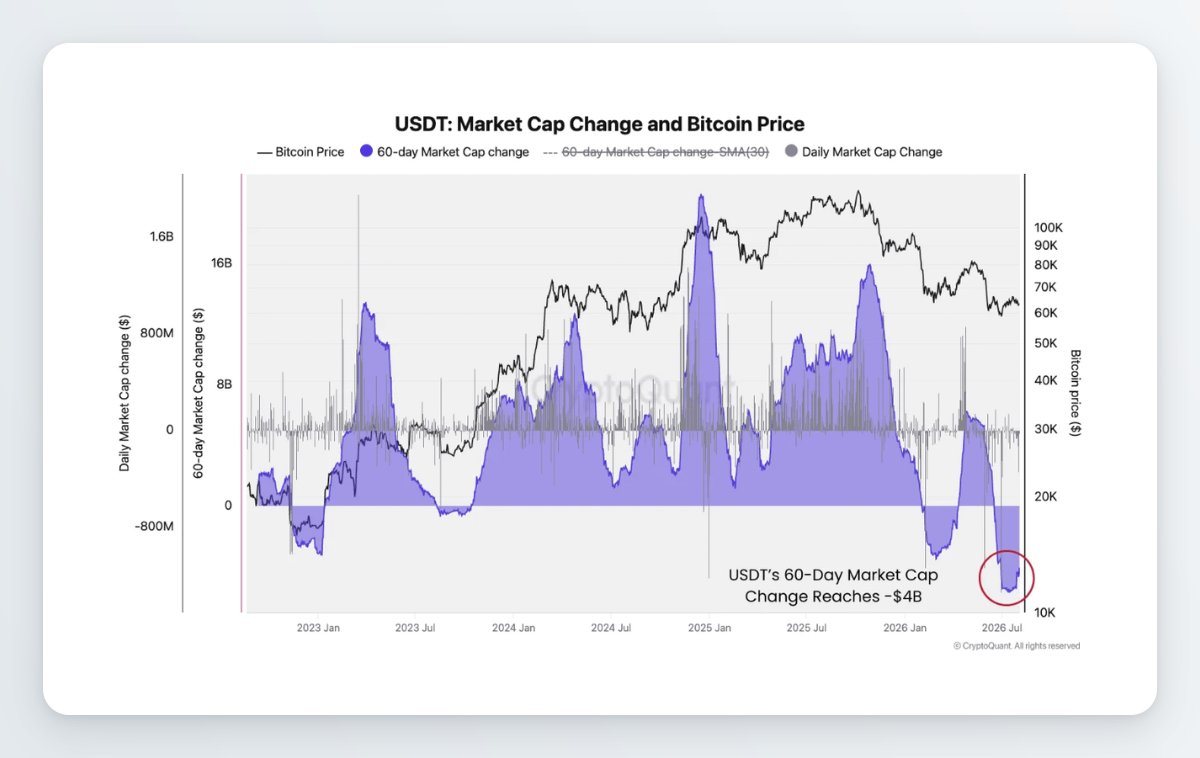
Data from Cryptoquant shows that the 60-day rolling change in $USDT supply is approximately minus $4 billion. About $870 million of this decline occurred in the last 11 days.

$USDT remains the dominant stablecoin with a circulating supply of around $184 billion, estimated to account for 60% of the total stablecoin supply. However, the recent supply reduction has raised questions about whether investors are reducing their overall exposure to cryptocurrencies.

Analyst Stacy Moore noted that part of this movement appears to be a direct exit into fiat currencies following Bitcoin's pullback from its 2025 peak. "Some investors are exchanging stablecoins for fiat currency and exiting cryptocurrencies altogether," she said.
Source: Cryptoquant

Yield Competition Is Only Part of the Picture

Changes in stablecoin economics may also be playing a role. $USDC offers a broader ecosystem of rewards through platforms like Coinbase, while lending protocols including Morpho and Aave provide additional avenues for yield.

However, Moore pointed out that the supply of $USDC has also declined sharply. This weakens the argument that capital is simply flowing from Tether to Circle's stablecoin.

"I think it's just a combination of factors," she said. "Some capital is chasing yield, some is returning to fiat, and stablecoin demand is decreasing as speculative activity cools."

This distinction matters because stablecoins are often viewed as an indicator of available cryptocurrency liquidity. A broad decline among major issuers could signal capital leaving digital asset markets rather than merely waiting on the sidelines.

Tron and Ethereum Still Dominate $USDT

Despite the supply contraction, $USDT remains heavily concentrated on two networks. Tron and Ethereum each account for roughly $90 billion worth of Tether, together making up about 97% of the token's circulating supply.

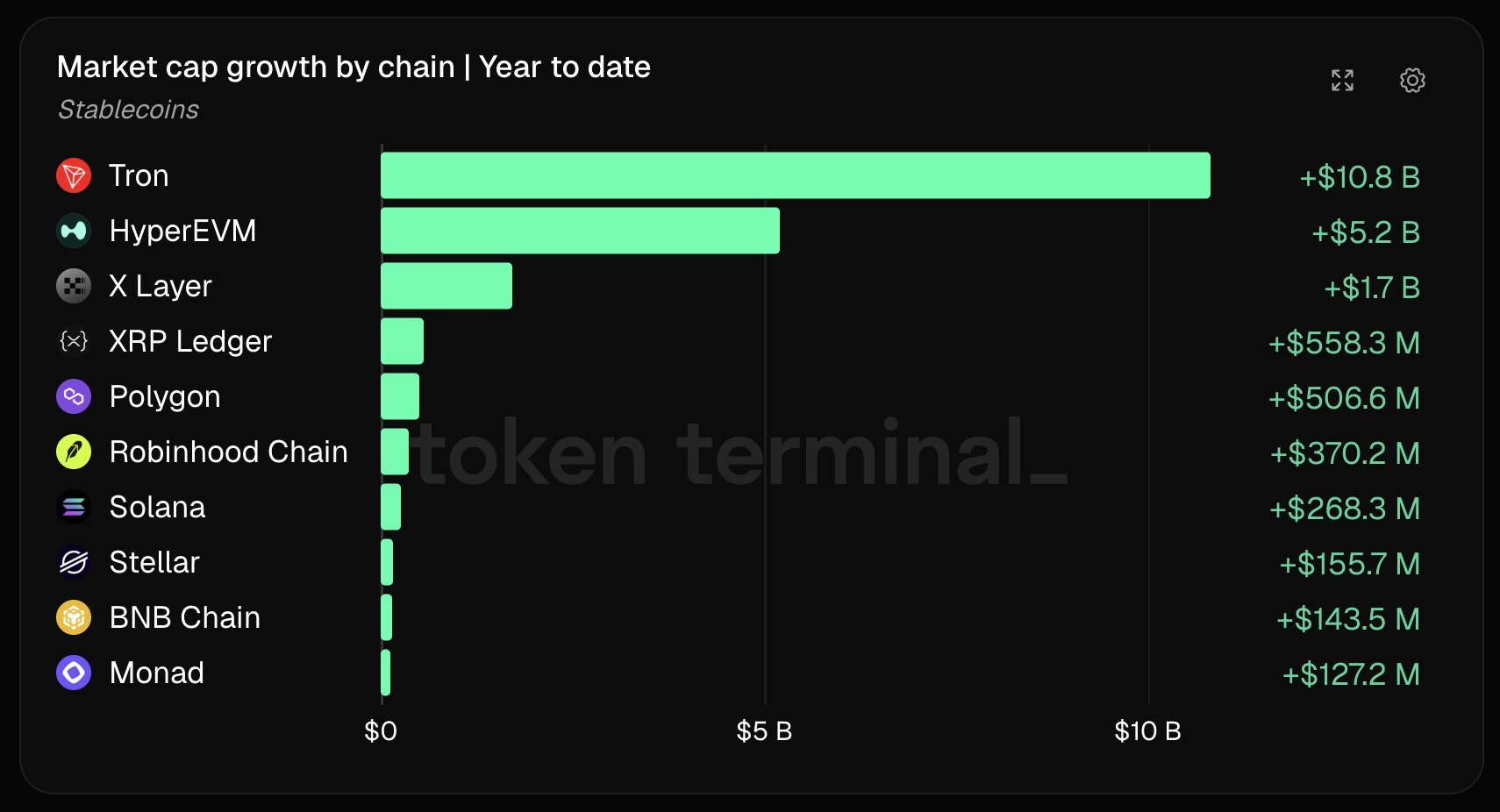
Tron is also leading stablecoin growth this year. The market capitalization of its stablecoins has increased by approximately $10.8 billion, outpacing HyperEVM ($5.2 billion) and X Layer ($1.7 billion).
Source: Token Terminal

Thus, the overall picture is mixed. Tether remains deeply entrenched in cryptocurrency payments, trading, and dollar demand in emerging markets, but its aggregate supply is no longer growing linearly.

For investors, a more significant signal may be whether a decline in stablecoin balances is followed by weaker trading activity and liquidity. If so, the latest $USDT contraction could indicate a broader cooling of appetite for crypto risk rather than a temporary redistribution of digital dollars.


Criptomoedas em alta

Perguntas relacionadas

QWhat is the total reduction in Tether's USDT supply over the past 60 days according to Cryptoquant data?

AAccording to Cryptoquant data, the 60-day rolling change in USDT supply is approximately a decrease of $4 billion.

QAccording to analyst Stacey Moore, what is one key reason for the reduction in stablecoin supply?

AAnalyst Stacy Moore stated that some investors are exchanging stablecoins for fiat currencies and exiting the cryptocurrency space entirely, particularly following Bitcoin's retreat from its 2025 peak.

QDoes the concurrent decrease in both USDT and USDC supply suggest a simple capital shift between these stablecoins?

ANo, the concurrent sharp decrease in USDC supply weakens the argument that capital is simply shifting from Tether to Circle's stablecoin, indicating a broader trend of capital leaving stablecoins.

QWhich two blockchain networks currently dominate the distribution of the circulating USDT supply?

ATron and Ethereum are the two dominant networks, with each holding approximately $90 billion worth of USDT, accounting for roughly 97% of the token's circulating supply.

QWhy is the overall decline in supply from major stablecoin issuers considered a significant signal for the crypto market?

AA decline in supply from major issuers signals that capital may be exiting digital asset markets entirely, rather than simply waiting on the sidelines. This could indicate a broader cooling of risk appetite, potentially leading to weakened trading activity and liquidity.

Leituras Relacionadas

Trading

Spot

Artigos em Destaque

Como comprar 4

Bem-vindo à HTX.com!Tornámos a compra de 4 (4) simples e conveniente.Segue o nosso guia passo a passo para iniciar a tua jornada no mundo das criptos.Passo 1: cria a tua conta HTXUtiliza o teu e-mail ou número de telefone para te inscreveres numa conta gratuita na HTX.Desfruta de um processo de inscrição sem complicações e desbloqueia todas as funcionalidades.Obter a minha contaPasso 2: vai para Comprar Cripto e escolhe o teu método de pagamentoCartão de crédito/débito: usa o teu visa ou mastercard para comprar 4 (4) instantaneamente.Saldo: usa os fundos da tua conta HTX para transacionar sem problemas.Terceiros: adicionamos métodos de pagamento populares, como Google Pay e Apple Pay, para aumentar a conveniência.P2P: transaciona diretamente com outros utilizadores na HTX.Mercado de balcão (OTC): oferecemos serviços personalizados e taxas de câmbio competitivas para os traders.Passo 3: armazena teu 4 (4)Depois de comprar o teu 4 (4), armazena-o na tua conta HTX.Alternativamente, podes enviá-lo para outro lugar através de transferência blockchain ou usá-lo para transacionar outras criptomoedas.Passo 4: transaciona 4 (4)Transaciona facilmente 4 (4) no mercado à vista da HTX.Acede simplesmente à tua conta, seleciona o teu par de trading, executa as tuas transações e monitoriza em tempo real.Oferecemos uma experiência de fácil utilização tanto para principiantes como para traders experientes.

780 Visualizações TotaisPublicado em {updateTime}Atualizado em 2026.06.02

Como comprar 4

Discussões

Bem-vindo à Comunidade HTX. Aqui, pode manter-se informado sobre os mais recentes desenvolvimentos da plataforma e obter acesso a análises profissionais de mercado. As opiniões dos utilizadores sobre o preço de 4 (4) são apresentadas abaixo.

活动图片