# Economic Data Related Articles

HTX News Center provides the latest articles and in-depth analysis on "Economic Data", covering market trends, project updates, tech developments, and regulatory policies in the crypto industry.

Fed Governor Bowman: No Urgent Need to Raise Interest Rates, Can Watch Economic Trends

Federal Reserve Governor and Vice Chair for Supervision Michelle Bowman stated that the Federal Reserve is in no immediate hurry to raise interest rates further. Speaking at the International Institute of Finance annual membership summit in Bangkok on October 14, Bowman emphasized the need to take time to assess the impact of the September rate hike and observe how economic and financial conditions evolve before making further policy decisions. While acknowledging inflation remains above target, she stressed a comprehensive, data-dependent approach. Her comments align with recent cautious tones from several Fed officials but highlight an ongoing internal debate. Other officials, including New York Fed President John Williams and Boston Fed President Susan Collins, have indicated openness to one more rate hike this year to combat persistent inflation. Market expectations now lean toward the Fed holding steady at its upcoming meeting, with future policy moves heavily dependent on incoming inflation data, particularly the upcoming September CPI report. Beyond monetary policy, Bowman addressed financial regulation. She critiqued some post-2008 crisis rules for pushing activity outside the formal banking system and called for a "comprehensive reorganization" of the Fed's internal supervisory structure following the Silicon Valley Bank collapse. On technology, she expressed concern about cybersecurity risks from advanced AI models and the capital demands of data center expansion, while also acknowledging the importance of allowing banks to innovate and exploring AI's potential applications in areas like fraud detection.

marsbit10/15 00:45

Fed Governor Bowman: No Urgent Need to Raise Interest Rates, Can Watch Economic Trends

marsbit10/15 00:45

"Fed's Favorite Inflation Gauge" Comes in Lower Than Expected, Goldman No Longer Anticipates October Rate Hike

"The Fed's Preferred Inflation Gauge" Falls Below Expectations, Goldman Sachs No Longer Expects October Rate Hike The U.S. August PCE inflation data came in lower than expected, altering Wall Street's outlook for the timing of the Federal Reserve's next interest rate increase. Goldman Sachs economists have pushed back their expectation for a second 2024 rate hike from October to December, citing the latest inflation figures and recent comments from New York Fed President John Williams. They noted the core PCE price index rose 0.25% month-over-month and 3.01% year-over-year in August, figures they described as "well below expectations." The team also sees a significant possibility the Fed may ultimately decide no further hikes are necessary. Market analysis suggests the PCE report did not substantially alter the existing inflation trend. "New Fedwire" Nick Timiraos pointed out that while June and July data showed improvement, the August figures indicate this progress did not continue. He noted inflation metrics remain around 3%, showing no recent progress toward the Fed's 2% target. Other analysts offered mixed interpretations. Capital Economics viewed the core price pressures as slightly less concerning, supporting a pause in October. However, BMO highlighted that the proportion of PCE components rising at an annualized rate above 3% only dipped slightly from 54% to 51%, a level still far above normal, indicating no meaningful improvement in underlying inflation trends. Market pricing reflected the shift, with the CME FedWatch Tool showing the implied probability of a October hike falling to about 39% from roughly 45% prior to the data release, while the probability for a December hike rose to 90%. Concurrently, economic data showed resilience. Second-quarter GDP growth was revised significantly higher to 2.2% from 1.5%, and consumer spending rose 0.9% in August, suggesting strong underlying economic momentum. This combination means that while the PCE data reduces the urgency for an October hike, it doesn't fundamentally change the broader inflation and growth landscape facing the Fed.

marsbit10/01 11:53

"Fed's Favorite Inflation Gauge" Comes in Lower Than Expected, Goldman No Longer Anticipates October Rate Hike

marsbit10/01 11:53

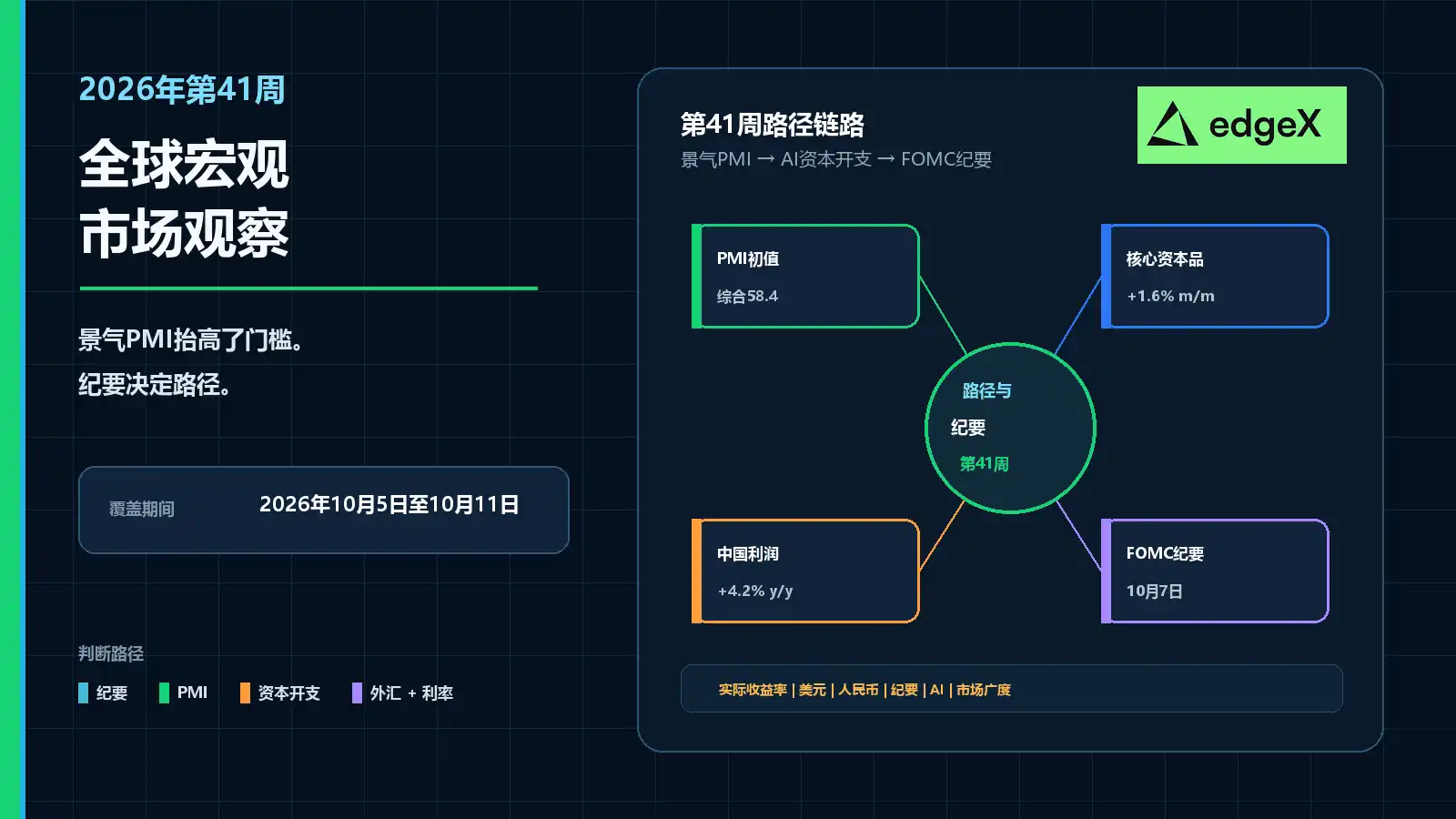
Week 41: After Robust PMI and Heated AI Capital Expenditure, Will the FOMC Minutes Lock in Another Rate Hike?

**Week 41: Will FOMC Minutes Lock in Another Rate Hike After Strong PMI and AI Capex?** (Summary) The focus for the week of Oct 5-11 is the release of the FOMC minutes from the Sep 15-16 meeting, the Fed's first hike in over three years. This release gains heightened significance following strong Week 39 data showing resilient US and Eurozone PMIs, a resurgence in business input price pressures, and robust core capital goods orders driven by AI-related investment. The minutes will reveal whether policymakers view this "boom plus bottlenecks" mix as a clear signal for further tightening ahead of the late-October G3 central bank meetings. Key data from Week 39 (Sep 21-27) set a higher bar: the US Composite PMI surged to 58.4, new orders and input prices jumped, and core capital goods orders rose 1.6% despite flat total durable goods. However, consumer confidence weakened and inflation expectations rose. Meanwhile, China's industrial profit growth slowed and the US current account deficit widened. The market will interpret the FOMC minutes alongside pending Week 40 data (JOLTS, August PCE, Q2 GDP revision, China's official PMI, and September non-farm payrolls). A hawkish tilt in the minutes, emphasizing capacity constraints and inflation risks, could keep front-end rate hike probabilities, real yields, and the USD elevated, pressuring EUR, JPY, and CNH. A more balanced tone would leave the path more data-dependent. Investors should watch for a coordinated market response across rates, FX (USD, EUR, JPY, CNH), and assets like industrial metals and AI-related equities. A sustainable outcome requires the FOMC minutes not to trigger immediate re-pricing for a second hike, coupled with firm but not overheated inflation/jobs data from Week 40, and stable demand signals from Europe, Japan, and China to prevent a broad downturn in cyclical assets.

marsbit09/29 21:02
Week 41: After Robust PMI and Heated AI Capital Expenditure, Will the FOMC Minutes Lock in Another Rate Hike?

marsbit09/29 21:02

活动图片