Starknet Launches Privacy-First Bitcoin strkBTC, Targeting Institutional On-Chain Finance

marsbitPublicado em 2026-07-21Última atualização em 2026-07-21

Resumo

Starknet introduces strkBTC, a privacy-focused version of Bitcoin designed for institutional on-chain finance. As digital assets face increased scrutiny, two major challenges emerge: the public visibility of all transactions and the looming threat of quantum computing to current cryptographic signatures. Bitcoin, representing over 56% of the crypto market, highlights these issues most clearly. strkBTC, built on Starknet’s STRK20 privacy framework, allows Bitcoin to be used privately on-chain while maintaining compliance. It operates in two modes: a public mode like standard ERC-20 tokens, and a shielded mode that hides balances and transactions from public view. This addresses the need for confidentiality in institutional finance, similar to traditional markets’ private trading venues. A third-party auditor, Financial Privacy Inc, holds view keys for regulatory access when necessary. Additionally, Starknet is positioned ahead in quantum resistance. Its STARK-based proof system relies on hash functions rather than elliptic-curve cryptography, making it less vulnerable to quantum attacks. Starknet’s native account abstraction also allows easier migration to quantum-resistant signatures without protocol-level forks. The team has outlined a roadmap to achieve end-to-end quantum security before “Q-day,” though dependencies on Ethereum’s own migration remain. While strkBTC currently uses a trusted bridge consortium, Starknet plans to transition toward more trustless, Bitcoin-nat...

Author: Castle Labs

Compiled by: TechFlow Deep Tides

Deep Tides Guide: As on-chain finance increasingly converges with traditional markets, two critical issues emerge: all capital flows are publicly visible, and quantum computing poses a threat to existing cryptographic signatures. Bitcoin, as the largest asset holding over 56% of the crypto market's share, serves as the clearest test case for both problems. Starknet's strkBTC solution attempts to address visibility and longevity simultaneously: enabling private Bitcoin transfers while preparing the technology for the quantum era.
As on-chain finance moves closer to traditional markets, digital assets are facing higher standards and more stringent requirements.

This new world presents two key issues: on-chain capital flows are publicly visible to everyone, and the cryptographic signatures underpinning the entire technology face a threat from quantum computing.

This is most evident with Bitcoin.

Bitcoin currently accounts for over 56% of the total crypto market capitalization, remaining the anchor of the entire crypto market, despite having almost no programmability itself.

To enhance its utility and programmability, Bitcoin is cross-chained out, entering the world of on-chain finance through wrapped tokens.

But Bitcoin in DeFi needs more than just higher yields; it needs a way to transfer large amounts without broadcasting it publicly, and a guarantee that it remains secure when tomorrow's quantum computers arrive.

The same is true for other assets in on-chain finance: assets need to be transferred, settled, and combined without exposing every position to the public, and they cannot rely on cryptographic technologies that may not survive the next decade.

We have been tracking a protocol that seems to have understood these issues earlier than most and built its solutions around these two problems.

While Starknet launched its BTCFi campaign earlier this year, it's not just about making Bitcoin usable on-chain. It's treating Bitcoin as the first clear test case for the conditions that individuals and institutions genuinely care about: private by default, disclosable when necessary, and hardened for a post-quantum future.

For context on Starknet's work in this area, we previously covered why $2 trillion worth of Bitcoin sits idle and how Starknet's roadmap charts a path to trustless BTC, as well as Starknet's new privacy framework STRK20, and why they designed the system for "privacy through ownership."

Privacy and the Quantum Countdown

A core tenet of the crypto world has always been "don't trust, verify," which is precisely what transparent blockchains have allowed us to do. Verify balances, peek at transfers, examine cash flows, monitor contract interactions. Everything is public for everyone.

You can understand how this started.

Transparency builds trust, but complete transparency harms intellectual property, strategy, personal safety, and operational privacy. This is especially true today, where AI-driven deanonymization can link public addresses to real identities with up to 90% accuracy.

Privacy is not only a human right but also critical infrastructure needed for user protection and institutional adoption on-chain.

Individuals need privacy to avoid surveillance, profiling, harassment, crime, and political exposure. Institutions need privacy to ensure the confidentiality of holdings, order flows, and other data, as well as to prevent counterparty visibility and strategy leaks. Furthermore, privacy needs to be configurable for selective disclosure to auditors, regulators, or compliance departments.

Previous attempts at on-chain privacy have repeatedly highlighted trade-offs:

Pure anonymity privacy pools like Tornado Cash faced compliance pressures, leading to OFAC sanctions, criminal charges, and prison sentences for developers, stark proof that non-compliant paths are fraught with political and legal risk.

Native privacy coins (e.g., Monero, Zcash) demonstrated that hiding transactions is possible but have struggled to integrate with the rest of the on-chain world, unable to compose with DeFi primitives at scale, pointing to a problem bigger than privacy itself: liquidity, interoperability, and compliance issues.

Private execution systems like Aztec saw early demand for private DeFi, but they often faced high costs, fragmented liquidity, and poor user experiences.

The lack of privacy leads to issues not just in the isolated on-chain world but also permeates the physical world. On-chain addresses tied to real people and publicly visible balances create higher risks of attack. CertiK reported 34 verified physical attacks against cryptocurrency holders in the first four months of 2026, a 41% increase year-over-year, representing only the documented portion of these severely underreported incidents. More specifically, in France, there were 41 crypto-related kidnappings from January to May 2026, averaging one every 2.5 days.

Privacy is not just about hiding transaction activity or protecting alpha; it's increasingly about lowering personal and operational risk.

While privacy issues are being actively addressed in the industry, another threat from quantum computing has emerged. A path that simultaneously solves visibility and longevity could propel blockchains closer to becoming next-generation financial infrastructure.

This March, a Google Quantum AI report co-authored by Justin Drake (Ethereum Foundation) and Dan Boneh (Stanford University) identified multiple attack vectors and estimated that roughly $100 billion in the Ethereum ecosystem is at risk. It also singled out Starknet as having a stronger post-quantum standing than other major L2s because its proof system is based on hash-based STARK assumptions rather than elliptic curve cryptography.
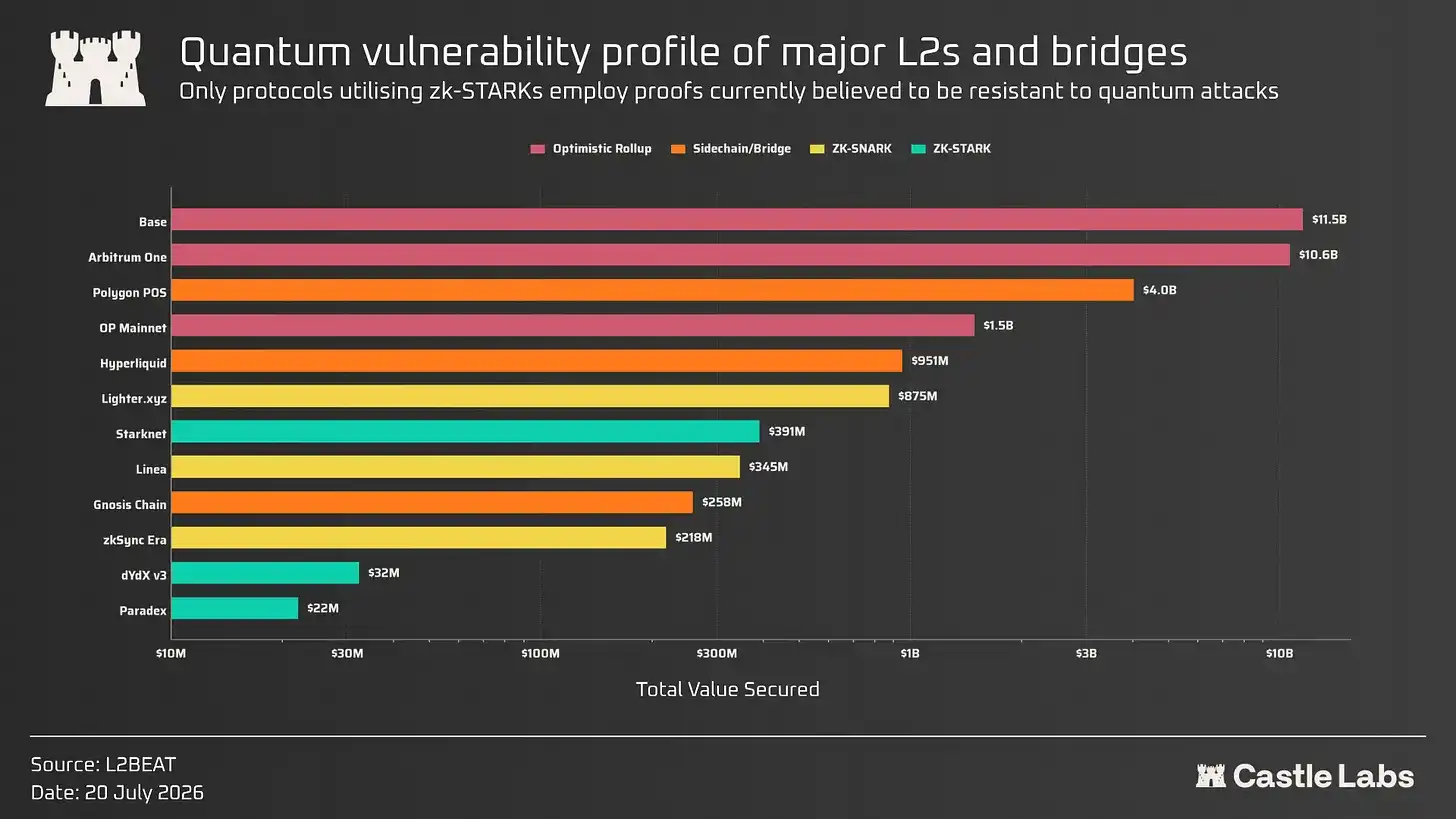
The paper focused on secp256k1 public key exposure, relevant to Bitcoin and Ethereum wallets, stating that a sufficiently powerful quantum computer could attack wallets in less than 9 minutes. Justin Drake later warned that there is "at least a 10% chance" quantum computers could recover private keys from exposed public keys by 2032.

While not a reality today, the long-term security and longevity of assets meant to be held for decades are being called into question.

Bitcoin is the world's most important digital asset, and as it increasingly serves as collateral, reserves, and assets on institutional balance sheets, its security and privacy requirements rise.

In the next section, we highlight a solution being developed around Bitcoin, the largest and clearest test case for these privacy challenges.

strkBTC: Private Bitcoin on Starknet

We've likely all used wrapped BTC tokens. They bring Bitcoin into other ecosystems and make it composable: as a tradable asset, as collateral, as liquidity.

What they don't solve is visibility.

While wrapped BTC can become productive, every move remains monitorable, inspectable, and counterparty-tradeable. Deposits, loans, trades, LP positions, repayments, withdrawals, wallet clustering, treasury flows. All public by default.

This is not how serious financial markets operate, and until this is addressed, on-chain finance will keep hitting an institutional ceiling.

In traditional finance, privacy is built into the infrastructure, whether you're a retail user or an institutional giant. In fact, a large portion of equity trading volume flows through private or over-the-counter venues like dark pools, where counterparties see what they need, regulators retain access when required, and the public sees aggregated volume, not every real-time move.

Cryptocurrency treats visibility as the standard. In reality, privacy should be the norm.

strkBTC is Starknet's attempt to let Bitcoin flow in the on-chain finance world without this limitation.

strkBTC is an ERC-20 on Starknet, backed by BTC locked on the Bitcoin network, and built on StarkWare's privacy framework STRK20 for shielded balances and private transfers.

STRK20 provides strkBTC with two modes:

In public mode, it behaves like a standard ERC-20: users can hold, transfer, supply to lending markets, provide liquidity, or use it as collateral.

In shielded mode, selected balances and transfers are hidden from public view. Users can shield, trade privately, and unshield back to public balances directly from within their wallet.
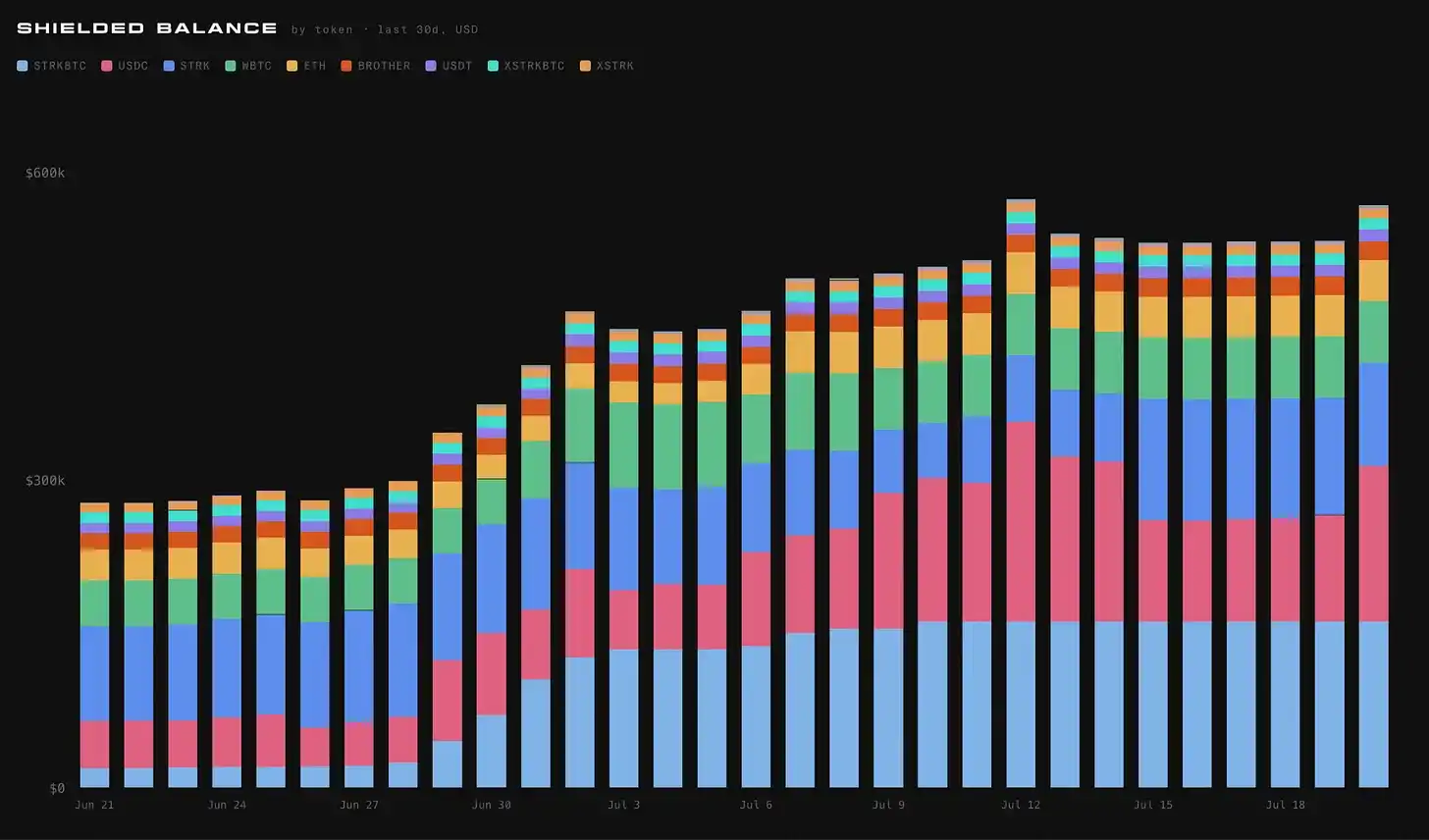
Before the Starknet v0.14.2 upgrade, which enabled STRK20, applications wanting to verify STARK proofs on Starknet had to do so within a smart contract, making it expensive and complex due to proof size. Now, transactions can directly reference off-chain proofs, with Starknet consensus handling verification natively via in-protocol proof verification.

This unlocks privacy at the protocol level, versus the historical friction of separate apps, chains, pools, or mixers, which added complexity, cost, and liquidity fragmentation. This allows applications to focus on building better products, as the underlying infrastructure has made private operations easily accessible to builders.

Compliance is a key part of the design, opening Starknet to institutions coming on-chain.

When users shield strkBTC, associated viewing keys are shared with Financial Privacy Inc. (also known as FPI), an independent third-party auditor operating the compliance infrastructure for STRK20, granting them scoped access in the event of a valid regulatory request. While this may not align with pure cypherpunk philosophy, it aligns much more closely with traditional markets. Private to the public, disclosed to regulators.

The bridge follows similar logic, operated by a trusted strkBTC consortium composed of Twinstake, NEAR Intents, Luganodes, UTXO Management, and Xverse. Currently, these independent signers support minting and burning between BTC and strkBTC. The consortium is not the final state; however, Starknet is committed to a hardening roadmap over time.

strkBTC is not meant to be just another wrapped token; it's meant to unlock the potential of a programmable, composable BTC whose moves aren't broadcast, solving the first issue: visibility.

The next issue is longevity.

The Quantum Problem for Blockchains

Every blockchain relies on public-key cryptography. When a user signs a transaction, they reveal their public key while keeping their private key hidden. This is routine on Bitcoin and most other blockchains, considered perfectly normal and secure in today's environment. But in a post-quantum world, this assumption becomes somewhat unstable.

As mentioned earlier, a sufficiently powerful quantum computer running Shor's algorithm could theoretically derive the private key from an exposed public key. This means public key exposure, the harmless part of transaction validation, could soon become a potential attack surface. This isn't unique to any single chain, as the same elliptic curve underpinnings lie beneath Bitcoin, Ethereum, and Solana.

The threat is shared, but the response capabilities are not. The most exposed chains are often the slowest to move, with Bitcoin being the clearest example.

Bitcoin isn't short on ideas for a post-quantum future. If anything, it has too many. The problem is agreeing on the trade-offs the network is willing to accept: larger signatures, higher costs, legacy coin handling, user migration, wallet support, miner policies, or battles over freezing dormant and unmigrated coins.

Clearly, Bitcoin's problem is as much social and political as it is technical.

Dan Boneh, a co-author of the Google paper, calmed everyone down in a recent interview: "Bitcoin should not panic, but it also can't ignore this. Moving too fast could be worse than waiting, because a rushed post-quantum migration could introduce catastrophic bugs before quantum is a live attack."

Bitcoin will likely solve its quantum problem, but not quickly or cleanly.

This slowness is, in some ways, a feature of sound money, but it also leaves a door open. While the base layer debates, more agile stacks can build the longevity that Bitcoin itself cannot yet commit to.

Ethereum and its extended L2s won't escape this problem. Most rollups settle to Ethereum and rely on it for data availability, thus inheriting the base layer's exposure. Ethereum is aware of this and has released its own multi-year migration plan, but until that plan arrives, every chain built on it is exposed to Ethereum's post-quantum migration problem.

This is where Starknet is ahead. While it settles to Ethereum like any other L2, Starknet's core, its proof layer, is built on foundations that don't rely on quantum-vulnerable cryptography. While the exposure inherited from Ethereum is real, everything within Starknet's own stack carries less migration debt than most major chains, and it has more in the pipeline.

Architectural Advantages

Starknet's advantageous position stems from two design choices, both made before quantum computing was a pressing concern.

The first is the proof layer, the system generating STARK proofs to secure every state transition on the network. It relies on hash functions, not the elliptic curve mathematics threatened by quantum computers, a design established since a 2018 paper co-authored by StarkWare CEO Eli Ben-Sasson. This is the critical security layer and why Google's paper listed Starknet as the only major L2 already ahead.

The second is native account abstraction. On most chains, signature schemes are fixed at the protocol level, so replacing them requires a hard fork, with every user and app having to follow. Starknet lets accounts define how to verify identity themselves, so users can migrate to quantum-resistant signatures without changing the protocol layer. According to StarkWare, a quantum-resistant wallet, S2morrow, is already deployed using Falcon-512, and OpenZeppelin is building a standardized version.

On many chains, such a change would mean coordinating a whole-protocol migration. On Starknet, much of the work can start with wallet upgrades. This doesn't mean every Starknet wallet is quantum-resistant, but this model provides an easier path for Starknet users.

StarkWare is now working to close the remaining gaps. Last week they released a roadmap to make Starknet end-to-end quantum-resistant before Q-day. Q-day refers to the point in time when quantum computers become powerful enough to break today's cryptography.

The roadmap is divided into three phases:
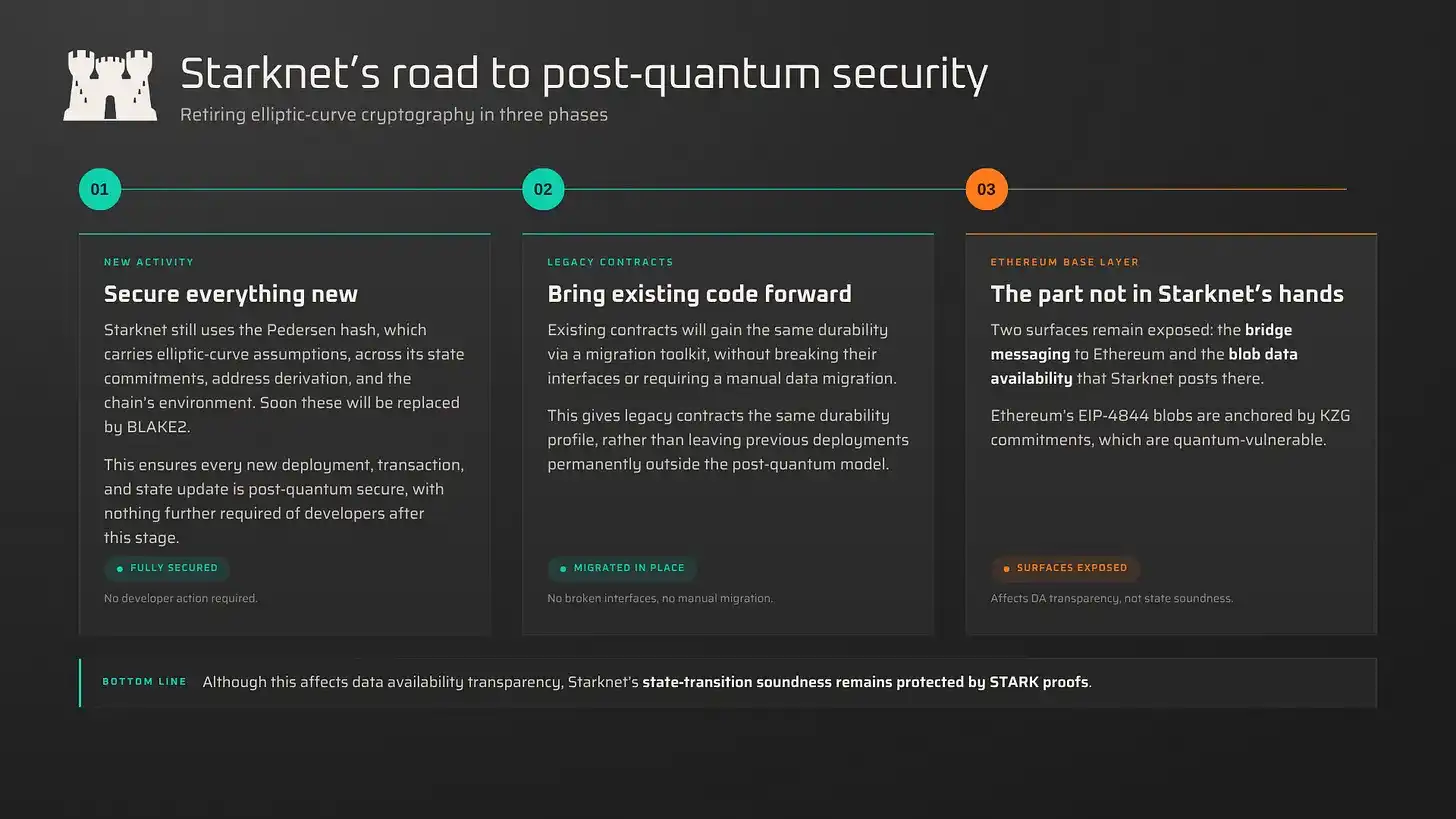
None of this means Starknet is fully quantum-resistant today, nor does the roadmap claim so.

What Still Needs Proving?

Starknet can replace Pedersen with BLAKE2, improve quantum-resistant wallet support, and provide migration paths for legacy contracts, but it cannot eliminate all problems inherited from the base layer. Bridged messages and blob data availability still depend on Ethereum's own quantum-resistant roadmap. Starknet can harden the parts it controls, but what's inherited from Ethereum will progress on Ethereum's timeline. That said, the Ethereum Foundation has outlined structured fork milestones, aiming to complete core quantum-resistant infrastructure around 2029.

strkBTC has a similar staged story. Currently, the bridge relies on a consortium to coordinate minting and burning between BTC and strkBTC. This is a trusted starting point, not the ideal trustless final state. Starknet aims to move from the consortium model to Bitcoin-native verification, then to a less-trust BitVM design, and finally, if Bitcoin enables the required opcodes in the future, to a fully trustless OP_CAT-based design.

Viewing keys are another part yet to be proven. They are Starknet's pragmatic answer to institutional privacy: publicly opaque but selectively disclosable, but they haven't been stress-tested in real scenarios, raising questions about who can request disclosure, under what conditions, and with what safeguards.

Digital assets, including Bitcoin, don't need another wrapper. They need surrounding infrastructure that can operate on-chain without compromising the two things institutions care about most: confidentiality today and longevity tomorrow.

strkBTC solves confidentiality by providing a private, selectively disclosable path for BTC into DeFi. Starknet's existing architecture and roadmap target longevity: its proof layer already avoids the elliptic curve assumptions that burden other protocols with quantum-resistant migration, and its roadmap now extends this advantage to the remaining pieces, explicitly aiming to make Starknet quantum-resistant before "Q-day."

While outcomes are still early, the direction is clear: the next institutional phase of on-chain finance needs more than just yield. It needs privacy, compliance, programmability, and longevity all integrated within the same tech stack.


Criptomoedas em alta

Perguntas relacionadas

QWhat are the two main challenges for on-chain finance as it approaches traditional markets, as described in the article?

AThe two main challenges are: 1) All capital flows are publicly visible, compromising operational and personal privacy. 2) The threat of quantum computing to existing cryptographic signatures, which endangers the long-term security of assets.

QWhat is strkBTC and how does it address the issue of transaction visibility on-chain?

AstrkBTC is a private version of Bitcoin on Starknet, built as an ERC-20 token backed by BTC locked on the Bitcoin network. It leverages StarkWare's STRK20 privacy framework to offer two modes: a public mode (like a standard ERC-20) and a shielded mode where selected balances and transfers are hidden from public view. This allows for private transfers, addressing the issue of default public visibility in on-chain finance.

QHow does Starknet's architecture give it a stronger position regarding the quantum computing threat compared to other major L2s?

AStarknet's proof system is based on hash-based STARK assumptions, not elliptic curve cryptography, which is vulnerable to quantum attacks. This design choice, made before quantum computing was a pressing concern, means its core proof layer is inherently more quantum-resistant. Additionally, its native account abstraction allows wallets to migrate to quantum-resistant signature schemes without requiring a protocol-level hard fork.

QWhat role does the 'viewing key' play in strkBTC's privacy and compliance model?

AWhen a user shields their strkBTC, a related viewing key is shared with an independent third-party auditor called Financial Privacy Inc. (FPI). This key grants FPI scoped access, enabling selective disclosure of transaction details to regulators or compliance bodies upon valid requests. This model provides privacy from the public while allowing for necessary regulatory oversight, aligning with traditional market practices.

QWhat are the stated future goals for the strkBTC bridge and Starknet's overall quantum resistance according to the article?

AFor the strkBTC bridge, the goal is to evolve from the current trusted consortium model to Bitcoin-native verification, then to a less-trust BitVM design, and finally to a fully trustless design based on OP_CAT if Bitcoin enables the required opcodes. For overall quantum resistance, Starknet has a roadmap aiming to make the network end-to-end quantum-secure before 'Q-day' (the point when quantum computers can break current cryptography). This involves upgrading hash functions, improving wallet support, and providing migration paths, though it acknowledges dependencies on Ethereum's own quantum migration timeline.

Leituras Relacionadas

9.42 Million Retail Investors Compete for Changxin Technology, Who Got Allotted?

Evergreen Technology's IPO subscription results are now available. On July 20, the domestic memory chip giant announced the offline preliminary allotment results and online lottery results for its IPO. A total of approximately 9.43 million retail investors participated in the online subscription, generating 770,000 winning lots with a final winning rate of about 0.4714%, setting a record for new shares on the STAR Market. After triggering a clawback mechanism from institutional to retail investors, the online retail allocation was significantly increased to 3.851 billion shares. Simultaneously, 285 institutional investors participated in the offline subscription, ultimately receiving 2.173 billion shares at an allotment rate of approximately 0.1756%. Leading insurers and public funds were among the major recipients. Notably, Liang Wenfeng, founder of the major AI model company DeepSeek, through his quantitative investment firms Ningbo Huanfang Quantitative and Zhejiang Jiuzhang Asset, secured the largest share among private funds, with a total allotment worth approximately 175 million yuan. Estimates suggest potential profits could reach 730 million yuan if Evergreen Technology's market capitalization reaches 3 trillion yuan post-listing. The company is expected to list on July 27 and could become the highest-valued tech stock on the A-share market, with various brokerages providing valuations ranging from 1 trillion to over 4 trillion yuan. However, recent significant corrections in global tech stocks may impact its post-listing performance. (Character count: 1,196)

marsbitHá 1h

9.42 Million Retail Investors Compete for Changxin Technology, Who Got Allotted?

marsbitHá 1h

Trading

Spot

Artigos em Destaque

O que é BITCOIN

Compreender o HarryPotterObamaSonic10Inu (ERC-20) e a Sua Posição no Espaço Cripto Nos últimos anos, o mercado de criptomoedas assistiu a um aumento na popularidade das moedas meme, cativando não apenas os traders, mas também aqueles que procuram envolvimento comunitário e valor de entretenimento. Entre estes tokens únicos está o HarryPotterObamaSonic10Inu (ERC-20), um projeto intrigante que mistura referências culturais no tecido das criptomoedas. Este artigo explora os principais aspetos do HarryPotterObamaSonic10Inu, examinando os seus mecanismos, a sua ética orientada pela comunidade e o seu envolvimento com o vasto panorama cripto. O que é o HarryPotterObamaSonic10Inu (ERC-20)? Como o nome sugere, o HarryPotterObamaSonic10Inu é uma moeda meme construída na blockchain Ethereum, classificada sob o padrão ERC-20. Ao contrário das criptomoedas tradicionais, que podem enfatizar a utilidade prática ou o potencial de investimento, este token prospera no valor de entretenimento e na força da sua comunidade. O projeto visa promover um ambiente onde utilizadores envolvidos possam reunir-se, partilhar ideias e participar em atividades inspiradas por diversos fenómenos culturais. Uma característica notável do HarryPotterObamaSonic10Inu é a zero taxa sobre transações. Este elemento atraente visa encorajar a negociação e o envolvimento da comunidade, isento de encargos adicionais que podem desencorajar os traders de pequena escala. A oferta total da moeda está fixada em mil milhões de tokens, uma cifra que marca a sua intenção de manter uma circulação substancial dentro da comunidade. Criador do HarryPotterObamaSonic10Inu (ERC-20) As origens do HarryPotterObamaSonic10Inu estão um pouco envoltas em mistério; os detalhes sobre o criador permanecem desconhecidos. O desenvolvimento deste token carece de uma equipa identificável ou de um plano explícito, o que não é raro no setor das moedas meme. Em vez disso, o projeto surgiu de forma orgânica, com o seu progresso a depender fortemente do entusiasmo e da participação da sua comunidade. Investidores do HarryPotterObamaSonic10Inu (ERC-20) No que diz respeito a investimentos externos e apoios, o HarryPotterObamaSonic10Inu também permanece ambíguo. O token não lista quaisquer fundações de investimento conhecidas ou apoio organizacional significativo. Em vez disso, o “sangue vital” do projeto é a sua comunidade de base, que informa o seu crescimento e sustentabilidade através da ação coletiva e do envolvimento no espaço cripto. Como Funciona o HarryPotterObamaSonic10Inu (ERC-20)? Como uma moeda meme, o HarryPotterObamaSonic10Inu opera principalmente fora dos quadros tradicionais que muitas vezes governam o valor dos ativos. Existem vários aspetos distintivos que definem como o projeto funciona: Transações Sem Taxas: Sem taxas sobre transações, os utilizadores podem comprar e vender o token livremente, sem a preocupação de custos ocultos. Envolvimento da Comunidade: O projeto prospera na interação da comunidade, aproveitando plataformas de redes sociais para criar entusiasmo e facilitar a participação. Discussões, partilha de conteúdo e envolvimento são elementos cruciais que ajudam a expandir o seu alcance e a fomentar a lealdade entre os apoiantes. Sem Utilidade Prática: Deve ser notado que o HarryPotterObamaSonic10Inu não oferece utilidade concreta dentro do ecossistema financeiro. Em vez disso, é classificado como um token principalmente para entretenimento e atividades comunitárias. Referência Cultural: O token incorpora de forma inteligente elementos da cultura popular para atrair interesse, conectando-se tanto com entusiastas de memes como com seguidores de criptomoedas. HarryPotterObamaSonic10Inu exemplifica como as moedas meme operam de forma diferente de projetos de criptomoedas mais tradicionais, entrando no mercado como construções sociais inovadoras em vez de ativos utilitários. Linha do Tempo do HarryPotterObamaSonic10Inu (ERC-20) A história do HarryPotterObamaSonic10Inu é marcada por vários marcos notáveis: Criação: O token surgiu de um meme viral, capturando a imaginação de muitos entusiastas de criptomoedas. Datas específicas de criação não estão disponíveis, sublinhando a sua ascensão orgânica. Listagem em Exchanges: O HarryPotterObamaSonic10Inu conseguiu entrar em várias exchanges, permitindo um acesso e negociação mais fáceis pela comunidade. Iniciativas de Envolvimento da Comunidade: Atividades contínuas direcionadas a melhorar a interação comunitária, incluindo concursos, campanhas em redes sociais e geração de conteúdo por fãs e defensores. Planos de Expansão Futura: O roteiro do projeto inclui o lançamento de uma coleção de NFTs, mercadorias e um site de eCommerce relacionado aos seus temas culturais, envolvendo ainda mais a comunidade e tentando adicionar mais dimensões ao seu ecossistema. Pontos-Chave sobre o HarryPotterObamaSonic10Inu (ERC-20) Natureza Orientada pela Comunidade: O projeto prioriza a contribuição coletiva e a criatividade, assegurando que o envolvimento dos utilizadores está na vanguarda do seu desenvolvimento. Classificação como Moeda Meme: Representa o epítome da criptomoeda baseada em entretenimento, destacando-se dos veículos de investimento tradicionais. Sem Afiliação Direta com o Bitcoin: Apesar da semelhança no nome do ticker, o HarryPotterObamaSonic10Inu é distinto e não tem qualquer relação com o Bitcoin ou outras criptomoedas estabelecidas. Foco na Colaboração: O HarryPotterObamaSonic10Inu é projetado para criar um espaço de colaboração e partilha de histórias entre os seus detentores, proporcionando uma via para a criatividade e o fortalecimento da comunidade. Perspectivas Futuras: A ambição de expandir além da sua premissa inicial para NFTs e mercadorias delineia um caminho para o projeto potencialmente entrar em avenidas mais mainstream dentro da cultura digital. À medida que as moedas meme continuam a capturar a imaginação da comunidade cripto, HarryPotterObamaSonic10Inu (ERC-20) destaca-se devido aos seus laços culturais e abordagem centrada na comunidade. Embora possa não se encaixar no molde típico de um token orientado para utilidade, a sua essência reside na alegria e camaradagem fomentadas entre os seus apoiantes, destacando a natureza em evolução das criptomoedas em uma era cada vez mais digital. À medida que o projeto continua a desenvolver-se, será importante observar como as dinâmicas comunitárias influenciam a sua trajetória no panorama em constante mudança da tecnologia blockchain.

1.7k Visualizações TotaisPublicado em {updateTime}Atualizado em 2024.12.03

O que é BITCOIN

Como comprar BTC

Bem-vindo à HTX.com!Tornámos a compra de Bitcoin (BTC) simples e conveniente.Segue o nosso guia passo a passo para iniciar a tua jornada no mundo das criptos.Passo 1: cria a tua conta HTXUtiliza o teu e-mail ou número de telefone para te inscreveres numa conta gratuita na HTX.Desfruta de um processo de inscrição sem complicações e desbloqueia todas as funcionalidades.Obter a minha contaPasso 2: vai para Comprar Cripto e escolhe o teu método de pagamentoCartão de crédito/débito: usa o teu visa ou mastercard para comprar Bitcoin (BTC) instantaneamente.Saldo: usa os fundos da tua conta HTX para transacionar sem problemas.Terceiros: adicionamos métodos de pagamento populares, como Google Pay e Apple Pay, para aumentar a conveniência.P2P: transaciona diretamente com outros utilizadores na HTX.Mercado de balcão (OTC): oferecemos serviços personalizados e taxas de câmbio competitivas para os traders.Passo 3: armazena teu Bitcoin (BTC)Depois de comprar o teu Bitcoin (BTC), armazena-o na tua conta HTX.Alternativamente, podes enviá-lo para outro lugar através de transferência blockchain ou usá-lo para transacionar outras criptomoedas.Passo 4: transaciona Bitcoin (BTC)Transaciona facilmente Bitcoin (BTC) no mercado à vista da HTX.Acede simplesmente à tua conta, seleciona o teu par de trading, executa as tuas transações e monitoriza em tempo real.Oferecemos uma experiência de fácil utilização tanto para principiantes como para traders experientes.

4.3k Visualizações TotaisPublicado em {updateTime}Atualizado em 2026.06.02

Como comprar BTC

O que é $BITCOIN

OURO DIGITAL ($BITCOIN): Uma Análise Abrangente Introdução ao OURO DIGITAL ($BITCOIN) OURO DIGITAL ($BITCOIN) é um projeto baseado em blockchain que opera na rede Solana, com o objetivo de combinar as características dos metais preciosos tradicionais com a inovação das tecnologias descentralizadas. Embora partilhe um nome com o Bitcoin, frequentemente referido como “ouro digital” devido à sua percepção como uma reserva de valor, o OURO DIGITAL é um token separado projetado para criar um ecossistema único dentro da paisagem Web3. O seu objetivo é posicionar-se como um ativo digital alternativo viável, embora os detalhes sobre as suas aplicações e funcionalidades ainda estejam em desenvolvimento. O que é o OURO DIGITAL ($BITCOIN)? OURO DIGITAL ($BITCOIN) é um token de criptomoeda explicitamente projetado para uso na blockchain Solana. Em contraste com o Bitcoin, que fornece um papel amplamente reconhecido como armazenamento de valor, este token parece focar em aplicações e características mais amplas. Aspectos notáveis incluem: Infraestrutura Blockchain: O token é construído na blockchain Solana, conhecida pela sua capacidade de lidar com transações de alta velocidade e baixo custo. Dinâmicas de Oferta: O OURO DIGITAL tem um fornecimento máximo limitado a 100 quatrilhões de tokens (100P $BITCOIN), embora os detalhes sobre o seu fornecimento circulante ainda não tenham sido divulgados. Utilidade: Embora as funcionalidades precisas não estejam explicitamente delineadas, existem indicações de que o token poderia ser utilizado para várias aplicações, potencialmente envolvendo aplicações descentralizadas (dApps) ou estratégias de tokenização de ativos. Quem é o Criador do OURO DIGITAL ($BITCOIN)? Neste momento, a identidade dos criadores e da equipa de desenvolvimento por trás do OURO DIGITAL ($BITCOIN) permanece desconhecida. Esta situação é típica entre muitos projetos inovadores no espaço da blockchain, particularmente aqueles alinhados com finanças descentralizadas e fenómenos de moedas meme. Embora tal anonimato possa fomentar uma cultura orientada pela comunidade, intensifica as preocupações sobre governança e responsabilidade. Quem são os Investidores do OURO DIGITAL ($BITCOIN)? As informações disponíveis indicam que o OURO DIGITAL ($BITCOIN) não tem apoiantes institucionais conhecidos ou investimentos proeminentes de capital de risco. O projeto parece operar num modelo peer-to-peer focado no apoio e adoção da comunidade, em vez de rotas de financiamento tradicionais. A sua atividade e liquidez estão principalmente situadas em exchanges descentralizadas (DEXs), como a PumpSwap, em vez de plataformas de negociação centralizadas estabelecidas, destacando ainda mais a sua abordagem de base. Como Funciona o OURO DIGITAL ($BITCOIN) A mecânica operacional do OURO DIGITAL ($BITCOIN) pode ser elaborada com base no seu design de blockchain e nas características da rede: Mecanismo de Consenso: Ao aproveitar o exclusivo proof-of-history (PoH) da Solana combinado com um modelo de proof-of-stake (PoS), o projeto assegura uma validação eficiente das transações, contribuindo para o alto desempenho da rede. Tokenomics: Embora mecanismos deflacionários específicos não tenham sido extensivamente detalhados, o vasto fornecimento máximo de tokens implica que pode atender a microtransações ou casos de uso de nicho que ainda estão por definir. Interoperabilidade: Existe o potencial para integração com o ecossistema mais amplo da Solana, incluindo várias plataformas de finanças descentralizadas (DeFi). No entanto, os detalhes sobre integrações específicas permanecem não especificados. Cronologia de Eventos Chave Aqui está uma cronologia que destaca marcos significativos relacionados ao OURO DIGITAL ($BITCOIN): 2023: O lançamento inicial do token ocorre na blockchain Solana, marcado pelo seu endereço de contrato. 2024: O OURO DIGITAL ganha visibilidade ao tornar-se disponível para negociação em exchanges descentralizadas como a PumpSwap, permitindo que os utilizadores o negociem contra SOL. 2025: O projeto testemunha atividade de negociação esporádica e potencial interesse em envolvimentos liderados pela comunidade, embora não tenham sido documentadas parcerias ou avanços técnicos notáveis até ao momento. Análise Crítica Forças Escalabilidade: A infraestrutura subjacente da Solana suporta altos volumes de transações, o que pode aumentar a utilidade do $BITCOIN em vários cenários de transação. Acessibilidade: O potencial preço de negociação baixo por token pode atrair investidores de retalho, facilitando uma participação mais ampla devido a oportunidades de propriedade fracionada. Riscos Falta de Transparência: A ausência de apoiantes, desenvolvedores ou um processo de auditoria publicamente conhecidos pode gerar ceticismo em relação à sustentabilidade e confiabilidade do projeto. Volatilidade do Mercado: A atividade de negociação depende fortemente do comportamento especulativo, o que pode resultar em volatilidade significativa dos preços e incerteza para os investidores. Conclusão O OURO DIGITAL ($BITCOIN) surge como um projeto intrigante, mas ambíguo, dentro do ecossistema em rápida evolução da Solana. Embora tente aproveitar a narrativa do “ouro digital”, a sua divergência do papel estabelecido do Bitcoin como reserva de valor sublinha a necessidade de uma diferenciação mais clara da sua utilidade pretendida e estrutura de governança. A aceitação e adoção futuras dependerão provavelmente da abordagem da atual opacidade e da definição mais explícita das suas estratégias operacionais e económicas. Nota: Este relatório abrange informações sintetizadas disponíveis até outubro de 2023, e desenvolvimentos podem ter ocorrido além do período de pesquisa.

141 Visualizações TotaisPublicado em {updateTime}Atualizado em 2025.05.13

O que é $BITCOIN

Discussões

Bem-vindo à Comunidade HTX. Aqui, pode manter-se informado sobre os mais recentes desenvolvimentos da plataforma e obter acesso a análises profissionais de mercado. As opiniões dos utilizadores sobre o preço de BTC (BTC) são apresentadas abaixo.

活动图片