Zcash price prediction – Can Ironwood upgrade keep ZEC’s 37% rally alive?

ambcryptoPublicado em 2026-07-21Última atualização em 2026-07-21

Resumo

Zcash has rallied nearly 37% since its Ironwood (NU6.3) upgrade deployed to testnet in early July. This major upgrade introduces a new shielded pool and a "turnstile" mechanism to strengthen supply verification without compromising privacy. Concurrently, it marks the retirement of the legacy zcashd node, a significant architectural shift for the network. After its rally, ZEC is consolidating around $546, with buyers attempting to establish support. Immediate resistance lies near $560, with a breakout potentially targeting $600, while the $500 region acts as key support. The final testing phase precedes Ironwood's planned mainnet activation later this month.

Zcash [ZEC] has rallied nearly 37% since developers deployed the Ironwood [NU6.3] upgrade to testnet earlier this month, with the privacy-focused cryptocurrency outperforming many of its peers ahead of the protocol’s next major network upgrade.

As the community prepares for Ironwood’s mainnet activation, the upgrade also marks the beginning of the end for zcashd. This is the network’s long-running reference node, making this one of the most significant transitions in Zcash’s history.

Ironwood aims to strengthen confidence in Zcash’s supply

The Zcash Open Development Lab deployed the Ironwood [NU6.3] upgrade to testnet on July 2, with activation following on July 4. The milestone serves as the final testing phase before the planned mainnet rollout later this month.

Ironwood was introduced following the disclosure of an Orchard protocol vulnerability in June. While developers said there was no evidence the issue had been exploited or that user funds were at risk, the flaw highlighted a limitation in proving the integrity of Zcash’s shielded supply.

To address that, Ironwood introduces a new shielded pool alongside a “turnstile” mechanism that enables the network to verify the amount of ZEC migrating into the new pool without compromising transaction privacy.

The upgrade is designed to strengthen confidence in Zcash’s circulating supply while preserving the privacy guarantees that distinguish the network from other cryptocurrencies.

Legacy zcashd node heads for retirement

Ironwood also marks a major infrastructure shift for the ecosystem.

The long-running zcashd reference implementation will not support NU6.3. It is being phased out as the network transitions to a Rust-based architecture built around Zebra, Zaino, and Zallet.

Developers have urged node operators to migrate before Ironwood activates on mainnet, as legacy zcashd nodes are approaching their automatic end-of-life shutdown. It will no longer participate in the upgraded network.

The transition represents one of the largest architectural changes since Zcash launched. It replaces the software that has underpinned the blockchain for years.

ZEC price prediction: Bulls pause after 37% advance

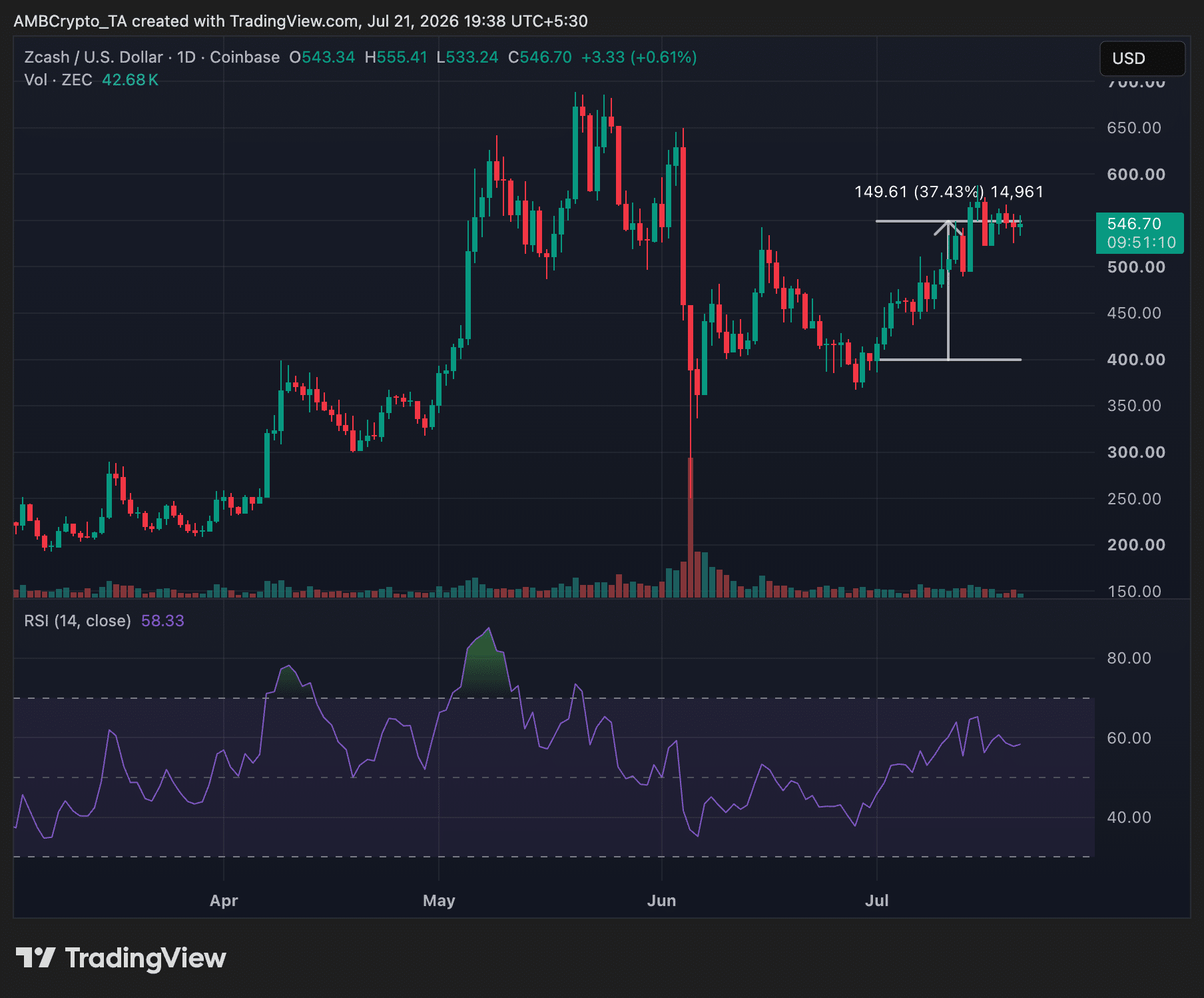
At press time, ZEC traded around $546, up roughly 37.4% from its early July lows.

The rally has since slowed into a period of consolidation, with buyers attempting to establish support after reaching the recent highs.

The daily RSI stood at around 58, indicating bullish momentum remained intact without entering overbought territory. That suggests buyers still hold a modest advantage. However, the strong upside momentum seen earlier in the month has begun to moderate.
Source: TradingView

The immediate resistance lies around $560, where recent advances have repeatedly stalled.

A decisive breakout above that level could pave the way for another attempt at $600, a price zone that acted as resistance earlier this year.

On the downside, the $500 region has emerged as the first meaningful support. Holding above that level would preserve the current higher-low structure. At the same time, a break below it could trigger a deeper pullback before buyers attempt another advance.


Final Summary

  • Zcash’s Ironwood upgrade has entered its final testing phase, introducing a new shielded pool while paving the way for the retirement of the legacy zcashd node.
  • ZEC has gained nearly 37% since Ironwood entered testnet, with bulls now attempting to break above the $560 resistance to target $600.


Criptomoedas em alta

Perguntas relacionadas

QWhat is the Ironwood upgrade and what key problem does it aim to address for Zcash?

AIronwood is Zcash's NU6.3 network upgrade, currently on testnet. It was introduced to address a limitation in proving the integrity of Zcash's shielded supply, following the disclosure of an Orchard protocol vulnerability. It introduces a new shielded pool and a 'turnstile' mechanism to verify ZEC migrating into it without compromising transaction privacy.

QWhy is the Ironwood upgrade a significant infrastructure shift for the Zcash network?

AIronwood marks a major infrastructure shift because the legacy reference node software, zcashd, will not support the upgrade. It is being phased out as the network transitions to a new Rust-based architecture built around Zebra, Zaino, and Zallet, representing one of the largest architectural changes since Zcash's launch.

QHow has ZEC's price reacted to the Ironwood upgrade news, and what are the key technical levels to watch?

AZEC rallied approximately 37% since the Ironwood upgrade was deployed to testnet. At the time of writing, it was consolidating near $546. Key resistance is at $560, with a breakout potentially targeting $600. Key support is at the $500 level.

QWhat is the role of the 'turnstile' mechanism in the Ironwood upgrade?

AThe 'turnstile' mechanism enables the Zcash network to verify the total amount of ZEC migrating into the new shielded pool, thereby strengthening confidence in the circulating supply, all while preserving the privacy of individual transactions.

QWhat is the current status of the Ironwood upgrade and its final deployment timeline?

AThe Ironwood (NU6.3) upgrade was deployed to testnet on July 2 and activated on July 4. This is the final testing phase before its planned mainnet activation later in the same month (July).

Leituras Relacionadas

Global Stock Market's Storm Center: South Korea's Stock Market De-leveraging Is Largely Complete

Storm's Eye: South Korean Market De-leveraging Nears Completion The recent sharp correction in South Korean equities, with the KOSPI index dropping 32% from its June high, has been a key trigger for global tech stock volatility. The core driver was not a fundamental shift but a forced de-leveraging process within the market's unique structure, which is now largely complete. Two main leverage channels amplified the sell-off: 1. **Leveraged ETFs:** Their size, proportionally four times larger than in the U.S., peaked near $50 billion. Their mandatory daily rebalancing mechanism created a vicious cycle of "price drop → forced selling → further drop." Approximately 75% of this excess has been unwound, shrinking to $26 billion, with regulatory curbs now blocking new inflows. 2. **Hedge Fund Leverage:** Using swaps to magnify exposure, hedge funds saw their net long positioning fall by over 50% from peak levels. The most intense phase of this institutional de-leveraging is over. In contrast, **retail margin debt** poses minimal systemic risk. At 0.5% of market cap, it is far lower than in the U.S. or China, lacks automatic triggers, and is concentrated in smaller stocks. The conclusion: the high-leverage structures most prone to "chain-reaction selling" have been substantially cleared. The market is transitioning from a liquidity-driven crash to one priced more on fundamentals. The article argues that the AI trend—centered on Korean memory chips—remains intact. This episode represents a painful but necessary clearing of crowded trades, not the end of the AI revolution. For investors, the key question is conviction in the long-term AI direction; if the trend is real, current volatility is a cost of entry, not a terminal risk.

链捕手Há 1h

Global Stock Market's Storm Center: South Korea's Stock Market De-leveraging Is Largely Complete

链捕手Há 1h

Trading

Spot

Artigos em Destaque

Como comprar ZEC

Bem-vindo à HTX.com!Tornámos a compra de Zcash (ZEC) simples e conveniente.Segue o nosso guia passo a passo para iniciar a tua jornada no mundo das criptos.Passo 1: cria a tua conta HTXUtiliza o teu e-mail ou número de telefone para te inscreveres numa conta gratuita na HTX.Desfruta de um processo de inscrição sem complicações e desbloqueia todas as funcionalidades.Obter a minha contaPasso 2: vai para Comprar Cripto e escolhe o teu método de pagamentoCartão de crédito/débito: usa o teu visa ou mastercard para comprar Zcash (ZEC) instantaneamente.Saldo: usa os fundos da tua conta HTX para transacionar sem problemas.Terceiros: adicionamos métodos de pagamento populares, como Google Pay e Apple Pay, para aumentar a conveniência.P2P: transaciona diretamente com outros utilizadores na HTX.Mercado de balcão (OTC): oferecemos serviços personalizados e taxas de câmbio competitivas para os traders.Passo 3: armazena teu Zcash (ZEC)Depois de comprar o teu Zcash (ZEC), armazena-o na tua conta HTX.Alternativamente, podes enviá-lo para outro lugar através de transferência blockchain ou usá-lo para transacionar outras criptomoedas.Passo 4: transaciona Zcash (ZEC)Transaciona facilmente Zcash (ZEC) no mercado à vista da HTX.Acede simplesmente à tua conta, seleciona o teu par de trading, executa as tuas transações e monitoriza em tempo real.Oferecemos uma experiência de fácil utilização tanto para principiantes como para traders experientes.

359 Visualizações TotaisPublicado em {updateTime}Atualizado em 2026.06.02

Como comprar ZEC

Discussões

Bem-vindo à Comunidade HTX. Aqui, pode manter-se informado sobre os mais recentes desenvolvimentos da plataforma e obter acesso a análises profissionais de mercado. As opiniões dos utilizadores sobre o preço de ZEC (ZEC) são apresentadas abaixo.

活动图片