Staking Inflation Reforms Trap Ethereum and Solana

marsbitPublicado em 2026-08-14Última atualização em 2026-08-14

Resumo

The article discusses the "Morton's Fork" dilemma facing both Ethereum and Solana, where both blockchains must choose between two paths that lead to the same outcome: increased centralization of their validator networks. Ethereum researchers have proposed EIP-8363, a "Progressive Issuance Burn" plan. It would gradually increase the proportion of validator rewards burned as the total staked ETH rises, aiming to reduce new token issuance. If staking reaches 50% of the supply, rewards would drop to zero. This proposal has faced strong opposition from major staking service providers and DeFi platforms (e.g., Aave, ether.fi), as staking yields form a crucial base rate for DeFi leverage strategies. Critics argue slashing rewards would first hurt small, individual node operators due to fixed operational costs, accelerating centralization. Solana faces a similar challenge. Its validators have fixed costs but rely heavily on token issuance for rewards (only ~13% of validator income comes from fees). Two current proposals, SIMD-0550 and SIMD-0553, aim to accelerate the reduction of its inflation rate and increase fee burns, respectively. A vote concludes on August 18th. The core conflict is between large token holders (whose assets are diluted by issuance) and the concentrated staking industry that depends on high yields. While reducing issuance could curb the influx of capital into centralized staking services, it could also force out smaller validators first. The article concludes...

Original Author: Thejaswini M A

Original Compilation: Chopper, Foresight News

In 1487, King Henry VII of England was in urgent need of funds. Having won the English throne two years earlier at the Battle of Bosworth Field, maintaining his rule incurred immense costs. The task of taxation fell to his Chancellor, John Morton.

Legend has it that Morton had his own methods. Visiting the estates of nobles, he observed their lifestyles: if a noble lived in luxury, Morton deemed him wealthy and thus obligated to pay tribute to the king; if a noble lived frugally, Morton judged him to be skilled at saving and equally capable of paying.

There was no third scenario. Regardless of what Morton witnessed, the outcome was always the same: the noble had to pay.

This anecdote is a secondhand account. Francis Bacon recorded it in 1622 when the story was still widely circulated. The term "Morton's Fork" was not widely used until the 19th century, but its logic endures due to its relevance. The "fork" refers to two choices that ultimately lead to the same unfavorable outcome, the opposite of a win-win situation.

Today, Ethereum and Solana find themselves trapped in a similar dilemma.

Both blockchains reward validators by issuing new tokens (inflation), and both are attempting to reduce these issuance subsidies. Relevant adjustment proposals for Ethereum have faced strong opposition; Solana's proposal is currently under vote, with the decision deadline set for August 18th.

On one hand, maintaining the current staking rewards for validators further advantages large, well-capitalized institutional service providers. On the other hand, reducing rewards places immediate pressure on smaller node operators, who face fixed operational costs and already operate on thin profit margins.

Regardless of the path chosen, the ultimate result is a contraction in the number of validators. This article analyzes the inflation policy debates on both chains: they are forced to make a choice, essentially deciding which form of centralization to move towards.

Ethereum: EIP-8363 Proposal for Progressive Issuance Burning

On August 4th, Ethereum researchers including Justin Drake and Jérôme de Tychey released a draft proposal titled "A Progressive Issuance Burn," known as EIP-8363. Its core mechanism involves increasing the proportion of validator rewards burned by the protocol as the total amount of staked ETH rises.

Once the total staked amount reaches 60.25 million ETH (approximately half the total supply), the reward burn rate would hit 100%, reducing the staking issuance yield to zero.

Currently, about 41.4 million ETH is staked, representing 34% of the total supply, corresponding to roughly 890,000 validators with an average staking yield of 2.67%. A calculation by Aave founder Stani Kulechov suggests that under this proposal, the validator yield would drop from 2.862% to 1.476%, nearly halving it.
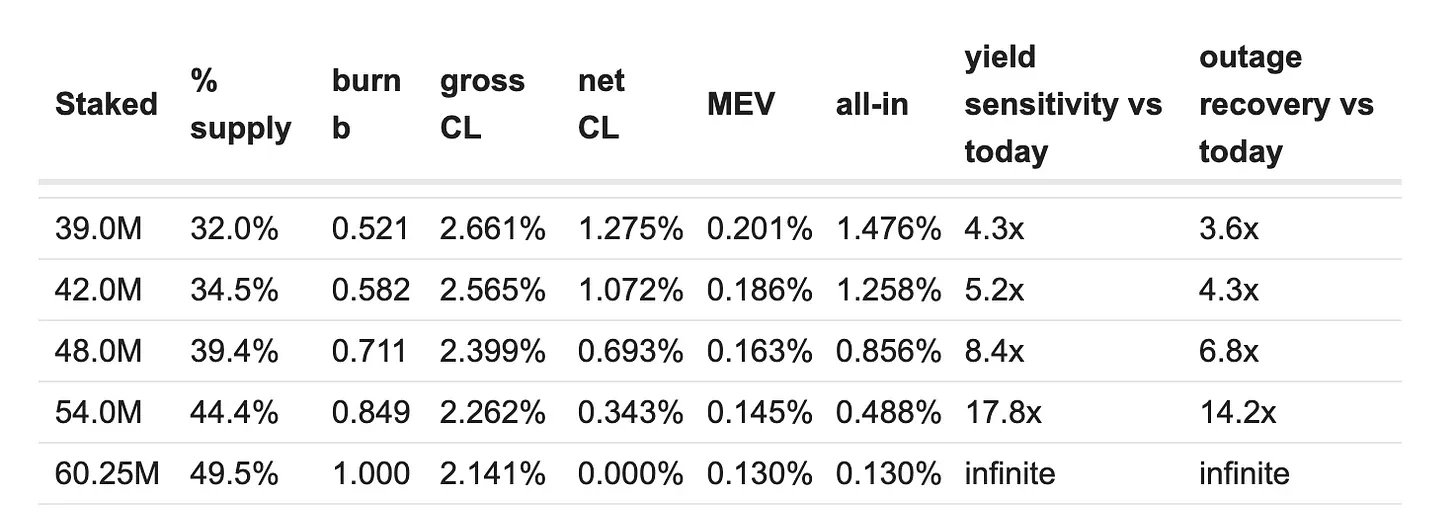
The proposal faced public opposition within three days from figures like Stani Kulechov, SharpLink CEO Joseph Chalom, and ether.fi's Mike Silagadze.

EIP-8363 is currently in the early draft stage, undergoing preliminary review on GitHub. It is far from finalization and implementation and is not included in Ethereum's upcoming Hegotá upgrade; however, it may still be submitted for consideration in future network upgrades.

To understand the strong resistance from the staking community to reward cuts, one must look at the size of this revenue pie. Ethereum incentivizes participants to secure the network by issuing new tokens, minting approximately 1.1 million ETH annually for validators. At a price of $1,921, this constitutes an annual salary pool worth $21 billion.
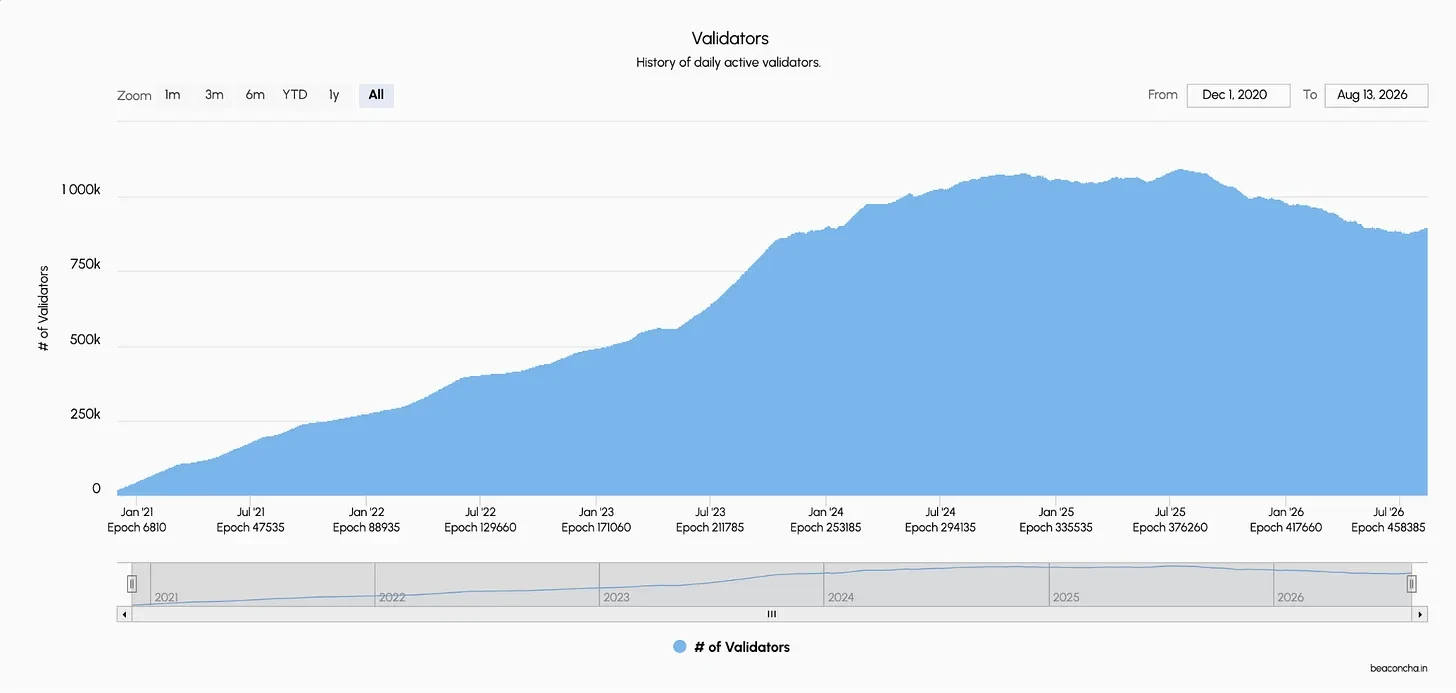
Number of Active Ethereum Validators

Solana has a similar mechanism, but its issuance is larger relative to its economic size. Solana issues approximately 19 to 22 million SOL annually, valued at around $1.5 billion at current prices. Users pay about 6,400–9,600 SOL daily in transaction fees and Jito tips, totaling about $225 million annually. This means user fees cover only about 13% of validator income, with the rest funded by token issuance. The situation is similar on Ethereum, where Chalom estimates tips and fees constitute about 15% of staking rewards, with the remaining 85% coming from issuance.

Solana's annual inflation rate is 3.7%, while Ethereum's is just 0.85%. Non-staking SOL holders see their assets diluted at more than four times the rate of equivalent ETH holders.

In traditional finance, the National Securities Clearing Corporation (NSCC) participates in nearly all stock and bond transactions in the United States. Its parent company, DTCC, processed $4.7 quadrillion in securities transactions in 2025 and custodied assets worth $115 trillion. NSCC maintains a Member's Clearing Fund, sized at $19.7 billion, funded by its members, with NSCC itself contributing only $130 million.

To attack the Ethereum network, an attacker would need to control 41.4 million staked ETH, representing a capital barrier of $79.6 billion—four times the size of the NSCC's fund. This is just the minimum; any large-scale ETH purchase would rapidly drive up the price. Additionally, the attacker would need to deploy a massive global server infrastructure to utilize these tokens. Ethereum has built-in defenses: malicious actions can trigger the network to directly slash (destroy) the attacker's entire staked assets, meaning a failed attack results in a total loss.

However, the operational logic of the two systems remains vastly different.

NSCC members contribute $19.7 billion as a collateral requirement for participation; this capital generates no yield, and members want this amount to be as low as possible. In contrast, Ethereum provides a 2.67% annual yield on equivalent staked capital, while Solana's staking yield is 5%–8%.

Years of stable staking yields have fostered a complete commercial ecosystem built upon them. Currently, about $35 billion worth of liquid staking tokens (LSTs) like stETH are used as collateral across various crypto lending platforms. Traders build leveraged loop strategies with these tokens: deposit LSTs into Aave, Morpho, borrow WETH to stake again, and repeat. This strategy hinges on the staking yield being higher than the borrowing rate. Pendle has built fixed-rate markets based on staking yields; Curve establishes trading pools for investors to exit; SharpLink holds $3 billion in ETH reserves, much of it staked through Coinbase, Anchorage, Figment, Galaxy.

Staking yield has become the benchmark interest rate for the entire DeFi market. If the consensus layer reward were halved, leveraged loop strategies would turn unprofitable, forcing Pendle to reprice fixed rates, and lending platforms would have to comprehensively reassess the collateral value of all liquid staking tokens.

The Key Difference Pre- and Post-Merge: Miners and Stakers Are Not the Same

Before the Ethereum Merge, the protocol issued about 13,000 ETH daily to miners; after the Merge, daily issuance dropped to about 1,700, an 88% reduction. Miners, who had invested tens of billions in hardware over years, strongly resisted the change, leading to a fork that created ETHW, a token now worth less than 1% of ETH's value.

But the mining ecosystem and the DeFi financial system were largely independent. Miners provided hash power for rewards; no one built complex financial products around mining revenue. Their income was not used as collateral for chain-wide lending, so even if their rewards went to zero overnight, the lending markets would remain unaffected. When miners left, the rest of the system could continue without adjustment.

Stakers play a dual role. On one hand, they secure the network; on the other, the staked tokens they receive serve as the underlying collateral for about half of DeFi lending. Therefore, cutting staking rewards impacts the entire financial ecosystem built on top of it.

Mancur Olson proposed a theory in 1965: small groups with significant potential gains often have more motivation and effectiveness in collective action than large groups where individual stakes are small. Small groups have stronger incentives to voice opinions and engage in political processes.

Running a validator node incurs fixed costs: servers, electricity, internet, etc., regardless of profitability. Currently, staking 32 ETH yields about 0.92 ETH annually (~$1,760). Under the new progressive proposal, annual income would drop to 0.47 ETH (~$900). With operational costs unchanged, expenses that were 20% of revenue would suddenly approach half of it. Slashing penalties for attestation mistakes would represent double the proportion of earnings lost for the same absolute amount.

Following Olson's theory, general token holders constitute a large group: Ethereum mints new tokens annually for stakers, continuously diluting the holdings of non-stakers. But this dilution is minuscule per individual—only fractions of a percent annually—which most people barely perceive, giving them little incentive to protest.

Large staking service providers constitute a small group: a significant portion of all newly issued tokens flows to them, representing tens of billions in revenue, which their businesses rely on entirely. If the network cuts rewards, these companies would face massive losses.

The argument from those supporting reduced issuance is that current staking rewards are too high, continuously attracting ETH inflows, and these rewards are concentrated among top exchanges and staking services. Institutional capital drove a ~15% increase in staked ETH in the first half of 2026. The proposal's logic is to raise the marginal cost of staking, making new staking unprofitable, thereby curbing centralization.

The opposing view is that cutting rewards directly would first bankrupt ordinary individual operators running nodes from home. In fact, both sides share the same goal—preventing a few capital giants from controlling Ethereum. The disagreement lies in which approach—reducing rewards or maintaining them—would harm network decentralization faster.

Solana Faces the Same Dilemma

Solana validators must pay about 389 SOL annually in voting fees, a cost incurred regardless of node profitability, market conditions, or whether they receive delegated stakes. The current staking yield is around 6.5%, with the break-even point for a node requiring about 200,000 SOL in delegated stake. The number of active Solana validators has dropped from a peak of 2,500 to 683; however, the total staked SOL has climbed to 430 million, representing nearly 68% of the stakeable supply.
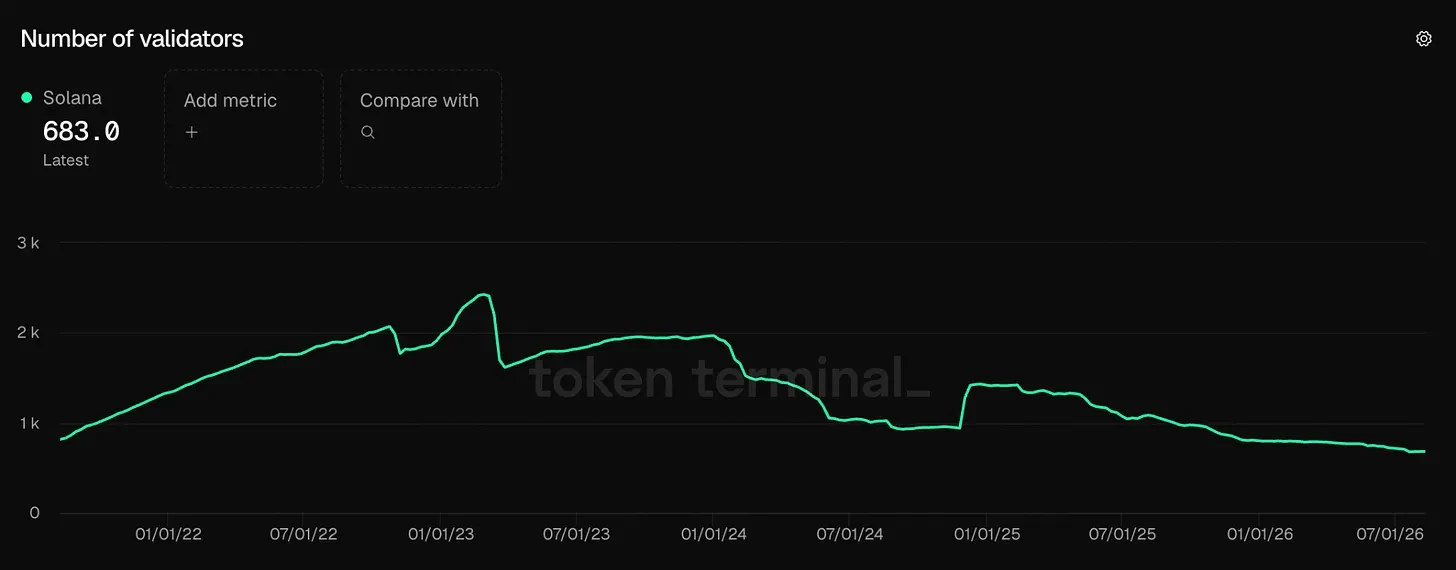
Change in Number of Solana Validator Nodes

Solana is currently voting on reward reforms. Proposal SIMD-0550 would increase the annual disinflation ramp from 15% to 30%, accelerating the achievement of the long-term 1.5% inflation target from 2032 to 2029, aiming to reduce future issuance by 18.9 million SOL. Proposal SIMD-0553 redesigns the fee mechanism based on resource usage, increasing daily burns from 648 SOL to 7,500–9,000 SOL. Even at the upper limit, the burn volume remains far below the daily issuance of ~60,000 SOL in rewards.

The vote concludes on August 18th. Proposals require an absolute majority of over 66.67% of the total staked supply to pass.

We are accustomed to viewing blockchain governance as a practice of autonomous decision-making, where code and community voting shape the future of digital economies. But Ethereum and Solana show a similar trend: protocol rules are ultimately constrained by real-world financial principles. Early architects designed economic models hoping markets would spontaneously maintain decentralization. Yet once a public chain's assets grow into a cornerstone of global liquidity and a target for institutional asset allocation, the underlying economic forces of yield, leverage, and corporate operational costs eventually override the original design vision.

If a blockchain relies on distributing yields to attract users to lock assets for expansion, it will inevitably hit this wall. Regardless of Solana's voting outcome next Monday, and regardless of Ethereum's future decisions on related proposals, they are merely choosing: how soon will we reach the endpoint, how soon will we hit the barrier.


Criptomoedas em alta

Perguntas relacionadas

QWhat is the 'Morton's Fork' dilemma that Ethereum and Solana are currently facing, as described in the article?

ABoth Ethereum and Solana face the 'Morton's Fork' dilemma regarding staking rewards. On one path, maintaining high staking rewards encourages centralization by benefiting large, well-capitalized institutional staking services. On the other path, drastically cutting staking rewards would pressure small, independent node operators with fixed costs, forcing them out of the network. Both choices ultimately lead to increased centralization, making it a 'lose-lose' situation akin to the historical 'Morton's Fork'.

QWhat is the core mechanism of Ethereum's proposed EIP-8363, and why is it facing significant opposition?

AEIP-8363, the 'Progressive Issuance Burn' proposal for Ethereum, introduces a mechanism where the proportion of validator rewards burned by the protocol increases as the total amount of staked ETH rises. It would reach a 100% burn rate (effectively zero issuance yield) when staked ETH hits 60.25 million. It faces opposition because major staking service providers and DeFi platforms (like Aave, ether.fi, and SharpLink) argue that slashing rewards by nearly half would severely impact the profitability of validators, especially small operators, and destabilize the DeFi ecosystem where staked ETH derivatives are used as critical collateral.

QHow does the role and impact of stakers in Ethereum's current system differ from that of miners before 'The Merge'?

ABefore 'The Merge', Ethereum miners were compensated for computational work (Proof-of-Work) but were largely separate from the DeFi financial system. Their rewards weren't used as collateral. Post-Merge, stakers in Ethereum's Proof-of-Stake system have a dual role: they secure the network and their staked assets (and liquid staking derivatives) form the backbone of a significant portion of DeFi lending markets. Therefore, cutting staking rewards doesn't just affect validators' income; it risks destabilizing the entire interconnected DeFi ecosystem built upon that staking yield, unlike the isolated impact on miners.

QAccording to the article, what key economic force ultimately constrains the governance and design of major blockchains like Ethereum and Solana?

AThe article argues that underlying economic forces—specifically yield, leverage, and corporate operational costs—ultimately constrain blockchain governance and design. Once a blockchain's native asset becomes a cornerstone of global liquidity and an institutional asset, the financial realities and interests of large capital holders and service providers (who depend on staking yields for profit) override the original design visions of decentralization. The system becomes subject to the same financial imperatives as traditional economies.

QWhat are the main proposals Solana is voting on (SIMD-0550 and SIMD-0553), and what is their combined goal?

ASolana is voting on two main proposals: SIMD-0550 aims to accelerate the reduction of its issuance (inflation) by increasing the annual disinflation rate from 15% to 30%, targeting the long-term inflation goal of 1.5% by 2029 instead of 2032. SIMD-0553 proposes a new resource-based fee mechanism designed to increase the daily burn of SOL from 648 to between 7500–9000. Their combined goal is to reduce the overall net supply expansion (inflation) of SOL more quickly by cutting new issuance and increasing token burns, though the burn would still be less than the daily rewards issued.

Leituras Relacionadas

Trading

Spot

Artigos em Destaque

O que é ETH 2.0

ETH 2.0: Uma Nova Era para o Ethereum Introdução ETH 2.0, amplamente conhecido como Ethereum 2.0, marca uma atualização monumental à blockchain do Ethereum. Esta transição não é meramente uma mudança estética; visa melhorar fundamentalmente a escalabilidade, segurança e sustentabilidade da rede. Com uma mudança do mecanismo de consenso em Proof of Work (PoW), intensivo em energia, para um Proof of Stake (PoS) mais eficiente, o ETH 2.0 promete uma abordagem transformadora ao ecossistema blockchain. O que é ETH 2.0? ETH 2.0 é um conjunto de atualizações distintas e interconectadas focadas na otimização das capacidades e desempenho do Ethereum. Esta reformulação foi projetada para abordar desafios críticos que o mecanismo atual do Ethereum enfrentou, particularmente em relação à velocidade das transações e à congestão da rede. Objetivos do ETH 2.0 Os principais objetivos do ETH 2.0 giram em torno da melhoria de três aspectos centrais: Escalabilidade: Com o objetivo de melhorar significativamente o número de transações que a rede pode manejar por segundo, o ETH 2.0 procura ultrapassar a limitação atual de aproximadamente 15 transações por segundo, alcançando potencialmente milhares. Segurança: Medidas de segurança melhoradas são integrais ao ETH 2.0, especialmente através da resistência aprimorada contra ciberataques e da preservação do ethos descentralizado do Ethereum. Sustentabilidade: O novo mecanismo PoS foi projetado não apenas para melhorar a eficiência, mas também para reduzir drasticamente o consumo de energia, alinhando a estrutura operacional do Ethereum com considerações ambientais. Quem é o Criador do ETH 2.0? A criação do ETH 2.0 pode ser atribuída à Ethereum Foundation. Esta organização sem fins lucrativos, que desempenha um papel crucial no apoio ao desenvolvimento do Ethereum, é liderada pelo co-fundador notável Vitalik Buterin. A sua visão de um Ethereum mais escalável e sustentável tem sido a força motriz por trás desta atualização, envolvendo contribuições de uma comunidade global de desenvolvedores e entusiastas dedicados a melhorar o protocolo. Quem são os Investidores do ETH 2.0? Embora os detalhes sobre os investidores do ETH 2.0 não tenham sido tornados públicos, é sabido que a Ethereum Foundation recebe apoio de várias organizações e indivíduos no espaço da blockchain e tecnologia. Esses parceiros incluem firmas de capital de risco, empresas de tecnologia e organizações filantrópicas que compartilham um interesse mútuo em apoiar o desenvolvimento de tecnologias descentralizadas e infraestrutura de blockchain. Como Funciona o ETH 2.0? ETH 2.0 é notável por introduzir uma série de características chave que o diferenciam do seu predecessor. Proof of Stake (PoS) A transição para um mecanismo de consenso PoS é uma das mudanças de destaque do ETH 2.0. Ao contrário do PoW, que depende da mineração intensiva em energia para a verificação de transações, o PoS permite que os utilizadores validem transações e criem novos blocos de acordo com a quantidade de ETH que apostam na rede. Isso leva a uma maior eficiência energética, reduzindo o consumo em aproximadamente 99,95%, tornando o Ethereum 2.0 uma alternativa consideravelmente mais ecológica. Shard Chains As shard chains são outra inovação crítica do ETH 2.0. Estas cadeias menores operam em paralelo com a cadeia principal do Ethereum, permitindo que várias transações sejam processadas simultaneamente. Esta abordagem melhora a capacidade geral da rede, abordando preocupações de escalabilidade que têm atormentado o Ethereum. Beacon Chain No coração do ETH 2.0 está a Beacon Chain, que coordena a rede e gere o protocolo PoS. Ela atua como uma espécie de organizador: supervisiona os validadores, garante que as shards permaneçam conectadas à rede e monitora a saúde geral do ecossistema blockchain. Linha do Tempo do ETH 2.0 A jornada do ETH 2.0 tem sido marcada por vários marcos chave que traçam a evolução desta atualização significativa: Dezembro de 2020: O lançamento da Beacon Chain marcou a introdução do PoS, preparando o caminho para a migração para o ETH 2.0. Setembro de 2022: A conclusão de “The Merge” representa um momento crucial em que a rede Ethereum fez a transição com sucesso de um quadro PoW para um PoS, anunciando uma nova era para o Ethereum. 2023: O lançamento esperado das shard chains visa melhorar ainda mais a escalabilidade da rede Ethereum, solidificando o ETH 2.0 como uma plataforma robusta para aplicações e serviços descentralizados. Características Chave e Benefícios Escalabilidade Melhorada Uma das vantagens mais significativas do ETH 2.0 é a sua escalabilidade melhorada. A combinação de PoS e shard chains permite que a rede expanda a sua capacidade, permitindo que acomode um volume de transações muito maior em comparação com o sistema legado. Eficiência Energética A implementação do PoS representa um enorme passo em direção à eficiência energética na tecnologia blockchain. Ao reduzir drasticamente o consumo de energia, o ETH 2.0 não só reduz os custos operacionais, mas também se alinha mais estreitamente com os objetivos globais de sustentabilidade. Segurança Aprimorada Os mecanismos atualizados do ETH 2.0 contribuem para uma segurança melhorada em toda a rede. O uso do PoS, juntamente com medidas de controle inovadoras estabelecidas através das shard chains e da Beacon Chain, assegura um maior grau de proteção contra potenciais ameaças. Custos Mais Baixos para os Utilizadores À medida que a escalabilidade melhora, os efeitos sobre os custos de transação também serão evidentes. Aumentada a capacidade e reduzida a congestão, espera-se que isso se traduza em taxas mais baixas para os utilizadores, tornando o Ethereum mais acessível para transações do dia a dia. Conclusão ETH 2.0 marca uma evolução significativa no ecossistema da blockchain do Ethereum. Ao abordar questões fundamentais como a escalabilidade, o consumo de energia, a eficiência das transações e a segurança geral, a importância desta atualização não pode ser subestimada. A transição para o Proof of Stake, a introdução das shard chains e o trabalho fundamental da Beacon Chain são indicativos de um futuro em que o Ethereum pode atender à crescente demanda do mercado descentralizado. Em uma indústria movida pela inovação e progresso, o ETH 2.0 representa um testemunho das capacidades da tecnologia blockchain em pavimentar o caminho para uma economia digital mais sustentável e eficiente.

263 Visualizações TotaisPublicado em {updateTime}Atualizado em 2024.12.03

O que é ETH 2.0

O que é ETH 3.0

ETH3.0 e $eth 3.0: Uma Análise Profunda do Futuro do Ethereum Introdução No ambiente em rápida evolução da criptomoeda e da tecnologia blockchain, o ETH3.0, frequentemente denotado como $eth 3.0, emergiu como um tema de considerável interesse e especulação. O termo abrange dois conceitos principais que merecem esclarecimento: Ethereum 3.0: Esta representa uma potencial atualização futura destinada a aumentar as capacidades da atual blockchain do Ethereum, focando especialmente na melhoria da escalabilidade e desempenho. ETH3.0 Meme Token: Este distinto projeto de criptomoeda procura aproveitar a blockchain do Ethereum na criação de um ecossistema centrado em memes, promovendo o envolvimento na comunidade de criptomoedas. Compreender esses aspectos do ETH3.0 é essencial não apenas para entusiastas de criptomoedas, mas também para aqueles que observam as tendências tecnológicas mais amplas no espaço digital. O que é ETH3.0? Ethereum 3.0 Ethereum 3.0 é promovido como uma atualização proposta para a rede Ethereum já estabelecida, que tem sido a espinha dorsal de muitas aplicações descentralizadas (dApps) e contratos inteligentes desde a sua criação. As melhorias vislumbradas concentram-se principalmente na escalabilidade—integrando tecnologias avançadas como sharding e provas de conhecimento zero (zk-proofs). Essas inovações tecnológicas visam facilitar um número sem precedentes de transações por segundo (TPS), potencialmente alcançando milhões, abordando assim uma das limitações mais significativas enfrentadas pela tecnologia blockchain atual. A melhoria não é meramente técnica, mas também estratégica; visa preparar a rede Ethereum para uma adoção generalizada e utilidade em um futuro marcado por uma maior demanda por soluções descentralizadas. ETH3.0 Meme Token Em contraste com o Ethereum 3.0, o ETH3.0 Meme Token aventura-se por um domínio mais leve e divertido, combinando a cultura dos memes da internet com a dinâmica das criptomoedas. Este projeto permite que os usuários comprem, vendam e negociem memes na blockchain do Ethereum, proporcionando uma plataforma que fomenta o envolvimento da comunidade através da criatividade e interesses compartilhados. O ETH3.0 Meme Token visa demonstrar como a tecnologia blockchain pode interseccionar com a cultura digital, criando casos de uso que são tanto divertidos quanto financeiramente viáveis. Quem é o Criador do ETH3.0? Ethereum 3.0 A iniciativa em direção ao Ethereum 3.0 é impulsionada principalmente por um consórcio de desenvolvedores e pesquisadores dentro da comunidade Ethereum, notavelmente incluindo Justin Drake. Conhecido por suas percepções e contribuições para a evolução do Ethereum, Drake tem sido uma figura proeminente nas discussões sobre a transição do Ethereum para uma nova camada de consenso, referida como “Beam Chain”. Esta abordagem colaborativa ao desenvolvimento significa que o Ethereum 3.0 não é fruto de um único criador, mas sim uma manifestação da engenhosidade coletiva focada no avanço da tecnologia blockchain. ETH3.0 Meme Token Os detalhes sobre o criador do ETH3.0 Meme Token são atualmente indetectáveis. A natureza dos tokens de meme frequentemente leva a uma estrutura mais descentralizada e impulsionada pela comunidade, o que poderia explicar a falta de atribuição específica. Isso alinha-se com a ethos da comunidade de criptomoedas mais ampla, onde a inovação geralmente surge de esforços colaborativos em vez de esforços individuais. Quem são os Investidores do ETH3.0? Ethereum 3.0 O apoio ao Ethereum 3.0 provém principalmente da Fundação Ethereum, juntamente com uma comunidade entusiástica de desenvolvedores e investidores. Esta associação fundacional proporciona um grau significativo de legitimidade e melhora as perspectivas de uma implementação bem-sucedida, uma vez que aproveita a confiança e credibilidade construída ao longo de anos de operações de rede. Em um clima em rápida mudança no mundo das criptomoedas, o apoio da comunidade desempenha um papel crucial no impulso ao desenvolvimento e adoção, posicionando o Ethereum 3.0 como um sério candidato a futuros avanços na blockchain. ETH3.0 Meme Token Embora as fontes atualmente disponíveis não forneçam informações explícitas sobre as fundações ou organizações de investimento que apoiam o ETH3.0 Meme Token, é indicativo do modelo típico de financiamento para tokens de meme, que frequentemente depende de apoio base e engajamento da comunidade. Os investidores em tais projetos costumam consistir em indivíduos motivados pelo potencial de inovação impulsionada pela comunidade e pelo espírito de cooperação encontrado dentro da comunidade cripto. Como Funciona o ETH3.0? Ethereum 3.0 As características distintivas do Ethereum 3.0 residem em sua proposta de implementação de sharding e tecnologia zk-proof. Sharding é um método de partição da blockchain em partes menores e gerenciáveis ou “shards”, que podem processar transações simultaneamente em vez de sequencialmente. Esta descentralização do processamento ajuda a prevenir congestionamentos e garante que a rede permaneça responsiva mesmo sob carga pesada. A tecnologia de prova de conhecimento zero (zk-proof) contribui com outra camada de sofisticação ao permitir a validação de transações sem revelar os dados subjacentes envolvidos. Este aspecto não apenas melhora a privacidade, mas também aumenta a eficiência geral da rede. Há também conversas sobre a incorporação de uma Máquina Virtual Ethereum de conhecimento zero (zkEVM) nesta atualização, amplificando ainda mais as capacidades e utilidade da rede. ETH3.0 Meme Token O ETH3.0 Meme Token distingue-se ao capitalizar sobre a popularidade da cultura dos memes. Estabelece um mercado para que os usuários participem da negociação de memes, não apenas para entretenimento, mas também para potencial ganho econômico. Ao integrar recursos como staking, provisão de liquidez e mecanismos de governança, o projeto fomenta um ambiente que incentiva a interação e participação da comunidade. Ao oferecer uma mistura única de entretenimento e oportunidade econômica, o ETH3.0 Meme Token visa atrair um público diversificado, variando de entusiastas de criptomoedas a conhecedores casuais de memes. Cronologia do ETH3.0 Ethereum 3.0 11 de novembro de 2024: Justin Drake sugere a próxima atualização do ETH 3.0, centrada nas melhorias de escalabilidade. Este anúncio sinaliza o início de discussões formais sobre a futura arquitetura do Ethereum. 12 de novembro de 2024: A proposta antecipada para Ethereum 3.0 deve ser revelada no Devcon em Bangkok, preparando o cenário para um feedback mais amplo da comunidade e potenciais próximos passos no desenvolvimento. ETH3.0 Meme Token 21 de março de 2024: O ETH3.0 Meme Token é oficialmente listado no CoinMarketCap, marcando sua entrada no domínio público das criptomoedas e aumentando a visibilidade de seu ecossistema baseado em memes. Pontos Chave Em conclusão, Ethereum 3.0 representa uma evolução significativa dentro da rede Ethereum, focando em superar limitações quanto à escalabilidade e desempenho através de tecnologias avançadas. As atualizações propostas refletem uma abordagem proativa às futuras demandas e usabilidade. Por outro lado, o ETH3.0 Meme Token encapsula a essência da cultura impulsionada pela comunidade no espaço das criptomoedas, aproveitando a cultura dos memes para criar plataformas envolventes que incentivam a criatividade e participação dos usuários. Compreender os distintos propósitos e funcionalidades do ETH3.0 e $eth 3.0 é fundamental para qualquer pessoa interessada nos desenvolvimentos contínuos dentro do espaço cripto. Com ambas as iniciativas a pavimentar caminhos únicos, elas sublinham coletivamente a natureza dinâmica e multifacetada da inovação em blockchain.

264 Visualizações TotaisPublicado em {updateTime}Atualizado em 2024.12.03

O que é ETH 3.0

Como comprar ETH

Bem-vindo à HTX.com!Tornámos a compra de Ethereum (ETH) simples e conveniente.Segue o nosso guia passo a passo para iniciar a tua jornada no mundo das criptos.Passo 1: cria a tua conta HTXUtiliza o teu e-mail ou número de telefone para te inscreveres numa conta gratuita na HTX.Desfruta de um processo de inscrição sem complicações e desbloqueia todas as funcionalidades.Obter a minha contaPasso 2: vai para Comprar Cripto e escolhe o teu método de pagamentoCartão de crédito/débito: usa o teu visa ou mastercard para comprar Ethereum (ETH) instantaneamente.Saldo: usa os fundos da tua conta HTX para transacionar sem problemas.Terceiros: adicionamos métodos de pagamento populares, como Google Pay e Apple Pay, para aumentar a conveniência.P2P: transaciona diretamente com outros utilizadores na HTX.Mercado de balcão (OTC): oferecemos serviços personalizados e taxas de câmbio competitivas para os traders.Passo 3: armazena teu Ethereum (ETH)Depois de comprar o teu Ethereum (ETH), armazena-o na tua conta HTX.Alternativamente, podes enviá-lo para outro lugar através de transferência blockchain ou usá-lo para transacionar outras criptomoedas.Passo 4: transaciona Ethereum (ETH)Transaciona facilmente Ethereum (ETH) no mercado à vista da HTX.Acede simplesmente à tua conta, seleciona o teu par de trading, executa as tuas transações e monitoriza em tempo real.Oferecemos uma experiência de fácil utilização tanto para principiantes como para traders experientes.

3.8k Visualizações TotaisPublicado em {updateTime}Atualizado em 2026.06.02

Como comprar ETH

Discussões

Bem-vindo à Comunidade HTX. Aqui, pode manter-se informado sobre os mais recentes desenvolvimentos da plataforma e obter acesso a análises profissionais de mercado. As opiniões dos utilizadores sobre o preço de ETH (ETH) são apresentadas abaixo.

活动图片