StableChain launches mainnet with USDT gas fees, dedicated governance token

cointelegraphPublicado em 2025-12-08Última atualização em 2025-12-08

Resumo

StableChain, a Tether-backed protocol, has launched its mainnet as a new layer-1 blockchain designed specifically for stablecoin transactions. It uses USDT for gas fees, eliminating the need for volatile assets. The launch includes a new governance foundation and a native STABLE token, separating network security from payment flows. The project follows a $28 million seed round and a pre-deposit campaign that attracted over $2 billion. This expansion is part of a broader trend of building dedicated blockchains for stablecoin payments, as seen with other projects like Plasma and Circle's upcoming Arc network, driven by the stablecoin market's growth to over $308 billion.

Tether-backed Stable protocol has launched its USDT-powered blockchain, StableChain, alongside a new governance foundation and a native token.

According to the protocol, the new layer-1 network is designed for stablecoin transactions and relies on Tether’s (USDT) for gas fees payments, removing the need for volatile assets to process payments.

Alongside the mainnet debut, Stable introduced the Stable Foundation and the STABLE governance token on Monday, separating network security from payment flows settled in USDT.

The rollout follows a pre-deposit campaign that drew more than $2 billion from over 24,000 wallets. It also comes on the heels of a $28 million seed round backed by crypto exchange Bitfinex, Hack VC and other investors, including Tether CEO Paolo Ardoino, who is also listed as an adviser to the project.

The launch expands the stablecoin infrastructure footprint of Bitfinex and Tether, which share the iFinex parent company, and extends USDT’s utility as a core element of the network’s design.

Brian Mehler, CEO of Stable, told Cointelegraph that the company has “maintained frequent contact with governing bodies overseeing the implementation of stablecoin and payments guardrails worldwide.”

Related: Circle and Bybit deepen USDC partnership as stablecoin nears $80B

Stablecoins’ role in digital payments continues to expand

The rise of stablecoins — digital tokens designed to maintain a steady value, often pegged to the US dollar — has pushed banks, payment companies and remittance providers such as Western Union to explore new strategies.

However, most stablecoins still run on blockchains that were not built for fast, low-cost payments. For example, Ethereum, home of the majority of the stablecoin supply, can take around three minutes to finalize transactions.

These constraints have helped drive interest in blockchains engineered specifically for stablecoin settlement.

In February, stablecoin startup Plasma raised $24 million to build a new blockchain for USDT in a funding round led by Framework Ventures and backed by Bitfinex, Peter Thiel and Tether CEO Paolo Ardoino. Plasma’s mainnet beta went live on Sept. 25, launching alongside its native XPL token

In August, Circle announced plans to launch Arc, an EVM-compatible layer-1 blockchain designed for enterprise-grade stablecoin payments, FX and capital markets, later this year.

The following month, payment giant Stripe disclosed plans to launch a new layer-1 network called Tempo, after CEO Patrick Collison said that existing blockchains are “not optimized” to handle the growing stablecoin and crypto activity moving through Stripe’s platform.

According to DefiLlama data, the stablecoin market capitalization has grown to about $308.45 billion from $198.76 billion a year ago, a roughly 55% increase over the period.
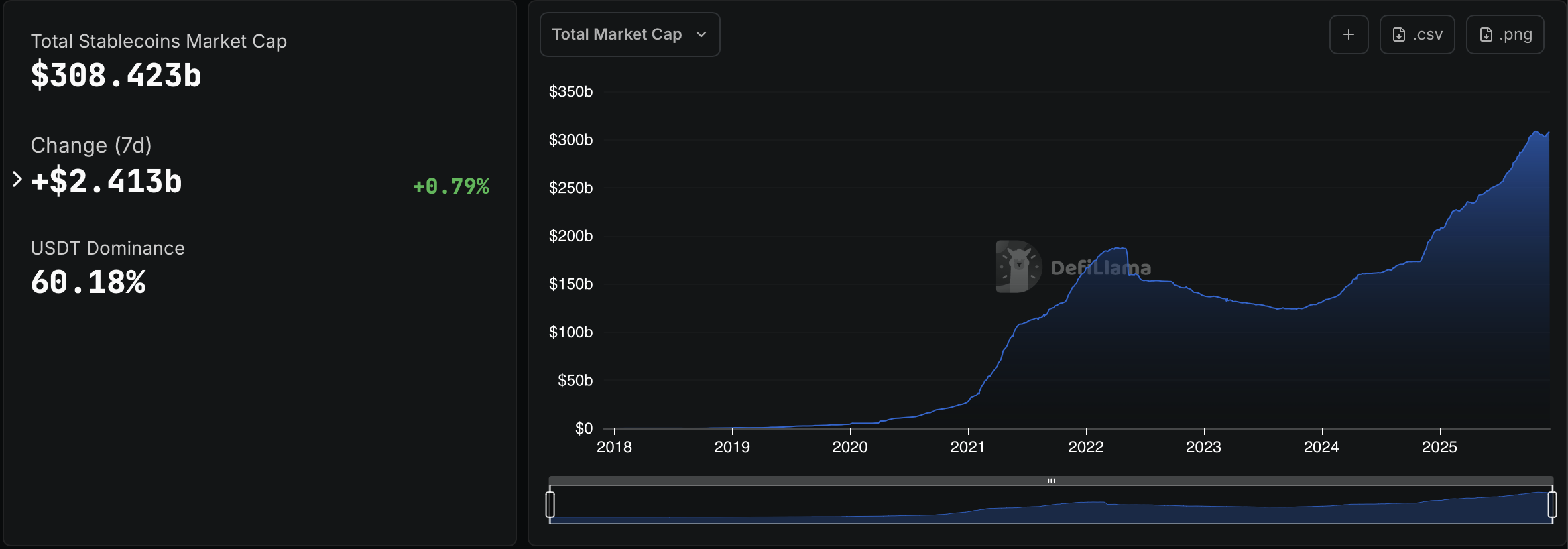
Stablecoin market capitalization. Source: DefiLlama

Magazine: 6 reasons Jack Dorsey is definitely Satoshi... and 5 reasons he’s not

Criptomoedas em alta

Leituras Relacionadas

2026 Mid-Year Report On-Chain RWA: Tokenized Stock Market Cap Doubles in a Year, But 90% of Rights Are Hollow Shells

The 2026 Mid-Year Report on On-Chain RWA highlights a significant growth in tokenized stock market capitalization, which nearly doubled from $951 million in March to $1.89 billion by July. However, the report reveals a fundamental contradiction in this "layer 2.5" ecosystem: products with the strongest legal foundation (like regulated U.S. infrastructure) lack liquidity and distribution, while freely tradable offshored wrapper products often lack substantive ownership rights. The increase is driven largely by a few products (SECZ, FGRS, STRCx) and platforms (Ondo, xStocks, Securitize collectively hold over 85% share). While distributed value across networks like Ethereum, Solana, and BNB Chain has grown, the market remains fragmented. Products referencing the same underlying asset (e.g., Apple stock) are distinct legal liabilities with different intermediaries and jurisdictional rules, offering varying degrees of legal claim. The report cautions that headline numbers are misleading, as they reflect changes in distributed token value—driven by issuance, conversions, and price movements—not pure investor inflows. True "canonical shares" with legal ownership, wide wallet distribution, institutional liquidity, and independent on-chain price discovery do not yet exist at scale. Tokenized treasuries show stronger product-market fit, and ETFs may be easier to scale than single stocks. The core takeaway is a trade-off: legal certainty versus liquidity and composability.

marsbitHá 49m

2026 Mid-Year Report On-Chain RWA: Tokenized Stock Market Cap Doubles in a Year, But 90% of Rights Are Hollow Shells

marsbitHá 49m

Coldcard Hardware Wallet Hacked: 594 Bitcoin Withdrawn in 25 Minutes

The Coldcard hardware wallet has been compromised, with hackers stealing approximately 594.5 Bitcoin (~$40 million) from 500 addresses in just 25 minutes. The root cause was a critical software bug, undetected for five years, which disabled the device's secure chip for generating true random numbers. This led to the creation of private keys based on predictable data like the processor's serial number, drastically reducing cryptographic security. The attackers exploited this offline by brute-forcing possible seed phrases, finding active addresses on the public ledger, and signing transactions. Initially, Coinkite (Coldcard's maker) claimed only older models were at risk but later admitted all devices running the compromised firmware were vulnerable. CEO Rodolphe Novak (NVK) apologized but ruled out financial compensation for affected users. To secure funds, owners must urgently update their firmware to specific safe versions, generate a completely new seed phrase on the updated device, and transfer all assets to new addresses created with that new seed. While a BIP-39 passphrase can help, it does not replace this migration process. Other Coinkite products like TAPSIGNER were not affected. This incident underscores that even specialized hardware requires rigorous, independent code audits, especially for cryptographic functions. It parallels past failures, like a 2006 OpenSSL bug in Debian, and raises questions about whether automated code analysis can ever fully replace human scrutiny in critical security areas.

cryptonews.ruHá 3h

Coldcard Hardware Wallet Hacked: 594 Bitcoin Withdrawn in 25 Minutes

cryptonews.ruHá 3h

Trading

Spot

Artigos em Destaque

Como comprar GAS

Bem-vindo à HTX.com!Tornámos a compra de GAS (GAS) simples e conveniente.Segue o nosso guia passo a passo para iniciar a tua jornada no mundo das criptos.Passo 1: cria a tua conta HTXUtiliza o teu e-mail ou número de telefone para te inscreveres numa conta gratuita na HTX.Desfruta de um processo de inscrição sem complicações e desbloqueia todas as funcionalidades.Obter a minha contaPasso 2: vai para Comprar Cripto e escolhe o teu método de pagamentoCartão de crédito/débito: usa o teu visa ou mastercard para comprar GAS (GAS) instantaneamente.Saldo: usa os fundos da tua conta HTX para transacionar sem problemas.Terceiros: adicionamos métodos de pagamento populares, como Google Pay e Apple Pay, para aumentar a conveniência.P2P: transaciona diretamente com outros utilizadores na HTX.Mercado de balcão (OTC): oferecemos serviços personalizados e taxas de câmbio competitivas para os traders.Passo 3: armazena teu GAS (GAS)Depois de comprar o teu GAS (GAS), armazena-o na tua conta HTX.Alternativamente, podes enviá-lo para outro lugar através de transferência blockchain ou usá-lo para transacionar outras criptomoedas.Passo 4: transaciona GAS (GAS)Transaciona facilmente GAS (GAS) no mercado à vista da HTX.Acede simplesmente à tua conta, seleciona o teu par de trading, executa as tuas transações e monitoriza em tempo real.Oferecemos uma experiência de fácil utilização tanto para principiantes como para traders experientes.

257 Visualizações TotaisPublicado em {updateTime}Atualizado em 2026.06.02

Como comprar GAS

Discussões

Bem-vindo à Comunidade HTX. Aqui, pode manter-se informado sobre os mais recentes desenvolvimentos da plataforma e obter acesso a análises profissionais de mercado. As opiniões dos utilizadores sobre o preço de GAS (GAS) são apresentadas abaixo.

活动图片













