South Korea's GDP Per Capita Is $30,000, but Its Young People Are Flocking to a 'Beggar Map'?

marsbitPublicado em 2026-08-05Última atualização em 2026-08-05

Resumo

Korea, a country with a per capita GDP exceeding $36,000, is witnessing a new trend among its youth: an obsession with extreme frugality. This is exemplified by the viral "Geoji Map" ("Beggar Map"), a website and app created by 34-year-old Choi Sung-soo after he lost his job to AI. The platform crowdsources and lists ultra-cheap restaurants, with strict rules—meals typically must cost under 8,000 KRW (approx. $6) and provide decent protein and vegetables. It gained 1.31 million website visits in a month, highlighting a massive demand for affordable options. This "jjantech" (frugal finance) movement extends beyond food. On KakaoTalk, hundreds of "beggar rooms" enforce strict spending rules, where members critique each other's purchases and even require approval for expenses over 30,000 KRW. Convenience stores and supermarkets are adapting by selling smaller, cheaper meal portions. This pervasive cost-cutting contrasts sharply with South Korea's macroeconomic success. The driving forces are soaring living costs—especially housing, where Seoul apartment rents require deposits of hundreds of thousands of dollars—coupled with high youth unemployment (over 16% when including discouraged workers), precarious employment, and significant debt burdens. Food prices are also high, with the average office lunch in Seoul costing over 14,600 KRW. The shift represents a deeper change in mindset. From the "YOLO" (You Only Live Once) spending of the 2010s, which used consumption to cope wit...

South Korean youth have recently invented a new way of dining: first open the "Beggar Map," filter nearby restaurants by price; once a single meal costs more than 8,000 won (37 yuan RMB) and has no meat or vegetables, it's immediately deemed "unworthy of the list."
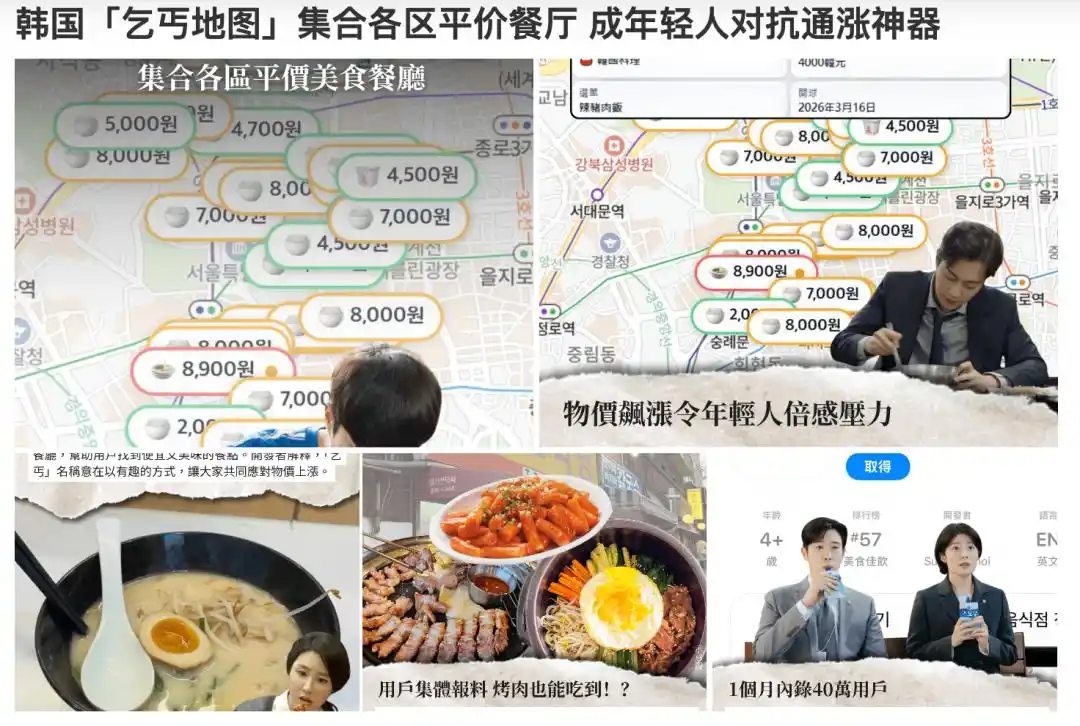
The developer of this map, Choi Seong-su, is 34 years old and lost his job due to the impact of the AI wave. Living on severance pay, he limited his daily food budget to 10,000 won. Later, using AI programming tools, he spent a weekend creating a website dedicated to finding cheap restaurants.

What made him unemployed was AI, and what helped him figure out "where to eat cheaply after becoming unemployed" was also AI—a closed-loop service in the making.

Within a month of its launch, the website reached 1.31 million visits; the app surpassed 21,000 downloads in 6 days. In a country with a GDP per capita exceeding $36,000, home to global giants like Samsung and Hyundai, "where to eat a 5,000-won meal today" has become a question studied by millions.

01: South Korean Youth Turn Saving Money into a Competitive Game

The official name of the "Beggar Map" is Geoji Map. There are no Michelin stars on this map, only prominent price figures: 3,000-won bibimbap, 3,900-won pasta, 4,000-won pork cutlet.
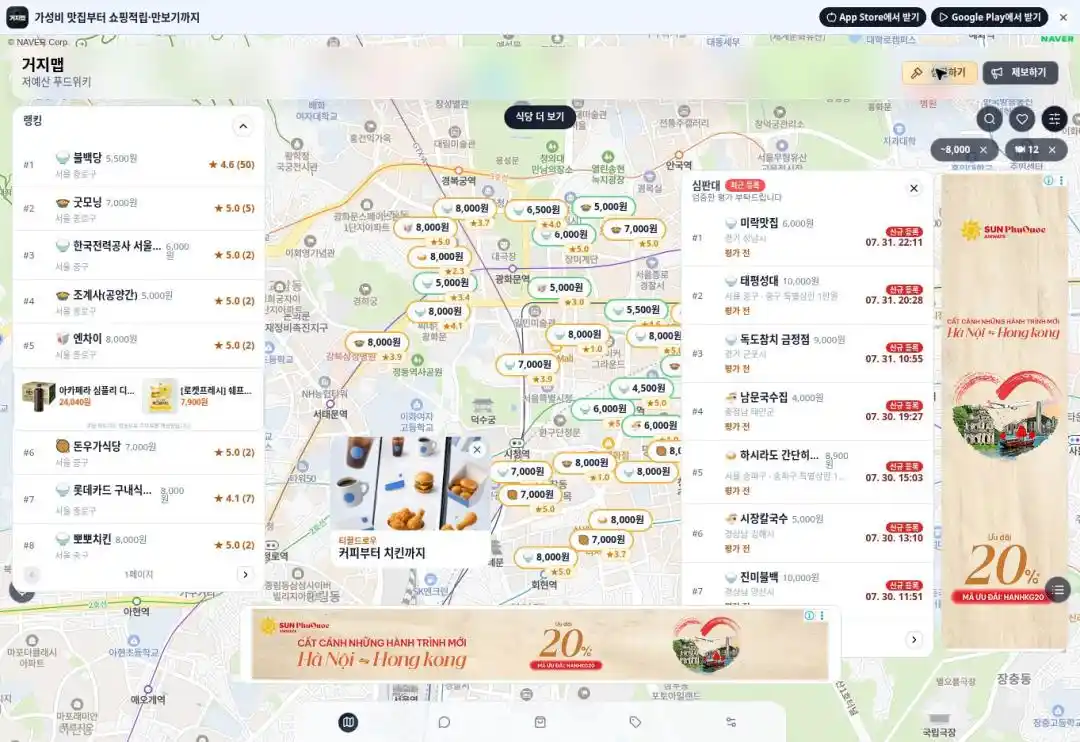
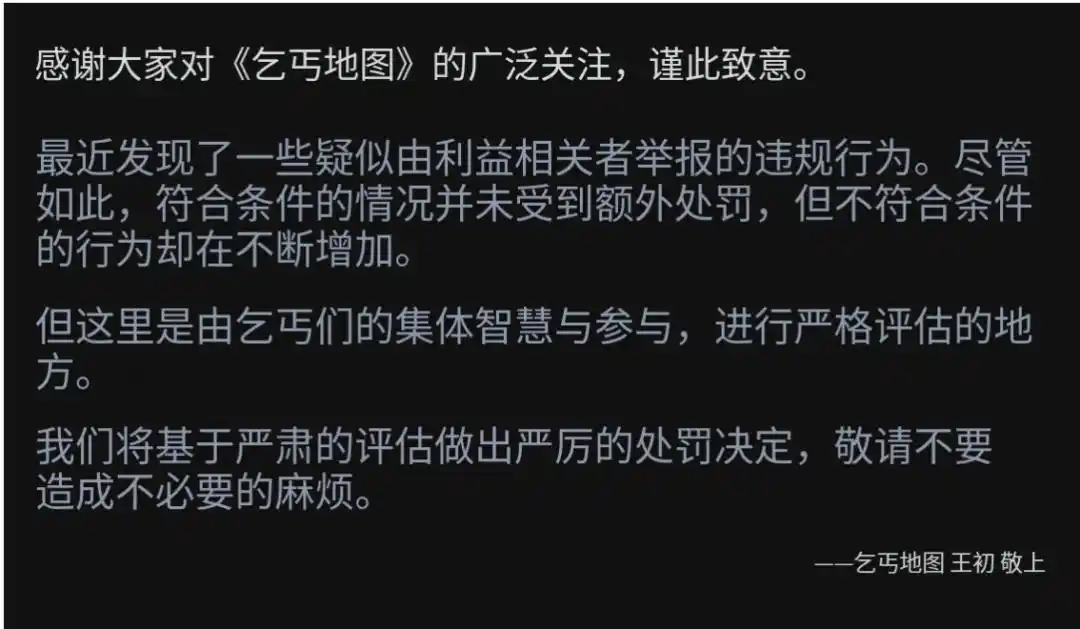
Its rules are stricter than many food guides. Initially, most areas used 8,000 won as the reference line, with high-consumption areas like Gangnam and Yeouido allowing up to 10,000 won; restaurants that exceed the price limit or use a single cheap side dish as a lure may be reported and removed by users.

Cheap isn't enough; the meal also has to be substantial. The platform emphasizes that "beggars also need" protein and dietary fiber. High-carb menus like noodles, if priced over 7,000 won, generally don't qualify; a meaty seolleongtang (ox bone soup) at the same price might pass. The platform's review rules carry a rigorous nutritional spirit of being poor but thorough.
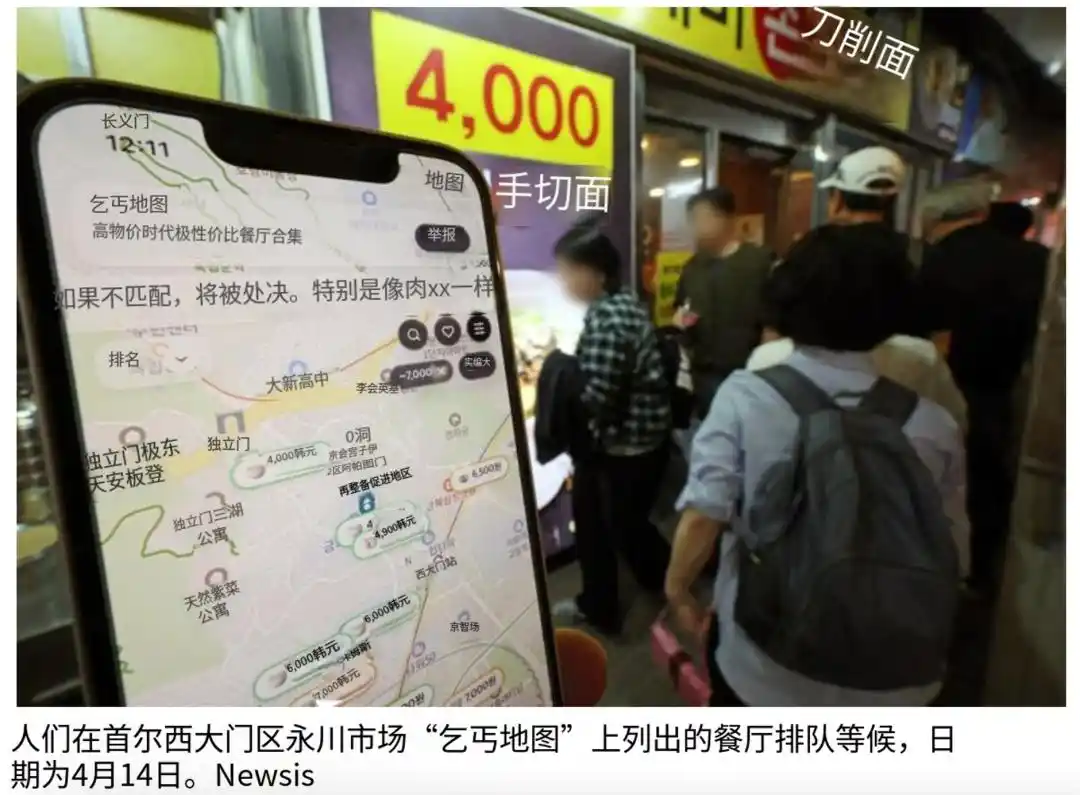
A pork cutlet shop in Sinchon, Seoul, charging only 4,000 won per portion, has long occupied a top spot on the map. Some diners, worried one piece wouldn't be enough, ordered two and ended up stuffed to the point of regret; others warned newcomers that water costs an extra 1,000 won at the shop, so true savings experts should bring their own. The list also includes a 9,500-won chicken and beer buffet. Taste, protein, free side dishes, and how much satiety you get per 1,000 won are all part of the review criteria. Food reviewing here has turned into folk cost engineering.

Restaurants are added, modified, and deleted collaboratively by users. Some upload menus, others add business hours, and some mark "mediocre hygiene." Businesses that use cheap dishes as bait to sell higher-priced items elsewhere are quickly reported. A group of highly vigilant wallets forms the internet's most difficult-to-fool review committee.

In Seoul, an average meal out easily reaches 12,000 won; finding something under 8,000 won already requires a dedicated search. Korean media recorded a 22-year-old female college student using the "Beggar Map" daily to find cheaper options than the school cafeteria. For small eateries, the map is like free advertising: without paying commissions to high-fee delivery platforms, lines form outside their doors.
Even before the "Beggar Map" appeared, South Korean youth had been rehearsing for three years in the social app KakaoTalk.

In 2023, numerous open group chats named "Beggar Rooms" became popular. Popular groups typically limit members to 300-500, with special "Standby Beggar Rooms" for when they're full. Members report daily expenses. Spending 3,000 won on an iced Americano gets you advised to drink from the office water cooler; wanting to take a bus for a 5.3 km trip gets told to trust your own legs; spending 40,000 won on a personal color test gets the suggestion to "hold a few colored papers next to your face and compare."

Some groups, like companies, have established complete rules: Spending over 30,000 won requires filling out an "Expense Application Form," answering if the item is necessary, whether it can be used weekly, if it has more than one purpose, and getting three group members to sign. Using paid emoticons can also get you kicked out, because cute emoticons stimulate spending; if you really want to use them, you have to draw your own. The person who spends the most each month must also write a 500-word reflection. According to Korean media statistics, there are hundreds of similar group chats on KakaoTalk.

This trend has a specific name: jjantech, often translated as "frugal finance," combining the word for frugality "jjan" with the term for finance management, jaetech. Young people study convenience store discounts, stack payment promotions, use gift cards to empty the fridge, and exchange steps for points.

24-year-old graduate student Jung Ye-eun walks whenever possible for trips under 40 minutes to save on transportation; 25-year-old job seeker Lee Ji-min reduces visits to her parents to save the roughly 100,000 won round-trip KTX ticket to Gimhae; 26-year-old Kim Se-rim walks 8,000 steps daily to exchange city app reward points for Seoul Pay to buy food. Someone spending 3,100 won on green tea bags gets immediate improvement suggestions from the group: brew each bag two or three times.

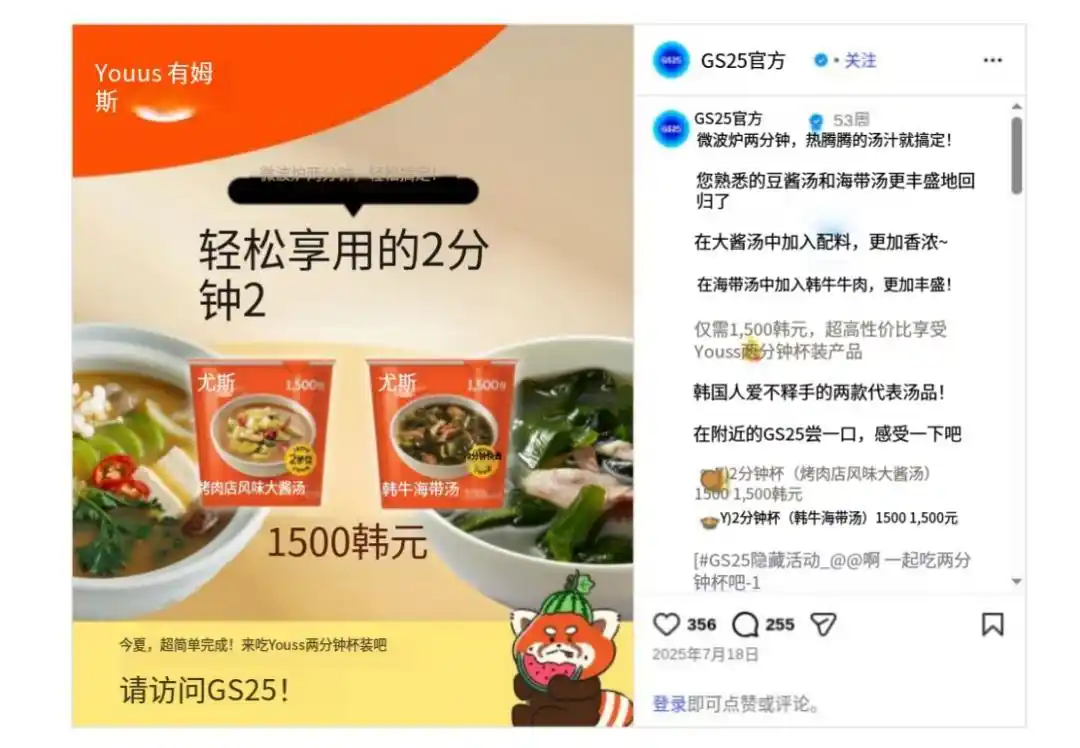
The consumer market quickly adapted. South Korea's largest convenience store chain, GS25, launched chilled cup rice meals for 3,000 to 5,000 won and instant soups for 1,500 won. In the first four months of 2026, sales grew by 33.8% and 167.4% year-on-year respectively. Supermarkets started selling 1kg bags of rice and single-meal portions of meat. Sales data shows young people care more about paying less today and whether food will spoil before they finish it.
From hunting for a 4,000-won pork cutlet to holding "consumption criticism sessions" over an iced Americano, it looks like a lively money-saving game. But behind it lies the increasingly tight living budget of South Koreans.

South Korea has already entered the ranks of developed countries with a GDP per capita over $30,000, so why do its young people have to split every few thousand won?

The answer lies in another map composed of wages, employment, housing prices, and debt.

02. How Did Young People in a Developed Country Become "Paupers"?

Looking at macro numbers, South Korea seems like a country where a "beggar lifestyle" shouldn't be popular.

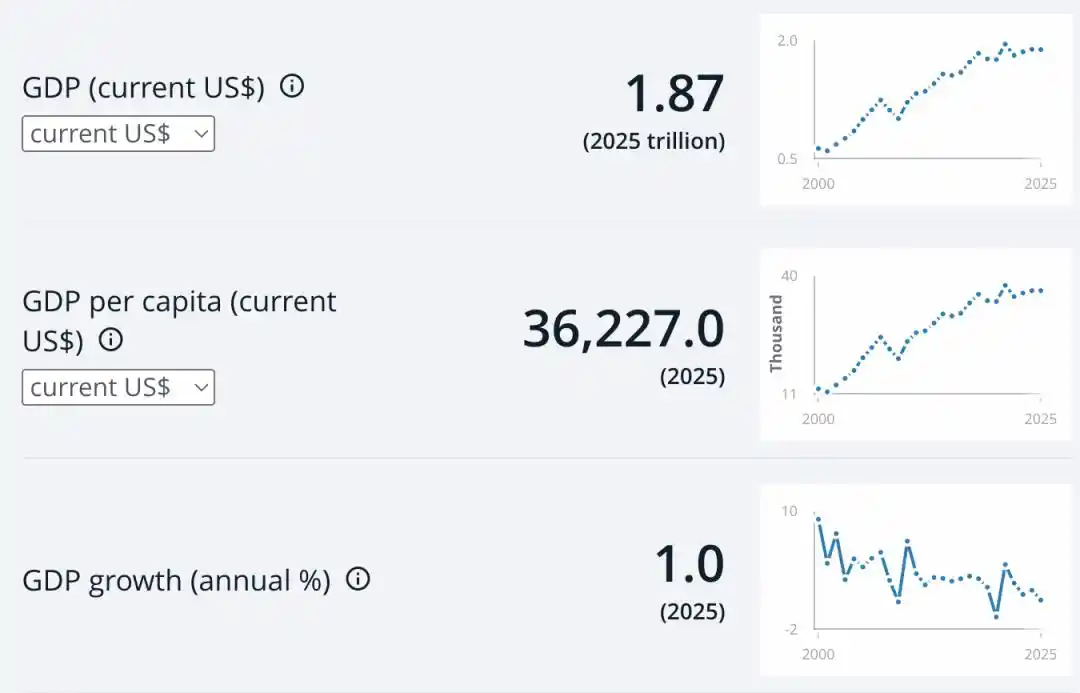
World Bank data shows South Korea's nominal GDP in 2025 was about $1.87 trillion, with a GDP per capita of $36,227; the IMF predicts it will rise to about $37,410 in 2026. It is Asia's fourth-largest economy, with mature industries in semiconductors, automobiles, shipbuilding, and chemicals. The World Bank's data on South Korea looks decent enough in any country profile.
Wage numbers don't look bad either. In 2026, the minimum hourly wage increased to 10,320 won (48 yuan RMB), equivalent to 2.157 million won per month based on 209 hours. The average nominal monthly wage for all workers in May, released by the Ministry of Employment and Labor, was 3.982 million won, about 19,000 yuan RMB.

The trouble lies beneath the average.

During the same period, the labor force participation rate for youth aged 15-29 fell to 47.2%; the employment rate dropped to 43.8%, with 255,000 fewer young people employed year-on-year; the unemployment rate rose to 7.2%. Including those preparing for jobs, those who have given up job hunting, and those wanting more work hours, the "extended unemployment rate" reached 16.6%. Surveys by Statistics Korea show the youth labor force is shrinking faster than the total population.
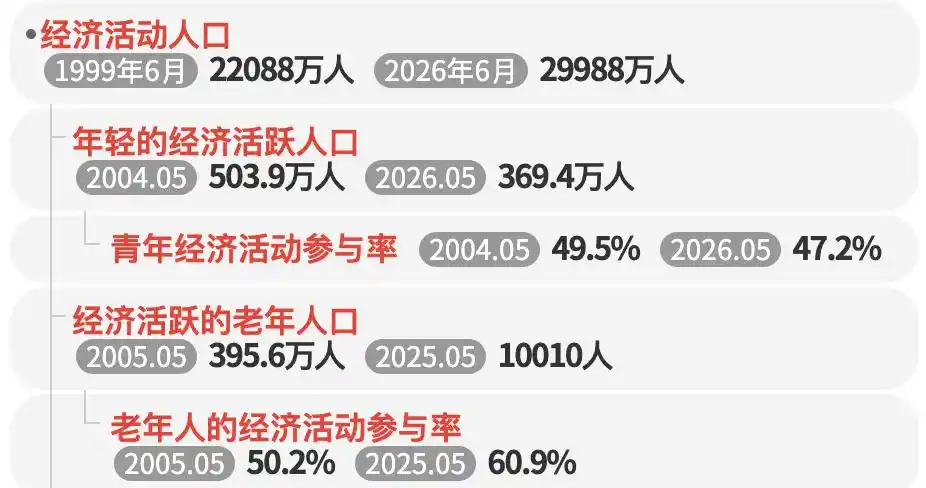
A university degree is no longer a guaranteed ticket. In Q2 2026, the number of unemployed South Koreans with college education or above reached 481,000, with those in their 20s and 30s accounting for 64.2%. Among youth aged 15-29 who have left school and are currently unemployed, 48.6% have been jobless for over a year—about 605,000 people; 19.4% have been unemployed for over three years. A July survey also showed it takes an average of 11.2 months for young people to find their first paid job.

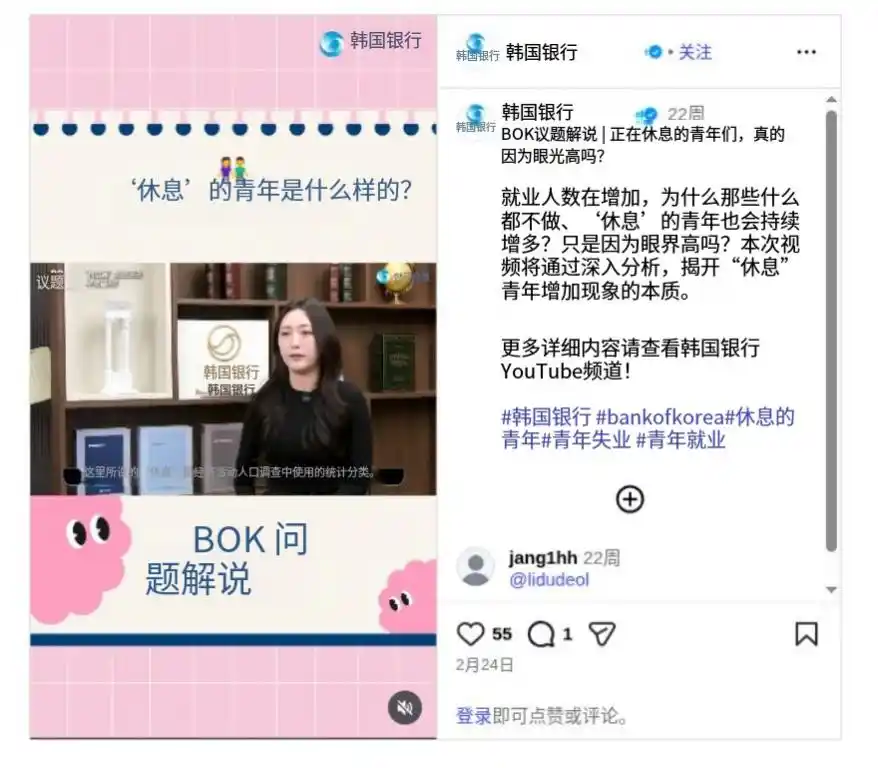
The first job is also hard to keep stable. Monthly salaries most commonly fall between 2 and 3 million won, with an average tenure of just 1 year and 6.8 months; among those who leave, 44.4% cite wages, working hours, and other labor conditions as the primary reason. The Bank of Korea also found that among the economically inactive population aged 20-34, the proportion "resting" increased from 14.6% in 2019 to 22.3% in 2025, with 450,000 explicitly stating they don't want to work. Many have work experience, making it hard to explain simply as being "choosy."
This disconnect has given rise to a term in the South Korean job market that sounds like a second-hand item: "중고신입" (jung-go-sin-ip), or "second-hand newbie"—someone who has worked for a while but is re-entering the job market as a fresh graduate.

Even if one can work steadily, housing in Seoul feels like a commodity priced in a different system.

In July 2026, the average selling price of an apartment in Seoul approached 1.595 billion won (7.46 million yuan RMB). South Korea also has a unique "jeonse" system: instead of monthly rent, the tenant pays a huge lump-sum deposit, refunded by the landlord when the lease ends. Now, the average jeonse deposit for a Seoul apartment has exceeded 700 million won.
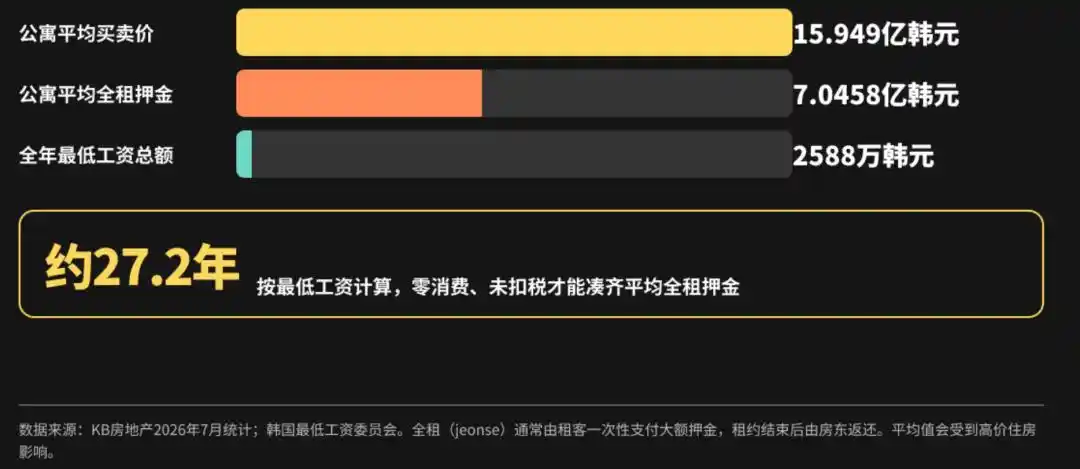
For most young people entering society, 700 million won is out of reach. At the 2026 minimum wage, someone would have to work for about 27 years without spending a penny to save that deposit. In reality, many young people end up in "gosiwons"—micro-rooms originally meant for exam takers that have become residences for low-income earners.

Late last year, a Korean journalist visited a gosiwon in Jongno, Seoul. A room about to be rented to someone in their 20s was only 2.85 square meters, with a bed 1.9 meters long and 1.5 meters wide. When lying down, your feet go under the desk, and either your head or feet still touch the wall.

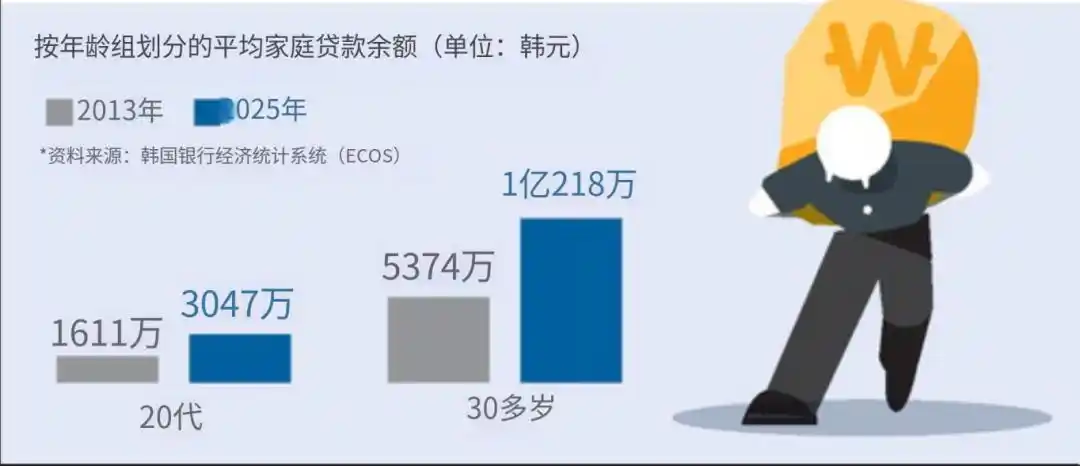
Housing is out of reach, but debt is getting closer. The average household loan for people in their 20s increased from 16.11 million won in 2013 to 30.47 million in 2025; for those in their 30s, it rose from 53.74 million to 102.18 million. Combined, these two groups saw an 89.9% increase, nearly doubling in 12 years.
The final pressure comes from food, which is unavoidable every day.

In the spring of 2026, the retail price of a 20kg bag of rice stayed above 60,000 won (280 yuan RMB) for eight consecutive months; in early May, domestic pork belly cost about 2,811 won per 100g, up 12.9% year-on-year. According to the "modified Engel coefficient," which combines food and dining out expenses, it reached 30.3% in 2025—the first time South Korea crossed the 30% mark in 31 years. This data means that for every 100 won a South Korean spends, 30 goes toward food.

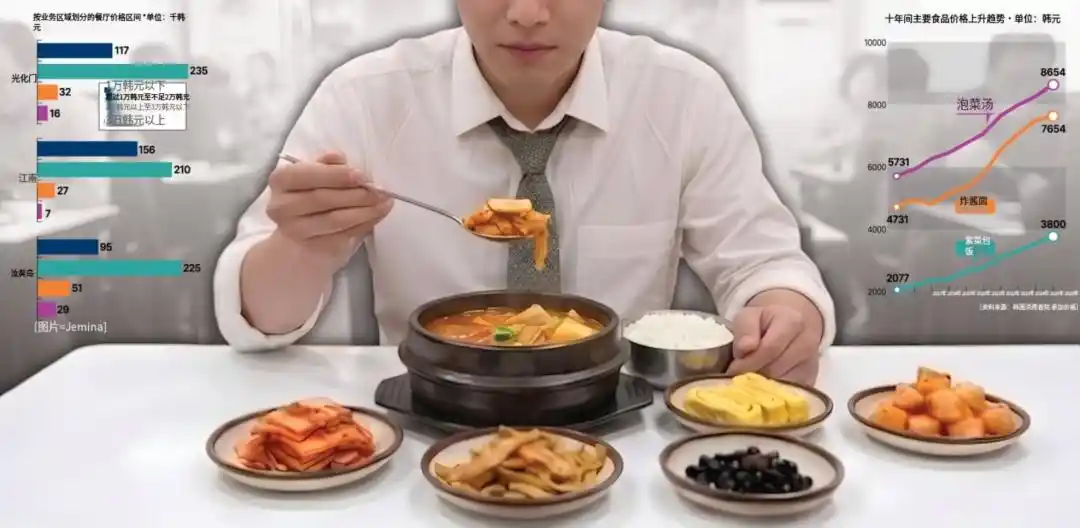
Korean media surveyed about 1,200 restaurants around three major office districts in Seoul: Gwanghwamun, Yeouido, and Gangnam. The average lunch price was 14,635 won. At the then-minimum hourly wage, someone had to work about 1 hour and 25 minutes to afford an ordinary lunch.
Around 2015, South Korean youth began using "Hell Joseon" to mock job competition, class rigidity, and high housing prices. More than a decade later, GDP per capita has climbed another notch, but "Hell Joseon" hasn't faded from the lexicon.

This is the gap between South Korea's two sets of accounts.

The national account shows a GDP per capita over $36,000, booming AI chip exports, and upgraded growth expectations. The young people's account shows unemployment, high rent, high debt, and high prices. The former proves South Korea is still wealthy; the latter determines how freely young people spend today.

When an ordinary lunch requires over an hour's wage, saving a few thousand won becomes meaningful. A decade ago, South Korean youth facing stress swiped cards for bags and shouted "live for the moment." Now, they walk five kilometers to save on transportation. Wallet usage has changed, and so has their judgment of the future.

03. From Living for the Moment to the "Beggar Generation"

South Korean society once held a very solid belief in the future.

From the 1960s to the 1990s, the "Miracle on the Han River" transformed a war-torn agricultural country into an industrial powerhouse. South Korea's average annual GDP growth was 8.5% in the 60s, 7.7% in the 70s, and 9.1% in the 80s. Factory expansion, export growth, and urbanization happened simultaneously. Many families saw refrigerators, cars, and apartments become staples of middle-class life.

This period left a simple intergenerational contract: Study hard, get into a large corporation, work long-term, let wages grow with seniority, and finally own a home. The parent generation saved because they believed enduring a few years would bring a wealthier tomorrow.

By the 2010s, this contract was loosening. Economic growth slowed, Seoul housing prices soared, big corporate hiring thresholds rose, and young people began calling themselves the "Sam-po Generation" (giving up three things), "O-po Generation" (five things), successively abandoning dating, marriage, childbirth, homeownership, and social relationships.
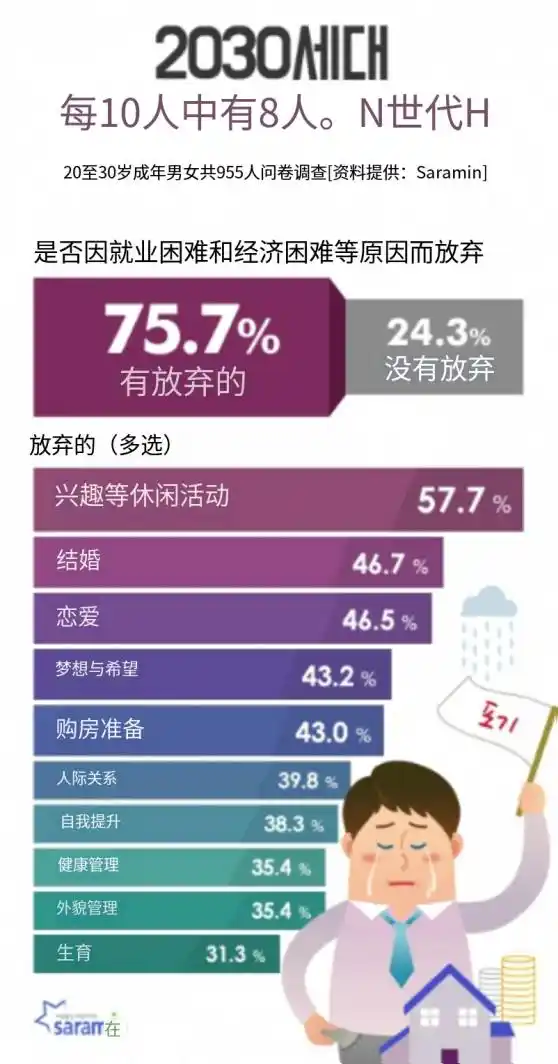
Back then, the residual warmth of the parents' growth era remained, and consumption and social media offered instant gratification. YOLO (You Only Live Once) gained a strong following.

The South Korean version of YOLO actually contained two mindsets. Some still believed future income would increase and were willing to spend ahead; others already doubted that savings could buy a home or achieve class mobility, so they traded distant big goals for a trip, a fancy meal, or a brand-name bag. The latter logic was almost pessimistic: Since saving for a down payment is like filling the sea with a spoon, at least buy some respectability you can afford today.

But this lifestyle of compensating for a distant future with present consumption had a hidden premise: Maybe you can't afford a house, but next month's salary will arrive on time, right?

Entering the 2020s, the pandemic, high inflation, high interest rates, shrinking hiring, and AI replacement anxiety arrived in succession. "Anything can go wrong anytime" gradually became the psychological backdrop for South Korean youth. High consumption became harder to sustain, and YOLO gave way to YONO—You Only Need One.
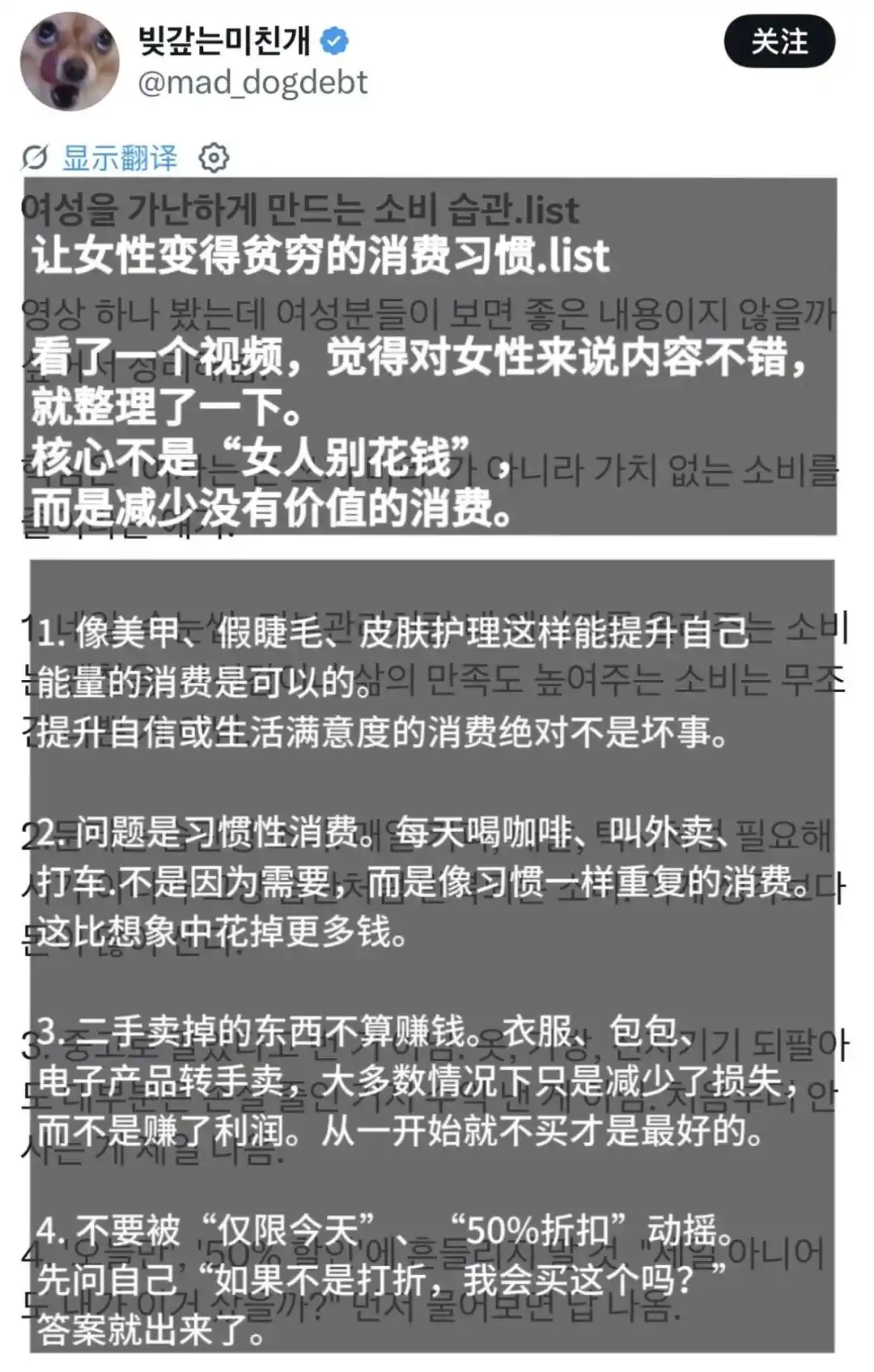
YONO emphasizes cutting unnecessary spending, paying only for things truly needed and used long-term. Many young people cut back on weekday coffee, dining out, and transport costs, but might still splurge on a trip or an item they genuinely love. The desire to consume hasn't disappeared; it's just concentrated on a few key targets.

Now, the Beggar Map pushes YONO to a more extreme version: even a single meal must pass a triple check of price, nutrition, and satiety.

From YOLO to YONO, to Beggar Rooms and the Beggar Map, the slogans of South Korean youth may seem to zigzag, but the core demand hasn't changed: To reclaim a bit of agency on an increasingly unpredictable life path.

Living for the moment uses consumption to prove "today belongs to me"; extreme saving uses the remaining balance to prove "there's still a way out tomorrow."

YOLO and YONO seem opposite, but they tackle the same puzzle: when long-term planning becomes harder, how should one arrange today. Some trade money for immediate experience; others keep money in the account for breathing room. Consumption patterns changed, but the need for a sense of certainty never disappeared.

The beggar lifestyle is the solution millions of South Koreans have rediscovered: breaking down overwhelming economic uncertainty into one meal, one bus ride, one day's budget. The 4,000-won pork cutlet, points earned from 8,000 steps, the tea bag brewed a third time—all make life tangible again. The future is still hard to predict, but at least how to spend today, they can still decide for themselves.

This article is from the WeChat public account "Cool Play Lab," author: Cool Play Lab

Criptomoedas em alta

Perguntas relacionadas

QWhat is the purpose of the 'Geoji Map' (乞丐地图) created by Choi Sung-soo, and how is it used by young people in South Korea?

AThe 'Geoji Map' is a website and app created by Choi Sung-soo to help people find extremely cheap restaurants. It filters nearby eateries by price, typically excluding meals costing over 8000 KRW (approx. 37 RMB) if they lack protein and vegetables. Users collaboratively add, review, and maintain listings based on strict criteria like cost, nutritional value, and satiety. It helps young Koreans, facing economic pressures like high living costs and unemployment, stretch their daily budgets by finding affordable meal options.

QHow does the article explain the paradox of young Koreans adopting 'beggar life' trends despite South Korea's high per capita GDP?

AThe article explains that while South Korea's macroeconomic indicators like a per capita GDP over $36,000 appear strong, many young people face significant personal economic hardships. These include high youth unemployment rates, precarious employment (like short-term contracts), soaring housing costs (especially in Seoul), rising personal debt, and increasing food prices. The 'beggar life' trends like the Geoji Map and 'jjantech' (frugal finance) are practical responses to this gap between national wealth and individual financial strain.

QWhat are some examples of 'jjantech' or frugal financial practices mentioned in the article?

AExamples of 'jjantech' practices include: using KakaoTalk 'beggar room' chat groups where members scrutinize each other's spending and require approval for purchases over 30,000 KRW; walking instead of using public transport for short trips; reusing tea bags multiple times; exchanging steps walked for municipal reward points (Seoul Pay) to buy food; and purchasing single-portion groceries to avoid waste. Convenience stores have also adapted by selling affordable ready-to-eat meals to cater to this demand.

QAccording to the article, how has the mindset of South Korean youth towards consumption and the future shifted from the 2010s to the 2020s?

AIn the 2010s, the 'YOLO' (You Only Live Once) mindset was prevalent, where young people spent on immediate experiences and luxury goods, either due to belief in future income growth or as compensation for feeling that long-term goals like home ownership were unattainable. By the 2020s, facing successive crises (pandemic, inflation, AI job displacement), the mindset shifted to 'YONO' (You Only Need One), focusing on cutting unnecessary spending for essentials. This has further evolved into the extreme frugality of the 'beggar generation,' where every small expense is meticulously calculated to maintain control and security in an uncertain future.

QWhat specific economic pressures on young Koreans are highlighted as reasons for the popularity of frugal living?

AThe article highlights several key economic pressures: 1) High youth unemployment and underemployment, with many graduates struggling to find stable, well-paying jobs. 2) Skyrocketing housing costs in Seoul, where apartment prices and 'jeonse' (lump-sum deposit) rents are prohibitively high. 3) Increasing levels of personal debt among people in their 20s and 30s. 4) Rising food and living costs, with a significant portion of income spent just on meals (a high 'modified Engel coefficient'). These factors collectively make saving even small amounts of money a critical daily concern.

Leituras Relacionadas

He Was the Hero of Shanghai's Two Major Industries, Yet Passed Away Quietly in Regret

He was a pivotal figure in the development of two major Shanghai industries—semiconductors and commercial aircraft—yet passed away in quiet regret. Jiang Shangzhou, son of a veteran revolutionary and a Swiss-educated technocrat, became Deputy Director of the Shanghai Economic Commission in 1997. Tasked with identifying strategic industries, he championed integrated circuits (ICs) despite a climate of skepticism. Countering a national plan for just two 8-inch chip production lines, he boldly declared Shanghai would build ten within five years. He masterminded the Zhangjiang microelectronics zone, personally recruited top talent like Morris Chang, and helped establish SMIC. Through innovative financing that circumvented Western embargoes, SMIC grew rapidly, with Shanghai exceeding its target by building 18 lines. Simultaneously, while battling lung cancer, Jiang led the push for China's large commercial aircraft program as head of a state major projects panel. He argued it was a strategic imperative that would drive advancements across multiple industries. His relentless advocacy culminated in the 2006 state approval that paved the way for the C919. Jiang's career was marked by foresight often deemed too超前. Earlier postings in Sanya and Yangpu saw his ideas for tourism and economic reform initially rejected, only to be validated years later. In 2009, he became Chairman of the embattled SMIC. Despite his deteriorating health, he steered the company until his death in 2011, leaving a final insight for the chip industry: China need not master every process but must lead in key areas. He did not live to see the C919 fly or SMIC's full recovery, but his foundational work made Shanghai a national leader in both semiconductors and aerospace. Colleagues remembered him as a visionary whose impact shaped the three decades that followed.

marsbitHá 8m

He Was the Hero of Shanghai's Two Major Industries, Yet Passed Away Quietly in Regret

marsbitHá 8m

Illustrating the Cloudflare Wallet: The New Player in Stablecoin Payments Using x402

On August 4th, Cloudflare announced the launch of "Wallets," though the initial offering is limited to claiming a user handle. Full functionality for topping up, making payments, and using a Virtual Wallet via API keys is marked "Soon." The announcement clarifies that this handle is not yet a functional wallet. It represents a key piece in Cloudflare's broader payments strategy, alongside the Stripe Projects service (currently in open beta for agent-assisted purchases) and the Monetization Gateway for merchants (on a waitlist). The Wallet is positioned as the payer-side component for managing identity, balances, and authorization rules. While the underlying x402 protocol shows activity (75.41 million transactions, $24.24M volume in 30 days, averaging ~$0.32 per transaction), this data reflects the open network's usage, not specifically Cloudflare Wallet adoption. These metrics indicate suitability for frequent micro-payments like API calls. Cloudflare's documentation uses a $0.01 per-call example to illustrate the x402 flow: a server returns HTTP 402, the agent signs the payment, a facilitator verifies it, and the server delivers the result. Currently, developers must manage private keys and use test networks/USDC for agent payments. The Wallet roadmap aims to separate the user's Account Wallet from an agent's Virtual Wallet, adding controls for spending limits, whitelists, and per-transaction caps. This design resembles a corporate card with approval rules. However, these controls are not yet available for configuration. In summary, Cloudflare Wallet's current launch is a preliminary step. Critical details like supported stablecoins, blockchains, regions, KYC, custody, and fees remain undisclosed. The announcement primarily establishes a payer identity framework, with the full payment and agent autonomy system still under development.

marsbitHá 29m

Illustrating the Cloudflare Wallet: The New Player in Stablecoin Payments Using x402

marsbitHá 29m

Report: DeepSeek Resumes Financing, Pre-money Valuation at 500 Billion Yuan

Several transaction sources revealed to Caijing that AI company DeepSeek has restarted its second round of financing, aiming to raise 50 billion yuan with a pre-money valuation of approximately 500 billion yuan. The signing is planned for late August. DeepSeek completed its first funding round of 50 billion yuan in June with a valuation over 350 billion yuan, marking the largest first-round financing in China's AI large model history. The second round was reportedly paused in late July, partly due to the founder's dissatisfaction with leaked investor meeting details circulating online. It has since been restarted with a desire for a more discreet process. The second-round valuation represents a 43% increase from the first round. If successful, DeepSeek will have raised over 100 billion yuan across both rounds. Investor interest remains high; the first round saw over 100 billion yuan in expressed intent, leaving significant unmet demand. DeepSeek's fundraising scale surpasses competitors like Moonshot AI, which recently raised funds at a $31.5 billion valuation and is planning a Pre-IPO round. Market pricing for these model companies is seen more as an "option" on reaching AGI rather than based on traditional financial metrics. Regarding model development, DeepSeek recently publicly tested the DeepSeek-V4-Flash official version in late July, featuring enhanced Agent capabilities and strong performance on benchmarks. It follows a high-value, low-cost strategy, with its pricing being competitive against rivals like Zhipu GLM-5.2 and OpenAI's GPT-4o. On the OpenRouter platform, DeepSeek-V4-Flash recently ranked first in weekly token consumption. The company faces pressure in training new models, and the release timeline for the V4-Pro official version remains unannounced.

marsbitHá 1h

Report: DeepSeek Resumes Financing, Pre-money Valuation at 500 Billion Yuan

marsbitHá 1h

Trading

Spot

Artigos em Destaque

O que é $S$

Compreender o SPERO: Uma Visão Abrangente Introdução ao SPERO À medida que o panorama da inovação continua a evoluir, o surgimento de tecnologias web3 e projetos de criptomoeda desempenha um papel fundamental na formação do futuro digital. Um projeto que tem atraído atenção neste campo dinâmico é o SPERO, denotado como SPERO,$$s$. Este artigo tem como objetivo reunir e apresentar informações detalhadas sobre o SPERO, para ajudar entusiastas e investidores a compreender as suas bases, objetivos e inovações nos domínios web3 e cripto. O que é o SPERO,$$s$? O SPERO,$$s$ é um projeto único dentro do espaço cripto que procura aproveitar os princípios da descentralização e da tecnologia blockchain para criar um ecossistema que promove o envolvimento, a utilidade e a inclusão financeira. O projeto é concebido para facilitar interações peer-to-peer de novas maneiras, proporcionando aos utilizadores soluções e serviços financeiros inovadores. No seu núcleo, o SPERO,$$s$ visa capacitar indivíduos ao fornecer ferramentas e plataformas que melhoram a experiência do utilizador no espaço das criptomoedas. Isso inclui a possibilidade de métodos de transação mais flexíveis, a promoção de iniciativas impulsionadas pela comunidade e a criação de caminhos para oportunidades financeiras através de aplicações descentralizadas (dApps). A visão subjacente do SPERO,$$s$ gira em torno da inclusão, visando fechar lacunas dentro das finanças tradicionais enquanto aproveita os benefícios da tecnologia blockchain. Quem é o Criador do SPERO,$$s$? A identidade do criador do SPERO,$$s$ permanece algo obscura, uma vez que existem recursos publicamente disponíveis limitados que fornecem informações detalhadas sobre o(s) seu(s) fundador(es). Esta falta de transparência pode resultar do compromisso do projeto com a descentralização—uma ética que muitos projetos web3 partilham, priorizando contribuições coletivas em vez de reconhecimento individual. Ao centrar as discussões em torno da comunidade e dos seus objetivos coletivos, o SPERO,$$s$ incorpora a essência do empoderamento sem destacar indivíduos específicos. Assim, compreender a ética e a missão do SPERO é mais importante do que identificar um criador singular. Quem são os Investidores do SPERO,$$s$? O SPERO,$$s$ é apoiado por uma diversidade de investidores que vão desde capitalistas de risco a investidores-anjo dedicados a promover a inovação no setor cripto. O foco desses investidores geralmente alinha-se com a missão do SPERO—priorizando projetos que prometem avanço tecnológico social, inclusão financeira e governança descentralizada. Essas fundações de investidores estão tipicamente interessadas em projetos que não apenas oferecem produtos inovadores, mas que também contribuem positivamente para a comunidade blockchain e os seus ecossistemas. O apoio desses investidores reforça o SPERO,$$s$ como um concorrente notável no domínio em rápida evolução dos projetos cripto. Como Funciona o SPERO,$$s$? O SPERO,$$s$ emprega uma estrutura multifacetada que o distingue de projetos de criptomoeda convencionais. Aqui estão algumas das características-chave que sublinham a sua singularidade e inovação: Governança Descentralizada: O SPERO,$$s$ integra modelos de governança descentralizada, capacitando os utilizadores a participar ativamente nos processos de tomada de decisão sobre o futuro do projeto. Esta abordagem promove um sentido de propriedade e responsabilidade entre os membros da comunidade. Utilidade do Token: O SPERO,$$s$ utiliza o seu próprio token de criptomoeda, concebido para servir várias funções dentro do ecossistema. Esses tokens permitem transações, recompensas e a facilitação de serviços oferecidos na plataforma, melhorando o envolvimento e a utilidade gerais. Arquitetura em Camadas: A arquitetura técnica do SPERO,$$s$ suporta modularidade e escalabilidade, permitindo a integração contínua de funcionalidades e aplicações adicionais à medida que o projeto evolui. Esta adaptabilidade é fundamental para manter a relevância no panorama cripto em constante mudança. Envolvimento da Comunidade: O projeto enfatiza iniciativas impulsionadas pela comunidade, empregando mecanismos que incentivam a colaboração e o feedback. Ao nutrir uma comunidade forte, o SPERO,$$s$ pode melhor atender às necessidades dos utilizadores e adaptar-se às tendências do mercado. Foco na Inclusão: Ao oferecer taxas de transação baixas e interfaces amigáveis, o SPERO,$$s$ visa atrair uma base de utilizadores diversificada, incluindo indivíduos que anteriormente podem não ter participado no espaço cripto. Este compromisso com a inclusão alinha-se com a sua missão abrangente de empoderamento através da acessibilidade. Cronologia do SPERO,$$s$ Compreender a história de um projeto fornece insights cruciais sobre a sua trajetória de desenvolvimento e marcos. Abaixo está uma cronologia sugerida que mapeia eventos significativos na evolução do SPERO,$$s$: Fase de Conceituação e Ideação: As ideias iniciais que formam a base do SPERO,$$s$ foram concebidas, alinhando-se de perto com os princípios de descentralização e foco na comunidade dentro da indústria blockchain. Lançamento do Whitepaper do Projeto: Após a fase conceitual, um whitepaper abrangente detalhando a visão, os objetivos e a infraestrutura tecnológica do SPERO,$$s$ foi lançado para atrair o interesse e o feedback da comunidade. Construção da Comunidade e Primeiros Envolvimentos: Esforços ativos de divulgação foram feitos para construir uma comunidade de primeiros adotantes e investidores potenciais, facilitando discussões em torno dos objetivos do projeto e angariando apoio. Evento de Geração de Tokens: O SPERO,$$s$ realizou um evento de geração de tokens (TGE) para distribuir os seus tokens nativos a apoiantes iniciais e estabelecer liquidez inicial dentro do ecossistema. Lançamento da dApp Inicial: A primeira aplicação descentralizada (dApp) associada ao SPERO,$$s$ foi lançada, permitindo que os utilizadores interagissem com as funcionalidades principais da plataforma. Desenvolvimento Contínuo e Parcerias: Atualizações e melhorias contínuas nas ofertas do projeto, incluindo parcerias estratégicas com outros players no espaço blockchain, moldaram o SPERO,$$s$ em um jogador competitivo e em evolução no mercado cripto. Conclusão O SPERO,$$s$ é um testemunho do potencial do web3 e das criptomoedas para revolucionar os sistemas financeiros e capacitar indivíduos. Com um compromisso com a governança descentralizada, o envolvimento da comunidade e funcionalidades inovadoras, abre caminho para um panorama financeiro mais inclusivo. Como em qualquer investimento no espaço cripto em rápida evolução, potenciais investidores e utilizadores são incentivados a pesquisar minuciosamente e a envolver-se de forma ponderada com os desenvolvimentos em curso dentro do SPERO,$$s$. O projeto demonstra o espírito inovador da indústria cripto, convidando a uma exploração mais aprofundada das suas inúmeras possibilidades. Embora a jornada do SPERO,$$s$ ainda esteja a desenrolar-se, os seus princípios fundamentais podem, de facto, influenciar o futuro de como interagimos com a tecnologia, as finanças e uns com os outros em ecossistemas digitais interconectados.

281 Visualizações TotaisPublicado em {updateTime}Atualizado em 2024.12.17

O que é $S$

O que é AGENT S

Agent S: O Futuro da Interação Autónoma no Web3 Introdução No panorama em constante evolução do Web3 e das criptomoedas, as inovações estão constantemente a redefinir a forma como os indivíduos interagem com plataformas digitais. Um projeto pioneiro, o Agent S, promete revolucionar a interação humano-computador através do seu framework aberto e agente. Ao abrir caminho para interações autónomas, o Agent S visa simplificar tarefas complexas, oferecendo aplicações transformadoras em inteligência artificial (IA). Esta exploração detalhada irá aprofundar-se nas complexidades do projeto, nas suas características únicas e nas implicações para o domínio das criptomoedas. O que é o Agent S? O Agent S é um framework aberto e agente, especificamente concebido para abordar três desafios fundamentais na automação de tarefas computacionais: Aquisição de Conhecimento Específico de Domínio: O framework aprende inteligentemente a partir de várias fontes de conhecimento externas e experiências internas. Esta abordagem dupla capacita-o a construir um rico repositório de conhecimento específico de domínio, melhorando o seu desempenho na execução de tarefas. Planeamento ao Longo de Longos Horizontes de Tarefas: O Agent S emprega planeamento hierárquico aumentado por experiência, uma abordagem estratégica que facilita a decomposição e execução eficientes de tarefas intrincadas. Esta característica melhora significativamente a sua capacidade de gerir múltiplas subtarefas de forma eficiente e eficaz. Gestão de Interfaces Dinâmicas e Não Uniformes: O projeto introduz a Interface Agente-Computador (ACI), uma solução inovadora que melhora a interação entre agentes e utilizadores. Utilizando Modelos de Linguagem Multimodais de Grande Escala (MLLMs), o Agent S pode navegar e manipular diversas interfaces gráficas de utilizador de forma fluida. Através destas características pioneiras, o Agent S fornece um framework robusto que aborda as complexidades envolvidas na automação da interação humana com máquinas, preparando o terreno para uma infinidade de aplicações em IA e além. Quem é o Criador do Agent S? Embora o conceito de Agent S seja fundamentalmente inovador, informações específicas sobre o seu criador permanecem elusivas. O criador é atualmente desconhecido, o que destaca ou o estágio nascente do projeto ou a escolha estratégica de manter os membros fundadores em anonimato. Independentemente da anonimidade, o foco permanece nas capacidades e no potencial do framework. Quem são os Investidores do Agent S? Como o Agent S é relativamente novo no ecossistema criptográfico, informações detalhadas sobre os seus investidores e financiadores não estão explicitamente documentadas. A falta de informações disponíveis publicamente sobre as fundações de investimento ou organizações que apoiam o projeto levanta questões sobre a sua estrutura de financiamento e roteiro de desenvolvimento. Compreender o apoio é crucial para avaliar a sustentabilidade do projeto e o seu impacto potencial no mercado. Como Funciona o Agent S? No núcleo do Agent S reside uma tecnologia de ponta que lhe permite funcionar eficazmente em diversos ambientes. O seu modelo operacional é construído em torno de várias características-chave: Interação Humano-Computador Semelhante: O framework oferece planeamento avançado em IA, esforçando-se para tornar as interações com computadores mais intuitivas. Ao imitar o comportamento humano na execução de tarefas, promete elevar as experiências dos utilizadores. Memória Narrativa: Utilizada para aproveitar experiências de alto nível, o Agent S utiliza memória narrativa para acompanhar os históricos de tarefas, melhorando assim os seus processos de tomada de decisão. Memória Episódica: Esta característica fornece aos utilizadores orientações passo a passo, permitindo que o framework ofereça suporte contextual à medida que as tarefas se desenrolam. Suporte para OpenACI: Com a capacidade de funcionar localmente, o Agent S permite que os utilizadores mantenham o controlo sobre as suas interações e fluxos de trabalho, alinhando-se com a ética descentralizada do Web3. Fácil Integração com APIs Externas: A sua versatilidade e compatibilidade com várias plataformas de IA garantem que o Agent S possa integrar-se perfeitamente em ecossistemas tecnológicos existentes, tornando-o uma escolha apelativa para desenvolvedores e organizações. Estas funcionalidades contribuem coletivamente para a posição única do Agent S no espaço cripto, à medida que automatiza tarefas complexas e em múltiplos passos com mínima intervenção humana. À medida que o projeto evolui, as suas potenciais aplicações no Web3 podem redefinir a forma como as interações digitais se desenrolam. Cronologia do Agent S O desenvolvimento e os marcos do Agent S podem ser encapsulados numa cronologia que destaca os seus eventos significativos: 27 de Setembro de 2024: O conceito de Agent S foi lançado num artigo de pesquisa abrangente intitulado “Um Framework Agente Aberto que Usa Computadores como um Humano”, mostrando a base para o projeto. 10 de Outubro de 2024: O artigo de pesquisa foi disponibilizado publicamente no arXiv, oferecendo uma exploração aprofundada do framework e da sua avaliação de desempenho com base no benchmark OSWorld. 12 de Outubro de 2024: Uma apresentação em vídeo foi lançada, proporcionando uma visão visual das capacidades e características do Agent S, envolvendo ainda mais potenciais utilizadores e investidores. Estes marcos na cronologia não apenas ilustram o progresso do Agent S, mas também indicam o seu compromisso com a transparência e o envolvimento da comunidade. Pontos-Chave Sobre o Agent S À medida que o framework Agent S continua a evoluir, várias características-chave destacam-se, sublinhando a sua natureza inovadora e potencial: Framework Inovador: Concebido para proporcionar um uso intuitivo de computadores semelhante à interação humana, o Agent S traz uma abordagem nova à automação de tarefas. Interação Autónoma: A capacidade de interagir autonomamente com computadores através de GUI significa um avanço em direção a soluções computacionais mais inteligentes e eficientes. Automação de Tarefas Complexas: Com a sua metodologia robusta, pode automatizar tarefas complexas e em múltiplos passos, tornando os processos mais rápidos e menos propensos a erros. Melhoria Contínua: Os mecanismos de aprendizagem permitem que o Agent S melhore a partir de experiências passadas, aprimorando continuamente o seu desempenho e eficácia. Versatilidade: A sua adaptabilidade em diferentes ambientes operacionais, como OSWorld e WindowsAgentArena, garante que pode servir uma ampla gama de aplicações. À medida que o Agent S se posiciona no panorama do Web3 e das criptomoedas, o seu potencial para melhorar as capacidades de interação e automatizar processos significa um avanço significativo nas tecnologias de IA. Através do seu framework inovador, o Agent S exemplifica o futuro das interações digitais, prometendo uma experiência mais fluida e eficiente para os utilizadores em diversas indústrias. Conclusão O Agent S representa um ousado avanço na união da IA e do Web3, com a capacidade de redefinir a forma como interagimos com a tecnologia. Embora ainda esteja nas suas fases iniciais, as possibilidades para a sua aplicação são vastas e cativantes. Através do seu framework abrangente que aborda desafios críticos, o Agent S visa trazer interações autónomas para o primeiro plano da experiência digital. À medida que avançamos mais profundamente nos domínios das criptomoedas e da descentralização, projetos como o Agent S desempenharão, sem dúvida, um papel crucial na formação do futuro da tecnologia e da colaboração humano-computador.

891 Visualizações TotaisPublicado em {updateTime}Atualizado em 2025.01.14

O que é AGENT S

Como comprar S

Bem-vindo à HTX.com!Tornámos a compra de Sonic (S) simples e conveniente.Segue o nosso guia passo a passo para iniciar a tua jornada no mundo das criptos.Passo 1: cria a tua conta HTXUtiliza o teu e-mail ou número de telefone para te inscreveres numa conta gratuita na HTX.Desfruta de um processo de inscrição sem complicações e desbloqueia todas as funcionalidades.Obter a minha contaPasso 2: vai para Comprar Cripto e escolhe o teu método de pagamentoCartão de crédito/débito: usa o teu visa ou mastercard para comprar Sonic (S) instantaneamente.Saldo: usa os fundos da tua conta HTX para transacionar sem problemas.Terceiros: adicionamos métodos de pagamento populares, como Google Pay e Apple Pay, para aumentar a conveniência.P2P: transaciona diretamente com outros utilizadores na HTX.Mercado de balcão (OTC): oferecemos serviços personalizados e taxas de câmbio competitivas para os traders.Passo 3: armazena teu Sonic (S)Depois de comprar o teu Sonic (S), armazena-o na tua conta HTX.Alternativamente, podes enviá-lo para outro lugar através de transferência blockchain ou usá-lo para transacionar outras criptomoedas.Passo 4: transaciona Sonic (S)Transaciona facilmente Sonic (S) no mercado à vista da HTX.Acede simplesmente à tua conta, seleciona o teu par de trading, executa as tuas transações e monitoriza em tempo real.Oferecemos uma experiência de fácil utilização tanto para principiantes como para traders experientes.

1.5k Visualizações TotaisPublicado em {updateTime}Atualizado em 2026.06.02

Como comprar S

Discussões

Bem-vindo à Comunidade HTX. Aqui, pode manter-se informado sobre os mais recentes desenvolvimentos da plataforma e obter acesso a análises profissionais de mercado. As opiniões dos utilizadores sobre o preço de S (S) são apresentadas abaixo.

活动图片