Illustrating the Cloudflare Wallet: The New Player in Stablecoin Payments Using x402

marsbitPublicado em 2026-08-05Última atualização em 2026-08-05

Resumo

On August 4th, Cloudflare announced the launch of "Wallets," though the initial offering is limited to claiming a user handle. Full functionality for topping up, making payments, and using a Virtual Wallet via API keys is marked "Soon." The announcement clarifies that this handle is not yet a functional wallet. It represents a key piece in Cloudflare's broader payments strategy, alongside the Stripe Projects service (currently in open beta for agent-assisted purchases) and the Monetization Gateway for merchants (on a waitlist). The Wallet is positioned as the payer-side component for managing identity, balances, and authorization rules. While the underlying x402 protocol shows activity (75.41 million transactions, $24.24M volume in 30 days, averaging ~$0.32 per transaction), this data reflects the open network's usage, not specifically Cloudflare Wallet adoption. These metrics indicate suitability for frequent micro-payments like API calls. Cloudflare's documentation uses a $0.01 per-call example to illustrate the x402 flow: a server returns HTTP 402, the agent signs the payment, a facilitator verifies it, and the server delivers the result. Currently, developers must manage private keys and use test networks/USDC for agent payments. The Wallet roadmap aims to separate the user's Account Wallet from an agent's Virtual Wallet, adding controls for spending limits, whitelists, and per-transaction caps. This design resembles a corporate card with approval rules. However, thes...

On August 4th, Cloudflare announced the launch of Wallets. Opening the announcement, the first thing you can do is simple: claim a handle for your future wallet, which means giving it a name first.

What's easily overlooked is another shorter sentence in the announcement. For actually setting up and using the wallet to purchase APIs and content, Cloudflare wrote "Soon." Users being able to claim a handle does not mean the agent already has a stablecoin card it can autonomously swipe. This time gap is precisely the most worthwhile part of this product to unpack.

Don't Mistake the Handle for a Wallet Just Yet
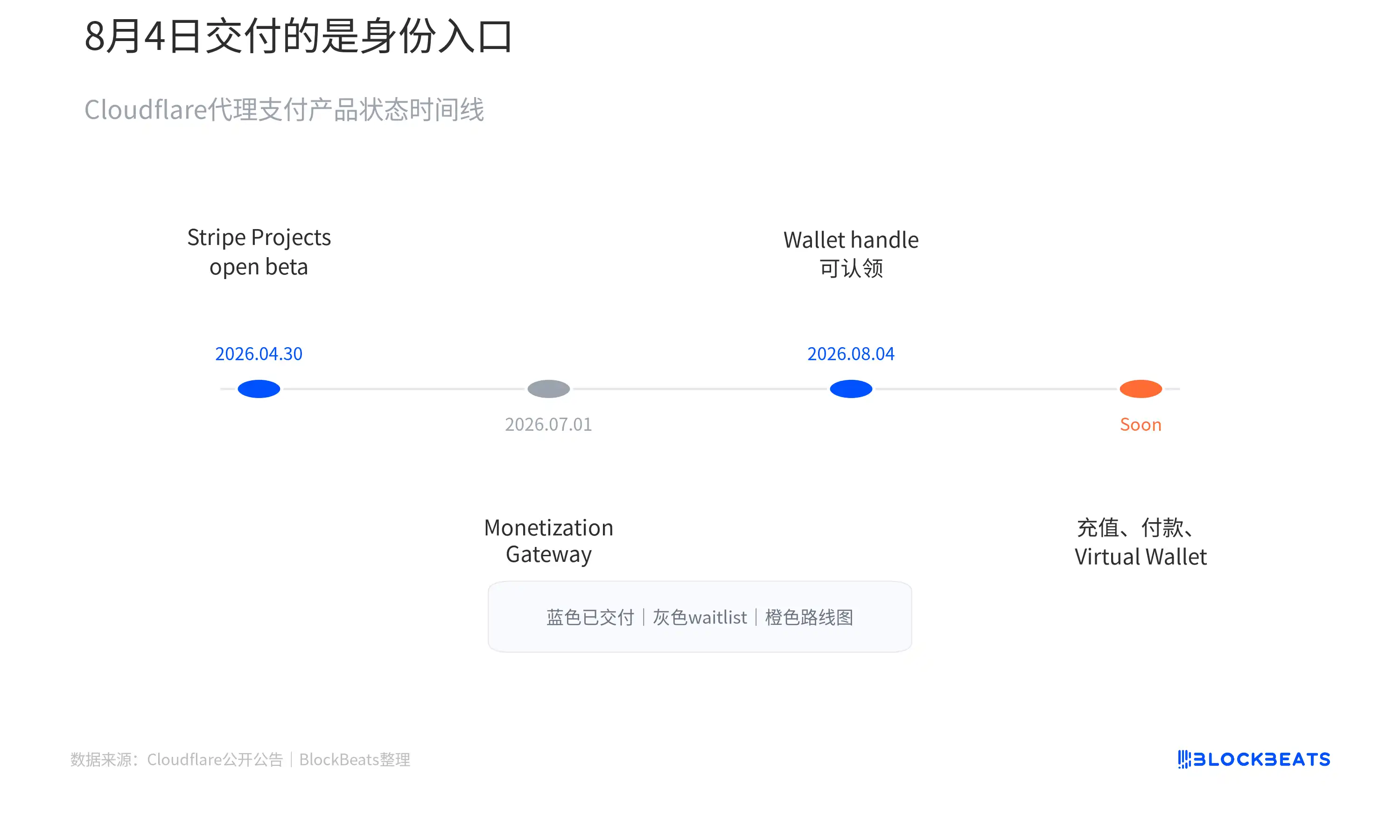
Figure 1 places several of Cloudflare's recent payment product lines together; the sequence is more important than the names. According to Cloudflare's Wallets announcement, what was delivered on August 4th was the handle. Top-ups, payments, and the Virtual Wallet used by agents via an API key are still left for later product descriptions.

This timeline already had two other pieces. According to announcements from Cloudflare and Stripe Projects, Stripe Projects allows agents to open Cloudflare accounts, purchase subscriptions, or domains on behalf of users and is currently in open beta. According to the Monetization Gateway announcement, the merchant-side entry point for receiving payments via x402 is still on a waiting list.

All three coincidentally involve agents and payments, but they are not on the same layer. Stripe Projects is a ready-to-try card-swiping proxy path. Monetization Gateway targets resource owners who want to receive payments. Wallet aims to supplement the payer side with identity, balance, and authorization rules. Looking at them side by side, what Cloudflare delivered this time is more like the payer's account page, not a fully operational payment network.

x402 Has Data, But That Doesn't Mean Cloudflare Has a Report Card
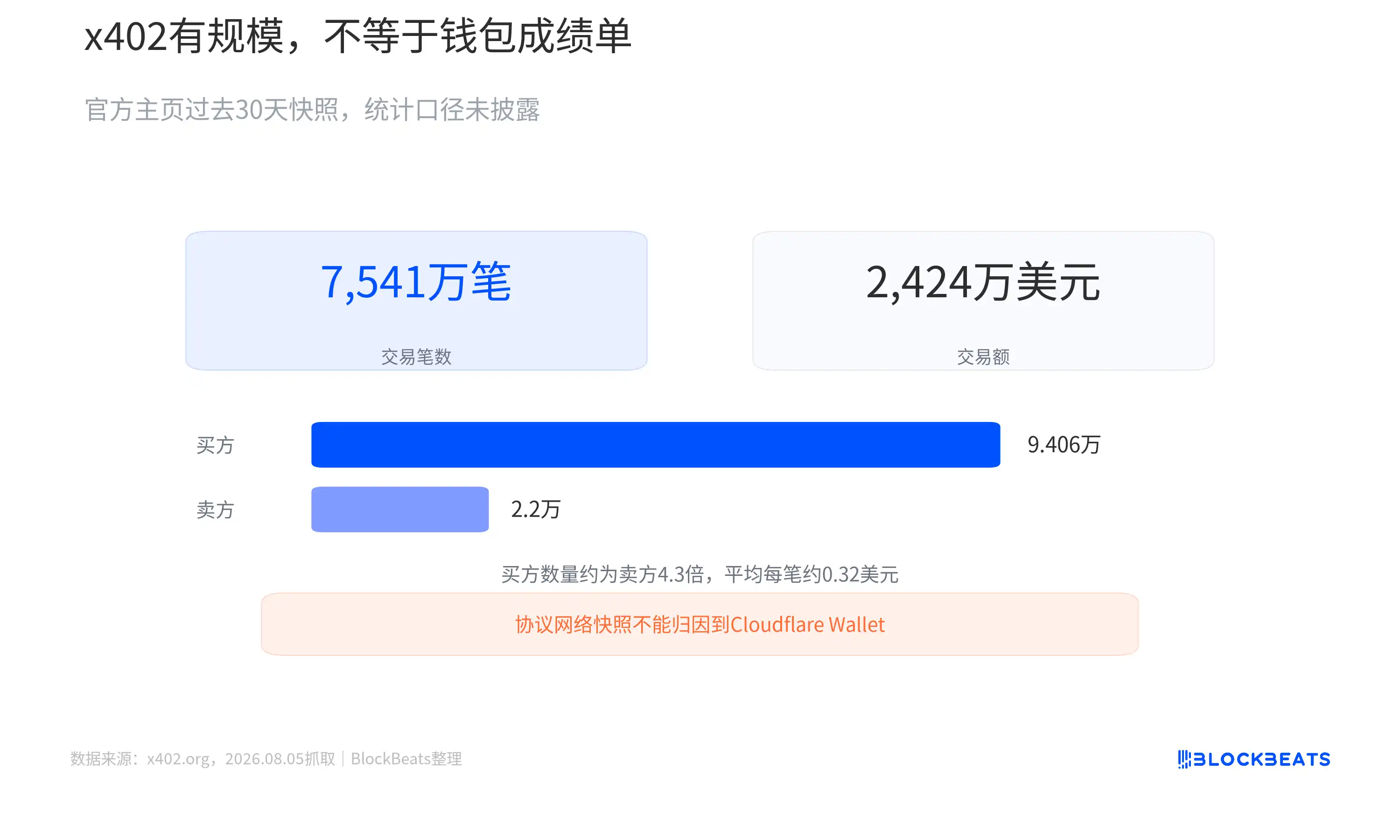
According to a 30-day snapshot displayed on the x402 official website on August 5th, the network recorded 75.41 million transactions and a transaction volume of $24.24 million. Dividing the two gives an average of about $0.32 per transaction. This scale closely aligns with small, frequent payments like API calls and content access, not a single large order.

But Figure 2 needs to be read with another boundary in mind. The website did not disclose how many of these transactions came from Cloudflare, how many were initiated by AI agents, nor did it provide any statistics on enabled Wallet accounts, merchants, or transaction volume. It proves there are vehicles on the x402 protocol road, but it cannot be reversed to deduce how many are registered under Cloudflare Wallet's license.

This distinction directly changes how one reads the news. x402 is an open process using HTTP 402 to initiate payment requests, not a settlement network exclusive to Cloudflare. Public snapshots can illustrate observable activity on the protocol, but they cannot serve as adoption rates for the Cloudflare Wallet, nor can they substitute for statistics on autonomous agent spending volume.

The Reality of One-Cent Calls Involves More Than Just a Wallet

Cloudflare's paid MCP tool example sets a single call at $0.01, but this is just a documentation sample, not the market average. It does break down micropayments quite specifically: the server first returns a 402, the agent signs the payment, the settlement facilitator verifies and settles, and only then does the server return the result.

In the existing developer path, the key is still held by the developer. According to the Agents SDK payment example, confirmation callbacks can be set to automatic, but the example also requires a private key and uses test networks and test USDC. Setting an agent for automatic payment does not equate to handing over the responsibility for spending, the keys, and spending limits to a mature wallet.

The Wallet roadmap is stuck precisely on this buyer side step. Cloudflare plans to separate the Account Wallet used by the account owner from the Virtual Wallet operated by the agent via an API key, and to add limits, whitelists, and per-transaction caps. It's more like a corporate card with approval rules; merchants still need to provide goods, and facilitators still need to complete settlements. Those rules are not yet open for configuration; the planned safety rails cannot be written as current features.

Three Agent Payment Paths Share Only Two Words
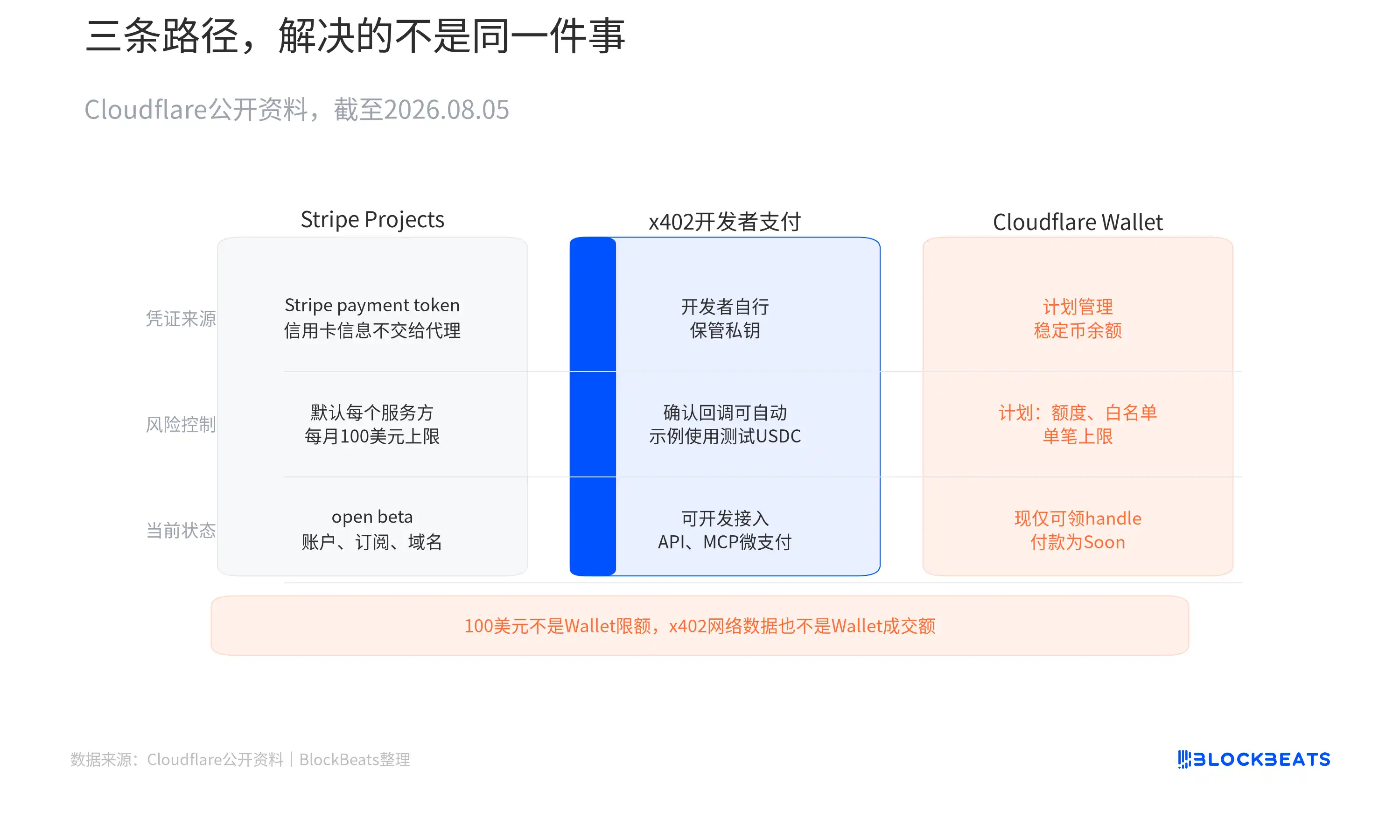
Figure 4 breaks down three easily confused paths into credentials, risk control, and status. Stripe Projects provides payment tokens to the service provider; the original credit card information is not given to the agent. Its default limit is $100 per service provider per month, and according to Cloudflare's announcement, it's still in open beta. This limit belongs to Stripe's card-swiping proxy service and cannot be transplanted as Wallet's spending limit.

x402's developer payment is a different starting point. Developers hold their own private keys and can implement pay-per-call for APIs or MCP tools. For Wallet, currently only the handle is open; stablecoin balance, spending limits, and whitelists have not yet been given practical configuration entry points. As for which stablecoins, which blockchains, in which regions it will be usable, along with KYC, custody, and fees, Cloudflare has also not disclosed these details.


Perguntas relacionadas

QWhat is the current status of Cloudflare's Wallets product announced on August 4th?

AAs of the announcement on August 4th, Cloudflare Wallets is in its initial launch phase where users can only claim a handle (name). Core functionalities such as funding the wallet, making payments, and the Virtual Wallet for agent API usage are not yet live and are marked as "Soon" in the announcement.

QWhat is the x402 protocol, and how does it relate to Cloudflare Wallets?

AThe x402 protocol is an open payment protocol that uses the HTTP 402 status code to initiate payment requests. It is not a Cloudflare-exclusive network. While x402 handles transactions, Cloudflare Wallets is intended to be the payer-side component providing identity, balance, and authorization rules. The public transaction data from x402 does not indicate the adoption rate or usage statistics specifically for Cloudflare Wallets.

QHow does the payment flow for a $0.01 API call work according to Cloudflare's documentation?

AAccording to the Cloudflare documentation example, the payment flow for a micro-payment (e.g., $0.01) involves several steps: the server returns an HTTP 402 status code requesting payment, the agent signs the payment, a facilitator coordinates and verifies the settlement, and only after successful payment does the server return the requested result.

QWhat is the key difference between the Account Wallet and the Virtual Wallet in Cloudflare's plan?

ACloudflare's plan distinguishes between the Account Wallet for the account owner and the Virtual Wallet for agents using API keys. The Virtual Wallet is designed to have configurable controls like spending limits, whitelists, and per-transaction caps, functioning more like a controlled corporate card for autonomous agents.

QWhat are the three distinct agent payment paths mentioned in the article, and what is their common limitation?

AThe three distinct agent payment paths discussed are: 1) Stripe Projects (handles credit card payments for users, currently in open beta), 2) x402 Developer Payments (requires developers to hold private keys for per-call fees), and 3) The planned Cloudflare Wallets (only handle claiming is currently available). Their common limitation is that none of them currently represent a fully realized, production-ready system where an agent has complete, autonomous, and securely controlled spending capability through Cloudflare Wallets. Key features like stablecoin funding, spending rules, and detailed configurations are not yet publicly available.

Leituras Relacionadas

Stunning, Musk Joins Forces with Huang Jen-hsun to Deploy the Stellar Brain! AI Computing Center Launched into Space

SpaceX, in its first public earnings report, has announced a partnership with NVIDIA to launch Starmind, an orbital AI computing network. This initiative aims to move AI's computational foundation into space to solve the critical challenges of energy consumption and heat dissipation faced by terrestrial data centers. The core concept involves deploying data centers equipped with NVIDIA's advanced GPUs (like the upcoming Rubin) into sun-synchronous orbit. Key advantages include near-continuous solar power for energy, the vacuum of space for highly efficient radiative cooling, and the absence of terrestrial constraints like land use and grid capacity. The first computational node, the Starmind AI1 satellite, is described as a massive vehicle with a 75-meter wingspan, generating 210 kW of solar power to run a 150 kW computing payload—equivalent to a full NVIDIA GB300 supercomputer rack. These "compute satellites" will connect to users via SpaceX's existing Starlink constellation using high-speed laser links, promising low-latency access from anywhere on Earth. SpaceX's ability to realize this vision is underpinned by its Starship rocket, designed for low-cost, high-frequency launches to transport thousands of satellites, and massive planned manufacturing facilities like the Gigasat factory and the Terafab chip plant. Elon Musk framed the project within the context of the Kardashev Scale, proposing Starmind as humanity's first substantive step toward becoming a Type II civilization capable of harnessing a star's energy. The ultimate goal is to deploy one terawatt of computational power in space, with even more ambitious plans involving lunar-based manufacturing and launch systems. The report positions Starmind not merely as a commercial AI service, but as a foundational infrastructure project to expand human intelligence and capability beyond Earth, leveraging SpaceX's integrated strengths in rockets, satellites, and global connectivity.

marsbitHá 23m

Stunning, Musk Joins Forces with Huang Jen-hsun to Deploy the Stellar Brain! AI Computing Center Launched into Space

marsbitHá 23m

Despite the sell-off, Goldman Sachs remains bullish on Samsung and SK Hynix. Here's why.

Goldman Sachs maintains "Buy" ratings on Samsung Electronics and SK Hynix despite recent stock declines. Its bullish view centers on three core arguments. Firstly, it expects HBM (High Bandwidth Memory) pricing to re-establish a premium over conventional DRAM by 2027, with a projected blended ASP of around $2.9/Gb. This is driven by tight supply-demand dynamics, increasing manufacturing complexity for newer HBM generations, and the need to restore its historical price premium. Secondly, the volatility of the memory cycle is expected to moderate due to widespread adoption of 3-5 year Long-Term Agreements (LTAs) with key customers. These contracts, covering a significant portion of planned capacity, feature mechanisms like price floors, prepayments, and penalties, reducing supplier risk and improving earnings visibility. Thirdly, inventory levels remain low at key suppliers and major customers, providing a buffer against a sharp downturn. Furthermore, robust demand from enterprise SSDs for AI servers is seen offsetting weakness in consumer segments like smartphones and PCs, preventing NAND markets from slipping into oversupply in the near term. While risks exist—such as potential weaker AI demand or aggressive capacity expansion—Goldman Sachs believes the combination of HBM repricing, LTAs, and low inventory underpins a more stable earnings outlook for the leading Korean memory makers.

marsbitHá 38m

Despite the sell-off, Goldman Sachs remains bullish on Samsung and SK Hynix. Here's why.

marsbitHá 38m

Korean Cryptocurrency Market Platform Kimpga Integrates with Global Web3 Data Platform RootData, Providing Popularity and Growth Scores for Token Projects

South Korean cryptocurrency market data platform Kimpga (kimpga.com) has announced a data partnership with the global Web3 project data platform RootData. As a result, Kimpga has integrated comprehensive token project information directly into its platform services. The integration introduces a new "RD Score" column within Kimpga's market listings. Clicking the score opens a detailed data window that displays the "RD Popularity Index," the "RD Growth Index," and key fundamental project data such as leading investors, core team members, and project category tags. For example, for Solana (SOL), users can view its indices and identify major backers like Polychain Capital, a16z, and Multicoin Capital directly from the interface, with links to full RootData project pages for deeper research. Jin Jae-yong, a representative of Kimpga, stated that the partnership allows users to quickly assess a project's fundamental strength, including its development team and investor lineup, without leaving the market data screen. This addresses a key challenge for investors who previously had to rely solely on price and premium data. RootData is a widely used global platform providing Web3 project details on funding history, team composition, and investor portfolios for due diligence and investment analysis. Kimpga, which boasts 10 million cumulative users, is a leading Korean crypto market platform providing real-time data and price premiums from over 18 domestic and international exchanges. This collaboration with RootData follows Kimpga's previous partnership with the token rating platform APYWA, further enriching its data offering to support user investment decisions.

marsbitHá 38m

Korean Cryptocurrency Market Platform Kimpga Integrates with Global Web3 Data Platform RootData, Providing Popularity and Growth Scores for Token Projects

marsbitHá 38m

He Was the Hero of Shanghai's Two Major Industries, Yet Passed Away Quietly in Regret

He was a pivotal figure in the development of two major Shanghai industries—semiconductors and commercial aircraft—yet passed away in quiet regret. Jiang Shangzhou, son of a veteran revolutionary and a Swiss-educated technocrat, became Deputy Director of the Shanghai Economic Commission in 1997. Tasked with identifying strategic industries, he championed integrated circuits (ICs) despite a climate of skepticism. Countering a national plan for just two 8-inch chip production lines, he boldly declared Shanghai would build ten within five years. He masterminded the Zhangjiang microelectronics zone, personally recruited top talent like Morris Chang, and helped establish SMIC. Through innovative financing that circumvented Western embargoes, SMIC grew rapidly, with Shanghai exceeding its target by building 18 lines. Simultaneously, while battling lung cancer, Jiang led the push for China's large commercial aircraft program as head of a state major projects panel. He argued it was a strategic imperative that would drive advancements across multiple industries. His relentless advocacy culminated in the 2006 state approval that paved the way for the C919. Jiang's career was marked by foresight often deemed too超前. Earlier postings in Sanya and Yangpu saw his ideas for tourism and economic reform initially rejected, only to be validated years later. In 2009, he became Chairman of the embattled SMIC. Despite his deteriorating health, he steered the company until his death in 2011, leaving a final insight for the chip industry: China need not master every process but must lead in key areas. He did not live to see the C919 fly or SMIC's full recovery, but his foundational work made Shanghai a national leader in both semiconductors and aerospace. Colleagues remembered him as a visionary whose impact shaped the three decades that followed.

marsbitHá 53m

He Was the Hero of Shanghai's Two Major Industries, Yet Passed Away Quietly in Regret

marsbitHá 53m

Trading

Spot
活动图片