Solana Takes Aim At Hyperliquid With Push For Fully Onchain Perps

bitcoinistPublicado em 2026-06-02Última atualização em 2026-06-02

Resumo

The Solana Foundation has announced a new initiative to actively support teams building fully onchain perpetual futures (perps) on Solana. This move directly challenges the current market structure, exemplified by platforms like Hyperliquid, where much of the derivatives volume still relies on centralized exchanges or hybrid models with offchain components. Solana argues that its high-performance blockchain makes fully onchain perps viable without sacrificing speed or user experience, aiming to shift a lucrative trading segment entirely onchain. The Foundation seeks to back projects that prioritize onchain price discovery (like order books or RFQ systems) over pool-based models, require projects to be "Solana-first" with revenue routed back to the chain, and mandate open-source development. The support includes distribution, technical assistance, and capital for core perps protocols as well as complementary infrastructure.

Solana Foundation is moving to back teams building fully onchain perpetual futures, setting up a clear challenge to the market structure that has powered Hyperliquid’s rapid rise. The initiative targets one of crypto’s most lucrative trading segments: perps, where volume still sits largely on centralized exchanges or hybrid venues.

Solana Vs. Hyperliquid

The Foundation framed the push as a bid to move derivatives execution more fully onto Solana, without relying on the offchain components that still underpin much of the sector. “Perpetuals are one of the most important financial primitives in crypto,” the Foundation wrote on X. “Solana makes it viable to run them fully onchain, without sacrificing the performance real participants and institutions require.”

The timing is notable. Hyperliquid has become the reference point for onchain derivatives, turning perpetual futures into one of the strongest product-market-fit stories in crypto. While Solana did not name Hyperliquid in its announcement, the competitive subtext is hard to miss.

In its post, the Foundation argued that most perp volume still flows through centralized exchanges or through hybrid architectures that use offchain sequencers and matching engines. “We view that as a transitional state, not a permanent one,” the Foundation said. “We want to support teams building onchain perps, other derivatives, and the applications around them, that prioritize price discovery infrastructure. Our support takes several forms: distribution, technical assistance, and above all, capital.”

That language matters because it draws a line between merely settling crypto trades onchain and running the entire execution path onchain. The foundation said it wants to support systems where every order submission, oracle update, match, cancellation and settlement happens onchain. For a chain that has long marketed itself around high throughput and low latency, perps are an obvious stress test: the product requires fast updates, deep liquidity, competitive market making and credible settlement.

The Foundation also made clear that it is not looking for pool-based pricing models as the center of this effort. It said it is interested in “models where price is set based on two-sided flow, not pool-based or as a function of deposits,” including orderbooks, RFQ systems with genuinely competing makers, or alternative designs where active participants set bids and offers against each other.

That is where the Hyperliquid comparison becomes especially relevant. Hyperliquid’s success has shown that crypto traders will use onchain or semi-onchain derivatives venues when the trading experience is fast, liquid and expressive enough.

Solana Wants Revenue Back Onchain

The announcement also included a more ecosystem-specific requirement: teams should build “Solana-first.” The Foundation said it wants projects optimized for SOL’s design and culture, with application revenue structurally routed back to the chain, preferably at the protocol level from launch rather than left to future governance decisions.

That is a pointed detail. In the current perps market, the battle is not only over where traders execute, but where fees, order flow and liquidity incentives accrue. A successful Solana-native perps venue would not merely add another DeFi app; it could become a recurring source of transaction activity, MEV-adjacent flow, validator economics and ecosystem-level liquidity.

The Foundation also said it is open to teams that have already built offchain or hybrid perps products and want to migrate to a fully onchain model. “We’ll support existing teams with a live product that are willing to explore a fully onchain, on-Solana model,” it said.

Open source is another filter. “Onchain integrity means little if the code behind it can’t be inspected,” Solana Foundation wrote. “Contributing to Solana culturally means contributing in the open.”

The initiative is not limited to core perps protocols. Solana said it also wants complementary infrastructure, including frontend integrations, vaults, structured products, aggregators, advanced trading interfaces, market making operations and social trading applications. Grants may be available through Solana Foundation funding channels or local Superteam chapters.

At press time, SOL traded at $79.54.
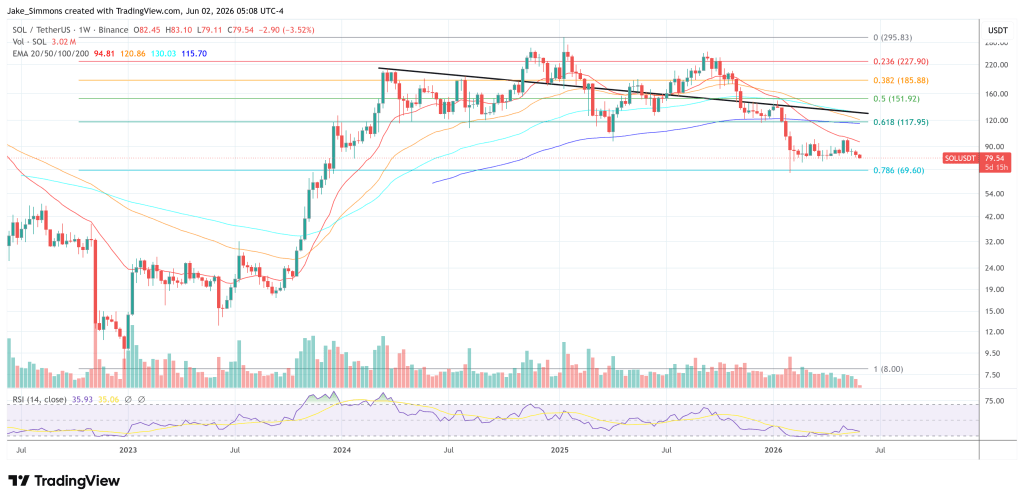
SOL remains in sideways trend, 1-week chart | Source: SOLUSDT on TradingView.com

Perguntas relacionadas

QWhat is the primary goal of the Solana Foundation's new initiative as described in the article?

AThe primary goal of the Solana Foundation's initiative is to support teams building fully onchain perpetual futures and other derivatives on Solana. It aims to move derivatives execution more fully onto the blockchain without relying on offchain components, capturing revenue for the Solana ecosystem, and supporting models based on two-sided flow for price discovery.

QAccording to the article, which platform is positioned as the main competitive reference point for Solana's onchain perps push?

AThe main competitive reference point is Hyperliquid. The article states that Hyperliquid has become the reference point for onchain derivatives, and Solana's initiative sets up a clear challenge to the market structure that powered Hyperliquid's rapid rise.

QWhat specific type of pricing models is the Solana Foundation NOT interested in supporting for this initiative?

AThe Solana Foundation is not looking for pool-based pricing models as the center of this effort. It is interested in models where price is set based on two-sided flow, such as orderbooks, RFQ systems with competing makers, or designs where active participants set bids and offers against each other.

QBesides the core perps protocols, what other types of complementary infrastructure does Solana want to support through this initiative?

ASolana also wants to support complementary infrastructure including frontend integrations, vaults, structured products, aggregators, advanced trading interfaces, market making operations, and social trading applications.

QWhat are the key requirements or filters mentioned for teams interested in the Solana Foundation's support?

AKey requirements include building 'Solana-first' (optimized for SOL's design and culture), structuring application revenue to route back to the chain, being open to teams migrating from offchain/hybrid models, and committing to open-source development ('contributing in the open').

Leituras Relacionadas

Can DeepSeek Save China One Trillion Dollars?

"DeepSeek and the $1 Trillion Infrastructure Question" The article examines whether DeepSeek's AI optimization breakthroughs could potentially save China $1 trillion in future AI infrastructure costs. The analysis begins with Nvidia's upcoming Vera Rubin AI platform, costing ~$7.8 million, where memory (HBM4/LPDDR5X) constitutes $2 million—a 435% cost increase in one year, highlighting how AI hardware spending is shifting toward expensive memory components. DeepSeek's approach works in the opposite direction. Through three key technical innovations showcased in DeepSeek V4, the company dramatically improves hardware efficiency: 1. **Memory Compression (MLA)**: Re-engineers the attention mechanism to compress long-context memory (KV Cache) by over 90%, drastically reducing expensive HBM usage. 2. **Selective Activation (MoE)**: Employs Mixture-of-Experts architecture where only a small fraction of parameters (e.g., 49B out of 1.6T in V4-Pro) are activated per token, allowing most parameters to reside in cheaper memory/SSD. 3. **Computation Caching**: Reuses previously computed results via cache hits, replacing expensive GPU computations with cheap memory reads. Combined, these optimizations allow the same hardware to produce approximately 4x more tokens, effectively reducing required hardware investment by 75%. DeepSeek's pricing reflects this: a 10-billion token workload costs ~$522 monthly versus ~$9,000-$10,000 for competitors. The $1 trillion savings projection stems from McKinsey's estimate that global AI infrastructure will require ~$5.2 trillion investment by 2030. As China's daily token consumption grows toward quadrillions, even marginal efficiency gains scale massively. With a conservative 4x throughput improvement, China could avoid building tens of thousands of AI data centers equivalent to ~7 trillion RMB ($1 trillion) in saved investment. Critically, this strategy shifts dependency from scarce, expensive GPU/HBM—where China lags—toward more accessible storage, caching, and systems engineering where domestic suppliers like CXMT are gaining strength. Rather than "replacing Nvidia," DeepSeek rebalances AI's value chain away from monolithic hardware dependency. Ultimately, DeepSeek's technical breakthroughs could lower the barrier to AI adoption across Chinese industries by making advanced capabilities affordable at scale—transforming who can access next-generation AI.

marsbitHá 31m

Can DeepSeek Save China One Trillion Dollars?

marsbitHá 31m

Overturning the Mainstream Approach to Hallucinations: Metacognition is the New Solution for Large Models to Break the Hallucination Barrier

This paper, "Hallucinations Undermine Trust; Metacognition is a Way Forward," proposes a paradigm shift in combating AI hallucination. It argues that the current mainstream approaches—striving for omniscience by scaling data/models or having AI abstain from uncertain answers—are fundamentally flawed. The former has inevitable knowledge gaps, while the latter imposes a crippling "utility tax," requiring the rejection of many correct answers to achieve high accuracy, due to models' poor "discrimination" (the ability to distinguish correct from incorrect answers internally). The core contribution is redefining hallucination not as "being wrong," but as "expressing false information with unwarranted certainty." The proposed solution is **Faithful Uncertainty** or **Metacognition**: enabling AI to accurately perceive its internal uncertainty and honestly express it in its language (e.g., using hedging phrases when unsure). This creates a more reliable assistant that provides useful information while signaling its confidence, minimizing harm from errors. The paper emphasizes that metacognition is critical for the era of AI Agents. Without it, Agents cannot intelligently decide when to use tools like search engines, leading to inefficiency and misuse. Key implementation challenges are highlighted: the "bootstrapping paradox" of training with static uncertainty data, the "alignment distortion signal" where human preference training suppresses internal uncertainty cues, and the difficulty of causally evaluating true metacognition vs. its superficial imitation. The paper concludes that the goal should not be an infallible AI, but one that is honest about the limits of its knowledge, thereby building user trust through transparent communication of its certainty.

marsbitHá 35m

Overturning the Mainstream Approach to Hallucinations: Metacognition is the New Solution for Large Models to Break the Hallucination Barrier

marsbitHá 35m

Hedge by Buying Gold and Oil, Chase Soaring Returns with AI. ‘Dated’ Bitcoin Enters a Bear Market

Bitcoin has recently declined, hitting a two-month low near $66,123, while Ethereum fell to a three-month low around $1,837. Analysts suggest the drop is not merely due to factors like ETF outflows or MicroStrategy's selling but reflects a deeper issue: Bitcoin is losing a broader asset competition. In a near-zero interest rate environment, Bitcoin previously thrived as an outlet for investor dissatisfaction with inflation and limited options. However, the market landscape has shifted. Bitcoin now occupies an "awkward middle ground," facing competition on three fronts. For inflation hedging, investors prefer gold, energy stocks, and commodity producers—assets with tangible backing and clearer pricing power. For growth exposure, AI-related companies with actual revenues and profits are more attractive. Even within crypto, investors can choose stablecoins, exchanges, or infrastructure firms tied directly to adoption, offering clearer business models and leverage. Thus, Bitcoin is no longer the top choice for hedging, growth, or crypto exposure. This shift is evident in market reactions: despite recent warnings about persistent inflation from a Fed official, Bitcoin did not rally as it might have in the past. Instead, capital flowed to assets with direct commodity or energy exposure. The recent ETF outflows and MicroStrategy sales are symptoms, not causes, of this new reality. Investors are becoming more selective, demanding clearer value propositions beyond mere scarcity. The emerging bear case for Bitcoin is not about it being a bubble or failed technology, but that scarcity alone is no longer sufficient.

华尔街日报Há 38m

Hedge by Buying Gold and Oil, Chase Soaring Returns with AI. ‘Dated’ Bitcoin Enters a Bear Market

华尔街日报Há 38m

Trading

Spot
Futuros

Artigos em Destaque

Como comprar PUSH

Bem-vindo à HTX.com!Tornámos a compra de Push Protocol (PUSH) simples e conveniente.Segue o nosso guia passo a passo para iniciar a tua jornada no mundo das criptos.Passo 1: cria a tua conta HTXUtiliza o teu e-mail ou número de telefone para te inscreveres numa conta gratuita na HTX.Desfruta de um processo de inscrição sem complicações e desbloqueia todas as funcionalidades.Obter a minha contaPasso 2: vai para Comprar Cripto e escolhe o teu método de pagamentoCartão de crédito/débito: usa o teu visa ou mastercard para comprar Push Protocol (PUSH) instantaneamente.Saldo: usa os fundos da tua conta HTX para transacionar sem problemas.Terceiros: adicionamos métodos de pagamento populares, como Google Pay e Apple Pay, para aumentar a conveniência.P2P: transaciona diretamente com outros utilizadores na HTX.Mercado de balcão (OTC): oferecemos serviços personalizados e taxas de câmbio competitivas para os traders.Passo 3: armazena teu Push Protocol (PUSH)Depois de comprar o teu Push Protocol (PUSH), armazena-o na tua conta HTX.Alternativamente, podes enviá-lo para outro lugar através de transferência blockchain ou usá-lo para transacionar outras criptomoedas.Passo 4: transaciona Push Protocol (PUSH)Transaciona facilmente Push Protocol (PUSH) no mercado à vista da HTX.Acede simplesmente à tua conta, seleciona o teu par de trading, executa as tuas transações e monitoriza em tempo real.Oferecemos uma experiência de fácil utilização tanto para principiantes como para traders experientes.

515 Visualizações TotaisPublicado em {updateTime}Atualizado em 2026.06.02

Como comprar PUSH

Discussões

Bem-vindo à Comunidade HTX. Aqui, pode manter-se informado sobre os mais recentes desenvolvimentos da plataforma e obter acesso a análises profissionais de mercado. As opiniões dos utilizadores sobre o preço de PUSH (PUSH) são apresentadas abaixo.

活动图片