Safety Narrative Meets Reality Squeeze: How Anthropic Fell into an Identity Crisis?

比推Publicado em 2026-02-27Última atualização em 2026-02-27

Resumo

In a span of seventy-two hours, Anthropic faced a severe identity crisis amid pressure from the U.S. Pentagon, public accusations from Elon Musk, and a major shift in its safety policy. The Pentagon issued an ultimatum: allow Claude to be used for "all lawful purposes," including autonomous weapons targeting and domestic mass surveillance, by Friday 5:01 PM, or risk losing a $2 billion contract and being blacklisted as a "supply chain risk." Anthropic initially resisted, citing ethical red lines. Simultaneously, Elon Musk accused Anthropic of large-scale training data theft, referencing a $1.5 billion settlement over using pirated books. Anthropic also accused three Chinese AI firms of "industrial-scale distillation attacks" on Claude, framing it as a national security threat—a move widely criticized as hypocritical. In a pivotal shift, Anthropic released its Responsible Scaling Policy (RSP) 3.0, removing its core commitment to halt training if safety measures were inadequate. The company cited competitive pressure and lack of industry-wide consensus as reasons. With a $380 billion valuation and rapid growth, Anthropic’s balancing act between its safety-brand identity and commercial-military demands appears increasingly unstable. Its narrative as a "responsible AI" leader is collapsing under political, competitive, and ethical pressures.

Author: Ada, Shenchao TechFlow

Original Title: Anthropic's 72-Hour Identity Crisis


February 24, Tuesday. Washington, the Pentagon.

Anthropic CEO Dario Amodei sat across from Defense Secretary Pete Hegseth. According to multiple media outlets including NPR and CNN citing informed sources, the atmosphere of the meeting was "polite," but the content was anything but.

Hegseth gave him an ultimatum: By 5:01 PM on Friday, lift the restrictions on Claude's military use, allowing the Pentagon to employ it for "all lawful purposes," including autonomous weapons targeting and domestic mass surveillance.

Otherwise, the $200 million contract would be canceled. The Defense Production Act would be invoked for compulsory requisition. Anthropic would be listed as a "supply chain risk," effectively blacklisting it alongside hostile entities from Russia and China.

On the same day, Anthropic released the third version of its "Responsible Scaling Policy" (RSP 3.0), quietly removing the company's core commitment since its founding: not to train more powerful models if safety measures could not be assured.

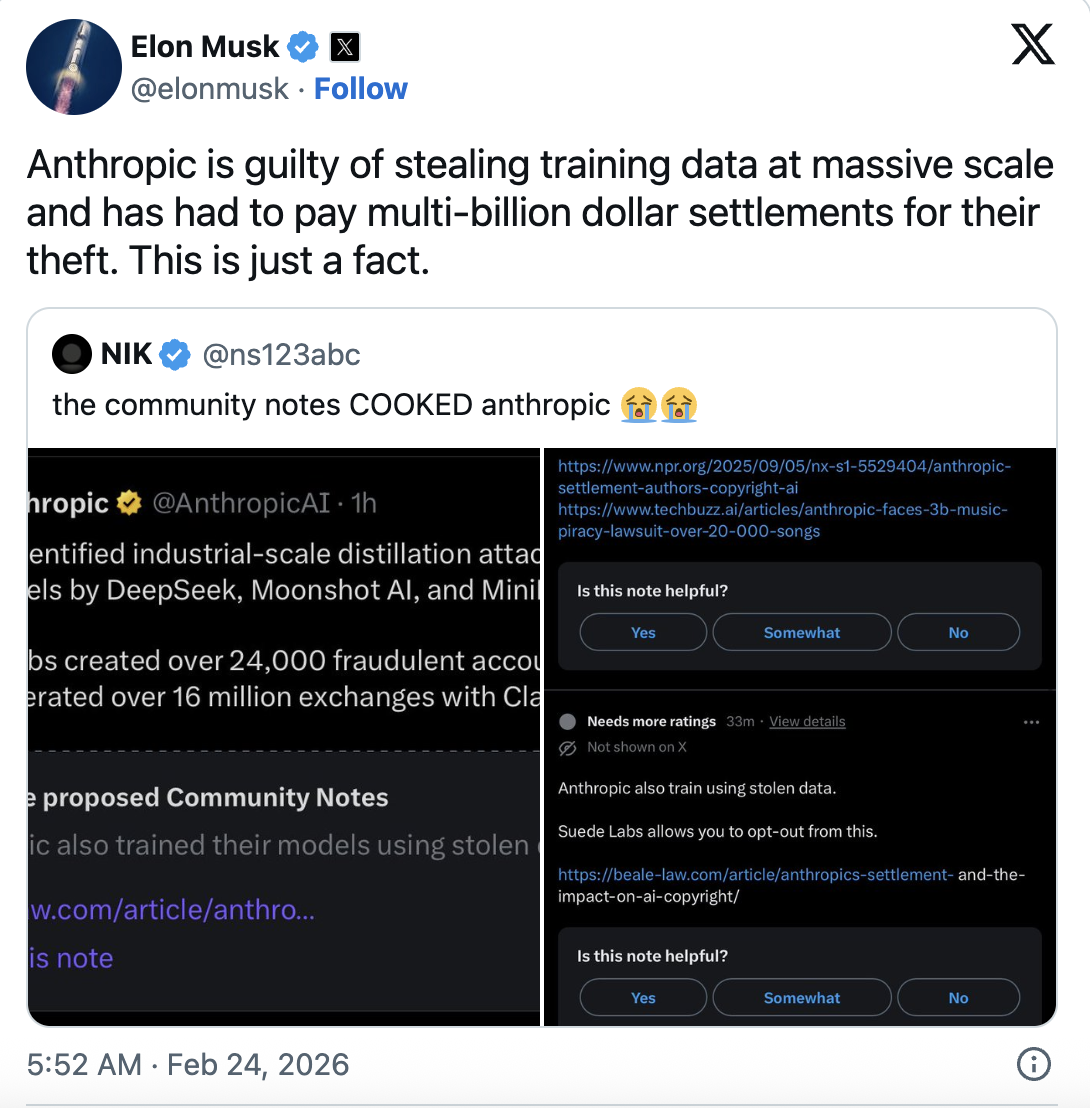
Also on the same day, Elon Musk posted on X: "Anthropic massively stole training data. This is a fact." Simultaneously, a Community Note on X supplemented this with a report that Anthropic had paid a $1.5 billion settlement for using pirated books to train Claude.

Within seventy-two hours, this AI company that claimed to have a "soul" simultaneously played three roles: safety martyr, intellectual property thief, and Pentagon traitor.

Which one is real?

Perhaps all of them.

The Pentagon's "Comply or Get Out"

The first layer of the story is simple.

Anthropic was the first AI company granted classified access by the U.S. Department of Defense. The contract, worth up to $200 million, was secured last summer. OpenAI, Google, and xAI subsequently secured contracts of similar scale.

According to Al Jazeera, Claude was used in a U.S. military operation in January of this year. The report stated the operation involved the kidnapping of Venezuelan President Maduro.

But Anthropic drew two red lines: no support for fully autonomous weapons targeting, and no support for mass surveillance of U.S. citizens. Anthropic argued that AI's reliability is insufficient for weapon control, and there are currently no laws or regulations governing AI's use in mass surveillance.

The Pentagon wasn't buying it.

White House AI advisor David Sacks publicly accused Anthropic on X last October of "using fear as a weapon and engaging in regulatory capture."

Competitors had already capitulated. OpenAI, Google, and xAI all agreed to let the military use their AI for "all lawful scenarios." Musk's Grok was just approved this week for entry into classified systems.

Anthropic was the last one standing.

As of publication, Anthropic stated in its latest announcement that it does not intend to concede. But the Friday 5:01 PM deadline is looming.

An anonymous former liaison between the Justice Department and the Defense Department expressed confusion to CNN: "How can you simultaneously declare a company a 'supply chain risk' and force that company to work for your military?"

Good question, but it's outside the Pentagon's consideration. What they care about is that if Anthropic doesn't comply, compulsory measures will be taken, or it will become a Washington pariah.

"Distillation Attack": A Slap-in-the-Face Accusation

On February 23, Anthropic published a fiercely worded blog post accusing three Chinese AI companies of carrying out an "industrial-scale distillation attack" on Claude.

The accused are DeepSeek, Moonshot AI, and MiniMax.

Anthropic accused them of using 24,000 fake accounts to initiate over 16 million interactions with Claude, specifically extracting its capabilities in agent reasoning, tool use, and programming.

Anthropic framed this as a national security threat, claiming that distilled models are "unlikely to retain safety guardrails" and could be used by authoritarian governments for cyber attacks, disinformation, and mass surveillance.

The narrative was perfect, the timing was perfect.

It came just after the Trump administration relaxed chip export controls to China, right when Anthropic needed ammunition for its lobbying stance on chip export controls.

But Musk fired a shot: "Anthropic massively stole training data and paid billions in settlement money for it. This is a fact."
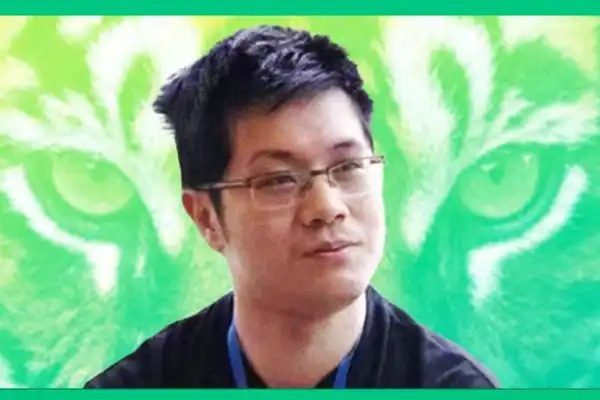
Tory Green, co-founder of AI infrastructure company IO.Net, said: "You train your models on data from the entire web, and when others use your public API to learn from you, it's called a 'distillation attack'?"

Anthropic calls distillation an "attack," but it's commonplace in the AI industry. OpenAI uses it to compress GPT-4, Google uses it to optimize Gemini, even Anthropic itself does it. The only difference is, this time they were the ones being distilled.

As Singapore's Nanyang Technological University AI professor Erik Cambria told CNBC: "The boundary between legitimate use and malicious exploitation is often blurry."

More ironically, Anthropic just paid a $1.5 billion settlement for using pirated books to train Claude. It trains its models on data from the entire web, then accuses others of using its public API to learn from it. This isn't double standards, it's triple standards.

Anthropic wanted to play the victim, but got exposed as the defendant.

Dismantling the Safety Promise: RSP 3.0

On the same day as the Pentagon standoff and the Silicon Valley spat, Anthropic released the third version of its Responsible Scaling Policy.

Anthropic Chief Scientist Jared Kaplan told media in an interview: "We felt that stopping AI model training doesn't help anyone. In the context of rapid AI development, unilaterally making promises... while competitors are moving full speed ahead, it doesn't make sense."

In other words, others aren't playing by the rules, so we're dropping the act too.

The core of RSP 1.0 and 2.0 was a hard commitment to pause training if model capabilities exceeded the coverage of safety measures. This commitment gave Anthropic a unique reputation in the AI safety community.

But 3.0 removed it.

It was replaced with a more "flexible" framework, separating the measures Anthropic itself can take from the safety recommendations requiring industry-wide collaboration into two tracks. A report on risks would be issued every 3-6 months. External experts would review it.

Sounds responsible?

Independent reviewer Chris Painter from the nonprofit METR, after seeing an early draft of the policy, stated: "This indicates Anthropic believes it needs to enter 'triage mode' because methods for assessing and mitigating risks are not keeping pace with the growth in capabilities. This is more evidence that society is not prepared for AI's potential catastrophic risks."

According to TIME, Anthropic spent nearly a year internally debating this rewrite, with CEO Amodei and the board unanimously approving it. The official line is that the original policy was designed to foster industry consensus, but the industry simply didn't follow. The Trump administration adopted a laissez-faire attitude towards AI development, even attempting to repeal state-level regulations. Federal AI legislation is nowhere in sight. Although establishing a global governance framework seemed possible in 2023, three years later, that door has clearly closed.

An anonymous researcher long involved in AI governance put it more bluntly: "The RSP was Anthropic's most valuable brand asset. Deleting the training pause commitment is like an organic food company quietly tearing the 'organic' label off its packaging and then telling you their testing is now more transparent."

Identity Torn Under a $380 Billion Valuation

In early February, Anthropic completed a $30 billion financing round at a $380 billion valuation, with Amazon as the anchor investor. Since its founding, it has achieved $14 billion in annualized revenue. Over the past three years, this figure has grown more than 10x annually.

Simultaneously, the Pentagon threatens to blacklist it. Musk publicly accuses it of data theft. Its core safety promise is deleted. Anthropic's AI safety lead, Mrinank Sharma, resigned and wrote on X: "The world is in danger."

Contradiction?

Perhaps contradiction is in Anthropic's DNA.

The company was founded by former OpenAI executives because they were worried OpenAI was moving too fast on safety. Then they built a company themselves, creating more powerful models at an even faster pace, while telling the world how dangerous these models are.

The business model can be summarized in one sentence: we are more afraid of AI than anyone else, so you should pay us to build it.

This narrative worked perfectly in 2023-2024. AI safety was a hot term in Washington, and Anthropic was the most popular lobbyist.

In 2026, the winds changed.

"Woke AI" became an attack label, state-level AI regulation bills were blocked by the White House, and the California SB 53 supported by Anthropic was signed into law, but the federal level was a wasteland.

Anthropic's safety card is sliding from a "differentiating advantage" to a "political liability."

Anthropic is performing a complex balancing act. It needs to be "safe" enough to maintain its brand, yet "flexible" enough not to be abandoned by the market and the government. The problem is, the tolerance space on both ends is shrinking.

How Much is the Safety Narrative Worth?

Look at all three events together, and the picture becomes clear.

Accusing Chinese companies of distilling Claude is to strengthen the lobbying narrative for chip export controls. Deleting the safety pause commitment is to avoid falling behind in the arms race. Refusing the Pentagon's autonomous weapons demand is to preserve the last layer of moral clothing.

Each step has logic, but the steps contradict each other.

You can't simultaneously claim Chinese companies "distilling" your model is a national security threat, while deleting the promise preventing your own model from going out of control. If the model is truly that risky, you should be more cautious, not more aggressive.

Unless you are Anthropic.

In the AI industry, identity is not defined by your statements, but by your balance sheet. Anthropic's "safety" narrative is essentially a brand premium.

In the early days of the AI arms race, this premium was valuable. Investors were willing to pay a higher valuation for "responsible AI," governments were willing to give the green light to "trustworthy AI," customers were willing to pay for "safer AI."

But in 2026, this premium is evaporating.

Anthropic now faces not a multiple-choice question of "whether to compromise," but a sequencing problem of "who to compromise with first." Compromise with the Pentagon, brand damaged. Compromise with competitors, safety promise voided. Compromise with investors, both must give.

Friday at 5:01 PM, Anthropic will deliver its answer.

But whatever the answer is, one thing is certain: the Anthropic that once stood its ground with "we are different from OpenAI" is becoming like everyone else.

The endpoint of an identity crisis is often the disappearance of identity.


Twitter:https://twitter.com/BitpushNewsCN

Bitpush TG Discussion Group:https://t.me/BitPushCommunity

Bitpush TG Subscription: https://t.me/bitpush

Original link:https://www.bitpush.news/articles/7615114

Criptomoedas em alta

Perguntas relacionadas

QWhat ultimatum did the Pentagon give to Anthropic regarding the use of Claude AI?

AThe Pentagon gave Anthropic an ultimatum to remove restrictions on Claude's military use by Friday at 5:01 PM, allowing it to be used for 'all legitimate purposes,' including autonomous weapons targeting and domestic mass surveillance, or risk cancellation of a $200 million contract and being designated as a 'supply chain risk'.

QWhat significant change did Anthropic make in its Responsible Scaling Policy (RSP) 3.0?

AAnthropic removed its core commitment to halt training more powerful models if safety measures could not be guaranteed, replacing it with a more flexible framework that separates internal safety measures from industry-wide recommendations and includes periodic risk reports.

QWhat accusation did Elon Musk make against Anthropic on X?

AElon Musk accused Anthropic of 'massive theft of training data' and referenced a $1.5 billion settlement Anthropic paid for using pirated books to train Claude.

QWhy did Anthropic accuse three Chinese AI companies of 'distillation attacks'?

AAnthropic accused DeepSeek, Moonshot AI, and MiniMax of using 24,000 fake accounts to interact with Claude over 16 million times to extract its core capabilities in reasoning, tool use, and programming, framing it as a national security threat.

QWhat internal contradiction does the article highlight in Anthropic's actions?

AThe article points out that Anthropic's accusation of Chinese companies 'distilling' its model for security risks contradicts its own removal of safety pause commitments, and its refusal to allow autonomous weapons use conflicts with its accelerated model development, revealing a conflict between its safety narrative and competitive pressures.

Leituras Relacionadas

Ethereum Q1 2026 Report: Fees Decline, Users and Transaction Volume Hit New Highs

Ethereum Q1 2026 Report: Fees Down, Users & Transactions Hit New Highs Token Terminal's Q1 2026 report on Ethereum presents a pivotal development: the network achieved record highs in monthly active users (13.2M, +85.9% YoY), total transactions (200.4M, +81.5% YoY), and throughput (25.78 TPS), while transaction fees on the mainnet plummeted by 47.9% quarter-over-quarter. This shift is attributed to the network's strategic move into a "low fees for scale" phase, exemplified by the Fusaka upgrade which increased data capacity and lowered block space costs, releasing pent-up demand (a manifestation of Jevons's Paradox). The report highlights a core narrative shift for Ethereum: from a DeFi-centric blockchain to a global financial settlement layer. It maintains a dominant position in tokenized assets, holding majority market shares among top chains in stablecoins (61.8%), tokenized funds (73.0%), and tokenized commodities (84.0%). Growth in tokenized funds (+73.1% YoY) and commodities (+325.9% YoY) was particularly strong, driven by institutions like BlackRock and JPMorgan entering the space. Contrasting these usage gains, several USD-denominated value metrics declined in Q1: fully diluted market cap fell 30.3% QoQ, total value locked (TVL) dropped 11.0%, and ecosystem transaction volume decreased 24.0%. The report interprets this as Ethereum prioritizing long-term network expansion and cementing its role as the default settlement layer for finance over short-term fee capture. The commentary from Etherealize argues that, much like the early internet, Ethereum's open, permissionless model is poised to win over closed alternatives as institutional tokenization accelerates.

marsbitHá 1h

Ethereum Q1 2026 Report: Fees Decline, Users and Transaction Volume Hit New Highs

marsbitHá 1h

He Just Raised 2.7 Billion, and Li Fei-Fei Also Invested

Pete Florence, a former senior research scientist at Google DeepMind and a key contributor to the Vision-Language-Action (VLA) model architecture, is deliberately distancing his startup, Generalist AI, from the trendy "world model" label. He argues that the industry should prioritize concrete goals over buzzwords. His goal is to create robots that can perform a vast range of unseen tasks with high speed and success rates, without needing task-specific training data. Recently, his company raised $400 million (¥2.7 billion) at a $2 billion valuation. Notable investors include NVIDIA's NVentures, Bezos Expeditions, NFDG, as well as Xiaomi co-founder Lin Bin, Zoom founder Eric Yuan, and renowned AI scientist Fei-Fei Li. Florence's approach stems from his academic background at MIT under Professor Russ Tedrake, focusing on understanding the physical world. After joining DeepMind, he developed models like Transporter Network and co-created the VLA framework. He left in 2025 to found Generalist AI. The company has launched two models: GEN-0, which demonstrated that scaling laws apply to physical motion, and GEN-1. GEN-1 was trained on over 500,000 hours of physical interaction data collected via a specialized wearable device. It achieves a 99% success rate on precise mechanical tasks like folding boxes and maintains performance three times faster than its predecessor. Florence believes GEN-1 is reaching a commercial utility threshold similar to the GPT-3 inflection point. The substantial funding round, following GEN-1's release, signifies strong investor confidence in Generalist AI's practical, goal-driven path to creating versatile, useful robots, regardless of the "world model" terminology.

marsbitHá 1h

He Just Raised 2.7 Billion, and Li Fei-Fei Also Invested

marsbitHá 1h

Two Legends Lost in Three Days: Is Google's AI Talent Dam Cracking?

In three days, Google lost two AI legends. On June 18, Noam Shazeer, co-author of the seminal "Attention is All You Need" paper and Gemini co-lead, left for OpenAI. Just 48 hours later, John Jumper, 2024 Nobel laureate and AlphaFold lead, departed DeepMind for Anthropic. This follows Andrej Karpathy joining Anthropic in May. These moves highlight a structural trend: top AI talent is concentrating at mission-driven, pre-IPO firms like OpenAI and Anthropic, while Google becomes a primary source. The exodus stems from a core mission mismatch. Google's ad-centric model often subordinates AI research to product and revenue goals, creating friction for pioneers like Shazeer, who returned in 2024 only to leave again. In contrast, OpenAI and Anthropic offer singular focus on pushing AI boundaries, whether towards AGI or safety-aligned models, which deeply appeals to top researchers like Jumper. Financial incentives amplify the pull. With both OpenAI and Anthropic nearing IPO, employees stand to gain immensely from equity, an upside Google's mature stock cannot match. Furthermore, the 2023 merger of Google Brain and DeepMind, intended to consolidate strength, has instead created cultural tension and slowed the path from research to product, as evidenced by Gemini's pace. This talent redistribution is reshaping the AI landscape. While Google retains vast data and compute resources, its true crisis is the quiet, continuous loss of the people who define the field's future. The real moat in AI is not infrastructure, but the concentration of brilliant minds—a battle Google is currently losing.

marsbitHá 3h

Two Legends Lost in Three Days: Is Google's AI Talent Dam Cracking?

marsbitHá 3h

Behind the AI Report Card, Lies a Chinese 'Exam Setter'

Beyond the familiar performance charts like MMLU-Pro and MMMU, which major AI models strive to ace, stands a key "examiner": Chinese-Canadian researcher Wenhu Chen. An assistant professor at the University of Waterloo and founder of TIGERLab, Chen addresses the crucial need for more rigorous AI evaluation. As models like GPT-4 began scoring near-perfect results on older benchmarks like MMLU, it became difficult to distinguish their true capabilities. In response, Chen introduced MMLU-Pro in 2024, featuring harder, more reasoning-focused questions with more answer choices, successfully reintroducing meaningful performance gaps. His work extends to multi-modal evaluation with MMMU and its enhanced version, MMMU-Pro. These benchmarks test a model's ability to understand and reason with complex information from images, charts, and text across diverse academic subjects, exposing the significant challenges even top models face in genuine comprehension. Chen's background in complex QA, table reasoning, and his experience at Google DeepMind on projects like Gemini inform his approach. He understands that effective benchmarks must anticipate how models might "cheat" by memorizing data or avoiding visual analysis. His lab also actively researches video understanding and generation models (e.g., UniVideo, Vamba), ensuring his evaluation work is grounded in practical model-building challenges. Now at Meta's Super Intelligence Lab, Chen continues his focus on multi-modal data and evaluation, representing the deep yet often unseen contributions of Chinese talent in shaping the fundamental tools of the AI industry.

marsbitHá 3h

Behind the AI Report Card, Lies a Chinese 'Exam Setter'

marsbitHá 3h

Trading

Spot
Futuros

Artigos em Destaque

Como comprar ADA

Bem-vindo à HTX.com!Tornámos a compra de Cardano (ADA) simples e conveniente.Segue o nosso guia passo a passo para iniciar a tua jornada no mundo das criptos.Passo 1: cria a tua conta HTXUtiliza o teu e-mail ou número de telefone para te inscreveres numa conta gratuita na HTX.Desfruta de um processo de inscrição sem complicações e desbloqueia todas as funcionalidades.Obter a minha contaPasso 2: vai para Comprar Cripto e escolhe o teu método de pagamentoCartão de crédito/débito: usa o teu visa ou mastercard para comprar Cardano (ADA) instantaneamente.Saldo: usa os fundos da tua conta HTX para transacionar sem problemas.Terceiros: adicionamos métodos de pagamento populares, como Google Pay e Apple Pay, para aumentar a conveniência.P2P: transaciona diretamente com outros utilizadores na HTX.Mercado de balcão (OTC): oferecemos serviços personalizados e taxas de câmbio competitivas para os traders.Passo 3: armazena teu Cardano (ADA)Depois de comprar o teu Cardano (ADA), armazena-o na tua conta HTX.Alternativamente, podes enviá-lo para outro lugar através de transferência blockchain ou usá-lo para transacionar outras criptomoedas.Passo 4: transaciona Cardano (ADA)Transaciona facilmente Cardano (ADA) no mercado à vista da HTX.Acede simplesmente à tua conta, seleciona o teu par de trading, executa as tuas transações e monitoriza em tempo real.Oferecemos uma experiência de fácil utilização tanto para principiantes como para traders experientes.

1.3k Visualizações TotaisPublicado em {updateTime}Atualizado em 2026.06.02

Como comprar ADA

Discussões

Bem-vindo à Comunidade HTX. Aqui, pode manter-se informado sobre os mais recentes desenvolvimentos da plataforma e obter acesso a análises profissionais de mercado. As opiniões dos utilizadores sobre o preço de ADA (ADA) são apresentadas abaixo.

活动图片