Original | Odaily Planet Daily (@OdailyChina)
Author | Ethan(@ethanzhang_web3)
RWA Sector Market Performance
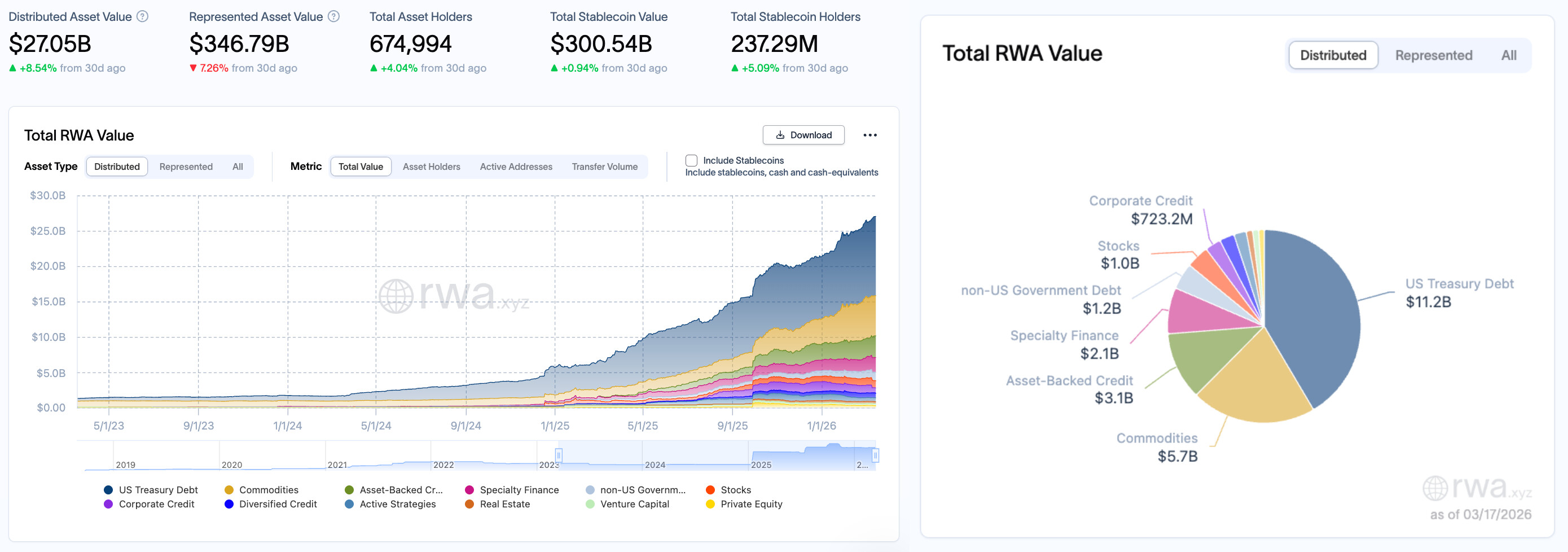
According to rwa.xyz data panel, as of March 17, 2026, on-chain assets continued to hit new highs this cycle. The total value of RWA on-chain increased from $26.43 billion on March 10th to $27.05 billion, a weekly increase of approximately $620 million, a gain of about 2.35%. The value of representative assets also rebounded synchronously, growing from $336.08 billion to $346.79 billion, an increase of about $10.71 billion, a gain of about 3.19%.
On the user side, growth continued, with the total number of asset holders increasing from 665,300 to 675,000, a weekly addition of about 9,730 people, an increase of about 1.46%. The overall stablecoin market cap stayed above the $300 billion mark, slightly decreasing from $301.04 billion to $300.54 billion, a reduction of about $500 million, a drop of about 0.17%; the number of stablecoin holders continued to climb, rising from 233.94 million to 237.29 million, an increase of about 3.35 million people, a gain of about 1.43%.
In terms of asset structure, the total scale of US Treasury bonds increased from $11 billion to $11.2 billion, a weekly increase of about $200 million. Commodity assets remained stable at a high level, basically staying around $5.7 billion, with little change from last week. Looking at a more detailed asset distribution, asset-backed credit has a market cap of $3.1 billion, becoming the most important credit sector besides US Treasuries and commodities; specialized finance has a market cap of $2.1 billion, indicating that scenario-based, customized financing needs are expanding on-chain; corporate credit is $723.2 million, while non-US government debt remains stable at around $1.2 billion; equity assets reached $1 billion; private equity further contracted to around $308.6 million, indicating that capital's willingness to allocate to low-liquidity, long-cycle equity assets remains cautious.
(This week, previously broader categories such as private credit and institutional alternative funds began to be broken down into more granular categories like asset-backed credit, specialized finance, corporate credit, diversified credit, active strategies, etc. Additionally, smaller volume assets like real estate and venture capital remain relatively marginal, having limited impact on the total.)
Trend Analysis (Compared to Last Week)
Overall, this cycle saw synchronous growth in on-chain distributed RWA assets and broadly representative assets. Capital flows remain clearly concentrated in high-certainty assets, with US Treasuries continuing to act as the main reservoir; at the same time, more细分的分流 (more细分的分流 - finer分流) began to appear within credit assets, with asset-backed credit, specialized finance, and corporate credit jointly absorbing some of the new funds, indicating that market risk appetite has slightly increased compared to the previous period but remains rational and restrained.
Market keywords: accelerating total volume,细化分类 (refined classification), rational sentiment.
Key Event Review
US SEC Chair: To Consider Innovation Exemption to Facilitate Tokenized Security Trading
US Securities and Exchange Commission Chair Paul S. Atkins indicated at an Investor Advisory Committee meeting that the agency will vote on recommendations regarding the tokenization of equity securities. The SEC is expected to soon consider an innovation exemption to facilitate limited trading of certain tokenized securities, with an eye towards developing a long-term regulatory framework. Paul S. Atkins also stated that the Crypto Assets Working Group has held multiple roundtables over the past 13 months, met with hundreds of market participants, solicited broad public feedback, and received substantial written comments to understand how best to adapt rules for new trading types, while still welcoming input on the potential design of innovation exemption schemes.
US SEC Commissioner Recommends Prudent Advancement of "Innovation Exemption" for Tokenized Securities and Raises Key Issues Like Disclosure Systems
US Securities and Exchange Commissioner Hester M. Peirce wrote that research has begun on an "innovation exemption" scheme for tokenized securities, allowing limited scope trading and technological experimentation for some tokenized securities. This exemption scheme will be more cautious than the industry-proposed "blanket exemption." She believes it should be explored whether the innovation exemption framework should allow experimentation with different types of security tokenization models, and consider whether issuer consent is needed for third parties to issue tokenized versions of their stocks, to promote technological innovation while avoiding regulatory arbitrage and maintaining core investor protection mechanisms.
Hester M. Peirce also emphasized that regulators should not excessively intervene in private capital allocation. The SEC is currently evaluating several key issues, including: whether existing disclosure systems are sufficient to cover the ownership structure of tokenized securities; the disclosure obligations of brokers and clearing agencies in the issuance of tokenized security interests; the compatibility of atomic settlement with the current T+1 settlement rules; and the applicability of regulatory authority in structures without intermediaries or with new types of intermediaries.
US Senate Majority Leader Says Clarity Act Unlikely to Advance Before April
US Senate Majority Leader John Thune stated that he expects the crypto market structure bill, the Clarity Act, will not pass the Senate Banking Committee before April. This bill aims to establish a comprehensive regulatory framework for digital assets in the US. The House had previously advanced this legislation, but discussions continue in the Senate.
The main obstacle to the bill's advancement is the issue of stablecoin yields, as the crypto industry and the banking industry have not yet reached a compromise. The banking industry believes that allowing stablecoins to provide yields could lead to deposits flowing out of traditional institutions, while Patrick Witt, Executive Director of the White House President's Digital Asset Advisory Committee, stated this week that compliant stablecoins could attract new global capital to the US banking system.
Additionally, the Senate passed a comprehensive housing bill that includes a provision prohibiting the Federal Reserve from issuing a CBDC. This bill will be sent to the House for further deliberation and voting. Legislators are currently prioritizing advancing President Trump's SAVE America Act, with Thune stating the Senate will vote on it next week.
JPMorgan analysts previously described the potential passage of crypto market structure legislation as a "positive catalyst" for the industry in the second half of the year. Trump also stated earlier this month on Truth Social that passing the Clarity Act is the "next step to get the job done" after the GENIUS Act.
US Stablecoin Legislation Negotiations Near Consensus, Yield Issue Remains Key Breakthrough
During The Digital Chamber's DC Blockchain Summit, multiple US Congress members and industry figures will discuss progress on stablecoin legislation. Tim Scott (Chair of the Senate Banking Committee) is expected to be asked about the timeline for the next markup of the relevant bill. Industry insiders revealed that negotiations around the "yield" issue for stablecoins are nearing consensus. Cody Carbone stated that the regulatory solution might include prohibiting yields on idle stablecoin balances but allowing reward mechanisms based on transactional behavior. Relevant parties are expected to reach a solution within the next week.
Additionally, Thom Tillis and Angela Alsobrooks are seen as key legislative drivers, both expressing concern about the banking industry's worries regarding funds flowing from deposit accounts to high-yield crypto products. Industry insiders believe that once these two legislators are satisfied with the bill text, the stablecoin yield dispute is expected to be largely resolved, after which regulatory focus will shift to DeFi and token classification issues.
European Central Bank Announces Tokenized Finance Plan to Enhance EU Financial Autonomy
The European Central Bank announced a timeline on Wednesday for building a tokenized wholesale financial ecosystem for the eurozone, aiming to ensure the euro's continued status as an international currency.
The strategy consists of two core projects: Pontes is a transaction layer based on Distributed Ledger Technology (DLT), expected to launch in Q3; Appia is a long-term project planned to continue until 2028, by which time the Eurosystem will release a blueprint for the tokenized financial ecosystem, covering infrastructure, governance frameworks, and standard setting.
European policymakers have positioned financial infrastructure as a geopolitical issue. A previous analysis by the European Parliament pointed out that Europe's reliance on foreign payment networks constitutes a "structural vulnerability" of its financial sovereignty. This plan aims to reduce dependence on non-European and dollar-centric financial systems, enhancing the EU's strategic autonomy and financial resilience.
ECB Executive Board member Piero Cipollone stated that Appia aims to build a path from the current financial system to the future tokenized market, based on central bank money.
Hong Kong Stablecoin Concept Stock Bright Smart Securities: Ant Group's Takeover Offer Approved
Hong Kong stablecoin concept stock Bright Smart Securities & Commodities Group announced that the takeover offer initiated by Ant Group has been approved by relevant Chinese authorities and is expected to be completed on March 30. The company's shares will resume trading on March 17.
DWF Partner: Institutional Funds Shifting Allocation to BTC, ETH, and RWA, Traditional Altseason is Disappearing
Analyzing, Andrei Grachev, Managing Partner of crypto market maker DWF Labs, pointed out that the "Altseason" driven by overall crypto market rallies is becoming history. Factors such as the surge in the number of tokens, limited participant scale, and crypto ETFs absorbing liquidity are changing the market structure. Currently, institutional funds prefer allocating to Bitcoin, Ethereum, and tokenized real-world assets (RWA), further diverting attention and funds away from altcoins. The future market will see shorter narrative cycles and more剧烈的板块轮动 (violent sector rotations), with a large number of mid-to-long-tail tokens becoming more like high-risk venture capital or "casino-style" assets,难以持续生存 (difficult to sustain survival) solely依靠炒作 (relying on hype). Data shows that the altcoin market has seen a cumulative outflow of over $209 billion in the past 13 months, with about 38% of altcoins currently trading near historical lows.
ShapeShift Founder Increases Holdings of Tokenized Gold Again, Cumulative Investment ~$23.76 Million
According to Lookonchain monitoring, early Bitcoin supporter and ShapeShift founder Erik Voorhees has resumed buying gold-related tokens after a pause of about a month. Since January 31st, he has created 28 new wallets,累计花费 (cumulatively spending) approximately $23.76 million to buy 2,834 XAUT (~$13.78 million) and 2,019 PAXG (~$9.97 million), with an average purchase price of about $4,896. He currently has an unrealized gain of approximately $513,000.
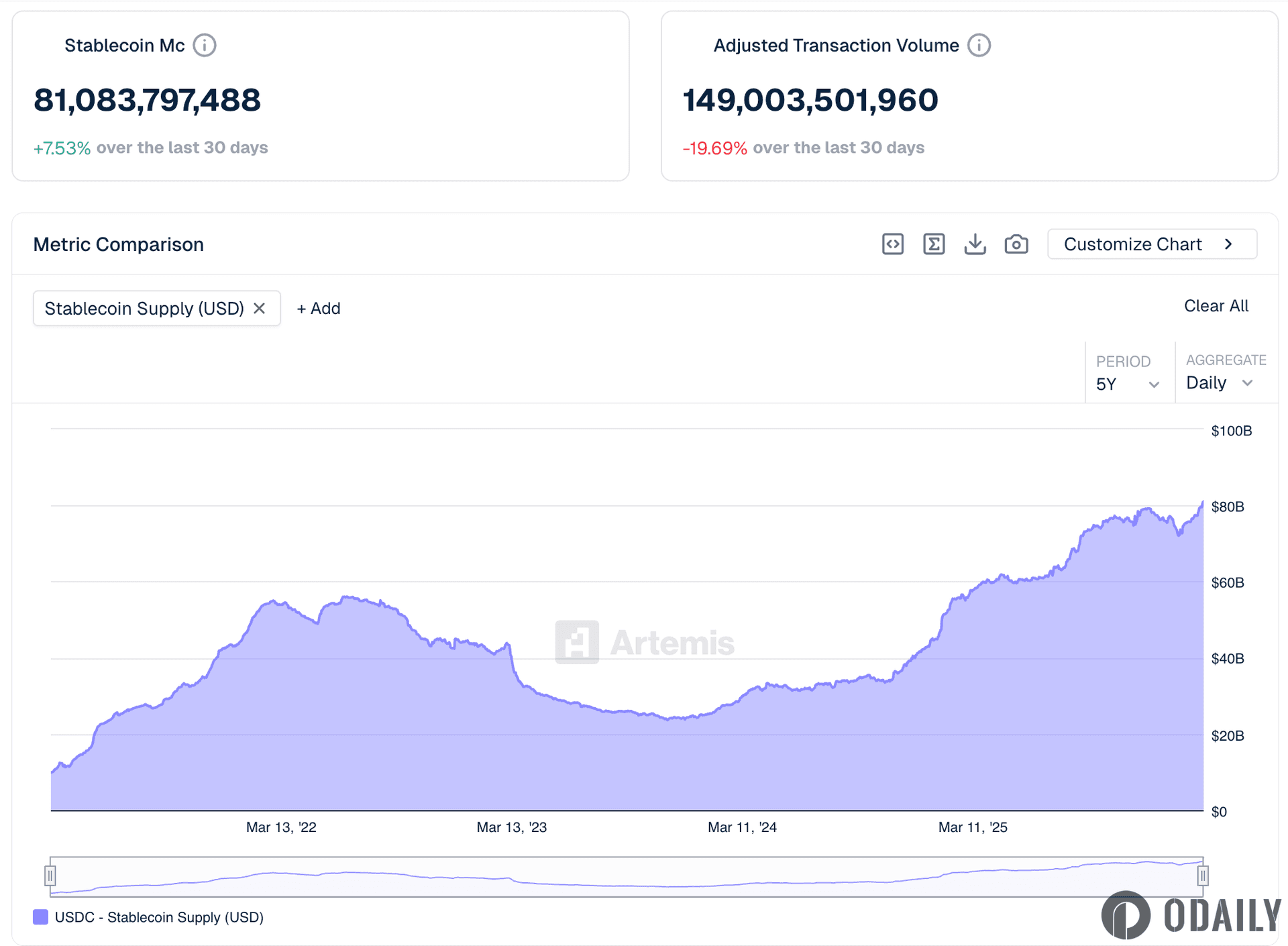
Data: USDC Issuance Scale Breaks $80 Billion for the First Time, Reaching Record High
Artemis data shows that the full-chain issuance scale of USDC has突破 (broken through) $80 billion for the first time, temporarily reported at $81.083 billion, setting a new historical record.
Pump.fun: Launches Tokenized Agent Auto-Buyback Function
Pump.fun posted on platform X stating that on-chain Agents are taking dominance, and Pump.fun is building tools to accelerate the Agent economy on its platform. The first step is launching an auto-buyback function for tokenized Agents. This solution aims to bridge the gap between Agent success and human opportunity. The function is now live.
World Liberty Financial Co-Founder Teases AI Agent Payment Technology for USD1
World Liberty Financial co-founder Zak Folkman stated on Wednesday that the stablecoin issuer is preparing to make a major push into the field of AI agent autonomous payments. This move will position its stablecoin USD1 for future scenarios where autonomous software agents transact at machine speed. Folkman said the team has been developing related technology behind the scenes, and an upcoming update will彻底改变 (completely change) perceptions of AI agent autonomous payments. Other developers on the project confirmed that World Liberty Financial is already developing AI agents capable of autonomous payments.
The total stablecoin market size is now接近 (close to) $315 billion, doubling since 2022. USD1 is the fifth-largest stablecoin. US Treasury Secretary Scott Bessent previously上调预测 (revised upwards the prediction) for global stablecoin adoption to $3 trillion by 2030, with Citi analysts predicting the market could expand to $4 trillion by the end of 2030.
Meanwhile, Circle is launching blockchain infrastructure and micro-payment features for agent transactions, Stripe is developing the Tempo blockchain dedicated to stablecoin payments, Shopify has integrated stablecoin payments, and Coinbase has incubated the x402 open standard for agent payments. Meta acquired Moltbook, a social network built for AI agents, on Tuesday, and OpenAI has also hired the creator of the autonomous agent framework OpenClaw.
Pharos Receives Strategic Investment from GCL New Energy, Valuation Nears $1 Billion
Layer 1 blockchain project Pharos has received a strategic investment from GCL New Energy, with the project valuation接近 (nearing) $1 billion. This investment was previously announced on January 8, 2026, and was finalized after completing relevant information disclosure procedures on the Hong Kong Exchange (HKEX).
The report指出 (points out) that this cooperation will focus on real-world asset (RWA) related applications, including renewable energy asset tokenization, decentralized energy trading systems, and carbon footprint tracking and verification. Pharos stated that its parallel execution architecture is designed to support high-throughput financial infrastructure to improve asset settlement efficiency, transparency, and liquidity.
GCL New Energy is an energy company listed on the Hong Kong Stock Exchange. The two parties plan to explore the application of blockchain technology in energy infrastructure and financial markets through cooperation.
Hot Project Dynamics
Ondo Finance (ONDO)

One-Sentence Introduction:
Ondo Finance is a decentralized finance protocol focused on structured financial products and the tokenization of real-world assets. Its goal is to provide users with fixed-income products, such as tokenized US Treasury bonds or other financial instruments, through blockchain technology. Ondo Finance allows users to invest in low-risk, highly liquid assets while maintaining decentralized transparency and security. Its token, ONDO, is used for protocol governance and incentive mechanisms. The platform also supports cross-chain operations to expand its application within the DeFi ecosystem.
Latest Developments:
March 10: RWAxyz data showed that the total on-chain value of tokenized stocks has突破 (exceeded) $1 billion. Ondo Finance and Backed Finance's xStocks platform hold the majority market share in tokenized stock issuance and trading. Ondo Finance accounts for about 58%, and xStocks about 24%, forming an early duopoly格局 (structure) in the industry.
March 9: According to an official announcement, Binance Wallet launched an Ondo tokenized securities trading competition on Binance Alpha. Event time: March 09, 2026, 18:00 to March 23, 2026, 18:00 (UTC+8). During the event, the top 20,000 users by trading volume of Ondo tokenized securities on Binance Alpha will equally share rewards equivalent to $500,000 worth of IAUon.
Previously, Ondo Finance posted on platform X stating that Ondo's tokenized stock DeFi application, supported by Chainlink as the official data oracle, is now live. QQQon, TSLAon, and other institutionally priced assets have been unlocked as high-quality collateral for on-chain stocks. Leveraging TradFi liquidity and oracle data, Ondo's tokenized US stocks can now support on-chain lending and structured products. The first projects launched are Euler Finance vaults, with risk management by Sentora and security provided by Chainlink. This marks the first time tokenized stocks are used as collateral in Ethereum DeFi.
MSX(STONKS)
One-Sentence Introduction:
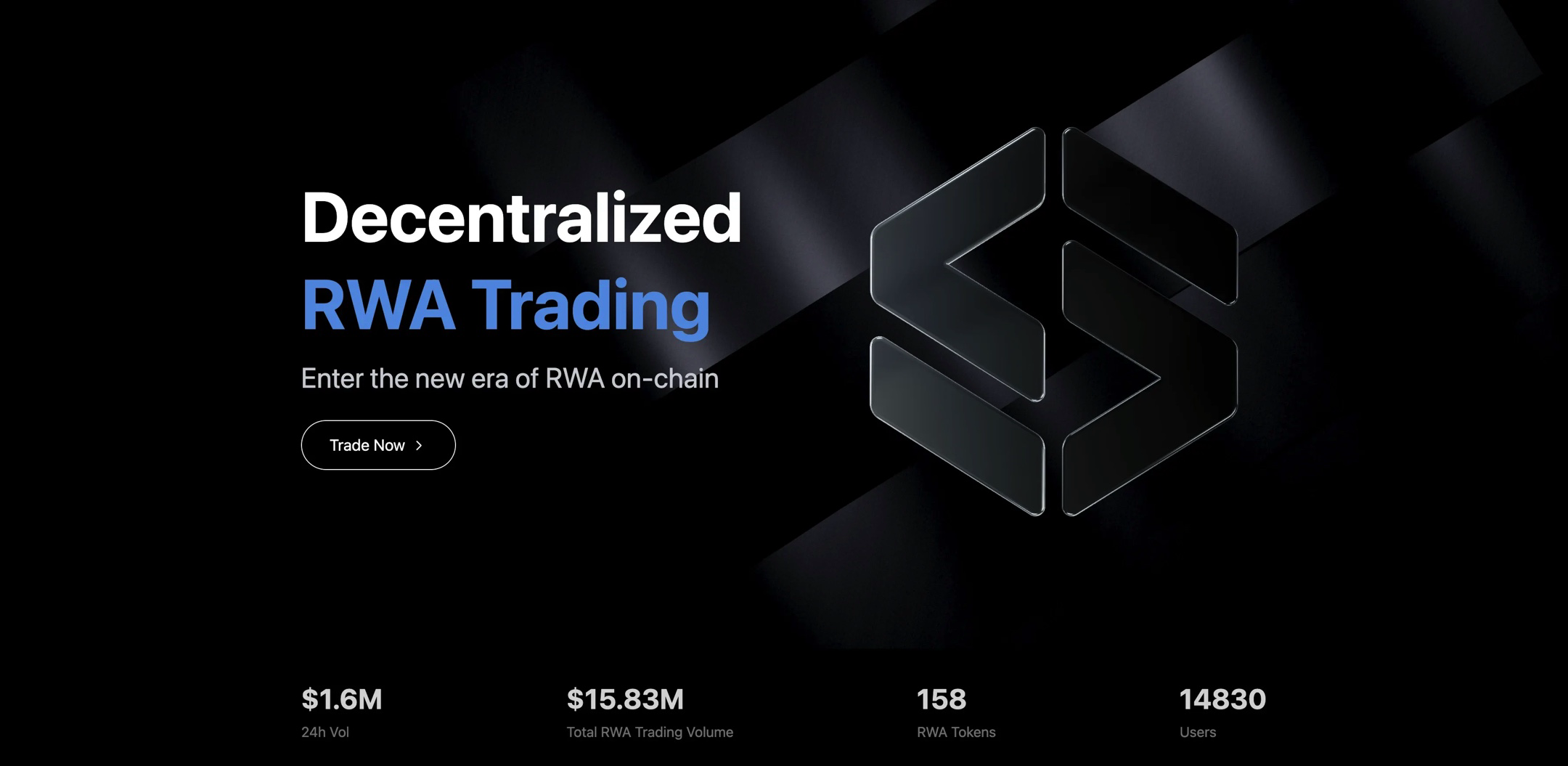
MSX is a community-driven DeFi platform focused on tokenizing US stocks and other RWAs for on-chain trading. Through a partnership with Fidelity, the platform achieves 1:1 physical custody and token issuance. Users can use stablecoins like USDC, USDT, and USD1 to mint stock tokens like AAPL.M and MSFT.M, and trade them 24/7 on the Base blockchain. All trading, minting, and redemption processes are executed by smart contracts, ensuring transparency, security, and auditability. MyStonks is committed to bridging the gap between TradFi and DeFi, providing users with a high-liquidity, low-barrier entry to US stock investments on-chain, building the "Nasdaq of the crypto world."
Past Developments:
March 2: MSX officially announced the formal launch of its Pre-IPO section and initiated its first issuance. The first batch of open targets includes equity quotas for 4 unlisted companies: SpaceX ($3 million), ByteDance ($2 million), Lambda Labs ($1 million), and Cerebras Systems ($500,000). Eligible users can participate in the subscription through the MSX platform, with a minimum subscription amount of $10 per transaction. This Pre-IPO section is built based on a cooperation structure between MSX and Republic. Related assets are accessed through compliant channels and held by regulated third-party custodians. MSX stated that it will expand the scope of Pre-IPO targets in stages in the future and explore technical paths to enhance asset liquidity.
Previously, MSX announced that its official website msx.com completed a comprehensive design upgrade on February 11, 2026. This revision focused on three main directions: "visual redesign, interaction optimization, and brand messaging," including adopting a dark financial color scheme, introducing neumorphic style and character elements, and reorganizing the layout of market quotes and functional modules. In terms of interaction, the website increased page whitespace based on a grid system, weakened interference from non-critical information, and centralized and streamlined the入口 (entry points) and buttons for high-frequency areas like quotes, positions, and order placement to shorten operation paths. Simultaneously, the website uniformly uses brand green to mark key operations and status feedback, improving the readability of crucial steps like order placement and confirmation, and reducing the risk of misclicks and misjudgments.
Related Links
《RWA Weekly Report Series》
《The RWA Narrative is So Strong, Why Are All RWA Tokens Falling? I Think the Logic Was Wrong from the Start》
《Survival Guide for Volatile Markets: A Complete Guide to Stablecoin Yielding》
《Circle CEO Latest Interview: Stablecoins Are Not Crypto Assets》