Ripple Lands Major Korea Deal With Top Insurance Giant Kyobo

bitcoinistPublicado em 2026-04-16Última atualização em 2026-04-16

Resumo

Ripple has partnered with Kyobo Life Insurance, one of Korea's largest insurers, to develop the country's first tokenized government bond settlement workflow on blockchain. The collaboration will utilize Ripple Custody to hold, transfer, and settle transactions within a regulated framework, aiming to replace manual process with on-chain execution that could compress the standard two-day settlement cycle to near real-time. This initiative is positioned as infrastructure for a broader institutional stack. Both companies aim to assess the technical and regulatory feasibility, reduce counterparty risk, and explore stablecoin-based payment rails for 24/7 transactions. Ripple described this as a strategic entry into Korea's institutional financial market and a signal that proven digital asset infrastructure is ready for deployment.

Ripple has struck a new partnership with Kyobo Life Insurance to explore what it says would be Korea’s first tokenized government bond settlement workflow on blockchain, extending the company’s institutional push in Asia into the country’s insurance sector.

The partnership is built around Ripple Custody, which will be used to hold, transfer, and settle tokenized government bond transactions within a regulated institutional framework. The firm said the setup is designed to replace fragmented, manual settlement processes with on-chain execution, potentially compressing the standard two-day settlement cycle into near real-time.

Ripple Signs First Tier-1 Korean Insurer for Custody Push

Kyobo, one of Korea’s largest and most established life insurers, will work with Ripple to assess both the technical and regulatory feasibility of tokenized Treasury settlement within Korea’s financial system. The custody layer sits at the center of that effort. Ripple described Ripple Custody as a bank-grade, fully integrated platform built for regulated financial institutions, supporting the secure transfer, settlement, and management of digital assets.

Notably, the announcement positions custody not as a standalone product, but as the first layer of a broader institutional stack that could later expand into tokenization, payments, liquidity, and treasury management. In other words, the bond-settlement pilot is being presented as infrastructure, not a one-off proof of concept.

Ripple also tied the partnership to a larger modernization argument around government bond markets. By settling transactions simultaneously on-chain, the companies say institutions could reduce counterparty risk and improve capital efficiency. Ripple added that it will also support Kyobo in exploring stablecoin-based payment rails, with the goal of enabling 24/7 transaction capability inside a compliant framework.

Fiona Murray, Ripple’s managing director for Asia Pacific, cast the agreement as both a Korea market entry point and a signal to other institutions watching from the sidelines. “Korea’s institutional financial market is at an inflection point, and we are privileged to be entering it alongside Kyobo Life Insurance—one of Korea’s most respected financial institutions and the first major insurer in the country to take this step with us,” Murray said. “This partnership is a signal to the broader market that institutional-grade digital asset infrastructure is no longer a future aspiration; it is available, proven, and ready to deploy in Korea today.”

She went further, describing the move as part of a broader regional commitment rather than a narrowly scoped pilot. “Ripple’s commitment to Korea is long-term and strategic. We see this as the beginning of a broad and enduring partnership, not only with Kyobo, but with the Korean institutional financial market as a whole,” Murray said.

Kyobo framed the initiative less as a bet on crypto markets than as a test of whether conventional financial products can function more efficiently on blockchain rails. “Our partnership with Ripple is not simply about digital assets — it’s about validating how traditional financial instruments can operate securely and efficiently on blockchain,” said Jin Ho Park, senior executive vice president at Kyobo Life Insurance. “We are proud to collaborate with Ripple to advance Korea’s financial market infrastructure and bring next-generation solutions to our customers.”

At press time, XRP traded at $1.3543.
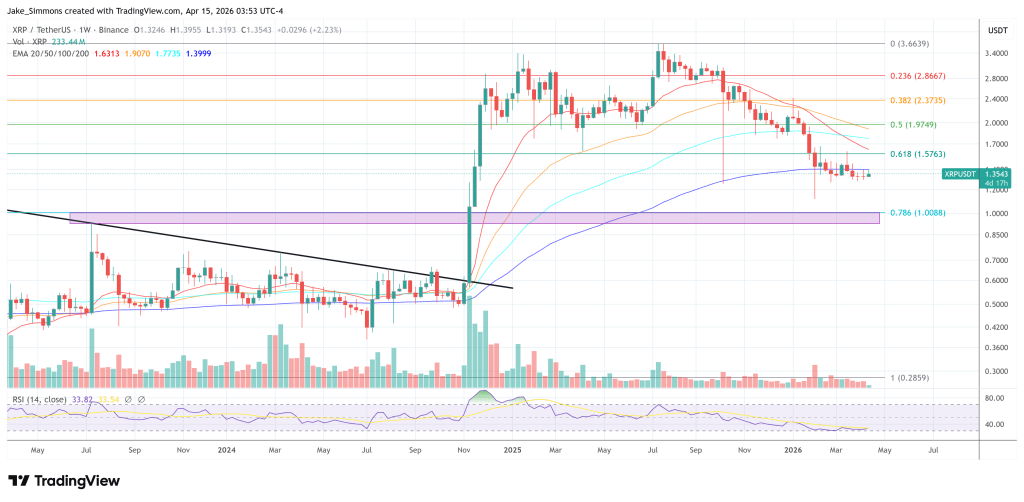
XRP must reclaim the 200-week EMA, 1-week chart | Source: XRPUSDT on TradingView.com

Perguntas relacionadas

QWhat is the main purpose of the partnership between Ripple and Kyobo Life Insurance?

AThe partnership aims to explore Korea's first tokenized government bond settlement workflow on blockchain, using Ripple Custody to hold, transfer, and settle these transactions within a regulated framework.

QHow does Ripple claim its technology will improve the settlement process for government bonds?

ARipple claims the on-chain execution will replace fragmented, manual settlement processes, potentially compressing the standard two-day settlement cycle into near real-time, reducing counterparty risk and improving capital efficiency.

QWhat additional payment rails will Ripple support Kyobo in exploring?

ARipple will support Kyobo in exploring stablecoin-based payment rails to enable 24/7 transaction capability inside a compliant framework.

QHow did Fiona Murray, Ripple's managing director for Asia Pacific, characterize the significance of this partnership?

AShe characterized it as both a market entry point into Korea and a signal to other institutions that institutional-grade digital asset infrastructure is available, proven, and ready to deploy in Korea today.

QAccording to Kyobo's executive, what is the broader goal of this initiative beyond digital assets?

AThe broader goal is to validate how traditional financial instruments, like government bonds, can operate more securely and efficiently on blockchain technology to advance Korea's financial market infrastructure.

Leituras Relacionadas

Winter for Crypto IPOs: Consensys and Ledger Withdraw Applications

The crypto IPO window is tightening significantly in 2026, marked by prominent companies delaying or pausing their public listing plans. Following a successful 2025 "harvest year" that saw Circle, Bullish, and Gemini go public amidst a bull market, the tide has turned. Consensys, developer of MetaMask, recently postponed its IPO until at least fall 2026. Hardware wallet leader Ledger also suspended its planned US listing due to unfavorable market conditions, with Kraken having previously delayed its own plans. This shift is driven by a cooling market in 2026, characterized by a significant Bitcoin price correction, declining trading volumes, and reduced investor risk appetite for crypto stocks. The poor post-IPO performance of 2025 listings like Circle and Bullish, which saw major share price declines, has heightened investor caution. This contrasts sharply with the current AI sector, where companies like SpaceX, OpenAI, and Anthropic are commanding massive valuations and investor enthusiasm based on narratives of stable, exponential growth. Crypto companies now face pressure to transition from hype-driven models to demonstrating reliable cash flows and robust compliance. While the paused IPO plans may lead to valuation resets and affect ecosystem liquidity, they also accelerate industry consolidation toward stronger, more compliant infrastructure players. A potential recovery in Bitcoin's price and clearer regulations could reopen the IPO window in the latter half of 2026.

marsbitHá 1h

Winter for Crypto IPOs: Consensys and Ledger Withdraw Applications

marsbitHá 1h

ChatGPT Can Manage Your Money for You. Would You Trust It with Your Bank Account?

OpenAI has launched a personal finance tool for ChatGPT, currently in preview for US-based ChatGPT Pro users. This feature allows users to connect their bank and investment accounts (via Plaid, supporting over 12,000 institutions) directly to ChatGPT. It analyzes transactions, generates visual dashboards, and offers conversational financial advice—such as budgeting or planning for major purchases—based on the user's actual data. This move follows OpenAI's acquisitions of fintech startups Roi and Hiro Finance, signaling a strategic push into vertical "super assistant" applications, similar to its earlier health-focused feature. However, the launch has sparked significant privacy concerns. Critics question the safety of granting such sensitive financial access to an AI, especially amid ongoing lawsuits alleging OpenAI shared user chat data with third parties like Meta and Google. OpenAI emphasizes that ChatGPT only reads data (no transaction capabilities), deletes it within 30 days if disconnected, and offers opt-out options for model training. Yet, trust remains a major hurdle. The trend reflects a broader industry shift: AI companies like Anthropic and Perplexity are also targeting high-value, data-rich domains like finance and health. While technically promising, the tool operates in a regulatory gray area—it provides personalized guidance but disclaims formal financial advice or liability. Ultimately, OpenAI's challenge is convincing users to trust an AI with their most private financial information.

marsbitHá 1h

ChatGPT Can Manage Your Money for You. Would You Trust It with Your Bank Account?

marsbitHá 1h

Trading

Spot
Futuros
活动图片





