Crypto Industry Watches As Poland Advances Long-Delayed Regulatory Bill

bitcoinistPublicado em 2026-05-16Última atualização em 2026-05-16

Resumo

Poland's parliament has passed a long-delayed cryptocurrency regulatory bill, driven by urgency following a fraud scandal at a local exchange. Prime Minister Donald Tusk cited the Zondacrypto case, where users lost access to funds and which had alleged Russian ties, as proof of the need for investor protections. The approved bill grants Poland's Financial Supervision Authority (KNF) broad powers to oversee the market, impose penalties, and block accounts or transactions. However, the legislation faces potential rejection, as it retains contentious account-blocking provisions that led President Karol Nawrocki to veto two prior versions. Critics argue it lacks sufficient judicial oversight. A third veto would prolong regulatory uncertainty as Poland races to align with the EU's MiCA framework by a July deadline. The bill prevailed over three other competing proposals in a parliamentary vote.

Poland’s prime minister has tied the country’s repeated failure to pass crypto rules to a high-profile fraud case — a charge that added urgency to a parliamentary vote that had already failed twice before.

A Scandal Shapes The Debate

Prime Minister Donald Tusk pointed to Zondacrypto, a Polish crypto exchange now under a prosecutor’s fraud probe, as evidence of what happens when investor protections are not in place.

Thousands of the exchange’s users reportedly could not access their funds, and Tusk alleged the platform had ties to Russian capital and influence dating to its early years.

He argued that Poland’s inability to finalize a regulatory framework had slowed any official response to the crisis.

The exchange scandal cast a long shadow over this week’s sitting of the Sejm, Poland’s lower house of parliament, where lawmakers debated four separate crypto bills simultaneously.
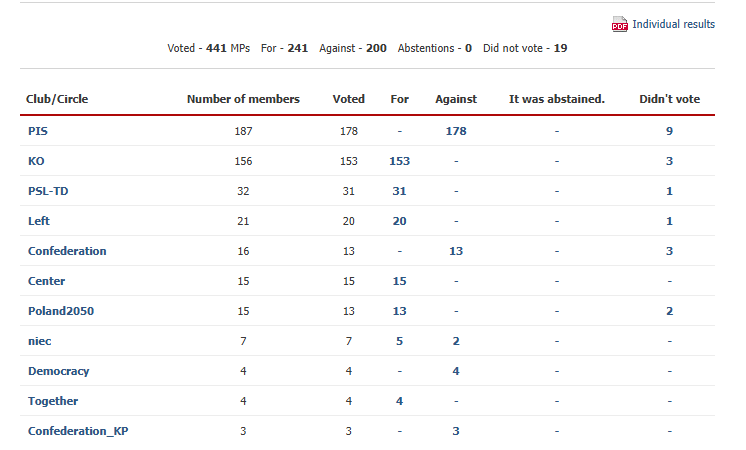
Source: SEJM

On Friday, they approved the government-backed bill — numbered 2529 and supported by the Ministry of Finance — by a vote of 241 to 200. It was the third time the government had pushed this kind of legislation through parliament after President Karol Nawrocki vetoed two earlier versions.

The approved bill hands broad authority to Poland’s Financial Supervision Authority, known as the KNF, to monitor crypto market participants, impose administrative penalties, and block accounts and transactions when deemed necessary.

Critics Point To Unchanged Provisions

Not everyone in the crypto community welcomed the outcome. Market participants and commentators noted that the account and transaction blocking provisions — the same ones that prompted Nawrocki’s previous vetoes — remained largely intact in the final text. Proposed changes such as stronger judicial oversight of enforcement actions were not included.

BTCUSD trading at $79,182 on the 24-hour chart: TradingView

With those concerns unresolved, many observers expect the president to veto the bill again. That prospect worries industry players, since a third rejection would deepen regulatory uncertainty at a particularly inconvenient time.

Poland is required to bring its rules in line with the European Union’s Markets in Crypto-Assets Regulation, known as MiCA, with implementation deadlines approaching in July.

Four Bills, One Outcome

The vote came after lawmakers reviewed competing proposals from four separate sources: the government, the president, the Confederation party, and a parliamentary group. A committee merged the texts before the final vote, and the government version ultimately prevailed.

Featured image from Hotels.com, chart from TradingView

Criptomoedas em alta

Perguntas relacionadas

QWhat event did Poland's Prime Minister Donald Tusk link to the need for cryptocurrency regulation?

APrime Minister Donald Tusk linked the need for cryptocurrency regulation to the scandal surrounding the Zondacrypto exchange, which is under a fraud probe, where thousands of users reportedly could not access their funds.

QWhat is the main regulatory body granted authority under the newly passed Polish crypto bill, and what powers does it have?

AUnder the newly passed bill, Poland's Financial Supervision Authority (KNF) is granted broad authority to monitor crypto market participants, impose administrative penalties, and temporarily block accounts and transactions when deemed necessary.

QWhy do critics expect the Polish President to veto the recently passed cryptocurrency bill?

ACritics expect the President to veto the bill because it retains controversial provisions, such as the power to block accounts and transactions without the stronger judicial oversight that was proposed but not included, which were the same reasons for his previous vetoes.

QWhat is the external regulatory deadline that Poland is facing regarding cryptocurrency legislation?

APoland is facing a deadline to align its national rules with the European Union's Markets in Crypto-Assets Regulation (MiCA), with implementation deadlines approaching in July.

QHow many different cryptocurrency bills were debated in the Sejm, and which one was ultimately approved?

ALawmakers debated four separate cryptocurrency bills from different sources: the government, the president, the Confederation party, and a parliamentary group. The government-backed bill (number 2529) was the one ultimately approved after a committee merged the texts for a final vote.

Leituras Relacionadas

Bitcoin Has Yet to Hit Bottom, While Exchange AscendEX Has Already "Run Away"

On July 6, 2026, cryptocurrency exchange AscendEX officially announced it is ceasing operations, with a complete shutdown scheduled for July 1, 2026. The platform cited the full implementation of the EU's MiCA regulation alongside market, financial, and operational challenges. Users can no longer perform most functions, with accounts limited to withdrawal purposes only. Prior to the announcement, on-chain investigator ZachXBT had issued warnings about significant withdrawal delays and a severe lack of high-liquidity assets (like ETH, USDT, SOL) in AscendEX's public hot wallets. Following the news, ZachXBT confirmed that the exchange lacks sufficient liquid assets to process multiple verified seven-figure withdrawal requests. AscendEX acknowledged that all withdrawals now require manual review, with no guarantees on processing times. Chain analysis via Arkham Intelligence shows the platform's marked wallets hold minimal readily accessible funds, with most recent activity being small withdrawals. One highlighted wallet reportedly contains only $13.46 million in altcoins. AscendEX, formerly known as BitMax, launched in 2018 and raised $50 million in a 2021 funding round. However, it suffered a major security breach in December 2021, losing approximately $77.7 million from hot wallets. The exchange compensated users but never fully recovered. The current crisis underscores the inherent risks of centralized exchanges, where poor liquidity management, regulatory pressure, and bear market conditions can trigger a collapse. The event is seen as part of a broader industry shakeout, highlighting the importance for users to prioritize non-custodial wallets or exchanges with transparent proof-of-reserves.

Foresight NewsHá 1h

Bitcoin Has Yet to Hit Bottom, While Exchange AscendEX Has Already "Run Away"

Foresight NewsHá 1h

Sevenfold Oversubscription, Can SK Hynix Save the Semiconductor Industry This Time?

SK Hynix's planned US ADR listing is drawing intense interest, with its offering reportedly oversubscribed by over seven times, potentially making it the largest foreign listing in US history. The fundraising of approximately $24.5 billion is intended for expanding its Korean production capacity, including advanced packaging and EUV equipment. This massive demand from long-term funds and prominent institutions like Baillie Gifford and Situational Awareness Partners (led by noted investor Leopold Aschenbrenner) presents a stark contrast to the recent downturn in the broader semiconductor sector. The sector has faced a significant correction, with SK Hynix's own stock falling nearly 30% from its June high. This sell-off was triggered by concerns that major tech giants might slow their AI infrastructure spending, following signals like Meta's reported plan to sell surplus computing capacity. The strong ADR appetite suggests long-term investors still believe in the AI investment cycle's fundamentals, viewing the recent decline more as a valuation reset than a demand collapse. Some market speculation even suggests the pre-IPO price drop could be strategic, setting the stage for a stronger post-listing performance. While SK Hynix's successful listing may act as a short-term positive catalyst for market sentiment, the article argues the true signal for a sustained semiconductor recovery will come from upcoming earnings reports of tech giants like Microsoft, Google, Meta, and Amazon. Their future capital expenditure plans will be crucial in determining whether the AI-driven growth cycle can continue.

Odaily星球日报Há 1h

Sevenfold Oversubscription, Can SK Hynix Save the Semiconductor Industry This Time?

Odaily星球日报Há 1h

Breaking News: Musk Delivers the Most Powerful Grok 4.5, Slashes Price of Top-tier Opus Intelligence Drastically

**Elon Musk Launches Grok 4.5: A Cost-Effective, High-Performance AI Rival** SpaceXAI, in collaboration with Cursor, has released Grok 4.5, its new flagship AI model designed specifically for coding and agentic tasks. Trained on tens of thousands of NVIDIA GB300 GPUs using massive, high-quality data filtered from trillions of Cursor developer interactions, the model emphasizes "per-token intelligence." In benchmark performance, Grok 4.5 is highly competitive. It scores 64.7% on SWE Bench Pro (surpassing GPT-5.5's 58.6% and Opus 4.7's 64.3%), 83.3% on Terminal Bench 2.1 (nearly matching GPT-5.5), and 62.0% on DeepSWE 1.0 (beating Opus 4.8). Overall, it ranks fourth in AAAI official tests and first in the Harvey legal agent benchmark. The model's key advantage is its combination of speed, efficiency, and low cost. It generates responses at 80 tokens per second and, crucially, uses far fewer tokens to complete tasks—4.2 times fewer than Opus 4.8 on SWE Bench Pro. It is priced at $2 per million input tokens and $6 per million output tokens, significantly undercutting competitors. Musk stated it is "roughly equivalent to Opus 4.7, but much faster." Early user tests show Grok 4.5 can generate functional code for applications like 3D solar system simulators and basic games from simple prompts, though some note it still lags behind top models in certain creative tasks. Musk has hinted at a major update next month, leveraging real-world engineering data from his companies, with an even larger 2-trillion parameter version reportedly in development. Grok 4.5 positions itself not as the absolute strongest model, but as a highly efficient and affordable alternative in the top tier.

marsbitHá 1h

Breaking News: Musk Delivers the Most Powerful Grok 4.5, Slashes Price of Top-tier Opus Intelligence Drastically

marsbitHá 1h

Trading

Spot

Artigos em Destaque

Como comprar BILL

Bem-vindo à HTX.com!Tornámos a compra de Billions Network (BILL) simples e conveniente.Segue o nosso guia passo a passo para iniciar a tua jornada no mundo das criptos.Passo 1: cria a tua conta HTXUtiliza o teu e-mail ou número de telefone para te inscreveres numa conta gratuita na HTX.Desfruta de um processo de inscrição sem complicações e desbloqueia todas as funcionalidades.Obter a minha contaPasso 2: vai para Comprar Cripto e escolhe o teu método de pagamentoCartão de crédito/débito: usa o teu visa ou mastercard para comprar Billions Network (BILL) instantaneamente.Saldo: usa os fundos da tua conta HTX para transacionar sem problemas.Terceiros: adicionamos métodos de pagamento populares, como Google Pay e Apple Pay, para aumentar a conveniência.P2P: transaciona diretamente com outros utilizadores na HTX.Mercado de balcão (OTC): oferecemos serviços personalizados e taxas de câmbio competitivas para os traders.Passo 3: armazena teu Billions Network (BILL)Depois de comprar o teu Billions Network (BILL), armazena-o na tua conta HTX.Alternativamente, podes enviá-lo para outro lugar através de transferência blockchain ou usá-lo para transacionar outras criptomoedas.Passo 4: transaciona Billions Network (BILL)Transaciona facilmente Billions Network (BILL) no mercado à vista da HTX.Acede simplesmente à tua conta, seleciona o teu par de trading, executa as tuas transações e monitoriza em tempo real.Oferecemos uma experiência de fácil utilização tanto para principiantes como para traders experientes.

307 Visualizações TotaisPublicado em {updateTime}Atualizado em 2026.06.02

Como comprar BILL

Discussões

Bem-vindo à Comunidade HTX. Aqui, pode manter-se informado sobre os mais recentes desenvolvimentos da plataforma e obter acesso a análises profissionais de mercado. As opiniões dos utilizadores sobre o preço de BILL (BILL) são apresentadas abaixo.

活动图片