Report Exposes Ripple Founder Larsen’s Hidden XRP Treasury Influence

bitcoinistPublicado em 2026-03-20Última atualização em 2026-03-20

Resumo

A Protos report reveals that Ripple co-founder Chris Larsen exerts significant influence over Evernorth, a company planning a Nasdaq listing. Through RippleWorks—a nonprofit he co-founded—Larsen controls a majority stake in Arrington XRP Capital Fund, which is contractually obligated to consult RippleWorks on Evernorth-related decisions. Additional XRP contributions from a family trust and Ripple itself further consolidate his influence. SEC filings highlight clear conflicts of interest, as Larsen’s roles at Ripple and RippleWorks may not align with public shareholders' interests. The deal structure also allows Larsen-linked entities to benefit from XRP price increases, while public investors face governance risks.

A Protos report says Ripple co-founder and executive chairman Chris Larsen stands to wield significant influence over Evernorth, an XRP treasury company headed for a Nasdaq listing through blank check firm Armada Acquisition. The report argues that a web of nonprofit, trust, and Ripple-linked contributions gives Larsen outsized sway while creating clear conflicts for prospective public shareholders.

At the center of the story is RippleWorks, the IRS-registered nonprofit Larsen co-founded. According to the report, RippleWorks invested $500,000 in cash plus 211,319,096 XRP into Arrington XRP Capital Fund, LP, the sponsor vehicle tied to the Evernorth deal. That investment gave RippleWorks a majority of the fund’s limited partner interests, while the fund is required to invest all of RippleWorks’ XRP tokens into Evernorth shares.

Ripple Founder Larsen’s Role

The formal control structure runs through Arrington XRP Capital Fund’s general partner, an LLC managed by Michael Arrington. But the filing described by Protos says that control is constrained by contract. Under an October 17, 2025 agreement, the fund must “consult with RippleWorks on any decisions directly related to the disposition or voting of Evernorth Holdings Inc. Stock” and “to vote such shares as directed by RippleWorks.”

That arrangement is what gives the report its edge. Protos highlights language from the SEC Form S-4 filed on March 18 that does not mince words about the misalignment. “The economic interests of the Sponsor diverge from the economic interests of holders of the Public Shares,” the filing states. It goes further: “This structure may create potential conflicts of interest between Mr. Larsen’s duties to Ripple, his influence over RippleWorks’ investment in Arrington XRP Capital Fund, and the interests of Evernorth Holdings Inc. and its stockholders.”

Those concerns are amplified by the other entities feeding XRP into the transaction. Protos reports that the Larsen Lam Children’s Remainder Trust will contribute 50 million XRP in exchange for 1,832,454 Evernorth shares, giving Larsen another line of influence in the soon-to-be-public company. Ripple itself is also contributing 126,791,458 XRP to the same deal, meaning a nonprofit Larsen co-founded, a company he co-founded, and a trust tied to his family are all participating in the same Nasdaq-bound structure.

The filing, as quoted in the report, acknowledges a limit to Larsen’s direct authority. It says he “does not have direct control over RippleWorks’ voting or investment decisions with respect to Arrington XRP Capital Fund.”

Yet Protos argues that this caveat does little to reduce the broader concern, because Larsen sits on RippleWorks’ board, helped create the nonprofit, and remains executive chairman of Ripple.

In another passage cited by the report, the SEC disclosure says Larsen’s “dual roles and affiliations could give rise to situations where his interests as an executive of Ripple differ from or conflict with the interests of Armada Acquisition and holders of Armada Acquisition Class A Common Stock.”

The financial backdrop makes the governance question more striking. IRS filings cited by Protos show RippleWorks held $1.4 billion in assets for fiscal year 2024. The report says Larsen contributed most of those assets, and that 89% of RippleWorks’ revenue in 2024 came from selling some of them. It also notes that CEO Doug Galen earned $845,945 that year, while Larsen was listed as secretary/treasurer with zero compensation.

Protos also points to deal terms that could further benefit RippleWorks and Ripple if XRP rises before closing. Under a closing adjustment, both can receive bonus shares in Evernorth if the token appreciates, while still retaining shares priced on fixed contractual terms even if XRP does not rally. That asymmetry is central to the report’s thesis: Larsen-linked entities may be positioned to capture upside in a public-market vehicle while ordinary shareholders absorb a governance structure already flagged in the filings themselves.

At press time, XRP traded at $1.45.
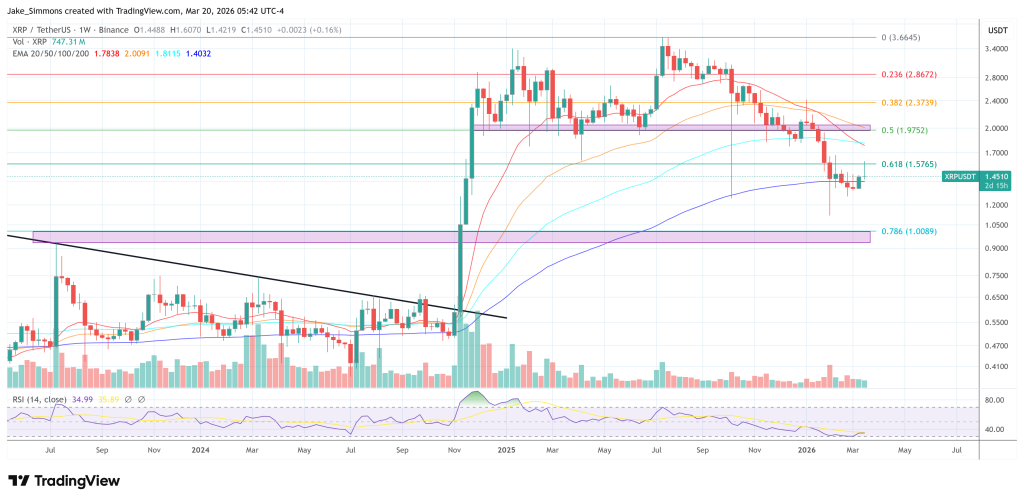
XRP must rise above the 0.618 Fib, 1-week chart | Source: XRPUSDT on TradingView.com

Perguntas relacionadas

QWhat is the main concern raised by the Protos report regarding Chris Larsen and the Evernorth deal?

AThe report's main concern is that a web of nonprofit, trust, and Ripple-linked contributions gives Ripple co-founder Chris Larsen outsized influence over Evernorth, creating significant conflicts of interest for its prospective public shareholders.

QWhich nonprofit organization is at the center of the story and what was its investment?

ARippleWorks, an IRS-registered nonprofit co-founded by Larsen, is at the center. It invested $500,000 in cash plus 211,319,096 XRP into the Arrington XRP Capital Fund, LP.

QWhat contractual obligation gives RippleWorks significant control over Evernorth shares?

AAn agreement requires the Arrington XRP Capital Fund to 'consult with RippleWorks on any decisions directly related to the disposition or voting of Evernorth Holdings Inc. Stock' and 'to vote such shares as directed by RippleWorks.'

QBesides RippleWorks, which other Larsen-linked entities are contributing XRP to the deal?

AThe Larsen Lam Children’s Remainder Trust is contributing 50 million XRP, and Ripple itself is contributing 126,791,458 XRP to the same deal.

QWhat financial asymmetry in the deal terms does the report highlight as a potential benefit to Larsen's entities?

AThe report highlights a closing adjustment clause where RippleWorks and Ripple can receive bonus Evernorth shares if the XRP price rises before the deal closes, while they are protected from downside risk with shares priced on fixed contractual terms.

Leituras Relacionadas

OpenAI Goes Left, DeepSeek Goes Right

On April 24, 2026, DeepSeek released V4, a Chinese large language model offering a free "million-token context window," enabling it to process vast amounts of data like entire books or years of corporate documents in one go. In contrast, OpenAI’s GPT-5.5, released around the same time, is more powerful but significantly more expensive, charging up to $180 per million output tokens. DeepSeek’s strategy represents a shift from a pure AI research firm to a heavy-infrastructure player, building data centers in Inner Mongolia’s Ulanqab to bypass U.S. chip export restrictions. This move, supported by Huawei’s Ascend chips and China’s cheap green electricity, highlights a fundamental divergence in AI development models: U.S. firms focus on high-cost, high-margin services, while Chinese players like DeepSeek prioritize accessibility and affordability. Facing intense talent poaching from tech giants, DeepSeek is seeking a $44 billion valuation funding round to retain researchers and scale infrastructure. Meanwhile, Chinese manufacturers are compressing AI models to run on smartphones, making AI accessible offline and across the Global South. Through open-source models and localized solutions, Chinese AI is empowering non-English speakers and low-income users, driving a form of "digital equality." While Silicon Valley builds walled gardens, DeepSeek and others are turning AI into a public utility—like tap water—flowing freely to those previously left behind.

marsbitHá 11m

OpenAI Goes Left, DeepSeek Goes Right

marsbitHá 11m

$292 Million KelpDAO Cross-Chain Bridge Hack: Who Should Foot the Bill?

On April 18, 2026, an attacker stole 116,500 rsETH (worth ~$292M) from KelpDAO’s cross-chain bridge in 46 minutes—the largest DeFi exploit of 2026. The stolen assets were deposited into Aave V3 as collateral, causing $177–200M in bad debt and triggering a cascade of losses across nine DeFi protocols. Aave’s TVL dropped by ~$6B overnight. This legal analysis argues that KelpDAO and LayerZero Labs share concurrent liability, with fault apportioned 60%/40%. KelpDAO negligently configured its bridge with a 1-of-1 decentralized verifier network (DVN)—a single point of failure—despite LayerZero’s explicit recommendation of a 2-of-3 setup. LayerZero, which operated the compromised DVN, failed to secure its RPC infrastructure against a known poisoning attack vector. Both protocols’ terms of service cap liability at $200 (KelpDAO) or $50 (LayerZero), but these limits are likely unenforceable due to unconscionability, gross negligence exceptions, and potential securities law invalidation (if rsETH is deemed a security under the Howey test). Aave’s governance also faces fiduciary duty claims for raising rsETH’s loan-to-value ratio to 93%—far above competitors’ 72–75%—without adequately assessing bridge risks, amplifying the systemic fallout. Practical recovery targets include LayerZero Labs (a registered Canadian entity), KelpDAO’s founders, auditors, and identifiable Aave governance delegates. The incident underscores escalating legal risks for DeFi protocols, infrastructure providers, and governance participants.

marsbitHá 1h

$292 Million KelpDAO Cross-Chain Bridge Hack: Who Should Foot the Bill?

marsbitHá 1h

Insider Trading in War: 5 People Involved, the Highest Earner Was Arrested

On April 24, the U.S. Department of Justice arrested U.S. Army Special Forces Staff Sergeant Gannon Ken Van Dyke for insider trading related to the capture of Venezuelan President Nicolás Maduro on January 3. Van Dyke allegedly profited over $400,000 by placing bets on a prediction market, Polymarket, using insider knowledge of the covert operation. According to the indictment, Van Dyke registered an account (0x31a5) on December 26 and made a series of bets predicting Maduro’s capture and U.S. military involvement in Venezuela. He withdrew most of his funds on the day of the operation and attempted to obscure his tracks by transferring assets through crypto and brokerage accounts. This case marks the first time the DOJ has prosecuted insider trading on Polymarket. PolyBeats had previously identified five suspicious accounts, including Van Dyke’s—the highest earner—in January. The other accounts, with profits ranging from $34,000 to $145,000, remain under unofficial scrutiny but have not been charged. Their lower profits, indirect access to information, and unclear legal boundaries may complicate prosecution. Polymarket has since strengthened its market integrity rules, explicitly prohibiting trading based on confidential or insider information. Van Dyke’s arrest, nearly four months after his trades, signals increased regulatory attention and the persistent traceability of blockchain-based transactions.

marsbitHá 1h

Insider Trading in War: 5 People Involved, the Highest Earner Was Arrested

marsbitHá 1h

Trading

Spot
Futuros

Artigos em Destaque

O que é XRP 2.0

XRP 2.0: Uma Nova Fronteira no Landscape das Criptomoedas Introdução ao XRP 2.0 No reino em constante evolução das criptomoedas, novos projetos surgem continuamente, lutando por atenção e adoção. Uma dessas iniciativas promissoras é o XRP 2.0, um novo projeto de criptomoeda concebido para aproveitar a tecnologia de blockchain avançada e as metodologias de criptografia robustas. Embora o nome tenha paralelos com o XRP da Ripple, é crucial notar que o XRP 2.0 opera de forma independente, focando em melhorar a segurança das transações, a privacidade e a escalabilidade. À medida que o panorama financeiro digital abraça cada vez mais soluções descentralizadas, o XRP 2.0 visa contribuir de forma significativa para a web3 e a expansão global dos projetos de criptomoedas. O que é o XRP 2.0? No seu núcleo, o XRP 2.0 é um projeto de criptomoeda que visa criar um ecossistema de moeda digital seguro e descentralizado. Sua tecnologia fundamental integra princípios de blockchain sofisticados com técnicas de criptografia de ponta. O objetivo abrangente do XRP 2.0 é estabelecer-se como uma plataforma confiável e eficiente que possibilita a execução rápida de transações, priorizando a proteção de privacidade aprimorada para os seus usuários. O projeto é promovido como uma solução para muitas limitações enfrentadas pelas criptomoedas existentes, propondo um sistema que pode lidar com um volume maior de transações com velocidade e privacidade melhoradas. Esta versatilidade posiciona o XRP 2.0 como um concorrente significativo em um mercado repleto de várias moedas digitais. Quem é o Criador do XRP 2.0? A identidade do criador por trás do XRP 2.0 foi identificada como 'Wilbur.' No entanto, detalhes abrangentes sobre Wilbur ou a sua entidade associada permanecem elusivos. O anonimato de muitos criadores de criptomoedas não é um fenômeno incomum na indústria, muitas vezes concebido para manter um grau de privacidade e segurança. Quem são os Investidores do XRP 2.0? Até agora, informações específicas relacionadas às fundações ou organizações de investimento que apoiam o XRP 2.0 não estão disponíveis publicamente. No setor das criptomoedas, o apoio de investidores reputados pode influenciar significativamente a credibilidade e o sucesso de um projeto, no entanto, a transparência em relação aos apoiantes financeiros do XRP 2.0 não foi estabelecida. Como Funciona o XRP 2.0? O XRP 2.0 destaca-se por empregar uma combinação de tecnologia blockchain e algoritmos de criptografia avançados que asseguram transações seguras e descentralizadas. Sua estrutura inovadora inclui características únicas projetadas para fomentar o envolvimento dos usuários e ampliar as funcionalidades além das transações convencionais de criptomoedas. Entre essas características, o XRP 2.0 incorpora capacidades potenciadas por IA, como funcionalidades de texto-para-imagem e texto-para-fala. Estas adições são projetadas para melhorar a experiência interativa dos usuários, promovendo uma maior aplicabilidade em vários setores. Ao unir avanços tecnológicos com um design centrado no utilizador, o XRP 2.0 pretende captar a atenção de uma diversa gama de indivíduos e empresas que procuram integrar soluções de criptomoedas em suas estruturas operacionais. Cronologia do XRP 2.0 Compreender o XRP 2.0 requer examinar os marcos que definiram sua jornada até agora: 23 de Julho de 2023: O XRP 2.0 é apresentado como um novo projeto de criptomoeda, visando revolucionar as capacidades de transação seguras e descentralizadas no domínio do blockchain. 8 de Setembro de 2023: O lançamento de outro projeto, XRP20, ocorre, marcando o surgimento de um token ERC-20 na blockchain Ethereum que permanece não relacionado ao XRP 2.0. 13 de Novembro de 2023: O XRP Ledger passa por uma atualização significativa com o lançamento da versão 2.0.0 do software do servidor rippled. É importante notar que este desenvolvimento está desconectado do projeto de criptomoeda XRP 2.0. Pontos-chave sobre o XRP 2.0 Para destilar a essência do XRP 2.0, vários fatores críticos emergem: Características Únicas: A inclusão de características como texto-para-imagem e texto-para-fala potenciadas por IA diversifica ainda mais as aplicações potenciais do XRP 2.0. Tecnologia Blockchain: A estrutura utiliza mecanismos de blockchain avançados e protocolos de criptografia, assegurando um ambiente seguro e descentralizado para transações. Escalabilidade e Privacidade: O XRP 2.0 prioriza proteção de privacidade aprimorada nos processos de transação e a escalabilidade necessária para acomodar uma base de utilizadores crescente. Sem Afiliação com a Ripple: Importante, apesar do seu nome, o XRP 2.0 não tem qualquer lealdade ou colaboração com o XRP da Ripple, distinguindo sua estrutura operacional e objetivos dentro do ecossistema das criptomoedas. Conclusão O XRP 2.0 representa uma empreitada ambiciosa no domínio das criptomoedas, visando oferecer uma combinação de segurança, privacidade e eficiência em transações digitais. Ao integrar tecnologias sofisticadas e características amigáveis ao utilizador, o projeto propõe-se a ampliar os horizontes do que as criptomoedas podem alcançar na economia digital atual. Embora o anonimato do seu criador e a falta de investidores divulgados possam levantar questões para alguns, o foco do XRP 2.0 em funcionalidades avançadas e descentralização aumenta seu apelo num mercado de criptomoedas cada vez mais congestionado. À medida que o panorama das criptomoedas continua a evoluir, o XRP 2.0 pode ainda emergir como um jogador crucial na expansão de soluções de blockchain seguras e escaláveis.

99 Visualizações TotaisPublicado em {updateTime}Atualizado em 2024.12.03

O que é XRP 2.0

Como comprar XRP

Bem-vindo à HTX.com!Tornámos a compra de XRP (XRP) simples e conveniente.Segue o nosso guia passo a passo para iniciar a tua jornada no mundo das criptos.Passo 1: cria a tua conta HTXUtiliza o teu e-mail ou número de telefone para te inscreveres numa conta gratuita na HTX.Desfruta de um processo de inscrição sem complicações e desbloqueia todas as funcionalidades.Obter a minha contaPasso 2: vai para Comprar Cripto e escolhe o teu método de pagamentoCartão de crédito/débito: usa o teu visa ou mastercard para comprar XRP (XRP) instantaneamente.Saldo: usa os fundos da tua conta HTX para transacionar sem problemas.Terceiros: adicionamos métodos de pagamento populares, como Google Pay e Apple Pay, para aumentar a conveniência.P2P: transaciona diretamente com outros utilizadores na HTX.Mercado de balcão (OTC): oferecemos serviços personalizados e taxas de câmbio competitivas para os traders.Passo 3: armazena teu XRP (XRP)Depois de comprar o teu XRP (XRP), armazena-o na tua conta HTX.Alternativamente, podes enviá-lo para outro lugar através de transferência blockchain ou usá-lo para transacionar outras criptomoedas.Passo 4: transaciona XRP (XRP)Transaciona facilmente XRP (XRP) no mercado à vista da HTX.Acede simplesmente à tua conta, seleciona o teu par de trading, executa as tuas transações e monitoriza em tempo real.Oferecemos uma experiência de fácil utilização tanto para principiantes como para traders experientes.

1.4k Visualizações TotaisPublicado em {updateTime}Atualizado em 2025.03.21

Como comprar XRP

Discussões

Bem-vindo à Comunidade HTX. Aqui, pode manter-se informado sobre os mais recentes desenvolvimentos da plataforma e obter acesso a análises profissionais de mercado. As opiniões dos utilizadores sobre o preço de XRP (XRP) são apresentadas abaixo.

活动图片