Sam Bankman-Fried Backs Off New Trial Request, Keeps Pressure On Judge Removal

bitcoinistPublicado em 2026-04-24Última atualização em 2026-04-24

Resumo

Sam Bankman-Fried has withdrawn his request for a new trial, stating he does not expect a fair hearing from Judge Lewis Kaplan, who oversees his criminal case. He withdrew the motion without prejudice, meaning he can refile it after his appeal and a separate request to remove Kaplan from the case are resolved. Bankman-Fried is serving a 25-year sentence for fraud related to the collapse of FTX. The withdrawal followed a court-ordered inquiry into whether he had legal help drafting an earlier filing, which he denied. His efforts to replace the judge and appeal his conviction continue. Outside court, he has sought a pardon, but former President Trump has indicated he will not grant one.

Sam Bankman-Fried has told a federal court he does not expect a fair hearing from the judge overseeing his criminal case — and because of that, he is pulling his request for a new trial.

A Calculated Move In Federal Court

The former FTX chief executive filed a letter Wednesday in the US District Court for the Southern District of New York, withdrawing a Rule 33 motion he had been pursuing to overturn his conviction.

The withdrawal, he made clear, is not final. He dropped the motion without prejudice, meaning he can bring it back after his appeal and his separate request to have a different judge assigned to the case are resolved.

Bankman-Fried, 32, is currently held at the Federal Correctional Institution in Lompoc, California, where he is serving a 25-year sentence handed down after his 2023 conviction on fraud and related charges tied to the collapse of FTX.

At its peak, the crypto exchange was one of the largest in the world.
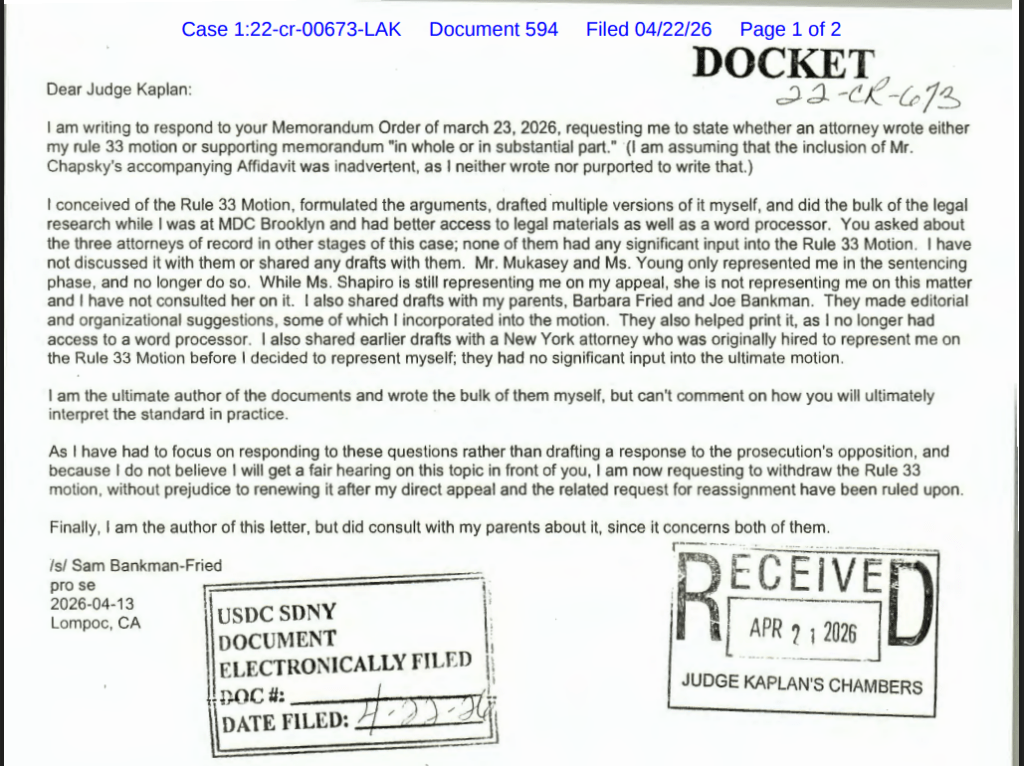
Sam Bankman-Fried's letter to Judge Kaplan released publicly Wednesday. Source: CourtListener.

His decision to pull the motion came after Judge Lewis Kaplan ordered him to explain whether lawyers had helped him draft an earlier filing — a pro se document, meaning one submitted without formal legal representation.

Federal prosecutors had raised doubts about whether Bankman-Fried had written the filing on his own, particularly after his mother, Barbara Fried, sent her own letter to the court. She had no legal standing to do so.

Questions About Who Wrote What

In his Wednesday response, Sam Bankman-Fried said he consulted with his parents while writing the letter but described himself as the “ultimate author of the documents.”

He said the need to respond to the court’s questions had taken time away from preparing a fuller response to prosecutors opposing his new trial request. That, combined with his stated belief that Judge Kaplan would not treat the matter fairly, led him to withdraw the motion.

BTCUSD currently trading at $77,600. Chart: TradingView

His bid to have Kaplan removed from the case predates Wednesday’s filing. Back in February, Bankman-Fried asked a court to assign a different judge to rule on his new trial request, accusing Kaplan of showing “extreme prejudice.”

That request remains active. So does his appeal of both his conviction and his sentence, which is pending before the US Court of Appeals for the Second Circuit.

Sam Bankman-Fried: Pardon Talk Has Done Little To Help His Cause

Outside the courtroom, Bankman-Fried has made no secret of his interest in a presidential pardon. According to reports, he has posted publicly praising US President Donald Trump’s crypto-related policies and his administration’s military moves in Iran.

But Trump has shown no sign of extending any relief. Based on reports from a January interview with The New York Times, Trump said flatly that he had no plans to pardon the convicted founder of FTX.

Featured image from Getty Images, chart from TradingView

Perguntas relacionadas

QWhy did Sam Bankman-Fried withdraw his request for a new trial?

AHe withdrew the request because he stated he does not expect a fair hearing from Judge Kaplan and the need to respond to the court's questions about who drafted an earlier filing took time away from preparing a fuller response.

QWhat is the status of Sam Bankman-Fried's request to have Judge Kaplan removed from his case?

AHis request to have a different judge assigned to the case remains active and is separate from his withdrawn motion for a new trial.

QWhat specific legal motion did Sam Bankman-Fried file and then withdraw?

AHe withdrew a Rule 33 motion, which is a request for a new trial based on newly discovered evidence.

QWhat was the reason federal prosecutors raised doubts about an earlier court filing from Sam Bankman-Fried?

AProsecutors raised doubts about whether he had written the pro se filing on his own, particularly after his mother, who has no legal standing, sent her own letter to the court.

QHas former President Donald Trump indicated he would pardon Sam Bankman-Fried?

ANo, based on a January interview with The New York Times, Trump said flatly that he had no plans to pardon the convicted founder of FTX.

Leituras Relacionadas

STRC Major De-pegging's First Financial Report, How Will Strategy Repair Its Capital Flywheel?

Bitcoin treasury company Strategy released its Q2 2026 earnings report on July 31. Despite a 6.9% year-over-year revenue increase to $122 million, the company recorded a net loss of $8.22 billion, largely due to $8.32 billion in unrealized losses from Bitcoin price fluctuations. As of quarter-end, Strategy holds 843,775 BTC with an average cost of $75,000 per coin, and Bitcoin per share increased. The report highlights a critical shift in Strategy's capital model following the de-pegging of its key financing tool, STRC (Strategic Coin), which fell below its $100 target. Management's top priority is restoring STRC to its target value, aiming for a recovery by September 8. They rule out discounted STRC issuances and plan to maintain its dividend yield at 12%, instead focusing on bolstering its $3.75 billion cash reserve. Strategy has moved from a one-way "buy-and-hold" Bitcoin strategy to active capital management. This new approach, part of its "Digital Credit Capital Framework," involves flexibly managing its balance sheet across four elements: BTC, USD cash, common stock (MSTR), and digital credit securities like STRC. This allows for BTC monetization (having sold $218.4 million in BTC so far), strategic repurchases of discounted securities, and debt optimization, as seen with a $1.5 billion convertible bond buyback. The company's future hinges on two key tests: successfully re-pegging STRC to restore market confidence in its digital credit system, and a long-term recovery in Bitcoin's price to ultimately support its growth thesis.

marsbitHá 23m

STRC Major De-pegging's First Financial Report, How Will Strategy Repair Its Capital Flywheel?

marsbitHá 23m

STRC's First Financial Report Post-Depegging, How is Strategy Restoring the Capital Flywheel?

On July 31, 2026, Bitcoin treasury company Strategy released its Q2 financial report. Despite a 6.9% year-over-year increase in revenue to $122 million, the company recorded a substantial net loss of $8.22 billion, primarily due to $8.32 billion in unrealized losses from Bitcoin holdings. While Strategy's core Bitcoin strategy remains intact—its holdings grew 11% to 843,775 BTC—the company is undergoing a fundamental shift in its capital model. Following the de-pegging of its key financing tool, the STRCoin (STRC), from its $100 target in May, Strategy has pivoted from a one-directional "raise funds, buy Bitcoin" cycle to a more dynamic, multi-asset capital management approach. A key part of this new framework is the "Monetization Program," through which Strategy has sold approximately $218.4 million worth of BTC to bolster liquidity. The company's top priority is repairing STRC's peg, committing not to issue discounted shares until it returns to its target range. It has initiated a $1 billion buyback program for discounted digital credit securities, having repurchased $28.9 million face value of STRC so far. Management aims to restore the peg around September 8, 2026. Strategy now actively manages a matrix of assets: Bitcoin (for accumulation or strategic sales), USD cash reserves (now at $3.75 billion), common stock (MSTR), and digital credit securities like STRC. This allows for tactical moves like repurchasing discounted debt or equity to capture value. The future success of Strategy's "capital flywheel" hinges on two factors: the short-term ability to successfully re-peg STRC to restore market confidence in its digital credit system, and the long-term price trajectory of Bitcoin, upon which its entire investment thesis ultimately depends.

Odaily星球日报Há 28m

STRC's First Financial Report Post-Depegging, How is Strategy Restoring the Capital Flywheel?

Odaily星球日报Há 28m

With Two Consecutive Quarters of Losses, Coinbase Must Rely on Paths Beyond Trading

Coinbase posted its second consecutive quarterly net loss of $359 million on $1.22 billion in revenue for Q2, highlighting its vulnerability to crypto market cycles where weaker prices and lower volatility reduce user trading. However, the report also reveals a strategic shift in its business model. Despite a 25% quarter-over-quarter decline in global spot trading volume, Coinbase increased its market share to a company-record 10.3%. This suggests its position as a compliant U.S. on-ramp is strengthening even in a cooler market. A key development is the diversification of revenue streams. Transaction revenue fell to $599 million, nearly equaling subscription and services revenue of $555 million. Stablecoin services, generating $292 million, are becoming a crucial revenue "floor." This income, derived from interest on the $20 billion average USDC balance held on its platform, is less tied to daily trading activity. Furthermore, while spot trading volume dropped significantly, derivatives volume held steady at $1.03 trillion. Coinbase is pushing to integrate spot, stablecoin, and derivatives liquidity to create a more interconnected and sticky ecosystem for users. The GAAP net loss includes non-cash expenses like stock-based compensation and crypto asset valuation changes. Its adjusted EBITDA remained positive at $208 million for the 14th straight quarter, indicating core operations can cover ongoing costs. The company is also reducing expenses to manage the downturn. The central question moving forward is whether Coinbase's growing market share, stablecoin revenues, and expanding product integration can sufficiently offset the inherent cyclicality of its core trading business during future market contractions.

marsbitHá 43m

With Two Consecutive Quarters of Losses, Coinbase Must Rely on Paths Beyond Trading

marsbitHá 43m

Trading

Spot
活动图片