POLY's Appearance Hints Are Getting Denser, How Far Away Is the Polymarket Airdrop?

Odaily星球日报Publicado em 2026-05-19Última atualização em 2026-05-19

Resumo

**POLY Debut Hints Grow More Frequent: How Far is the Polymarket Airdrop?** Recent continuous hints from Polymarket team members regarding the POLY token have sparked widespread analysis within airdrop communities about its launch timeline and potential scale. According to predict.fun data, the probability of "Polymarket launching its official token before year-end 2025" currently stands at 56%. Hints about POLY began in October 2024. CEO Shayne Coplan's social media post mentioning $POLY alongside major cryptocurrencies first fueled speculation. This was followed by Growth Lead William LeGate discussing "prospective airdrop farmers," and CMO Matthew Modabber explicitly confirming that "Polymarket will have a token, and there will be an airdrop." The momentum continued into 2025. In April, major crypto data platforms CoinGecko and CoinMarketCap created placeholder pages for POLY, further solidifying expectations. May saw discussions shift towards token utility and airdrop criteria. A team member's "Soon" reply to a question about staking POLY for fee reductions, and a leaked internal screenshot showing an "Airdrop" tab, significantly increased anticipation. LeGate also outlined potential airdrop qualifiers, mentioning badges for employees, high-volume/high-profit traders, and ecosystem builders. He suggested that linking a Polymarket account to X (Twitter), sharing trades and market insights, and actively engaging with the community might constitute part of the eligibilit...

Original | Odaily Planet Daily (@OdailyChina)

Author | Asher (@Asher_0210)

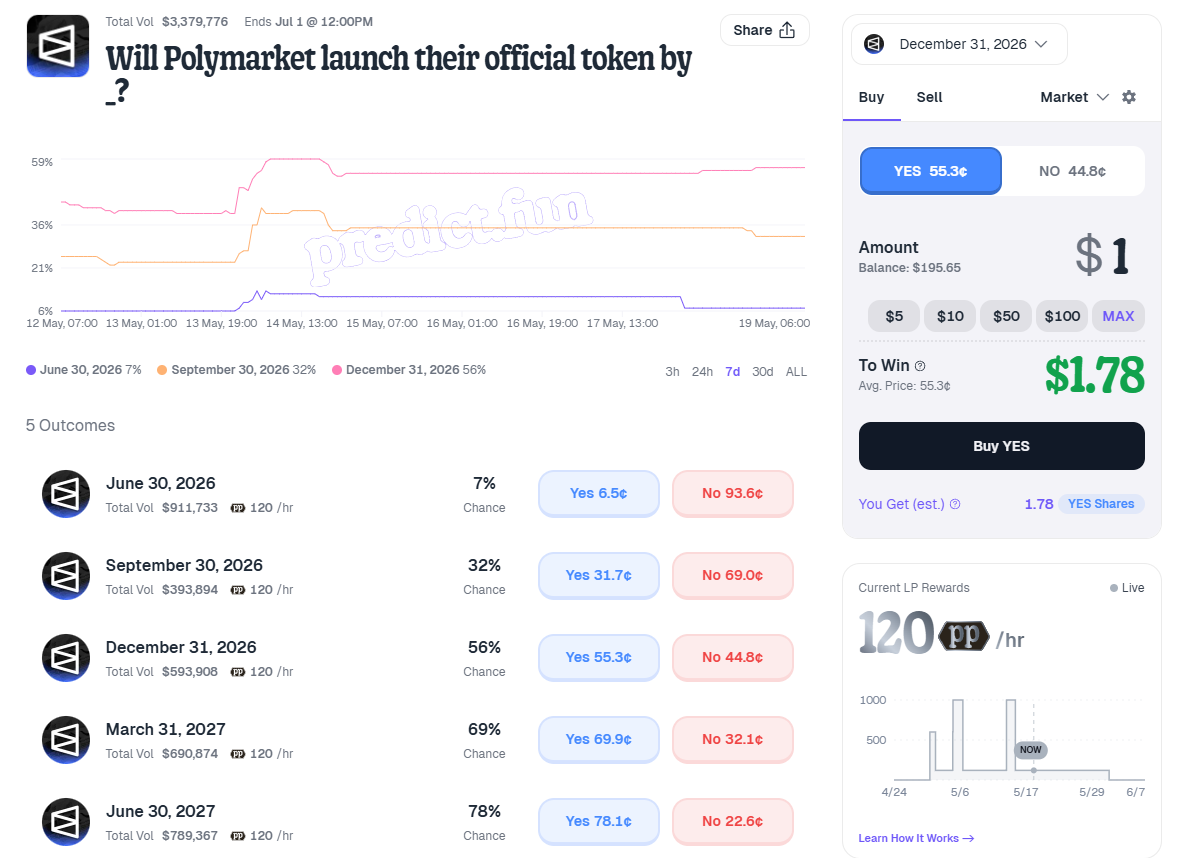
Recently, due to continuous hints from Polymarket's official team members regarding POLY token-related content, major airdrop farming communities have analyzed the timing and scale of a potential POLY airdrop from various angles. According to data from predict.fun, the probability of the event "Polymarket will launch its official token before the end of this year" is currently reported at 56%; there is even a 7% probability that "Polymarket will launch its official token before Q2 this year."
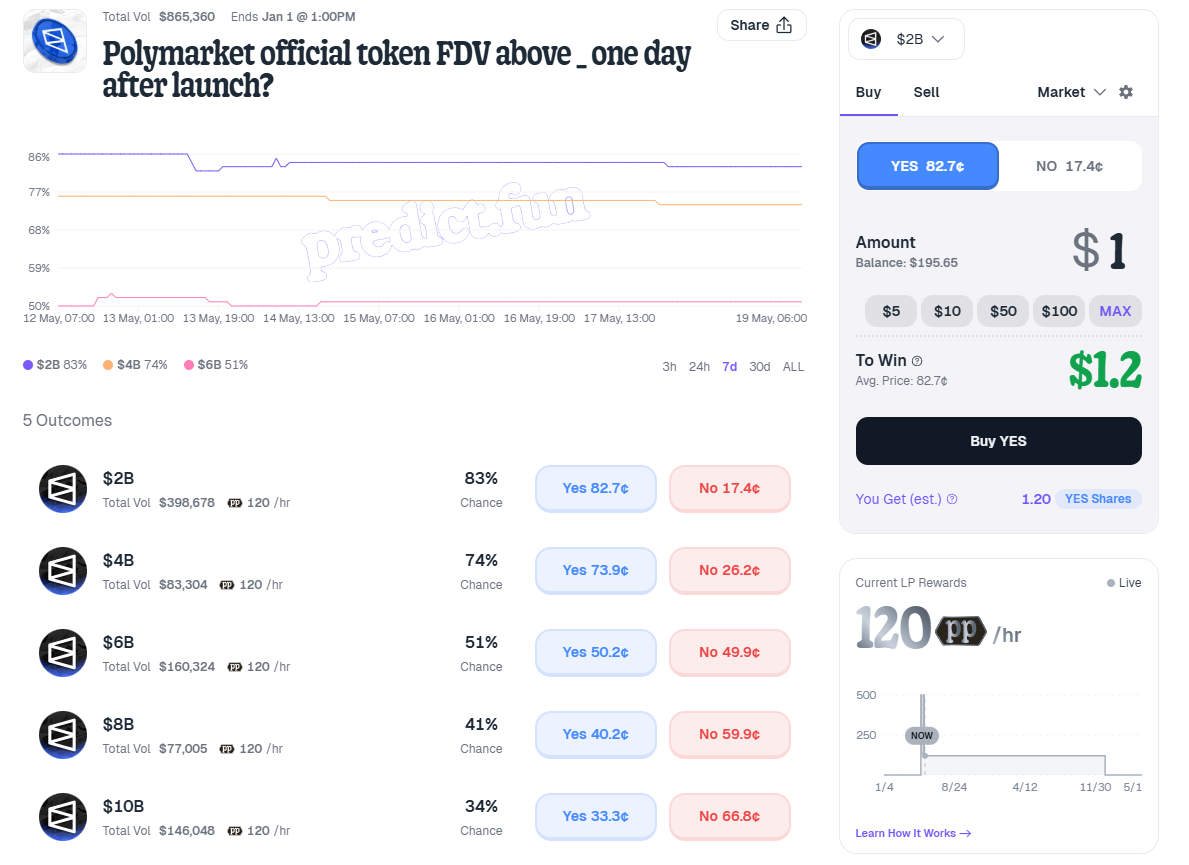
Furthermore, regarding market cap, the probability of the event "Polymarket's FDV exceeds $6 billion one day after launch" is currently reported at 51%; there is a 34% probability that "Polymarket's FDV exceeds $10 billion one day after launch."
Timeline of Polymarket's Official Token Hinting

October 2025: Initial Hints and Official Confirmation of the POLY Token

Signals from the Polymarket official team about the POLY token can be traced back to October last year.

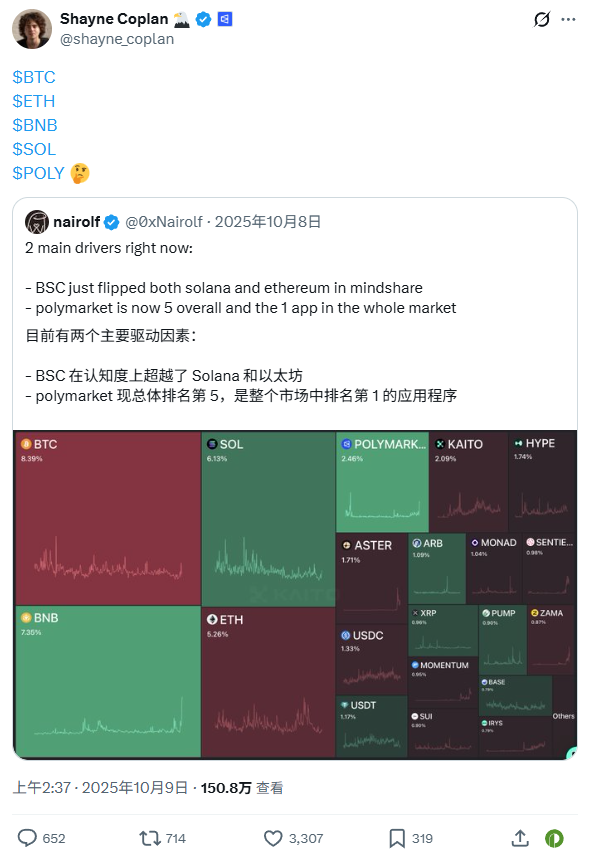
On October 8, 2025, Polymarket CEO Shayne Coplan posted on platform X, listing POLY alongside BTC, ETH, BNB, SOL, sparking community speculation about a Polymarket token launch. Although this was not an official token announcement, for the market, the founder personally writing $POLY was sensitive enough. After that, community discussion about a Polymarket token launch began to noticeably heat up.
Subsequently, the airdrop expectation was further brought into public discussion by official team members. On October 23, 2025, Polymarket Growth Lead William LeGate mentioned "prospective airdrop farmers" in a podcast or related discussion. While not an official rules clarification, this acknowledged the existence of user behavior and expectations surrounding a potential Polymarket airdrop in the market.

What further solidified the POLY token expectation was on October 24, 2025. Polymarket CMO Matthew Modabber explicitly stated in a podcast, "Polymarket will have a token, and there will be an airdrop." This statement became a key turning point for Polymarket's token expectation, shifting from community speculation to official confirmation.

After entering November, the focus of official discussions began to shift from whether there would be an airdrop to what kind of behavior would NOT qualify for an airdrop. On November 11, 2025, William LeGate explicitly stated in response to Sybil farming, "I can tell you for sure that these Sybil accounts will not get airdrop allocations. They are wasting their time."

April This Year: Major Price Tracking Platforms Launch POLY Preview Pages

Entering April this year, the POLY token expectation extended to major crypto price-tracking websites.

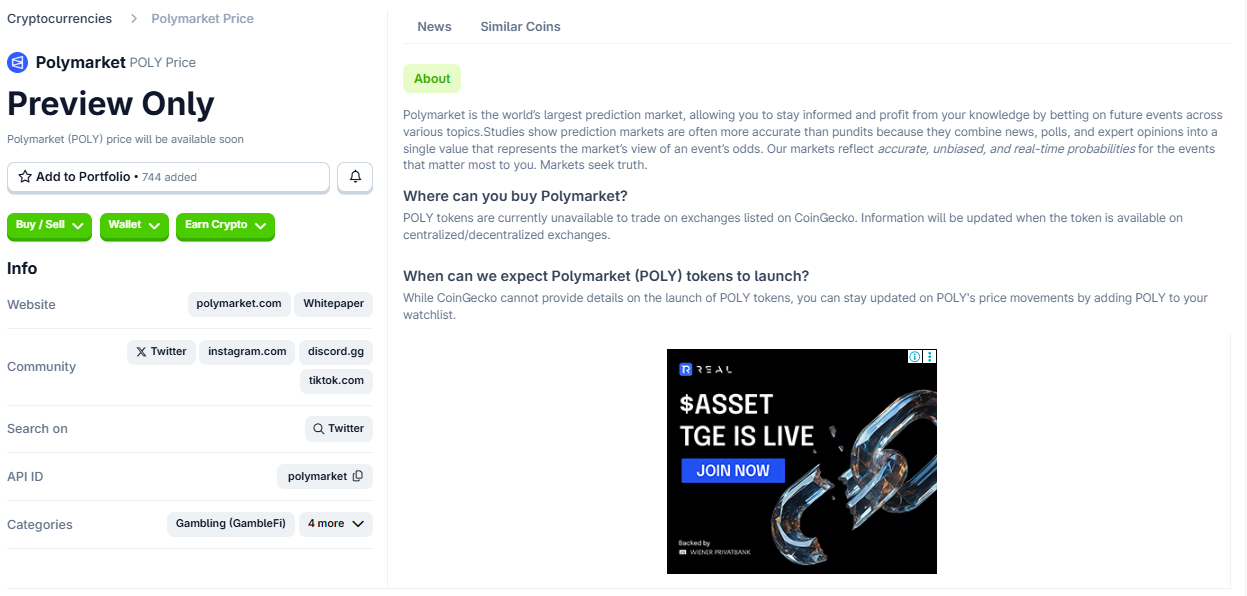
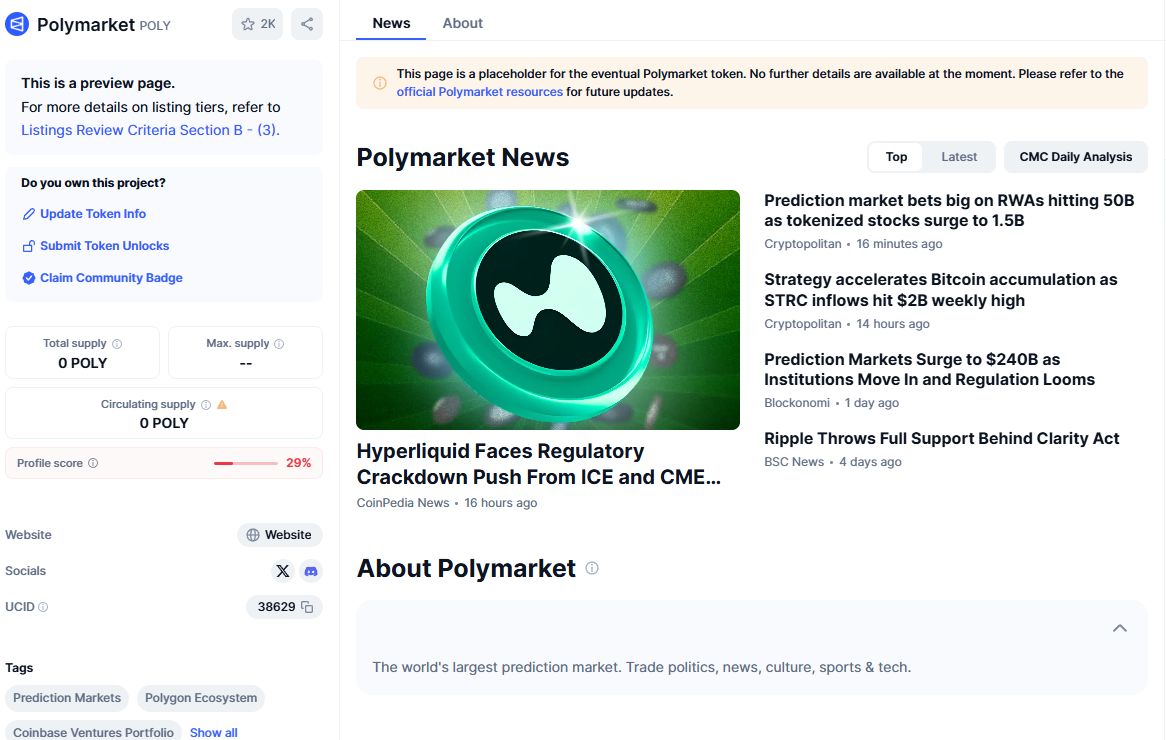
Currently, preview pages for Polymarket (POLY) have appeared on both CoinGecko and CoinMarketCap. While these pages do not equate to the formal token launch and do not represent an announced TGE date by Polymarket, the fact that external price-tracking platforms are reserving space for $POLY further reinforces the community's expectation for a Polymarket token launch.
May This Year: POLY Token Moves from Airdrop Expectation to Product Hinting

After entering May, discussions about the POLY token have progressed further towards specific functionalities and airdrop eligibility.

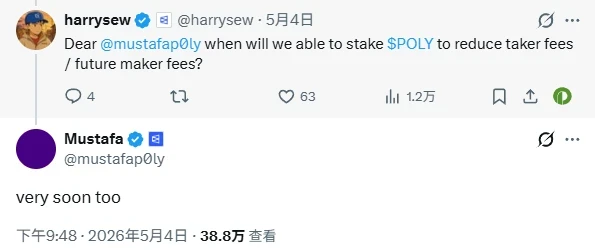
On the evening of May 4, Polymarket official team member Mustafa responded to a question about the POLY token during a community interaction. A user asked when it would be possible to stake POLY to reduce taker fees or potentially future maker fees. Mustafa replied: "Soon." The community quickly interpreted this official response as an indication that Polymarket is preparing for the token's launch.
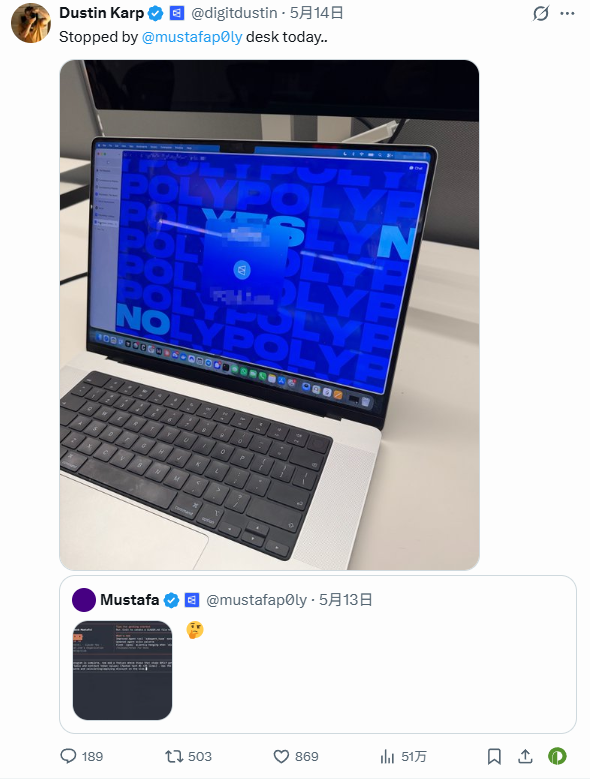
On May 13, more clues around the POLY token emerged. Polymarket Product Lead Dustin Karp posted a photo of a workstation, saying he passed by Mustafa's desk. The photo appeared to show an internal page related to the POLY token airdrop. Upon zooming in, the community spotted an "Airdrop" label, further increasing expectations for the POLY token airdrop.
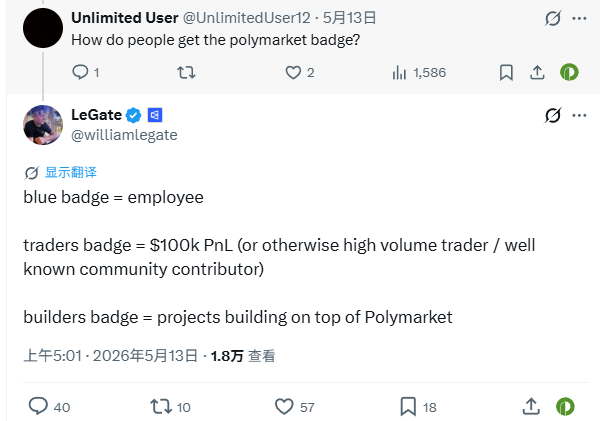
Subsequently, Polymarket Growth Lead LeGate also responded in a community discussion regarding official badges. LeGate replied that blue badges represent Polymarket employees; Traders badges are mainly for traders with cumulative profits reaching $100,000, or other high-volume users (in other tweet replies he mentioned transaction volume exceeding $10 million, adding that if users are active traders on Polymarket, profit amounts and transaction volumes could be slightly adjusted), and notable community contributors; Builders badges are for projects developing and building based on the Polymarket ecosystem.
Badges may not be the sole criterion for receiving an airdrop. The community inquired whether X content contributions would be rewarded with POLY tokens. LeGate replied that connecting an X account to a Polymarket account is only one-third of the conditions. Additionally, users should perhaps also put their Polymarket profile link in their X bio, actively share their trades, profit records, and market views on X, and engage with the community.
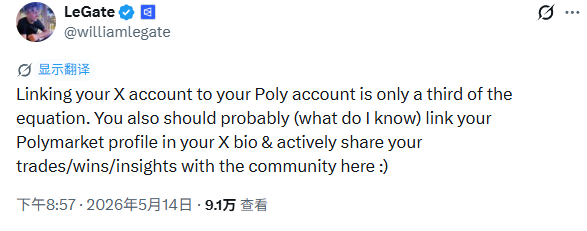
Although this reply did not explicitly confirm whether "jaw farming" (creating content for potential airdrops) would actually yield an airdrop, major communities are relatively optimistic and are actively posting Polymarket-related content on X to vie for potential token airdrops.

Personal Strategy

For me, having been deeply involved in prediction markets throughout the first half of this year, I still lean towards Polymarket not launching its token before the World Cup.

The reason is simple: Polymarket's more important task right now might not be launching a token immediately, but first refining the trading experience and infrastructure. Whether it's the continuous optimization of the V2 version or even changing chains, the essence is to prepare for high-traffic, high-frequency trading scenarios like the World Cup. For Polymarket, if the platform experience is unstable during the World Cup, launching a token beforehand might not effectively capture new users and trading volume.

Therefore, recent trading has primarily been hedging: placing orders for points on predict.fun, and then hedging the acquired positions on Polymarket. At the same time, I participate in various events on Polymarket with the goal of making profits. Additionally, I will bind my personal X account information on Polymarket and post Polymarket-related content on X, hoping that future token launches might allocate a portion of airdrops to "jaw-farming users."


Perguntas relacionadas

QWhat are the key pieces of evidence from Polymarket officials that have fueled speculation about a POLY token airdrop?

AThe evidence includes: CEO Shayne Coplan mentioning $POLY alongside major cryptocurrencies in Oct 2025; CMO Matthew Modabber explicitly confirming 'Polymarket will have a token, and there will be an airdrop' in late Oct 2025; Growth Lead William LeGate discussing 'prospective airdrop farmers'; internal screenshots from May 2026 showing 'Airdrop' labels; and LeGate outlining potential airdrop criteria like linking X accounts and active community participation.

QAccording to the prediction market data in the article, what is the perceived likelihood and potential valuation of a POLY token launch?

AAccording to predict.fun data: There is a 56% probability that Polymarket will launch its official token before the end of the year. There is a 34% probability that its Fully Diluted Valuation (FDV) will exceed $10 billion one day after launch, and a 51% probability it will exceed $6 billion.

QWhat specific user behaviors does the article suggest might *not* qualify for a potential POLY airdrop, based on official hints?

ABased on comments from Growth Lead William LeGate, Sybil farming (creating fake accounts to farm airdrops) will not qualify for an airdrop allocation. He stated such accounts are 'just wasting their time.'

QWhat are the three types of official badges mentioned by Polymarket's team, and what do they represent?

AThe three badge types are: 1) Blue Badge: Represents Polymarket employees. 2) Traders Badge: For users with cumulative profits of $100,000+, very high trading volume (hinted at over $10 million), or notable community contributors. 3) Builders Badge: For projects building on or developing within the Polymarket ecosystem.

QWhat is the author's personal prediction regarding the timing of the POLY token launch, and what is their reasoning?

AThe author predicts Polymarket will NOT launch the token before the FIFA World Cup. The reasoning is that Polymarket's priority is likely perfecting the trading experience and infrastructure (like V2 optimizations) to handle the high traffic and transaction volume expected during the World Cup. A stable platform is seen as more critical than an immediate token launch to capitalize on that event.

Leituras Relacionadas

Bloomberg Uncovered: How Do China's Wealthy Circumvent the Annual $50,000 Limit to Transfer Assets?

**Summary: How Wealthy Chinese Circumvent $50,000 Annual Foreign Exchange Limits** Despite China's strict capital controls, including an annual $50,000 per person foreign exchange quota, an estimated $150 billion in funds still leaves the country annually via various gray and underground channels. This report outlines the evolution of China's "capital wall" and the methods used to bypass it. **The Evolving Capital Controls:** * **Foundation (1994):** The system of "current account convertibility with strict capital account controls" was established. * **Quota Set (2007):** The $50,000 individual annual forex purchase limit was formalized. * **Crackdown Begins (2015-2017):** Following market volatility, enforcement tightened. Banks were required to scrutinize transactions, and channels like using UnionPay cards for Hong Kong insurance premiums or buying overseas property were blocked. * **Digital & Legal Upgrades (2024-2026):** Enhanced algorithms now flag suspicious patterns (e.g., "smurfing"). The Common Reporting Standard (CRS) provides Chinese tax authorities with data on citizens' offshore accounts. Unlicensed cross-border brokers have been targeted. **Five Primary Methods for Moving Capital:** 1. **Underground Banking / "Hawala" (Duiqiao):** The largest-scale method. No money crosses borders. Clients pay RMB to a domestic account; an overseas associate deposits equivalent foreign currency into the client's offshore account. Risks include high fees, account freezes, and legal penalties. 2. **"Smurfing" or "Ant Moving":** Using multiple individuals' $50,000 quotas to pool funds for one offshore recipient. Increasingly detected by anti-money laundering algorithms. 3. **Trade Invoice Manipulation:** Businesses over-invoice imports or under-invoice exports via offshore shell companies, creating a pretext to transfer excess funds abroad under the guise of trade. 4. **Channel Migration:** After a crackdown on internet brokers, funds flow toward more compliant but costly channels like major banks' cross-border wealth management services or Qualified Domestic Institutional Investor (QDII) quotas. 5. **Structural Arrangements:** High-net-worth individuals use complex, high-cost legal structures involving offshore trusts, insurance, and investment migration programs to transfer asset ownership. **Regulatory Response: Focusing on People, Not Just Money** The current strategy extends oversight from enterprises to **individual residents**. Tools like CRS allow retroactive visibility into offshore assets. Cryptocurrencies, once seen as a potential loophole, are now actively monitored and prosecuted as an illegal channel. The underlying driver remains: with significant wealth concentrated among millions of affluent households seeking diversification amid domestic economic shifts, the incentive to move assets offshore persists despite regulatory barriers.

marsbitHá 13m

Bloomberg Uncovered: How Do China's Wealthy Circumvent the Annual $50,000 Limit to Transfer Assets?

marsbitHá 13m

Ethereum's Ballmer Moment: As Everyone Is Bearish, the Circulating Supply Is Disappearing

"Ethereum's Ballmer Moment: Circulation Shrinks Amid Bearish Sentiment" Amid widespread bearish sentiment, with prominent figures like Bankless founder David Hoffman selling ETH and young developers flocking to Solana, some argue Ethereum is entering its "Ballmer era"—akin to Microsoft's perceived stagnation under Steve Ballmer. While surface-level criticisms about slow protocol development, cautious leadership, and competitive pressure are valid, underlying fundamentals tell a different story. Approximately 30% of ETH is staked, major holders like BitMine are accumulating, and spot ETFs continue to absorb supply. Regulatory clarity, including the SEC/CFTC's March ruling on staking rewards and the potential passage of the CLARITY Act, is transforming crypto from a regulatory threat into a legitimized framework. This institutionalization, alongside a shrinking circulating supply (with net issuance around 0.23% annually), creates significant buy-side pressure independent of fee-based value capture. The broader crypto total addressable market is expanding through regulated stablecoins, tokenized assets, and institutional adoption. While public chains face competition from permissioned alternatives, the winning model appears to be permissioned assets settling on public chains like Ethereum and Solana. The author advocates a non-maximalist, barbell strategy: holding ETH for its institutional role and supply squeeze, SOL for consumer/throughput trends, BTC as a macro hedge, and a basket of next-gen L1s. Key bullish drivers for ETH include rapid circulation shrinkage, potential Q2 staked ETF approvals, regulatory tailwinds solidifying its role as a default settlement layer, and the optionality of an eventual "Satya moment" leadership shift. Despite bearish consensus, the current setup—where crypto is "not hot" and regulatory groundwork is being laid—presents a compelling investment opportunity. The crypto cycle's focus may have shifted to AI, but blockchain infrastructure is gaining a legal and institutional foothold precisely while attention is elsewhere.

marsbitHá 13m

Ethereum's Ballmer Moment: As Everyone Is Bearish, the Circulating Supply Is Disappearing

marsbitHá 13m

Claude Code Introduces Dynamic Workflows: Enabling AI to Form Teams and Collaborate

Claude Code introduces dynamic workflows, enabling AI to coordinate teams of specialized agents for complex tasks. This transforms Claude from a code assistant into a programmable workbench. Workflows address key limitations of single-agent systems: agentic laziness (premature task completion), self-preferential bias (favoring own outputs), and goal drift (losing sight of original objectives). The system allows Claude to dynamically create execution frameworks using JavaScript. It can split tasks, dispatch parallel agents for isolated work (e.g., in separate worktrees), implement adversarial validation, run tournaments, and synthesize results. This multi-agent approach is valuable for tasks requiring deep research, factual verification, code migration, root cause analysis, large-scale triage, and qualitative sorting. Key patterns include: classify-and-route, fan-out-and-synthesize, adversarial verification, generate-and-filter, tournaments, and loop-until-done. While token usage is higher, workflows excel where tasks resemble programming—needing problem decomposition, isolated context, hypothesis testing, and handling many details. They extend Claude Code's utility beyond technical work to areas like business plan review, resume screening, and naming brainstorm. The feature is not a universal solution but points to a future where AI tool competitiveness depends on organizing reliable, reusable, and auditable execution flows for complex goals.

marsbitHá 54m

Claude Code Introduces Dynamic Workflows: Enabling AI to Form Teams and Collaborate

marsbitHá 54m

Hyperliquid, Wall Street's 24/7 Trading Convenience Store

Hyperliquid: The 24/7 Trading "Convenience Store" for Wall Street Hyperliquid, a decentralized cryptocurrency exchange, has become a go-to platform for Wall Street traders seeking to trade around the clock, especially during traditional market closures. Founded by Jeff Yan, a former quantitative trader, after the FTX collapse, the platform emphasizes user self-custody of assets. It offers a wide range of perpetual contracts—leveraged derivatives with no expiry—on assets from Bitcoin and crude oil to the S&P 500 and even pre-IPO companies like SpaceX. A notable example involves a hedge fund trader who capitalized on geopolitical news over a weekend, securing a 243% return on oil derivatives before markets reopened. The platform, run by just 11 employees, generated approximately $800 million in revenue last year, and its native token HYPE has seen significant growth. Its rise highlights the merging of traditional finance and crypto. While U.S. users are currently restricted, recent CFTC rule changes could open access. The platform is known for its transparency, having processed $10 billion in liquidations during a market crash while competitors faltered. Regulators warn of the high risks and complexity of perpetual contracts for retail investors. Key to its appeal is a strong community culture, direct engagement with founders, and a simple interface. Despite rules against VPN use, it attracts global users with its permissionless approach. Hyperliquid plans to expand into prediction markets and options, aiming to eventually host all financial activity.

marsbitHá 54m

Hyperliquid, Wall Street's 24/7 Trading Convenience Store

marsbitHá 54m

Trading

Spot
Futuros
活动图片