No Holiday Break|What Have Crypto KOLs Been Talking About in the Last 24 Hours?

比推Publicado em 2026-02-18Última atualização em 2026-02-18

Resumo

This article summarizes discussions from crypto KOLs on X (formerly Twitter) over the past 24 hours during the Chinese New Year period. Key topics include: - Reflections on the Spring Festival and the growing role of AI, especially its prominence in the Spring Festival Gala. - Kraken Exchange launching an official Chinese account, with executives greeting the community in Chinese. - An analysis of the evolution of crypto listing cycles, arguing that "narratives are dead, utility prevails." The piece discusses different eras—from early chaos, to IEOs, the rise of Airdrops, and the current balance between VCs, projects, and retail. He Yi from Binance commented on the industry’s maturation and shifting dynamics. - Market sentiment discussions, noting that in a bull market, even unrelated news is seen as positive, while in bear markets, all news is perceived negatively. Some expect Bitcoin to consolidate around $60k–$70k for a while. - Humorous community comments about Justin Sun (often referred to as "Sun Ge" or "Sun Cut"), poking fun at his reputation and anecdotal stories. The article includes multiple screenshots of tweets and disclaims that the opinions expressed are personal and not investment advice.

Dear readers, may the Year of the Horse bring you great fortune!

This Bingwu Spring Festival, we wish you: ever-rising portfolios, a mindset as steady as a galloping horse, and profits racing like a track sprint!

Let’s take a look at what KOLs in the crypto space have been hotly discussing over the past 24 hours—

Note: The following content is compiled from the X platform, representing personal opinions only. It does not represent the stance of this platform and should not be considered investment advice.

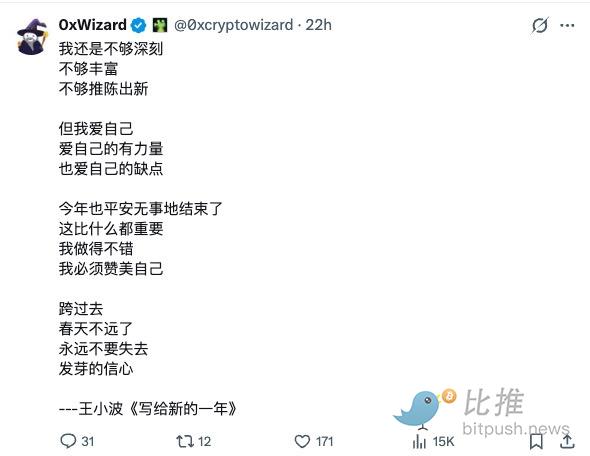
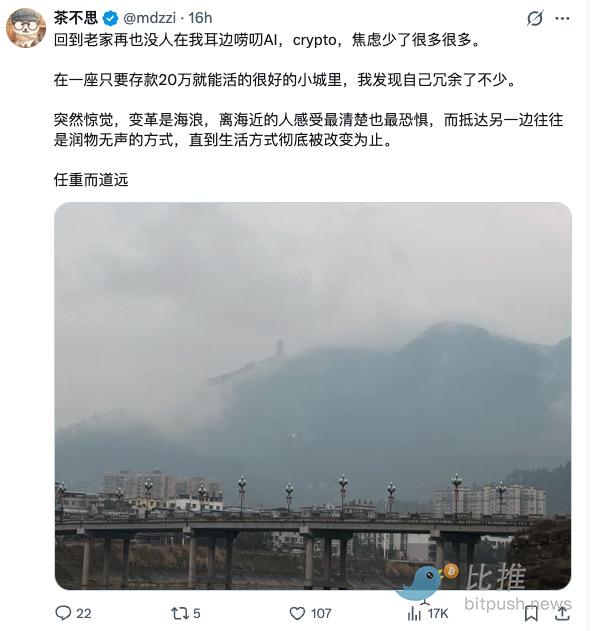
New Year Reflections, and When AI Takes Center Stage at the Spring Festival Gala
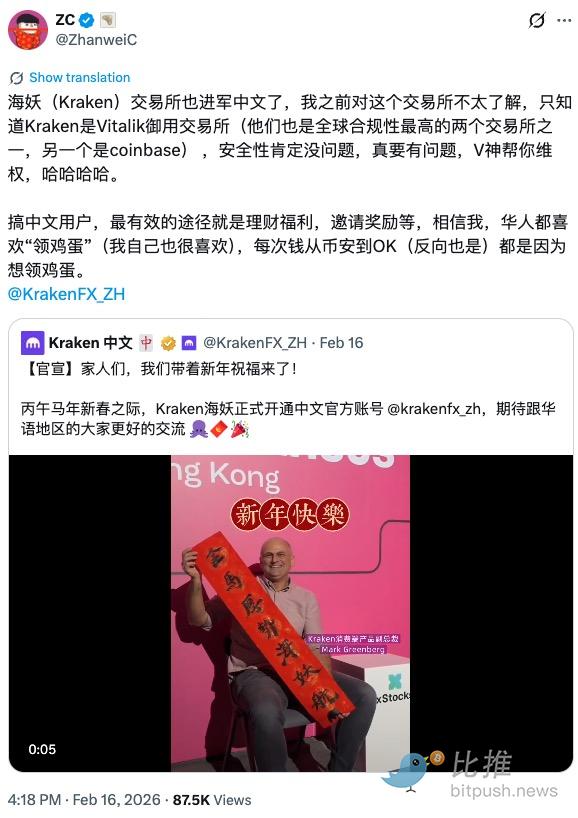
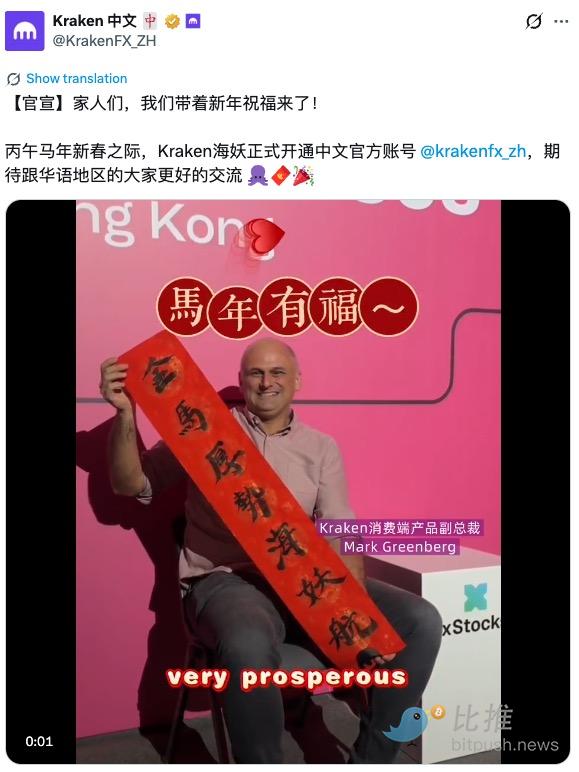
Kraken Exchange Launches Chinese Account, Executives Extend New Year Greetings in Chinese
The Evolution of Listing Cycles: “Narratives Are Dead, Utility Reigns”

Article link: https://www.bitpush.news/articles/7612622

Author’s note: “As an old-timer in crypto who’s anti-VC, this sentiment really resonates with us—do you know how long it took for the crypto community to reclaim pricing power? So today, from the perspective of a seasoned veteran, I’ve strung together these phases to help newcomers understand the journey. This is a hearty dish for you to savor during boring family visits or while traveling. It’s worth reading again and again.”

He Yi’s repost comment:

“From an exchange’s perspective, the first phase was the wild west era where many projects cashed out and left. Binance began restricting investors & project teams from unlocking tokens based on milestones or timelines.

The second IEO era emerged because liquidity was concentrated, giving Binance more leverage to advise projects on low-price TGEs to benefit retail investors, without charging listing fees—a win-win logic. Coupled with the bear market introducing longs, shorts, and leverage, this became the ‘golden age’ everyone reminisces about.

The third era saw AMMs revolutionize DEXs, the rise of VCs, and the professionalization of industry KOLs and institutions. This diluted CEXs’ pricing power and introduced compliance standards, leading to airdrops.

The fourth era is marked by further institutional professionalization among players. Exchanges evolved from early curation to CEXs integrating wallets and enabling trading of any on-chain token, giving rise to ‘the eggs every generation must claim’—Alpha, intended to balance VC & institutional, project, and retail interests.

For any emerging industry, it’s a process of feeling our way forward. Most people lack faith in the industry’s long-term prospects, hence ‘not looking long-term.’ It’s like many don’t believe we can cross this river, but only those who believe can make it to the other shore.”

Market Discussions
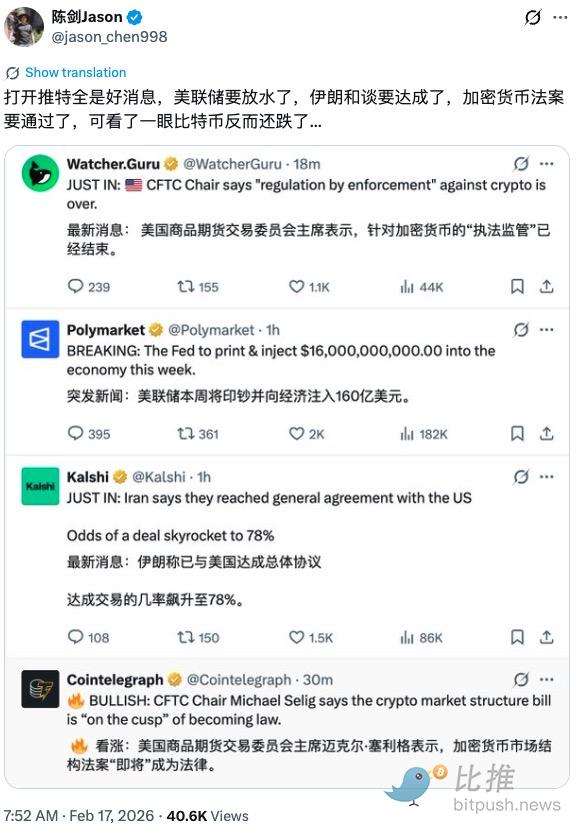
Popular replies:

In a bear market, any news is bearish; in a bull market, even unrelated news is bullish;

When Bitcoin ETFs were approved, the price didn’t rise—it actually dropped from 44k to 38k, but later hit 120k. Probably now it’ll hover around 60k-70k for a long time;

It’s these positive factors that pushed it past 70k; otherwise, it would’ve dropped to 60k already.

The Charm of “Sun Studies”

Popular replies:

A joke: you think he’s just borrowing a pen, but when you look back, your wallet’s gone too. Then Brother Sun invites you to dinner under the pretext of returning it, and you end up losing the meal on top of it;

His never-miss-a-trick nature is etched in his genes;

I heard that last time Sun Cut was interviewed in Hong Kong, he pocketed two glass cups on his way out;


Original article link: https://www.bitpush.news/articles/7612688

Perguntas relacionadas

QWhat is the main topic discussed by crypto KOLs in the past 24 hours according to the article?

AThe main topics include Chinese New Year reflections, AI's role in the Spring Festival Gala, Kraken Exchange opening a Chinese account and executives greeting in Chinese, the evolution of token listing cycles, market discussions, and the 'charm of Sun Studies' (referring to Sun Yuchen's influence).

QWhich exchange opened a Chinese account and had executives send New Year greetings in Chinese?

AKraken Exchange opened a Chinese account and had its executives send New Year greetings in Chinese.

QWhat is the core argument in the 'Token Listing Cycle Evolution Theory' mentioned in the article?

AThe core argument is 'Narrative is dead, utility stands,' highlighting a shift from speculative narratives to practical utility in token listings, with insights into the industry's phases from wild growth to institutional professionalism.

QHow did the community react to market discussions, as per the popular replies in the article?

AThe community noted that in a bear market, any news is seen as negative, while in a bull market, even unrelated news is perceived as positive. They also discussed Bitcoin's price consolidation around $60,000-$70,000 after ETF approval.

QWhat is the community's humorous take on 'Sun Studies' (孙学) in the article?

AThe community humorously commented on Sun Yuchen's reputation, joking that he might take advantage of situations, such as 'taking wallets' or even pocketing glass cups after an interview, reflecting his opportunistic character.

Leituras Relacionadas

Fixed Supply + Institutional Frenzy, After Bitcoin's 50% Plunge, Will It Replicate Gold's 'Explosive' Run from 20 Years Ago?

"Fixed Supply & Institutional Craze: Bitcoin's Potential to Mirror Gold's 'Explosive' Price Rally of Two Decades Ago After a 50% Crash?" Despite a challenging period in 2026 where Bitcoin fell over 50% from its late 2025 peak above $126,000, analysts see potential for a turnaround, drawing parallels to gold's performance after the launch of its ETFs. Bloomberg Intelligence senior ETF analyst Eric Balchunas suggests Bitcoin ETFs could follow a "roadmap" similar to gold ETFs over the past 22 years. Since their 2004 debut, gold ETFs have seen dramatic surges, painful drawdowns, and recoveries, ultimately driving gold's market capitalization near $28 trillion. Both assets are non-yielding stores of value driven purely by investor sentiment. Spot Bitcoin ETFs, launched in early 2024, rapidly became among the fastest-growing ETFs ever, marking Bitcoin's move into mainstream finance. However, this also introduced significant volatility, with concerns about potential large-scale ETF outflows interrupting rebounds. For instance, BlackRock's IBIT, a leading Bitcoin ETF, has sold nearly 100,000 Bitcoin recently to meet redemptions, though it still holds over 733,000. The core parallel lies in fixed supply meeting surging, albeit fickle, institutional demand. Balchunas notes that both gold and Bitcoin experienced explosive price moves when demand concentrated, but such demand often comes in waves. Industry observers believe Bitcoin's "digital gold" narrative, bolstered by halving cycles and growing institutional adoption through ETFs, supports long-term bullish prospects. While the path will be volatile, if Bitcoin captures even a fraction of gold's role as a store of value, its upside potential remains substantial.

marsbitHá 4m

Fixed Supply + Institutional Frenzy, After Bitcoin's 50% Plunge, Will It Replicate Gold's 'Explosive' Run from 20 Years Ago?

marsbitHá 4m

Starknet Launches Privacy-First Bitcoin strkBTC, Targeting Institutional On-Chain Finance

Starknet introduces strkBTC, a privacy-focused version of Bitcoin designed for institutional on-chain finance. As digital assets face increased scrutiny, two major challenges emerge: the public visibility of all transactions and the looming threat of quantum computing to current cryptographic signatures. Bitcoin, representing over 56% of the crypto market, highlights these issues most clearly. strkBTC, built on Starknet’s STRK20 privacy framework, allows Bitcoin to be used privately on-chain while maintaining compliance. It operates in two modes: a public mode like standard ERC-20 tokens, and a shielded mode that hides balances and transactions from public view. This addresses the need for confidentiality in institutional finance, similar to traditional markets’ private trading venues. A third-party auditor, Financial Privacy Inc, holds view keys for regulatory access when necessary. Additionally, Starknet is positioned ahead in quantum resistance. Its STARK-based proof system relies on hash functions rather than elliptic-curve cryptography, making it less vulnerable to quantum attacks. Starknet’s native account abstraction also allows easier migration to quantum-resistant signatures without protocol-level forks. The team has outlined a roadmap to achieve end-to-end quantum security before “Q-day,” though dependencies on Ethereum’s own migration remain. While strkBTC currently uses a trusted bridge consortium, Starknet plans to transition toward more trustless, Bitcoin-native verification over time. The initiative underscores a shift in on-chain finance beyond yield—prioritizing privacy, compliance, and long-term security for institutional adoption.

marsbitHá 11m

Starknet Launches Privacy-First Bitcoin strkBTC, Targeting Institutional On-Chain Finance

marsbitHá 11m

Bank of America Quietly Positions: Could $6 Trillion in Bank Deposits Flow into Stablecoins?

Bank of America has quietly made leadership appointments to accelerate its digital asset strategy, sparking discussion about a potential large-scale migration of bank deposits to stablecoins. Reports highlighted the bank naming Sonali Theisen, Kevin Milsom, and Adam Dixon to lead its global digital asset and AI platform, focusing on stablecoins, tokenized deposits, custody, and crypto settlement. This move revived a claim that $6 trillion in bank deposits could flow into stablecoins, a figure originally cited by Bank of America's CEO Brian Moynihan in January. However, he conditioned this shift on stablecoins being allowed to pay interest—a feature not permitted under the current GENIUS Act. The legislation's final rules are delayed, pushing its effective date to January 2027. Major banks are not waiting. JPMorgan and Citigroup are already piloting tokenized deposit services, and a consortium including Bank of America is building a shared tokenized deposit network targeting a 2027 launch. While some, like Pacemakers.io's Alessandro Hatami, remain skeptical of rapid bank collaboration, data shows significant institutional adoption. Stablecoin settlement volume hit $33 trillion in 2025, and analysts project the market could surpass $1 trillion by 2026. Despite a recent dip in crypto prices and stablecoin supply, the institutional push for real-world use cases continues. The race is on for January 2027, when the GENIUS Act takes effect, potentially reshaping the competition between traditional finance and digital assets.

Foresight NewsHá 29m

Bank of America Quietly Positions: Could $6 Trillion in Bank Deposits Flow into Stablecoins?

Foresight NewsHá 29m

Trading

Spot
活动图片