Netting $2.4 Million: These 9 Insider Addresses Knew the US-Iran War Best

marsbitPublicado em 2026-05-25Última atualização em 2026-05-25

Resumo

On May 18th, Bubblemaps investigators disclosed the discovery of nine highly correlated anonymous accounts on Polymarket that netted over $2.4 million from prediction markets tied to US military actions, with a 98% win rate. The accounts focused almost exclusively on the 2026 US-Iran conflict, placing bets with uncanny precision days before key events like the "Operation Epic Fury" strike on February 28th, which eliminated Iran's Supreme Leader. Bubblemaps' analysis linked four core accounts—each profiting around $400k—and five others through synchronized timing, transaction patterns, and fund flows. The money moved through shared wallet networks, suggesting professional obfuscation. This case is six times larger than the earlier prosecution of US Army Sergeant Gannon Van Dyke for insider trading on Polymarket. While platforms like Polymarket have established AI monitoring and explicit rules against trading on stolen or confidential information, the incident has spurred controversial "insider copy-trading" services that help users follow high-success accounts, raising new regulatory questions.

Written by: Mahe, Foresight News

On May 18, Nicolas Vaiman, founder of Bubblemaps, and lead investigator Deebs (a pseudonym used by a former U.S. military officer for safety reasons) disclosed to the public: they discovered nine highly correlated anonymous accounts on Polymarket that collectively netted over $2.4 million from prediction markets related to U.S. military actions, with a winning rate as high as 98%.
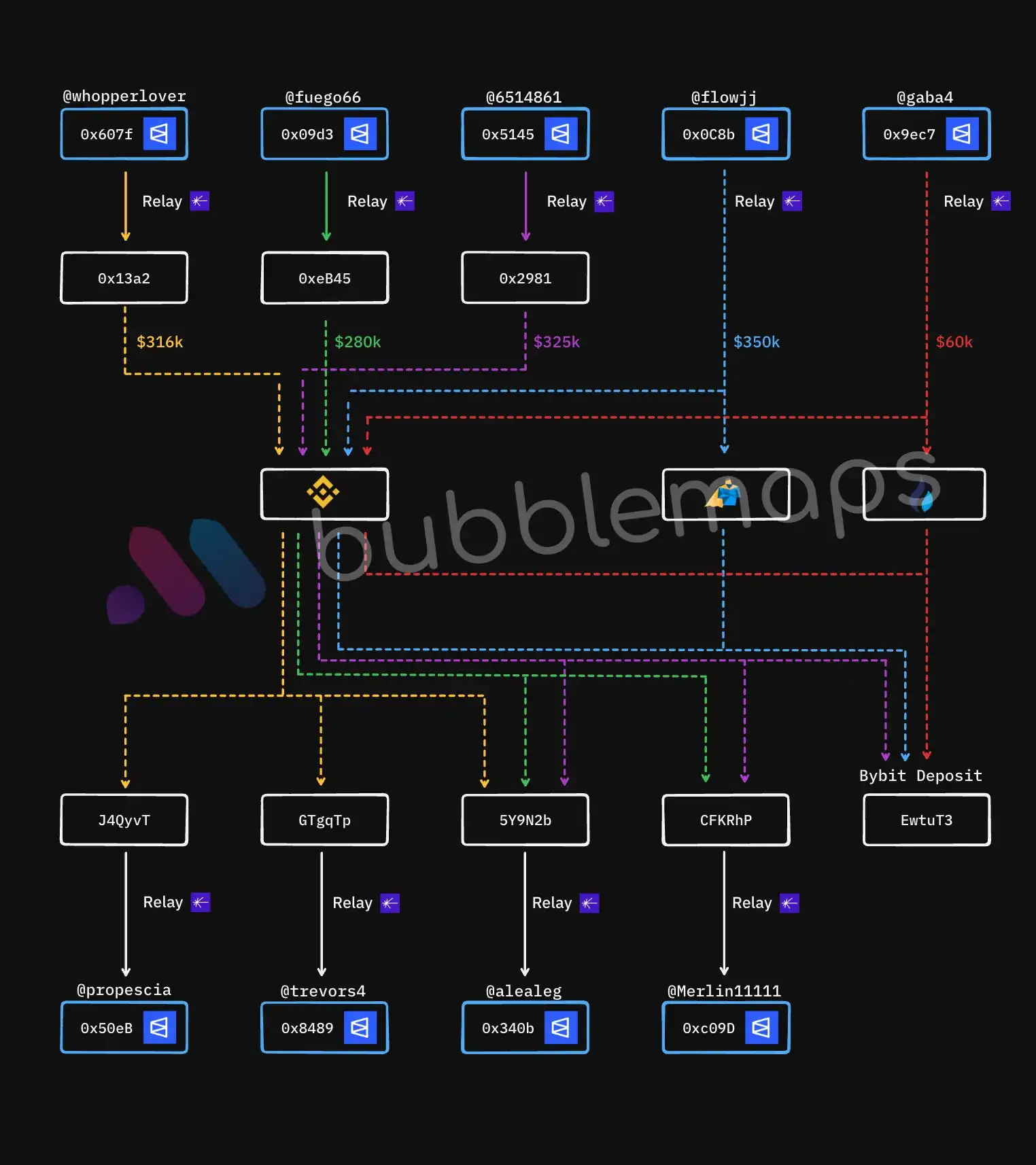
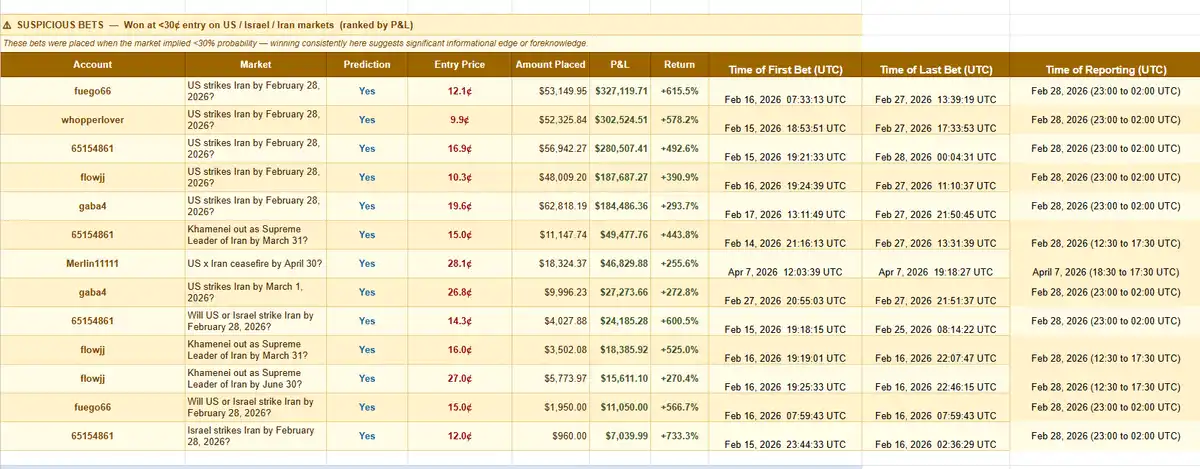
Bubblemaps provided a detailed analysis of these accounts on Twitter. They almost exclusively bet on military events related to the US-Iran conflict in 2026, with timing so precise it was chilling—often placing bets just days before key actions occurred, and favoring long-odds, low-probability options.

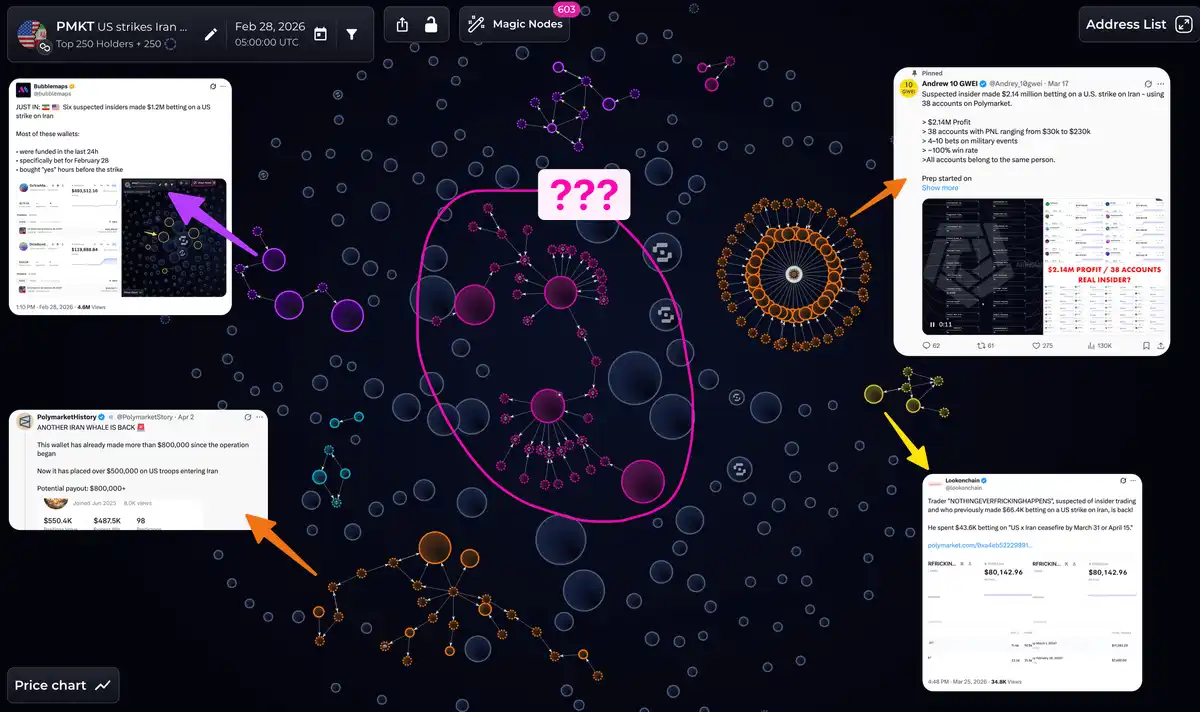
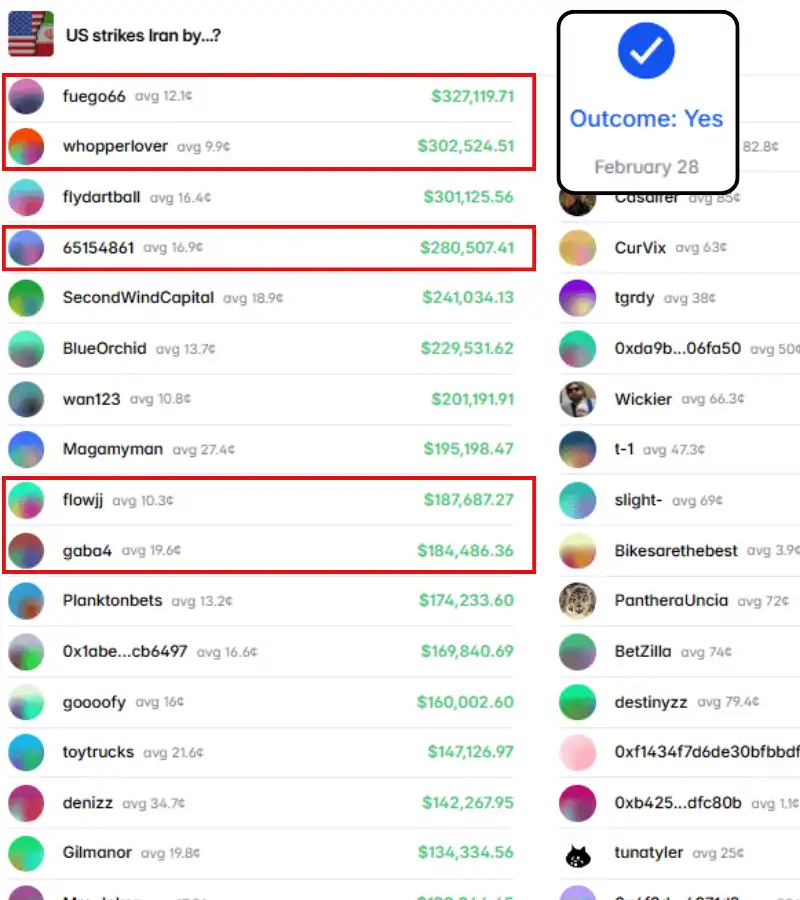
This wasn't simply "good luck." After visualizing the trades in the "Will the US strike Iran for the first time before February 28?" market on Polymarket, Bubblemaps discovered a massive pink cluster previously unmentioned on the X platform.
Further investigation linked the initial 4 accounts to another 5 through identical time windows, trade sizes, and fund flow paths. The nine accounts followed highly consistent funding paths: funds were transferred via centralized exchanges into a shared wallet network within an extremely short timeframe, with suspected use of professional services to hide traces.

4 Core Accounts Each Earned $400,000

In the early morning of February 28, 2026, the United States and Israel launched large-scale joint strikes codenamed "Operation Epic Fury" and "Lion's Roar." US-Israeli forces conducted nearly 900 strikes against Iran within 12 hours, targeting nuclear facilities, missile bases, military command centers, and hideouts of senior leaders. Iran's Supreme Leader Ali Khamenei and several of his family members, along with senior commanders of the Revolutionary Guard Corps, were killed in the initial strikes.

As early as the day of the February 28 strikes, Bubblemaps had publicly flagged six "fresh" accounts. Most of these accounts were created and funded within 24 hours before the strike, accurately betting on "the US will strike Iran before February 28," collectively netting about $1 million (some reports said $1.2 million). At the time, market odds were extremely low, yet these accounts heavily bet on them. Bubblemaps called it "suspected insider trading."

Five months later, the nine-account cluster they discovered was larger and had a higher win rate.
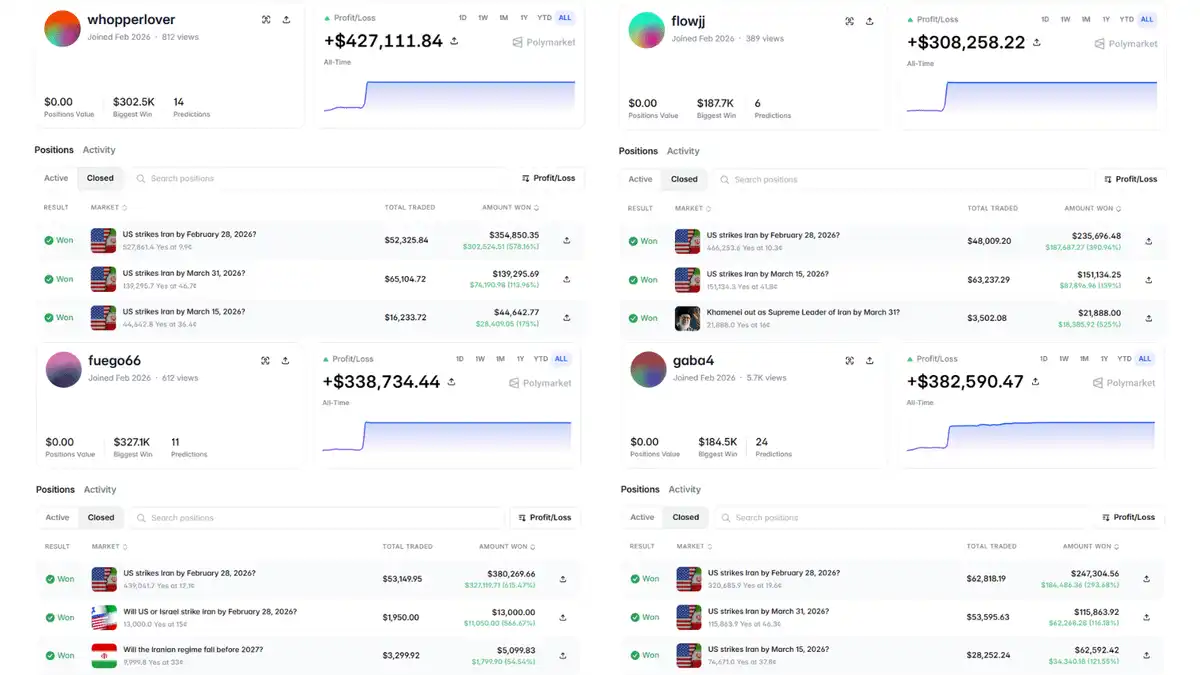
The four core accounts were created a few days before February 28, each earning about $400,000; the subsequent five accounts were linked through fund flows and trade overlaps. The nine accounts placed over 80 bets, almost all on US military actions: the first strike on February 28, the specific timing of Khamenei's elimination, the announcement of a ceasefire agreement, etc. They even placed bets spread across multiple dates to maximize gains, while occasionally placing one or two small losing bets (like on February 20), likely as cover.
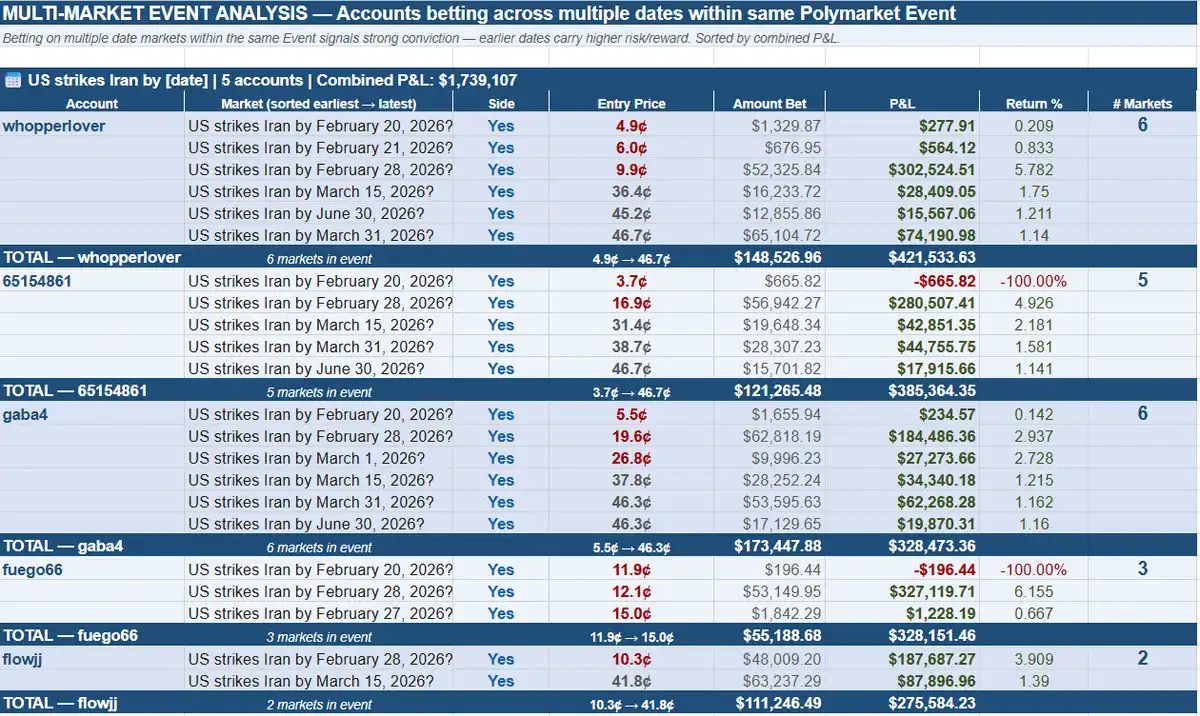
Bubblemaps listed the nine Polymarket wallet addresses (including 0x09d3273fa76282ce09f4f35a87d6f087c05f4e84, etc.), emphasizing that these accounts have long dominated the profit/loss leaderboards. Funds ultimately flowed to a shared wallet network, showing signs of professionalized money laundering or service use.
Vaiman stated bluntly: "Luck cannot explain these numbers." Deebs added that potential insider sources are numerous—government officials, military planners, intelligence analysts, even family members of military personnel.
Earlier this year, US Army Staff Sergeant Gannon Ken Van Dyke was charged with using classified intelligence to bet on special operations in Venezuela on Polymarket, investing $34,000 to profit $400,000 before quickly withdrawing funds and attempting to delete the account. Polymarket cooperated closely with law enforcement, ultimately leading to the prosecution. The Van Dyke case is seen as a landmark case for insider trading in prediction markets.

This nine-account cluster's profit is six times that amount, with a higher win rate, and is entirely concentrated on US-Iran military events.
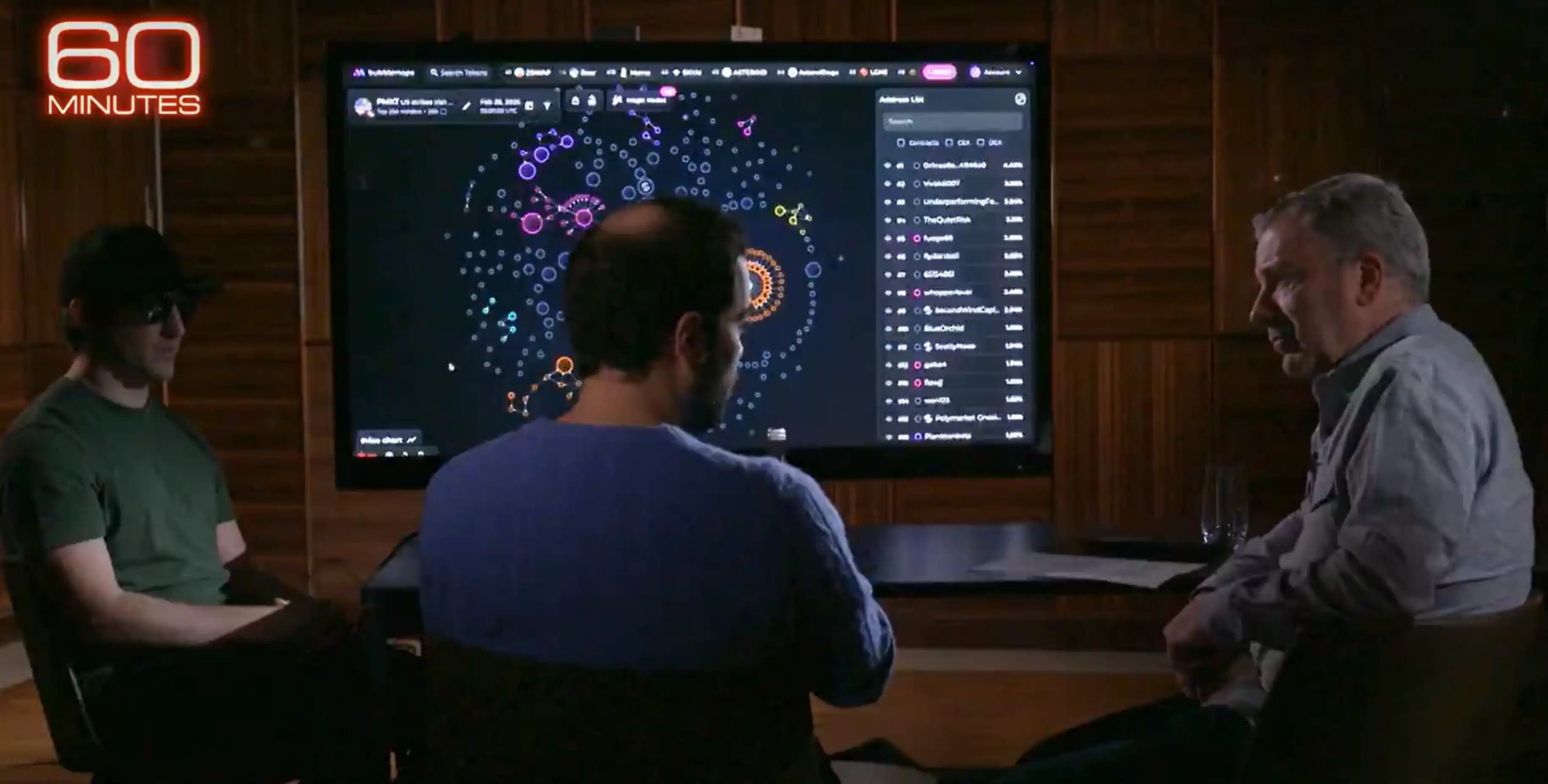
Bubblemaps exclusively shared the investigation with "60 Minutes." The segment aired on the evening of May 17, garnering significant attention. The CBS report noted that Polymarket has established AI monitoring and blockchain forensics systems, reporting suspicious activities to law enforcement authorities once detected, and emphasized that "insider trading is not welcome on the platform."

As of publication, Bubblemaps has not directly linked the nine accounts to any specific entity or government agency, stating only that "the correlation and near-perfect win rate raise serious suspicions."

Fighting Insider Trading vs. Copying Insider Trading

Insider trading makes many market participants feel the game is unfair. Prediction market platforms, including Kalshi and Polymarket, are taking more measures to combat it.

In late March this year, Polymarket updated its market integrity rules for its DeFi platform and its US exchange regulated by the U.S. Commodity Futures Trading Commission (CFTC). The updated rules clarify three core prohibited insider trading behaviors:

  • Trading using stolen confidential information—Participants may not trade any contracts if they possess confidential information about the outcome or likely outcome of an underlying event, and using that information would breach a pre-existing duty of trust or confidence owed to another person or entity.
  • Prohibition on trading using illegal insider tips—Participants may not trade using confidential information provided to them by another person, if the information was provided by someone who owed a pre-existing duty of trust or confidence to another, and the participant knows or has reason to know that the person providing the information themselves would be prohibited from trading on it.
  • Trading by those able to influence the outcome—Participants may not trade any contracts if they have authority or influence sufficient to affect the outcome of the underlying event.

However, rules always have loopholes. Since insider trading cannot be completely eradicated, some ill-intentioned so-called "insider copy-trading projects" have also sparked controversy. These applications compile trading accounts with abnormally high win rates for users, or flag suspiciously timed, abnormally sized trades, helping users copy these trades with one click.

Kreo's selling point is helping users "find insider traders before others." Polycool directly posts a "Polymarket Insider Trading Guide" on its website, stating "This isn't the stock market, betting with non-public information won't land you in jail, the rules for decentralized prediction markets are completely different."

A question then arises: does copying trades from insider trading addresses constitute a violation?

There has been no official response yet.

However, so-called "insider copy-trading platforms" like PolyGUN and Polycule have suffered hacker attacks this year, incurring losses ranging from tens of thousands to hundreds of thousands of dollars.


Perguntas relacionadas

QWhat did Bubblemaps investigators discover about a group of anonymous accounts on Polymarket?

ABubblemaps investigators discovered nine highly correlated anonymous accounts that collectively netted over $2.4 million from prediction markets related to US military actions, with a win rate of 98%. They were primarily focused on US-Iran conflict events in 2026.

QAccording to the article, what characteristics made the trading activity of these nine accounts highly suspicious?

AThe accounts were highly suspicious because they placed bets almost exclusively on US-Iran military events, their timing was unnervingly precise (often days before key actions), they preferred low-odds, long-term options, and they used shared wallet networks and professional services to obscure fund flows.

QWhat is the name of the US soldier mentioned in the article who was charged for insider trading on Polymarket, and what was his profit?

AThe US soldier mentioned is US Army Staff Sergeant Gannon Ken Van Dyke. He was charged for using classified intelligence to bet on a Venezuelan special operations event on Polymarket, investing $34,000 and making a profit of $400,000.

QWhat are the three core types of prohibited insider trading behaviors outlined in Polymarket's updated market integrity rules?

AThe three core prohibited behaviors are: 1) Trading using stolen confidential information. 2) Trading using illegal insider information provided by someone who breached a duty of trust. 3) Trading by individuals who have the authority or influence to affect the outcome of the event.

QWhat controversial practice related to potential insider trading has emerged on prediction market platforms according to the article?

AThe controversial practice is the emergence of 'insider copy-trading' platforms or applications. These services identify accounts with suspiciously high win rates or anomalous trades, allowing users to copy their bets, essentially attempting to profit from potential insider information.

Leituras Relacionadas

An AI Read SpaceX's Prospectus and Wrote This Investment Memo in 12 Minutes

An AI agent autonomously analyzed SpaceX's 226MB S-1 filing, purchased real-time market data on-chain for $1.87, and generated a comprehensive investment memo in 12 minutes. The memo concludes a "Hold" recommendation. Bull Thesis: SpaceX holds a near-monopoly in commercial launch (80% of global orbital mass since 2023), operates the profitable Starlink business (10.3M subscribers, $7.2B adj. EBITDA), and is vertically integrated from rockets to AI via the xAI acquisition. Starlink alone is a standout, high-margin business. Bear Thesis: The AI division is a massive cash burn ($6.4B operating loss on $3.2B revenue in 2025). True debt obligations approach ~$42B, not the headline $29B, due to bridge loans and X-related debt. Significant contingent liabilities exist, including a potential $10B fee from a Cursor option agreement. The company faces concentrated counterparty risk (e.g., a $45B Anthropic contract), slowing revenue growth, and complex governance as a controlled company with four share classes. Valuation anchors Starlink's standalone value at ~$84B (applying Iridium's 7.4x sales multiple), suggesting the current ~$500B+ IPO target prices in immense future execution risk for Starship and AI. Key risks include Starship delays, accelerating AI losses, and underwriter conflicts (the IPO's lead banks are also lenders on the $20B bridge loan it aims to refinance). Investment triggers: upgrade to "Overweight" if priced ≤$350B and Starship meets milestones; downgrade to "Pass" if priced >$510B or key risks materialize.

marsbitHá 8m

An AI Read SpaceX's Prospectus and Wrote This Investment Memo in 12 Minutes

marsbitHá 8m

MLCC Capacitor Price Increase: A Comprehensive Overview of Beneficiary Companies

Recent teardown reports of Nvidia's next-generation AI chips have reignited investor interest in the MLCC (Multi-Layer Ceramic Capacitor) sector. Analysis of the Rubin architecture VR200 server reveals a 30% increase in MLCC count and a 182% surge in component value per rack compared to the previous generation, with GPU board usage nearly doubling. High-power, high-voltage hardware designs are driving massive adoption of high-end, high-withstand-voltage, and large-capacity MLCCs, exacerbating supply shortages. The global MLCC supply-demand balance remains tight. Leading Japanese and Korean manufacturers have successively raised prices across series, compounded by overseas capacity constraints and long-term customer order locks at major factories. Delivery lead times for high-end products now exceed 20 weeks, with capacity struggling to keep pace with surging orders. Demand drivers include AI servers, automotive electronics, and recovering consumer electronics, leading to both volume and price increases for MLCCs. The industry chain beneficiaries are outlined as follows: **1. MLCC Product Manufacturers:** Direct beneficiaries of price hikes. Key Chinese companies include Fenghua Advanced Technology (leading domestic player), Sanhuan Group (vertical integration from materials to products), and others like Hongyuan Electronics (military focus) and Torch Electron (specialty ceramics). **2. MLCC Raw Materials & Components:** The foundation of the supply chain. * **Release Film:** A critical consumable in production. Companies include Jiemei Technology (domestic leader), Shuangxing New Materials, and Sidike. * **Metal Powders (Ni/Cu):** Core materials for internal electrodes. Key suppliers are Boqian New Materials, Yuean New Materials, and Gripm Advanced Materials. * **Dielectric Ceramic Powder:** The core material determining MLCC performance. Sinocera Advanced Materials is a global leader, while Sanhuan Group and Fenghua Advanced Technology also have significant in-house capabilities. The report highlights that rising AI server power is significantly increasing requirements for chip capacitors and inductors, forecasting explosive industry growth aligned with projected GPU/TPU shipments through 2027-2028.

marsbitHá 1h

MLCC Capacitor Price Increase: A Comprehensive Overview of Beneficiary Companies

marsbitHá 1h

Trading

Spot
Futuros

Artigos em Destaque

Como comprar WAR

Bem-vindo à HTX.com!Tornámos a compra de WAR (WAR) simples e conveniente.Segue o nosso guia passo a passo para iniciar a tua jornada no mundo das criptos.Passo 1: cria a tua conta HTXUtiliza o teu e-mail ou número de telefone para te inscreveres numa conta gratuita na HTX.Desfruta de um processo de inscrição sem complicações e desbloqueia todas as funcionalidades.Obter a minha contaPasso 2: vai para Comprar Cripto e escolhe o teu método de pagamentoCartão de crédito/débito: usa o teu visa ou mastercard para comprar WAR (WAR) instantaneamente.Saldo: usa os fundos da tua conta HTX para transacionar sem problemas.Terceiros: adicionamos métodos de pagamento populares, como Google Pay e Apple Pay, para aumentar a conveniência.P2P: transaciona diretamente com outros utilizadores na HTX.Mercado de balcão (OTC): oferecemos serviços personalizados e taxas de câmbio competitivas para os traders.Passo 3: armazena teu WAR (WAR)Depois de comprar o teu WAR (WAR), armazena-o na tua conta HTX.Alternativamente, podes enviá-lo para outro lugar através de transferência blockchain ou usá-lo para transacionar outras criptomoedas.Passo 4: transaciona WAR (WAR)Transaciona facilmente WAR (WAR) no mercado à vista da HTX.Acede simplesmente à tua conta, seleciona o teu par de trading, executa as tuas transações e monitoriza em tempo real.Oferecemos uma experiência de fácil utilização tanto para principiantes como para traders experientes.

126 Visualizações TotaisPublicado em {updateTime}Atualizado em 2026.04.28

Como comprar WAR

Discussões

Bem-vindo à Comunidade HTX. Aqui, pode manter-se informado sobre os mais recentes desenvolvimentos da plataforma e obter acesso a análises profissionais de mercado. As opiniões dos utilizadores sobre o preço de WAR (WAR) são apresentadas abaixo.

活动图片