Morning Report | xAI Launches Skills; Duan Yongping Takes First Position in Circle in Q1 2026; Polymarket Partners with Nasdaq to Launch Prediction Market

链捕手Publicado em 2026-05-20Última atualização em 2026-05-20

Resumo

**Title:** Daily Brief: Musk's xAI Launches "Skills"; Duan Yongping's First Circle Investment; Polymarket Partners with Nasdaq **Key Highlights:** * **AI Developments:** Elon Musk's xAI released "Skills," enabling its Grok AI to retain memory across conversations. OpenAI co-founder Andrej Karpathy joined rival Anthropic. * **Crypto & DeFi:** May saw 14 crypto hack incidents, including 3 major DeFi attacks in 5 days (Echo Protocol, THORChain, Verus). The Ethereum Foundation faces another exodus with two core members departing. * **Corporate Moves:** Investor Duan Yongping disclosed a new $19M position in Circle. Analog Devices is in talks to acquire AI chip firm Empower Semiconductor for ~$1.5B. * **Financials & Partnerships:** Canaan reported Q1 2026 revenue of $62.7M and record-high crypto reserves. Prediction market Polymarket partnered with Nasdaq to launch markets for private companies. * **Market Data:** VanEck predicts digital credit markets could reach $2.5T in a decade, with Bitcoin potentially hitting $1M. Top trending meme tokens on ETH, Solana, and Base networks are listed. **Featured Articles:** Three analysis pieces explore: 1) potential regulatory pressures on DEXs like Hyperliquid, 2) challenges to Solana's "internet capital market" narrative, and 3) the future emergence of a dedicated capital market for autonomous AI agents (Agents).

Compiled by: ChainCatcher


Key News:

  • Three Major DeFi Attacks in Five Days, Total Crypto Hacks in May Reach 14
  • Elon Musk's xAI Launches Skills
  • Analog Devices to Acquire AI Chip Company Empower Semiconductor for $1.5 Billion
  • Duan Yongping Takes First Position in Circle in Q1 2026, Holding Value $19.08 Million
  • Polymarket Partners with Nasdaq to Launch Prediction Market for Private Companies
  • Canaan Releases Q1 2026 Financials: Total Revenue $62.7 Million, Cryptocurrency Holdings Hit New High
  • Ethereum Foundation Hit by Another Wave of Departures, Core Members Carl Beek and Julian Ma Announce Exit

What Major Events Happened in the Past 24 Hours?

OpenAI Co-founder Andrej Karpathy Joins Anthropic

ChainCatcher news: OpenAI co-founder and former Tesla AI director Andrej Karpathy officially announced joining Anthropic, stating: "I believe the next few years will be a particularly critical period for frontier development of large language models (LLMs). I am very excited to join the team here and get back to R&D work. I remain passionate about education and plan to continue advancing related work at an appropriate time in the future."

Polymarket Partners with Nasdaq to Launch Prediction Market for Private Companies

Canaan Releases Q1 2026 Financials: Total Revenue $62.7 Million, Cryptocurrency Holdings Hit New High

ChainCatcher news, Canaan Inc. announced its first quarter 2026 financial results. The report shows total revenue of $62.7 million, in line with prior guidance; net loss of $88.7 million. As of March 31, 2026, the company's cryptocurrency holdings reached 1,807.60 Bitcoin and 3,951.53 Ethereum, hitting a new all-time high.

In terms of operations, the total installed hash rate capacity of the company's ten joint mining projects reached approximately 11 EH/s, up 10.7% quarter-over-quarter; 257 Bitcoin were produced in Q1. Strategically, the company acquired a 49% stake in the ABC project in West Texas from Cipher Mining, with project-level operating hash rate reaching approximately 4.4 EH/s; meanwhile, a "hash rate to heat" project was deployed in Northern Europe, with a planned total capacity of approximately 8 megawatts.

Canaan expects total revenue for the second quarter of 2026 to be in the range of $35 million to $45 million.

VanEck: Digital Credit Market Could Reach $2.5 Trillion in the Next Decade, BTC Could Hit $1 Million

Duan Yongping Takes First Position in Circle in Q1 2026, Holding Value $19.08 Million

ChainCatcher news: The SEC 13F filing for the first quarter of 2026 submitted by H&H International Investment, the US-managed investment account of prominent investor Duan Yongping, shows that as of March 31, 2026, the portfolio held 19 securities with a total value of approximately $20.004 billion, with all holdings under sole discretion.

Among them: Apple (AAPL) held 28,945,607 shares, valued at $7.346 billion; Berkshire Hathaway (BRK.B) held 9,147,796 shares, valued at $4.384 billion; Nvidia (NVDA) held 13,843,775 shares, valued at $2.414 billion; Pinduoduo (PDD) held 19,748,294 shares, valued at $2.018 billion; Tesla (TSLA) held 3,408,900 shares, valued at $1.267 billion. Microsoft (MSFT) held 1,016,000 shares, valued at $376 million. Circle was a newly disclosed position for the quarter, holding 200,000 shares valued at $19.082 million, accounting for approximately 0.1% of the portfolio.

Analog Devices to Acquire AI Chip Company Empower Semiconductor for $1.5 Billion

ChainCatcher news: According to informed sources, Analog Devices is in advanced negotiations to acquire AI chip startup Empower Semiconductor for approximately $1.5 billion.

If the deal goes through, it will further expand Analog Devices' footprint in high-performance computing infrastructure. The transaction reflects strong market demand for AI chip power supply and energy efficiency management technologies, as growing AI workloads impose higher requirements on power management and energy efficiency for AI chips.Agents Capital Markets: How Will Autonomous Agents Get Funded?

Elon Musk's xAI Launches Skills

ChainCatcher news, Elon Musk's AI company xAI announced the launch of the "Skills" feature simultaneously on web, iOS, and Android platforms. This feature endows the AI assistant Grok with persistent memory across conversations, marking Grok's evolution from a traditional single-session Q&A chatbot to a configurable, programmable automated workspace.

According to the introduction, with the "Skills" feature, users only need to teach Grok the operating method for a specific task once, and Grok will permanently remember the relevant personal preferences, formatting rules, or specific workflow steps in all subsequent independent conversations. This means users no longer need to tediously repeat entering cumbersome preamble prompts or background settings when starting new conversations.

Coinbase CEO Assists Law Enforcement with Blockchain Forensics Leading to 5 Convictions

Three Major DeFi Attacks in Five Days, Total Crypto Hacks in May Reach 14

ChainCatcher news, Echo Protocol suffered a vulnerability attack on the Monad network, with the attacker minting 1,000 eBTC (worth approximately $76.64 million). According to PeckShield tracking, the attacker deposited 45 eBTC (~$3.45 million) into Curvance, borrowed 11.29 WBTC, bridged to Ethereum and exchanged for ETH, with 384 ETH transferred into Tornado Cash. Curvance has suspended the affected market, stating that smart contracts were not compromised and other markets remain unaffected.

Echo Protocol has suspended all cross-chain transactions. Monad CEO Keone Hon clarified that the vulnerability did not affect the Monad network, and security researchers assessed the actual theft at approximately $816,000.

This incident pushes the total number of crypto hacks in May to 14, with three major DeFi attacks occurring in just the past five days: THORChain lost over $10 million to a vault exploit on May 15, and the Verus Ethereum cross-chain bridge was attacked three days later, losing approximately $11.58 million. The frequency of security incidents highlights the persistent systemic risks facing the DeFi space.

Top Meme Tokens

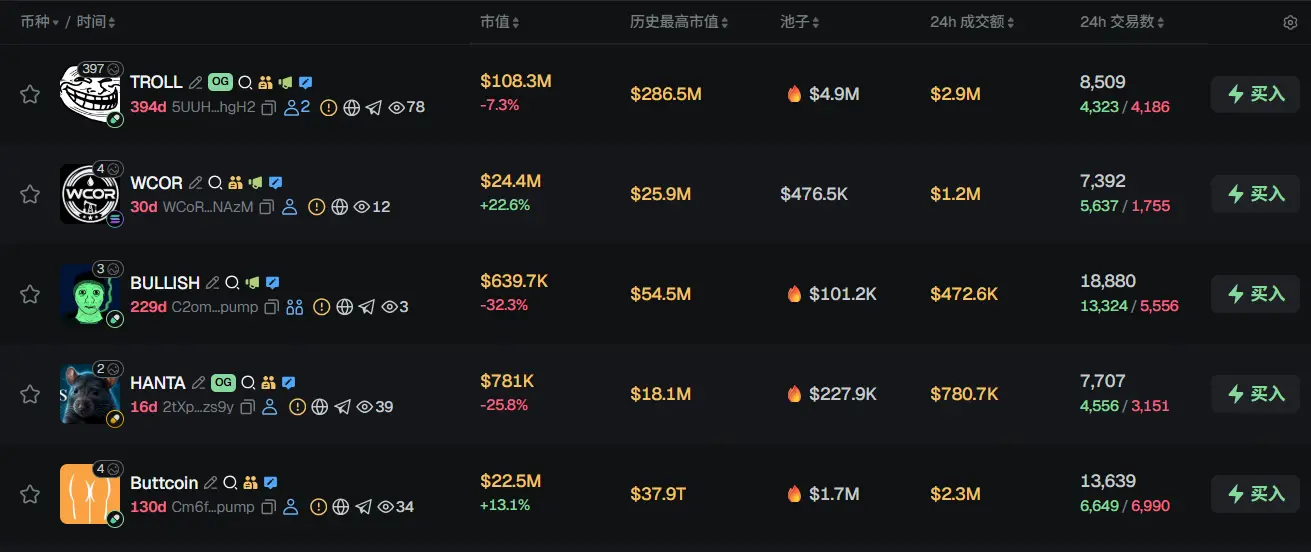
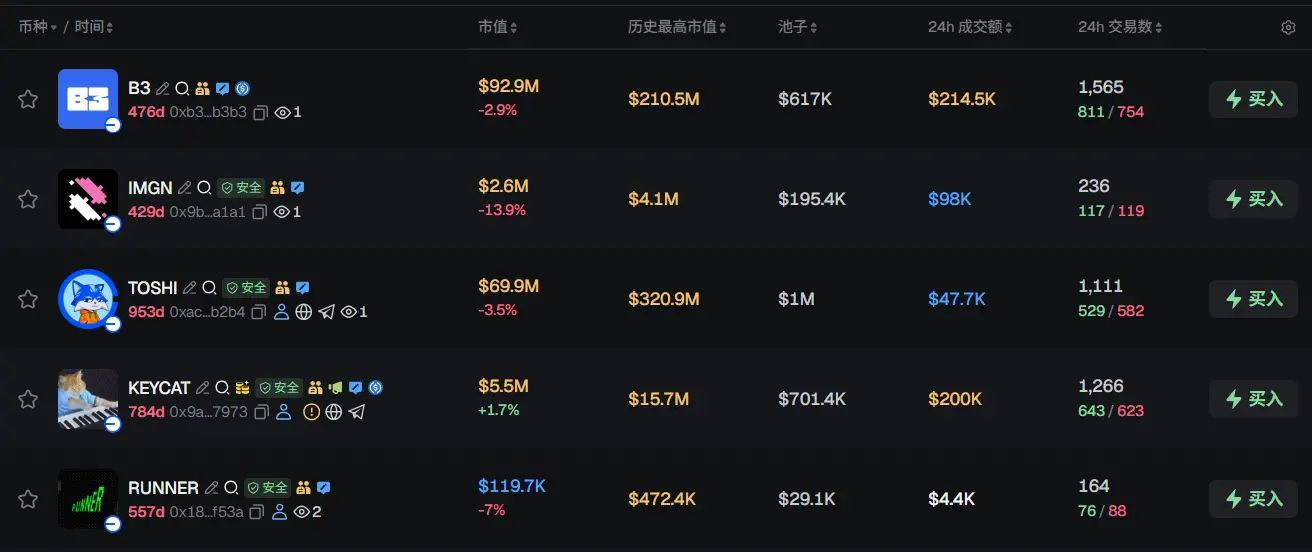
According to data from the meme token tracking and analysis platform GMGN, as of 09:00 on May 20,

The top five trending ETH tokens in the past 24h are: HEX, SHIB, LINK, PEPE, mUSD
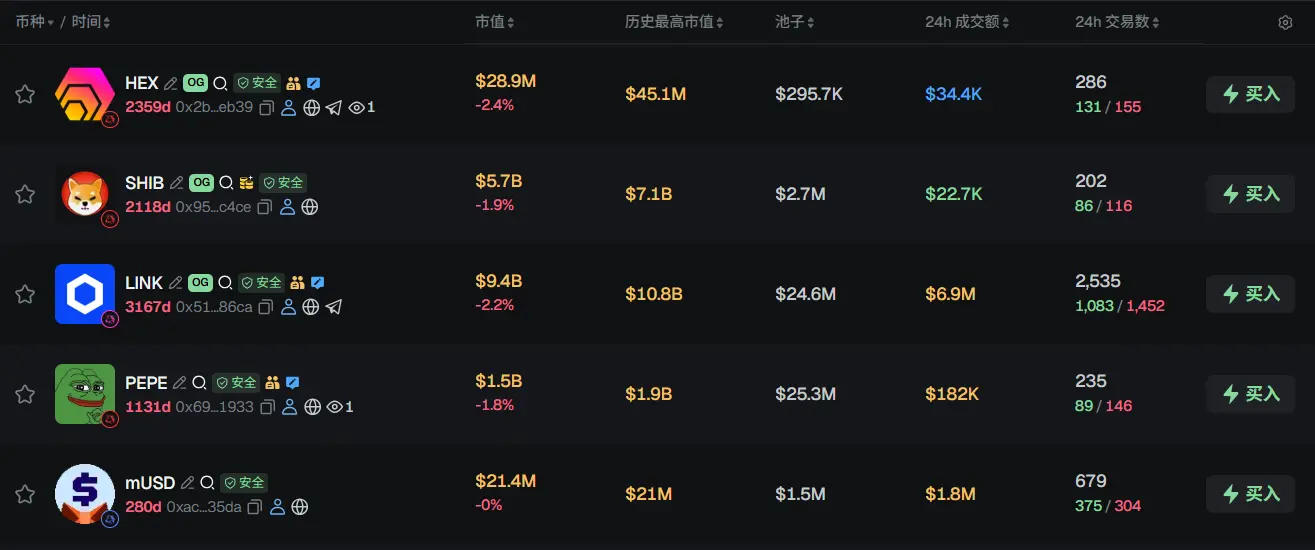
The top five trending Solana tokens in the past 24h are: TROLL, WCOR, BULLISH, HANTA, Buttcoin
The top five trending Base tokens in the past 24h are: B3, IMGN, TOSHI, TOSHI, KEYCAT, BRETT
What Are the Must-Read Articles From the Past 24 Hours?

Is Hyperliquid Disrupting Wall Street's Game? Regulation Pending, Market Makers Flee First?

Yesterday, two addresses marked by the market as mainstream market makers on Hyperliquid withdrew nearly 90% of BTC and ETH liquidity during the same time period, with an estimated total withdrawal scale of nearly $100 million.

And it just so happens that 3 days prior, the world's two largest traditional exchanges, CME and ICE, jointly pressured the US CFTC and Congress to strictly regulate Hyperliquid.

Is this merely a single event of professional players 'pricing in regulatory risk,' or a sign that the regulatory arbitrage benefits DEXs have enjoyed over the past three years are coming to an end?

When Hyperliquid Steals Solana's "Internet Capital Market" Playbook

In the cyclical turns of the cryptocurrency market, Solana once regained its peak with the narrative of an 'Ethereum killer' and extreme performance. However, entering 2026, this 'high-performance computer' that once ran at full throttle is facing unprecedented deceleration pressure, first reflected in price.

Over the past year, SOL's price has fallen a maximum of 73.5% from its high, the largest drop among all major cryptocurrencies. In the recent market correction over the past month, SOL's upward momentum has also been very weak, significantly lagging behind other major cryptocurrencies like BTC and ETH.

Furthermore, Solana's core "internet capital market" vision has been severely hit by internal and external challenges, forcing the Solana Foundation's senior team to frequently speak out recently, building momentum for their ecosystem in the public opinion sphere.

Agents Capital Markets: How Will Autonomous Agents Get Funded?

Within a decade, Agent companies will have their own capital markets. Not a crypto sub-economy, not a thought experiment, but a real market: with rating agencies, underwriters, indices, brokers, and the institutional machinery that makes any market a market.

A capital market as real as the public stock market: a system where capital flows to a certain class of economic actors, without relying on the subjective judgment of any single capital allocator. These actors will be Agents — software entities wrapped in a legal shell. They can sign contracts, hold bank accounts, sue and be sued, and earn income through actual work.

The work itself is highly routine: marketing, logistics, legal research, procurement, property management, customer support — precisely the categories of routine business that fill the office parks of every medium-sized city today.

Agents will sell services to humans, other Agents, and any party with the ability to pay. Their need for capital will be no different from the reason every service company needs capital.


Perguntas relacionadas

QWhat are the key new AI developments mentioned in the article?

AThe article highlights several key AI developments: 1) Elon Musk's xAI launched a new 'Skills' feature for its Grok AI, enabling persistent memory across conversations. 2) OpenAI co-founder Andrej Karpathy joined the AI company Anthropic. 3) Analog Devices is in advanced talks to acquire AI chip startup Empower Semiconductor for approximately $1.5 billion.

QWhat was the financial performance and strategy of Canaan Inc. (Canaan Technology) in Q1 2026?

ACanaan Inc. reported Q1 2026 total revenue of $62.7 million, with a net loss of $88.7 million. The company's cryptocurrency reserves, consisting of 1,807.60 BTC and 3,951.53 ETH, reached a record high. Strategically, it expanded its joint mining capacity to approximately 11 EH/s, acquired a 49% stake in a Texas mining project, and deployed a 'computing power to heat' project in Northern Europe. Q2 revenue is forecasted to be between $35 million and $45 million.

QWhat significant security incidents occurred in the DeFi space according to the article?

AIn May 2026, there were 14 crypto hacking incidents, including three major DeFi attacks in just five days: 1) An exploit on Echo Protocol on the Monad network, resulting in a potential $76.64 million loss (though actual losses were assessed around $816,000). 2) A THORChain vault exploit on May 15th causing over $10 million in losses. 3) An attack on the Verus Ethereum cross-chain bridge three days later, leading to losses of approximately $11.58 million.

QWhat investment moves did investor Duan Yongping (through H&H International Investment) make in Q1 2026?

AFor Q1 2026, Duan Yongping's portfolio, managed by H&H International Investment, had a total value of approximately $20.004 billion. The top holdings were Apple ($7.346B), Berkshire Hathaway ($4.384B), Nvidia ($2.414B), Pinduoduo ($2.018B), and Tesla ($1.267B). A notable new position was a first-time investment in Circle, comprising 200,000 shares valued at $19.082 million, representing about 0.1% of the portfolio.

QWhat partnership was announced between Polymarket and a traditional financial institution?

APolymarket, a prediction market platform, announced a partnership with Nasdaq to launch a prediction market specifically focused on private (non-public) companies. This collaboration represents a significant bridge between decentralized finance (DeFi) concepts and traditional capital markets infrastructure.

Leituras Relacionadas

Five Core Forms of AI Agent in YC's Eyes

The article outlines five core architectural patterns for effective AI Agents, emerging from tools like Codex and Claude, that move beyond simple prompts towards reusable, process-based capabilities. 1. **Skills**: Reusable, parameterized workflows that function like method calls, allowing a single process (e.g., "/investigate") to handle various tasks based on input parameters. 2. **Thin Harness**: A lightweight execution framework (~200 lines) that manages the AI model's "hands and feet"—handling loops, file I/O, and context—without becoming bloated. 3. **Resolvers**: Routing tables that map tasks to specific Skills, preventing "context corruption" when managing dozens of Skills and ensuring outputs go to the correct locations. 4. **Latent vs. Deterministic Layer**: A critical separation where LLMs handle judgment, synthesis, and pattern recognition, while deterministic code handles tasks requiring precision, consistency, and low cost (like calculations). 5. **Memory**: A persistent, accumulating knowledge base (e.g., a markdown folder) with a "current trusted conclusion" section and an append-only timeline, enabling the system to learn and retain context over time. Together, these patterns create a "process power"—a durable competitive advantage. Unlike one-off prompt-based applications whose value quickly commoditizes, a well-designed AI Agent system encodes experience into reusable, parameterized workflows, offloads stable rules to code, and continuously learns through memory. This creates a structured, hard-to-replicate capability that can provide sustained value for individuals or businesses, such as an accountant automating client reviews while preserving privacy and accumulating expertise.

marsbitHá 55m

Five Core Forms of AI Agent in YC's Eyes

marsbitHá 55m

Tiger Research: On-Chain Risk Operators, The Market Cap Gap Between 147 Trillion and 70 Billion

This report by Tiger Research examines the evolution of risk management in decentralized finance (DeFi) lending. It highlights a power shift from protocol developers to specialized professional risk operators who manage on-chain capital. The era of protocols and community governance solely dictating DeFi lending is ending. A new professional asset management layer has emerged. While the sector is nascent, capital and distribution channels are rapidly consolidating around top risk operator teams, whose past performance is now a key criterion for institutional entry. The industry's development, accelerated by modular infrastructures like Morpho, has led to a clear division of labor mirroring traditional finance: distribution channels (e.g., exchanges), strategy/risk management (the risk operators), and product infrastructure/asset custody (smart contract protocols). This structure lowers the entry barrier for traditional institutions. Currently, the total value managed by risk operators is approximately $70 billion, dominated by a few leading teams like Steakhouse (RWA focus), Sentora (AI models), and Gauntlet (crisis management). Competition now centers on collateral standards, distribution access, and crisis response capabilities. The report outlines three primary entry paths for institutions: 1) **Distribution Model**: Leveraging external risk operators as backend service providers (common for exchanges). 2) **Asset Supply Model**: Onboarding real-world assets to DeFi as collateral. 3) **Independent Operator Model**: Building an in-house team to become a risk operator (e.g., Bitwise). The core opportunity lies in the strategy/risk management layer, where traditional financial institutions can leverage their existing expertise in due diligence and risk assessment without deep technical development. A vast opportunity gap exists: the global traditional asset management industry manages ~$147 trillion, while the entire DeFi sector is only ~$800 billion, with the risk operator niche at ~$70 billion. This disparity signifies immense growth potential. Once robust risk frameworks and clearer regulations are established, even a minor allocation from traditional markets could trigger exponential DeFi growth. Early movers who help build these foundational systems will gain significant rule-setting influence and first-mover advantages.

marsbitHá 1h

Tiger Research: On-Chain Risk Operators, The Market Cap Gap Between 147 Trillion and 70 Billion

marsbitHá 1h

Interview with Circle's Chief Economist: USDC's Entry into Hyperliquid Benefits Circle and HYPE, Stablecoins Are Becoming Marginal Buyers of U.S. Treasuries

In an interview with Circle's Chief Economist Gordon Liao, the conversation covers the strategic significance of USDC replacing USDH as the reference asset on the decentralized perpetual exchange Hyperliquid. This shift, facilitated by Coinbase as the reserve manager and Circle providing technical infrastructure, aims to capture net interest income for the platform, with 90% of reserve earnings directed back to Hyperliquid for HYPE token buybacks. Liao discusses how stablecoins like USDC, with their substantial on-chain settlement volumes (e.g., $21 trillion in Q1 2026), are emerging as marginal buyers of U.S. Treasuries, concentrating on short-term debt and effectively reducing the weighted duration of the market, which may provide underlying support for long-term rates. The dialogue also explores the evolving nature of stablecoins as both a medium of exchange and a vehicle for capital and collateral liquidity. Additionally, the panel touches on the CLARITY Act's legislative progress, noting compromises around "activity-based rewards" and remaining hurdles like ethics concerns. On AI, there's debate over value capture, with predictions that distribution and application layers, rather than foundational model companies like OpenAI, will accrue most value. Regarding the bond market, Liao attributes the rise in 30-year yields primarily to an increased term premium (around 80 bps) driven by supply-demand dynamics, including fiscal expansion and changing investor demand, rather than expectations of Fed rate hikes.

marsbitHá 1h

Interview with Circle's Chief Economist: USDC's Entry into Hyperliquid Benefits Circle and HYPE, Stablecoins Are Becoming Marginal Buyers of U.S. Treasuries

marsbitHá 1h

Trading

Spot
Futuros
活动图片