Data: 75% of Traders on Hyperliquid Are Losing Money. What Are the Profitable Ones Using?

marsbitPublicado em 2026-05-20Última atualização em 2026-05-20

Resumo

On Hyperliquid, approximately 75% of addresses are losing money, indicating that manual traders are increasingly competing against automated systems. Profitable traders primarily employ one of three approaches: 1) Running systematic, high-frequency strategies (e.g., one address executed 261k trades with a 64.75% win rate), 2) Placing high-conviction, asymmetric bets with large positions (e.g., 50 trades yielding $4.48M at a 28% win rate), or 3) Using algorithms for execution while making manual macro judgments. The article argues that traditional methods like chart patterns or reacting to social media news are often already priced in by bots, making such traders the "exit liquidity" for systematic players. Success now depends on unique narrative timing, structural insights, or conviction during market capitulation.

Author: Stacy Muur

Compiled by: Deep Tide TechFlow

Deep Tide Guide: Three-quarters of addresses on Hyperliquid are losing money. It's not bad luck; the rules of the game have changed. While you're still looking at candlestick patterns for formations, arbitrage bots have already made their profit. Data shows that truly profitable traders either use algorithmic systematic execution or place large bets on asymmetric opportunities with high conviction. Manual retail traders watching screens are becoming the exit liquidity for others.
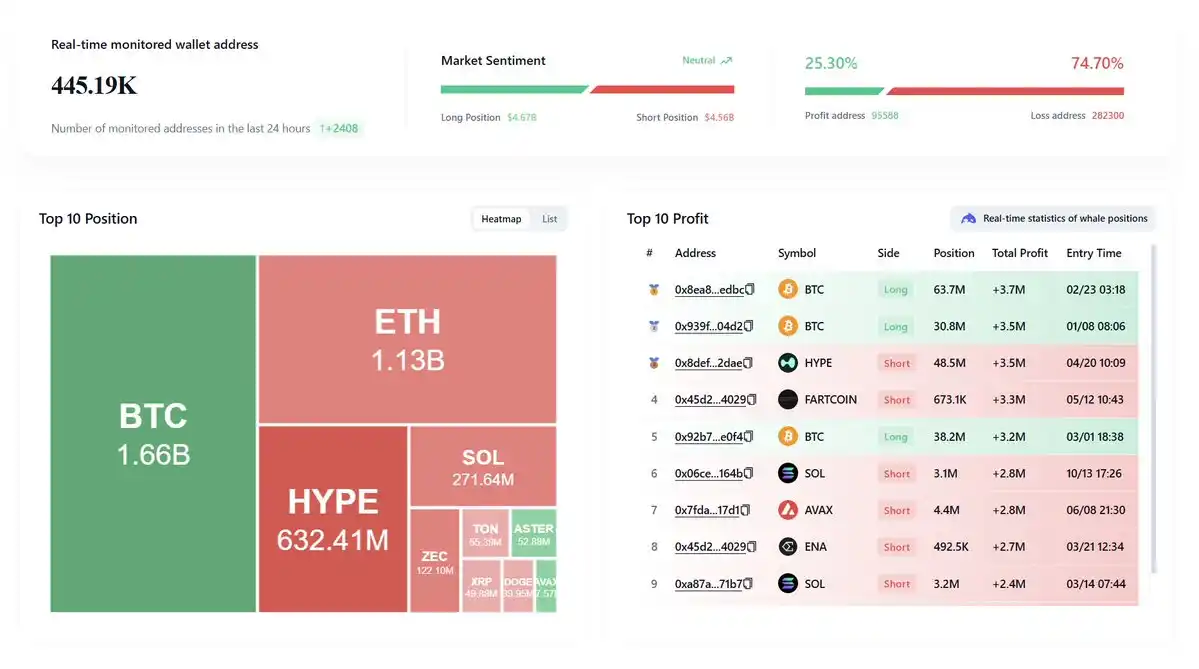
About 75% of addresses on Hyperliquid are in a loss-making position.

The reality is that people trading manually on Hyperliquid are competing against systems that never rest. The trading opportunity you just discovered has likely already been priced in by the system.

When you see a certain pattern, chances are it has already been arbitraged.

Extreme funding rates are balanced in an instant.

Technical patterns have already appeared across more than 50 order books.

News headlines are priced in as soon as they appear.

What the most profitable traders are doing:

→1. Running systematic strategies (the second most profitable address executed 261,000 trades this month with a 64.75% win rate)

→ 2. Holding high-conviction positions, betting on asymmetric returns (a wallet made $4.48 million with just 50 trades and a 28% win rate)

→ 3. Using algorithms as execution tools while making macro judgments manually

If you have timing in narratives, structural insight, or conviction when everyone else capitulates, you can still make profitable trades.

But if your trades are based on chart patterns or news you saw on X, you are likely just exit liquidity.


Perguntas relacionadas

QAccording to the article, what percentage of addresses on Hyperliquid are losing money, and what is presented as the primary reason?

AApproximately 75% of addresses on Hyperliquid are losing money. The primary reason is that manual traders are competing against automated, systemized strategies that execute trades faster and more efficiently, often pricing in opportunities before a human trader can act.

QWhat are the two main strategies used by the most profitable traders on Hyperliquid, as described in the article?

AThe two main strategies are: 1. Running systematic, automated strategies (one example executed 261,000 trades with a 64.75% win rate). 2. Holding high-conviction positions to bet on asymmetric opportunities (one wallet made $4.48M with only 50 trades, despite a 28% win rate).

QThe article suggests that several common trading signals are often ineffective. Name at least three of these signals.

AThree common but often ineffective signals mentioned are: 1. Technical chart patterns (which appear across many order books). 2. Extreme funding rates (which get arbitraged instantly). 3. News headlines (which are priced in immediately upon release).

QWhat role does the article suggest algorithms can play for a trader who still wants to make manual, high-level decisions?

AThe article suggests using algorithms as an execution tool. A trader can make macro or high-level directional judgments manually, and then use an algorithm to handle the rapid, systematic execution of trades based on that judgment.

QAccording to the article's conclusion, what kind of manual trader is most likely to succeed, and what kind is most likely to fail?

AA manual trader who succeeds is likely one acting on deep narrative timing, unique structural insights, or having strong conviction when others are capitulating. A manual trader who fails is likely one whose decisions are based on commonly seen chart patterns or news headlines found on social media (like X), as they become 'exit liquidity' for others.

Leituras Relacionadas

From Somersaults to Working 24/7: We Saw the ‘Working-Class’ Aura in Robots at WAIC

From performing acrobatics to working 24/7: Robots at WAIC are getting down to business. This year's World Artificial Intelligence Conference (WAIC) in Shanghai showcased a significant shift in the robotics industry. While "show-off" robots that dance, play music, or compete in sports are still present, the dominant trend is now practical, task-oriented machines. Hundreds of wheeled and humanoid robots were deployed as guides, baristas, factory workers, and even traffic controllers, moving beyond mere demonstrations to highlight real-world "work capabilities." The focus has pivoted from showcasing technical parameters to pursuing mass production and industrial落地 (landing/implementation). This transition presents major challenges. First, deploying powerful AI models onto robots requires overcoming hardware limitations in computing power and latency. Second, robots demand complex, integrated systems for real-time perception and control. Third, achieving reliable mass production necessitates unprecedented industry-wide collaboration on standards and supply chains. A key bottleneck identified by industry leaders is the robot's "brain"—its AI and cognitive capabilities. While hardware and basic movement ("little brain") have advanced rapidly, the higher-level intelligence for understanding complex instructions and adapting to unstructured environments is progressing more slowly. Companies are investing heavily in developing more advanced "brain" systems, but fully autonomous operation in dynamic settings remains a work in progress. Cost is another critical hurdle. While some consumer-oriented humanoid robots are now priced under $15,000, capable industrial models often cost $50,000 or more. The industry consensus is that bringing robots into unstructured home environments for tasks like comprehensive cleaning is still at least five years away due to technical, safety, and cost barriers. Therefore, 2026 is being called the "first year of mass production," but primarily for industrial and specific commercial applications. WAIC 2026 served less as a stage for spectacular tricks and more as a serious examination of robots' commercial viability, marking their transition from laboratory prototypes to real-world products that must prove their value through stable, repetitive work.

marsbitHá 30m

From Somersaults to Working 24/7: We Saw the ‘Working-Class’ Aura in Robots at WAIC

marsbitHá 30m

Live-Action Short Series Forced onto the Big Screen by AI

Live-action short dramas, originally a popular online format, are now attempting to enter the cinema. Several top IPs like "What a Good Girl" and "One Family, Same Class" have received approval for film adaptations. This shift is driven by several pressures within the short drama industry. After rapid growth fueled by low costs and platform support, the sector now faces a slowdown with fewer hits and reduced investment. A major disruptor is the explosive rise of AI-generated short dramas, which dominate new releases and challenge the traditional model with their speed and low cost. Platform policy changes, such as adjustments to revenue guarantees, have further squeezed producers. In this context, film adaptation is seen as a potential new growth path. It offers a chance to extend a short-lived online hit into a longer-lasting IP asset, moving beyond the "fast production, fast consumption" cycle. Established short dramas bring pre-validated stories and emotional appeal to the table, potentially lowering the risk for film investors. However, significant challenges remain. Translating a fast-paced, fragmented viewing experience designed for phones into a compelling cinematic narrative is difficult. Past attempts by popular TV shows and variety programs to make films have often failed due to weak content. A short drama's massive online viewership does not guarantee box office success, as cinema requires a higher commitment of time and money from audiences. Ultimately, the success of these adaptations will depend not on their original popularity, but on their ability to tell complete, emotionally resonant stories that meet the standards of the theatrical market.

marsbitHá 2h

Live-Action Short Series Forced onto the Big Screen by AI

marsbitHá 2h

Asymmetry of Algorithmic Agency: When AI Makes Decisions for You, You Don't Even Have the Right to Oppose

As AI increasingly makes decisions on our behalf, a critical asymmetry emerges: the entities deploying these systems understand and refine their algorithms, while individuals merely endure the consequences. This article explores the three layers of this "algorithmic agency asymmetry." First, opacity shields system goals, incentives, and flaws, creating a "black box fallacy" where outputs seem objective. Second, algorithms amplify historical biases, repackaging past inequalities in a seemingly neutral, computational form. Third, recursive systems lead to "algorithmic drift," where users train the system and are simultaneously trained by it, shaping their own choices and behaviors. This asymmetry has profound implications, extending into hiring, education, policing, and daily life. Users adapt to what the system rewards, but only see the end result—a score, recommendation, or price—without understanding the underlying logic or manipulated conditions. To rebalance this power dynamic, the article proposes policy interventions: 1) Meaningful transparency and explainability for users affected by AI decisions. 2) Enforceable impact assessments before deploying high-risk systems. 3) Genuine human oversight with the power to challenge outputs. 4) Mandatory post-deployment monitoring and auditing. 5) Outright bans on manipulative or exploitative systems. Finally, fostering widespread "algorithmic literacy" is essential public infrastructure. Ultimately, this asymmetry is a structural power imbalance. Good policy cannot eliminate it but can narrow the gap by making automated influence visible, contestable, auditable, and governable.

marsbitHá 2h

Asymmetry of Algorithmic Agency: When AI Makes Decisions for You, You Don't Even Have the Right to Oppose

marsbitHá 2h

Trading

Spot
活动图片